


16,99 €
Mehr erfahren.
- Herausgeber: Vahlen
- Kategorie: Fachliteratur
- Sprache: Englisch
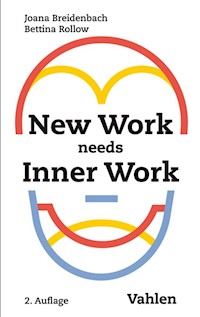
Most approaches to introducing self-management, agile forms of work, and "teal organisations" are doomed to failure. After five years of extensive experience with new forms of leadership, we have seen this process happen over and over again. Most of the time, this is because teams focus exclusively on the external, visible dimension of change.
However, any external change in structures and processes must necessarily be accompanied by an internal transformation. For that reason, this book is particularly dedicated to the "inner innovation" of teams. By this we mean the way that employees and teams can mature and grow in order to shape the complex, flexible, and accelerating world around them with competence and purpose.
Future work needs Inner Work is a practice-oriented manual in which we describe, step-by-step, how to introduce self-management into a team or company. We combine the perspectives of the entrepreneur (Joana, betterplace.org and betterplace lab) and the coach (Bettina). This combination allows us to use organisational principles, as well as concrete examples and exercises, to explore which competencies are important for reducing hierarchies and working flexibly and meaningfully.
Joana Breidenbach is founder of Germany’s largest donation plattform betterplace.org and the Think-and-Do-Tank betterplace lab.
Das E-Book können Sie in Legimi-Apps oder einer beliebigen App lesen, die das folgende Format unterstützen:
Veröffentlichungsjahr: 2020
Ähnliche












About the authors:
Joana Breidenbach is founder of Germany’s largest donation platform betterplace.org and the Think-and-Do-Tank betterplace lab.
Bettina Rollow develops organisational and leadership forms, e. g. with betterplace lab and Ashoka Germany.
The Future of Workneeds Inner Work
A handbook for companies on the way to self-organisation
by Joana Breidenbach Bettina Rollow
Translation by Victor Breidenbach
Editing by
VPreface
This book will help you find out which leadership styles and forms of cooperation best suit you and your company. At a time of widespread discussion about new forms of work and changing company cultures, we see the need for more precise and differentiated research into which organisational forms are suitable for which teams, tasks and markets. By “Future of Work” we mean a transformation of the world of work that puts the employee and her abilities at the centre, in which hierarchies are flattened or even completely abolished and replaced by collective leadership or self-organisation. But should every company change its hierarchical structures and be self-organised? And what prerequisites and steps are necessary for new forms of work to become successful? These are the questions we want to explore in this book.
Our handbook is practice-oriented and follows the working process of organisational development. Many steps can be taken by teams on their own, even without external support. For some further developments, especially when it comes to identifying and dealing with areas of conflict, we consider external support in the form of a coach to be necessary. But the handbook is also useful here, as it provides the reader with a guide to assess the quality of the coach or organisational developer. In our experience, there are many concepts and tools that are too general and superficial. As a result, change processes fail and leave management and teams frustrated.
One major reason for the failure of organisational developments is that they concentrate on the external, visible dimension of change. This problem lies at the centre of our interest. Every external change in structures and processes must be accompanied by an inner transformation. Therefore, we dedicate this book in particular to the “inner innovation” of teams. By this we mean the way in which employees and teams can mature and grow, so that they can design their increasingly complex and fluid outside world more competently and fulfillingly. As the title says: The Future of Work needs Inner Work.
Coming from the startup world, we see this book as an MVP (Minimum Viable Product). We want to succinctly share our own insights from five years of self-organisation with people who are just starting out on their own journey towards new forms of work and leadership. VIThat’s why this book is also an invitation: to exchange ideas with us and to promote the topic of the Future of Work co-creatively. We are curious about your knowledge. This is because our own experience is based on working with small and medium-sized companies (between 12 and 120 employees) in Germany and Europe, and we do not yet know whether this experience can be transferred to much larger transnational corporations. A collaborative approach is necessary if we are to better understand the potentials and limitations of new forms of work. Our interest in knowledge is not limited to the world of work alone. We are convinced that new, more flexible forms of organisation and the associated principles and competencies, will play an important role in the next phase of human development. As Peter F. Drucker wrote: “Only a few changes have such a lasting effect on civilisation as a change in the principle on which the organisation of work is based” (Drucker, 2002). The skills described in this book are necessary to master the great social and environmental challenges of our time.
As you may have already noticed, we employ an informal style of writing. This corresponds to the kind of relationship we want to build in this book. Improving the (working) world is only possible if we open up to each other and build real relationships. For the sake of better readability, we have also decided against a strict gender-neutral form and instead intermix feminine, masculine and neutral pronouns. Every pronoun refers to all of our readers.
In order to make the book as useful as possible, we have integrated a selection of practical exercises at the end, which should serve you and your company to easily test what you have read. All of the exercises come from Bettina’s repertoire and can be freely adopted and adapted à la Creative Commons.
VIIAcknowledgement
This handbook stands on many shoulders, and we would like to thank those who helped us in the process. First and foremost, the companies that we work with in our various functions and from which we were able to learn. For those who think they recognise themselves in it: the descriptions are based on our subjective perceptions and make no claim to objectivity.
Joana thanks all former and present employees of betterplace lab for their enthusiasm and courage, their perseverance and their constant dedication to finding new ways of working. Without you – Nadine Brömme, Dennis Buchmann, Barbara Djassi, Moritz Eckert, Isabel Gahren, Hanna Gleiss, Nora Hauptmann, Katja Jäger, Franziska Kreische, Yannick Lebert, Gesa Lüdecke, Ben Mason, Stephan Peters, Medje Prahm, Sebastian Schwiecker, Carolin Silbernagl, Lavinia Schwerdersky, Michael Tuchen, Angela Ullrich, Kathleen Ziemann and our student interns – this book would not exist! Special thanks go to Dennis, who first told Joana about Reinventing Organizations in 2014 and thus set the impulse for the betterplace lab development process, internally called “Team Transformer”.
Bettina also thanks the betterplace lab for its pioneering spirit. Her further thanks go to all the other companies that have trusted her and engaged in an experimental development process. These include in particular the teams from Ashoka Germany and Ashoka Europe around Rainer Höll, Oda Heister, Marie Ringler and Matthias Scheffelmeier as well as the European Forum. Our joint experiences around the Future of Work have been incorporated into this book to a great extent. A special thank you also goes to Nadjeschda Taranczewski, who introduced Bettina to many of the tools and exercises described here.
We owe our approach to describing the Future of Work, in the form of certain principles fruitful for organisational development, to Thomas Hübl. Thomas is a spiritual teacher whose work deals with mystical principles, i. e. the fundamental modes of life and creation, innovation and development. Much of what we write about Inner Work we have learned and experienced in his groups. However, the book does not presume that you share this mystical view of the world; it addresses everyone.
VIIIFinally, we thank each other. Without Joana, Bettina would never have co-authored this book. And without Bettina, Joana would never have explored and understood the Future of Work and self-organisation so thoroughly.
IXTable of contents
Preface
Acknowledgement
Chapter 1 From hierarchy to the development of potential
Organisational development in the digital age
Why Inner Work?
Bettina’s journey
Joana’s starting point
How does one become a self-organised, holistic enterprise?
Who is this book for?
Principles as touchstones for navigation
Popular misunderstandings
Chapter 2 Outside and Inside
First assess your situation, then change
What does an organisation consist of?
Change in organisations
Chapter 3 Instruments for internal navigation
The individual inner dimension
Needs, values and interests
Learning in the inspiration zone
The collective inner dimension
How can organisational structures become more fluid?
Chapter 4 Assessing the current situation: Leading and cooperating
Basic elements of good leadership
How does psychological safety arise?
Leadership in different value systems
Chapter 5 The Future of Work as avoidance
The challenges of transferring power
Chapter 6 Escape or inspiration?
Anchoring theory in practice
Where does this motivation come from?
Confronting tensions consciously
The inside and outside of push effects
XInspiration for the next step – pull effects
Know your competencies
Chapter 7 Inner clarity and the big picture
Good sensors as a foundation for self-organisation
Appearing as a whole human being
Self-reflection and self-contact
I can do this. You can’t do this.
Empathy, co-creation, feedback and conflict
Meta-reflection, multiperspectivity and the big picture
Why is meta-reflection so important?
Negative consequences of lacking multiperspectivity
Chapter 8 The equilibrium between reflection and implementation
Reflection is not an end in itself
The competence of manifestation
Temporary competency-based hierarchies
Self-responsibility
Chapter 9 Redesigning the organisation
How the organisation has changed so far
The next steps
Parameters and product: clarifying requirements
Team: Defining guiding values
New structures and processes
Guiding questions and principles for a new model of leadership and cooperation
Transfer of power and responsibility
Epilogue
Catalogue of questions for self-organisation
Exercises
References
1Chapter 1
From hierarchy to the development of potential
2Ground Control to Major Tom Take your protein pills and put your helmet on
David Bowie, Space Oddity
Imagine it’s your first day of work at a new company. You are warmly welcomed and asked to spend the next few weeks getting to know the company better. “If a project catches your interest, you can start there immediately. And if you have an idea of your own, try to get your new colleagues excited about it and start a team.” All the office tables have wheels, so that employees can move between projects with maximum flexibility. This is not a dream. A company that actually works in this way is called Valve and is one of the most successful American developers of computer games. Founded in Seattle in 1996, it now employs around 400 people. There is no management, and even the founder and president cannot dictate to employees what to work on or how to work.
On the other side of the world, in Berlin, the betterplace lab also works without bosses and managers. The non-profit think-and-do-tank explores how digitisation can be used for the common good. Its employees are responsible, among other tasks, for hiring their own colleagues. Each autumn, when planning the coming year together, they even negotiate their salaries with each other. Instead of a static organisational chart, the betterplace lab has developed a competency-based hierarchy in which the employees with the highest competency can make decisions independently in various domains.
Organisational development in the digital age
Our working world is undergoing a fundamental change. Conventional management and control functions, developed during the first and second industrial revolution, are proving, in the course of digitization, increasingly outdated.
New business models and value chains, as well as rapidly advancing automation, are exerting enormous pressures on the business world. Companies are forced to adapt to change much faster and to change more radically. They need to become more innovative and take more risks. The more complex the world, the less fitting do 3conventional hierarchies become. This is because the knowledge and creativity requisite for navigating complexity are not centralised at the top, but distributed throughout the company. Decentralised organisational forms, “startup thinking” and “digital mindsets” are therefore in demand. Such models call for the ability to act autonomously, to cooperate with others, to be flexible, to endure uncertainties, to embrace diversity, and to recognise developments at an early stage.
Another factor is that many people feel a widening gap between their own needs and interests and what they experience in the workplace. This applies to employees as well as superiors. It seems to employees that they have to “shrink” themselves in order to fit through the office door. Bosses get bored when they have to approve vacation days or settle disputes in departments instead of promoting innovations and researching new business opportunities. These tensions lead to continuously rising burnout and absenteeism rates, with associated human dramas and economic losses. On top of this, companies have to compete fiercely for young talents that have their own ideas about what makes for a good job.
In order to meet these challenges, many companies are embarking on the path of change. Terms that express innovation, willingness to change and transparency are coined for this purpose. New formats, structures and processes are developed under the catchwords Future of Work, New Work, Holacracy, agile companies or “teal” organisations. The measures employed range from cosmetic to despondent to radical. Some people already apply the label “Future of Work” to the monthly cultural evening in the canteen, the office dog, or the newly designed intranet. Others try to rejuvenate themselves materially, they tear down walls and set up table tennis and football, put free drinks in the refrigerator and bean bag chairs in the lounge. Many hire change coaches to rethink the company using design thinking methods, introducing flexible working hours and creative titles on their business cards. Digital collaboration tools are introduced: you communicate via Slack, Google Drive or Trello. The executive floors open up and C-level managers seek to exchange with employees. This often works well at first, but does not penetrate to the core of the challenge.
A small but growing number of companies are taking a more fundamental look at the issue. They flatten hierarchies or eliminate them completely, including the bosses.
4They are prepared for a change of perspective, for example, by letting trainees run the company for a month. They make management decisions transparent and disclose salaries. They give teams responsibility for recruiting so that they hire their own colleagues. They empower employees to freely decide how much vacation they take, as well as from where, when, and on what they work. Some teams even negotiate their salaries with each other and develop the company’s strategy together.
Many of these more radical approaches are based on the conviction that companies should test and exemplify future lifestyles as role models. Founders and employees feel that in the early 21st century we have reached the end of an era, and are faced with the task of building more sustainable, just and healthy structures for society as a whole. But how can we demand new values and blueprints for society if we are, at the microlevel of our own companies, still trapped in old, often non-functioning structures? This is a burning question, especially for so-called impact companies, i. e. those that have expressly committed themselves to social and ecological change. More and more of them are becoming pioneers of the Future of Work movement and are developing the future of work in an exemplary manner within the framework of their own companies.
Why Inner Work?
However, almost all of the measures that go by the name Future of Work today are inadequate and doomed to fail. New forms of work are implemented, but they cannot achieve the expected system-changing effect.
They fail, because the implemented changes only involve the external world. Most companies act as if you only have to change a few roles and rules to make people more creative, responsible and self-determined. This approach overlooks the fact that any significant change in the outside world requires a corresponding change in the inner lives of individuals. Change can only succeed if we approach it holistically and actively include inner transformation. We must put the subjective sensations and perceptions of the Future Workers at the centre of change. When companies enlarge the scope for individuals – giving them more freedom and responsibility – they need to help them build competencies and mature, 5in the course of which employees become internally stronger and more self-confident. In order to properly implement the Future of Work and tap the potential of this great wave of change in the world of work, we need to focus on both outside and inside, objective structures and subjective experiences.
The fact that new organisational models do not work if teams only change their external working methods and organisational structures is illustrated by the fact that more and more companies that have introduced transparent (holacratic) and change-ready (agile) structures, stumble when faced with implementation. Even some Future of Work pioneers are now disillusioned and report falling sales and layoffs. The hoped-for innovation boost often fails to materialise. Supervisors blame the employees who allegedly cannot tolerate this much freedom and apparently require a directive management style. For their part, employees talk about increased pressure to perform, structures that lack clarity, and a general sense of uncertainty. After these experiences, many companies return to traditional hierarchies.
But it doesn’t have to be this way. If we combine external change with internal transformation processes, we can successfully implement new forms of work and thus take a big step towards a better economy, in which people can develop their potential in an unprecedented way.
This conviction shapes our work as well as this book.
Bettina’s journey
Bettina’s journey into the Future of Work began almost involuntarily. In 2014, after four years as a process consultant in a large automotive group, she reached a critical point in her career path. Equipped with a Master’s degree in International Business Studies and training in Gestalt Therapy, Bettina set out to make technical development and cooperation within the corporate group more holistic. To achieve this, she wanted to harmonise the structures and processes of the company with the values and needs of the employees. It was at this point, however, that her corporate career ended. Despite efforts on both sides, it quickly became clear that such a holistic perspective on work was not going to find its place there now, nor in the next few years.
6Bettina quit her job and planned a time-out to consider her next professional steps. It was at this very moment that the Future of Work entered her life, in the form of Joana Breidenbach and the betterplace lab.
Joana’s starting point
In 2007, Joana co-founded the donation platform betterplace.org. In 2010, the betterplace lab followed, a Think and Do Tank that explores how digital media can be used for the common good. In 2014, however, Joana wanted to give up her leadership position to devote herself to something new. But who would succeed her? Social enterprises like betterplace are often very reliant on their founders, and it seemed difficult to find a “new Joana”.
A colleague told her about a new book called Reinventing Organizations by Frederic Laloux (2014), which describes an unusual business and leadership model. Joana read it and was electrified. Instead of fixed hierarchies, the cooperation in the companies described by Laloux is based on self-organisation. Traditional managerial positions do not exist and employees can step out of their ready-made roles to take on tasks that correspond to their interests and potential. Laloux describes how employees in these companies appear as “whole people”, and jointly design the necessary structures and processes. Strategies are not prescribed top-down, but are developed by employees, guided by the “evolutionary purpose” of the company.
The principles of self-organisation, a holistic approach and an intuitive strategy planning fascinated not only Joana, but the entire twelve-member betterplace lab team. They wanted to try something completely new. They would not only disseminate their knowledge about digital-social innovations, but also experiment with their own working environment. In their trend research, they were describing how digitisation was far more than just the proliferation of technology, but was accompanied by new cultural dynamics such as decentralisation, co-creation, collaboration, and agility. Now they could explore for themselves what that really meant.
7How does one become a self-organised, holistic enterprise?
Though the will was there, one big question still remained: how do we do it? Laloux had collected inspiring case studies and described many principles of the new organisational form (which he calls “teal organisations” on the basis of the development theory of Spiral Dynamics). However, he had written very little on how to actually become a self-organised company with a flexible, competency-based hierarchy. Thus Joana had to find an organisational developer who could put the process into practice. And Bettina was the perfect match.




