


Erhalten Sie Zugang zu diesem und mehr als 300000 Büchern ab EUR 5,99 monatlich.
- Herausgeber: THP Ireland
- Kategorie: Lebensstil
- Sprache: Englisch
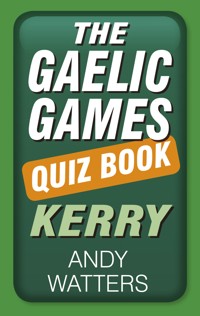
This is the ultimate Gaelic games quiz book for Kerry supporters. An ideal gift for fans of all ages, this is your chance to interact with the county's long and eventful history in Gaelic football and hurling from early successes and classic matches to more recent heroics. Informative and fun, this book is the perfect companion for those long match-day trips up, down and across the country or for simply testing you and your mates´ knowledge of our illustrious teams. From the obscure to the things you need to know, the book is packed with 30 themed rounds of questions designed to entertain and amuse all Kerry supporters. So get your thinking caps on - it´s quiz time!
Sie lesen das E-Book in den Legimi-Apps auf:
Seitenzahl: 59
Veröffentlichungsjahr: 2014
Das E-Book (TTS) können Sie hören im Abo „Legimi Premium” in Legimi-Apps auf:
Ähnliche












Thanks to my dad Frank, a lifelong GAA fan, for his help with the questions in this book
Contents
Title
Dedication
Introduction
Round 1 A Mixed Grill
Round 2 Family Ties
Round 3 AKA (Also Known As)
Round 4 Micko
Round 5 Grounds for Optimism
Round 6 Páidí
Round 7 The Swinging Sixties
Round 8 A League of Their Own
Round 9 That Winning Feeling
Round 10 You Can’t Win Them All
Round 11 The Munster Mash
Round 12 Through the Back Door
Round 13 Allstar State of Mind
Round 14 The Seventies
Round 15 Far Off Fields
Round 16 Countdown
Round 17 Who’s Who?
Half Time Interview with Colm Cooper
Round 18 Who, What, Where, When, Why … ?
Round 19 Numbers Game
Round 20 A Set of Clubs
Round 21 The Eighties
Round 22 Clubbing Together
Round 23 Captain’s Log
Round 24 Walk the Line
Round 25 The Writing’s on the Wall
Round 26 Crucial Conundrums
Round 27 Penalty Points
Round 28 The Nineties
Round 29 When a Star was Born
Round 30 Sisters are Doing it for Themselves
Round 31 Kingdom Queens
Round 32 Caman Have a Go
Round 33 Hurley Burly
Round 34 The Noughties
Round 35 The Warm-Down
The Answers
Copyright
Introduction
Kerry is known as ‘the Kingdom’. The county colours inspire confidence in the men and women who wear them and fear in opponents from their first glimpse of that green and gold jersey which has become synonymous with attacking élan, flair, style and success in Gaelic games.
The games, particularly Gaelic football, are a religion in the county and pious Kerrymen have won more All-Ireland senior football titles than any other county.
For some of the best players ever to lace up boots – from Joe Keohane, Mick O’Connell, Mick O’Dwyer, Páidí Ó Sé, Pat Spillane to Colm Cooper – playing for Kerry has been life’s greatest honour, a privilege and a labour of love.
The prominence of Gaelic football in the county today can be attributed to local traditions in the game of ‘Caid’ long before the establishment of the Gaelic Athletic Association (GAA), but Kerry’s first national title was actually in the game of hurling – in 1891.
The county’s initial All-Ireland football title wasn’t captured until 1903, almost twenty years after the GAA was founded, but since then thirty-five more have been won and Kerry’s women have also enjoyed success in ladies’ football.
In its formative years, Gaelic games were locked in a power struggle with rugby, which threatened to become the dominant sport in the county.
Rugby was popular and widespread but in October 1888, the influential Laune Rangers club in Killorglin held a meeting at which their captain J.P. O’Sullivan called on members to concentrate instead on Gaelic football.
Kerry’s first annual GAA Convention was held in Tralee in November 1888, at which nineteen clubs were represented and a Kerry county board was formed.
In 1889, the inaugural county championships were held, and Kerry, represented by Laune Rangers, made its first appearance in the Munster championship.
A decade later, however, and the game had regressed to the point of extinction – no county conventions were held in 1898 or 1899 and rugby, the ‘garrison game’, reclaimed some of the ground it had lost.
Compelled by what he saw as the erosion of his national identity, the emergence of the energetic Thomas F. O’Sullivan helped galvanise Gaels in the county and a new county board was formed in 1900.
O’Sullivan, a journalist, was fervently opposed to what he perceived as the pollution of Irish culture by British sports and embarked on a crusade to undermine those involved in playing rugby while at the same time promoting Gaelic games.
The introduction of ‘the Ban’ or Rule 27 in 1902 which forbade GAA members from engaging or promoting ‘foreign’ sports dealt rugby a knockout blow and Gaelic football assumed the dominance it has held ever since.
In 1902, Kerry reached their first All-Ireland final. Though they lost to Tipperary, they made the final again the following year and won it for the first time.
Kerry, captained by the legendary Austin Stack, who would later take part in the 1916 Easter Rising and after whom one of Tralee’s clubs is named, retained the All-Ireland title in 1904.
Steady progress continued and the first of two four-in-a-rows began in 1929 when the Kingdom beat Kildare 1-8 to 1-5. John Joe Sheehy top scored with 6 points as Kerry defended their title and John Joe Landers’s 2 goals saw off Monaghan the following year.
The fourth title of the run arrived in 1931. Again Kildare were the opposition and this time Austin Stack’s clubman Jackie Ryan led the way with 6 points.
Kerry dominance secured their reputation as Gaelic football’s powerhouse and since then successive generations have been inspired by the feats of their forebears – young men driven on by tales of the great deeds performed by the men who went before them.
Kerry won two more All-Irelands in the 1930s, three in the 1940s and three more in the 1950s when Mick O’Connell emerged as the team’s midfield star.
Galway and Down were formidable rivals in the 1960s, but Kerry won All-Irelands in 1962 (the last of eight under the management of Dr Eamon O’Sullivan) and 1969 and, as the 1970s dawned in glorious technicolor, marauding Kerry teams decked out in green and gold became engrained in popular culture.
Beating Meath in 1970 secured a twenty-second All-Ireland for the Kingdom and the twenty-third came five years later, the first under the management of the legendary Mick O’Dwyer. ‘Micko’ was still at the helm when they won again in 1978 – the start of another four-in-a-row.
Eoin ‘Bomber’ Liston and Mikey Sheehy ran riot as Dublin were routed, and Sheehy weighed in with 2-6 the following year as the Dubs were once again put to the sword.
Kerry, with Sheehy, Liston, Jack O’Shea, ‘Ogie’ Moran, Pat Spillane and others in their pomp, continued to dominate in the 1980s and they took the first title of the new decade by beating Roscommon.
They won again in 1981, this time against Offaly, to equal the record set half-a-century earlier and the talk throughout 1982 was of a ground-breaking ‘five-in-a-row’. But, against the odds, Offaly avenged their defeat the previous year to spoil the party with a dramatic one-point win.
Despite that disappointment, Kerry recorded a treble between 1984 and 1986 but the good times ended there and the Kingdom suffered the longest drought in its rich history, going eleven years without a title.
The drought ended in 1997 when a Maurice Fitzgerald-inspired Kingdom team beat Mayo. Showing an impeccable sense of timing, Kerry were the first All-Ireland champions of this millennium.
With a new batch of stars, including the Ó Sé brothers and Colm Cooper coming to the fore, Kerry lifted the Sam Maguire Cup five times in the decade, despite increasing competition from their rivals.
From obscure trivia to the essential facts you need to know, what follows are thirty-five themed rounds of questions designed to entertain and amuse – so get your thinking caps on – it’s quiz time!




