


19,99 €
Mehr erfahren.
- Herausgeber: John Wiley & Sons
- Kategorie: Fachliteratur
- Sprache: Englisch
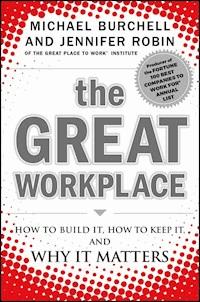
Gold Medal Winner, Human Resources and Employee Training, 2012 Axiom Business Book Awards Trust, Pride and Camaraderie--transform your company into a "Great Place to Work" The Great Place to Work Institute develops the annual ranking of the Fortune 100 Best Companies to Work For. In this book, the authors explore the model of a Great Place to Work For-one which fosters employee trust, pride in what they do, and enjoyment in the people they work with. They answer the fundamental question, "What is the business value of creating a great workplace?" and brings the definition of a Great Place to work alive with anecdotes, best practices, and quotes from employees working at the best workplaces in the U.S. * Reveals the essential ingredients in and the trends of the best places to work * Explores Great Place to Work model developed in 1984 and validated through its enduring resonance in both the United States and in over 40 countries around the world * Written by Michael Burchell and Jennifer Robin two Great Place to Work Institute Insiders If you organization is struggling with the challenges of leveraging human capital, discover why some companies have what it takes to be great.
Sie lesen das E-Book in den Legimi-Apps auf:
Seitenzahl: 360
Veröffentlichungsjahr: 2010
Ähnliche


















Contents
Foreword
Preface
Chapter 1: Introduction: The Value of Creating Great Workplaces
The Knowledge Base
The Three Relationships
The Attitude Adjustment
Beginning the Journey
Chapter 2: Credibility
Two-Way Communication
Competence
Integrity
Leader Imperatives
Credibility Behavioral Checklist
Chapter 3: Respect
Support
Collaborating with Employees
Caring for Employees
Leader Imperatives
Respect Behavioral Checklist
Chapter 4: Fairness
Equity
Impartiality
Justice
Leader Imperatives
Fairness Behavioral Checklist
Chapter 5: Pride
Personal Pride in One’s Job
Pride in the Team
Pride in the Company
Leader Imperatives
Pride Behavioral Checklist
Chapter 6: Camaraderie
Intimacy
Hospitality
Community
Leader Imperatives
Camaraderie Behavioral Checklist
Chapter 7: Global Perspectives
Are the Business Benefits of the Model the Same Across the World?
How Do You Create a Consistent Culture Across a Multinational Company?
Neither My Country Nor My Company Is Very Big. Is it Still Possible to Create a Great Workplace, and if so, How?
How Can I Address Cultural Diversity and Inclusion?
I’ve Liked Hearing What Companies Have Done to Incorporate the Model, but I’m Concerned the Same Things Won’t Work in My Country or in Some of the Countries Where My Business Has Offices.
Leadership Imperatives and Next Steps
Chapter 8: Taking Action: Creating Your Great Workplace
The Perspective of a Great Leader
How to Move Forward
References and Resources
Acknowledgments
About the Authors
Index
More Praise for The Great Workplace
“A wonderful road map for becoming a great place to work. Burchell and Robin present a compelling case for improving workplace culture. This book is ideal for any leader who wishes to improve team effectiveness and make a difference in the organization. Inspiring!”
—Tim Felt, CEO, Colonial Pipeline
“Filled with practical examples of how great firms reinforce the trust, pride, and camaraderie essential to a great workplace. These are great ideas meant to be shared.”
—Jim Weddle, managing partner, Edward Jones
“Well-researched and well-written, Burchell and Robin’s book captures the essentials of what it takes to transition to a truly great workplace.”
—Brian E. Keeley, president and CEO, Baptist Health South Florida
“Many companies aim to be a great place to work, yet their leaders struggle with how to get there. Burchell and Robin do a wonderful job articulating the importance of building great workplace culture and provide great examples and ideas for how to achieve this. Everyone in a leadership position should read this book.”
—Andrew Botwin, principal, Rothstein Kass
“Burchell and Robin tell real stories of how great organizations became (and remain) great workplaces by engaging the hearts and minds of the people who work there. The good news: the methods are transferable!”
—Peter J. Giammalvo, vice president, Organizational Development, OhioHealth
“The Great Workplace is a blueprint for all business owners who want to create and maintain a happy and productive workplace. A valuable guide for managers looking to empower their staff at every level.”
—Jill Leonard Tavello, executive vice president of Culture, Stew Leonard’s
THE GREAT WORKPLACE
Copyright © 2011 by The Great Place to Work® Institute, Inc. All rights reserved.
Published by Jossey-Bass
A Wiley Imprint
989 Market Street, San Francisco, CA 94103-1741—www.josseybass.com
No part of this publication may be reproduced, stored in a retrieval system, or transmitted in any form or by any means, electronic, mechanical, photocopying, recording, scanning, or otherwise, except as permitted under Section 107 or 108 of the 1976 United States Copyright Act, without either the prior written permission of the publisher, or authorization through payment of the appropriate per-copy fee to the Copyright Clearance Center, Inc., 222 Rosewood Drive, Danvers, MA 01923, 978-750-8400, fax 978-646-8600, or on the Web at www.copyright.com. Requests to the publisher for permission should be addressed to the Permissions Department, John Wiley & Sons, Inc., 111 River Street, Hoboken, NJ 07030, 201-748-6011, fax 201-748-6008, or online at www.wiley.com/go/permissions.
Readers should be aware that Internet Web sites offered as citations and/or sources for further information may have changed or disappeared between the time this was written and when it is read.
Limit of Liability/Disclaimer of Warranty: While the publisher and author have used their best efforts in preparing this book, they make no representations or warranties with respect to the accuracy or completeness of the contents of this book and specifically disclaim any implied warranties of merchantability or fitness for a particular purpose. No warranty may be created or extended by sales representatives or written sales materials. The advice and strategies contained herein may not be suitable for your situation. You should consult with a professional where appropriate. Neither the publisher nor author shall be liable for any loss of profit or any other commercial damages, including but not limited to special, incidental, consequential, or other damages.
Jossey-Bass books and products are available through most bookstores. To contact Jossey-Bass directly call our Customer Care Department within the U.S. at 800-956-7739, outside the U.S. at 317-572-3986, or fax 317-572-4002.
Jossey-Bass also publishes its books in a variety of electronic formats. Some content that appears in print may not be available in electronic books.
FORTUNE 100 Best Companies to Work For is a registered trademark of Time Inc.
The following names that appear in the book are copyrighted by the Great Place to Work® Institute©:
Great Place to Work® Institute©
Great Place to Work® Model©
Trust Index© Survey
Culture Audit©
Library of Congress Cataloging-in-Publication Data
Burchell, Michael, 1967-
The great workplace : how to build it, how to keep it, and why it matters / Michael Burchell, Jennifer Robin.
p. cm.
Includes bibliographical references and index.
ISBN 978-0-470-59626-5 (hardback), ISBN 978-0-470-93168-4 (ebk), ISBN 978-0-470-93171-4 (ebk), ISBN 978-0-470-93172-1 (ebk)
1. Corporate culture. 2. Work environment. 3. Employee morale. 4. Organizational behavior. 5. Job satisfaction. I. Robin, Jennifer, 1974- II. Great Place to Work Institute. III. Title.
HD58.7.B867 2011
658.3'12—dc22
2010034711
This book is dedicated to employees at great workplaces all over the world. Their words and stories have shaped the model of a Great Place to Work® and forever changed how we think about workplaces.
FOREWORD
By Robert Levering
Great Place to Work® Institute Cofounder
When I first picked up the manuscript of this book, I asked myself why I didn’t write a similar book 20 years ago. The Great Workplace: How to Build It, How to Keep It, and Why It Matters gives practical advice to any leader who wants to transform his or her workplace culture. Indeed, it promises to help leaders achieve their organizational goals while having a positive impact on the working lives of their employees.
The reason I wondered why I hadn’t tackled the same subject 20 years ago is that that was when I wrote A Great Place to Work: What Makes Some Employers So Good—and Most So Bad (Random House, 1988). In that book, I explained what distinguishes a great workplace from others based on what Milton Moskowitz and I observed in researching our best-selling 1984 book The 100 Best Companies to Work for in America. My definition of a great place to work became the basis for the Model that has been used by our Institute for its survey work and consulting, and is explained and discussed at length in this volume. So it would have been a logical next step for me, as a professional journalist and author of a half-dozen books on business subjects, to write the book that Michael Burchell and Jennifer Robin have done so beautifully in the volume you’re now holding in your hands.
As I read through Burchell and Robin’s book, however, I understood that I was not the right person to have written this book. As experienced consultants, the two of them are in a much better position than I to offer practical advice to leaders. Prior to joining the Great Place to Work® Institute in 2003, Burchell had firsthand experience inside a great workplace as an HR leader at W. L. Gore & Associates, one of only four companies that have appeared on every FORTUNE 100 Best® list since 1998, as well as in our 1984 and 1993 books. At the Institute, Burchell has worked with dozens of companies all over the globe in applying the Great Place to Work® Model to a wide variety of business issues. A former board member of the Delaware chapter of the Society for Human Resource Management, he currently is involved with the Organization Development Network. Burchell received his doctorate in diversity and social justice from the University of Massachusetts Amherst.
Robin also spent three years in a consulting role at the Institute before writing this book, working with leaders of a wide spectrum of organizations in applying the Great Place to Work Model. Robin brings the added dimension of having taught human resource management for three years at Bradley University in undergraduate, master’s, and executive programs. She has a particular passion for applying the cutting-edge policies and practices as seen in her previous book focused on work-life balance issues, A Life in Balance: Finding Meaning in a Chaotic World (coauthored with Charles Stoner, University Press of America, 2006). She received a doctorate in industrial organizational psychology from the University of Tennessee.
Besides their own personal experience as consultants and academics, the two authors conducted on-site interviews at thirteen great workplaces—Camden Property Trust, CH2M HILL, General Mills, Google, W. L. Gore & Associates, Hoar Construction, Holder Construction, Microsoft, PricewaterhouseCoopers LLP, SAS, SC Johnson, Scripps Health, and Wegmans Food Markets. At each of the firms, they interviewed the CEO and top HR executives, and conducted a focus group with a group of employees to fully understand their perspective. You will find studies of these companies in The Great Workplace as well as extensive quotes from their employees and leaders throughout the book.
Together, Burchell and Robin have produced a book that you will find extremely useful, if for no other reason than it’s chock full of case studies as well as best practices from great workplaces, such as the “responsibility statements” used at Edward Jones instead of job descriptions, or the “Vision Days” at Stew Leonards, or the “Back to Basics” refresher course given to employees after five years working at J.M. Smucker. While leaders may not be able to directly import any of these best practices to their own organizations, they will undoubtedly find themselves stimulated to emulate the kinds of practices used by their peers at the best workplaces.
What makes this book especially significant is that Burchell and Robin do a masterful job of explaining the “why” behind such practices. They provide a framework for understanding why various practices help to create a great workplace environment, which in turn helps an organization be more productive and foster more innovation.
Burchell and Robin’s message is simple: any company can become a great workplace, and this book can be your handbook to make yours one of them.
PREFACE
This book was 25 years in the making.
The Great Place to Work Institute has recognized and studied great workplaces since the early 1980s, and today the Institute operates in over 40 countries and conducts the largest annual study of workplace environments globally. We publish lists of the best workplaces in each of these countries, and we also have published benchmark studies, white papers, research articles, and several books. We advise businesses, hold educational conferences, and conduct training programs on the lessons we have learned. And yet, leaders were always asking us when we were going to write “The Book”—a book that would illustrate in a practical way how leaders can take action to create a great workplace.
This book is an answer to those requests. In this book we endeavor to lay out the basic framework of what a great workplace is from an employee’s perspective. While the voice of the employee takes center stage in this book, we have also incorporated the views and ideas of leaders, organizational best practices, and anecdotes and stories from our work as consultants. We have worked to draw upon the rich, deep experience that stems from studying great workplaces for over two decades. As you might imagine, we have learned a lot in that time, and we want to share with you a couple of things we now know.
We know and believe at our core that we can build a better society by helping companies transform their workplaces into great workplaces. Everyone benefits—individuals, organizations, families, and communities—when employees can give their best and know that the organization will also give them back its best. Yes, having a great workplace makes good business sense—as we will discover here—but at the end of the day, we believe that it is also the right thing to do.
We also know that great workplaces exist in every country, in every industry, and cut across organizations of all sizes and business models. Great workplaces exist in large, global organizations, small nonprofits, and government agencies as well. We believe your workplace can be a great workplace. This book aims to help you in that journey.
We know that the employee experience is central to understanding how to create a great workplace. It is the employee that determines whether his or her work environment is a great one, not the academic or business guru. As authors, we have had a front row in learning from these organizations—first and foremost by listening to their people. We have learned that great workplaces are at the same time simple and complex. We have tried to write this book in a rather straightforward, accessible style but still capture some of that complexity.
And finally, we know that leaders and organizations grow from the right amount of both challenge and support. This book aims to provide both. The challenge comes from the goal itself: to create and sustain a great workplace. Whether you cast that goal in language such as “be an employer of choice” or “have the best company to work for” or have a “fully engaged workforce” or win a “best company honor,” the underlying challenge you have is to transform your workplace. The support comes from the words of employees, leaders, and the best practices from their companies. From our own experience, we can tell you that an understanding of what makes a great workplace deepens and becomes more nuanced over time. Eventually, it becomes second nature to consider your actions as a leader through the lens of the employee perspective. You will want to read this book and then keep it on hand to reference its best practices and stories. The final chapter gives suggestions on how to use best practices as you embark upon your own journey to a great workplace. We also encourage you to join our online community, which provides additional tips, tools, stories, and practices to support you along the way.
Both of us came to the Institute energized by the fact that it was our company that named hundreds of great workplaces around the world each year that we could learn from. Even more encouraging was that every year companies kept getting better. It energizes and encourages us now to know that your company may be the next list-maker. We wish you all the very best.
Michael and Jennifer
June 2010
CHAPTER ONE
INTRODUCTION: THE VALUE OF CREATING GREAT WORKPLACES
Ninety-five percent of my assets drive out the front gate every evening. It’s my job to bring them back.
—Jim Goodnight, CEO and Founder of SAS
What makes a great workplace? It’s not what you do. It’s how you do it.
If you are a leader, you must communicate, make decisions, and interact with people, just as leaders in all companies do. You may carry out your job description very well. But to be a leader in a great workplace, you need to not only execute your role but also instill certain beliefs in people as you are doing it. A great workplace is one where people trust the people they work for, take pride in what they do, and enjoy the people they work with. As a leader, you are the one to create and reinforce these beliefs with every communication, every decision, every interaction. To create a great workplace, you’ll need to do your job differently. It requires a mindshift; it requires viewing your employees like Jim Goodnight suggests in the quote that opens this chapter. You’ll need to do your job realizing that how you do what you do makes a world of difference to employees.
Lesen Sie weiter in der vollständigen Ausgabe!
Lesen Sie weiter in der vollständigen Ausgabe!
Lesen Sie weiter in der vollständigen Ausgabe!
Lesen Sie weiter in der vollständigen Ausgabe!
Lesen Sie weiter in der vollständigen Ausgabe!
Lesen Sie weiter in der vollständigen Ausgabe!
Lesen Sie weiter in der vollständigen Ausgabe!
Lesen Sie weiter in der vollständigen Ausgabe!
Lesen Sie weiter in der vollständigen Ausgabe!
Lesen Sie weiter in der vollständigen Ausgabe!
Lesen Sie weiter in der vollständigen Ausgabe!
Lesen Sie weiter in der vollständigen Ausgabe!




