


18,49 €
Mehr erfahren.
- Herausgeber: The History Press
- Kategorie: Lebensstil
- Sprache: Englisch
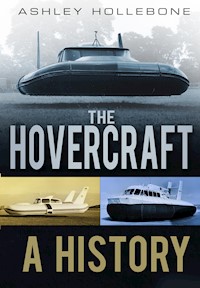
The hovercraft was first created in 1959, when Sir Christopher Cockerell came up with a prototype that crossed the English Channel. The SRN1, the first ever hovercraft, is now proudly housed by the Science Museum and this very British invention enjoys an active role in many arenas, from travel, leisure cruising and racing to lifesaving and transporting goods. This detailed book delves into the history of the hovercraft, from the early days of its development through to the commercial and military applications of the craft. It looks into the exciting world of hovercraft leisure, cruising and racing from amateur to Formula 1, and also explores the important role the hovercraft plays in rescues whether on water or delivering aid around the word in places that helicopters can't reach. Finally, it details the types of hovercraft in use today, and what the future holds. The hovercraft is more than a product of 1960s Britain: it is one that has pushed the boundaries of transport as we look into the future and we have the back-shed culture of Britain to thank for its invention.
Das E-Book können Sie in Legimi-Apps oder einer beliebigen App lesen, die das folgende Format unterstützen:
Veröffentlichungsjahr: 2012
Ähnliche


















FOREWORD
It is not every day you get asked to write a foreword for a book, and indeed I wasn’t actually asked; I was tasked with asking either the hovercraft inventor’s daughter, Frances Cockerell, or Lord Mountbatten’s grandson, Lord Romsey, both being Patrons of the Hovercraft Museum Trust of which I am a founding trustee. Needless to say Frances Cockerell was invaluable and preferred to be involved in helping to proofread and get the Cockerell facts right as indeed Sir Christopher would have wanted. Though the book doesn’t emphasise this, he received very little remuneration for his fantastic invention; a knighthood and the equivalent of a deposit on a nice little bungalow. It certainly wasn’t a living and he had to go on inventing, with wave power and future energy alternatives being next. Had he been an American he would have been a millionaire, though Cockerell never complained.
If it wasn’t for Dr Cockerell and Lord Louis Mountbatten’s promotion of his work then maybe ‘Hovercraft’ would have been the American ‘Ground Effect Machine’, or the French ‘Aeroglisseur’, or the Austrian ‘Leufkissenboot’ – maybe even the ‘Vazsnashino’ from the Eastern Bloc. This very British invention nearly didn’t happen except for the perseverance of these two great Englishmen.
So for me it is with great pleasure that I get to write the foreword for Ashley’s hovercraft history. Like Ashley and many a schoolboy I fell in love with hovercraft at first sight. With great engineering, the hovercraft is the ultimate transformer machine as it metamorphs as it inflates, lifts and drops, changing from sea to land and back. Always a crowd puller with its speed, spray and noise – rudders and props moving and skirts bellowing – the hovercraft is a quirky, futuristic sci-fi machine.
When I first met Ashley he was a student who turned up at an early hovershow asking if he could bring in his rare American Hoverstar craft towed by an Austin Seven car, driven down from London. Needless to say we said yes and enjoyed his display only to find afterwards that he’d never even driven it before!
Ashley’s enthusiasm comes through in his book and I hope that this will introduce a new generation to the hovering craft, as well as educate us older ‘schoolboys’! As Cockerell always said and believed, it is the youth of today we have to enthuse as they are the future and we have to educate people on both the Arts and Sciences or else we are half educated.
Cockerell was my idol, and I had the pleasure of meeting him aged thirteen. Years later I was to paint his portrait whilst he quizzed me on the History of Art and his latest letters to TheTimes. He was a well-rounded gentleman and knew his stuff! He would have liked Ashley (writer, actor, journalist and props expert on the Bond films) and I know his book will go a long way to educating the next generation of engineers and enthusiasts on this wonderful machine. As Cockerell said himself, ‘Oh well you have to understand it is only half developed you know ... you can’t un-invent something. There will always be Hovercraft!’
With this book, Ashley brings us right up to date and ready for the future!
Warwick Jacobs
Trustee, Hovercraft Museum Trust, Lee-on-the-Solent
CONTENTS
Title
Foreword by Warwick Jacobs
Introduction
1
Where it all Began
2
The Workings of a Hovercraft
3
SRN-1: The First Hovercraft
4
The Next Chapter…
5
The British Hovercraft Corporation and the SRN-5/6: Hovering the World
6
BHC SRN-4 Mountbatten Class: The ‘Super 4’
7
Hoverspeed
8
Military Hovercraft
9
Wing in Ground Effect: The Age of the Ekranoplan
10
Light Hovercraft
11
Hovertravel: The World’s Oldest Commuter Hovercraft Service
12
Griffon Hoverwork
13
The Future
Appendix 1
Patents of Sir Christopher Cockerell
Appendix 2
Griffon Hoverwork Sales List, 1983–2012
Plates
Copyright
INTRODUCTION
In 1959 a new invention came into being, and it wasn’t long before it changed the world, inspiring many designers, visionaries, businessmen and members of the public. This was the hovercraft, and this is my account which chronicles the history of this wonderful invention that is statistically one of the world’s safest modes of transport. The hovercraft is having something of a renaissance, growing from strength to strength as it continues to meet the world’s demands for an amphibious and truly versatile vehicle. Nothing else can match it!
I would like to express my gratitude to Hovercraft Museum trustee Warwick Jacobs, not only for his hard and loyal work devoted to the preservation of countless historic hovercraft, but also for the archiving of tens of thousands of images and cuttings that span the entire evolution of the hovercraft.
A home-made 1960s hovercar which used the running gear and wheels from a car to provide an adequate means of control for the road. This strange vehicle was also road legal, utilising the registration from the car which it was mechanically based upon.
The Hovercraft Museum near Gosport, Hampshire, on the south coast of England houses a truly unique collection of the most important hovercraft and archives to be found anywhere in the world. (Author’s collection)
This book is my opinion on the hovercraft and I really wanted to finally make good use of many images that have never been seen before, all of which help to document and appreciate the history of the hovercraft, and of the men and women that pushed it to the extremes and gave the world a life-saving vehicle. I hope that you enjoy gaining an insight into this unique mode of transport.
Unless otherwise stated, all images come from the collection of the Hovercraft Museum.
ONE
WHERE IT ALL BEGAN
Six thousand years ago, during the fourth millennium B.C., modern man’s hairy ancestors were formulating the idea of a wheel hewn from stone, which they later made from wood, having discovered this material was easier to work with and could be more durable. They had proved that moving objects could be made easier by a simple method, one that would enable them to advance their lives and civilisations. Six thousand years later, and only a short time after Elvis had a hit with Hound Dog, another strange but forward-thinking concept would emerge in the twentieth century. By now the human population of the world was familiar with the aeroplane in both military and civilian applications. Cars were continuing to get faster and faster, ships were getting bigger and bigger, while trains were slowly turning from imperial steam to diesel and electric traction.
Earth is a wonderful place but few of us ever really take note of the natural beauty that is all around us, or at least not far from wherever we may be. Our planet is covered by a thick blanket of air which is over 200 miles in depth, commonly referred to as the atmosphere, although there are different areas to be found within this zone. These include the stratosphere, jet stream and ionosphere, all of which vary in air pressure; the higher you rise, the lower the pressure of air and thus the lower the amount of energy required to achieve high speeds as the earth spins on its axis below. High altitude jets, such as the now sadly redundant Concorde, ferried their passengers on the very edge of space (58,000ft), while satellites glide even further above us as we sleep.
We have three main elements that make up our environment, these being land, sea and air. Man has achieved transportation through all of these media but only after many years of development. Since the innovation of the wheel, the boat is the oldest form and records can prove that thousands of years have passed since the first examples were constructed. The aeroplane is considered a definite twentieth-century breakthrough, though medieval genius Leonardo da Vinci proved that powered flight was a definite possibility. So on the face of it, transport history would seem to suggest that these three elements have been dealt with, and that man has firmly mechanised earth. Of course, as with all things, it is only a matter of time before someone will try to improve an existing creation or in some cases form a totally new one.
If we examine the three modes of transport we will find flaws in all of them. Ships are the most commercially used mode of transport but are slow; in most cases the maximum speed of a cargo ship is not more than that of the top speed of a 100-year-old motor car! Where an increase in power is obtained it does not translate into forward momentum as that extra power is needed to punch through the water. Boats in their state of movement require quite a lot of energy and high-speed vessels have also presented efficiency challenges. A ship is a much larger version of a boat which may be used for private and recreational use, although in both cases these vessels have their limits, requiring docks or dredged channels to berth.
Wheels are the most practical for everyday day use but they too have limitations. Trucks can carry heavy loads but nowhere near the quantity a ship can carry, while the size of load is constricted by the roads on which it will travel. Further to this, they are heavily affected by traffic congestion, a problem not suffered to any great extent in the air or at sea. The wheel is also greatly affected by severe weather conditions; when placed under stress a wheel can slip in icy conditions and lose all traction. Snow chains and desert ballon tyres provide a practical solution in some cases but the drawbacks to the wheel in extreme conditions are far greater than can be rectified with aftermarket creations for the masses.
Flying is by far the fastest way to get around but also attracts huge costs. Aircraft only stay airborne at speed and require large amounts of energy to get off the ground, as well as to stop! Generally aircraft loads are quite small by comparison to other forms of transport at smaller costs.
To be quite blunt, the faster you travel the more it costs. As the ever-increasing world population demands its resources and consumer items at an ever-increasing pace in the manner of ‘I want that and I want it now!’ then so does the need follow for speed in delivery. The aircraft being too costly, shipping being too slow and the wheel being limited to land it was clear that a gap existed.
By the middle of the twentieth century an unorthodox-looking invention entered public knowledge; however despite its appearance it did not emerge from a secret government test site in the Nevada Desert or from a Cold War British air base but a small, rustic boatyard in Norfolk, the same place where turnips and mustard originate, and later plastic sports cars! However, while the creation’s home may have been simplistic, its qualities for the future were anything but. This was to become quite possibly one of most futuristic-looking vehicles of the post-war industrial era, the hovercraft.
As with all forms of movement, friction is the inevitable barrier that has to be overcome. The hovercraft is based around the idea of eliminating friction, and while the hovercraft itself did not appear until the middle of the Cold War era, ideas of transport focusing on overcoming friction originated centuries earlier.
Whilst da Vinci’s concept of a human-powered flying machine never made it past his famous sketch, it paved the way for future aviators. Da Vinci’s flying machine has in later years been built by countless historians who have proved that this medieval genius was in fact the inventor of the helicopter, although it was aviation firm Sikorsky that would make it a reality some half a millennium later. The theory of hovering can therefore be traced back to the artistic, rapidly advancing Renaissance era.
The next chapter in the air cushion history comes from the early eighteenth century when, in 1716, Swedish philosopher and designer Emmanuel Swedenborg devised an air-cushioned vessel which resembled an upturned dinghy with a cockpit in the centre. Apertures on either side of this allowed the operator to raise or lower a pair of oar-like air scoops, which on the downward strokes would force compressed air beneath the hull, thus raising it above the surface. The project was short-lived and it was never built, for Swedenborg soon realised that to operate such a machine required a source of energy far greater than that which could be supplied by a single human occupant.
Hovermarine sidewall vessel – note the lack of a bow wave.
In France, not even a Citroen H van could escape being hovered! In this case the vehicle was used as a load to demonstrate the advantages of an air cushion pallet.
The hoverbed. A British invention that helped and continues to help the treatment of major burn victims.
This strange boat is actually one of the first full-scale working examples of an air cushion vehicle. The 1916 ‘Gleiftboat’ was a high-speed German torpedo launch that used an elaborate air blower system to reduce friction under the hull while its shape meant the bow would rise out of the water at speed. A design way ahead of its time.
A light one-person hovercraft made at the Royal Aeronautical Establishment at Cardington, Bedfordshire.
The hovercraft at Cardington. From this shot it is clear to see why the base was used to experiment in hovercraft activities. The building is one of the old airship hangars which once housed the famous R101, however in the background lie barrage balloons, perhaps surplus from the Second World War?
Another RAE Cardington inflatable craft.
‘The Skimmer’, 24 April 1961, under the control of its designer, former test pilot for Supermarine (manufacturers of the Spitfire) Don Robertson. Whilst trying not to look like he is sat on the toilet, Don skilfully hovers the craft under the watching eye of the press.
Winfields hovering at Jersey Hoverdrome in the 1970s.
Through the next century, things progressed with a range of practical experiments with air cushion transport. This time the location was England in the 1870s, when engineer John Isaac Thornycroft experimented by forcing air underneath the hull of a small boat. Thornycroft was no stranger to the water as he was already involved in constructing boats for the Admiralty from his yard on the Thames. Thornycroft’s idea was to reduce friction of the hull as it passed through water, enabling a reduction in drag so an increase in momentum. He constructed a form of crude bellows system which was pumped from inside, drawing air from the top and then vented to the underside of the hull. The idea worked, as air bubbles formed and displaced water. However, the power source required to make this method a viable proposition just wasn’t around at that time. It wouldn’t be until a century later that the frictionless vehicle idea would ‘surface’ once again. Thornycroft died in 1928 but his legacy would remain to the end of the twentieth century as his firm went on to build the famous RAF motorboats for air rescue duties during the Second World War. The Thornycroft name was also used for commercial motor vehicle production, most famously with fire engines and trucks. A great number of Thornycroft’s original working models have thankfully been preserved and can be seen on display at the Hovercraft Museum in Hampshire.
Now we reach the final chapter in the experimental phase of the concept of air cushion theory when in 1955 another highly skilled but very much independent man of modest means transformed centuries of experiments into a practical product. Dr Christopher Cockerell (later knighted) is known as the inventor of the machine we call the hovercraft, a word he also coined, but few are aware of the man himself. To appreciate invention you have to appreciate and understand the inventor and when you delve into Cockerell’s life history it’s not hard to see why it would be such a character that would create this breakthrough.
Born on 4 June 1910, Cockerell was part of a very well-placed family in society. His father, Sir Sydney Carlyle Cockerell, was a private secretary to Sir William Morris and from 1908–37 was Director of the Fitzwilliam Museum in Cambridge.
Inventor of the hovercraft as we know it, the English gentleman Sir Christopher Cockerell.
The Cockerells were a talented family. Sir Sydney’s parents were Sydney John Cockerell, a London coal merchant, and Alice Bennett, the daughter of a City watchmaker, while his elder brother, Theodore, was a biologist. His younger brother, Douglas, an eminent bookbinder, had a son, Sydney Maurice, who was two years Cockerell’s senior and a celebrated and innovative designer of marbled papers.
Christopher Cockerell is honoured by HRH the Queen Mother at Buckingham Palace in 1969.
Cockerell studied engineering at Peterhouse, the oldest and smallest college of Cambridge. It seems a strange turn of events that such a historic old city would lay claim to the world’s most futuristic contraption of the decade, if not the century! After his studies at Cambridge, Cockerell gained employment at the Radio Research Company until 1935 when he moved to Marconi. He stayed with the wireless telegram firm until 1950.
Cockerell’s father once described his son as ‘no better than a garage hand’; despite this he had a vast capacity for invention. Throughout his life Cockerell filed numerous patents for a wide variety of designs and inventions. He created thirty-six in his short time with Marconi alone, and despite his reservations, his father funded his son’s files for many of his patents. Over history it is often the case that great people of our time can be interlinked with other such personalities. Cockerell’s father was no exception as he was associated with the likes of T.E. Lawrence (Lawrence of Arabia) and George Bernard Shaw among others, who were often house guests.
During the war years Cockerell worked with a highly skilled elite team at Marconi developing radar, a development which Winston Churchill believed had a significant impact on the outcome of the Second World War. Cockerell left Marconi in 1950 and with the financial aid left by his dear wife’s father, he and his wife Margaret were able to purchase a small boatyard in Suffolk. It wasn’t long before they had established a new venture at the Old Wherry Dyke in Somerleyton which had in the previous century been used as a quay for a Victorian brickworks, although it was at that time home to broad cruisers which were growing in popularity. A new company was registered, Ripplecraft, through which Cockerell would run his marine business of hiring out cruising boats as the demand for holidays on the Norfolk Broads increased. Each year Cockerell would plan to lay a new keel over the winter period so that a new boat would be ready for hire in the following summer. There were alterations made to the conventional Broadland cruiser as Cockerell insisted on placing the steering wheel at the front in a car-like fashion so that hire customers could enjoy the panoramic views of the countryside when the large sliding roofs were open. Ripplecraft was an active and vibrant little boatyard and the small fleet of Broadland cruisers allowed Cockerell to provide a living for his family, as well as to fund his development work on new technology.
He didn’t run this venture alone, however; behind the scenes were other highly skilled and very much underrated men that had great experience in design, construction and operation of boats. One such man was Douglas Rushmer, who remained managing director of Ripplecraft until 1979. Doug worked very closely with Cockerell on the testing of various air cushion ideas, including a side wall concept which utilised a modified clinker-built rowing boat. Thin side members were added which penetrated the water line. At the keel a transverse slot was cut from where air would enter under the bottom of the craft. An industrial vacuum cleaner was used to provide the required air pressure. The results proved that friction had decreased and this led Cockerell to carry on and eventually purchase a small motor launch named Spray that he could use to develop the idea to another level under powered motion.
Spray was modified with a large centrifugal air fan that was powered from its propeller shaft. Air was vented over the bows of the launch and to determine the pressure pattern a series of simple water height gauges were installed through the bottom and could easily be monitored.
But despite all of this Cockerell still had his day-to-day business to run and playing with toy boats like boys on the riverbank on the way home from school does not pay the bills. All of this kept Cockerell busy, but his brain was buzzing for further creation and during the winter of 1953 he started to give his air cushion idea some serious thought.
His experiments led him to construct large-scale models which would test his idea about making a boat ride upon a cushion of air. Cockerell spent much time in his quest to pursue a frictionless craft. One example of his experiments involved a small dinghy which had a special pump to blow high-pressure air underneath and around the edge of the hull. This high pressure air was then retained by the aid of a rubber curtain which then created lift. This working test bed was to become the first step in the development of the hovercraft as we know it. It was one Saturday evening in June 1954 that Cockerell stumbled upon a method that would actually turn all of his hard work and forward thinking on air cushion ideas into a viable, fully working example. He had created the very item that makes a hovercraft hover – the momentum curtain. For some time he had been playing with the notion of devising some sort of contained pressured segment on the underside of the hull. Cockerell thought of having a plenum chamber; a ‘storage’ chamber where the entering air would be contained for a little longer, and thus pressurised, so as to reduce the power needed for given lifting capacity.
Making good use of what he had around him, Cockerell used two tin cans of slightly different circumferences: a Lyons coffee tin and a Kitekat cat food tin. The smaller tin was recessed within the larger one and fixed at the top, leaving a gap around the sides. A hole was then made in the top of the large tin and from there an industrial air blower hose was connected. The result created a desired plenum chamber as the high-pressure air entering the tin was forced to dissipate around the sides of the smaller tin, exiting at a greater pressure from the underside of these two cans. This method, seemingly so simple, created a highly effective air curtain and test model that would go on to prove the fundamental basis of the future of the hovercraft. This was called the ‘momentum curtain’ and Cockerell filed yet another patent, one of his most significant to date, although it made him very little money.
Cockerell used this simple coffee tin experiment to demonstrate the principle and goings-on of the plenum chamber. The cans were made in such a way that it was possible for the smaller inside can to be removed so that the exiting thrust air could be directed onto a pair of scales with weights on. The test showed that the scales would not move much when the tin was placed over the scale; however, when the smaller tin was reinserted, a plenum chamber was created and the tin rig offered up to the scale once more. This time the weights lifted, showing a clear advantage in air having the momentum curtain as for the same amount of power a greater exiting force was reached. The test rig proved highly successful. Now all Cockerell needed to do was build a working model that would show this in a more practical and suitable manner.
It is quite easy to reproduce this simple test yourself using basic household items just like Cockerell did himself. You can even use plastic drinks bottles.
A full working model of the concept was built, which resembled a cross between a flying helmet from a Dan Dare adventure comic and a spaceship. Yet this balsa wood contraption was powered by a small model glow-plug aero engine. Even more primitive, compared to its futuristic appearance, was the fact that it was tested on bowling greens on a tethered rope. The design was of Cockerell’s mind but the construction wasn’t by his hand. He simply did not have the time to make models whilst managing the growing boatyard, so he called on the skills of his colleague Desmond Truman to build the working model of this revolutionary design. This model was Cockerell’s first working example which he would use to prove his air cushion theory to potential investors. Like the models of John Thornycroft of the Victorian era, Cockerell’s original is preserved at the Hovercraft Museum. It was at this time that Christopher Cockerell gave his new design the name ‘hovercraft’.
Another company was formed alongside Ripplecraft, Hovercraft Ltd. The small ramshackle old shed which had been used in the past to store unused tools and boat bits became the workshop for the most iconic vehicle of the decade if not the century, similar to the Apollo rockets. But of course, this was not a multi-billion dollar NASA plant, this was the Norfolk countryside.
The impressive stately home of Somerleyton Hall lay within a stone’s throw from the Ripplecraft yard and in June 1956 Cockerell met with Lord Somerleyton, who granted him full permission to use the estate to further his work on the hovercraft model tests within the seclusion of the Pergola Lawn. This was an important place for Cockerell, as he could undertake tests without having to concern himself of onlookers that could place an issue. The connection with Somerleyton deepens further as it was Lord Somerleyton who initially contacted Lord Louis Mountbatten in August 1957, who was at the time First Sea Lord of the Admiralty and had a well-known interest in technology and innovation. In his forthright way he later said, ‘I sent the papers on to the Admiralty Director of Research Programes and Planning with my personal instructions that this was to be investigated at once.’ Mountbatten turned out to be as vital a part of the hovercraft story as the momentum curtain itself, but more on that later.
The first practical hovercraft model built by Cockerell, seen here on Lord Somerleyton’s lawn in Norfolk.
Cockerell’s model of the craft of the future.
Cockerell preparing the model for a tethered flight on Lord Somerleyton’s lawn.
Eventually in 1955 Cockerell managed to gain the support of the Ministry of Supply but the MoD was another task in itself! He tried to persuade officials that his new hovercraft was the vehicle of the future and one that could meet certain requirements in various roles. Sadly he was met with firmly shaking heads from the armed forces. The Admiralty said that it was an aircraft and not a boat, the RAF said it was a boat and not a plane! The Army held neither of these opinions but were not interested. It is quite ironic that most of the world’s military hovercraft are today operated by the Marines.
One other rather unsettling thing became clear from this early period of the development of Cockerell’s craft. More or less as soon as he had patented the design of the craft and the momentum curtain, it was placed on a secret list. In an almost James Bond fashion you could picture a sunken room deep within the Whitehall citadel where numerous weird and wonderful gadgets are filed, stored and played with by mature men in Savile Row suits and bowler hats. This secret list prevented anyone other than those with direct permission from government authorities, or in some cases deeper, from doing anything with the patent or project. These were dark times, the Cold War was getting very chilly, the USSR was watching Great Britain and the United States while Great Britain and the United States were watching the USSR. There was never any doubt that a very short fuse existed that could be lit at any time, and everything relied on technology being developed by boffins at defence research establishments. During this time the UK had firmly launched its greatest deterrent, the V bomber force, which consisted of three types of high-altitude, long-range jet bombers capable of dropping the Blue Steel nuclear missile.
The hovercraft arrived at the peak of a major RAF overhaul; its piston-engined aircraft which dated back to the Battle of Britain were now being replaced with supersonic jets that could break the sound barrier in a vertical climb, seconds from take-off. It’s not hard to see why the powers that be were determined to tread carefully with this new invention. When taken to Whitehall the model was demonstrated amongst a gathered crowd of senior top brass. It must have been a strange sight to witness this free flight little model, noisily hovering in circles over the grandest flooring it was ever likely to, a world away from a leaky damp shed in a Suffolk boatyard! The project was quickly whisked from under Cockerell and placed on the secret list, although as already mentioned not because they had a plan for it, but just to stop someone else having a plan of their own for it. Could it have assisted their nuclear deterrent? Or aided their ground forces? Only time would tell. What was clear was that Cockerell was getting increasing agitated by the suppression of the technology. Eventually in 1958, after declassification, Cockerell got a step further. A member of the Ministry of Supply was rather concerned, as was Cockerell, about reports of hovering progress being made abroad and together they saw the need to act fast in Britain to keep her foot in front as she had done so far. Mr R.A. Shaw of the Ministry of Supply gave permission to the National Research Development Council (NRDC) to fund the design, construction and development of the world’s first full-size working hovercraft, the SRN-1.
The design code of SRN-1 originates from the name of the manufacturer given the contract: aircraft firm Saunders Roe – Nautical division, a company based in Cowes on the Isle of Wight, just off the south coast of England. The Isle of Wight evolves from here onwards as the birthplace of the hovercraft to being the very epicentre of its activity. Saunders Roe, meanwhile, was one of Britain’s oldest aviation companies, with a long connection with vehicles that combined air and sea, having built some of the most important seaplanes throughout both world wars.
The Saunders family came from Streatley, situated on the Thames, where they designed and built boats for use on the river. They continually refined their designs and methods of construction in order to make the boats lighter and more durable. The weight and hull design became more important when engines were installed, as the early designs were not very efficient. In addition, they also made great attempts to reduce the wash generated by powered craft.
Sam Saunders established his business on the Isle of Wight in the early 1900s and soon began manufacturing boats for open sea applications in addition to his existing river boats business. The sleekness of his designs and their light weight soon brought many new customers. This was particularly important when the early aircraft were being built. After building fuselages for a number of aircraft, it was not long before Sam Saunders commenced building his own aircraft. His company was responsible for many very interesting aircraft designs.
As the business expanded, changes in the ownership and management structure of the company occurred, typical of any pioneering business, and naturally the name of the business also changed. In 1929, when Sir Alliott Verdon Roe bought into the company, Saunders Roe was born and set on its way to becoming one of the more enduring names in the UK aircraft industry. Although they became synonymous with flying boats in particular, it should not be forgotten that the company also built several land-based aeroplanes.




