


87,99 €
Mehr erfahren.
- Herausgeber: John Wiley & Sons
- Kategorie: Geisteswissenschaft
- Sprache: Englisch
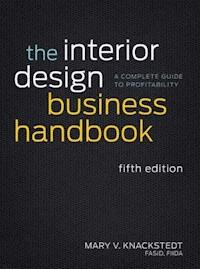
Thousands of interior design professionals have come to rely on The Interior Design Business Handbook for comprehensive, accessible coverage of the essential procedures, tools, and techniques necessary to manage a successful interior design business. The Fifth Edition of this essential resource has been revised to address the latest trends and changes in the field, with new and updated material on business size and structure, building a brand, client development, social networking and Internet marketing, finances, purchasing, technology and software programs, and other key areas. Complete with more than 75 sample forms and letters, this Fifth Edition is a one-stop resource for all aspects of establishing and running an interior design business--from choosing a location and managing day-to-day operations to growing a business and putting it up for sale. All of the techniques and procedures in the book are rooted in real-world experience and are used daily in successful design firms throughout the United States. Filled with valuable information for solo practices and small firms as well as larger businesses, this book is an indispensable resource for seasoned professionals as well as interior designers who are at the start of their career.
Sie lesen das E-Book in den Legimi-Apps auf:
Seitenzahl: 952
Veröffentlichungsjahr: 2012
Ähnliche




















Contents
Cover
Title Page
Copyright
Preface
Acknowledgments
Chapter 1: Finding Your Place in Interior Design
What it Takes to be an Interior Designer
Five Traditional Ways of Working
Working Styles
Specialization and Specialties
Finding Your Place
Measures of Success
Chapter 2: Starting or Changing Your Business Type or Structure
Initial Considerations
Planning Ahead
Advantages
Disadvantages
Getting Feedback
Buying an Existing Business
Selecting the Right Form of Ownership for You
Dealerships
Joint Ventures And Associations
Considerations
Chapter 3: Planning for Profit and Growth
Developing a Firm
Planning or Designing
Setting Goals
Formulating a Business Plan
Planning for Profit
Selling Your Business
Considerations
Chapter 4: Setting Up a Design Studio
The Right Location
Equipping Your Office
Inventory
Considerations
Chapter 5: The Design Team
Forecasting Requirements
Staff Positions
Finding the Right Employees
Interviewing a Prospective Employee
Salaries and Benefits
Employee Evaluations
Termination or Resignation of an Employee
Employee-Related Letters
Hiring Consultants
Considerations
Chapter 6: Business Development
Market Development
Public Relations
Advertising
Selling
Considerations
Chapter 7: Charging for Your Services
Job Pricing
How to Charge
Fee Bases
Methods for Saving Expenses
Determining the Fee Structure
Contracts and Letters of Agreement
Considerations
Chapter 8: Succeeding in Project Management
The Programming Phase
The Schematic Design Phase
The Design Development Phase
The Contract Phase
Placing Orders
The Contract Administration Phase
Freight Claims
Client Retention
Client Loyalty
Considerations
Chapter 9: Working with Sources and Contractors
Selecting Sources
Working with Your Suppliers
Buying Methods
Buying Service
Working with Your Contractors
Considerations
Chapter 10: Managing Your Office
Management
Management Styles
Time Management
Meetings
Delegation
Handling Mail
Recordkeeping
Protecting Confidential Material
Copyrights and Intellectual Property
Using Office Tools
Considerations
Chapter 11: Managing and Securing Your Financial Position
Your Profit Forecast
Cash Management
Overhead Costs
Banking Relations
Establishing Credit
Insurance
Taxes
Considerations
Chapter 12: Growing Your Firm and Your Professional Skills
Evaluation
Developing Yourself and Your Staff
Educating Your Staff
Attending Seminars
Additional Design Education
Considerations
Epilogue
Appendix: AIA Document B171 ID
Professional Associations
CIDA
Accredited Programs
Glossary
Recommended Reading
Designers’ Business Forum
Index
Cover Image: © iStockphoto
This book is printed on acid-free paper.
Copyright © 2013 by Mary Knackstedt. All rights reserved
Published by John Wiley & Sons, Inc., Hoboken, New Jersey
Published simultaneously in Canada
No part of this publication may be reproduced, stored in a retrieval system, or transmitted in any form or by any means, electronic, mechanical, photocopying, recording, scanning, or otherwise, except as permitted under Section 107 or 108 of the 1976 United States Copyright Act, without either the prior written permission of the Publisher, or authorization through payment of the appropriate per-copy fee to the Copyright Clearance Center, 222 Rosewood Drive, Danvers, MA 01923, (978) 750-8400, fax (978) 646-8600, or on the Web at www.copyright.com. Requests to the Publisher for permission should be addressed to the Permissions Department, John Wiley & Sons, Inc., 111 River Street, Hoboken, NJ 07030, (201) 748-6011, fax (201) 748-6008, or online at www.wiley.com/go/permissions.
Limit of Liability/Disclaimer of Warranty: While the publisher and the author have used their best efforts in preparing this book, they make no representations or warranties with respect to the accuracy or completeness of the contents of this book and specifically disclaim any implied warranties of merchantability or fitness for a particular purpose. No warranty may be created or extended by sales representatives or written sales materials. The advice and strategies contained herein may not be suitable for your situation. You should consult with a professional where appropriate. Neither the publisher nor the author shall be liable for damages arising herefrom.
For general information about our other products and services, please contact our Customer Care Department within the United States at (800) 762-2974, outside the United States at (317) 572-3993 or fax (317) 572-4002.
Wiley publishes in a variety of print and electronic formats and by print-on-demand. Some material included with standard print versions of this book may not be included in e-books or in print-on-demand. If this book refers to media such as a CD or DVD that is not included in the version you purchased, you may download this material at http://booksupport.wiley.com. For more information about Wiley products, visit www.wiley.com.
Library of Congress Cataloging-in-Publication Data:
Knackstedt, Mary V. The interior design business handbook : a complete guide to profitability / Mary V. Knackstedt, FASID, FIIDA.—Fifth edition. pages cm Includes bibliographical references and index. ISBN 978-1-118-13987-5 (cloth); 978-1-118-31157-8 (ebk); 978-1-118-31159-2 (ebk); 978-1-118-32818-7 (ebk); 978-1-118-32819-4 (ebk); 978-1-118-32820-0 (ebk) 1. Interior decoration—Practice—Handbooks, manuals, etc. 2. Interior decoration firms—United States—Management—Handbooks, manuals, etc. 3. Interior decoration—United States—Marketing—Handbooks, manuals, etc. I. Title. NK2002.K57 2012 729.068—dc23 2011051092
Preface
Design creates change. Designers are therefore leaders in the progress of the world.
But being a leader has challenges of its own. Today’s designers are under great pressure to perform at a high level, often faster than ever before. This means designers’ business procedures must complement their creativity.
These procedures are key to our success—whether in developing products or services or in communicating with clients. When we use the right procedures, the business portion of our organizations can complement the creative process beautifully.
We deal with business issues every day. We engage in business development when we seek new clients. We deal with finance every time we handle money. We sign contracts and letters of agreement, address personnel issues, and seek out new resources. We cope with masses of paperwork, including specifications and orders.
To stay in business, we have to understand business. We don’t have to earn business degrees or be personally capable of performing every business function, but we do have to be able to talk with and understand the people who are specialists in these fields. We must relate to other industries, including the financial and legal entities that are part of the business world. A good, basic understanding of specific business functions is necessary for every staff member, not just the person running the design company.
Everything that affects business in general affects the interior design business. When insurance rates go up or certain types of insurance become expensive or unavailable, we may have to modify the way we do business. The state of the stock market, the price of oil, and the value of real estate all affect our clients’ attitudes toward buying design services; therefore, they affect us.
When designers are comfortable dealing with money and financial issues, it gives them a tremendous sense of freedom and enhances their creativity.
Though business procedures are taught in design schools, I feel they are not emphasized as extensively as they should be. The Interior Design Business Handbook was written primarily for practicing interior designers, whether working independently or within large firms. It covers the full range of business activities and procedures for the life of a practice, from choosing a location and running a business on a daily basis to selling it when you’ve decided to retire. It is also useful to students and as a training manual for support staff members. Give a copy of the book to your bookkeeper, accountant, and other consultants so they understand our field better.
This fifth edition of the Handbook addresses many new issues not included in previous editions. Financial issues and many general procedures have changed significantly. Technology has been part of that change. Interior designers are also dealing more on an international basis, and technology has allowed us to have more virtual relationships. The Glossary includes an extensive list of business terms designers use regularly; the descriptions have been tweaked to be as user-friendly as possible. Many more subjects could have been included, but then the book would have been difficult to carry. It was imperative to keep the book as concise as possible, yet to convey the important issues that are in front of us today.
This book is for the practicing designer who wants to be assured of a continuously profitable business—in terms of profit and quality. Moreover, the information in this book is experiential: It has been taken from situations that arose in the many firms with which I have consulted. It has been researched and gathered in a real, hands-on fashion during the many workshops, programs, and classes I have held with designers, architects, and professionals in related industries. At these meetings, many new questions surfaced. If I did not have a solution, I asked my consultants for their assistance in finding one. Once we did, we asked the designers in these programs to try the particular procedure. If appropriate, we tested the procedure in our firm. As a result, I can state with confidence that every procedure in this book works. They are being used daily in successful design firms throughout the United States—including my own.
I believe interior designers have a great contribution to make to the world. It is my hope that The Interior Design Business Handbook will enhance your creative energies by making the business end of interior design not only comprehensible but rewarding—in every sense of the word.
Acknowledgments
My goal in writing this book is to present business procedures that complement designers’ creative abilities.
Without the help and encouragement of many special people, I could never have completed a book of this scope and complexity.
Special thanks to the late Samuel Ledger, for teaching me to understand accounting procedures better.
To Laura J. Haney, for teaching me to write and for developing and refining earlier editions.
To Barbara Trainin Blank, for her assistance in editing this book and several others, as well as many articles.
To Lauren Poplawski and Doug Salvemini of Wiley, for their hard work.
To Attorney Jane Alexander, for her legal expertise.
To Gary Harshbarger of Gunn-Mowery LLC, for updating me as to current insurance information and practices.
To Scott Micklewright and Bryan Reidell of Mid Penn Bank, for their review of the section on banking issues.
To Alan Wycheck, for his expertise in photography.
To Attorney Marcie Einhorn, for her review of the section on debt management.
To David Bullock and Adam Nornhold, for their technical assistance.
To all my designer friends and fellow members of ASID, IIDA, IDEC, IDS, and IFDA, for posing questions that inspired research and sharing their views on a variety of issues.
To the consultants and business friends, who helped develop ways to improve professional business practices for designers.
To my support staff, who helped me live, run a business, and write a book at the same time.
To all the designers in the Designers’ Business Forum, for testing and proving that these techniques work and add to the success of their businesses.
To the many design firms with which I have been working—using their firms as testing laboratories for the many procedures described in this book. Fortunately, these procedures have worked for them, so we have evidence that they work well.
And to my friends, who thought I had deserted them during the long, arduous process of writing a book.
CHAPTER 1
Finding Your Place in Interior Design
Whether you are considering entering the field, or you have been practicing for many years, it is valuable to consider its different aspects. A review of the abilities that are usually part of the successful designer will help you define if these talents are natural to you, or perhaps you need to design your career to have others fill in where you have weak spots. A review of the specialties is also very worthwhile.
As designers, we are usually not happy in doing the same thing year after year. This is why we create change. So, as you review the specialties, consider the ones that may fit your market. You may want to add them to your practice, or find another designer with that specialty to partner you.
Interior design is a very socially interactive discipline. We work with clients to define their needs. We often have many consultants on our team to develop design solutions. We then orchestrate the workings of many different types of resources, craftsmen, and artisans. Today, there are not as many large design firms as there were in the past. Considering the special needs of today’s clients and the independent spirit of many of those in our industry, there is movement toward teams, joint-venture groups formed on an as-needed basis.
This often permits design work to be done on an even-higher level. The team leader can select the very best talents for the job.
We see the entrepreneurial trend in many types of businesses today. Interior designers are entrepreneurial by nature. So, this process is really very effective and practical and also provides a growing and developing opportunity for each member of the team. Designers enjoy new challenges. The system really fits their personalities.
Interior design is a profession, a career, a vocation, and a lifestyle. It is not just a job. To practice successfully, it is important to have a clear idea of what interior design involves, as well as an appreciation of its demands. It is important to have the combination of personal attributes and interests a professional interior designer needs.
WHAT IT TAKES TO BE AN INTERIOR DESIGNER
Design expertise comes from exposure and experience, a combination of academic study and on-the-job learning. Every one of your experiences contributes to your design vocabulary. Design education stresses problem solving. The four-to-six years you spend in the formal study of interior design gives you the informational tools to use in your work. Problem-solving skills may be the most valuable tool of all. Interior design demands a tremendous amount of ongoing research. To be a responsible designer, you must study new technologies; new-product specifications; laws and regulations; changes in building, fire, and safety codes; and environmentally responsible issues. With each new project there is more to study and learn. Your education never ends. Learning is part of a designer’s lifestyle.
Interior design work, by nature, requires that those who practice it learn to temper their innate idealism with the practical demands of reality. You design for real people in the real world. In every design project you undertake, you must be willing to strike a balance between what you envision as “the ideal” and what you can achieve within the project’s practical constraints.
Interior design is creative work, and it attracts talented, creative people. In fact, without talent, you cannot go far in this field. Your challenge is to direct and focus your creativity. You will have no problem coming up with new ideas, but it is often difficult to determine which ones should have priority.
The days of sitting at a drafting table and drawing pretty pictures are over—if they ever existed. Designers have to make things happen. Social contacts are important in acquiring new projects. You must like people and be able to get along with all kinds of people and inspire their confidence. Take the following personal inventory to help determine whether you have what it takes to be an interior designer.
Personal Inventory for Prospective Interior Designers
An interior design career depends on organization. From beginning to end, every project involves myriad details; keeping on top of things is absolutely critical. Even if your firm has someone on staff whose job it is to expedite the projects, you will always have to deal with mountains of details.
Interior design demands high energy and passion. It is almost never a nine-to-five business; on occasion, it is a 24-hour-a-day profession. Interior designers need physical and emotional stamina to fuel their long hours and to cope with the pressures of completing a job on schedule and to their clients’ satisfaction.
Most extremely successful designers—those with annual personal incomes of $200,000 to millions per year—are addicted to interior design. They live it, eat it, and sleep it. It is a passion they cannot live without. But design addiction can also be destructive, and the most successful designers are those who have managed to merge good business practices with their positive “addiction.”
This book is about how you can integrate your love for the creative parts of interior design—and the way of life that comes with your career—with good business practices. It is about success with profitability.
Lesen Sie weiter in der vollständigen Ausgabe!
Lesen Sie weiter in der vollständigen Ausgabe!
Lesen Sie weiter in der vollständigen Ausgabe!
Lesen Sie weiter in der vollständigen Ausgabe!
Lesen Sie weiter in der vollständigen Ausgabe!
Lesen Sie weiter in der vollständigen Ausgabe!
Lesen Sie weiter in der vollständigen Ausgabe!
Lesen Sie weiter in der vollständigen Ausgabe!
Lesen Sie weiter in der vollständigen Ausgabe!
Lesen Sie weiter in der vollständigen Ausgabe!
Lesen Sie weiter in der vollständigen Ausgabe!
Lesen Sie weiter in der vollständigen Ausgabe!
Lesen Sie weiter in der vollständigen Ausgabe!
Lesen Sie weiter in der vollständigen Ausgabe!
Lesen Sie weiter in der vollständigen Ausgabe!
Lesen Sie weiter in der vollständigen Ausgabe!
Lesen Sie weiter in der vollständigen Ausgabe!
Lesen Sie weiter in der vollständigen Ausgabe!
Lesen Sie weiter in der vollständigen Ausgabe!




