


Erhalten Sie Zugang zu diesem und mehr als 300000 Büchern ab EUR 5,99 monatlich.
- Herausgeber: THP Ireland
- Kategorie: Lebensstil
- Sprache: Englisch
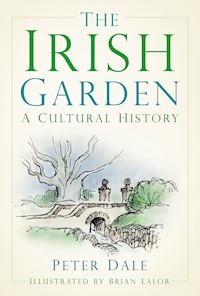
Don't leave yet. Let there be one more piece of magic to remember the place by. Is there something especially Irish about Irish gardens? The climate, soils, availability of plants and skills of green-fingered people generate an unusually benign environment, it's true, but not one that is unique to Ireland. Irish gardens tend to avoid magnificence in favour of a quiet and domesticated beauty, but that is not peculiar to Ireland either. Strains of Irishness run through these gardens like seams of ore. Seen not just as zones of horticultural bravura, but also as reflections of historical, cultural, political and religious events and values, the gardens accrue an unusual richness of surface and depth of meaning. Atmospherically illustrated by Brian Lalor, The Irish Garden wanders into individual gardens, rather than presenting a sweeping chronology. This book is a rhapsody on themes of Irishness, as if the spirit and soul of Ireland itself were sometimes more visible in these places than in the more conventionally visited locations of battlefields, breweries and bars.
Sie lesen das E-Book in den Legimi-Apps auf:
Seitenzahl: 640
Veröffentlichungsjahr: 2018
Das E-Book (TTS) können Sie hören im Abo „Legimi Premium” in Legimi-Apps auf:
Ähnliche



















TheIrishGarden
In memory of my gardening parents
Brian Lalor’s illustrations do not represent particular gardens, but rather the spirit of all Irish gardens. They are generic, not specific.
First published 2018
This paperback edition published 2022
The History Press
No. 97 St George’s Place,
Cheltenham,
Gloucestershire,
GL50 3QB
thehistorypress.co.uk
© Peter Dale, Brian Lalor, 2018, 2022
The right of Peter Dale to be identified as the Author of this work has been asserted in accordance with the Copyright, Designs and Patents Act 1988.
All rights reserved. No part of this book may be reprinted or reproduced or utilised in any form or by any electronic, mechanical or other means, now known or hereafter invented, including photocopying and recording, or in any information storage or retrieval system, without the permission in writing from the Publishers.
British Library Cataloguing in Publication Data.
A catalogue record for this book is available from the British Library.
ISBN 978 0 7509 8959 6
eBook converted by Geethik Technologies
Typesetting and origination by The History Press
Printed and bound in Great Britain by TJ International Ltd
The sunlight on the garden
Hardens and grows cold,
We cannot cage the minute
Within its nets of gold,
When all is told
We cannot beg for pardon …
The earth compels,
We are dying, Egypt, dying
And not expecting pardon,
Hardened in heart anew,
But glad to have sat under
Thunder and rain with you,
And grateful too
For sunlight on the garden.
Louis MacNeice
Tá súil le Dia agam go bhfaighidh sí fhéin agus m’athair a luach insa Ríocht Bheannaithe agus go mbuailfeadsa agus gach n-aon do léifidh an leabhar so im dhiaidh leo ann in Oileán Parthais.
Tomás Ó Criomhthain, An tOileánach
My mother was carrying the turf so that she could send me to school when I was eight years old. I hope in God that herself and my father will inherit the Blessed Kingdom; and that I and every reader of this book after me will meet them in the Island of Paradise.
Tomás Ó Crohan, The Islandman
The gardens of Buckingham Palace
Were strewn once with Irish loam
So those English moles that knew their place
Would have no sense of home.
Paul Muldoon
Contents
Acknowledgements
Introduction
Annes Grove, County Cork
Birr Castle, County Offaly
Carraig Abhainn, County Cork
Mount Usher, County Wicklow
Wren’s Wood, County Wicklow
Ilnacullin, County Cork
Derreen, County Kerry
Mount Congreve, County Waterford
Altamont, County Carlow
Kilmokea, County Wexford
Mount Stewart, County Down
The Dillon Garden, Dublin
Four More Dublin Gardens
Butterstream, County Meath
Rowallane, County Down
The Gardens of June and Jimi Blake, County Wicklow
Envoi: Ireland as a Place in the Mind
Bibliography
Acknowledgements
This book has benefitted incalculably from being read, in part or in whole, by Peter Chadwick, Brian Lalor, Brandon Yen, Martin Ventris-Field, Jonathan Blaney and Alexander Mattei. Similarly, conversations with Nigel Everett and Seamus O’Driscoll have, in equal measure, refined often and corrected occasionally what I have written. David Wheeler, in whose journal Hortus many of these chapters were first published, had the idea of collecting them into a book – something I’d never have dared to think. Again and again, he has encouraged the long gestation.
Pat Hennessy – always the best touchstone of Irishness, for me – is laid in Milltown Cemetery now, in Dingle, but he’s here quite often in these pages, his quizzical eye, his Irish eye.
To Hal Robinson, a man who thinks and does, I owe a lot of the physical fact of this book.
Ruth brooded over the years of this book’s writing, carefully, caringly.
To my father – whose gentle ghost haunts all of this book – I owe the simple but central idea that gardens matter.
Every effort has been made to identify, and obtain permissions from, the holders of all the copyright material reproduced in this book, including quotations from:
Heinrich Böll’s Irish Journal, translated by Leila Vennewitz (Abacus, 1984)
Austin Clarke’s Collected Poems (Carcanet, 2008)
Pádraig J. Daly’s poem ‘Walls: John’s Lane 1978’ (by kind permission of the Dedalus Press)
Helen Dillon’s On Gardening (Town House, 2005)
John O’Donohue’s Benedictus: A Book of Blessings (Transworld, 2007)
Damien Enright’s A Place Near Heaven: A Year in West Cork (Gill & Macmillan, 2004)
J. G. Farrell’s Troubles (Jonathan Cape, 1970)
Lavinia Greacen’s J. G. Farrell: The Making of a Writer (Bloomsbury, 1999)
Seamus Heaney’s Wintering Out (Faber & Faber, 2002), North (Faber & Faber, 2001), and Preoccupations (Faber & Faber, 1984)
Edward Hyams and William MacQuitty’s Irish Gardens (MacDonald, 1967)
Louis MacNeice’s Collected Poems (Faber & Faber, 2007)
Bernard McCabe and Alain Le Garsmeur’s James Joyce: Reflections of Ireland (Little, Brown, 1993)
Eugene McCabe’s Death and Nightingales (Vintage, 1998)
Edward Malins and the Knight of Glin’s Lost Demesnes: Irish Landscape Gardening, 1660-1845 (Barrie & Jenkins, 1976)
The Element of Lavishness: The Letters of William Maxwell & Sylvia Townsend Warner, edited by Michael Steinman (Counterpoint, 2001)
Arthur Miller’s Plays: One (Methuen, 1988)
Paul Muldoon’s Why Brownlee Left (Faber & Faber, 1980)
David Thomson’s Woodbrook (Barrie & Jenkins, 1974)
William Trevor’s Fools of Fortune (Bodley Head, 1983).
Any omission will be acknowledged and made good in any future editions of this book in the event of the copyright holders pointing it out.
Introduction
And Grateful Too For Sunlight
What – if anything – makes a garden Irish? On the face of it, there isn’t a lot in the reckoning. A west-facing Scottish garden will likely be, at least superficially, quite similar to an Irish garden twenty, forty, one hundred miles away. Likewise many a Cornish or Devonian or Welsh garden. Mount Congreve in County Waterford, at least in some respects, is manifestly a scion of Exbury in England’s Hampshire. But if the question were slightly shifted, slightly refocused – What goes into the making of an Irish garden? – it becomes both more answerable and, perhaps, more interesting.
In the first place, gardens, in Ireland or anywhere else, though not entirely determined by climate and geology, are certainly conditional upon them. A garden in Ireland is different from a garden in Iraklion or Islamabad in the first place because of climate. In one rough and ready sense, Ireland itself is popularly defined by precisely that. Because it is damp, because sun or wind rarely scorch, because there is so little frost generally, Ireland is green – the Emerald Isle. Geology too is a shaping factor. Ireland has perhaps the most famous limestone landscape, and then limestone flora and fauna, in the world – the Burren in north County Clare – but liberally spread all over Ireland are also miles and miles of poorly drained bogland, intensely acidic. At a stroke, Ireland can provide places for both acid-loving and lime-loving plants to thrive. It is no accident that probably more primulas and gentians – acid soil-lovers, all of them – have been bred in Ireland than anywhere else in the world; nor that harebells or toadflax (‘Killarney Ivy’ indeed) or maidenhair spleenworts – lime-lovers – are almost as emblematic of Ireland as maples are of Canada or pæonies of China.
But soil, and soil conditions, can be figurative as well as literal, just as cultural conditions can embrace not only climate and soil but also the culture of human intercourse, the arts, politics, even religion. And such is certainly the case in Ireland, not uniquely to be sure, but with a defining bite. If the rose is emblematic of England and English gardens, that is certainly not the case for Irish gardens. There is, not uncommonly, clay heavy enough for roses to thrive if people wish to grow them, and indeed some are grown, but not really all that many. Two of the world’s great rose breeders did their work in Ireland, the McGredys and the Dicksons. But that was in Ulster, what is now Northern Ireland, part of Britain’s putatively United Kingdom, where not only the cultural conditions, in the conventional horticultural sense, but also the cultural climate in the broader, figurative sense were propitious. Roses are grown measurably less in the Republic of Ireland. You are considerably more likely to encounter a rose in the lyrics of an Irish song than on the walls or in the beds of a typical Irish garden. Conventional wisdom sometimes has it that the summer rains spoil the blooms, so people don’t try to grow them much, but the soft rain doesn’t prevent the same people growing (say) asters (which are notoriously prone to mildew) or pæonies (whose flowers are also easily ruined by too much rain). Perhaps the challenge to grow them is sometimes a lure as well as a deterrent: twice at Mount Stewart – first in the 1920s, in response to a fiat from Edith, Lady Londonderry, and then again in the 1970s. On this latter occasion it was on the instructions of Graham Stuart Thomas (but, though he was hugely respected as garden advisor to the National Trust in Great Britain, was he really the person best placed to be alert to the nuances of nationalist iconography in Ulster?). The roses failed there in the Italian Garden in the 1920s (wrong soil, they said then, but there are some roses there now), and they failed again in the Mairi Garden in the 1970s despite, I’m sure, their having changed the soil and made it bespoke before planting even a single bush. The really interesting question is why they should have been so persistent in trying to settle a lot of (essentially English) roses into an Irish garden in the first place. The defining factor here is culture in the figurative sense – a deep brew of history and loyalties and affections and disaffections. Indeed, the very frequency of roses in those ballads and songs from the sixteenth to the nineteenth centuries reflects not just a love of a singularly beautiful flower, nor are they working simply as symbol and shorthand for pretty girls. Those songs are also a covert process – no doubt sometimes unconscious, but frequent enough to constitute a national habit – by which the flower is repossessed for Ireland, by which it is detached from its adhesively sticky English cultural soils.
Beyond climate and soil, what goes into the making of a garden becomes progressively less visible and incrementally more interesting. Money – such a very visible component in the making of so many English and American gardens – is only occasionally important in the Irish context. In the Republic, Powerscourt, in County Wicklow, is the only example of such a place that springs obviously to mind, though there are several in Ulster (which is perhaps what you would expect). On the other hand, the absence of money – on a moving scale from genteel poverty to breadline subsistence – is a major contributing factor, as it is, not entirely coincidentally, in the English cottage garden style, the other side of the moneyed coin of the grand manner of a Chatsworth or a Blenheim Palace, or indeed of a Powerscourt.
At the furthest extremes of money, or its absence – I mean the poverty and privation and punishment of famine – the Irish landscape and the Irish garden have both been shaped, subtly but indelibly, either by wealth, or by its lack. And the way poverty carves a national consciousness as surely as a glacier carves a landscape is not to be overlooked, even when, centuries later, that landscape appears to be different, seems to have been recovered, because now it is tree-bearing or pastured, ploughed or built on. History, Irish history, the nebulous but shaping paradox of a very old, mature culture in a very young, sometimes volatile nationhood, is a part of the Irish Mind, passed on and reflected in the Irish garden – physically, sometimes, as in the remarkable number of follies (and lovely walls, and excavated lakes – in other words, the products of charitable Famine Works from the 1840s), and psychologically in the deep craving in the Irish psyche for a place of its own, somewhere safe, in the face of a centuries-old history of deracination, depopulation, dispossession, eviction and emigration. It is no accident that the boom years of the Celtic Tiger were driven frequently by property lust, speculative and foolish though so much of it was. The frenzy was at least partly fuelled by an ancient, chthonic yearning for security. Irish gardens – their walls and sense of enclosure and safety, keeping some things (people) in, and others out – quietly but powerfully reflect an Irish history. Trollope, in 1848, has his Widow Kelly (in The Kellys and the O’Kellys) consider herself not ‘at all fit company for people who lived in grand houses, and had their own demesnes, and gardens, and the rest’. She is voicing a kind of inverted snobbery: ‘she had always lived where money was to be made’ (she runs an inn and sells pennyworths of tobacco over the counter of a small shop) rather than in ‘a place where the only work would be how to spend it’. She thinks she is claiming a species of moral and fiscal superiority. But she is also self-parodying; there is a comic irony within her words deprecating gardens and their like, because subconsciously she would love to have access to what a garden means even if she would happily jettison all the social and political entailments of the same. A comic irony indeed. But there is, perhaps, a tragic irony too, if and when essentially that same attitude can be worked into the weft of national consciousness.
The first-time visitor to Ireland – the person who, because their eyes are fresh, sees both more and less than the rest of us – quickly spots, of course, what they think they have come to see (what Bord Fáilte, the Tourist Board, has led them to expect): the sober dignity of Dublin’s eighteenth-century streets and the liveliness of some of the others – Temple Bar, Grafton Street, Henry Street, and so on; the undemonstrative softness of the countryside, the laziness of rivers, of the weeds along the roadside, of the drinkers in country bars who seem immune to the tiresomeness of time. And these visitors love it. All being well, they’re even inducted into that most Irish of mysteries: how it is that rain – steady, almost daily rain – can sometimes invest a landscape not with less but with more charm and character, can supply more, not less, of a moodily atmospheric beauty. But they also notice things the Irish themselves are apt to overlook, things Bord Fáilte doesn’t mention, things that are significantly less likely to attract visitors in the first place. In the countryside they spot the ruins of farmhouses and sometimes these ruins are really rather pretty, but very close by there will be characterless new buildings, and these have been erected in preference to restoring the old. Then they notice the frequency of cemeteries, those proprietorial, eye-claiming, space-colonising forests of Celtic crosses, and they notice the respect afforded them. They’re not marginalised as they so often are in other countries, with the telling Irish exception to this of Famine Graveyards or of those out-of-the-way places – in Irish, cillín (the ‘church beyond the pale’) where unbaptised children, suicides, mothers who died in childbirth, vagrants – outcasts all – are laid to rest, out of mind and out of sight. The regular cemeteries you cannot miss, and – as if just to make sure of this – there are commonly road signs telling you that one is nearby. And the third thing visitors notice? It’s the hideous new bungalows – ranch-style, Mexican casita-style, American West-Wing style – the unmissable concrete, brick and glass litter on hillsides that were previously unspoilt and beautiful. The contention that these three things – picturesque but spurned ruins; the cities of the dead (the ubiquitous cemetery, the necropolis); and the unregulated new housing that effectively destroys a place – amount to a defining characteristic of modern Ireland is one of the quiet theses of this book: the places themselves – so often versions, or paraphrases or parodies of gardens actually – and then the reasons for their presence, for why they have happened or have been tolerated, the way they reflect a nation historically habituated to dispossession, people whose claim to a place of their own could never have extended – for hundreds of years – beyond a grave plot, people to whom the conventional idea (in other cultures) that a beautiful landscape is an unpopulated one seems to aggravate an invisible sore in the collective memory which not even sensible planning laws are allowed to modify; people for whom the picturesqueness of ruins could never compensate for the shame and pitifulness they had once entailed … and perhaps still do.
Strangely, though, that very same craving – for home, for a home and a garden, for a safe place of your own, for a glimpse of a Paradise Recovered – leads to a paradox in the Irish Mind, and then in the Irish landscape: gardens and gardening in Ireland are indeed (almost) always associated with the Big House – the residence and lifestyle of the colonial overlord – and therefore something to be eschewed by a nationalist, as if there were something fundamentally un-Irish about having a garden … unless, of course, it were prefaced by another word, one singularly resonant in an Irish context – potato garden. Put crudely, viscerally, in an Irish context gardens are Protestant, and Protestantism is alien. Austin Clarke, the poet, has it succinctly: ‘the house of the planter [the usurper, in other words] is known by the trees’. To grow rhododendrons or Sweet Williams (say) is as un-Irish as spelling whiskey, ‘whisky’. But, crude or not, it is essentially true. Not just true in the ghetto of some pinched, tribal, Paisleyite mentality, but true to historical experience: to grow rhododendrons or Sweet Williams requires at least a little bit of both money and leisure, and at least a little of the luxuries of space and time and superfluous energies denied to the poor, the rent-squeezed, the landless. Irish cabins, the stone and thatched cottages of the peasantry, had potato gardens; Irish demesnes had pleasure gardens. Even the name of a plant could fall foul of history. Sweet William – Dianthus barbatus – sounds innocent enough, but word-hygienists in nationalist Ireland would look askance once they had spotted a certain English flavour to the name, and nationalists in the Six Counties of that province of Ulster would home in on the covert resonances entailed in the name Billy, itself encoded in the innocent-seeming William: King Billy, William III of England, the Battle of the Boyne, the Relief of Derry, the Orange Order, and so on.
Perhaps even as fundamental and simple a word as plant carries with it the germ of language distressed. It would be hard to talk or think about gardens and gardening without using the word – like writing a travel book without ever using the word journey – and, on the surface, it seems neutral, value-free. But in an Irish context it isn’t necessarily so – far from it. To plant is to sup-plant, to evict, and then to impose alien settlers upon lands ancestrally Irish. Plant and plantation are words, in an Irish context, that are actually deeply infected. They are the euphemisms, the corruptions of language, used by the colonist and conqueror to mask theft, dispossession, deracination … and they worked. They achieved those goals both in the mind and on the ground: by the end of the seventeenth century only fifteen per cent of Irish land remained in Irish hands, a larceny whose scale had no equal anywhere else in early modern Europe. I know of no explicit occasion in Irish discourse when the word plant is treated – in an agricultural or horticultural context – with caution (or worse), but equally it seems extremely unlikely that the word did not – does not – carry a subliminal freight of contaminated meaning even now.
The sum of all this is as if there has been an Irish abstinence – Catholic, nationalist Ireland, that is – from garden-making, as if what we encounter there (sometimes? often? almost always?) is a kind of conscientious objection, as if gardens and garden-making were a forbidden zone, even now, nearly a hundred years on from Ireland’s independence. The word boycott springs to mind (as well it might: Captain Charles Cunningham Boycott was a Mayo landlord’s agent, from whom cooperation was withdrawn early in the Land War, which began in 1879). It is as if there were a taboo – unspoken, unwritten often, though not always unconscious – yet powerful enough to compel observance, as if it were written into the collective Irish Mind. Damien Enright, for example, author of two marvellous books about living for twenty years in West Cork, notices everything – flora, fauna, weather, birds, fish, rockpools, rabbits that go on eating the grass though the rain is pouring down. He notices everything about the natural world and the way humans interact with it. And not often does he mention a garden, but he does remember what Austin Clarke says about the ‘poshness’ of growing trees and then remembers to distance himself with a terse ‘I am not a planter’. Of course, there have been, and are, exceptions: Catholic gardens and Catholic gardeners. Even in the 1840s, the years of the famine at its worst, there was a Catholic middle class. It was small but growing, and some of these people had gardens, even pleasure gardens. But they were exceptions then, and even now such gardens are not all that common. In his book Irish Gardens (1967), Edward Hyams was of the opinion that: ‘The Irish householder is not by any means such an enthusiastic gardener as his English opposite number’. Irish readers might bridle at that. For their part, English readers – the natural citizens of what is not uncommonly dubbed ‘a nation of gardeners’ – might bridle at an Italian author observing that his countrymen garden more and better than the English. Both comparisons are more or less true, for all that local pride may have been offended. What Hyams saw in Ireland fifty years ago is only marginally less the case now: on the whole, the Irish do not garden all that much. To the innocent eye of the visitor (English? Italian? Japanese?) this is so conspicuous that he or she might be forgiven for wondering if there were some cultural disincentive, some invisible, unspoken, even unrecognised embargo at work. The absence of gardening in Ireland – relative though that is – is indeed quite striking. And yet, the Irish mind, eye, ear and soul seek satisfaction in beauty as much as do those of any other ethnic collective – indeed, more so, you could soberly argue. On the one hand, Irish music is probably unrivalled for a certain beautiful melancholy in its slow airs and, on the other, an irresistibly contagious liveliness in its jigs and reels; Irish literature – and poetry in particular – is a world-beater. The Irish aren’t insensitive either to beautiful flowers or to beautiful landscapes, to wit – if we confine ourselves in the first case to just one flower (indeed, why not to that rose again!) – The Last Rose of Summer, the Dark Rosaleen, the Roisin Dubh, the Rose of Tralee (Irish all of them), and in the second case all those ballads lamenting the loss of those lovely places that the emigrant must leave. The rosary is the Irish devotion of choice, of course it is. There have been quite a few Mollys in Irish literature, history and folklore, and it is not surprising that they’re quite often Dubliners. Molly Malone belongs to Dublin’s ‘streets broad and narrow’, and she it is who catches the popular imagination. But it is surely no accident – and unusually for her maker, a certain Mr Joyce, not entirely ironic either – that the most imagined of them, the most celebrated (notorious, PhD-discussed, parodied, blushed over) Molly of them all Blooms. Jack Yeats is surely the greatest of Irish painters – another world-beater, in fact – but it is Paul Henry’s Connemara landscapes which epitomise Ireland both to the Irish and to the rest of the world – achingly beautiful, melancholy, wistful. In the case of the rose – both flower and symbol – historians have sometimes noted the irony implicit in the Irish making so much in their songs of what is quintessentially an English icon, but, as we remarked earlier, that is really to miss the point: it is as if a willed repatriation of the rose were being enacted, and – given that the context of this plant is normally a garden – it is a repatriation into what is perhaps the most sensitive arena (sensitive culturally, politically) it is possible to imagine. The citizen of the world might smile at this point, might recall other roses from Iraklion or Islamabad, might think some special, selective pleading is being invoked. I almost wish it were so, but I have to doubt it. Here is a verse from a northern Irish song popular in the 1860s and for years after:
Rule Romania, Romania rules the taigs;
Poor Rosie’s childer ever, ever, shall be slaves.
If these are the words, you have no difficulty in guessing the melody. Taig (Teague, Teigue) is an anglicised form of the Irish Tadhg – Timothy – but it also became the stock name of the stage Oirishman in Victorian popular dramas. From that it became shorthand for ‘Catholic Oirishman’, that is to say, ‘nationalist bog-trotter’. This song was coined almost certainly in the 1860s or, just possibly, a little earlier. There’s no doubt, however, about the period of its great vogue: those same 1860s. In 1886, Gladstone introduced his first Home Rule Bill. Songs like this helped to defeat it. The slogan ‘Taigs Out!’ (out of Ulster in particular, but out of Ireland in general too) was first slung then. Since then it has become a stock-in-trade of Unionist invective. And if Taig is the Irish Man, Rosie is the Irish Woman.
One argument periodically dusted off to address this strange paradox – this seeming reluctance to garden – is that Ireland is naturally a garden anyway. And so it is (though there are dreary, featureless rural parts to be sure, and there are mean, ugly towns too). The further west you go, the stone walls – or ditches, the Irish call them, the earth-walls and hedges – are replaced or just overgrown by hedges of massed fuchsia (F. magellanica, which looks as if it has been there forever but was actually introduced in the late eighteenth century). The roadsides become ribbons of montbretia (Crocosmia x crocosmiiflora, a hybrid in fact, and raised in France in the 1870s). The telegraph poles become so smothered in swags of ivy that they look like clubbable yetis. Fields – particularly damp ones – have margins marked out by the yellow flags of iris (I. pseudacorus). Others are carpets – huge ones, sometimes – of purple loosestrife blended into meadowsweet with its cream-coloured breaths of those lovely vanilla-scented flowers in July and August. All the year round, hillsides are golden with the blossom of the furze, gorse, a weed in England, but almost actively cultivated once-upon-a-time in Ireland because its new growth, cut with leather-gloved hands and crushed in a mill, was fed to horses who enjoyed it and found it highly nutritious. Ireland is a garden indeed, and, the further west you go, the more that is the rule rather than the exception. After a day or two in West Cork, Kerry, Clare or maritime Galway, the visitor almost ceases to notice it, this gratuitous flowering everywhere. But it must never be forgotten that these are the very same districts where people were gnawing grass in the late 1840s to stay alive if they could. As Yeats put it, beauty can be terrible, terrifying in its implacable hardness.
Gardens reflect climate and geology. They reflect history and, if there is such a thing, they reflect national temperament. But garden-making is always, in some measure, autobiography – singly and individually, or collectively perhaps, or even the aggregate of an entire people. Gardens reflect the minds of the people who set aside time, space, money perhaps, to embark on the more or less gratuitous act of making them – almost certainly not a lucrative venture (though a bit of pomp and circumstance might impress the neighbours and prospective clients if you were in business or politics as, for example, were the Wingfields – viscounts in due course – who made Ireland’s most exclamatory, least private, garden at Powerscourt. The matter begs the fundamental question: if gardens are not to make money, what are they for? Worldwide, a certain consistency of answers emerges, but not necessarily comprehensively. Gardens are often meant to show off wealth, power, chic. Some gardens – and they tend to be the big, famous ones – are simply fantasies, ideal worlds peopled by ideal characters: worlds fit for the gods (albeit stone ones) if you are wealthy and classically educated and incline towards nudes (and you are not exercised by the absurdity of even the gods wearing nothing in a northern winter), or nymphs and shepherds (if you are pastorally inclined and bashful about all that flesh). They are tableaux really, and then tableaux vivants – bits of theatre – once you yourself come out of the house, step into the garden and walk among the gods too. Better still if you are accompanied by your admiring guests. And then there’s the working-class version of this tendency to fantasising in gardens: here it is a case of little chaps with shovels over their shoulders and peaky hats. Gnomes began as the fantasy of certain spiritualists in mid-Victorian Germany and Britain, but pretty rapidly became a craze among either the potty or the urban artisan class – a bizarrely prescient anticipation of twentieth-century Disneyfication really, and one that never caught on in Ireland, presumably because it would have seemed recklessly self-mocking in its blatant reification of the fabled Irish Little People, the Sidhe. Once again, in an Irish context it is an absence rather than a presence that has a tale to tell.
Sometimes (and much more interesting than the foregoing), gardens are ways of recovering lost Edens – another kind of fantasy perhaps, but much more adult, much closer to real ghosts. Fantasies possibly, metaphors certainly. Individually, that usually means a real or an imagined idyll of childhood, but some gardens are modelled on (say) memories of a holiday in Spain, or of a private myth of goals achieved (Dunroamin, Thistledoe, and so on). Collectively, it means something very deep indeed, something groping towards mythic, or even religious, meaning, some barely glimpsed and even less understood platonic recoveries – the sort of thing evinced (crudely, I know, but none the less really) in barbecues (atavistic memories of life on the savannah?), or (strangely, if not crudely) in that weird tendency we have, on the one hand, to try to make our gardens into outside rooms, as if they were (seasonal) extensions of the inside of our houses and, on the other, to make the rooms inside our houses into simulacra of the gardens outside, by covering the walls with flowery, leafy wallpaper, laying flower-patterned carpets under our feet, putting petal-shaped lampshades over electric light bulbs, covering sofas in flowery chintzes and – most strangely of all – displaying framed landscapes on the walls as if they were trompe l’œil windows onto the world outside. Whatever it is that is going on here in the way of striving to recover something – however crudely, strangely – it is evidently a kind of compulsive, primal nostalgia and it can assume quite a lot of different forms, but it is most acutely evident (and interesting) in the act of garden-making … which perhaps should be the subject of another book entirely, but it is certainly not out of place to mention it here either, and we shall indeed return to it.
Gardens are hobbies. Hobbies provide occasions for recreations and for stress relief, for asylum from all-too-busy, or boring, or intractably bootless lives. In Shakespeare, gardens are always places for amorous assignations – wooing, canoodling, cavorting. But cuddling in February would have to be driven more by the imperative to keep warm than by strategies of the heart, so it tends to be a rather seasonal occupation. Nevertheless, the proposition broadly invites our consent. Gardens are sometimes places where people set up their own inviolable little kingdoms – unilateral declarations of independence from an otherwise unsatisfactory world – places where the gardeners/owners are in control and no one may gainsay them. As a matter of fact, there must be an element of that in all gardens really: it goes with the territory, both on the ground and in the mind. Sometimes gardens serve as places to exercise and express one’s constructive – perhaps even creative – impulses. Or they can be the places where control freaks can manage, manipulate, manacle every blade of grass, every twig on wretchedly trussed bushes. They may serve as a last bastion for beleaguered blokiness to make a lot of noise and fumes with ‘manly’ machines such as chainsaws, power-washers and strimmers. More likeably, gardens – especially town gardens – are oases of peace and quiet. That can be as true of a shared, communal garden in a London square as of a private garden behind a private house. Some gardens are playgrounds for children. Some are places where collectors compile botanical showcases – zoos really, but for plant materials, not animals. These are intense versions of the garden-as-hobby.
There is a paradox here. The very best gardens – the ones that affect you most, then and there, and later in the recollected memory – achieve that impression because they appear to be gratuitous, they appear to be above and beyond the exigencies of something as mechanical as purpose. They rank up there with playing football or chess, with listening to or performing Beethoven, with Hamlet. If these things were not to happen, life would go on without them, not much would change, but we would be demonstrably lesser human beings. In their gratuitousness, their economic pointlessness, lies their power, because we are never more human than when we are doing profoundly useless things, useless but not necessarily pointless: acts of kindness, altruism, acts of love, stopping to stare at a moment of fleetingly beautiful landscape, tottering through a Chopin nocturne, wrong notes and all, playing a game with your feet when it would have been so much easier to pick up the ball with your hands, running a race only to come back to where you began. Gardens – especially back gardens, and certainly not just big gardens – are all of a piece with that: very profoundly human events, because they are essentially useless, because they float free of function and purpose. In fact, of course, they probably don’t. Or not entirely. But nevertheless, an impression of gratuitousness is achieved, and that’s what matters. And that is actually what marks out a great garden: it is the impression made that is great, rather than the dimensions or even the contents. What it means is greater by far than what it is.
The foregoing fundamentally destabilises the question What are gardens for? in the first place. But – placing one’s feet back upon the ground, and going along with the conditional proposition that, despite all this, they can and do serve at least some purposes, some functions – we must address the last, but not least, of the answers to that conditional question. It is the one most difficult to pin down at the same time as it is the most contemporarily relevant, indeed urgently pressing – in the sense some of us (a lot of us? but inarticulately? mistily?) have that gardens are, definitively, the liminal, transitional zones between Nature and Human Nature. But then that sense is coupled, first, with the growing apprehension that Nature is not necessarily on our side any more (if it ever was), and then that Human Nature, homo sapiens indeed – uniquely among animals, and actually anything but sapient – is essentially self-destructing because we are already pretty far down the critical road towards the fouling of our own nest. Gardens – we begin dimly to perceive – mediate between the urge to control (that is to say, usually, to destroy) and the willingness to go with the flow, to learn from, to cooperate with, to accept a revision of received hierarchies vis à vis who is in control, a revision of the mandate we have traditionally believed ourselves to hold, to ‘have dominion over the fish of the sea, and over the fowl of the air, and over every living thing that moveth upon the earth’. Never mind that that is a commission we exercise no less vigorously for probably not much heeding these days its source – the God in the Bible, in the Koran. I take it as axiomatic that the situation is serious, and also that not much is being done about it. Controversies about peat-based composts and chemical insecticides apart, gardeners are probably among those who are most particularly sensitive to this. At the very same confluence of Nature and Human Nature, Wordsworth could have been found two hundred years ago, and the profundity of his careful observations and psychologically acute, philosophically searching ruminations, is one of the great intellectual and emotionally compelling achievements of our forebears, but – by and large – we haven’t seen fit to learn from his (and anyone else’s) insights any more than we do from the incrementally obvious evidence of global environmental degradation. We gloss breakdown as change, we mock anxiety about change as feeble-mindedness, and we carry on with business as usual. Nevertheless, it would seem that a not inconsequential number of people now mistily perceive of gardens – theirs and the sum of gardens as a whole, and then co-opting the meta-gardens of allotments and wildlife reserves and municipal parks – as places where rapprochements can be made, wounds dressed, new treaties tentatively negotiated. Gardens are radically at odds with the zeitgeist: they reward husbandry but they – most of the good ones – more or less reprove management, and management is one of our contemporary gods. Gardens intimate – they always have done – who we are and where we stand in terms of the several time-schemes at work in a garden: the annual, the seasonal – the great life of a tree, the small life of an ephemeral blossom. They afford places where real repairs to the consequences of concrete, fumes, waste, over-population, under-education, can be embarked upon: a bird-feeder here, a CO2-scrubbing tree there, water for frogs, shelter for beetles and hedgehogs, a plot for children to grow their own carrots and marigolds. Gardens are places of refuge for endangered plants. They are laboratories for wiser ways of living, penitentiaries for lapsed egos, for reformed control freaks. In short, though gardens may not make any money, though they don’t generally make waves or friends for us, they do make sense, and therein lies possibly their most profound raison d’être. The pressure – global anxiety about the condition of the Earth – is at last gathering pace (I hope), but Ireland has space, a generous ratio of population to space that gives the country a rather special advantage. There is also a sense that there, gardening is something new – an adventure, for most people.
You learn quite a lot about a person from the books on their shelves (or even from whether they have books and shelves in the first place). You learn to read parts of people’s characters from their gardens. The impersonality – the absence of a single originating mind – in a public garden is instantly recognisable; the presence of the same in a private garden is correspondingly revealing. Sometimes a garden – however horticulturally complex – is emotionally, psychologically simple. Stourhead, for example, is self-evidently someone’s reconstruction of an Arcadia, but it also has the air of an Eden just out of reach, a paradise not exactly lost, but unachieved, an Arcadia reconstructed but not quite recovered. Henry Hoare, its maker, was driven to create it having gained the whole world (or at least the ownership of a very remunerative bank and the possession of vast sugar estates supplying sweet-toothed Georgian England), only to lose, one by one, those whom he loved. This garden is essentially about grief. Versailles is about a king’s bloated ego, it’s about hubris. Little Sparta, Ian Hamilton Finlay’s garden in the Pentlands of Strathclyde, is not really horticultural at all. It is a place designed to frame a poet, and it’s about poetry frustrated and refracted into a kind of barely sublimated embitterment: violence and the unleashing of violence are only just held in an uneasy abeyance by the artifice of the inscriptions you find there at almost every turn.
In the case of Ireland, Mount Stewart has a similarly simple (fairly simple) raison d’être, it seems to me. Originally conceived as a hobby for a very rich woman married to a philanderer, it became in the end an act of contrition, a gesture, a token of wished-for expiation, almost literally a deed of repatriation. But answers to the question What is a garden for? are generally muddier, more tentative – they are compounds rather than purities.
Just as there is occasionally an Irish garden which is simple and more or less singular in its sense, in the answer it offers to the question What am I for?, so there is at least one individual who rises out of and beyond the otherwise all-embracing and collective scope of national temperament in the way that he has influenced the character of Irish gardens. That person is William Robinson, and his ideas about wild gardening – transmitted in the first place through his own garden at Gravetye Manor (albeit in Sussex, where he latterly settled, rather than in Ireland, where he was born and learned his craft), then through his book, the gardening classic The Wild Garden (1870), and finally through the discipleship of Gertrude Jekyll (and of many other people since) – have had an enormous influence upon gardens worldwide but especially in Ireland and Britain. Robinson represented – he still does – the opposite pole to everything exemplified by Chelsea, by the whole business of garden design, by the notion of style and styles, by the modern mantra of self-expression, and so on. A Robinsonian garden is kind to the earth but a bit harder to live with than many people’s idea of what a garden should be, because it is always in process, never a product. Actually, that is true of all gardens, but frequently neither acknowledged nor respected. A Robinsonian garden tends towards deregulation (or some might call it, untidiness), so it may be harder to live with for people to whom order, regime, control is important. It is harder too in the sense that to husband it well is quite time-consuming, not least because the work must be relatively invisible. If you have a gardener, he or she must really know what they are doing, because the division between weed and plant is as fluid and contextual in a Robinsonian garden as the shoreline in a tidal estuary. Being time-consuming, it would also be expensive (if it were done well), and therefore it pays to do it yourself. It follows that in many an Irish garden – large as well as small – the work is often done by the owner. Elsewhere, however, owners – rich ones particularly – tend not to work but only to dabble, often to the irritation of the real gardener. But that is markedly less the case in Ireland than elsewhere. That might simply reflect a certain contraction of cash among the once affluent. I think that’s quite likely, but it also reflects the type of a conscientious gardener, sensitive to the sort of care that a Robinsonian garden requires; and Robinson himself, quietly but significantly, reflects the national temperament anyway.
The alert reader will have noticed in all this a similarity between the English cottage garden on the one hand and, on the other, the received idea of the Irish national character – easy-going, un-ostentatious, convivial – and those two things coinciding, or overlapping, we have noticed already elsewhere. Most Irish gardens are more or less Robinsonian, some out of conscience and principle, some out of indigence, all out of consent to the climate and geography. Robinson’s other important, hugely influential book, The English Flower Garden (1883), would seem, by its title, to run counter to the idea of Irish character in a Robinsonian garden; but, title apart, more or less the opposite is really the case because this second book (and its numerous subsequent editions – well over forty at the last count) is the locus classicus of precisely that very (English) thing idiomatically paralleled so closely in the character of so much of Irish gardening: the English cottage garden style. But even here, surfaces and appearances and common forms of words can be deceptive. In England, the term cottage garden denotes (now) a style, in origins humble but evolved into what is seen now as virtually the vernacular of English gardening, however modest – or indeed plutocratic – the premises. It defines the Englishness of a particular manner – informal, artless, abundant, generous and somehow natural. In Ireland, though, the cottage garden was almost never that at all. Even the sense of the words slips away: there is no word in Irish for cottage but only the diminutive of the word for house. All that prettiness and cosiness entailed in the word cottage in England vanishes at a stroke. And the word garden – as we shall see – means something very different from the English usage. In Ireland, a cottage garden was the acre or so growing potatoes, a few oats, a cow and a pig, attached to the cabin where a farm labourer and his family struggled to live and to feed themselves. They lived on the potatoes, and the pig paid the rent if all went well. If there were flowers – woodbine perhaps, bindweed, wild garlic, wild roses, flag iris where it was wet, meadowsweet too – they would not have been actively cultivated. They would have been the pleasant incidents of country life. Accidents, but they must have been at least passively enjoyed.
There is quite an extensive literature pertaining to cottage gardens within the Irish complexion of the term, or simply as gardens as they were more generally spoken and written of there. These writings are to be found in official or private reports of rural poverty, in the pages of philanthropic schemes to make those famous ‘improvements’: the radical cooperative at Ralahine in the early 1830s, for example; the proceedings of bodies such as the Labourer’s Friend Society and of the Cummer Society, the latter set up to improve techniques of husbandry; and then of the Vacant Land Society, established in 1909 to encourage allotments, especially but not exclusively, in Dublin. Occasionally there is a survival of a non-literary kind: the vast Gortahook cabbage, for example, which can reach a metre or more in girth, and then there is the famous Lumper, the potato most widely cultivated in the famine years of the later 1840s. What the written texts describe is probably broadly similar to what would have been found in England through the later eighteenth century and for most of the nineteenth, though minor differences of classification may imply larger differences of social character as, for instance, in the interesting incidence of the names of gentry and even nobility in the membership of Irish Florists’ Societies in precisely this period – clubs that grew and competitively exhibited not so much vegetables (as now) but tulips, auriculas, violas and, as the nineteenth century wore on, dahlias and chrysanthemums. In mainland Britain, Florists’ Societies were definingly a working-class phenomenon. At some point there must have occurred a bifurcation of English and Irish meanings in the term cottage garden. In Ireland, it remained, as it always had been, an expression denoting the vegetable patch (and perhaps a little livestock too) attached to a farm-worker’s dwelling. In England, it became that blend of the edible and the ornamental – something for the eye, something for the pot – that we think of now as one of the two national styles associated with horticulture in England (the other being the English Landscape Garden of the eighteenth century). At what moment the two islands parted company in their understanding of what was meant by a cottage garden we do not precisely know, but I would hazard a guess that William Robinson had something to do with its final (modern) canonical form, even though its origins are probably several decades earlier. In the 1830s, J.C. Loudon rhapsodises (fantasises?) about the (English) rural labourer’s garden and tries to employ it – or what he imagines of it – as a model for the gardens of English suburban villas. Fifty years later, Richard Jefferies – in Hodge and his Masters – is much more realistic, but by the end of the century, in the sentimental paintings of people such as Helen Allingham, it had become a vision of a sort of Merrie England. It must have had some basis in fact – look at Samuel Palmer’s In a Shoreham Garden of 1829 – but in the absence of photographic records there is no certain telling of how much.
In Ireland, the author T.P. Gill, in a manual published in 1911 by the Department of Agriculture and Technical Instruction for Ireland, includes that rare thing, a paragraph about flowers – or, at least, about the possibility of flowers – in ‘narrow borders’ along the edges of your garden. These are neither literally nor metaphorically at the heart of gardening, but at the peripheries. You might have ‘simple and inexpensive’ nasturtiums, roses, sweet peas, lupins, wallflowers, and so on. You could be ‘more adventurous’ and sow candytuft and godetias, staples indeed of the cottage style now. But really this is in the nature of an afterthought, an appendix, a brief indulgent holiday away from the proper industries of cabbage growing and manuring the potato beds. It doesn’t sound very Irish either. This is, I think, someone looking over his shoulder at the contemporary Garden City Movement in England.
In origin, the English cottage garden was a construct of (some) reality, quite a lot of idyllising and idealising, and a very great deal of nostalgia – especially formative, I think, where it is least visible. That – the blending of these three elements – is rare in Ireland. You catch a glimpse of it – but that is all – in the ‘Swiss Cottage’ near Cahir in Co. Tipperary. It’s a cottage orné, a fantasy, a toy … and it was probably designed by the Englishman John Nash for the Anglo-Irish landowner Richard, Lord Caher, the Earl of Glengall. It’s a gingerbread house bred out of memories of an arrested childhood, Alpine holidays and a vision of distilled Englishness. Not Irish at all. But there are/were, in fact, at least two other such ‘Swiss’ cottages in Ireland: Glena Cottage at Muckross, Co. Kerry, and Lord Bantry’s Lodge at Glengarriff in Co. Cork. Exceptions that, more or less, prove a rule.
Gertrude Jekyll was not exactly a romantic escapist, but there is no more favourite word in her writing than ‘old’. If a plant has a pedigree that is old, it is straightaway desirable. And yet … though its origins squelched no end with sentimentality, the cottage garden style did come to have a real identity, a real character. So much so that we need not blush to recognise it as indeed a defining character in English gardening, in some respects the envy of the rest of the world. As so often – in this book, as in life – it is language itself, rather than the material things which language denotes, which is the critical and protean factor. You might take, for example, the cabbage rose. In some respects, it is the epitomous plant of the cottage garden style. Its very name fuses the utilitarian, the workaday and kitchenesque, with the gratuitously beautiful. But which came first, the rose or its name? Botanically it is Rosa centifolia, and it is an ancient plant. But when did it become the cabbage rose? Mawe’s Gardener – a Dublin publication which was in its nineteenth edition by 1808, the edition I am consulting – doesn’t ever use the term. Jekyll, seventy years later, does, and those intervening years are precisely those in which the expression ‘cottage gardening’ shifted its meaning. Is our perception being led by the forms of the words we use, or is it the thing itself that shapes our seeing? Is this, in fact, yet another piece of image-manufacture, usefully representative in this context as a miniature of the whole idea/ideal of the cottage garden? At the risk of courting hilarity and bathos, it is not entirely unrelated either to notice that that is certainly what is going on in that very English habit of making the public lavatory in the park masquerade as a Tudor cottage – the coy style much preferred for these buildings for some of the nineteenth and much of the twentieth centuries: an exemplary piece, if ever there were one, of fantasy and euphemising and play-acting not all that far removed from cottage gardens themselves and, of course, from the cottage orné these places often so much resembled. Indeed, cottage used to be the very name used by people whose breeding prevented them from using the words public lavatory.
In any case – and murky though the whole nomenclature of the cottage garden is – cottage gardening, as the term is now generally understood, is rarely found in Ireland. And perhaps this reflects simply that Irish labourers were poorer than even their English counterparts. But given that, latterly, cottage gardening has been in any case very much less to do with the gardens of the working class (be they Irish or English), and very much more to do with the romantic nostalgia of the middle classes, it may also reflect a frame of mind: to epitomise England or – even more potently – a vision of Englishness, you would plant and grow a cottage garden. To avoid precisely that – to conscientiously depart from a sense of Englishness – you would not. You would strike out for something more Irish – even perhaps if that meant not having a garden at all … which actually is what quite often happens in Ireland.
Go to Glasnevin in Dublin or to Altamont in County Carlow and you encounter another kind of Irish inflection in their respective gardens. There you will find plant labels in three languages, not just the usual unitary, botanical Latin or a grudging binary (Latin, plus English common names). The third language here is that of the Irish local name. Every little bit (of cultural appropriation, I suppose) helps, and I hope the habit becomes widespread. Irish gardens deserve Irish plants, as it were, and there is – as always, wherever you are, whatever the language – a wonderful realm of meaning in local names, local plant lore, and local genealogies in which history begins to fray into just story, and is none the worse at all for it. For example, Hyacinthoides non scripta we familiarly translate as bluebells, but in an Irish garden such as Altamont they are also Coinnle corra … which slips rather nicely off the tongue, as it happens. It means ‘Candle-taper’, and candle-tapers do, indeed, lean a little out of the perpendicular just like the bluebell (the ‘English bluebell’, not the wicked, invading Spaniard which is, of course, bolt upright). Cowslip (Primula veris) is Bainne bó bleachtáin – a lovely lilting alliterative name (and it means ‘Milk of the milch cow’). The maidenhair spleenwort (Asplenium trichomanes) – one of the most beautiful and most common of Irish ferns – comes into Irish as Lus na seilge, a name probably so ancient that its sense is now misty but nevertheless suggestive, ‘Herb of our quest’ or, possibly, ‘Herb of the chase’.
Gardens can – and often should – be enjoyed without reference to any botanical, historical or biographical baggage at all, either one’s own or that of the person who made the place. That’s what children do and – at least before they are of an age to be infected by the obligation to be bored – children are the most infallible of all critics in their responses to and evaluations of gardens, in their capacity to understand a garden by entering into and sharing its spirit. Without the impedimenta of education, you get just the beauty and, if you’re lucky, a bit of magic. In the end, beauty transcends. But indispensable to the serious study of Irish gardens, if you are that way inclined, is E. Charles Nelson’s A Heritage of Beauty: The Garden Plants of Ireland (2000). The first thing that impresses about the book is its sheer size: thousands of ‘plants of Irish origin’ (albeit that that’s an elastic expression covering everything from plants discovered in Ireland, or bred in Ireland, or introduced – from China, or wherever – through Ireland). As with the number of Nobel Prizes Ireland has won (in relation to its small population), or the number of world-class writers it has spawned (in relation, again, to its relatively miniscule population), for a long time Ireland has boxed far, far above its weight in terms of plants. You look up particular genera. You notice particular gardeners’ names cropping up again and again, ditto particular gardens; particular plants – heathers, ferns, ivies – occur frequently as varieties of native Irish plants. And then you get to the Annexes. There are twelve, and they cover Irish historical peculiarities and particularities (the legendary auriculas at Kilruddery; potatoes, of course; daffodils; Irish-bred roses, etc.). Then comes Annexe XII, Augustine Henry’s Plants. It is essentially just a pair of lists, the first descriptive and detailed (Henry’s own plant discoveries in China), and the second, all the plants – some three hundred or so – named after Henry by other botanists. If you didn’t know already about Augustine Henry, you would be astonished by the number of plants he introduced, and then red-faced that while most of them (hundreds and hundreds) are fairly obscure, fairly specialised plants, so many others turn out to be indispensible plants, staples of any self-respecting garden: the handkerchief tree Davidia involucrata, the winter box Sarcococca humilis, the tasselled Itea, his lily Lilium henryi, and so on. Only occasionally do they carry his name; he was an inveterately modest man, and so many of the plants named by others after him have the name differently encrypted – henryii, augustinii, henryana, augustiniana, henrianum, augustinei – that it is quite easy to see why, for all these years and all those hushed references to Reginald Farrer, Frank Kingdon-Ward, Joseph Hooker, Ernest Wilson, etc., Henry has been overlooked. That is not the end of it, though: there is yet another category of his plants, those that are not at all well known but should be, and yet (because of their Irish backwater provenance, is it?) are almost completely overlooked. I mean, for example, Emmenopterys henryi. Ernest Wilson thought it was ‘the most beautiful tree ever to have come out of China’. See for yourself – if you can; it is very rarely planted – and you’ll likely agree, I think. In fact, whether visibly or more or less invisibly, Henry’s contribution to occidental gardens has been colossal, easily the equal of those of the vaunted ‘great plant-hunters’. And he, in the form of his plants, is another factor in what makes a garden Irish.




