


Erhalten Sie Zugang zu diesem und mehr als 300000 Büchern ab EUR 5,99 monatlich.
- Herausgeber: The History Press
- Kategorie: Geisteswissenschaft
- Sprache: Englisch
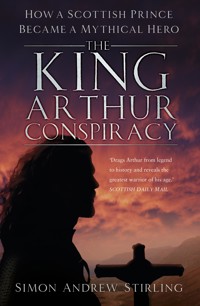
Arthur led the Britons to the brink of victory but was cut down by treachery and betrayal. Arthurian legends have since been corrupted, leading to popular but false assumptions about the king and the belief that his grave could never be found. Drawing on a vast range of sources and new translations of early British and Gaelic poetry, Arthur explodes these myths and exposes the shocking truth. In this, the first full biography of Arthur, Simon Andrew Stirling provides a range of proofs that Artuir mac Aedain was the original King Arthur; he identifies the original Camelot, the site of Arthur's last battle and his precise burial location. For the first time ever, the role played by the early Church in Arthur's downfall and the fall of North Britain is also revealed. This includes the Church's contribution to fabricated Arthurian history, the unusual circumstances of his burial and the extraordinary history of the sacred isle on which he was buried.
Sie lesen das E-Book in den Legimi-Apps auf:
Seitenzahl: 659
Veröffentlichungsjahr: 2012
Das E-Book (TTS) können Sie hören im Abo „Legimi Premium” in Legimi-Apps auf:
Ähnliche


















An ART & WILL Book To William Arthur Stanley – Art & Campbell-Godley, who made me an honorary member of the clan
In Memoriam
CONTENTS
Title Page
Dedication
List of Illustrations
Acknowledgements
Author’s Note
Prologue
One Birth of a Dragon
1 Dragon of the Island
2 The Sea-Kingdom
3 Prince of the Forth
4 The Beltane Fires
5 Bear-Guardian
6 Son of the Mother
7 Dove of the Church
Two Duke of Battles
8 Little-Shout
9 Merlin Went Mad
10 Stone of Destiny
11 Camelot
12 The Round Table
13 Mordred
14 The Last Battle
Three Twilight of the Gods
15 The Maimed King
16 Navel of the Sea
17 Treasures of Britain
18 The Journey of Arthur
19 House of the Spirits
20 The Lights Go Out
21 End of the Road
Appendix – The Grail Today
Selected Bibliography
Copyright
LIST OF ILLUSTRATIONS
Maps
1 Britain, Fourth Century AD
2 Wales, Sixth Century AD
3 Scotland, Mid-Sixth Century AD
4 The Old North, c.AD 560
5 Arthur’s Battles, 573–580 (after Nennius)
6 Arthur’s Last Campaign
7 Arthur’s Final Journey
Figures
1 The Descent of Arthur
2 The Stone of Destiny
3 The Cauldron Ritual
4 Arthur’s Grave
ACKNOWLEDGEMENTS
KEEPING IT brief: thanks, first and most of all, to Kim and Kiri for their unflagging patience and encouragement. Thanks also to my parents, Norman and Brenda, for introducing me to the Arthurian realms, to the inimitable Campbell of Barcaldine Castle – sorely missed – for inspiring me, and to Charbel Mattar for accompanying me on my first proper research trip. Special thanks go to Rev. Richard Armitage, for making the journey to Avalon for a very special ceremony; to Joyce and Lindsay, our guides to the island, and to Bruce Wall for additional information; to Jim Kilcullen and the Charna for the early island-hopping jaunts; and to Phil and Ness for taking me to ancient sites.
Fond thanks to Mike Southworth, history teacher extraordinaire; to Professor Edwin Barrett, for instilling an interest in the Greeks; to my tutors at the University of Glasgow; to An Comunn Gàidhealach and the Birmingham Cymmrydorion (Welsh) Society. A huge thanks also to my friends in the Authonomy community, especially N. Gemini Sasson, Maria Bustillos, Richard Dowling, Shayne Parkinson and Richard Pierce-Sanderson, for all their enthusiasm and advice; to Simon Young for the books; to Andrew Lownie and Ian Drury for helping to shape the project; to Michael Birkett for arguing with me about it; and to John Gist for the kind words. Heartfelt thanks to my editor Lindsey Smith and to all at The History Press for their outstanding help and support. Finally, thanks to Sue and Martin Grantham and Melissa Cother, who did their bit to make sure that I found the road’s end.
AUTHOR’S NOTE
ANY CREATIVE endeavour involves making choices. One choice I have made is not to include footnotes or endnotes. This was a conscious decision. Footnotes clutter up the page and distract the eye of the reader; endnotes would add extra bulk and little else. I suspect that too many numbers intruding on the text can detract from the simple pleasure of reading, and if the information isn’t important enough to be included in the narrative then it arguably has no place in the book – and besides, the bibliography indicates where most of the references came from.
Most readers will, I hope, forgive me for not attempting to write a quasiacademic tome and for concentrating on being a storyteller rather than a scholar. There are hurdles enough as it is in the story of Arthur, two of the main ones being language and nomenclature.
Some of the names and places in this book will be familiar; many will not. To make matters worse, many of the individuals encountered in these pages were known by more than one name. Different regions, speaking different tongues, evolved different names and titles for Arthur and his confederates. The poets of the time specialised in devising descriptive ways of referring to well-known people. At each new stage of life a person could be awarded a new name. Keeping track of all these name changes can be quite a challenge.
The problem is compounded by the fact that place names and personal names could switch from one language to another. For example, what appears to have been a Welsh name, and is generally treated by scholars as such, can in fact make more sense when it is seen as an attempt to replicate a Gaelic term – or, to put it another way, the Britons took an Irish word and reproduced it, more or less phonetically, in their own language. Though these terms originated in the Gaelic language of the Irish, they settled into the Welsh language of the Britons and over time their initial meanings were forgotten. Only by tracing these odd terms back to their roots can we hope to reveal their original meanings.
The Celtic languages of the Atlantic littoral of Europe are grouped into two branches. The Goidelic or ‘Q-Branch’ languages are Irish, Scottish Gaelic and Manx. The Brythonic or ‘P-Branch’ languages are Welsh, Cornish and Breton. The principal difference between the two groups is that words which begin or end with a ‘C’ in one branch (e.g. ceann and mac – ‘head’ and ‘son’ in Gaelic) tend to have a corresponding ‘P’ or ‘B’ in the other (e.g. pen and mab – ‘head’ and ‘son’ in Welsh).
The world of Arthur incorporated both branches. He straddled the Brythonic and Goidelic worlds and probably had a command of several languages. More to the point, the story of Arthur takes in names, places and literature deriving from P-Branch and Q-Branch sources, and so we will come up against words and phrases from both, with translations immediately provided (for the sake of clarity I shall generally refer to the languages of the Britons and the Irish Scots as ‘Welsh’ and ‘Gaelic’ respectively; ‘Scots’, when it occurs, relates to the Lowland dialect which evolved from the same Germanic tongue as English).
A comprehensive guide to the pronunciation of every consonant, vowel and diphthong in Welsh and Gaelic would be of minimal benefit. Few readers would want to keep flicking back to consult it whenever they came across a new character, place name or quotation. Now and then, an approximate pronunciation is offered in the text – for example: Gwenddolau (pronounced ‘gwen-thol-eye’).
There are, however, two sounds which deserve a short note of their own. These are the Gaelic ‘ch’ and the Welsh ‘ll’. The ‘c-h’ combination is in fact present and sounds the same in both languages. As with the name of the German composer J.S. Bach, the sound is made by the tongue very nearly forming a hard ‘k’ while forcing air up past the back of the tongue. The uniquely Welsh ‘l-l’ is fairly similar, only the tongue should be flatter and the air forced around its sides. Thus, the ‘ch’ sound can be formed by softening and extending the ‘k’ sound, making a hard, rasping ‘h’, while the ‘ll’ effect can be achieved by softening and prolonging an ‘l’ sound.
In the crude pronunciation guides Iinclude in the text, the ‘ch’ sound is designated ‘ch’ and the ‘ll’ sound is given as ‘cl’ – examples: Culhwch (pronounced ‘kil-hooch’) and Gwyddbwyll (pronounced ‘gwith-boo-ud’).
I have translated most of the early poems in this book myself. It follows that any inaccuracies or infelicities are mine as well.
Alas! there exists an order of minds so sceptical that they deny the possibility of any fact as soon as it diverges from the commonplace.
It is not for them that I write.
André Gide
Map 1 Britain, Fourth Century AD
PROLOGUE
THE WINTER had been hard.
Hidden away in the depths of the forest, the crazy man had shivered and gibbered his way through the dark months; snow up to his thighs, ice in his beard. Bitterly, he imagined the feasting halls with their bright choking fires, their music, stories and laughter. More bitterly still, he thought of the great hall of Dumbarton, where his enemy would have celebrated the foreign Christmas feast.
Once, he had worn a golden torque around his neck. Girls swarmed around him like bees to a comb. But that was before.
In his dreams he saw them. Their hollow faces floated above him: black mouths spewing accusations.
Only the wolf kept him company, sharing his hunger and his mountain solitude.
He cut an alarming figure; short and emaciated, his hair was long and matted at the back, the front of his scalp bristling with stubble. When his eyes were not starting from their sockets they were sunk deep inside their cavities, contemplating things most men would be glad not to have seen. Blue-black tattoos pricked into his skin with iron awls told his story. He was a poet, a shouter, one of the inspired ones; he was also a battle-horseman and an enchanter. He was the madman, the wild prophet of the woods, the myrddin.
For months he had guarded the spring which burst through the side of the world (it was the earth’s wound, where the Mother made water). From the summit of his forest hideaway he could glimpse the great hills of Bryneich and Rheged and the mountains to the north, even those beyond Dumbarton. He could look down on the ruin of Britain. The metallic spring water had kept him alive.
Alone with the wolf and the wraiths he kept watch on the skies, waiting for a sign. He knew it would come. The world had not ended. Men would polish their armour.
All winter long, when the madness was not upon him, he had thought ahead. The tang of iron was in his mouth. Sometimes the spring water made him retch. It tasted of blood and weapons. And then the visions came again.
The battle-fog, the cries of confusion, the killing.
The voices that whispered.
All winter long, up to his thighs in snow.
On the first day of spring, the serpent came from the mound. That was the way of things.
He was a serpent, coiled inside the cavern where the spring trickled out of the Mother like a running wound. The men of Rhydderch had not found him. The stars had turned: the stream froze in its rocky gully – a terrible winter.
It was time for the serpent to emerge from its mound, sloughing its skin like an old garment.
Spring brought the youth up the mountain. He rode from the lake where he had passed the winter, safe on an island of stones, and left his pony down in the valley where the river was young. There was still ice in the gully, and the peaks were white.
The boy was a man now. At the battle, he became a man; now the years had caught up.
The Wildman greeted him. It was a sorrowful reunion. Though moons had passed the youth still wore the battle on him. But unlike the myrddin, who heard voices in the trees, the boy suffered his own recriminations. The madman was blamed by everybody, the youth only by himself.
They could not talk of plans and purposes until ghosts had been laid to rest. The man they called Little-Shout, who could talk with the birds, had readied himself for this meeting through endless frosty nights. He spoke: ‘Peiryan faban, cease your weeping. Áedán will come across the wide sea. And from Manau a host of excellent hundreds. On the islands on the way to the hill of the Irish, a series of bloody encounters, like a race.’
He was seeing now, just as he had seen by the winter moonlight. Long-headed spears, many long lances. Many red swords, stern troops, shining shields, lively steeds.
‘Peiryan faban, fewer tears. The encounter of Rhydderch and Áedán by the bright Clyde will resound from the northern border to the south.’
The young man listened. Ahead of him was his sixteenth summer, a season of battles, and beyond that more battles – a lifetime of war, perhaps. Would they all be as awful as the one at which his friend had gone mad?
‘Peiryan faban, try to rest.’
The young warrior gazed down the hillside, his eyes following the course of the water through its rocky gully. He was taller than his crazy friend but he wore his hair the same way, long at the back. It streamed from the top of his head like reddish gold. His forehead was speckled with dark spots. He had brought the eagle with him.
His name was already famous among the tribes. Druids had prophesied that he was the longed-for one and a brilliant poet had spent the winter spreading the word.
Last summer, he had fought his first battle. This summer, he would lead the armies of the North. He had become a dragon, a champion, a leader of men. The Romans had a word for such things, but his crazy friend had just given him a new title: Little-Shout called him peiryan faban. He was the Commanding Youth.
Though the people knew him as Arthur.
ONE
BIRTH OF A DRAGON
‘This Arthur of whom the idle tales of the Britons rave
even to this day is a man worthy to be celebrated
not in the foolish dreams of the deceitful fables,
but in truthful histories.’
William of Malmesbury, History of the Kings of England, 1125
1
DRAGON OF THE ISLAND
AVALON, THE blessed island on which Arthur was buried. Where is it?
Had it not been for centuries of obfuscation, misdirection, make-believe and propaganda, that question would not need to be asked. Finding Avalon is much the same as finding Arthur: it cannot be done unless prejudices are eschewed and myths laid bare. The facts are that Arthur did exist and the island of his burial can be visited. That is the good news. The bad news is that all this was hidden for so many years because of a conspiracy: a conspiracy that began during Arthur’s lifetime; a conspiracy, moreover, which led directly to the fall of Britain.
Such conspiracy talk can often seem far-fetched – by the end of this book the reader will be able to judge for themselves whether or not there was a conspiracy to overthrow him and hand power to his enemies. That conspiracy was of its time; in the case of Arthur, though, we are actually dealing with two conspiracies. The second continues to this day, appropriating his legacy and seeking to turn Arthur into something he was not. For evidence of the latter one has only to visit the county of Somerset in south-west England.
Approaching the town of Glastonbury, the visitor is greeted by a road sign proudly announcing that Glastonbury is the ‘ANCIENT ISLE OF AVALON’. Once a thriving religious community, Glastonbury has now become a centre of the New Age movement. The town is dominated by a steep, conical hill known as the Tor, which has attracted more than its fair share of legend. But the association of Glastonbury with Arthur’s Isle of Avalon rests on nothing more than an act of deception.
The abbey at Glastonbury was established 300 or 400 years after the death of Arthur. Then, in 1184, disaster struck: the old church was destroyed by fire. Money was urgently needed to build a more durable structure, and the principal source of money was pilgrims. The monks had to come up with a plan to lure pilgrims in their thousands to Glastonbury. It was King Henry II who threw the monks a lifeline by wondering out loud whether the grave of Arthur might not be found in the abbey precinct.
Henry II died in 1189 and was succeeded by his son Richard, nicknamed ‘Lionheart’. Richard’s overriding interest was the Third Crusade, for which he too needed funds, and so he summoned Henri de Sully, the Abbot of Fécamp in Normandy, over to Glastonbury to work a miracle. Henri de Sully had already turned the abbey at Fécamp into a profitable enterprise by making the most of its holy relics, which supposedly included a bone from the arm of Mary Magdalene and a quantity of Christ’s own blood. In their different ways, both of these relics would magically reappear at Glastonbury, the latter in the form of the mysterious receptacle known as the Holy Grail.
The monks of Glastonbury began their excavations in 1191. In no time at all they had unearthed a grave ‘between two stone pillars that were erected long ago in that holy place’. The grave contained two skeletons ‘hidden very deep in the earth in an oak-hollow’, one being that of a large man with a damaged skull, the other belonging to a woman whose golden hair crumbled to dust when it was grasped by one of the monks.
There is no evidence that a Christian settlement existed at Glastonbury in Arthur’s time, and if one did it was not significant enough to be mentioned in Bede’s eighth-century Ecclesiastical History of the English People. Equally, there were no strong grounds at all for believing that Arthur was buried there, and perhaps a certain amount of scepticism greeted the claims that Arthur’s grave had been discovered. To overcome these doubts a propagandist by the name of Giraldus Cambrensis (‘Gerald of Wales’) was brought in to provide an ‘eye-witness account’ of the discovery and to add a few details of his own. Writing in 1193, Giraldus went into overdrive:
What is now called Glastonbury was, in antiquity, called the Isle of Avalon; it is like an island because it is entirely hemmed in by swamps. In Welsh it is called Inis Avallon, that is insula pomifera, ‘The Island of Apples’, because the apple, which is called aval in the Welsh tongue, was once abundant in this place …
Giraldus was right, insofar as the Welsh word for an ‘apple’ is afal. In all other regards, though, he was wrong. Almost certainly, Giraldus had misidentified the kind of apples for which Avalon was famous, and his claim that Glastonbury was the Isle of Avalon had no basis in fact.
Giraldus Cambrensis was on a roll, however. He described a leaden cross he claimed had been discovered on the underside of the gravestone. The cross bore a Latin inscription, which read:
HERE LIES ENTOMBED KING ARTHUR,
WITH GUENEVERE HIS SECOND WIFE,
IN THE ISLE OF AVALON
It does not appear to have occurred to Giraldus that ‘Guenevere’ was a medieval French version of the name of Arthur’s queen and, therefore, not quite authentic. The leaden cross vanished many years ago, but William Camden made a sketch of it in 1607. Camden’s sketch shows no reference whatsoever to Arthur’s ‘second wife’. Giraldus, it would seem, had dreamt that bit up.
Still, the ‘discovery’ of the grave, along with the publicity campaign undertaken by Giraldus Cambrensis, did the trick. Pilgrims flocked to Glastonbury (rather like their latter-day counterparts, now known as tourists) and their cash paid for the reconstruction of the abbey and for the Lionheart’s military adventures in the Holy Land. As an added benefit, the rebellious Welsh were thoroughly discomfited. For years they had predicted the return of their glorious culture hero. Once his bones had been found mouldering in an English grave, the prospect of him riding forth again seemed much less likely.
The ‘discovery’ of Arthur’s remains had been engineered to boost the fortunes of Glastonbury Abbey, but the effects would be far-reaching. In the summer of 2008, an exhibition entitled King Arthur: A Legend in the Making opened at the French university of Rennes. The event’s curator, Sarah Toulouse, told the world’s press, ‘King Arthur is a mythical character who was invented at a certain point in history for essentially political reasons.’
There is, sadly, some truth in that statement, but it is not the full story. Ms Toulouse continued: ‘If [King Arthur] had really existed there would be more concrete historical traces of him.’ Those historical traces are not difficult to find, if one is prepared to look in the right direction. A hero named Arthur undoubtedly existed, but his legend was stolen, uprooted from its proper place and time and transplanted to another country. Few acts of cultural appropriation can compare with this flagrant theft. Quoted in the BBC’s Radio Times magazine in 2011, author Peter Ackroyd described one of the more famous versions of the Arthur legend as ‘a story of Englishness’. But Arthur was never English. England did not exist in his day. Ackroyd’s statement offers proof of the fact that the cult of Arthur was commandeered by his enemies.
The scam of Arthur’s grave and the subsequent myth that Glastonbury was the Isle of Avalon formed a major part of the conspiracy to reinvent Arthur as an English paragon. Not for nothing has Glastonbury been described by one writer as a ‘factory of fraud’ and a ‘laboratory of forgeries’. The same manipulative cynicism was brought into play more than three centuries after the faked discovery of Arthur’s grave, when Glastonbury’s interests were once again threatened. On this occasion it was another King Henry – the eighth of that name – who had set his sights on the vast wealth of the Church. His officers were standing by to ‘suppress’ the monasteries and seize their assets for the Crown.
With exquisite timing, at that precise moment – 1536 – a manuscript appeared; known to scholars as the Hafod MS 19, it also goes by the more enticing title of The Greal.
The manuscript contained an account of the life of St Collen, an obscure British saint more commonly associated with the parish of Llangollen in Wales. The tale, as told by the Glastonbury monks, had St Collen inhabiting a primitive hovel at the foot of Glastonbury Tor. One day, Collen overheard two men outside who were talking about Gwyn ap Nudd (pronounced ‘gwin ap nith’) and saying that he was the ‘King of Annwn and of the fairies’. Collen stuck his head out of the door and reprimanded the men with the words: ‘Hold your tongues quickly, those are but Devils.’ The men replied that it was Collen who should hold his tongue, lest he receive a rebuke from the mighty Gwyn.
A little later, a messenger knocked on the door to Collen’s hut, inviting him to a meeting with Gwyn ap Nudd on the Tor at noon. For two days, Collen ignored the summons. On the third day, he armed himself with a flask of holy water and climbed the hill to meet with the ‘King of Annwn’.
On the summit of the Tor, Collen saw ‘the fairest castle he had ever beheld’, surrounded by the ‘best-appointed troops’, the most talented minstrels and ‘maidens of elegant aspect’. Courteously, Collen was ushered into the castle, where the king was seated on a throne of gold. Gwyn ap Nudd offered the saint an abundance of sweetmeats and entertainments, to which Collen responded with a fit of righteous fury and a well-aimed dash of holy water, instantly sending Gwyn and his court back to the realm of everlasting fire and interminable cold.
The story, as told in 1536, was a thinly veiled parable: such was the sanctity of Glastonbury that it could withstand the blandishments of luxury-loving kings like Gwyn ap Nudd, and like Henry VIII. The propaganda machine had swung into action once more, but this time it failed in its mission. Three years after The Greal appeared, the king’s officers swooped. The walls of the abbey were torn down, its library plundered and burnt; even the black marble tomb to which the supposed remains of Arthur and his queen had been transferred was destroyed, and the last Abbot of Glastonbury was marched up to the top of the Tor and cruelly butchered.
The myth, however, refused to die. Along with the fabricated legend of the Holy Grail at Glastonbury, the notion that the Tor was the dwelling place of the king of the fairies, Gwyn ap Nudd, is regularly trotted out in books of British folklore. Glastonbury had not only laid claim to having been the Isle of Avalon – it was now also Annwn (pronounced ‘an-noon’), the Celtic Otherworld. And all this on the basis of a tale concocted simply to preserve the abbey from the greed of King Henry VIII and his supporters.
On the face of it, there is little to link the Glastonbury legend of St Collen and Gwyn ap Nudd with the historical Arthur. But the fact is that Glastonbury had again turned to the traditions of Arthur and his people in an attempt to bolster its spiritual reputation. St Collen, as we shall discover, was implicated in the assassination of Arthur, while Gwyn ap Nudd was one of Arthur’s closest companions.
Gwyn ap Nudd – the name meant ‘Blessed son of Mist’ – is traditionally thought of as a very British sort of Devil: a lord of the underworld who rides out on stormy nights at the head of his pack of spectral hounds. A fourteenth-century manuscript preserves an invocation uttered by Welsh magicians:
ad regum Eumenidium et regina eius: Gwynn ap Nudd qui es ultra in silva pro amore concubine tue permitte nos venire domum
to the king of the Fates and his queen: Gwyn son of Nudd, who is far off in the forest, for the love of your lover permit us to enter your domain
The assumption, then, is that Gwyn was some sort of British god. But the gods of today tend to be the heroes of yesteryear, and before he was demonised in Christian fables the original Gwyn was a princely poet and a prophet. It is he who will eventually lead us to the true place of Arthur’s burial.
His story was transcribed by Llewellyn Sion, a Welsh bard of the sixteenth century, who introduced him as Gwion Bach or Little Gwyn. He was raised by a foster-father named Gwreang (meaning ‘page’ or ‘squire’) and, at an early age, made the short journey from the old Roman fort at Caereinion to the lake of Llyn Tegid in the kingdom of Gwynedd.
Llyn Tegid is better known in English as Bala Lake. It is a long, deep stretch of water, hemmed in by mountains and cleansed by the River Dee, which runs the entire length of the lake on its way, via Llangollen (the parish of Gwyn’s persecutor), to its junction with the sea near Liverpool. The lake is also the home of a supernatural water-monster affectionately known as ‘Teggie’.
In Gwyn’s day, Llyn Tegid was the site of a finishing school for the British nobility. Central to the cultic nature of this school was a remarkable cauldron, which dispensed what Gwyn would refer to as the ‘liquor of science and inspiration’. The divine patron of the cauldron was a sow-goddess called Ceridwen. The goddess was said to be the spiritual partner of Tegid the Bald, who was perhaps none other than ‘Teggie’, the resident monster of the lake.
On arrival at the Llyn Tegid college, Little Gwyn was given the task of tending the fire that warmed the sacred cauldron of inspiration. The cauldron was being prepared for a lad named Morfrân (meaning ‘Cormorant’), who was so hideously ugly that he was also known as Afagddu (from afanc, a ‘water-monster’, and du, meaning ‘black’). The cauldron’s gift of poetic inspiration was intended to compensate Morfrân for his ghastly appearance. But where Morfrân was horrible to look at, his sister was the absolute opposite. She was a striking beauty known as Creirwy.
Morfrân is mentioned elsewhere in early British literature as one of the few survivors of Arthur’s last battle; he was also the father of the original Merlin. Creirwy, meanwhile, was even more crucial to the story of Arthur. Her name (pronounced ‘cray-ir-ooy’) seems to have drawn on crëyr, the Welsh word for a ‘heron’. The lovely Creirwy would, therefore, appear to have had something in common with the grey, ghostly and elegant bird – perhaps because the heron stands on one leg, which was also the stance adopted by Celtic seers. The likelihood is that Creirwy, as a senior priestess of the cauldron cult, was a prophetess. She was also destined to give birth to the most famous hero of them all.
Creirwy and Morfrân were lined up to play the parts of goddess and consort in what would have been a joint initiation. But, according to legend, fate intervened to ensure that it was Little Gwyn who received the blessing of the cauldron. Three droplets of the mystical brew splashed onto his hand. Gwyn thrust his smarting fingers into his mouth and instantly gained wisdom and enlightenment. The cauldron gave a shriek and broke into pieces, spilling its remaining contents into a stream and poisoning the horses of the local magnate.
With his newly acquired knowledge, Gwyn realised that he was in trouble. As the goddess Ceridwen lumbered towards him, furious that the cauldron’s goodness had been stolen, Gwyn turned himself into a hare and gambolled away. The goddess transformed herself into a greyhound and chased after him. Gwyn leapt into a river, becoming a fish. Ceridwen took on the form of an otter. Next, Gwyn flew up into the air as a bird, but the goddess transformed herself into a hawk. Finally, Gwyn spied a farmyard and dropped down into the middle of it, disguised as a grain of wheat. Ceridwen changed her shape into that of a great crested hen and swallowed him whole.
Gwyn’s transformations find their echo in the Scottish legend of Tam Lin. Abducted by the Queen of Elfland, Tam Lin was rescued by his lover Janet, who had to hold him fast while he took on a variety of menacing forms. Such shape-shifting seems to have been an integral part of a poet’s visit to the Otherworld, and it was Creirwy’s task to hold Gwyn still as he wrestled with the demons of his imagination.
The ‘liquor of science and inspiration’ almost certainly contained hallucinogens which, once imbibed, gave the initiate the sensation of being chased and of passing through different states. Writing in the person of Merlin, a churchman of the twelfth century clearly grasped what the ritual was all about:
I was taken out of my true self, I was as a spirit and knew the history of people long past and could foretell the future. I knew then the secrets of nature, bird flight, star wanderings and the way fish glide.
The story of Little Gwyn suggests that he jumped the queue for this trippy experience, inadvertently taking the place of the ugly Morfrân. In reality, Gwyn’s preferential treatment was probably the result of blood ties and politics.
The horses that were poisoned when the cauldron shrieked and fell apart belonged to one Gwyddno Garanhir, whose epithet meant ‘Tall-Crane’; like Creirwy, Gwyddno was associated with the sacred bird of letters and foresight. Gwyddno (pronounced ‘gwi-th-no’) governed the province of Meirionydd, a subdivision of the Welsh kingdom of Gwynedd. His roots were in the North, however: he was a descendant of the venerable Dyfnwal, onetime overlord of the British kingdom of Strathclyde. The sons of Dyfnwal the Old had spread out to occupy most of what we now think of as the Scottish Lowlands. One of Dyfnwal’s grandsons was Clydno, the ruler of Lothian (Clydno’s epithet, ‘Eidyn’, indicates that he controlled the citadel of Din Eidyn – Edinburgh). Clydno Eidyn had at least two children: a son known as Cynon and a daughter named Creirwy.
Another grandson of Dyfnwal the Old was Nudd the Generous, who held the tribal lands of the Selgovae in what are now the Scottish Borders. As the son of Nudd, Little Gwyn was himself a prince of Strathclyde and a cousin to Creirwy daughter of Clydno, as well as being related to Gwyddno Tall-Crane, the chieftain whose domain embraced the site of the cauldron cult at Llyn Tegid.
Morfrân belonged to a different British dynasty. He was descended from Coel the Old, the last Romanised dux Britanniarum (‘Duke of Britain’) and the ‘Old King Cole’ of the children’s rhyme. To all intents and purposes, Morfrân the Speckled came from another tribe, and so his place in the queue for the cauldron initiation was taken by the better-connected Gwyn son of Nudd as the children of Strathclyde asserted their dominance. Morfrân would just have to wait his turn.
For nine months Gwyn gestated in the belly of the goddess, until the time came for him to be reborn. The goddess was so struck by his beauty that she decided not to kill him after all – he was not yet forgiven for his theft of the cauldron’s bounty. Instead, she placed him inside a wicker coracle and cast him adrift like Moses in the bulrushes. The date, so we are told, was 29 April.
The proper name for a wicker coracle with a leather canopy, like the one in which Little Gwyn was placed, is a Dovey coracle, after the River Dovey on which these simple fishing boats were seen. The same kind of vessel was said to have carried St Collen to his parish at Llangollen, a short distance downriver from Llyn Tegid. The irascible Collen was seemingly another graduate of the cauldron cult – his Druidic-sounding name, ‘Hazel’, would certainly suggest as much – who later embraced Christianity and turned on his former associates with all the fiery zeal of the convert.
Gwyddno Tall-Crane now re-enters the story. He had a hapless and highly strung son named Elffin. On the first of May, Gwyddno instructed his son to go down to the weir on the river near his court and to bring back 100 pounds worth of salmon.
Elffin son of Gwyddno came to the salmon weir on the river and found it devoid of fish. There was, however, a Dovey coracle trapped in the weir. Elffin pulled back the leather canopy to reveal a youth whose forehead had been shaved in the Druidic manner, across the top of the head from ear to ear, and had probably been tattooed with salmon-like speckles. With a gasp, Elffin exclaimed, ‘Behold, a beautiful brow!’
And so Little Gwyn acquired his new name, Taliesin (tal iesin – ‘beautiful brow’), and he sprang from the coracle spouting verses. With his own personal bard by his side, Elffin son of Gwyddno grew in confidence. He became a favourite of his uncle Maelgwyn, the ‘tall, fair prince’ of Gwynedd.
It is at the court of King Maelgwyn that we next find Taliesin. Maelgwyn’s chief seat was at Deganwy, on a pair of fortified hilltops overlooking the mouth of the River Conwy on the coast of North Wales. Taliesin had prepared his protégé, Elffin son of Gwyddno, for his own cauldron ordeal, part of which involved a form of ritual imprisonment. The bard went to Maelgwyn’s stronghold to release Elffin from his enchanted prison. Hiding himself in a corner of Maelgwyn’s hall, Taliesin first played a trick on the king’s twenty-four bards by making them bow to their lord while playing ‘Blerwm, blerwm!’ on their lips with their fingers. The bard then leapt to his feet and delivered a typically cocksure performance:
Primary Chief Bard am I to Elffin,
And my native realm is the place of the summer stars.
Other bards have called me Myrddin,
But soon all kings shall call me Taliesin.
Nine months in the womb of Ceridwen,
Before I was Gwyn, but now I am Taliesin …
His song charmed the fetters from Elffin’s feet, and the bard then presented his student with a cauldron full of gold. Elffin, it would seem, had passed his own initiation ordeal.
The legend of Little Gwyn – or Taliesin, as we must now call him – the son of Nudd the Generous, has given us our first glimpse of the item that came to be thought of as the Holy Grail. It has also introduced us to certain individuals who would play major roles in the story of Arthur. The presence of Maelgwyn the Tall in the story allows us to put a rough date to the proceedings. According to the Annales Cambriae, or Welsh Annals, Maelgwyn of Gwynedd succumbed to the ‘yellow plague’, which swept through Britain like a veil of mist in the middle of the sixth century. He died, near his Deganwy court, in about the year AD 547.
The death of Maelgwyn the Tall set in motion a chain of events which would lead to the birth of a boy named Arthur.
Maelgwyn’s kingdom of Gwynedd had been established about a century earlier. Cunedda, a warlord responsible for defending Manau Gododdin (the Stirling region of the River Forth), was transferred to North Wales in order to drive out Irish settlers. Along with his sons, Cunedda forced the Irish back into the Lleyn Peninsula, so called after the people of Leinster, and took control of north-west Wales, founding the kingdom of Gwynedd. One of Cunedda’s sons, Einion, gave his name to the Roman fort where Taliesin was raised. The lake of Llyn Tegid, meanwhile, was named after one of Cunedda’s predecessors, Tacitus, who had previously defended Manau Gododdin against violent incursions by the Picts and the Scots.
As a descendant of Cunedda of Manau, Maelgwyn the Tall had northern roots, which helps to explain why so many noble youths of North Britain had flocked to Gwynedd for their education. Maelgwyn allowed the cauldron school to flourish at Llyn Tegid. This provided him with a steady supply of bards and ensured that the princes of Strathclyde studied the arts of verse and vision in Maelgwyn’s realm. It also earned him a place in history, thanks to a scabrous open letter penned by a man of the Church.
Gildas Sapiens – ‘Gildas the Wise’ – was himself a child of the North, born and raised near the edge of Britain. St Gildas left his native region, presumably to study Christianity, and according to one (highly suspect) account of his life he ended his days at Street in Somerset, a stone’s throw from the town of Glastonbury. His De Excidio et Conquestu Britanniae – ‘Of the Ruin and Conquest of Britain’ – is a document of enormous historical importance; in it, Gildas outlined the history of Britain after the Roman withdrawal and fired off a savage critique of his contemporary kings.
Even before the Romans left, Gildas wrote, the Britons had grown painfully accustomed to the ‘cruelty of two foreign nations – the Scots from the north-west and the Picts from the north’. These were not the only enemies of Britain, but they were the ones with whom Gildas had been most familiar. With the departure of the last Roman legion in AD 409, the Picts and their Scottish neighbours, ‘differing from one another in manners but inspired by the same avidity for blood, and all the more eager to shroud their villainous faces in bushy hair than to cover with decent clothing those parts of their bodies which required it’, resumed their assaults on the Romanised Britons. When a welcome respite came, the Britons failed to prepare themselves for future attacks. Britain was ‘deluged with a most extraordinary plenty of things,’ stated Gildas, ‘greater than was known before, and with it grew up every kind of luxury and licentiousness.’ But rumours of an impending invasion from the North, coupled with a fresh outbreak of plague, forced the Britons to take defensive measures.
A ‘proud tyrant’ – Gildas called him Gurthrigen, but he is more widely known as Vortigern – made the mistake of inviting, ‘like wolves into the sheep-fold, the fierce and impious Saxons, a race hateful both to God and men’ to wage war on the troublesome Picts and Scots on the Britons’ behalf. Germanic mercenaries were recruited by the British High King to drive the Picts and Scots back into their homelands beyond the River Forth – it was at about this time that Cunedda of Manau was transferred from Stirling to North Wales, clearing the way for the Germanic warriors to tackle the northern barbarians head-on.
As a reward for their efforts, the mercenaries of Jutland, Angeln and Saxony received land on the eastern seaboard of Britain. They sent word back to their compatriots on the Baltic shores that the Britons were incapable of defending themselves. More and more settlers crossed the North Sea to join the Germanic communities in Britain. Finally, the immigrants complained that their ‘monthly supplies’ were not being ‘furnished in sufficient abundance’ by their British hosts and ran amok.
‘[The] fire of vengeance spread from sea to sea,’ wrote Gildas. ‘Lamentable to behold, in the midst of streets lay the tops of lofty towers, tumbled to the ground, stones of high walls, holy altars, fragments of human bodies, covered with livid clots of coagulated blood, looking as if they had been squeezed together in a press.’
All was not lost – not yet, at any rate. The Britons rallied under the leadership of one Ambrosius Aurelianus, a ‘modest man’ born into the Romano-British nobility. Under Ambrosius the Britons fought back against the Germanic marauders and ‘sometimes our countrymen, sometimes the enemy, won the field’. This continued up until ‘the year of the siege of Badon Hill, when took place the last almost, though not the least slaughter of our cruel foes’, which was, St Gildas was sure, ‘forty-four years and one month after the landing of the Saxons, and also the time of my nativity’.
If, as seems likely, Gildas had in mind the adventum Saxonum or ‘coming of the Saxons’, which the Venerable Bede dated to the year 449, then the British triumph at the siege of Badon Hill must have taken place in about 493, which, as Gildas observed, was also the year of his own birth.
The reference to a ‘siege of Badon Hill’ (obsessionis Badonici montis) is one of the banes of Arthurian research. Another early source lists a battle on Mount Badon as the twelfth and last of Arthur’s famous victories, and many historians have assumed that the Battle of Mount Badon and the ‘siege of Badon Hill’ must have been one and the same. This has required some tortured explanations for the fact that St Gildas made no mention of Arthur in his De Excidio. The real reason is simple enough: Arthur had not yet been born when St Gildas wrote his lengthy open letter. Arthur’s Battle of Mount Badon and the ‘siege of Badon Hill’ referred to by Gildas were two completely different occasions. But by trying to shoehorn Arthur into a battle at which he could not possibly have fought, historians have persisted in placing him in the wrong part of Britain and in the wrong century.
The British victory at Badon Hill in roundabout 493 heralded a period of peace. The Britons were still plagued by ‘civil troubles’ but their ‘foreign wars’ had come to a temporary end. The Germanic intruders, known collectively as Saxons, retreated to their east-coast settlements while the Britons recovered from the traumas of the fifth century and, if Gildas is to be believed, fell back into their bad old ways.
The De Excidio et Conquestu Britanniae is an extremely partisan piece of work. It represents the view of an early churchman. Christianity had taken root in Britain during the latter years of the Roman occupation. The collapse of the Roman administration in Britain left the natives to fend for themselves. Inevitably, many Britons returned to the customs and beliefs of their forebears, and even the Christians in Britain demonstrated their independence from Rome by supporting the heretic Pelagius, who rejected the orthodox belief in Original Sin. Two continental bishops were despatched to combat this heresy, and these bishops almost certainly colluded in a rebellion against the High King of Britain. In short, many Britons were fighting to preserve not only their land but their political and religious freedoms as well. They were opposed in this by those Britons who looked upon the Church of Rome as the natural successor to the Roman Empire and welcomed its influence. There were, in effect, two factions in Britain: the hairy pagans and the Romanised Christians. St Gildas was writing exclusively from the point of view of the latter. He was dismissive of anyone who did not accept the Church as the ultimate authority in all things, and carefully avoided admitting that the ‘civil troubles’ to which Britain was prone were often the result of hectoring and intransigence on the part of the Christians.
Gildas seems to have considered the British triumph at Badon Hill as a success for the Romanised party, led by Ambrosius Aurelianus. To the saint’s dismay, though, the Britons did not all rush to join the Church. In the aftermath of the Badon Hill siege his fellow countrymen allowed ‘all the laws of truth and justice’ to be ‘shaken and subverted’. They were hurtling ‘headlong down to hell’. So Gildas unleashed a vicious attack on the kings of Britain.
Starting in the extreme south-west, with Devon and Cornwall and their chieftain Constantine, the ‘tyrannical whelp of the unclean lioness’, Gildas the Wise worked his way up through the western kingdoms, spewing his bile with abandon, until he came to the imposing figure of Maelgwyn, Lord of Gwynedd. Gildas dubbed him Maglocunus – ‘Hound-Prince’:
And likewise, O thou dragon of the island, who hast deprived many tyrants, as well of their kingdoms as their lives, and though the last-mentioned in my writing, the first in mischief, exceeding many in power, and also in malice, more liberal than others in giving, more licentious in sinning, strong in arms, but stronger in working thine own soul’s destruction, Maglocune, why art thou (as if soaked in the Sodomitical grape) foolishly rolling in the black pool of thine offences? Why dost thou willfully heap like a mountain, upon thy kingly shoulders, such a load of sins?
It was into this world that Taliesin, the Primary Chief Bard, had burst like a supernova. Like the twenty-four bards of Maelgwyn’s court, Taliesin was a product of the school at Llyn Tegid – the ‘black pool’ of Maelgwyn’s ‘offences’. Maelgwyn’s kingdom included the Isle of Anglesey, which had been the site of a major Druidic college until it was destroyed by the Roman army. Druidism was enjoying something of a renaissance under Maelgwyn of Gwynedd and, therefore, in the eyes of St Gildas, Maelgwyn was damned.
The designation ‘dragon of the island’ provides a hint as to how far Maelgwyn was embroiled with the Druidic elite. The Welsh draig can mean either a ‘dragon’ or a ‘lord’, just as the Gaelic equivalent, drèagan, can mean ‘dragon’ or ‘champion’ (as late as the sixteenth century one MacDougall of Dunollie was described in the Book of the Dean of Lismore as ‘the dear dragon from Connel’). By branding him ‘dragon of the island’, St Gildas might have been acknowledging that Maelgwyn was the Chief Warlord of Britain, although it is more likely that Gildas was thinking of a specific island where the Druidic intelligentsia still held sway.
Maelgwyn’s first marriage was to a princess identified as Gwallwen ferch Afallach. The Welsh term Afallach compares with the Gaelic ubhalach, meaning ‘apple-bearing’, and was an early form of the more familiar Avalon. As we shall see, Arthur was reportedly buried ‘in a hall on the island of Afallach’. Maelgwyn’s first wife, then, was a ‘daughter of Avalon’ – one of only two we shall meet in these pages, the other being Arthur’s half-sister. The tradition that the isle of the apple trees was guarded by a ‘dragon’ or champion can be traced back to deepest antiquity; it also accounts for the fact that Arthur’s father – another ‘dragon of the island’ – came to be thought of as the Pendragon. By marrying Gwallwen, a ‘daughter’ of the island of apples, Maelgwyn might well have taken on the responsibility of defending the Druidic isle, thereby becoming the ‘dragon’ of the sacred island.
The Christian community refused to accept the validity of such a pagan marriage and the product of the union – a boy named Rhun – was summarily declared by the Church to be illegitimate. In an attempt to placate his critics, Maelgwyn next married a British princess of the Pennines. The ceremony was presumably conducted along Christian lines because the clergy were happy with it. Maelgwyn upset the Christian fraternity again, however, by taking for his third wife a princess of the Picts.
To the Christians of North Britain, such as Gildas and St Patrick, the Picts of the far north were barely human. They were tattooed savages; the bogeymen of the Roman world. But Maelgwyn’s decision to marry a Pictish princess was canny. Pictish society was matrilineal: power and prestige were handed down from mother to son. This meant that a male child born to Maelgwyn and his royal Pictish bride would automatically become the next in line to the Pictish throne. In fact, Maelgwyn’s Pictish queen provided him with at least two children: a boy named Bridei or Bruide, who did indeed become King of the Picts a few years after his father’s death, and a girl named Domelch, who would grow up to marry the father of Arthur.
Arthur’s mother, meanwhile, was happily settled in North Wales where, under Maelgwyn’s protection, she had initiated her cousin Gwyn, who became Taliesin, the Primary Chief Bard in Britain. She was helping to educate a new generation of warrior-poets, preparing them for their cauldron initiation, much to the chagrin of churchmen like Gildas the Wise.
But the death of Maelgwyn the Tall in the late 540s sparked a crisis, setting Briton against Briton and forcing Creirwy to return to her Lothian homeland, where a warrior-prince was waiting to deprive her of her sacred virginity.
Map 2 Wales, Sixth Century AD
2
THE SEA-KINGDOM
THE YEAR was 498. Three brothers set sail from the north coast of Ireland.
They crossed the Moyle and came to the peninsula of Kintyre. Following the shoreline they arrived at the bay of Loch Crinan, where the winding River Add empties into the Atlantic. Ahead of them, standing out from the surrounding plain, a double-crested rocky outcrop rose 50m above the sodden peat of the Big Moss. Capping the hill was the stronghold of Dùn Add – ‘Dunadd’. First fortified many centuries earlier, it would continue to function as a seat of royal power in the region for a 1,000 years to come.
The brothers climbed to the lower summit of Dunadd where, by placing his right foot inside a footprint carved into the rock of the hill, the eldest of the three was proclaimed king of the Irish colony of Dalriada. His name was Fergus Mór mac Eirc. He was the great-great-grandfather of Arthur.
His brother Loarn proceeded northwards as far as the Little Haven, or an t-Òban, where he established his headquarters at the hill fort of Dunollie – the future home of a ‘dear dragon from Connel’. From there, Loarn’s kindred patrolled the land and seaways which still bear his name: ‘Lorne’. Oenghus, the youngest of the three, sailed for the island of Islay so that his clansmen could guard the maritime approaches to the colony.
The sons of Erc thus took control of the ‘Coastland of the Gael’ – Airer Gáidel, or Argyll as it is known today – the sea-kingdom of the Scots.
They had done so in line with a prophecy uttered by the British-born evangelist who called himself Patricius; the Irish knew him as Pádraig. The Tripartite Life of St Patrick relayed the words spoken by the saint to Fergus Mór:
Though today thy brother hath little esteem of thee, yet thou shalt be king, and from thee shall come the kings in this country and over Fortriu for ever.
By ‘this country’, Patrick meant the Irish province of Ulster. ‘Fortriu’ referred to the tribal lands of the southern Picts in the great central plain of what we now call Scotland. St Patrick had promised Fergus the Great that his descendants would govern both the north of Ireland and the fertile realm of the southern Picts. In staking their claim to the Irish colony in Argyll, the sons of Erc were pursuing their manifest destiny.
The origins of Arthur’s Scottish ancestors are shrouded in myth. Irish tradition records a series of invasions, beginning with the arrival of Noah’s granddaughter; she fled to Ireland to escape the Flood and there married one Fintan, who alone survived the deluge by turning himself into a salmon. Fintan thereby became the original ‘salmon of wisdom’ and the first in a long line of Druids.
The last of the conquests, as outlined in the medieval Book of the Taking of Ireland, was that of the Milesians, who were also known as the Gaels. They wrested control of Ireland from the magicians of the Tuatha dé Danann, ‘Children of Danu’, a race of poets and prophets (a collective term for artists is still aois-dàna or ‘people of Danu’). During their earlier period of exile the Tuatha dé Danann had wandered as far as ancient Greece, where they settled at Thebes and performed acts of magic on behalf of the Athenians. Their skills reputedly included reviving the fallen warriors of Athens. If certain classical authors are to be believed, the Druids of the Children of Danu also tutored the mathematical genius Pythagoras of Samos, who established a secret sect of vegetarian mystics and was associated with a mystery cult devoted to the death-and-rebirth process of initiation.
The Children of Danu eventually moved on, turning homewards in search of their Land of Promise. The legends argue that they spent some time in the Northern Isles of Scotland and, when they finally reached Ireland, brought with them four magical objects from their cities in the North. The sacred objects were a cauldron, a sword, a spear and a stone. Each one has a role to play in the story of Arthur.
Despised by the Church, these cultic hallows vanished into the European underground, only to return as the suits of the Tarot pack and the familiar hearts, spades, clubs and diamonds of the ordinary deck of playing cards.
The priestly Children of Danu were no match for the militaristic elite that swept them from power and seized Ireland. Folklore would claim that the Tuatha dé Danann retreated into their burial mounds and lonely places, becoming those ancestral spirits known as the Sìdhe (pronounced ‘shee’), the Shining Ones, the Fair Folk and the Gentry. But reports of their demise were somewhat exaggerated. Their influence would linger among the natives of Britain and their Pictish cousins, as well as their Irish counterparts, the Cruithne. The Welsh legends often refer to Arthur’s British relatives as the ‘Children of Dôn’, for in Arthur the blood of the Tuatha dé Danann mingled with that of the Gaels.
Two origin myths account for the Milesians who became the Gaels of Ireland and Scotland. The first is to be found in the eleventh-century Book of the Taking of Ireland. It states that one Míl Éspáine – ‘Soldier of Spain’ – fought for the King of Scythia before moving to Egypt, where he married the daughter of a pharaoh named Nectanebus. The Egyptian princess was known as Scota and she was the progenitor of the Scots.
The alternative myth concerns the father of the Gaelic peoples, a figure referred to as Gathelus or Gáedal Glas. According to some accounts he was a Scythian king who was bitten by a snake in Egypt. His friend Moses cured the wound, leaving a pale grey-green scar, and told Gathelus that no snakes would infest the land in which his people settled; he also advised the king to escape from Egypt ahead of the coming plagues. Gathelus duly sailed from the Nile to Spain.
The historian Hector Boece recorded a version of this story in 1527:
Gathelus, an Athenian or Argive, travelled from Greece to Egypt, where he married Scota, daughter of Pharaoh. At the Exodus, Gathelus fled with Scota to Iberia, where he founded a kingdom at Brigantium, now Santiago de Compostella. There, Gathelus reigned in the marble chair, or fatal stone like a chair: wherever it was found would be the kingdom of the Scots. Simon Breck, a descendant of Gathelus, then took the chair from Spain to Ireland, and was crowned King of Ireland in it.
Quite clearly, the two myths – those of Míl Éspáine and Gáedal Glas – are almost identical, in that both involve a King of Greece (or Scythia) who visited Egypt, married the pharaoh’s daughter and then travelled west to Spain and the Galician city of Brigantium (now La Coruña), a traditional launching pad for migrations to Britain and Ireland. The twin myths seem to revolve around the same person, and the key to identifying who that might have been lies in the name of the Egyptian pharaoh, Nectanebus.
There were two pharaohs of the Thirtieth Dynasty who bore the name Nectanebo. The latter of the two, Nectanebo II, would be the last native Egyptian to rule the kingdom of the Nile until Egypt regained its independence in the 1950s.
Nectanebo II came to the Egyptian throne in about 360 BC. His reign lasted for some twenty years and during that time he enjoyed an unrivalled reputation as a magical adept. C.J.S. Thompson – who, in his Mysteries and Secrets of Magic, referred to the pharaoh as ‘Nectanebus’ – noted that the pharaoh was ‘profoundly learned in astrology, in the interpretation of omens, in casting horoscopes and in magical practice’, being able to ‘rule all kings by his magical powers’. One of his skills involved a bowl of water, into which he would place wax models of enemy ships and warriors along with miniatures of his own forces. Putting on an ‘Egyptian prophet’s cloak’, he would then take up his ebony wand and pronounce ‘words of power’:
the figures of the men in wax would come to life, and the ships began to engage in battle. He contrived that the models representing his own navy should vanquish the enemy and sink their ships to the bottom of the bowl, as did his real ships sink the enemy’s vessels on the sea. Thus Nectanebus fought his battles by aid of magical art.
Magical battles aside, Nectanebo might never have secured the Egyptian throne had it not been for the support of a mercenary army commanded by the lame King of Sparta, Agesilaus II. Described by Plutarch as ‘by far the most famous Greek of his time’, Agesilaus had achieved the Spartan throne in 401 BC in defiance of a prophecy that Sparta would suffer an irreversible decline if a lame man became king. The oracle turned out to be right: Sparta never did recover its former glory after it was defeated by the Thebans during the reign of Agesilaus. The memory of a lame king and his effect on the fortunes of his kingdom would resurface, hundreds of years later, in the Arthurian legends of the Waste Land.
Five years into his reign, Agesilaus led a large army into Anatolia to defend Greek interests in what is now Turkey. It is conceivable that during his Anatolian campaign Agesilaus recruited Celtic soldiers of fortune from the Bronze Age city of Miletus. Situated on the Ionian coast near the mouth of the River Maeander, Miletus was the birthplace of Greek science and philosophy; Pythagoras of Samos had studied there. The people of the city were known as Milesians.




