


14,39 €
Mehr erfahren.
- Herausgeber: Fernhurst Books Limited
- Kategorie: Lebensstil
- Sprache: Englisch
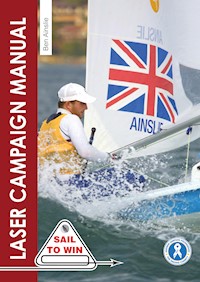
Sir Ben Ainslie won his first two Olympic medals (silver, then gold) in the Laser Class. After winning the gold medal he wrote down the secrets that won him that medal in this book. This new edition is published to mark the 20th anniversary of that first of his four Olympic gold medals. It features a brand-new introduction by Ben reflecting on his victory 20 years ago. It is the only how-to book that the world's most successful Olympic sailor has written and so, while he and the Laser class have moved on, this is the only place where you can gain access to Ben's skills and thought process. It is an invaluable guide on how to perform at the top of the Laser class or, indeed, any single-handed sailing dinghy. From psychology, goal setting and getting the boat right to speed, fitness and training – this book illustrates how to win a championship. Brimming with photographs, it is a colourful, detailed account of how to dominate in your fleet.
Das E-Book können Sie in Legimi-Apps oder einer beliebigen App lesen, die das folgende Format unterstützen:
Veröffentlichungsjahr: 2020
Ähnliche



















SIR BEN AINSLIE
THE MOST SUCCESSFUL OLYMPIC SAILOR
Ben Ainslie’s sailing career started when he was given an Optimist by his parents when he was 8 years old. He soon became fanatical about sailing that Optimist and joined Jill and Phil Slater’s Optimist team at his local sailing club, Restronguet Sailing Club, in Cornwall. He won the UK Optimist National Championships and represented Great Britain four times at the Optimist World Championships.
From there he moved on to the Laser Radial and became world champion at the age of 16. He graduated to the full-rig Laser and won the Olympic silver medal at Atlanta in 1996 aged 19, beaten to gold by Robert Scheidt. Four years later he reversed the positions and won the Laser gold medal at the Sydney Olympics in 2000. Shortly after that he wrote the first edition of this book.
Ben then moved into the Finn class where he reigned supreme, winning the Olympic gold medal in Athens in 2004, Beijing in 2008 and London in 2012, making him the most successful Olympic sailor ever. He was the flag bearer for Team GBR at the closing ceremony of the London 2012 Olympics.
Ben has won 11 World Championships, 9 European Championships and been World Sailing’s Sailor of the Year four times, and the UK’s YJA Yachtsman of the Year six times. He was knighted in 2012.
In the America’s Cup, Ben has worked with a number of teams over the years. In 2007 he was part of Team New Zealand which won the Louis Vuitton Cup in Valencia, Spain. In 2013, in one of the biggest comebacks in sporting history, Ben was tactician for Oracle Team USA when they won the America’s Cup.
Ben formed his own America’s Cup team, Ben Ainslie Racing, which competed in the 2012/13 America’s Cup World Series. The team, then called Landrover BAR, won the 2015/16 Louis Vuitton America’s Cup World Series. He is now the Team Principal and Skipper of British America’s Cup INEOS Team UK which will compete in the 2021 America’s Cup.
In Part 2, Speed Around The Course, there are links to videos of Ben Ainslie performing particular manoeuvres in his Laser.
While the quality of the videos reflect the technology of 20 years ago, the opportunity to watch Ben sail and hear his commentary is not to be missed.
Go to www.fernhurstbooks.com and search for ‘Laser Campaign Manual’ and click on ‘Other Resources’.
Alternatively you can visit the Fernhurst Books channel on YouTube where you will find these videos as well as other content from some of our authors.
CONTENTS
FOREWORD TO THE 20TH ANNIVERSARY EDITION
INTRODUCTION
PART 1 SPEED
Chapter 1 Checking The Hull
Chapter 2 Putting The Boat Together
Chapter 3 Control Lines
Chapter 4 Other Equipment
PART 2 SPEED AROUND THE COURSE
Chapter 5 Starting
Chapter 6 Beating
Chapter 7 Tacking
Chapter 8 Reaching
Chapter 9 Running
Chapter 10 Gybing
Chapter 11 Other Manoeuvres
PART 3 LET’S GET PERSONAL
Chapter 12 Diet
Chapter 13 Fitness
Chapter 14 Training
Chapter 15 Clothing
PART 4 HOW TO WIN A CHAMPIONSHIP
Chapter 16 Countdown To A Particular Event
Chapter 17 Racing To Win
Chapter 18 A Typical Race Day
Chapter 19 The Race
Ben Ainslie sailing Britannia – INEOS TEAM UK’s AC36 yacht
FOREWORD TO THE 20TH ANNIVERSARY EDITION
It is amazingly 20 years since I won my first Olympic gold medal at the Sydney Olympics in 2000 in a Laser. That certainly wasn’t the start of my sailing journey, but it was a significant milestone.
It was also the last time that I raced a Laser competitively and my sailing career has taken me a long way from that fantastic, relatively cheap, strict one-design dinghy. I’ve been through the more technical and complex Finn class and now into the rarefied world of foiling America’s Cup yachts which, despite a few one-design components, are still totally the other end of the spectrum from the Laser! There are also a few more people onboard!
The Laser itself has also been through some changes since then – particularly with the Mark 2 mainsail and carbon fibre top mast. No doubt other changes will come along in the future as well.
But I am still the same sailor who raced a Laser in 2000 and the boat is basically the same boat that I sailed 20 years ago, so I do feel that this book is more than just a celebration of the 20 years since I won that first gold medal – it contains the information that helped me win that medal and it can still help Laser sailors (and other single-handed sailors) get on the podium.
It is the only how-to sailing book I have written, and I remain very proud of it – even if the young man in the photos looks ever-so-young! I hope it helps you to win!
Ben Ainslie
March 2020
Ben Ainslie helming Britannia
INTRODUCTION
Dinghy sailing started for me when, as an eight-year-old, I woke up one Christmas morning to find an Optimist dinghy beside my bed. I guess I have been sailing mad ever since.
Growing up by the water near Falmouth meant that I could sail as much as I wanted, and I was fortunate that there was a great sailing club nearby in Restronguet. One of the local sailing heroes, Phil Slater, started weekend coaching and it wasn’t long before he had made us the top Optimist club in the country. The racing was ultra-competitive and half the time we would charge around pretending to be Chris Dickson or Russell Coutts; it was a lot of fun and it was great preparation for the future. I did well in the Optimist, achieving some good results nationally but was never able to perform that well internationally or find any consistency in my sailing.
I remember one race in particular. I had been winning but got some windshifts wrong and lost two places, to my arch-rivals David Lenz and Darren Williams. I slumped down in the boat thinking how unfair life was and all the rest of it, without realising that my Dad was right behind me watching. That night my Dad and I sat down and talked it through, deciding that if I wanted to take the sport seriously and be successful then I had to be prepared to go for it and give it 100%. My parents have always been a great support and every now and then you need someone to point you in the right direction. From that point on I was totally committed to sailing and knew there was nothing else I wanted to do. It was also around that time that I matured enough to realise that I had to think for myself regarding my sailing and performance, and it was due to this that I started making big improvements.
The Laser
The Laser may appear to be a very simple boat, which I suppose in some ways it is. But the strict one-design aspect means that it is very small differences in technique, boat set-up and psychology which make the difference.
What has always attracted me to singlehanded sailing is the freedom. There is no crew to argue with, it’s just you, the boat and the rest of the fleet. There is no one to blame or praise and the performance on the water is down to your efforts; you alone make the difference.
It does take a certain amount of self-discipline and determination to sail and race single-handed. The usual scenario is when you turn up to the club on a frosty winter’s morning to find most people have decided they would be better off staying in bed. Do you head off to your local for a pint or take the opportunity to spend some more hours on the water training and make a gain?
One of the great things about the Laser is that whatever your situation, whether it be club sailor or Olympic hopeful, you will always find competition at your level to race against. There is a great camaraderie between competitors, especially between races and ashore.
Goal Setting
One of the most important things to decide from the outset is what it is you want to achieve. It doesn’t matter whether your goal is to win the club championship or an Olympic gold – you need an aim and something to work towards.
It is important to be realistic with your goals and try to take things step-by-step. From the age of ten, I dreamt of winning a gold medal and when I became a Laser sailor that dream became more of a reality, but there was still an Everest between me and that goal. At sixteen I remember sitting with my Dad trying to work out how I was going to get there, but it soon became obvious that I had to try to become the best youth sailor in Britain. The next step was to go for being the best in Britain and then the world. If your goals are set too high or are at best a ‘long shot’, then you run the risk of always falling short and, after time, this can be very disappointing and a real de-motivator. Similarly, if you under-estimate your ability you will not push yourself to the limits of your capability.
If the Olympics are your objective it is important to realise that a four-year goal is a long way off. Yes, it is important to have a long-term aim, but it is also important to look at the short term and set goals year by year. That way you are able to re-evaluate your performance almost constantly and this will, no doubt, affect your goal setting and your rate of improvement.
Time
There really is no substitute for time on the water. Full-time sailors spend as much as 25 hours a week training on the water, and it shows. Obviously if you are trying to hold down a full-time job or have a family you will not be able to put in that much commitment but again it depends on what you want to achieve and being realistic about your situation. One way to make more time is obviously to try to manage your time better, but also if you can get a good routine going and stick to it, that always seems to save time.
If you have to decide between keeping to your fitness routine and time on the water, in almost all circumstances I would say your time would be far better spent on the water. It’s more fun as well.
It can take a long time to get where you want. I started Radial sailing at 15 and moved into the full rig at 17. It wasn’t until I was 21 that I won my first senior world title so that’s four years of non-stop full-time racing and training in the standard Laser. In the end all of us have only so much time sailing so the key to it all is – enjoy it.
Learning
I don’t think I have ever gone on the water and not learnt something. Ultimately it is essential to increase your performance. You go out on the water, make a mistake, learn from it and try not to make the same mistake again. Obviously, it is not as simple as that, but a top Laser sailor must always be on the lookout for ways to improve, be it through fitness, technique, boat set-up or psychology. The moment when you sit back and think you have made it to the top is probably the time when you will get a nasty reminder that the rest of the fleet is still improving and will probably leave you behind.
Reading sailing books and watching sailing videos are also great ways to feed your mind and get you thinking about how to improve. To this day, I love watching America’s Cup racing. Although it may not be as applicable to Laser sailing it still gets me thinking about the sport and tactics, while being a lot of fun.
Winning my first gold medal at Sydney, 2000
CHAPTER 1
Checking The Hull
One of the great advantages of Laser sailing is being able to go anywhere, borrow a boat and know that it will be as good, or nearly as good, as your boat at home.
It is a relatively simple boat to put together and rig but there are still some tricks to setting up the boat properly and making life easier for yourself.
When you collect your boat, be it new or used, check it over – this can save a lot of time. New boats vary very little (the one-design tolerances are tight) but older boats may have gained weight or had some disaster in their past which has affected the key measurements. You certainly don’t want a boat that is heavy, for obvious reasons.
Mast Rake
It is important on older boats to check the mast rake. You don’t want the mast raked a long way back, because you won’t be able to get enough leech tension on the mainsail, causing the leech to flap even in moderate winds. You will also find that you suffer more from weather helm and the inability to point.
Similarly you do not want the mast raked too far forwards as this creates more mast bend, giving large diagonal creases from the mast join to the clew. What you are really looking for is something in the middle.
To check, put the bottom mast in the boat and ‘rake’ it back. Hook the end of a tape measure to the top / back of the mast and measure to the middle of the round of the transom. 148 inches (3759mm) is raked back, 152 inches (3860mm) is raked forward. If in doubt, forward is better because it’s quick downwind and you get good leech tension upwind.
Next, measure from the top of the bottom mast to each gunwale to make sure the rig is vertical.
Measure the rake with a tape measure from the top of the bottom mast to the middle of the transom
Check all the spars for bends, etc. Again, you will not need to worry if you are buying new. I prefer a bottom mast that is bendy and reacts more to the gusts and lulls so, given the choice, would go for one with minimum weight or which appears to have a thin wall.
Measure like this to each gunwale: is the mast vertical?
Hull
Check the bottom of the boat for scratches and also for any unevenness in the hull – using a flat piece of wood will highlight this. The nature of the construction (the Laser is still hand laid-up) means there will nearly always be some unevenness but, clearly, don’t pick one that is worse than the others! The Laser rules forbid you from long board sanding your boat so you need to have it right from the beginning. I don’t ‘prepare’ the hull or foils in any way.
Make sure your trolley is well padded and that you have some decent covers because manoeuvring ashore is the easiest way to damage your boat.
Check the bottom of the boat
Foils
Turn the boat upside-down with the centreboard in its case and the rudder attached. You will now be able to check if both the centreboard and rudder are straight and line up. You may need to adjust the rudder gudgeons if the rudder is off-line.
Check that the rudder and centreboard are in line




