


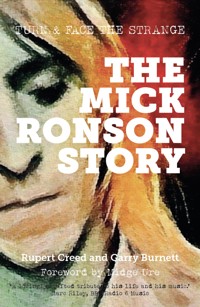
Erhalten Sie Zugang zu diesem und mehr als 300000 Büchern ab EUR 5,99 monatlich.
- Herausgeber: McNidder and Grace
- Kategorie: Geisteswissenschaft
- Sprache: Englisch
This book explores Mick Ronson's life and career with his family, friends, fellow musicians and fans. For devotees of David Bowie, and Mick Ronson – the Spider from Hull – who lit up the fabulous Ziggy Stardust shows with his dazzling guitar playing and powerful stage presence. This is Mick Ronson's story. And it begins in his home-town of Hull. Based on the successful show Turn and Face the Strange. With unique material and exclusive interviews with fellow musicians, friends and family (to include Maggie Ronson, his sister, and Nick Ronson, his son) and those who knew him. A new leading biography of guitarist, songwriter, arranger, producer and musician Mick Ronson. Most famous for his critical contribution to David Bowie's spectacular live band, studio albums including Hunky Dory, The Rise and Fall of Ziggy Stardust and the Spiders from Mars and Aladdin Sane. Mick also helped produce Lou Reed's Transformer, released five solo studio albums, performing in bands with Ian Hunter, Van Morrison and Bob Dylan as well as working with many other musicians. This is an authentic story of a boy from a council estate from Hull who achieved international rock god status. Set in a time of seismic social change, with colliding cultures of personal and community identity, image and fashion, gender roles and sexual freedom.
Sie lesen das E-Book in den Legimi-Apps auf:
Seitenzahl: 454
Veröffentlichungsjahr: 2022
Das E-Book (TTS) können Sie hören im Abo „Legimi Premium” in Legimi-Apps auf:
Ähnliche




















‘A fascinating and brilliantly-researched guide to the life of a great and much missed musician.’
David Quantick, music writer
‘Released in 1970 “The Man who Sold the World” was Bowie’s first record with Mick Ronson and was Bowie’s attempt to shrug off his failed ‘one-hit-wonder folkie’ tag (achieved through the albeit limited success of “Space Oddity”). And strike a light did it do the job! Step in Bowie’s very own Jeff Beck, the Spider with the Platinum hair, my fellow northerner, Mick ‘Ronno’ Ronson. This is a lovingly crafted tribute to his life and his music.’
Marc Riley, BBC Radio 6 Music
‘Mick came from good stock. A no-nonsense Yorkshire lad who would rather get things done than talk about them. Need the public gardens in Hull sorted out? Done. Need some strings arranged on a Mott song? Done. Need a stunning guitar solo on Mott’s last single? Done (that one took 3 meticulous days). Need to beef up Dylan’s Rolling Thunder Tour with some proper rock guitar? Done. Want me to dress up and make up like a platinum-haired rock god? Done (with a touch of persuasion from Bowie). And a hundred other brilliant musical deeds. He didn’t live nearly long enough - but by gum, this book shows he LIVED!’
Morgan Fisher, Mott the Hoople
‘The wonder you felt if you were lucky enough to meet or encounter a musical genius like Mick Ronson, and the curiosity you couldn’t help but contemplate at that intangible gift which enabled, someone like him, to create such beautiful music and melodies, was truly fascinating to experience. His humble gift and legacy has been appreciated by many millions of people around the world and looks likely to remain just as impactful for many, many more to come. What a legacy it is. Hull and Yorkshire – be proud. Be very proud.’
Kevin Cann, designer, writer, and music promoter
‘Ronson’s innovative use of the wah-wah pedal is still being appraised and appreciated by contemporary discerning guitarists. His track record as a player and composer is second to none. He was a massive influence on a whole generation of musicians. I first saw him play when I was 15. He blew my mind. A genuine guitar god!’
Martin Bramah, singer-songwriter and guitarist, and founding member of the Fall
‘I worked with Ronno at Trident Studios where he was responsible for producing the song that Bowie had written for me, “Andy Warhol”, which came out on my Weren’t Born A Man album when I was also signed to MainMan (as well as some other tracks) and not forgetting that his “Slaughter on 10th Avenue” came out as a single with me on the flip side. The first ever string arrangements that Ronno ever did was on my album. It was a sort of try out for him so he could then do what he wanted to do, which was to write arrangements. If you listen to the ‘found’ demo tracks that were discovered by Tris Penna and came out on my MainMan double album 2 years ago on Cherry Red Records, then you’d hear two rare tracks of “Andy Warhol”, with Ronno and Bowie playing, which had never been heard before until this release. To work with Ronno was such an honour as his talent was extraordinary, especially his unique guitar sound. I will always consider it an honour to have worked with him, and he will always be missed by me. Love Dana’
Dana Gillespie, actress, singer-songwriter
‘My first recollection of hearing David Bowie was on a Saturday morning in 1969 whilst ice skating at Crossmyloof in Glasgow, Scotland. The radio was blaring out ‘Space Oddity’ and I was hooked. My interest took me on an adventure of exploration, seeking out everything I could from this weird alien God. My best friend, Ian Reekie, bought Ziggy Stardust and the Spiders from Mars and this lit the touch paper for my meteoric rise to lead guitar playing. Mick Ronson had a style of his very own, even the clothes he wore had me imitating him in my days at College. I would wear white Oxford bags, a striped red and white v-neck T-shirt, with platform shoes borrowed from my brother John. Ziggy was coming to Glasgow, and my brother and I managed to get tickets for the matinee show. I had read in the music papers that the band never did encores at the matinee shows. The long- awaited day came and we went to the show at Green’s Playhouse in Glasgow. The band didn’t disappoint, they were incredible. I was very privileged to see that tour. The show ended and the band left the stage. John and I knew they wouldn’t be back on so we left the crowd cheering for an encore. Renfield Street was almost empty as we headed away for our bus home. We walked for about three blocks when we heard screaming from back at the gig. A limo was approaching and the lights beside us were red. We looked at the limo and saw David looking straight on and suddenly Ronno stuck his head out at the window and waved at us. In later years I reminded Ronno that he was the first Rock Star to acknowledge me.’
Derek Forbes, Simple Minds
‘Even now 50 years on Ronson’s guitar solo at the end of ‘Moonage Daydream’ still sends me to heaven.’
Daniel Ash, guitarist of Bauhaus
A proper biography of Mick Ronson, with a focus on the city that moulded him, was long overdue. Thankfully Rupert Creed and Garry Burnett have not just provided it, they’ve done so with style and panache. Mick Ronson was a genius who would never answer to such a description. His self-effacement in an industry bloated by hyperbole was one of the things that made him special – the other was his soaring musicality. It’s very good and worth the wait for all those millions of fans of Ziggy Stardust and the Spider’s from Hull!’
Alan Johnson, award-winning author, and former MP
‘I feel the stage show Turn and Face the Strange celebrating Hull’s very own Mick Ronson deserves a world-wide audience, and I feel the same about this book.’
David ‘Burnsy’ Burns, BBC Radio Humberside
For Tracey
and for Louise
and everyone involved in making the magic that is the legendary Turn and Face the Strange show:
the TAFTS family!
Foreword
by Midge Ure
It’s 1977 and the band I had recently moved from Glasgow to London to join, Rich Kids, were sitting in a pub discussing who we might want to produce our, what transpired to be, only album. We had various names suggested to us by the label but we suspected the names given were for their sales prowess rather than what they might bring to the music. I then suggested someone who I hugely respected and admired as a producer, guitarist, pianist and arranger. Mick Ronson.
It’s 1973 and I’m sitting in the Glasgow Greens Playhouse eagerly awaiting the matinee show from Ziggy Stardust and The Spiders from Mars. I was playing in my own bands that evening hence the matinee but I wasn’t about to miss this moment. It was love at first note! The band. The look. Bowie seducing the audience and to top it all, Mick. Mick with his beat up Gibson Les Paul, his Marshall half stack and his wah wah pedal pulled halfway back giving the guitar its unique, slightly strangled voice playing like there was no tomorrow and at the same time giving Bowie a run for his money when it came to stagecraft and showmanship. Eyes darting from one to the other like watching and supporting both tennis players in a match and never quite knowing who to root for more. It takes quite a powerful force to outshine David Bowie but more than once the spark from the side of the stage outdazzled the spark in the centre!
Mick producing Rich Kids gave me the opportunity to spend time with this unassuming, sometimes shy, understated man. Always happy to pop down the pub or smoke his roll ups. He seemed to be the antithesis of the guitar hero I had witnessed a few years before but his skills and abilities remained. I even found myself the keeper of the ‘holy grail’ of guitars when Mick asked me to look after his Gibson for a few months. Musician friends would come and gaze in wonder at the instrument responsible for the classic ‘Moonage Daydream’ solo. I’m not convinced in hindsight that the ensuing album was the ‘musical marriage made in heaven’ we all anticipated but it brought this genius into our lives and we were all better for it.
Mick agreed to play guitar for me on my 1986 Gift tour. Maybe xbecause I was wanting to hear ‘that sound’ I always associated with Mick or maybe I was living some sort of unattainable schoolboy dream it didn’t work out. I came to the conclusion I was restricting him by having him play parts rather than be himself, rather than be the brilliant musician I loved hearing. A few weeks into rehearsals I had to make the most difficult phone call in my life and explain to Mick I didn’t think this was working. Being who he was he took it with enormous grace and said he understood but I’ll never really know because we never had the opportunity to meet up again.
His melodies. His unique guitar and piano playing. His absolute northern down to earthiness. I miss it all.
He never wanted to be the centre of attention.
He never sought the limelight.
He was happy being a musician.
Not just a sidekick. THE sidekick.
Midge Ure, 2022
Preface
by Garry Burnett
When I was twelve, Top of the Pops was one of the most popular programmes on the telly. We never missed it! I remember the momentous night when David Bowie put his arm around Mick Ronson in the middle of ‘Starman’ and feeling waves of silent disapproval emanating from my father’s fireside chair. I glanced over uncomfortably to see his newspaper lower six inches below his eyes and his brows rise almost to his hairline. ‘Bloody hell!’ he scoffed. ‘Is that a lad or a lass?’ Then he recognised Mick. ‘That’s him off Greatfield! He cuts the grass in East Park!’ I just kept my mouth shut because I thought it was brilliant. And the way he played guitar! Like thousands of others, from that moment on I wanted to be just like him.
I bought the Aladdin Sane LP the week it came out, from Cleveland Records on Craven Street Corner. I couldn’t wait to get home and play it. In those days we had a radiogram record player in our front room which was as big as a sideboard, and if you put a record on, everybody had to listen, you had no choice. So you can imagine how relieved I was that I was on my own the first time I played Aladdin Sane. The lyrics! Track 1 on side 2 was ‘Time’. ‘Time he flexes like a whore. Falls wanking to the floor…’ I blushed. I didn’t even really know what wanking meant at the time. All I knew was it was one of those words that you didn’t ask Dad the meaning of. So I came up with a diversionary tactic: to cough loudly every time it came on.xii
It seemed to work fairly well until one day, disaster struck. There must have been a piece of dust or fluff on the needle because the record began to jump, exactly on the word. ‘Time, he flexes like a whore, falls wanking… wanking… wanking…wanking…’ It must have sounded like I was having a coughing fit. I didn’t realise Dad was in the kitchen. He just strode over and booted the record player, all the way to ‘Jean Genie’. He never said a word, just disappeared behind his newspaper, as if nothing had happened. But when I went to give him his goodnight kiss that night, he just held up his hand. ‘Men don’t kiss men,’ he said. And from that time on I had to shake hands with him at bedtime. Every night, I’d kiss my mum and shake hands with dad. And though I laugh about it now, I remember going to bed that night feeling ashamed and embarrassed, as if I’d done something wrong, and also a bit scared, because I knew everything had changed.
Drifting through my open bedroom window were all the night noises from East Park where Mick had worked, the peacocks and owls, and I thought, ‘Yes, Mick, you had something to do with all this’. And it was through you I that knew you could be from round here, from East Hull, there was nothing wrong with that, but you didn’t have to be the same as all the rest, that it was okay to dream, to be different.
And so most of my life Mick Ronson has been with me, as firstly a neighbour, then a role model and always an inspiration. Our families grew up and worked in many of the same places. And now he is buried in Hull’s Eastern Cemetery, close to home in the same grave as his parents, just round the corner from my own grandparents and uncles. It is a peaceful place, an oasis of calm sandwiched between two tough estates and opposite what was my old school. Turn your head and you can see cranes turning on the edge of the Humber, or smoke chuffing from the funnels on the North Sea Ferries, and catch the smell of the river and the woodyards in the air.
Listen carefully and you might also hear beautiful music, birdsong, sometimes woodpeckers, in the trees near the chapel, or tinkling wind chimes from the baby cemetery at the far end. One day as I put some flowers down I even thought I caught the four notes of ‘This is for You’, one of Mick’s haunting solos playing on the jingling chimes as a light breeze blew through.
Heaven, and Hull.
Preface
by Rupert Creed
In contrast to Garry, my teenage years were spent in Brighton. In the late ’60s and early ’70s, ‘London by the seaside’ was a cool place to be. I hung out with hippies on the beach, saw Pink Floyd, King Crimson, Free and Dr John play at the Dome, and sprawled on bean bags, listening to the latest albums on headphones in the smoke-filled booths of Virgin Records on North Street. In 1974 I swapped this vibrant southern scene for what felt at the time, the grey parochial grimness of Hull, moving north to study Drama and German at Hull University. Unlike Mick, who’d had to head to London to make his name as a musician, I was travelling in the opposite direction to train in theatre. By the time I arrived in Hull, Mick had relocated to America. I never got to see him play, let alone meet him in person, despite living in his home city for the next two decades. In fact, until his death in 1993, I didn’t even know that he came from Hull – such was the city’s lack of interest at that time in promoting or celebrating its stars. Close to half a century after first coming to the city, I am still here. I have made a career as a writer and theatre director, documenting and portraying the stories of this unique place and its remarkable people.
In 2016 Garry approached me with the idea of collaborating on a project recording the untold stories of Mick Ronson and celebrating his life and music in a stage show. With a commission from Hull City of Culture we embarked on Turn and Face the Strange. Over six months in 2017, we recorded the memories and stories of Mick’s family, friends, fans and fellow musicians. What emerged was the story of a young man whose personality and attitude were firmly rooted in the culture of the city, but whose ambition and sheer musical talent drove him from the safe and familiar into a new uncharted world of creativity. As sideman to David Bowie onstage, and a key collaborator in the making of his music, Mick played a crucial role in the history of popular music. Although he didn’t maintain the same success achieved with Bowie and the Spiders from Mars, his story doesn’t stop there. He sustained a prolific music career as a guitarist, song arranger and album producer right up to his death.xiv
Most rock histories portray Ronson primarily through the prism of Bowie in his Ziggy period, or alongside stars such as Lou Reed or Ian Hunter. We wanted to flip the traditional narrative back to Mick and offer a more Hull-centric focus. Our story sheds a more nuanced light on how the city and its culture shaped his personality, offered him a safe haven, and gave him a thorough grounding as a musician. It also gave him a culture he would ultimately kick against. Leaving Hull to join Bowie released the creative genie from the bottle and he never looked back. With his Spiders from Hull, Mick played a crucial role in the development of glam rock, journeying from a geographical backwater to the cosmopolitan mainstream. Alongside David Bowie they redefined and reset the boundaries of popular culture. It’s a story of the unlikely juxtaposition of northern attitude and London cool, and how the two at times clashed and combusted, but more often than not coalesced to produce the creative spark for songs that have inspired and been enjoyed by generations of listeners.
Being ‘on the ground’ in Hull, Garry and I had access to a rich resource of local people’s memories and stories of Mick. Some featured in the stage show Turn and Face the Strange, but many more appear for the first time in this book. The stage show sold out with its initial run in 2017 and this success continued through further performances at Hull Truck Theatre through to 2021. The show attracted visitors from as far afield as America, Scandinavia and Europe – a testimony to Mick’s enduring popularity at home and abroad. We have gathered more stories in the interim, all of which offer first-hand accounts of Mick’s life, character and skill as a musician. From estate kid to superstar, Mick Ronson was a man who stepped beyond his predetermined path, who turned and not only faced the strange, but chose to embrace it.
Contents
Introduction
Once upon a time, not so long ago
People used to stand and stare at the spider with the platinum hair
They thought you were immortal
(‘Michael Picasso’ by Ian Hunter)
It’s 4 July 1973. Guests are arriving at the Café Royal on Regent Street in London. It’s the post-Ziggy ‘Last Supper’ party and the social event of the year. The previous night David Bowie and the Spiders from Mars played the final show of a world tour that had taken them the length of Britain, crossed America from east to west coasts, and on to Japan — finally to return to London. In just a year and a half, Bowie and his band have gone from half-empty pubs in North London to sell-out gigs in the States. They’ve made iconic albums that have sold worldwide, generated a frenzy for glam rock and achieved international stardom. It’s been a wild ride, and tonight there’s that post-show buzz in the air of sweat mingling with sweet success. Bowie’s main man, Mick Ronson, with his tanned physique and long flowing hair, looks like a Greek god as he steps into the gilded, art deco lift and ascends – if not to the heavens, then at least to the upper floor. The night before, he’d played the gig of a lifetime. To a packed Hammersmith Odeon crammed with adoring fans and rock glitterati such as Mick Jagger and Rod Stewart, Mick Ronson played his blond Les Paul with phenomenal power and passion, blasting a raw energy of sound throughout the auditorium. Jeff Beck had played alongside him, guesting on a couple of numbers. A guitarist emulated and idolised by Mick for years, was now publicly acknowledging Mick’s status, a new guitar great. Then at the end of the concert, before the final number, Bowie declares to a stunned audience that this is not just the last night of the tour, it’s the last night ever of Ziggy Stardust and the Spiders from Mars. Bowie is killing them off, he’s breaking up the band. Mick knew it was coming and had a solo career lined up thanks to Bowie’s manager Tony Defries, but for drummer Woody Woodmansey and bassist Trevor Bolder it came as a complete surprise, a knock-out 2blow delivered in public, leaving them shocked, angry and deeply hurt. They’d been on this rollercoaster ride together, they’d helped make it happen, but now it looks like they are out of the picture. As they leave the stage they can’t help but notice that Mick, their fellow musician and long-time mate from Hull, is avoiding eye contact. It feels like betrayal. The following evening in the crowded throng of the Café Royal, Woody is making the best of it, trying to work out if he still has a job, but Trevor has stayed away. Mick is surrounded by fans, family and friends and the champagne is flowing. There’s Mick and Bianca Jagger, Paul and Linda McCartney, Ringo Starr, Keith Moon, Cat Stevens, Lou Reed, Barbara Streisand, Britt Ekland, Tony Curtis, Elliot Gould, Ryan O’Neal, Spike Milligan, Peter Cook and Dudley Moore. Anyone who is someone, and in London, is here. And at the centre of it all is David Bowie and the man who helped make him a star. Though the lyrics said, ‘Ziggy played guitar’, everyone knew it was in fact Mick Ronson. How did this kid from a council estate in east Hull get to be here? From the edge of nowhere to the pulsing heart of popular contemporary music? How did this happen? And where did it start?
Michael Ronson was born in 1946 in the city of Hull in the north-east of England. As a baby boomer he was the product of his time and place, born into a working-class family in an industrial northern city where manual work was the norm and jobs were plentiful up to the 1970s. His destiny should have been to tread the path mapped out by his parents and previous generations: leave school at 14; find work on the docks, or in a factory or ancillary trade; earn enough to marry and start a family; holiday on the East Coast at Bridlington or Scarborough; and, more likely than not, live a life pretty much within the city. Mick chose a different path. By his mid-twenties he was a rock superstar touring the globe, an icon of glam rock renowned for his good looks and mastery of the guitar. His career drew countless accolades, not only for his guitar-playing but for his arrangements on piano and strings, his skill as a producer in the studio, and his enthusiasm for working his magic with unknown bands as well as established musicians. Having left Hull in the ’70s, he never returned to his home city, apart from visits to family. He lived in London, then mainly in the States, and wherever the work 3took him – a guitar-playing, album-producing nomad, jet-setting across continents.
His journey, however, is no simple stellar trajectory, but a series of failed early attempts to make his mark as a musician. His burning ambition was tempered by self-doubt, the need to earn a regular working wage, and the lure of staying firmly in the comfort zone of known musical parameters and familiar home territory. Mick’s formative years tell the story of a boy born into a community battered and bruised after the Second World War, where the pressure to get a ‘proper job’ was suffocating to someone blessed with artistic talent. He grew up in a largely working-class community, where negative attitudes to the arts and culture created enormous peer pressure to do the opposite of what he was restless to achieve. The male head of the household was expected to hold down a dependable job sufficient to pay the rent and put food on the table. This had been true for generations. Mick, however, was to lead a fairly maverick, hand-to-mouth lifestyle, and despite having huge earning potential was always focused more on the music than the money. He died poor with little to show of the financial rewards usually associated with being a rock superstar.
Hull’s location would also play a part in shaping Mick’s character and early music ambitions. The city lies 40km (25 miles) inland from the north-east coast, on the broad sweep of the Humber Estuary, isolated from the main north-south transport routes of the UK. It’s a one road in, one road out, ‘end of the line’ town. It has a rich maritime history of fishermen and merchant seamen pioneering the distant horizons, but in equal measure it has a paralysing culture of looking inward, being insular and resistant to change. In the 1960s when Mick was first looking to make a career in music, the only real option available was to take the one road out of Hull and head for London. Dread of getting into debt and the lure of familiar home territory would invariably pull him back. Hull had a cultural drag anchor as strong as the Humber tide, that could easily snag and sink a young man’s ambition and dreams. Having failed to make it as a musician in London in 1966, Mick was highly reluctant to ever leave Hull to try it again. It took the persistence of drummer John Cambridge to convince him that it was worth one more go – and it was only then that the Bowie-Ronson partnership opened the door to mutual success.
Mick had advanced practical knowledge of classical music and musical theory well before he even picked up an electric guitar, which set him apart both from his mates growing up on a Hull estate and 4from many of the musicians working the circuit at that time. He had the talent and credentials to hold his own with any of the top musicians he later played or collaborated with, be that Bowie, Dylan, Ian Hunter, Lou Reed or Morrisey. Through years of studious listening, practice and performance, he had developed an innate sense of melody, and how a hook or riff could enhance an embryonic tune. This, combined with the driving rock guitar he perfected in the Rats, offered Bowie the ‘magic music bullet’ he needed to enhance his own singer-songwriter skills and give his career a decisive and stratospheric breakthrough.
The years before, playing in the Mariners, Crestas and the Rats, were the musical equivalent of his day job marking out sports pitches, methodically exercising his craft, moving comfortably, predictably and proficiently within predetermined lines. Partnership with Bowie broke beyond those boundaries, rejected the orthodox rules and encouraged creative risk-taking. Bowie once said of Mick’s ability to interpret: ‘I would literally draw out on paper with crayon or felt-tip pen the shape of a solo. The one in ‘Moonage Daydream’, for instance, started as a flat line that became a fat megaphone-type shape and ended as sprays of disassociated and broken lines. Mick could take something like that and actually bloody play it, bring it to life. Very impressive.’
With Bowie and the emergence of glam rock, Mick also played a part in legitimising more liberal attitudes to homosexuality and gender. The community he grew up in held firmly to the orthodox distinction between male and female identity. Any transgression of the norm would often result in overt homophobia and violence. Given their background, it’s not surprising that Mick and his fellow Spiders from Hull were initially resistant to Bowie’s glam rock ideas. Long hair was acceptable, not lipstick or mascara. However, a growing cult following meant that it didn’t take long for them to embrace both, and by doing so, they helped generate momentum toward a more tolerant, inclusive society.
There’s no doubt that Mick’s striking good looks and fit physique also contributed to the huge popularity of the bands he played in. It gained him a loyal female following, some of whom were quite happy to be counted as not just a fan but one of his amorous conquests. Mick had significant relationships with at least three women, one of whom he married, and all of whom bore his children. His rock lifestyle and constant touring, however, meant he was never consistently at home for either partner or child, and none of these relationships endured. Nicholas, his first son, was born in 1971 and grew up without ever knowing his father. His third son, Joakim, was born in 1990 and still a 5toddler when his father died, his mother having separated from Mick a short time before. Only his middle child Lisa, born in 1977, enjoyed a childhood with her father, and Mick’s relationship with her mother, Suzi, did not sustain beyond his daughter’s teenage years.
On one level Mick Ronson shows a consistent personality. Unlike Bowie he has no chameleon qualities. Fame doesn’t change him, neither his broad flat-vowel Hull accent, nor his qualities of friendliness, generosity, modesty and his dry Yorkshire humour. At the height of rock stardom, he was still the person he’d always been – down-to-earth and grounded. But his story also shows contradictions and complexities. Like many performers he was shy by nature and not a natural extrovert, but once on stage, particularly on the Ziggy tours, he would become larger than life, interacting physically and theatrically with Bowie, personifying and inhabiting, shaman-like, the raw power of sound that he could summon from his guitar. There are further contradictions to his personality. He was admired, revered and held in almost universal affection by those who came into contact with him. He showed generosity, friendliness and a readiness to connect with people on equal terms regardless of their status. He was modest and rooted in values handed down from his parents. His father George taught him the need for discipline, hard work and living within one’s means. From his mother Minnie he learnt to be generous and kind, values not always associated with rock stars. Yet when it came down to decisions regarding fellow musicians, the drive of his ambition could lead him to be ruthless. As a committed artist, he prioritised the music above loyalty to friends. His friendliness and desire to be liked made this a particular challenge for him and he tended to avoid confronting, or addressing difficult situations with band members.
When Mick died from cancer in 1993 at the far too young age of 46, the universal response was a massive outpouring of sadness and loss – from people in the music industry internationally, to friends and fans in Hull. Mick’s story was not only a soundtrack to their lives, it was a guiding light, a compass, giving direction and meaning to their own sense of identity and aspiration. He helped them make sense of the person they were, and who they could become. Whatever contradictions or inconsistencies he might have shown as a person, the overriding emotions he evoked were admiration and affection. The epitaph on his gravestone in East Hull cemetery rings as true as his music: ‘To know him was to love him’.6
1
Childhood and Early Years: 1946–1963
8Its official title is Kingston-upon-Hull, named after the river that flows south through the city into the much larger Humber estuary, which in turn flows east to the coast and the North Sea. Few people call the city by its full name, as the shortened version ‘Hull’, sits far more satisfyingly on the tongue. Michael was the first child of George and Minnie Ronson, a working-class couple, who lived at 1 Grosvenor Terrace, a small two-up two-down terrace house just north of the city centre. He was born in a nursing home on the nearby Beverley Road.
Mick’s mother was born Minnie Morgan in 1924 in Hull, the second daughter of Harold Morgan and Hilda Shortland. The Morgan family came originally from Wales and the Shortlands from Lincolnshire, both families drawn to Hull by the jobs on offer in the expanding industrial city. Mick’s father, George Ronson, was born in Hull in 1920, the son of a deep-sea trawlerman also called George, who worked the tough and dangerous trade on the storm-tossed seas off Norway and Iceland. The Ronson family came originally from Lancashire and by 1911 George Ronson Sr, Mick’s grandfather, had settled in the city, marrying Maria Dunn from Ireland. Maria died in 1933 when Mick’s father George was only 13, and the evidence suggests George was now brought up by a guardian relative. With a father at sea and mostly absent in his life, he came to value the stability and security that family life could offer, the importance of taking responsibility for oneself and being financially self-sufficient. George Ronson was a strict father to Michael and exerted a big influence on his son’s attempts to forge a career as a musician, constantly stressing the need for his son to get a ‘proper job’ and keep music as a hobby. The Morgan, Shortland and Ronson families all lived in the Hessle Road area of Hull, a close-knit community of densely packed terraced houses adjacent to the fish dock in west Hull, with its constant flow of trawlers landing their catch or setting sail on the tide.
Minnie Morgan and George Ronson had met prior to the outbreak of war, but it wasn’t until January 1944 that they were able to marry. In 1945 victory brought peace, and for the citizens of Hull, an end to the aerial bombardments they had endured for five long years. The city had suffered a grim tally of both physical and human costs: over 5,000 houses destroyed, almost 1,200 civilians killed and 3,000 injured. The people of Hull had been battered by the war and that shaped the attitude of their generation and what they passed on to their children. Young lads such as Michael were told to get a trade or join the army, become a skilled hand at something that would ‘sort them out’. It was an important part of what it meant to be a man. Work was not only essential to pay the 9bills, it was something to take pride in: it helped define your sense of identity and place in the community. Music, as with any other form of entertainment, was there to be enjoyed, but unless it could pay the bills and put food on the table, was no substitute for a proper job. The 1960s were to usher in a different set of social attitudes, but born only a year after the end of the Second World War, Mick grew up in a city and time that carried physical and emotional scars of war, along with the prevailing attitudes of his parent’s generation.
For George and Minnie Ronson, the birth of Michael, their first child, marked a significant new chapter in their lives. Peace and a return to civilian life provided the stability and relative security to invest in a family and a future. Despite living in an age of austerity, with food rationing not ending till 1954, a new era was beginning. It offered a new contract with the people: a National Health Service for all, improved work and welfare benefits, and a massive programme of home rebuilding. For baby boomers like Mick, it offered the life for which the older generation had fought and sometimes died – the chance to inherit a new age with the sound of music, not bombs.
One of Mick’s first childhood friends was Rod Block, who lived down the same terrace and remembers that early time: ‘When I first met Michael we both lived down Grosvenor Terrace, down Grosvenor Street, which is off Beverley Road between Leonard Street and Wellington Lane. We both went to the same school, Park Road School, which is near Pearson Park. Michael used to sit next to me in class and I do recall writing and looking at him and saying, “What you doing, Michael?” He said: “I’m copying off you”, and I said: “I’m writing my name!”’ The Ronson family had acquired a second-hand accordion and Rod recalls Mick as a child displaying an extraordinary ability to play a tune from memory: ‘I remember one evening I was sat on the table listening to the wireless when Mrs Ronson and Michael came into the house and Michael had an accordion strapped to his back and Mrs Ronson said: “I’ve just taken Michael to the Strand Cinema to watch a movie, now just listen to this.” And he played the theme tune to the movie by ear, which was “The Man from Laramie”.’
The bombing of Hull required a substantial post-war programme of house building on new greenfield council estates in East Hull, named Bilton Grange, Longhill and Greatfield. The houses came with indoor toilets and plumbed-in bathrooms, until then a dream for many working-class families, previously having to make do with an outside privy in the backyard, and a tin bath once a week in front of a coal 10fire. The estates were built on the ‘garden city’ concept, where curved avenues and closes with plenty of outdoor spaces were replacing the older housing of dense, cramped terraced streets and poor sanitation. George, Minnie and Michael Ronson moved into a new-build council house on Hopewell Rd, on Bilton Grange estate, where Mick attended the local Wyvern Primary School. Minnie Ronson found work at the Imperial Typewriter factory on Hedon Rd, and George Ronson got a job at British Industrial Solvents, later to become BP, at the petrochemical works at Saltend on the eastern edge of the city’s commercial docks.
Recognising her son’s innate musical talent, Minnie bought him a piano for £73, which in the 1950s was a serious amount of money. She arranged lessons with Mrs Bolder, a piano tutor who just happened to be the grandmother of Trevor Bolder, one of the future Spiders from Mars. According to Minnie Ronson, ‘Mrs Bolder sent me a note saying: “This boy needs to drink more milk”’ – no doubt a response to Mick’s slim build. Estate friend David Harvey remembers his mother responding in a similar way: ‘Mick sometimes would walk past my house and I’d go out and see him. My mum always used to say, “Ask him to come in because he looks like he needs something to eat! Tell him to come in, I’ll make him a sandwich, I’ll give him some soup or something.” Mick always looked very slim, even in his later years when he was playing with David Bowie and Mott the Hoople. He always was very slim on stage, but he’d always been a slim lad from when I first knew him.’
Susan Baird grew up on Bilton Grange Estate and remembers Mick’s early music talent: ‘We used to go in his house and he would be playing the mouth organ and playing the piano. He seemed to be able to play anything really. I remember him being quiet and he seemed shy, he didn’t go boasting that he could play. He used to play spoons and the mouth organ – yes, he used to play the spoons! When he came down to our house it was because we had the [tape] recorder. I don’t think he had one. He would come down and we would just have a laugh outside. At the side of our house was our bathroom and the window. We used to put the tape recorder on the floor and put the wire through the window and we used to put it in the light socket, and then we used to be sat at the side of the house with the tape recorder. He used to sing and we used to sing as well. He would play the recorder or the mouth organ and then we would play it back to listen to it.’
For the first eleven years of his life, until the birth of his sister Margaret in January 1957, Mick was an only child – and doted on by his mother. Minnie not only encouraged her son’s musical talent, she 11taught him the values of kindness, politeness and generosity, of treating people as equal, which were values he followed throughout his life. Growing up meant inevitably getting into scrapes, and when in trouble, punishment was traditionally meted out by the father. George was strict and like many fathers of his generation didn’t show much overt affection to his son. According to Minnie: ‘Michael had a sometimes strained relationship with his dad and had a few “clouts around his head” when he was growing up.’ Susan Baird remembers Mick throwing stones one day and breaking a window in their house. ‘His mother come round and said, “Don’t tell his dad, his dad will go mad.” So my dad said, “It’s alright.” My dad had some picture frames and he cut the glass out of a picture frame. His own dad was quite strict. But his mother, she was real good with him.’
In September 1957 Mick started at Maybury School, where he became friends with Ian ‘Taffy’ Evans, who would later be a roadie with Mick in the local band The Rats: ‘When we first went to Maybury it was a big school. There was rugby teams, there was football, there was sports. Mr Coverdale used to come out on a morning in middle of winter and say: “Are you cold boys?” and we said: “Yes, sir’. And he said: “Last one back from the end of that football pitch gets the cane” and we was off like stink! But Mick was never the last, he was always quite athletic, he was good at PE.’ Taffy recalls: ‘Smoking in the bike sheds, Woodbine tipped. We just had a good time, we were a really good class together.’ The school encouraged Mick to develop his interest in music: ‘The music teacher at the time was Mr Harris and he realised Mick had some musical talent and put him in the recorder group for the school which appeared every morning at assembly on the stage to accompany us singing hymns.’
In 1958 the Ronson family moved from Hopewell Rd on Bilton Grange, to 8 Milford Grove on the adjoining Greatfield Estate. Their council house was modern, closer to the bus stop into town, and like the Hopewell Rd house had a small back garden. Mick took on a paper round, and two brothers, Dennis and David Wright, helped him with deliveries: ‘We used to do both sides of Hopewell Road and one side of Lingdale. Most times I would meet Mike where they dropped the papers off at the telephone kiosk near Hopewell Road School. I used to meet him there and I’d do one side of Hopewell Road for him. I would have my own little bag and he would give me the papers and he would do the other side. We used to race each other and I often used to win, but I think that was Mike letting me win so he didn’t do so much work!’12
At Maybury School Mick’s musical range was expanding, as Taffy Evans recalls: ‘They arranged for extra violin lessons for half an hour after school, where he would receive violin lessons. When Mr Harris left we had a man called Geoff Slaughter, a great bloke, and he clicked on to Mick as well and kept him going and started him with the piano. I don’t know what his mother was doing with him with the piano, but he certainly was targeted for extra lessons.’
For some of the kids on the estate the sight of one of their own playing violin, or walking home carrying a violin case, was so out of the ordinary it invariably provoked a response. Childhood friend Ray Jordan lived in the house backing on to the Ronson family: ‘He used to play the violin and I remember vividly ’cause it was unusual. We was all from working-class families. It wasn’t usual to see a kid playing a violin. So we used to creep up to his window, knock on his window and pull funny faces, and he was there playing his violin. And he took it all in good fun and we used to laugh and we used to run off, but I always remember him playing the violin.’ Another friend Tony Ward recalls: ‘We used to play football outside and we used to tease Mick when he was going across to his music lessons with his music case. We used to tease him like mad.’ Mick used to pay some of the older estate kids to carry his violin case for him, in effect his first roadies. In a 1976 interview from Guitar Player, Mick reminisced about that time: ‘Violin was quite fun but after about three years I got fed up with it because people used to make fun of you if you carried a violin case. I used to pay people to carry my violin because I was afraid to myself. There were some tough lads there!’
The taunts and jibes of his peers didn’t deter him, however. What stopped him from playing the violin was the more tempting proposition of another stringed instrument – the guitar. In an interview in Rock Scene from March 1975, Mick recalled the transition: ‘I first studied on the piano, then recorder and violin. The guitar came much later. I got thrown out a lot in my violin class because I kept holding it like a guitar and plucking the strings. I was playing those kind of things on the violin and the teacher threw me out. I mean I was playing good violin, but as soon as his back was turned I was plucking and I was thinking like the Shadows and the Beatles, and then after that I thought, I’ve got to get a guitar. I put my violin away and got a guitar and I stopped playing piano and I was just playing guitar. So guitar became a big part of my life for a long while.’
In 1960, at the age of 14, Mick left school and started full-time work. 13Fourteen might sound like a tender age to enter the adult world of employment, but in those days for working-class kids it was the norm. A professional or academic career required further education, which in turn placed a financial burden on families that was simply unaffordable. With the young baby Margaret now part of the family, Mick would be expected not only to look after her when he could, which he more than happily did, but also to contribute financially to the household by giving his mother a regular amount from his weekly wage. His first job was with the Co-op, working on the mobile van that toured the estates selling groceries. David Wright remembers it well: ‘He was working on the Co-op van and he used to always pop in. He knew me mam real well. Me mam could play the piano and there was always a key out of tune, and Mike used to tell me mam: “Edie, that bloody piano key, it’s out of tune!” and she’d play up hell with him and say: “No, it isn’t. You don’t know how to bloody play the piano. Get yourself back on that van!’’ and she would kick him out in a nice way.’
With his good looks and polite, friendly manner Mick became a well-known and popular figure to the local mums and their impressionable young daughters, as Lynn Mitchell recalls: “He was about 15, I think. He used to work on the Co-op van. It was a maroon one with Co-op written on the side, and the back opened up and they stood inside, him and this chap. Every day it stopped right outside my mum’s house, and me and my mum used to go and buy our little bits of shopping, ’cause there was no shops around there at all then, and that’s how we met him. I mean I was only 9 or 10 I think, but he always had five minutes for me. He always used to have a little chat. He was blonde and I thought he was real nice looking. I was in love with him! I never missed going to the van with my mum. And then I remember him telling her that he’d been bought a guitar. Whether it was a Christmas present, birthday present, I don’t know, but he said, “I’m practising like mad.”’
The guitar was a cool instrument exemplified by skiffle bands, performers like Duane Eddy, and emerging guitar groups such as the Shadows and the Beatles. These were the early years of rock ’n roll, and for Mick the guitar was not only more acceptable within the working-class culture of a council estate, but it also allowed him to pursue his passion for music more intuitively. It offered a route out of the formal and tightly prescriptive music lessons, as he described in a 1988 article in Music Maker Holland’: ‘I used to play classical piano and violin and I learned to hate practising the scales. When I took up the guitar I decided not to practice anymore, just play.’ Mick did practise, endlessly, but on 14his own terms. His mother remembers him playing incessantly at home: ‘His fingers were constantly moving, practising guitar on his knee at the table in the kitchen.’ The guitar was becoming his total passion, but at this point still a hobby, slotted between work and family obligations, and with no audience other than friends. His younger brother David was born in November 1962 and as with his sister Maggi, Mick would come home in his lunch break to take David out in the pram. His mother recalled, ‘He always made sure everybody else was alright. At Christmas he would be the pot washer and he just wanted everybody else to relax and enjoy themselves.’
At this stage in his life Michael was simply the good-looking lad on the estate who worked on the Co-op van. His obsession with the guitar would soon set him on a new path, taking him out of the estate he grew up in, out of the city of Hull, into a future he could barely imagine.
2
First Bands: The Mariners and The Crestas: 1963–1966
16It’s December 1965. Mick Ronson is onstage playing guitar with the Rolling Stones. He’s one of them, one of the band. Jagger’s out front, strutting his stuff, and nobody seems worried that Keith is missing. There are two Micks in the band now and the fans love them both. It’s a big venue, a sell-out gig with the audience going wild. Girls scream, drowning out the amplified sound. Some are in distress, hands on temples, imploring the gods onstage to acknowledge their longing, their desire, their adoration. Mick’s hand slides up and down the guitar neck, fingers shifting fluidly and effortlessly into the shapes of each chord. He feels the waves of sound wrapping around him and the band, the energy flowing back from the audience. They’re playing so tight tonight, and he feels the perfect pleasure of being onstage doing what he loves most. He’s fuelled by euphoria.
That feeling stays for a short while on waking, but before he’s even left the house it’s dissolving into the winter grey of another dull day in flat town. Reality has checked in. A dream is just a dream, and that level of success and adoration is not going to happen with his band: the Crestas are going nowhere. They’ve reached the end of the line. Four of them have left in the last six months, faced with the responsibility of married life, or the draw of a regular job putting more pound notes into their pocket. They’re all older than he is, and they’ve run out of steam. By the time he’s reached the bus stop he knows what he’s got to do. Leave Hull. Go to London. It’s the only way. That evening he tells his mother. She’s worried by the idea of him being so far away, but she knows how much he wants this, and gives him her support and love. His father, George, is not impressed. He’s told Mick before, ‘Music should be your hobby. It’s not going to pay your way in life.’ He adds, ‘If you’re not careful, you’re going to end up on the street, selling matches.’




