


9,14 €
Mehr erfahren.
The Mind-Body Connection\" is a thought-provoking and transformative exploration of embracing fear, cultivating courage, and harnessing the profound link between the mind and body to achieve holistic well-being and personal growth. Through eloquent prose and profound insights, this book empowers readers to overcome fear, develop courage, and embark on a journey of self-discovery and mind-body harmony.
Drawing from a rich tapestry of scientific research and ancient wisdom, the author unravels the complexities of fear and its impact on the mind-body connection. Instead of being held back by fear, the book posits that by understanding the power of the mind-body connection, we can develop courage and unlock the potential for healing and transformation.
At the core of \"The Mind-Body Connection\" lies the understanding that fear often manifests in physical and emotional symptoms. By delving into the psychology of fear and mind-body interactions, the book offers practical strategies to develop courage and enhance our well-being through fostering a harmonious mind-body relationship.
Throughout the narrative, the book celebrates the transformative role of courage in nurturing the mind-body connection. By sharing inspiring stories of individuals who bravely confronted their fears and embarked on a journey of mind-body healing, the book serves as a beacon of hope and inspiration for readers seeking to cultivate a deeper understanding of their mind and body.
Moreover, \"The Mind-Body Connection\" delves into the significance of mindfulness and self-awareness in nurturing the mind-body relationship. By being present and attuned to our thoughts and emotions, readers can navigate the path towards healing and transformation with greater awareness and compassion.
The book also explores the art of embracing mind-body practices, such as meditation and yoga, to foster greater harmony and balance. By integrating these practices into their lives, readers can develop the courage to embrace fear and achieve a deeper sense of well-being.
In addition to personal growth, \"The Mind-Body Connection\" addresses the impact of mind-body harmony on overall health and happiness. By providing practical guidance and wisdom, the book empowers readers to embrace fear, develop courage, and cultivate a harmonious mind-body relationship for greater well-being and fulfillment.
In conclusion, \"The Mind-Body Connection\" is an insightful and empowering guide to embracing fear, cultivating courage, and harnessing the power of the mind-body connection for holistic well-being and personal growth. With its profound insights and actionable strategies, the book empowers readers to navigate the complexities of fear with resilience and grace, fostering a deeper sense of self-awareness and a pathway to authentic living. It stands as a testament to the transformative potential within each of us to embrace fear, develop courage, and achieve mind-body harmony, leading to a life of greater self-awareness, health, and genuine fulfillment.
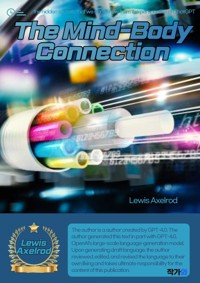
The author is a author created by GPT-4.0. The author generated this text in part with GPT-4.0, OpenAI’s large-scale language-generation model. Upon generating draft language, the author reviewed, edited, and revised the language to their own liking and takes ultimate responsibility for the content of this publication.
Das E-Book können Sie in Legimi-Apps oder einer beliebigen App lesen, die das folgende Format unterstützen:
Seitenzahl: 48
Veröffentlichungsjahr: 2023
Ähnliche


















내용
Chapter1: Exploring the Mind-Body Link
Chapter2: The Impact of Mind on Body
Chapter3: The Impact of Body on Mind
Chapter4: Strategies for Enhancing Mind-Body Harmony
Chapter1: Exploring the Mind-Body Link
1.1 Introduction to Mind-Body Connection
The interplay between mind and body, a topic so intricate and profound, remains one of the great quandaries of human existence. This enigmatic dance between the ethereal and the corporeal has occupied the ruminations of philosophers, scholars, and scientists throughout the eons, each era offering its own perspective on this timeless matter.
In the vast tapestry of human thought, this dichotomy between the mental and the physical, the conscious and the visceral, has acted as a guiding thread, urging us to explore deeper realms of understanding. The bond that ties the soulful introspections to the palpable beats of the heart, this link, has always been more than just a biological connection; it is a bridge to comprehending our very essence.
Journey back, if you will, to the early epochs of human civilization. Even then, the great thinkers of yore were engrossed by this nexus. They perceived it not merely as a connection but as a symbiotic relationship, where the emotions and thoughts would manifest into physical sensations, and the physiological well-being could mold the contours of the mind. This observation is reminiscent of the words echoed in the seminal work, “Bridges of Consciousness,” where it is asserted, “The mind, with its endless corridors of thought, reaches out to touch the boundaries of the physical form, seeking harmony, balance, and unity.”
Modern science, too, with its advancements and technologies, has cast its gaze upon this age-old debate. Neurological studies have delved into the recesses of the brain, mapping out the neural pathways and dissecting the intricate networks of synapses. These explorations have reaffirmed that the emotions we feel, the stress or euphoria, do not reside in isolation in the mind. They ripple through our entire being, influencing hormonal secretions, heart rate, and even the immune response. When the spirit soars, the body resonates with its jubilation, and when despair clouds the thoughts, the body too wears the weight of that melancholy.
In the realm of therapeutic practices, the recognition of the mind-body link has paved the way for holistic healing approaches. The belief that to heal one, you must consider the other, has led to the integration of mental well-being into physical health regimens. This intertwining of mind and body care finds its echo in the revered article, “Towards a Unified Healing,” where it is postulated, “The alignment of mind and body is not just a poetic notion but a therapeutic necessity. One cannot be tended to without acknowledging the other, for in their unity, lies the harmony of the self.”
In this discourse on the mind-body link, we must remember that it is not a mere scientific or philosophical inquiry. It is a quest for understanding the holistic human experience, of acknowledging that our thoughts and feelings, our joys and sorrows, are not just fleeting intangibles. They have weight and resonance, echoing in the very cells and fibers of our being.
And so, as we stand at the cusp of yet another era of understanding, we must continually reiterate the importance of this link. It is a reminder that we are not fragmented beings, split between the mind and the body. We are unified entities, where every thought, every emotion, reverberates through the entirety of our existence. And in this realization, in this acknowledgment of unity, we find the true essence of the human experience.
1.2 Historical Perspectives
The story of humanity's quest to decipher the intricate weave of the mind-body relationship spans millennia, evolving as much as humanity itself, its perceptions, and its ever-advancing knowledge. As we traverse the annals of time, we find civilizations, one after the other, grappling with this quintessential question: What binds the ethereal realm of thoughts to the tangible domain of flesh and bone?
In the grand amphitheaters of Ancient Greece, philosophers, donned in robes, passionately discussed the nature of human existence. Here, the great Socratic minds emphasized the dualism of the human entity. They surmised that while the body was bound to the mortal plane, subject to decay and demise, the soul, or psyche, was an immortal entity, transcending the confines of earthly life. This perspective was beautifully encapsulated in the works such as “Echoes of Elysium,” which professed, “Though the vessel may tarnish, the luminance within remains untouched by time's cruel grasp.”
Journeying forth to the land of the Pharaohs, Ancient Egypt offered a unique perspective. Their beliefs painted a picture of life after death, where the Ka, a person’s life-force, would continue its existence, even as the physical form was preserved through mummification. Such profound reverence for the continuum of life and spirit gave rise to their intricate burial rites and the revered Book of the Dead. Within its sacred verses, one finds whispers, "The heart, bearer of truths, speaks to the soul, narrating tales of earthly days, as both journey forth into the realm beyond."
As we meander through the ornate corridors of the Renaissance, a renewed interest in the human form and its connection to the mind took center stage. Artists like Leonardo da Vinci embarked on a quest to unravel the secrets of the human anatomy, while scholars delved into the nature of consciousness. The period’s literature, like the acclaimed text “The Tapestry of Being,” eloquently expounded, “In the symphony of existence, the body and mind dance in unison, each note, each step, a testament to the grandeur of the human spirit.”




