


Erhalten Sie Zugang zu diesem und mehr als 300000 Büchern ab EUR 5,99 monatlich.
- Herausgeber: Third Editions
- Kategorie: Lebensstil
- Sprache: Englisch
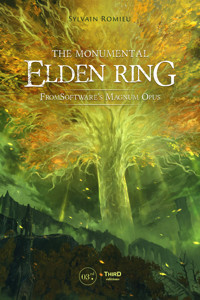
The result of a joint work between the creators of Dark Souls and the mind of George R.R. Martin (Game of Thrones), combined with an impressive seven years of development, Elden Ring is an extraordinary adventure. It's a monument whose gameplay and thematic depth are revealed over hundreds of hours of play and beyond fiction; Elden Ring is the source of long and fascinating discussions.
After co-writing the best-selling Dark Souls: Beyond the Grave, Sylvain Romieu continues his investigation into the intricacies of FromSoftware's creations. He uncovers the behind-the-scenes development of Elden Ring and the evolution of its game design, before turning his attention to the most important part: the meticulous deciphering of the lore and its thematic interweavings that make it the new benchmark for dark fantasy
Sie lesen das E-Book in den Legimi-Apps auf:
Seitenzahl: 560
Veröffentlichungsjahr: 2025
Das E-Book (TTS) können Sie hören im Abo „Legimi Premium” in Legimi-Apps auf:
Ähnliche


















Couverture
Mentions légales
The Monumental Elden Ring. FromSoftware’s Magnum Opus by Sylvain Romieupublished by Third Éditions10, rue des Arts, 31000 [email protected]
Follow us: @ThirdEditions — Facebook.com/ThirdEditionsFR — Third Éditions
All rights reserved. This work may not be reproduced or transmitted in any form, in whole or in part, without written authorization from the copyright holder.
Copying or reproducing this work by any means whatsoever constitutes copyright infringement subject to the penalties stipulated in French copyright protection law No. 92‑597 of July 1, 1992.
The Third Éditions logo is a registered trademark of Third Éditions, registered in France and in other countries.
Publishing Directors: Nicolas Courcier and Mehdi El Kanafi Edited by: Damien Mecheri Publishing Assistants: Ken Bruno and Ludovic Castro Text by: Sylvain Romieu Proofreading: Pierre Van Hoeserlande (copy preparation) and Charles Vitse (proofing) Layout: Bruno Provezza Classic cover: Ali Shimhaq First Print cover: Gabriel Amalric Cover creation: Marion Millier
This educational work is Third Éditions’s tribute to the video game Elden Ring.The author traces the history of Elden Ring in this unique compendium, which uses original thinking and analysis to explore the inspirations, context, and content of the game.
Elden Ring is a registered trademark of Bandai Namco and FromSoftware. All rights reserved. The cover art is inspired by Elden Ring.
English edition, copyright 2025, Third Éditions.All rights reserved.ISBN: 978-2-37784-556-9
Titre
SYLVAIN ROMIEU
TABLE OF CONTENTS
PREFACE
PARADOXICALLY, I am writing this introduction last. I’ve already finished writing the rest of the book. I’ve actually made a habit of saving the introduction for last. I find that doing so allows me to properly take stock of the work as a whole when writing an analysis or essay such as this one, especially with such a vast subject. Indeed, Elden Ring is a game that’s larger than life, almost monstrous in many respects.
There’s the colossal amount of work that went into the game’s production–seven years if you include the Shadow of the Erdtree DLC expansion, and around 1,600 people who worked on the project in one way or another.
There’s the extensive time needed for players to complete the adventure–150 hours on average when including the DLC, according to the website HowLongToBeat.
There’s the blockbuster sales–25 million units sold to date for the main game and 5 million for Shadow of the Erdtree, making it one of the top 50 best-selling video games of all time.
There’s the astonishing number of times players have died in-game–9 billion, an amusing figure announced by the publisher Bandai Namco a year after the game’s release.
There’s the deluge of awards given to the game by prestigious organizations– over 30 in total.
There’s the hundreds of hours spent on research and reflection for me to complete this book, which included countless branches and details on the massive family tree I sketched as part of that research, a solid foundation that helped me wrap my head around the game’s mammoth corpus of lore.
Moreover, there’s the tremendous and seemingly endless amount of content produced by the title’s community, teeming with all sorts of fascinating ideas and reflecting the richness of the game’s universe.
For all of these reasons and many others, Elden Ring is a monumental work, resulting from the unique ambition and cumulative expertise of FromSoftware.
Elden Ring is the studio’s magnum opus.
PART 1
CREATING ELDEN RING
CHAPTER 1
A BRIEF HISTORY OF FROMSOFTWARE
Before we dive into the making of Elden Ring, let’s take a few moments to examine the history of FromSoftware and the events that made it into such a beloved studio today1. Indeed, FromSoftware’s games have not always received such high praise from audiences and critics.
FromSoftware was founded in 1986 as a developer of business software. It wasn’t until 1994 that the company developed and self-published its first game. FromSoftware made King’s Field for the PlayStation, and while the game was never sold outside of Japan, it marked the start of a series of role-playing games that would largely lay the foundations for most of the studio’s future productions. Over the years, FromSoftware continued churning out titles at a prolific pace, including both sequels and games set in new universes. The studio’s games were almost always self-published in Japan, where the company built its expertise and a decent customer base. FromSoftware also began publishing many of its games internationally and developed a name for itself as a studio producing modest games that weren’t always the greatest, but which nonetheless offered variety.
Hidetaka Miyazaki joined the FromSoftware team in 2004, and several years later, he would completely transform the company’s reputation. Miyazaki, a former accountant, was enchanted by the ambiance and game design of the game ICO, released in Japan for the PlayStation 2 in 2001. After falling in love with the game, he decided to change careers to enter the world of video game development. He joined the FromSoftware team, cutting his teeth as a developer while working on an episode in the Armored Core series. From there, he quickly rose through the ranks to become a game director–the person who supervises the development of a game, both in terms of creative aspects and managing production constraints–for two other titles in the same franchise. His work as the director of Demon’s Souls (2009) marked a major turning point in his career. The game became the first in a long line of descendants, both direct and indirect.
A cryptic world ; confounding difficulty ; a dark-fantasy ambiance filled with despair ; asynchronous multiplayer mechanics, notably including the ability for players to leave informative messages on the ground for other players ; rich and original game design ; natural and surprising level design ; all of these aspects of Demon’s Souls were later baked into 2011’s Dark Souls, FromSoftware’s first big commercial success, selling over 2 million copies. Dark Souls was more polished and more open, with a more coherent universe and game design. What’s more, it benefited from better worldwide, multi-platform distribution, with simultaneous releases for the PlayStation 3 and Xbox 360, then for PC a year later. The game was FromSoftware’s first major collaboration with the publisher Namco Bandai Games (now known as Bandai Namco Entertainment), the two companies having previously worked together on less ambitious games.
Hidetaka Miyazaki continued to sit in the director’s chair for the offspring of Demon’s Souls and Dark Souls–with the exception of Dark Souls II (2014). This included Bloodborne (2015), which swapped out the dark-fantasy universe for a Victorian-style setting with a bit of Gothic flavor ; Dark Souls III (2016), the final entry in the series, widely considered to be a fitting ending ; Sekiro : Shadows Die Twice (2019), whose sword-based gameplay fit with its setting in feudal Japan ; and finally Elden Ring (2022), which transposed the Souls formula into an open world. Meanwhile, there were some big changes in FromSoftware’s structure. In 2014, the studio was acquired by a large company, Kadokawa Corporation. Shortly thereafter, Hidetaka Miyazaki was named president of the studio. It’s a role with lots of responsibilities and time-consuming duties, one that would seem to be incompatible with Miyazaki’s other role as a game director. However, one of his stipulations when he agreed to become the company’s president was that he would remain involved in game development and continue to work closely with the studio’s artists and developers.
This was especially important for Miyazaki as he has a very particular way of working with his team when he directs a game. He supervises everything, from the folds in the sleeves of modeled characters to the organic sequencing of shortcuts in level design. But even as he scrutinizes every minute detail, he remains open to suggestions from his team. He’s OK with being told that his ideas aren’t great, and he has no problem with implementing or exploring good suggestions submitted to him. Still, he drives the overall vision for the games he directs and personally writes the numerous bits of narration, description, and dialogue that cement the unique storytelling of his games. In short, Miyazaki is everywhere all at once and knows himself to be a bit of a micromanager. One has to wonder how he’s able to fit so much work into his schedule. The best explanation is that he knows how to dedicate his time to the things that matter, and it shows in the company’s results : since Miyazaki became president of FromSoftware, the studio has put out one great game after another, garnering numerous awards and honors, and the company has continued to grow its sales and improve its reputation with both critics and players. Moreover, Hidetaka Miyazaki puts his own ego low on the list of priorities, maintaining a low profile in spite of his success. For example, he grants few interviews, even during media blitzes around game releases. Simon Parkin, a contributing writer for The New Yorker, explained in his article published the day of Elden Ring’s release that Miyazaki had rescheduled their interview three times. Interviews are simply not a priority for Miyazaki, even with such a prestigious magazine !
To make a long story short, FromSoftware has sold 30 million units in the Dark Souls franchise and earned prestigious awards, including one given during the Golden Joystick Awards in 2021 to celebrate 50 years of video game history, the “Ultimate Game of All Time” award. The first Dark Souls took home the prize, beating out legendary titles like Doom, Tetris, and Super Mario 64. FromSoftware has created games that have inspired players and developers alike, and although the company is more modest in size than some of its big global competitors like Ubisoft and Electronic Arts, it still knows how to grab media attention and build excitement among its audiences with each new game announcement.
And all that was before the release of Elden Ring.
1 For a much more detailed analysis of FromSoftware’s history, refer to previous books published by Third Éditions on the studio’s games : Dark Souls : Beyond the Grave, volumes one and two, and Sekiro : The Second Life of Souls.
CHAPTER 2
THE SEEDS OF ELDEN RING’S DEVELOPMENT
A new organizational chart
Development of Elden Ring began in 2017, just after the release of the second and final DLC for Dark Souls III : The Ringed City. At the time, Miyazaki was supervising another game, Sekiro, and had to organize his teams in such a way that he could monitor both titles at once. For a time, he focused primarily on game design and art direction (for both visuals and music), and appointed two co-directors–a structure he’d previously experimented with on Dark Souls III–so he could delegate all other aspects to them. He selected Kazuhiro Hamatani (lead game designer for Bloodborne) and Yui Tanimura (director of Dark Souls II and co-director of III) for Sekiro and Elden Ring, respectively.
There were changes to the rest of the team structure, with the addition of a top level of managers that had been absent from FromSoftware’s previous productions. Miyazaki added directors of programming, gameplay, level design, environment art and character art, battles, etc. In all, ten directors took the reins of departments that had previously been managed by their respective “leads” (lead programmer, lead level designer, etc.), even while the leads remained part of the team structure. This new level of management allowed the leads to better support their teams, letting them focus on technical ideas and decisions, rather than strategic ones. More broadly, the new organizational chart aimed to respond to the needs of the team’s growing headcount and the high ambitions for Elden Ring. The website MobyGames lists 1,629 people who took part in the game’s development, including the staff of contractors and publishers, versus 1,099 for Sekiro and 744 for Dark Souls III.
In 2017, at the very beginning of the project, before the studio got its full team working on Elden Ring, FromSoftware’s leaders began imagining what the new game might look like. The general idea was to make a “Souls-like” game, following in the footsteps of the studio’s storied titles, but with a much bigger, more open world to offer players new sensations and more in-depth exploration. Miyazaki had already announced the previous year that he was personally done with the Dark Souls series–comments that were reported by Brian Ashcraft on the website Kotaku (September 21, 2016). However, he still wanted to draw from the dark fantasy genre for his next game, just not in connection with the universe and themes of Dark Souls ; in other words, he wanted to experiment with new ideas that might be incompatible with the studio’s flagship series. While the initial concepts for the world of Elden Ring trended more towards classic fantasy than dark fantasy, something important happened early in the world-building phase that helped the studio in its goal of breaking away from the constraints of Dark Souls : FromSoftware’s leaders got the idea to outsource the world-building for their new game to someone not just outside the company, but outside the world of video games entirely, someone with a keen sense of the dark fantasy genre. They turned to one George R. R. Martin.
The writer
George Raymond Richard Martin is a man who needs no introduction. He is the author of several best-selling novels and the producer, and occasional screenwriter, of hit TV series. His A Song of Ice and Fire series is, without a doubt, at the heart of his work : it is a series of novels published over the last few decades that have been read by millions of readers and adapted by the American TV channel HBO into the series Game of Thrones, which in turn was watched by millions of viewers over the years. Martin was also involved in the production–and even provided the voice for a character made in his likeness ! –of the Game of Thrones video game released in 2012, a fairly typical RPG developed by the French studio Cyanide. While A Song of Ice and Fire was already a highly respected series of novels, with numerous prestigious awards to prove it, the franchise reached the height of its popularity with mainstream audiences during the era of the TV series, from 2011 to 2019. George R. R. Martin, who was heavily involved in the HBO adaptation, became a household name, famous for his dark stories of plotting, betrayal, twisted families, and bold, memorable characters, as well as for his habit of killing off his protagonists, no matter how important, without any warning or moral qualms. He was even named one of the 100 most influential people in the world in 2011 by Time magazine. All this to say, whether in writing or in images, Martin has enthralled and traumatized generations of fantasy lovers, or in any case, fans of a darker type of fantasy that’s more realistic than other classics of the genre.
Hidetaka Miyazaki counts himself among those fans of George R. R. Martin. And not just for A Song of Ice and Fire, which he certainly loves. In various interviews, Miyazaki has cited Tuf Voyaging, a collection of science-fiction novellas, and the horror novel Fevre Dream, which he considers an absolute masterpiece.
From early in the project that would become Elden Ring, the Japanese creator dreamed of collaborating with Martin to create the universe for the new game. However, he hesitated to make the ask, fearing that the writer would categorically refuse. Finally, his executive producer, Eiichi Nakajima, took the plunge and contacted Martin. The author accepted the proposal, and even mentioned his appreciation for the Dark Souls games, even though he’s not actually a gamer himself, as he has written on his blog2 (December 18, 2021). Incidentally, in that same blog post, Martin mentioned some of his favorite video games from back in the day, listing management and strategy games from the 1990s, particularly Railroad Tycoon, Romance of the Three Kingdoms, and Master of Orion. So, Miyazaki breathed a sigh of relief and a meeting was scheduled.
In spite of some anxiety, particularly about their 26-year age difference and the language barrier, the first meeting went well. From there, the two creators talked regularly, and Miyazaki laid out for Martin his vision for the game, including its major themes and certain ideas that he wished to put into action in the new universe. On the Xbox official website (article dated June 9, 2019), Miyazaki explains what this period was like : “[We had] many free and creative conversations regarding the game, which Mr. Martin later used as a base to write the overarching mythos for the game world itself. This mythos proved to be full of interesting characters and drama along with a plethora of mystical and mysterious elements as well.” Miyazaki then adds : “Elden Ring’s world was constructed using this mythos and stimulus as a base.”
George R. R. Martin laid the foundations for the new universe and, importantly, described the history of the Lands Between, the fictitious region in which the game takes place, including its peoples, important families, and the connections between them. He established what the game’s world was like up until the Shattering, a crucial event that occurred some 5,000 years before the events of the game3. Miyazaki explains the approach to IGN (June 21, 2019) : “Storytelling in video games–at least the way we do it at FromSoftware–comes with a lot of restrictions for the writer. I didn’t think it was a good idea to have Martin write within those restrictions. By having him write about a time the player isn’t directly involved in, he is free to unleash his creativity in the way he likes. Furthermore, at FromSoftware, we didn’t want to create a more linear and story-driven experience for Elden Ring. Both issues could be solved by having Martin write about the world’s history instead.”
So, the Japanese creator’s very peculiar style of fragmented storytelling, as seen in his previous games, was once again used for Elden Ring. We will examine this approach in detail in the second part of this book, dedicated to the game’s story and universe. For now, I’ll just mention that the story is broken up into pieces like a jigsaw puzzle, with each piece cleverly hidden in dialogue and the descriptions of objects, but also in various elements of the backgrounds and in the characters’ style of dress and battle habits. As such, it’s hard for a player to mentally put that jigsaw puzzle together, especially since many pieces are (purposely) missing, leaving room for each individual to use their imagination to fill in the holes. This type of storytelling is a real trademark of FromSoftware, and especially of Miyazaki, who typically writes all or some of the script for objects and dialogue in his games. For Elden Ring, given the volume of content, he did a lot of reviewing of other people’s work. However, he notes in an interview with Famitsu (June 14, 2021) that he wrote a large portion of the text himself. In this, we can see why Miyazaki insisted on “micromanaging” every aspect of his project, as mentioned previously, always striving to ferret out any inconsistencies and set aside any elements that might reveal more than intended. It was a delicate exercise, particularly when paired with the game’s story, which is in many cases more complicated than it initially seems. To understand the story, you need to understand the universe’s past, with a hazy timeline that makes interpretation difficult. It all adds up to a sort of mythology, or “lore, ” composed of the universe’s peoples, gods, heroes, and great tragedies.
So, George R. R. Martin developed the history and mythology–the lore–for Elden Ring. He wrote a sort of world-building bible, which Miyazaki has compared to the kind of guide used by a game master in a tabletop role-playing game. While developing the game, Miyazaki was able to draw from that “bible, ” which lays out the key features and laws of the game’s universe, along with descriptions and histories of various figures, and even small anecdotes, which, though they may seem trivial, are essential for enriching the story, fleshing it out, and giving it a certain credibility. In his interview with The New Yorker (February 25, 2022), Miyazaki notes : “In our games, the story must always serve the player experience. If [Martin] had written the game’s story, I would have worried that we might have to drift from that. I wanted him to be able to write freely and not to feel restrained by some obscure mechanic that might have to change in development.”
G.R.R. Martin delivered his world-building work well before production of the game began in earnest. After the fact, Martin was amazed at how long the development process took, as he no longer participated in the project after writing his part of it. From time to time, FromSoftware would send him examples of designs for characters or creatures, and even a few visual effects. So, the studio kept him in the loop for a while, but Martin no longer had any direct involvement in working with the lore he’d created.
That said, the game’s universe continued to evolve throughout the development process. For example, the Erdtree, the giant, sun-like entity that can be seen from every corner of the Lands Between, was added later, as Miyazaki recounted in an interview with the magazine Weekly Famitsu (March 10, 2022). All of the events set in the game’s present were built on the foundation laid by Martin. Interestingly, the fantasy author has always employed a similar approach, focusing on the history, major themes, and mythology, rather than on the crafting of dialogue or the fate of his characters. Incidentally, when IGN (June 21, 2019) asked Miyazaki about the possibility of the best-selling author writing a book based on Elden Ring, he responded : “A novelization would mean that all the secrets and mystery hidden in our game would be revealed. From the point of view of a director, I’m not sure if that would be the right thing to do.”
Secrets and mystery have always been at the heart of FromSoftware’s games, whether in their respective universes, made to be as cryptic as possible, complex and sometimes unclear rules in game design, and even in their development. As I’ve said previously, Miyazaki grants very few interviews, and his team grants even fewer. Their responses are always meticulously measured ; they make sure to never reveal too much about their work methods or their creative approach. So, all official information on Elden Ring has been delivered in dribs and drabs over several years, with tight control by FromSoftware and Bandai Namco, which once again served as the studio’s publisher after Activision took on that role for Sekiro. All that in spite of audiences and the media being eager for all the information they can get. Unfortunately for the companies, the announcement of their new title did not go quite as planned.
The announcement
In chronological order : George R. R. Martin was the first to mention his involvement in a Japanese video game, doing so in a long blog post in which he bid farewell to the Game of Thrones TV series, which had aired its final episode a month earlier in May 2019. No other information was provided, whether about the game in question or even the studio making it. However, rumors began to circulate suggesting a connection with an upcoming title from Miyazaki. Still, the gaming world would have to wait several months before learning any more about the mysterious collaboration mentioned by the author.
Even as audiences awaited the announcement of a DLC for Sekiro, the game having been released earlier in the year, FromSoftware suddenly and unexpectedly found itself making headlines in the video-game world. Due to a security flaw on the Bandai Namco website, Daniel Ahmad (alias ZhugeEX), an analyst specializing in the Asian video game market who is very active in the gaming community, revealed confidential data on FromSoftware’s upcoming game on June 7, 2019. He was able to share the name Elden Ring, the logo with interlocking golden circles, the platforms that would receive the game, and the fact that it was the much-talked-about collaboration with George R. R. Martin.
The official announcement was made a few days later at the 2019 edition of E3, the video-game industry trade show, with a trailer packed with mysteries. Eagle-eyed viewers will note that the trailer actually revealed one of the game’s biggest secrets, concerning the link between Marika and Radagon, which we will discuss in detail in the second part of this book. The unveiling of a new game by FromSoftware is always a big event, but the tagline “A new world created by Hidetaka Miyazaki and George R. R. Martin” pushed the excitement to the next level. After the announcement, the team granted a handful of interviews, in which they shared a basic overview of the new game. However, over the next two years, no additional information was shared with the public. Even still, at the Game Awards, Elden Ring was named the “most anticipated game” in both 2020 and 2021. So, well before its release, the game had a real aura around it.
Development under constraints
Little information about the actual development of Elden Ring has been shared in FromSoftware’s official communications. However, we know of two things that created real challenges for the game’s team.
When the project was first launched, a portion of the studio’s employees were still busy with Sekiro. Miyazaki managed both projects at the same time, but he has noted several times that the two games did not really influence each other. On the PlayStation blog (January 28, 2022), Miyazaki discusses the overlapping development period : “I’d have to say that, [even though] Sekiro’s development overlapped with Elden Ring’s to an extent, there’s nothing that directly came through from that [Sekiro] project. But there were several indirect examples there. For instance, the enemy stance break mechanic in Elden Ring is similar to Sekiro’s successful posture system. We even referenced Sekiro’s player traversal for the horse mounting system and how you traverse the map in Elden Ring.” Indeed, players enjoy very fluid movement as they explore the Lands Between on horseback, especially with the double jump, which allows you to reach great heights, much as you can with the grappling hook in Sekiro. Players also have the ability to break an adversary’s stance, although Elden Ring differs from its predecessor by hiding this stat. In contrast, Sekiro’s more intimate approach to storytelling, with a true protagonist instead of the “empty shell” avatars found in the studio’s previous games, did not return in Elden Ring. On the other hand, the game’s designers focused more on character development, an approach likely introduced by George R. R. Martin and his descriptions of the major families of the Lands Between.
Working on two projects at once, especially with a title as ambitious as Elden Ring, requires considerable resources. As we’ve already seen, FromSoftware seriously beefed up its teams, both internally and by outsourcing to partners, but hiring more help isn’t the only solution for the problem of development lead times. For example, the studio saved time by having 80 % of the open world’s vegetation be procedurally generated, with staff making manual touch-ups afterward. For comparison, almost everything was done by hand in Dark Souls, in which the environments were much more limited in size. What’s more, as Elden Ring was produced by Bandai Namco, the publisher of Dark Souls III, FromSoftware was able to reuse numerous assets, including both graphic and audio resources, and also probably part of the older game’s engine. Of course, a lot of work was required to adapt the game engine to handle an open world, not to mention the work required for the thousands of new assets that had to be created, but without that foundation, the game’s development would have taken a few years more, or it might never have gotten off the ground as the level of risk would have deterred all sources of funding. Miyazaki suggested as much in an interview with 4Gamer.net (June 24, 2022). All in all, the game took five years to create. At the same time, that length was influenced by an external factor that no one saw coming and which affected literally the entire world : the COVID-19 pandemic.
In 2020 and 2021, Miyazaki had to deal with all sorts of complications : staff out sick, everyone working remotely full time, and eventually shortages of certain pieces of computer equipment. That was true for the Elden Ring project, but also for the rest of FromSoftware, as Miyazaki is the company’s president. He talked about these difficulties to Edge magazine (issue 367, February 2022) : “It would be false to say it didn’t affect Elden Ring’s development in any way–we had to change how we approached a lot of the aspects of game development, including communication, which was obviously a big part of it. It was a big challenge to adapt at first, but we succeeded thanks to the team.” Before the pandemic, FromSoftware had already started allowing its employees to work remotely more often, but the new constraints, which came on fast and strong, really interrupted the company’s routine.
The homestretch
In June 2021, during the annual Summer Game Fest, FromSoftware showed a new trailer for Elden Ring. Unlike the video revealed two years earlier, the new trailer was made up entirely of sequences from the final game. The audience got its first look at the Lands Between, along with a steed, dragons, and a slew of bosses. The trailer was a big hit and ended with the announcement of a release date : January 21, 2022. It was also revealed that the game would be available for the latest generation of consoles, the PlayStation 5 and Xbox Series X and S.
The release date was eventually pushed back to February 25, 2022. “The level of freedom that we wanted to ultimately achieve in Elden Ring exceeded what we were initially planning for. This [complexity] gradually built up, and the time needed to debug and QA in particular took a lot more effort, ” Miyazaki explains in the Edge interview. Was this delay caused by pandemic complications or did Miyazaki want to avoid wearing out his team with a brutally long crunch time ? Again, it’s hard to know exactly what was happening inside FromSoftware. While Miyazaki has tried to ensure optimal working conditions for his team, telling 4Gamer.net that the work environment has greatly improved in recent years, he also talks about a “peak time of development” in his interview with Edge.
Anyone who has worked in the realm of software is sure to be familiar with these “peak times of development.” As a delivery or “code freeze” (when you can no longer touch the source code before it’s sent into the final testing phase) date draws near, any number of situations can imperil the late stages of development, including last-minute critical bugs and outages of crucial infrastructure. And then there’s the unfortunate fact that developers can almost always count on Murphy’s Law : “anything that can go wrong, will go wrong.” There are all sorts of tools to help prevent these kinds of situations, along with proper upstream risk management, with choices made accordingly. But in spite of all that, studios are rarely able to avoid a peak in activity in the critical final stages of development. With a bit of lucidity and the right decisions, it’s manageable. But otherwise–and this is unfortunately often the case for projects under strong financial pressure or with high anticipation, as in the video game world–that peak in activity can extend over a longer period and become a true “crunch time.” It’s a vicious circle in which exhaustion and distraction, or even circumvention of procedures to save time, can lead to new problems and drag everyone into development hell.
In any case, Miyazaki has described a “peak time of development” for Elden Ring, but he still tried to ensure proper working conditions for his employees. And that’s all we’ll ever know, at least from official channels. A few months after the game’s release, a number of articles described appalling reviews of FromSoftware from its employees on the Japanese community website Career Connection. Indeed, the studio received some less-than-admirable scores and comments on the site, shining a light on problems with gender parity and equality, as well as a lot of regular overtime work. If we take a closer look at the reviews, the worst ones are several years old, with some from 2016 and 2015, but most from 2012. In November 2022, a new article on the subject was published on the website Games Industry. This one relied on more recent testimonials, though the individuals remained anonymous as FromSoftware does not allow its employees, whether current or former, to give interviews. Depending on the department, some of those interviewed described two to three months of crunch time, along with fairly low pay given the amount of work they did. On FromSoftware’s official website, all of the company’s job postings list a generic monthly salary starting at 260,000 yen (as of November 2022), or about $1,857, with actual amounts varying according to the candidate’s skills and experience. Staff also get two bonuses per year. For comparison, that’s slightly above the lower end of the normal pay range for a video game developer in Japan, which is about $1,648, according to the reference values on the website SalaryExplorer. We don’t have much more concrete information than that, especially since the Games Industry article is vague on a number of points, such as the actual number of people they talked to or the departments in which those people work. It’s a touchy subject and FromSoftware has refused to comment on it, which doesn’t help us get a firm and objective understanding of the situation. Moreover, the article in question says that not everyone the journalist talked to was unhappy. It ends with a short paragraph mentioning “multiple sources”–once again, a vague description–who had a positive experience. Whatever the case may be, we hope that FromSoftware’s management is taking working conditions and respect for employees seriously, and more importantly, that management is constantly working to improve them.
Returning to the delay in Elden Ring’s release, one month is not actually that much of a delay. That extra month was barely enough time to fine-tune a day-one patch that corrected a few critical bugs after release. That said, one month can also be the time a team needs to catch its breath and gain some clarity, depending on the state of the project they’ve been working on. Although the game was very highly anticipated, the announcement of the delay was received quite positively. Over the years, audiences have come to realize the complexity of developing a video game and they generally prefer to wait a little longer in order to get a better level of polish and a better experience. In any case, the video-game market is so diverse and intense that players are never bored.
In spite of the extra month for testing the game and fixing bugs, several critical issues remained when the title was released, including failures to save on the PlayStation 5 and unstable performance for the PC version. As some players experienced an inexplicable drop in the frame rate and jerky performance, things started to get heated. On the day of the game’s release, Bandai Namco published on its website a list of known problems, with a few work-arounds, particularly for saving issues–after all, what could be worse for a player than losing their progress ?
Thankfully, most people had no problem while playing the game. And so, on February 25, 2022, millions of people–over 760,000 on Steam alone–finally discovered Elden Ring, diving into an unknown and hostile world, for an experience much more intense and extensive than most players probably expected. For weeks, which flew by for players exploring the Lands Between around the clock, the media devoted all its attention to FromSoftware’s latest production, leaving all other announcements and releases by the wayside. But before we talk about the game’s critical and commercial success, a record-shattering period for FromSoftware, let’s examine in more detail what the game itself has to offer.
2 George R. R. Martin regularly uses his personal blog, entitled Not A Blog, to publish various announcements and musings. While this means of communication is a bit, shall we say, “vintage”–the blog has been around since 2005–it nonetheless lends a certain authenticity to the larger-than-life figure that is G.R.R. Martin.
3 Martin revealed this number in an interview on The Late Show with Stephen Colbert, broadcast on October 25, 2022. When asked about the popularity of Elden Ring, the writer briefly summa- rized his collaboration with FromSoftware five years previously. Martin seems to have selected this “5,000” number at random as a way of saying “long before the events of the game.” But otherwise, it would be the one and only specific indication of a clear timeline in the entire game !
CHAPTER 3
CONCEPTS AND DESIGN
Open world
n Let’s define it
The open world is not a genre, but rather a way of designing a game’s environment. It offers a response to linear games that unfold through a series of levels and narrative sequences, with a certain control over the pacing (X passage is estimated to take Y time to complete), but also over the difficulty (the first level is easier than the fifth), the progression of the story (information given at the end of a level will lead to revelations in the next), and even rules in the game design, since it’s easier, for example, to add or experiment with a more complex gameplay idea within a clearly defined level.
This classic and effective structure is obliterated when you design your game as an open world, in which the goal is generally to offer a more immersive experience, giving the player much more flexibility in discovering the game’s universe and story. The freedom of movement given to the player, and thus the ability to really explore, makes it impossible to “organize” the player’s experience into levels, i.e., units in a sequence, or at least organized into a carefully thought-out order. It’s true that the designers can always orient the player’s progression with a main storyline, or even block off certain zones, whether physically with sealed passages or cliffs, for example, or artificially by ramping up the difficulty to an insurmountable level, a sign that the location in question is outside the natural sequence of the adventure. But the designers must be careful, as imposing too many restrictions detracts from the open-world experience. Thus, the openness of the world will depend on how much the designers wish to control the experience they offer to players. As a result, some games offer semi-open worlds, others are much more closed and linear while giving a false impression of openness (which is not at all meant to be a criticism), and others still offer so much freedom that it’s almost like playing in sandbox mode. All sorts of different games offer open worlds, and that’s what makes this approach so difficult to date and define. Still, we can retrace the evolution of open-world philosophies to better understand the approach used in Elden Ring.
n Emergence and evolution
The Legend of Zelda (1986) was one of the first mainstream games to offer an open world. Up to that point, only a niche group of PC gamers had been familiar with the concept, for example, people who played the RPG series Ultima, of which the first installment was released in 1981. In fact, The Legend of Zelda adopted certain ideas from Ultima, like the top-down perspective. This was revolutionary at a time when most games were side-scrollers, in which the avatar is seen in profile and moves from left to right to advance. Changing perspective opened up new directional possibilities. With the newfound ability to explore to the north, south, east, and west, players’ relationship to the world and gameplay therein changed radically, and The Legend of Zelda became an instant classic. Years later, Ocarina of Time (1998), which successfully brought the series into a 3D universe, introduced its own bundle of innovations while at the same time taking a step backwards in terms of the player’s freedom to explore. Indeed, the only truly open area in Ocarina of Time is Hyrule Field, which serves as a hub between other, more closed areas ; however, the game offered the novelty of allowing players to cross Hyrule Field on horseback. The cycling between day and night in the game also had an impact on the changing standards for open worlds. The idea of a very open central hub that links together more limited and detailed areas, like villages and dungeons, became quite common in a segment of games aiming to offer more openness without giving the player total freedom. It became a good compromise for a semi-open world, while illustrating the difficulty of developing such an approach in a fully 3D environment.
For that very reason, 2001’s Grand Theft Auto III was viewed as revolutionary. The title from Rockstar Games impressed the industry with its sandbox-style world. The first few installments in the series had already allowed players to freely explore the streets of an entire city, whether on foot or by car, and to live the life of a gangster while completing various missions for the local organized crime syndicate. But with one (huge) difference : they were in 2D. GTA III brilliantly brought the series into a 3D world, managing all of the implications of a revamped game design (shooting, driving, freedom of action, etc.) and changed perspective, thus setting a new standard for open worlds and the immersiveness that’s so important for game designers.
The Elder Scrolls is another hit series of games that has always preferred to offer an open-world experience. Among the most notable in the series, the third installment, Morrowind (2002), delivered an enchanting, “handmade” open world, in which every element was placed manually, from the vegetation to the houses in the various villages. This was in response to the game’s immediate predecessor, Daggerfall, with its 80,000 square miles (200,000 km²), 15,000 towns, and 750,000 characters, all procedurally generated using algorithms. That approach allowed the developers to automatically create a large volume of content using some basic rules ; however, it naturally results in a lot of redundancy or, as in the case of Daggerfall, a lot of emptiness. Morrowind went in the opposite direction, with absolutely everything being carefully crafted in a much smaller world, but one which was still quite vast. Additionally, the 3D graphics added a vertical dimension to the universe, and the developers also put special care into creating various side quests. While playing the game, it’s not uncommon to get side-tracked far from the main plot as you solve the problems of different villagers or complete guild missions to climb through the ranks. It’s fascinating stuff. With Morrowind, the open-world concept opened up further, moving in the direction of a captivating universe in which the player’s interest is constantly renewed by the game’s storytelling. Skyrim, the fifth volume in the Elder Scrolls saga, was also extraordinarily successful, outperforming Morrowind by far : as of 2023, the game had sold over 60 million copies. That’s an astronomical figure that reflects the larger-than-life nature of the epic adventure, which has inspired numerous developers over the years. While Morrowind already contained the heart of the Elder Scrolls open-world philosophy, Skyrim brought the concept to a much wider audience. In Skyrim, even more than in its predecessors, the player follows the on-screen compass, but also intriguing sights. What secret might be hiding on the snow-capped peak ? What treasure might this cave have in store for me ? Via the approach to its level design, Skyrim became a real free-roaming game, in which the player explores all the different natural structures in the game’s snowy environment.
At the same time, the open-world concept received some major updates from Ubisoft, which became one of the most prolific publishers of games using the approach. The amazing Assassin’s Creed (2007) established a number of elements that were perfected two years later in its sequel, notably an approach based on the placement of numerous point-of-interest icons on the map. While at first refreshing, this strategy was then deployed ad nauseam in most of the studio’s productions. It has gotten to the point that many players now lament this systematic approach : scaling dozens of towers to find pieces of a map, collecting tons of resources and other objects, completing numerous side quests that are often generic and rarely interesting, whether in terms of gameplay or in terms of storytelling. All of these ideas–which, while acceptable, get truly repetitive over dozens of hours of gameplay and over dozens of games–were infused into the specifications for many other projects after the commercial success of Assassin’s Creed. As such, for many years, a whole host of studios tried to apply the Ubisoft formula, often with lackluster results. The problem was only made worse by long development lead times and the resulting inertia. Meanwhile, many gamers found themselves getting increasingly frustrated with this standardization.
That said, as open-world games became more common, they also became more diverse. While there were more and more RPGs and action-adventure games, other genres tried their hand at the open world : racing games like Burnout Paradise (2008) and Midnight Club : Los Angeles (2008), pirate games like Assassin’s Creed IV : Black Flag (2013), puzzle games like The Witness (2016), and the astounding Mortal Kombat : Deception (2004), setting a “versus-fighting” game in a semi-open world. And then came The Witcher 3 : Wild Hunt (2015), which brought its own innovations to the open-world concept, this time in terms of storytelling. The two previous series installments had also put an emphasis on storytelling aspects, with fascinating quests and characters ; however, they were set in semi-open levels. The ambition for the third installment was to bring that same quality of writing into a fully open world. The thing is, those two things are often incompatible. Indeed, most often, an open world means dull “filler” quests with very little connection or interaction between them. As the player can explore every part of the open world in any direction and complete quests in any order, storytelling is often a weak spot for these games. Fallout : New Vegas (2010), in its time, succeeded in pairing good writing with real choices affecting the fate of the player’s avatar. However, with its modest budget, the game was unable to go toe-to-toe with AAA titles, whether in terms of the target audience or production values, and that’s where The Witcher 3 shined upon its release. It’s an incredible world, a long and dense game, and above all, it has outstanding writing. While the game’s main quest is, overall, pretty conventional, the creators put a lot of effort into developing the secondary characters and side quests. The side quests, in particular, are truly captivating, at least for the most important of the lot. It’s not unusual for them to intersect with one another, with references to certain situations and characters. This gives the whole a real sense of coherence, making for a natural, organic progression. Unsurprisingly, given its complexity, this storytelling system is not free from bugs. But sincerely, we can salute the game’s boldness and ambition, which it accomplished, as it set a new standard for storytelling in an open world. It meant that, going forward, competitors would have to get out of the comfort zone of humdrum, independent side quests. To do so, studios would have to reach farther into their already deep pockets to develop convincing storylines.
Over the years, the standardization of AAA games–the big blockbusters of the video-game industry, with colossal budgets to match their colossal sales ambitions – gradually trended toward the use of open or semi-open worlds. The RPG series Final Fantasy offers some interesting examples. The series’ twelfth episode (2006) largely opened up its areas for exploration, while the thirteenth episode (2009) imposed a very linear and closed first part before offering a much more open environment once the characters arrived on Gran Pulse. Final Fantasy XV (2016) implemented a true open world, through the lens of a strange road trip with a gang of friends, on the tragic backdrop of a war between kingdoms. The increasing power of gaming consoles from generation to generation has made it possible to open up game environments, but as we’ve seen, developing such games remains a long and expensive process, making them risky undertakings. Indeed, the development of Final Fantasy XV was absolute hell and lasted for at least a decade, first being announced in 2006 as a spin-off from the thirteenth installment in the series.
Another game-changer arrived in 2017. Inspired by Skyrim, Breath of the Wild (2017) marked the return of the Zelda franchise to a completely open world, as first popularized by the game’s ancient ancestor. Breath of the Wild actually transcended that legacy by offering a multitude of ideas which, while not necessarily new, had never before been integrated so cleanly. The game is a giant sandbox, with logical and natural laws of physics. Wood burns, metal conducts lightning, you can die of cold or collapse from exhaustion, etc. The result is what’s called “emergent gameplay, ” meaning that each player comes up with their own way of progressing through the adventure, solving puzzles, and fighting the most formidable foes. Moreover, everything is explorable and anything can be climbed. It was a real crowning achievement for the open-world concept after three decades of experimentation. Added to that were a few truly intriguing elements, like the map. A true blank map, nothing like the standards seen in the 2010s with maps covered in dozens or even hundreds of annotations, some relevant but many not. In Breath of the Wild, the player adds their own notes. They have a vague notion of which direction they need to go, guided by a series of quests from the beginning of the game, but they don’t know exactly what path to follow. The player is forced to observe their environment to get their bearings. This choice in game design went against the grain, but offered a breath of fresh air for aspiring explorers.
Death Stranding (2019) is another open-world game that stands out from the crowd. Developed by Kojima Productions, and thus by creator Hideo Kojima, best known for the Metal Gear series, Death Stranding is a game centered on delivering packages in a post-apocalyptic world. The title really threw down the gauntlet, challenging the many open-world games filled with many such tasks, referred to as “FedEx quests, ” often criticized and viewed as uninteresting. Death Stranding went ahead and centered itself entirely on these quests ! Of course, the game has much more to offer–great writing and a fascinating journey, among other things–but on its face, it was a perplexing choice. A game with walking at the heart of its gameplay : that wouldn’t be an easy title to market if it wasn’t for the name of the creator. In any case, the game was reasonably successful.
So, the open-world mode of game design has continued to gain traction and has been the subject of a wide range of experiments. And that’s true not just for AAA productions, but also for independent studios with more modest budgets, who have tried to approach the “genre” differently, particularly in terms of storytelling, offering, for example, a more minimalistic story, free of NPCs and explicit side quests. There’s Subnautica (2018), which followed a popular trend at the time of survival-oriented open worlds, popularized by Minecraft (2011), adapting the concept to a hostile underwater world. The game involves fascinating discoveries in different stages, each offering different crafting possibilities and deeper knowledge of the environment. Then, there’s the equally fascinating Outer Wilds (2019), set in space, which offers a new approach to an open world, reaching the scale of an entire solar system that only exists and evolves for a fixed period of time before resetting. The entire game is a puzzle, an enigma, in which freedom of exploration is crossed with segmented storytelling and the need to decode the universe’s mysteries. It’s a mystifying experience. At the beginning, everything seems foreign, but the player learns the ins and outs as the game progresses. Indeed, there’s no need to be a gaming veteran to play Outer Wilds, as experienced players will find themselves just as lost as novices. The player must observe and learn–some basic instructions that also happen to characterize the games of FromSoftware. Could it be, then, that the open-world approach has been a natural evolution for the studio’s games ?
n FromSoftware productions
Indeed, what about the Souls games, Bloodborne, and Sekiro ? Are they open worlds ? Well, no, not really, although they have borrowed some interesting ideas and sensations from some of the games previously cited.
Demon’s Souls offers open levels, but they are not directly connected to one another. The player can use five “Archstones” to travel to the different levels, which are each divided into several segments. Each level offers a certain degree of freedom, particularly thanks to ingenious level design, and is dotted with shortcuts to facilitate exploration and help the player build a mental map of the spaces. There’s no on-screen map ; the player must follow their own sense of direction and learn organically how to get around. Demon’s Souls also introduced an element that would become a mainstay for its successors : the game’s segmented, puzzle-like storytelling. While the title’s storytelling isn’t necessarily typical of open-world games, it does encourage the player to explore every nook and cranny in hopes of finding an object or a clue that might reveal a little more of the lore of a particular area. And indeed, players are rewarded for their efforts.
The Dark Souls games and Bloodborne offered more openness, transposing the Demon’s Souls formula, including its storytelling, into a series of coherent and connected environments. The already-successful level design was adapted to the rest of the game environment, with shortcuts connecting different areas in all sorts of improbable ways. Dark Souls added a significant vertical dimension to its semi-open world, making the game environment feel both enormous and labyrinthine. While this perception is absent from the first few hours of gameplay, as indications remain brief, you feel it more and more as the adventure progresses. Not every area is accessible at the beginning of the game–far from it–but the player can follow several different paths, creating a certain sense of freedom. Dark Souls II and III maintained the major aspects of the first installment, but with a more linear construction, while still offering choices for exploration–first this zone, then that zone–without really imposing a specific order or logic. The third installment, while not actually offering an open world, visually creates the impression of one, as Drangleic Castle is the central point of the game, both geographically and narratively. It can be seen from most areas of the game, which allows you to easily get your bearings. It serves as a real spatial marker, even if it can’t be accessed in a straight line from any given location, as there is only one path to get there.
Finally, Sekiro kept the same spirit, even while being a bit more restrictive, or even more linear. On the other hand, it added gameplay elements that reinvigorate the sensation of freedom. Jumping–it’s impossible to do a good and useful jump in the Souls games ! –and the grappling hook add a bunch of vertical movements, and it’s not unusual in the game to visit different areas by crossing over rooftops, adding new perspectives, both visually and in terms of gameplay.
n Great expectations
Again, none of FromSoftware’s previous titles could claim to offer true open worlds. They borrowed some ideas from the open-world concept and experimented with various sensations, but just as they did with many other concepts and genres. They did, however, revolutionize–or at least significantly update–the action-RPG genre with certain game design rules now used here, there, and everywhere in recent productions, and a style of level design that many studios have tried to reinterpret in their own games. The Souls games, especially Demon’s Souls and Dark Souls, truly left their mark on the entire video game industry.
For that very reason, when a new game from Hidetaka Miyazaki was announced, it got the attention of the entire gaming world. Especially given that the game would take on the new challenge of offering an open world. As we’ve already seen, the open-world approach is a costly one, and while trendy, an open-world game can end up being disappointing or even redundant once in the hands of players. Excellent open-world games are rare, and even rarer still are those that update the recipe with zesty new ingredients. Still, there are success stories, like Horizon, Ghost of Tsushima, and the Marvel’s Spider-Man games, which stand out from the crowd thanks to their universes and gameplay sensations.
Although games like Breath of the Wild and Death Stranding have proved that it’s possible to make a hit while infusing an open world with a different philosophy, the “Ubisoft way” remains very popular and relevant as it meets the primary expectations for an open-world game : immersion and a feeling of freedom, reinforced, moreover, by increasingly stunning graphics.
Indeed, a few years before Elden Ring, a AAA game with an open world made its mark on the video-game industry thanks to its bold, extraordinary vision : Red Dead Redemption II (2018). Developed by Rockstar, the studio behind the emblematic GTA series, Red Dead Redemption II took just about everyone by surprise when it was released. Both for better and for worse, mind you. In terms of structure, it’s a classic Rockstar game, with its quests, long rides accompanied by dialogue, chase sequences, shoot-outs, etc. On the surface, the game’s open world seems to follow the typical philosophy. In terms of application, however, the title aims to be extremely realistic. For example, the approach to “fun” of the studio’s previous games was replaced by a whole host of controller manipulations allowing the player to carry out various actions and moves. It’s a bold artistic decision that immerses the player in a Wild West world that feels credible in every way, from the gameplay to the graphics–not to mention the incredible weather-management system !
Much like Death Stranding, Red Dead Redemption II exposed audiences’ curiosity, with players always ready to experience new sensations ; it also proved that a game with a big budget and high expectations can still deliver an artist’s vision, no matter how daring it may seem, and even when the game appears to rely on tried and true approaches.
As such, expectations were very high for Miyazaki’s next game. Would Elden Ring prove to be as revolutionary as Dark Souls in its time ? Would the title set new standards for open-world games ?
n FromSoftware’s approach




