


10,79 €
Mehr erfahren.
- Herausgeber: Luath Press
- Kategorie: Lebensstil
- Sprache: Englisch
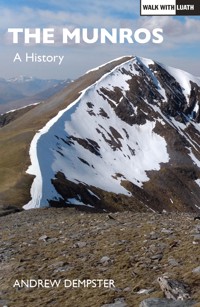
The mountains provide the spiritual nourishment so essential to a truer understanding of the hills and, ultimately, ourselves. Munro bagging is a headily addictive pursuit, with the holy-grail of 'compleation' the ultimate aim, currently achieved by around 7,000 Munroists. It all began in 1891 when Sir Hugh Munro's Tables of 3,000-foot Scottish mountains appeared in The Scottish Mountaineering Club Journal. Since then, this innocent compilation of hills has become a hallowed hit-list. Andrew Dempster traces the meandering course of this cult activity, which has gone from trickle to torrent in the space of a century. From early map-makers to current record-breakers, from the why and the wry to wildness and well-being, The Munros: A History explores the compulsions and philosophies underpinning the Munro phenomenon.
Das E-Book können Sie in Legimi-Apps oder einer beliebigen App lesen, die das folgende Format unterstützen:
Seitenzahl: 484
Veröffentlichungsjahr: 2021
Ähnliche

















ANDREW DEMPSTER has over 40 years’ experience of Scotland’s mountains. He is nearing completion of a third round of the Munros and has climbed all the Corbetts and Grahams, and has written the first guidebook to the latter. In addition, he has compiled a list of Hughs – Scottish hills below 2,000 feet and has published the first volume of a guide to these summits. He has also walked and climbed in such varied locations as the Alps, the Pyrenees, the Himalaya, Africa, Iceland, Greenland and the USA. He is a retired mathematics teacher, currently living in rural Perthshire with his wife, Heather.
By the same author:
Classic Mountain Scrambles in Scotland, Mainstream 1992; new edition Luath Press 2016
The Munro Phenomenon, Mainstream 1995
The Grahams: A Guide to Scotland’s 2,000ft Peaks, Mainstream 1997
Skye 360, Walking the Coastline of Skye, Luath Press 2003
100 Classic Coastal Walks in Scotland, Mainstream 2011
The Hughs: The Best Wee Hills Under 2,000ft, Volume 1, Luath Press 2015
First published 2021
ISBN: 978-1-910022-98-6
The author’s right to be identified as author of this book under the Copyright, Designs and Patents Act 1988 has been asserted.
Typeset in 10.5 point Sabon by Main Point Books, Edinburgh
Photographs (except where indicated) and text © Andrew Dempster 2021
Contents
Introduction
Munro Timeline
Chapter 1 Veterans and Visionaries
Early map-makers William Roy and Thomas Colby; early tourists and baggers; early lists: Matthew Forster Heddle and Sir Hugh Munro
Chapter 2 Munroist Ministers
The Rev AE Robertson and the Rev ARG Burn
Chapter 3 Fire And Freedom
Early Munroists, the 1930s working-class outdoor revolution, the Craigallion fire
Chapter 4 Topography and Topology
Formation of the Scottish mountains; Munros and Tops analysis with heights
Chapter 5 Boomers and Baggers
The post-war revolution, influences, books, media, magazines
Chapter 6 Rounds and Records
Continuous Munro rounds, fell-running, other records
Chapter 7 The Why, the Wry and the Whimsical
Reasons, risks, musings
Chapter 8 Below and Beyond
Post-Munro activities, hill lists, The Munro Society
Chapter 9 Memorable Munros
Profiles of some memorable Munros
Chapter 10 Wildness and Well-Being
Conservation, land use, access, rewilding, well-being
Bibliography
Acknowledgements
Endnotes
Dedicated to all Munro baggers, past, present and future.
Introduction
WHEN MY BOOKThe Munro Phenomenon (the natural precursor to this book) was published by Mainstream in 1995, over a thousand people were known to have climbed all 282 Munros. Today the tally is around 7,000, and rising rapidly. It is reckoned that at least 200 people a year ‘compleat’ a full round of the Munros.
The Munro Phenomenon was essentially a history of ‘Munrobagging’ and an analysis of the rationale behind the growing popularity of this addictive pursuit. In the 25-plus years since the book’s release, advancing years, hindsight, experience and wisdom have led me to re-evaluate the book’s content, aims and conclusions. In addition, the formation of The Munro Society in 2002, the passing of the centenary of Sir Hugh Munro’s death in 2019 and the COVID-19 hiatus of 2020 and beyond have given cause to stop and reflect. Several people have indeed commented that The Munro Phenomenon is long due a reprint – updated to include more modern trends, new records and different viewpoints.
This book attempts to tackle this challenge, but rather than simply reproduce The Munro Phenomenon with additional updated material, I have effectively started from scratch and written a book which I believe to be more relevant and focused on the issues and influences of today. Of course, history never changes… or does it? The name Matthew Heddle may not ring any bells, but it turns out that this 19th century ‘mineralogist and mountaineer’ was a key player in the subsequent creation of Hugh Munro’s famous Tables. Indeed, following Heddle’s death, Hugh Munro himself paid tribute to him, writing that ‘Professor Heddle had climbed far more Scottish mountains than any man who has yet lived’. Quite how this influential character has fallen through the net is a mystery, but this book has attempted to raise Heddle from the trough of obscurity and restore his reputation to its rightful place in Munro history. (See chapter 1: Veterans and Visionaries.)
Moving to the present day, one phenomenal Munro exploit in 2020 deserves a mention in this introduction: namely, Donnie Campbell’s staggering accomplishment of a complete round of the Munros in just under 32 days. In The Munro Phenomenon, I commented that doing ‘the Munros in a month’ could be considered to have ‘ultimate challenge’ status – now, a supercharged fell-runner has come within a hair’s breadth of realising this dizzying goal. Munro legend Hamish Brown (the first person to perform a continuous round of the Munros) once commented that
when someone does the Munros in a month, I will shake my head, and his hand.1
I still shake my head in disbelief at Donnie’s incredible feat. You can read more about it in chapter 6: Rounds and Records.
One other ‘undone’ challenge posed in The Munro Phenomenon was a continuous round of all the Munros and Tops. The ‘Tops’ are an additional class of subsidiary summits which are not classified as full Munros, despite being over 3,000 feet (see chapter 4). Only a year after the release of the book, celebrated long-distance walker and backpacker Chris Townsend took up the challenge with relish, compleating the round in 118 days – again, see chapter 6 for more details.
On reading the last two paragraphs, some could be forgiven for thinking that Munros are only for super-fit, driven, highly motivated individuals. Think again, however. The vast majority of the seven thousand ‘compleaters’ mentioned at the start of this introduction are just ordinary, sane folk of all ages and occupations. Doctors and decorators, teachers and preachers, lawyers and labourers and even television presenters and politicians have all been smitten with the healthy addiction of a recreational activity which has now morphed into a gloriously rampant phenomenon.
This book has been written for all those Munroists and aspiring Munroists, but also for ‘armchair’ Munro-baggers who may have no intention of hauling themselves up a 3,000-foot peak, but nevertheless are curious about this growing craze. Indeed, if the book encourages just a few to swap their armchair for the more healthy delights of Munro climbing, then it will have been worth writing.
Munro Timeline
1590The first recorded ascent of a Munro (Stuchd an Lochain) by Colin Campbell of Glen Lyon.1791Formation of the Ordnance Survey.1819Completion of the Scottish map survey by Thomas Colby.1856Sir Hugh Munro is born.1882Robert Hall’s list of Scottish mountains is published.1889The Scottish Mountaineering Club is formed.1891The first edition of Munro’s Tables appears in the SMC Journal.1894Hugh Munro is elected president of the SMC.1901The Rev AE Robertson becomes the first person to climb all the Munros (the first Munroist).1919Sir Hugh Munro dies aged 63.1921The SMC publishes its General Guide with Hugh Munro’s revised and updated list of 3,000-foot mountains.1923The Rev A Burn becomes the second Munroist and the first person to also compleat all the Tops. (For an explanation of the spelling, please see chapter 2)1929JA Parker becomes the first person to compleat all the Munros and3,000-foot peaks in England, Wales and Ireland (Furth).1947Mrs J Hirst becomes the first woman to compleat all the Munros (and Tops). Mr and Mrs J Hirst also become the first married couple to compleat.1949WM Docharty becomes the first person to compleat all the Munros, Tops and Furth – known as the Grand Slam.1960Anne Littlejohn becomes the first woman to compleat the Grand Slam.1964Philip Tranter becomes the first person to compleat a second round of the Munros and climbs a record 19 Munros in 24 hours.1965WA Poucher’s The Scottish Peaks is published.1967The first attempt at a continuous traverse of all the Munros by the Ripley brothers. 230 Munros are climbed.1974The first successful continuous, self-propelled traverse of all the Munros by Hamish Brown in 112 days.1978Hamish’s Mountain Walk is published by Gollancz. Charlie Ramsay climbs 24 Munros in 24 hours (Ramsay’s Round).1981Publication of new edition of Munro’s Tables with the controversial Donaldson/Brown revisions.1982Kathy Murgatroyd makes the first continuous round of the Munros by a woman and the second continuous round, taking 134 days.1984George Keeping accomplishes the first continuous round of the Munros and English and Welsh 3,000 foot peaks in 165 days (entirely on foot).1984–5The first continuous winter round of the Munros in 83 days by Martin Moran (vehicle assisted).1985The SMC guide, The Munros, is published.1985–6The first continuous round of the Munros and Corbetts is made, within 13 months, by Craig Caldwell.1986Irvine Butterfield’s The High Mountains is published. Ashley Cooper makes the first continuous round of the Munros and Furth.1987Martin Stone extends Ramsay’s Round and climbs 26 Munros in 24 hours.1988Mark Elsegood compleats the Munros in 66 days with vehicular support. Jon Broxap climbs 28 Munros in 24 hours in the Shiel/Affric area.1989Paul Tattersall makes the first continuous round of the Munros while on or carrying a mountain bike.1990Hugh Symonds achieves the fastest continuous traverse of the Munros and Furth in 97 days; also including the fastest purely self-propelled (entirely on foot and without ferries) round of the Munros in 67 days. A team of seven fell runners complete the Munros by relay in under 13 days. Stuart Clements and Kate Weyman become the first couple to accomplish a continuous round of the Munros.1991The Munro Show appears on Scottish Television. Munro Tables centenary dinner held in the Roxburghe Hotel, Edinburgh. Adrian Belton climbs 28 Munros in 24 hours in the Lochaber area, extending Ramsay’s Round.1992Andrew Johnstone and Rory Gibson compleat the Munros in 51 days.1993A team of seven fell runners complete the Munros by relay in 11 days and 20 hours.1994Mike Cudahy compleats the Munros in 66 days and 7 hours entirely on foot, but using ferries.1995The Munro Phenomenon by Andrew Dempster is published and Burn on the Hill by Elizabeth Allan are published. Andrew Allum begins his record round of all British peaks over 2,000 feet.1996Chris Townsend becomes the first person to accomplish a continuous round of the Munros and Tops.1997Publication of new edition of Munro’s Tables (SMC) with 284 Munros. (Two later deleted, being under 3,000 feet.)1999The Munroist’s Companion (SMC) by Robin N Campbell is published and The Magic of the Munros by Irvine Butterfield are published.2000Charlie Campbell compleats the Munros in 48 days.2002The Munro Society is formed by Iain Robertson and others.2003The Scottish Land Reform Act is introduced.2005–6Steven Perry completes the second continuous winter round of the Munros (without a vehicle) in 121 days.2006Walkhighlands website set up by Paul and Helen Webster.2010Stephen Pyke compleats the Munros in 39 days. Gerry McPartlin becomes the oldest continuous Munroist at age 66, taking 88 days.2015Matthew Forster Heddle, Mineralogist and Mountaineer by Hamish H Johnston is published.2017Jim Mann climbs 30 Munros in under 24 hours in the Cairngorms area.2019–20In 97 days, Kevin Woods compleats the third continuous winter Munro round using a vehicle.2020Donnie Campbell compleats the Munros in 32 days. Sasha Chepelin climbs 32 Munros in under 24 hours in the Cairngorms area.2021The new large format SMC guide to the Munros is published. Members of the Carnethy Hill Running Club of Edinburgh achieve the first recorded ascent of all the Munros in a day.CHAPTER 1
Veterans and Visionaries
ON THE LEVEL bealach below the high point of the Beinn a’ Ghlò ridge in Perthshire, the wind shrieks like a banshee as it funnels furiously through the gap in the ridge. A lone figure is crouched over a wooden-shafted alpenstock, steadying himself in the frenzied maelstrom. The abominable cold impels him to persevere upwards, dragging his heavy hobnail boots through deep powder snow to another wind scoured bealach 500 feet above.
The figure then turns to face north-east with the merciless wind now thankfully behind him. The manic, turbulent gusts are now whipping up snow
in spiral columns several hundred feet high, penetrating everything, filling pockets and drifting between waistcoat and shirt, where it melted and then froze into a solid wedge of ice.1
The wind has partially stripped the final section of summit ridge of snow to reveal lethal, verglassed, angular rocks on which he attempts to gain purchase. Wild eddies of spindrift momentarily conceal maddening pockets of deep snow, into which he clumsily staggers, cursing under his breath.
After what seems like an eternity, his smarting eyes spot a substantial pile of heavily iced rocks, which he aims for like a man possessed. On reaching the cairn, with his back still to the buffeting wind, he lays down his long ice-axe and then removes his woollen mittens, stuffing them under his tweed jacket.
His hands, already cold, reach into a jacket pocket and pull out a round container. Fumbling desperately, he opens the lid, removes a pocket aneroid and proceeds to perform various height measurements, despite the frenzied flapping of his Inverness cape, which he continually pulls round him for extra warmth.
Leaden clouds are now scudding across the sky to reveal acres of blue above sculptured waves of white peaks in all directions. Thankfully, he has already recorded details of the views on a lower summit:
Views good – Cairngorms and Ben Alder groups, the Glencoe hills, Schiehallion (which does not show to advantage from here), Ben Lawers looking well, with Stobinian over his left shoulder, Ben Chonzie, the Fifeshire Lomonds and Sidlaws showing well, with the smoke of Dundee behind. The special feature, however, is the fine view of the higher peaks of Beinn a’ Ghlò.2
The highest peak of Beinn a’ Ghlò, on which he now stands, is a freezing and furious cauldron from which he knows he must immediately descend. His hands, now red and numb with cold, struggle to replace the aneroid back in its container and the container back to ice-lined pocket. He forces his Balmoral bonnet more firmly onto his head and briefly touches his beard, now a frozen mass of tiny icicles, as are his moustache and eyebrows. Before replacing his mitts, he pulls a solid ice-caked chunk of tablet from a pocket and forces it into his mouth, slowly releasing its sweetness and energy to his flagging form. Finally, he reaches into an inside pocket for a hip-flask. His fingers are useless, unfeeling appendages, but he manages to unscrew the flask and swig back a mouthful of the amber nectar within.
In seconds he replaces the flask, dons his mitts and grabs his axe to begin the steep descent to Glen Loch. On his journey through deep, drifting snow, he mercifully escapes the worst of the wind, but the relief is short-lived: blood returns to his hands, producing painful hot-aches. Over two hours later he reaches the lonely outpost of Daldhu and the start of the last seven miles through Gleann Fearnach to his nightly destination at the estate house of Dirnanean.
In the fastly fading light of the Scottish winter, he finally reaches shelter, where his hosts
had to scrape me down with a knife to get the frozen snow off me before I could enter the house.3
He goes on to remark that ‘in all my winter experience I never suffered so severely from cold’.
During that winter’s day of 22 January 1891, Hugh Munro had completed a 20-mile mountain traverse from Blair Atholl to Dirnanean. An hour later, a thawed out, bathed and freshly dressed Munro sat before a roaring log fire with dram in hand, awaiting dinner. He would certainly deserve it.
Leaving aside the obvious fitness, fortitude and sheer determination of someone tackling the above expedition, which even in summer would be considered a long and challenging route, two observations stand out. Firstly, that the route was attempted in winter, and secondly, that a return to his point of departure at Blair Atholl was declined in favour of a new nightly destination.
Concerning the first point, Munro, a member of the Scottish Mountaineering Club (SMC), had previously intimated in the SMC Journal that he was looking for companions to join him in hill forays during the months of January, February and March, being ‘much engaged’ later in the year. It is also apparent that he relished winter climbing, and his series of articles entitled ‘Winter Ascents’ in early editions of the SMC Journal are proof of his finer appreciation of the Scottish peaks when under a mantle of snow and ice. He acknowledges that
it cannot be denied that some few disadvantages attend winter and early Spring climbing, but I am sure that all who have tried it will agree that the pleasure derived is more than ample compensation.4
I would surmise that such ample compensation would struggle to exert itself on his Beinn a’ Ghlò traverse of 1891!
Concerning the second point, Munro had a passion for long cross-country routes through remote areas, often lasting several days. These were the days before motor transport dictated one’s return to their starting place. Undoubtedly, the advent of the motor-car opened up large areas of the Highlands to the general public, but contrarily became a ‘millstone’ for those wishing to indulge in long through-routes.
After many other such skirmishes in the Scottish hills, in September of that year, Hugh Munro released his famous ‘Tables of Heights over 3,000 feet’, blissfully unaware that in doing so, his very name would soon become synonymous with Scottish mountains over 3,000 feet and that he was destined to become a legendary figure in Scottish Mountaineering.
Hugh Munro was undoubtedly the visionary in the formation of ‘the Tables’, but to fully understand the man and his mountains we must step back a century or more and examine briefly the various strands and influences which ultimately led to their publication.
In 1791, exactly a hundred years before the launch of Munro’s Tables, the Ordnance Survey (OS) was founded. The existence of reliable and accurate mapping had an obvious, crucial bearing on this list. Almost half a century before this, at the time of the 1745 Jacobite Rebellion, there were no reliable maps of the Highlands in existence. Their absence at the time makes Charles Edward Stuart’s five-month wander through the Highlands as a prime fugitive, with £30,000 on his head, a truly monumental feat. During his 22-week flight through the heather, he traversed many Munros and discovered a bewildering variety of hideouts in the high and lonely places.
He probably skulked past more summits than we are aware of today and was at times so near to the enemy’s campfires that he and his helpers could hear the soldiers’ conversations. By the time he escaped to France in September 1746, the Prince must have been a thoroughly seasoned mountaineer, weather beaten, midge-ridden, skeletal, exhausted and a shadow of his former self. The iconic image of the ‘Bonnie Prince’ with kilt, blue doublet, powdered wig and starched lace ruffles is perhaps a poor reflection of the ‘real’ Prince. In a sense, Charles Stuart could be considered the first hill gangrel in Scotland, despite his wanderings lacking any recreational nature. The first recorded ascent of a Munro, however, had already been made by ‘Mad’ Colin Campbell of Glenlyon, around 1590, when he climbed Stuchd an Lochain in Glen Lyon.
In the wake of the ‘Forty-Five’ and the Culloden bloodbath, ‘Butcher’ Cumberland’s Deputy Quartermaster, General Watson, decided that a map of the Highlands was essential. A specialist detachment was posted to Fort Augustus in 1747 to spend the next eight years on the Survey. One particular man stood out as largely responsible for the final product, a 21-yearold engineer named William Roy, whose competence and quest for perfection ensured his well-earned promotion to Surveyor-General of Coasts in Great Britain in 1765. Roy had always championed the formal establishment of a National Survey for the whole of Great Britain, and it is largely due to his vision that the Ordnance Survey was founded in 1791, a year after he died.
One final observation concerning Roy and mountain heights and topography was his visit to Schiehallion in 1774, when the Astronomer Royal, the Rev Nevil Maskelyne, succeeded in estimating the mass of the Earth by observing the gravitational attraction of the mountain on plumb lines. Roy spent an extra three days making geometrical and barometrical observations on neighbouring mountains and subsequently produced a paper entitled ‘Rules for Measuring Heights with a Barometer’. At the same time, Dr Charles Hutton, an eminent geologist, came up with the ingenious notion of contour lines, which was to revolutionise cartography. Spot heights are all very well, but only show… well, height. Contour lines give a clear indication of the topography of mountains and general landscape, which we all take for granted today. Their general usage, however, did not come about until the mid-1800s.
Following the inauguration of the Ordnance Survey, the ambitious plan was the eventual production of a series of one-inch to the mile maps for the whole of Great Britain. Hot off the press and the first to appear was the map of Kent, published in New Year 1801. The first decade of the 19th century saw the heights of some 300 hills in England and Wales calculated with reasonable accuracy and the completion of the English series of maps.
The surveying principle of triangulation, using trigonometry, formed the basis of Ordnance Survey map-making, creating a three-dimensional interlocking network of triangles across the country. The latitude, longitude and height of two specific points could be used to determine the same for a third point, using a theodolite to measure the various angles. The ‘points’ in question are Triangulation Points or ‘Trig Points’, of which more modern versions can be found on many Munro summits.
By 1810, the triangulation was finally pushing on into Scotland, with all the extra challenges of terrain, weather and wildness that this would entail, and by 1819, the Survey was finally completed.
As a wee aside, a remark made by well-known outdoor guru Cameron McNeish in his fascinating biography There’s Always the Hills stands out in my mind. His loathing of mathematics is most apparent, when in maths classes he would
gaze across the city to the blue outline of the Campsie Fells… and daydream, much to the annoyance of my teachers.5
(Totally understandable!) But the remark in question:
To this day I’m not sure what purpose algebra and trigonometry plays in the great scheme of things6
strikes me as rather ironic. The very maps which he no doubt uses to plan and ‘daydream’ were created using trigonometry and triangulation. Being an ex-mathematics teacher, I felt impelled to raise this, yet I will forgive him just this once… but don’t let it happen again!
In 1810, the Rev George Skene DD made some phenomenally accurate barometric height measurements in the Cairngorms, being only four feet out with the height of Ben Macdui. After sending his son to climb Ben Nevis with his barometer, Ben Macdui lost the pride of place it had held until then as Britain’s highest mountain. There was even an idea bandied about to build a burial vault 100 feet high on Ben Macdui’s summit to reinstate its prior glory, a plan which fortunately failed to materialise.
As William Roy had been the prime instigator of the post-Forty-five map of Scotland, the Ordnance Survey of Scotland also had its own prime motivator, the colourful Thomas Colby, who became Director General in 1820. Like Roy, Colby possessed almost inexhaustible patience and a dogged determination to see the job through.
In the summer of 1819, Colby led a party covering the eastern side of Inverness-shire, Ross-shire, Caithness and Orkney Mainland, walking 513 miles in 22 days – an average of more than 23 miles a day. With only one rest day, Colby then led a fresh party west and north-west covering 586 miles in another 22 days – an average of more than 26 miles a day. Considering the roughness of the terrain, the weight of food and equipment, the often-abysmal weather and the time spent observing and measuring, these itineraries are truly mind-boggling. Colby possessed a fitness, toughness and a resolute indomitability that left others far behind. His men, too, who endured endless days carrying massive loads through wild, pathless country, should not be forgotten.
It was therefore highly fitting that the completion of the great Scottish Survey was marked by a celebration. All involved in this remarkable endeavour were treated to a mammoth feast, the chief dish being an enormous plum pudding weighing nearly a hundred pounds. The pudding was suspended by a cord from a wooden beam and boiled for a whole day in a copper pot. Colby, his staff and his men, after wolfing down the ‘excellent’ pudding, drank a toast: ‘SUCCESS TO THE TRIG!’
Alongside all the manic map-making enterprises of the 18th and 19th centuries, another group of intrepid explorers were winding their way to the Scottish Highlands. As what could be described as the first Highland tourists, people like Thomas Pennant, Samuel Johnson and James Boswell, Dorothy Wordsworth, Sir Walter Scott and countless others began to see natural landscape not just as something to be tamed and measured, but to be appreciated for its inherent beauty. Sir Walter Scott introduced a whole new generation of visitors to the Highlands, and in particular, the Trossachs, an area for which he had a particular affinity.
It is also well-documented that a fair proportion of these pioneering travellers climbed mountains for pure enjoyment. One of the earliest of these was a young man named William Burrell who embarked on a Scottish tour from London in July 1758. Whilst staying at Luss on Loch Lomond, he related:
On the opposite side (of Loch Lomond) stands a mountain of the same name of a prodigious height, overshadowing all the neighbouring rocks; the way to it is very irksome and in some places so steep that we were obliged to crawl on hands and knees. From the beginning of the ascent to the summit is five English miles; in several parts we sunk up to our knees in mire; we were fortunate enough to have a fine day.7
A quarter of a millennium later, Burrell would have witnessed hordes of hillwalkers hauling themselves up the well-trodden trade route to the summit. What on earth would he have thought? Being within a stone’s throw of Glasgow and Scotland’s southernmost Munro, Ben Lomond is well-visited and is the most common first Munro to be ascended.
However, not all travellers at this time were enamoured by mountainous scenery, and Johnson and Boswell described one mountain as ‘a considerable protuberance’. Others perceived mountains as fearsome, menacing places, usually emphasising the gloomy, ominous and melancholic aspects of the dark cliffs and crags.
For some, it was not just the mountains that provoked fear and menace, but the spartan nature of overnight accommodation. Thomas Pennant, when in Sutherland, was unfortunate in encountering ‘a gigantic and awful landlady; a spouse fit for Fin-Mac-Cuil himself’ (I’ve met some of these as well). Johnson and Boswell at Glenelg were forced to supply their own hay on which to sleep in their greatcoats. A certain John MacCulloch (1773–1835) describes the wretchedness of breakfast in a ‘vile pot-house’ in Taynuilt. So miserably sluggish was the serving of musty bread, paste-like toast, tepid tea and ‘damp and melancholy sugar’ that the clouds were well down on Ben Cruachan, despite early morning sunshine. Yet ‘a delicious herring, hot from the fire’ provided temporary cheer.
MacCulloch was planning an ascent of Ben Cruachan and indeed ascended many other Scottish peaks, mostly between 1811 and 1821. He could lay claim to being Scotland’s first peak-bagger, but his bold assertion that ‘I have ascended almost every principal mountain in Scotland’ must be taken with more than a pinch of salt. Despite his sub-standard breakfast in Taynuilt and the lowering clouds, he claimed Ben Cruachan’s summit, one of around twenty he completed in Scotland – not quite every principal mountain. However, a look at his list of conquests reveals that he had made ascents of such notable summits as Ben Nevis, Ben Lawers, Schiehallion, An Teallach, Ben Lomond, The Cobbler, Ben Ledi, Ben More on Mull, Goat Fell (Arran), Alisa Craig and Dun Caan (Raasay), to name around half. By ‘principal’ mountains, he was referring to the ones which he regarded as having presence or attitude and therefore were worth climbing.
One notable failure however, was the ‘iconic, unassailable pillar’ of Suilven in the far north. In 1820 he wrote:
To almost all but the shepherds, Suil Veinn is inaccessible; one of our sailors, well used to climbing, reached the summit with difficulty, and had much more in descending.8
His success (or lack of it) on Skye was equally abysmal, and he came to the conclusion that the main Cuillin ridge was totally out of bounds for mere mortals:
The upper peaks are mere rocks, and with acclivities so steep and so smooth, as to render all access impossible.9
I would not doubt that even today, a few hillwalkers would totally agree with this assertion!
MacCulloch’s trips to Scotland between 1811 and 1821 were not purely for recreational purposes; he had been appointed the post of geologist to the Trigonometrical Survey during these years, despite having studied medicine at Edinburgh University. Of course, at this time, having a scientific background in any discipline was essentially sufficient to become proficient in another. He was in fact later commissioned to produce a geological map of Scotland. However, MacCulloch is probably best remembered for his four-volume Highlands and Western Islands of Scotland, published in 1824, both a guide and a personal account of his explorations and mountaineering ascents. Of the various tourist guides which were starting to appear around this time, MacCulloch’s is generally viewed as being superior.
One publication with obvious associations to Munro’s Tables was Scottish Tourist (1825) by W Rhind, which contained the first table of ‘Mountains in Scotland’. Although the list is longer than MacCulloch’s ‘principal mountains’, it is essentially a potpourri of hills of all heights with no obvious criterion for inclusion other than the author’s preference. Though many of the given heights are relatively accurate, others are ludicrously adrift, with an Orkney hill given a height of nearly 4,000 feet. Meall Fuar-mhonaidh on Loch Ness side attains Munro status despite it being a Graham (under 2,500 feet), and Buachaille Etive Mòr shrinks to 2,500 feet. The inclusion of Alisa Craig and Calton Hill are also interesting, as the latter could in no way be considered a mountain.
Whilst the likes of map-makers Roy and Colby and early mountain climbers such as MacCulloch had distinct, but chronologically more distant links to the eventual creation of Munro’s Tables, there remains one individual who played a largely uncelebrated but substantial part in their formation – Matthew Forster Heddle. Heddle remained in relative obscurity until his great-great grandson, Hamish H Johnston, wrote his biography, published in 2015, entitled Matthew Forster Heddle: Mineralogist and Mountaineer. Quite how this ‘unsung hero’ failed to find his way into Munroist culture and literature is something of a mystery, but hopefully, Johnston’s book and this account will go some way in addressing this serious imbalance.
Heddle was born in Orkney in 1828 and descended from Estate-owners. He enjoyed a comfortable home life and from a young age displayed a natural inclination towards the collection, classification and preservation of botanical specimens, shells, rocks and minerals. Curiously, Hugh Munro himself possessed exactly the same collecting tendencies as a youngster. The wild, natural coastline of Orkney and the surrounding sea were both a magnet for Heddle’s inquiring and intrepid nature, and as well as wandering ‘amongst the dangerous precipices and lofty sea-cliffs of his native islands’, he would also ‘traverse the wild seas’ alone in a small boat.
From the age of nine, Heddle attended Edinburgh Academy and Merchiston Castle, where he excelled in academia. His mother had died when he was only four years of age, and his father tragically died just a decade later. However, Heddle still returned to his beloved Orkney during the long summer holidays to enjoy outdoor adventures in the company of his brothers.
Heddle went on to study medicine at Edinburgh University, where the curriculum also included natural history. Under the watchful eye of eminent mineralogist Professor Robert Jameson, Heddle wrote a chemical-mineralogical thesis relating mineralogical elements to possible medical treatments, a vision far ahead of its time. Following his graduation in 1851, he became a doctor in Edinburgh’s Grassmarket area, which at the time was the worst part of the city for poverty and disease. Despite more British medical graduates training in Scotland than in England at the time and Edinburgh’s citizens enjoying the highest quality of medical care anywhere in the world, the dismal, squalid nature of his surroundings and his low salary made Heddle
look forward to the time when he might escape from the duties of a profession which was evidently so uncongenial to his natural tastes and inclination.10
Heddle retained his sanity by pursuing a parallel career in his true passions of geology and mineralogy, becoming president of the Edinburgh Geological Society aged only 23. It was largely because of Heddle that the National Museum of Scotland came into being following his successful championing for a Natural History Museum. His desire to leave medicine was finally realised in 1858 when he took up a position as chemistry lecturer at St Andrew’s University, eventually graduating to Professor of Chemistry in 1862. At a time when universities were an all-male environment, Heddle defended women’s education and in the year of his Professor-ship took on Elizabeth Garrett as a student in his class, only for the university to invalidate her matriculation. Not to be outdone, Garrett took private lessons from Heddle and eventually became Britain’s first female doctor. Heddle also married in 1858 and went on to produce a healthy ten offspring!
The academic year at St Andrews allowed an extremely generous six months holiday, giving Heddle full opportunity to pursue his linked passions of mineralogy, geology and the exploration of the Scottish Highlands and Islands, usually accompanied by his great friend Patrick Dudgeon. During this fruitful and fulfilling period of his life, Heddle published a profusion of papers, many seminal, and in 1876 he cofounded the Mineralogical Society of Great Britain and Ireland, becoming its second president.
Despite Heddle’s life and career flourishing at this time, a series of setbacks tested his resolve and endurance. University finances were becoming critical and Heddle himself was running low on cash, as well as developing health problems. Following a short stint in South Africa as adviser to a gold-mining company, he retired from the university on the grounds of ill health, but was granted Emeritus status. He continued to write papers until the last year of his life in 1897. His classic work, the two volumes of The Mineralogy of Scotland, were published posthumously in 1901.
The late 1870s and1880s were Heddle’s most prolific time in the Scottish mountains, and in 1879 he told his friend Archibald Geikie that
I have not been and am not at all well; my heart is troubling me much – there is nothing puts it right like the mountain air, and Billy the 3rd.11
(The latter was a favourite geological hammer!) The benefits of the mountains for his physical health, however, were overshadowed by their benefits for his mental health. His sheer pleasure of being among hills was wholly apparent, both in his conversations and written accounts, commenting that
every geologist must be more or less of an artist; he is none the worse if he be a little of a poet also.12
His poetic sensibilities are beautifully illustrated when he describes the hills of his beloved Sutherland as
Hills of all fashions and forms and tints – mountains which rear their heads like waves which are curling aloft to break, and have been petrified in the poise.13
‘Stac Polly is a porcupine in a condition of extreme irascibility’, he wrote, while ‘its weathered pinnacles project against the sky in a wondrously felicitous similitude of human forms’.
Heddle’s preferred type of walk were long, demanding, multi-day cross-country treks, when he could immerse himself completely in the landscape, gathering geological evidence as he went. His knapsack would grow heavier from accumulation of geological specimens, but this certainly did not deter him from climbing hills en route. He records having climbed 80 peaks during the course of his Sutherland fieldwork, in such areas as Torridon, Assynt and Coigach. It is evident that the more of these expeditions Heddle undertook, the more he enjoyed the hills for themselves, with rock and boulder hunting almost getting in the way. He also surmised that boulders found at high levels were most likely to have been there indefinitely, so he generally stuck to mountain ridges and tops, in contrast to previous rock searchers who had stayed low in the glens.
In addition to Archibald Geikie, several other companions regularly joined Heddle on his numerous exploits – namely, the Rev William Peyton, Colin Phillip and John Harvie-Brown. With the latter, Heddle spent several summers in the mid-1880s, island-hopping and generally enjoying a social life of drinks, jokes, songs and female appreciation. However, it was Peyton and Phillip who joined Heddle on many of his cross-country jaunts. Phillip was a proficient landscape artist, a keen mountaineer and one of the original members of the Scottish Mountaineering Club when it was founded in 1889.
During 1882, the Rev Peyton joined Heddle on a mammoth expedition which initially included the likes of Glen Dochart, Glen Lyon, Creag Meagaidh and eventually Glen Shiel, where they based themselves at the Cluanie Inn. This inn has been a honeypot for hillwalkers for nearly two centuries and has recently been updated and extended. It was the next part of the trip, however, that had been a long-held hankering for Heddle.
Between Glen Shiel and Glen Carron to the north lies a vast tract of wild, mountainous country, containing nearly 40 Munros and where no roads penetrate. Three great east-west glens cut deep into this wilderness; Glen Affric, Glen Cannich and Glen Strathfarrar. The bulk of the area is covered presently by one of my favourite Ordnance Survey Landranger sheets (Sheet 25), and many an hour has been spent drooling and dreaming with a dram over possible future forays into this wonderful area. Having previously completed two multi-day traverses of the region – one north to south with a crowd of school kids and one south to north on a trans-Scotland walk – I have a deep affinity for this spectacular area.
What Heddle had termed ‘the great traverse’ was a route of some 45 miles from the Cluanie Inn northwards to Strathcarron and taking four days, staying in the homes of shepherds and keepers. Today, ‘shepherds and keepers’ would be replaced by bothies or tents. The other main difference between then and now are the enlargements of both Loch Mullardoch (Glen Cannich) in 1951 and Loch Monar (Glen Strathfarrar) in 1962 as part of post-war hydro-electric schemes. Both lochs have now drowned out parts of Heddle’s route and the cottages where they stayed. Looking at the grotesquely enlarged versions of these lochs today, with their ugly ‘tide-lines’ and massive concrete dams, there is a feeling that both a unique Highland lifestyle and the peaceful innocence of two beautiful Highland glens have vanished forever.14
An article by Heddle describing his ‘great traverse’, ‘South West Ross’, appeared in the Scottish Mountaineering Club Journal posthumously in 1898 and was one of only two full accounts from his own pen, despite having undertaken countless other long expeditions in the Highlands. Several years after his traverse and other visits to the area, a geologist named Lionel Hinxman, a founding member of the SMC, annoyed Heddle when he claimed that the district was ‘as yet unexplored’. Heddle’s verbal reaction cited that
I have been at the top of every 3,000 foot peak of the district named… and hardly think that the district can be said to be as yet unexplored.15
Indeed, Hugh Munro himself was a great admirer of Heddle and wrote of ‘South West Ross’:
this article was written by one who not only had an intimate acquaintance with the country, but was also able to add much, out of his own knowledge, to existing maps.16
Although Heddle had not joined the SMC when it was founded, his vast knowledge, achievements and expertise were soon recognised by the powers that be, and he was made an Honorary Member of the Club by Hugh Munro in 1893. It was a decade earlier that Munro and Heddle first met by chance on the box seat of the mail coach from Kingussie to Fort William on 15 October 1883, where Heddle was going to attend the opening of the Ben Nevis Observatory the following day. Munro’s first impressions of Heddle were highly favourable, and he remarked:
What an agreeable travelling companion he was! What a fund of information, and how pleasantly he told it!17
By the early 1890s, several people were known to be pursuing the 3,000-foot peaks in Scotland, namely Heddle, Phillip, Joseph Scott, Peyton and Munro. For a time, Heddle was way ahead of his rivals, remarking to his friend Geikie, in April, 1891, that ‘I have now done 350 of the 409 3,000ers, Peyton 270 – Phillip 260, others nowhere’.
His competitive nature is obvious in this remark, but it is interesting that Munro himself is not mentioned, or perhaps implicitly included in the ‘others nowhere’. In fact, Munro had only climbed 27 Tops when he joined the SMC in 1889. Early in 1891, in a talk to the St Andrews Literary and Philosophical Society, Heddle remarked that
there were 409 hills in Scotland above 3,000 feet high of which I have been at the top of 350.18
These musings would appear to indicate that Heddle was in possession of a self-made, 409-peak list of 3,000-foot Scottish mountains, but unfortunately, that list has never been discovered.
Other than the highly subjective pseudo-lists of Scottish mountains, such as that of W Rhind in Scottish Tourist (1825), mentioned earlier, and a later ‘authoritative Baddeley’s Guide’, listing only 31 hills (which never claimed to be a complete listing!), only one relatively serious attempt at cataloguing Scotland’s hills had yet been undertaken. In 1882, Robert Hall’s The Highland Sportsman and Tourist listed 236 heights of 3,000 feet or more, plus nearly 2,000 lower hills, each including county and district. However, this publication was clearly aimed at the ‘hunting, shooting, fishing’ fraternity and included little or no information on possible routes.
Both Heddle and Munro were unlikely to have been influenced by Hall’s list and indeed were probably unaware of its existence. By this time, the Ordnance Survey had completed its comprehensive and detailed large scale (six inches to the mile) field survey of Scotland (1877), forming the basis for the one-inch series, with the 3,000-foot Tops appearing on 30 one-inch sheets. Both would have gleaned the bulk of their height and route information from these maps, as well as from many of the six-inch sheets.
By the early 1890s, Heddle’s increasingly ill health was restricting many activities, but he stubbornly refused to allow it to hamper his hillwalking, regarding the exercise as something to be embraced at all costs. No doubt, he was thinking of his mental health as well. Rheumatism, lumbago and other assorted problems soon took their toll, however, and on an outing to Balquhidder in 1894, he remarked:
walked 4 miles and climbed 1,100 feet – but was very tired. I think 3 miles is about my measure and I am not pulling up much.19
Heddle was ‘only’ 66 (the age I am as I write these words!), and it makes one wonder what he could have achieved had his health been in better shape. The first Munroist (one who has climbed every Munro)? It could well have been a possibility.
Since Heddle had climbed 350 three-thousanders, many more than Munro’s list of 283 separate mountains, it would initially appear that in all likelihood, Heddle could easily have already climbed all the Munros. However, it is known that there were three Munros in Wester Ross that he definitely had not ascended, probably due partly to access problems and partly to his deteriorating health. A recent discovery of a set of Heddle’s own maps by Hamish Johnston actually showed that Heddle had not ascended 110 Munro summits, indicating that many of his ascents were of subsidiary Tops rather than distinct mountains – Heddle did not distinguish between the two. Ironically, by 1897, the year of Heddle’s death, the first Munroist, Rev AE Robertson, had only climbed 100 Munros; it would be another four years before he finished them. That the field was therefore wide open to Heddle, had circumstances been different, is a frustratingly difficult pill to swallow.
Following Heddle’s death, Hugh Munro published a tribute to him, saluting his incredible achievements:
There can be little doubt that Professor Heddle had climbed far more Scottish mountains than any man who has yet lived… no district was unknown to him, and scarcely any high mountain unclimbed by him, and wherever he went there went not merely the trained geologist, but the truest lover and keenest observer of nature, and above all the Scottish mountains… It is indeed a privilege… to have known Professor Forster Heddle.20
Amen to that.
We now delve into the life of Hugh Munro, to learn a little of his character, passions, skills and aspirations, leading ultimately to the famous Tables, which would eventually result in his name needing no explanation in households across the country.
Hugh Thomas Munro was born in London in 1856, the eldest of nine children and the son of Sir Campbell Munro of Lindertis, a large, 3,000-acre estate, three miles south of Kirriemuir on the southern edge of the Eastern Grampians. During his childhood, he spent some of his time in London and the rest in the old family house of Drumleys at Lindertis, which would form the base of many of Munro’s mountain sojourns.
As a youngster, his great delight was in collecting things, such as fossils, shells, eggs and butterflies, categorising and classifying them with extraordinary attention to detail. This ‘collecting and organising’ tendency continued into adulthood and goes far in explaining his consequent suitability for collecting and classifying Scotland’s 3,000-foot summits.
At the age of 17, he went to Stuttgart to learn German and during this time developed a passion for walking and climbing in the Alps, which was soon to transfer to the Scottish peaks. He also showed a great love of travelling, thriving on change and variety, which ultimately stood him in good stead for his job as a professional courier, carrying foreign dispatches for diplomats.
He became Private Secretary to Sir George Colley, Governor of Natal, and in 1880, his stint in South Africa, where he enjoyed the social life and magnificent natural world of the Cape, was good convalescence following a bad attack of pleurisy. On the outbreak of the Basuto War, Munro volunteered for active service and endured much hardship and danger, carrying dispatches through deepest enemy territory. Following the end of the war and George Colley’s death, Munro returned home, living principally at Lindertis, managing the property and gaining more experience in his beloved hills.
Politics played an active part in his life from this time, and in 1885 he stood as parliamentary Tory candidate for Kirkcaldy Burghs, but at that time Scotland was entirely Radical; a Conservative candidate had no chance of success. He enjoyed the fight, but would have hated the life in London as an MP. He continued to dabble in politics on a local level, organising meetings, hosting speakers at his home, and generally acting as a key player in the political life of Forfarshire, his local seat.
He married in 1892, a year after the publication of the ‘Tables’, which perhaps indicates the priorities ordering his mind at the time! Unfortunately, his wife died just ten years later, but during her life he shared his travelling bug and they enjoyed many trips together to such diverse destinations as the West Indies, Switzerland, Spain and Morocco. When his daughters were old enough, they too accompanied him on many delightful tours, culminating in a five-month round-the-world trip with his eldest daughter that included the likes of the Grand Canyon, Yosemite, Honolulu, Japan, China and Singapore.
Munro was also a notable musician, enjoying Wagner and showing much skill on the flute. He was a fine dancer and light on his feet, not partly helped by his fairly small and slight frame. In fact, his old friend and neighbour, George Ramsay, first president of the SMC, remarked that he was ‘devoted to music’ and ‘as keen a dancer as a climber’. Being a warm-hearted host, he was a fine talker and story-teller, both in a social and formal sense. There was an occasion when Munro and another talkative companion had been out on the hills together, and on their return, both complained they had been silent all day, as neither could get a word in edgeways! He was, however, also a good listener and always gave opposing views fair consideration – unlike many of today’s hard-headed zealots.
Munro was an original member of the SMC at its conception in 1889, and his knowledge, skills and experience saw him duly elected as president from 1894 to 1897, a post which he coveted and relished. In his obituary, William Douglas wrote:
His joy at being elected president was intense. He even, in the exuberance of his delight, went the length of saying that he held the honour In higher esteem than he would have done had he been made Prime Minister of Great Britain.21
Despite Munro’s upper class background and Conservative leanings, his first act upon taking on the role of President was to propose a motion that the Committee
should adjudicate solely upon a candidate’s qualifications (to join the SMC) and not upon his social status.22
That the motion was subsequently defeated says more about the SMC than Hugh Munro. By all accounts, Munro showed no indication that he preferred any particular class of men (or women!) to accompany him on the hill. However, being a landowner himself, he took an uncompromising position in relation to exclusion rights and did everything to avoid wandering on what he considered to be private land. This inevitably contributed to the rather compliant policies of the SMC concerning land access. His severe stance on this issue even resulted in his making many expeditions in total darkness to avoid being seen. An account of one significant such expedition is given later in this chapter.
As mentioned previously, Munro had only climbed 27 Tops upon joining the SMC at the end of 1889. However, Joseph Stott, the first editor of the SMC Journal, soon commissioned Munro to produce the Tables when it became pivotal to have a definitive list of 3,000-foot mountains. The SMC were fully aware that there must be at least 300 such summits, ‘some perhaps never ascended’, and they saw Munro’s cataloguing, classifying and climbing abilities as essential attributes for the job. The stimulus that this assignment gave to Munro was manifestly obvious, and by the end of 1890 he was manically engrossed in major mountain excursions. In the course of only four winter months, he completed nearly 20, mostly multi-day expeditions in the hills – including the Beinn a’ Ghlò outing described at the beginning of this chapter.
The fact that these were winter trips and largely solo may give the impression that Munro was reckless and foolhardy. However, he firmly believed that there was nothing dangerous about climbing alone, and there is no doubt that it occurred frequently amongst the early pioneers. Munro clearly enjoyed climbing alone, despite himself being a notably social and gregarious creature in other spheres of his life.
However, his solo winter exploits did not go entirely without incident. The last day of a marathon four-day sortie to the Cairngorms in February 1890 saw his skills and resolve tested to their limits. By today’s standards, the sheer distances walked and climbed by Munro in the depths of winter are a testament to his incredible fitness, determination and tenacity.
He had left Lindertis on 6 February 1890 and ‘crossed the Braes of Angus to Braemar’ in glorious weather. It is not clear what route he took, but even by the obvious walking route via Glen Clova and Jock’s Road, the total distance would have been over 30 miles. Even in summer, this is an extremely long day. The following day he was ‘disappointed to find the clouds hanging low on the hills’ so decided to skip any hill ascents and
dawdled away some time in a cottage by the Linn of Dee, and some more at Derry Lodge.23
This lodge lies ten miles from Braemar and is today, sadly, boarded up and not in use. A partial clearance in the weather tempted him to think of a possible ascent of Cairntoul or Braeriach, but prudence and lack of time, together with a hankering to see the Lairig Ghru, (the main pass through the Cairngorms) saw him wandering through Glen Luibeg before swinging north to the Lairig where
the walking on this occasion was much facilitated, as the glen in its upper and rougher parts was full of hard, frozen snow, as smooth and as good to walk on as a turnpike road.24
After a half-hour rest at the Wells of Dee (now 3.00pm), he continued on through the narrowing jaws of the pass, where he describes the sun setting ‘in a soft pink haze, graduating through many tints of yellow to an ethereal blue’. Finally, three and a half hours later, after a long, dark trek through the Rothiemurchus Forest, in starlight, he reached Aviemore Station, where he caught a train to Kingussie – another 30-mile day!
The next day, Munro took the train to Kincraig Station and at 8.30am set off while
a hard white frost and an intensely cold morning made a quick walk of three or four miles up Glen Feshie agreeable.25
He then struck off on the good path by the Allt Ruadh and reached the top of Sgoran Dubh (now Sgòrr Dubh Mòr) by noon. Heading south over Sgòr Gaoith, he followed the crest of the Gleann Einich cliffs before making a long cross-country trek across the Moine Mor (Great Moss) and a final ascent to Cairn Toul. The time was now 2.45pm. He then proceeded to follow the ridge past Sgòr an Lochain Uaine to Braeriach, where he spent ten minutes taking in the fine view and identifying dozens of summits. At 4.30pm, he left Braeriach and descended by the arête to the east of Loch Coire an Lochain, to eventually reach the road in Gleann Einich and Lynwilg Inn by 9.00pm… a 12-and-a-half hour day and yet another 30-mile marathon.
On the final day, his luck was to change; things went adrift from the beginning. A latish 8.45am start ‘was regretted before the day was over’. On failing to locate a bridge over the Morlich, he stripped to ford it, after having to break the ice at the edges. His subsequent agreeable walk through the Rothiemurchus Forest was soon dampened by troublesome deep heather, tracks leading nowhere, hot sun and a total lack of cooling wind – yes, this is still February! By the time he reached Cairngorm’s summit (2.40pm), ominous low cloud was already creeping up the glens and rolling across the top of Braeriach.
The combined circumstances of deteriorating weather and lateness of day would seem to suggest a return to base, but Munro decided to continue round the summit plateau to Ben Macdui, still nearly four miles distant. He ‘was soon in dense mist, which froze to one’s hair, clothes and beard’. The constant necessity of consulting map, compass and aneroid had wasted precious time, and it was 4.30 before he reached Ben Macdui’s featureless summit.
His plan from here was to descend the relatively easy slopes to Loch Etchachan, nestling in a corrie a mile to the north-east. However, a miscalculation took him further north than intended, where
I found myself at 5.00pm… on the top of the precipices overhanging Loch Avon… dangerous cliffs all round, the cold so intense that one could scarcely have lived an hour without moving. It was long after sunset, and the chances of getting out of difficulties before it became quite dark seemed slight.26
Munro had no flask and very little food. To put it bluntly, his situation was desperate.
Many lesser mortals, by this stage, would have panicked and become another grim hillwalking statistic. In our modern age, others would have used the lifeline of the mobile phone and mountain rescue – and stayed where they were. For Munro, this was not an option. He had to keep moving. Dashing up a steep, hard snow slope, with no time to cut steps (no crampons then!), he had to haul himself up with the point of his axe. After crossing an intervening spur, he then descended once again, hoping for easier ground. Instead, he found himself in a worse situation than before, amongst steeper and higher cliffs. His worst nightmare was fast becoming a reality. He momentarily considered descending a dangerously steep gully of hard snow and ice, but soon saw sense and again retreated upwards with the help of his ice-axe. Then, bearing left, an easy snow descent led to a stream bed and eventually
deeply thankful to find myself at 5.45 on a dark night early in February, 3,100 feet above the sea, on the shores of the frozen Loch Etchachan.27
Finally, a descent to Glen Derry and eight miles of further walking in the dark took him to Derry Lodge at 8.30, ‘where I was hospitably entertained by Fraser, the head stalker and his wife’.




