


10,99 €
Mehr erfahren.
- Herausgeber: Parkstone International
- Kategorie: Geisteswissenschaft
- Sprache: Englisch
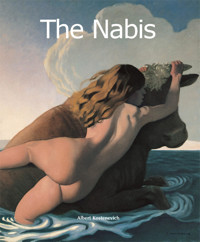
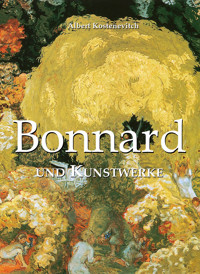
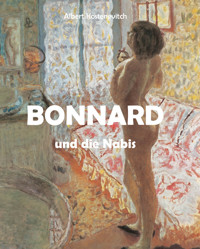
Pierre Bonnard was the leader of the group of post-impressionist painters who called themselves “the Nabis”, from the Hebrew word for “prophet”. Influenced by Odilon Redon, Puvis de Chavannes, popular imagery, and Japanese woodblock printing, Bonnard, Vuillard, Vallotton and Denis (to name the most prominent members) revolutionised the spirit of decorative technique during one of the richest periods in French painting. Although the increasing individualism of their works often threatened to weaken their unity, the Nabis were above all a group of close friends. The artwork presented in this book − varying between Bonnard’s guilelessness, Vuillard’s ornamental and mysterious works, Denis’s soft languor and Vallotton’s almost bitter roughness − plunges us into the deep source of their creative talents.
Das E-Book können Sie in Legimi-Apps oder einer beliebigen App lesen, die das folgende Format unterstützen:
Seitenzahl: 170
Veröffentlichungsjahr: 2014
Ähnliche















Text: Albert Kostenevich
Layout:
Baseline Co. Ltd
61A-63A Vo Van Tan Street
4th Floor
District 3, Ho Chi Minh City
Vietnam
© Parkstone Press International, New York, USA
© Confidential Concepts, worldwide, USA
© Estate Bonnard / Artists Rights Society, New York, USA / ADAGP, Paris
© Estate Denis / Artists Rights Society, New York, USA / ADAGP, Paris
© Aristide Maillol / Artists Rights Society, New York, USA / ADAGP, Paris
© Estate Matisse / Artists Rights Society, New York, USA / Les Héritiers Matisse
© Estate Roussel / Artists Rights Society, New York, USA / ADAGP, Paris
© Jan Verkade
© Estate Vuillard / Artists Rights Society, New York, USA / ADAGP, Paris
All rights reserved
No part of this publication may be reproduced or adapted without the permission of the copyright holder, throughout the world. Unless otherwise specified, copyrights on the works reproduced lie with the respective photographers. Despite intensive research, it has not always been possible to establish copyright ownership. Where this is the case we would appreciate notification.
ISBN: 978-1-78310-180-1
Albert Kostenevich
Contents
The Group
Major Artists
Félix Vallotton
Ker Xavier Roussel
Pierre Bonnard
Édouard Vuillard
MauriceDenis
BIOGRAPHIE
1. Paul Sérusier, The Talisman, 1888.
Oil on wood, 27 x 21.5 cm.
Musée d’Orsay, Paris.
Although Bonnard, Vuillard, Denis, Roussel and Vallotton have gone down in the history of painting as artists belonging to a single group, their works, in spite of some common features, in fact display more differences than similarities. They were bound together in their youth by membership in a circle which bore a curious name—theNabis. Art historians, who see the Nabis’work as a special aspect of Post-Impressionism, have long resigned themselves to this purely conventional label. The wordNabissays next to nothing about the aims and methods of these artists, but probably on account of their very diversity it has proved impossible to replace the label by a more meaningful term, or at least one which fits better into the established scheme of things. The Hermitage Museum in St. Petersburg possesses a splendid collection of works by Bonnard and his friends, and a much smaller collection of no less artistic merit is housed in the Pushkin Museum of Fine Arts in Moscow. All these works are presented in this book.
An interest in Nabis painting arose very early in Russia. Here, as elsewhere in Europe, it emerged not among art lovers as a whole, but among a tiny group of art collectors who were ahead of the general public in their appreciation of new developments. Works by Bonnard, Denis and Vallotton found their way to Moscow, and later to St. Petersburg, soon after they had been painted, some of them even being specially commissioned. In those days the purchase by Russian collectors of new French painting was a defiance of what was accepted as“good taste”. In contrast to earlier times, these new connoisseurs of painting came not from the aristocracy but from the merchant class. Several well-educated representatives of the new type of up-and-coming entrepreneurs, used to relying on their own judgement, also became highly active and independently-minded figures in the art market. Two of them, Sergei Shchukin (1854-1937) and Ivan Morozov (1871-1921) formed collections which at the beginning of the twentieth century ranked among the best in the world.
The name of Shchukin is probably more widely known, and this is not surprising: his boldness, seen by many of his contemporaries as mere folly, soon attracted attention. He had brought the most notable works of Henri Matisse, AndréDerain and Pablo Picasso to Moscow before Paris had had time to recover from the shock that they caused. Even today specialists are astonished by Shchukin’s unerring taste and keen judgement. He proved able to appreciate Matisse and Picasso at a time when so-called connoisseurs still felt perplexed or even irritated by their paintings. The Nabis, however, attracted Shchukin to a lesser degree, perhaps because their work did not appear sufficiently revolutionary to him. He acquired one picture by Vuillard and several by Denis, among them thePortrait of Marthe Denis, the Artist’s Wife,Martha and MaryandThe Visitation.Later another canvas was added to these,Figures in a Springtime Landscape(The Sacred Grove),one of the most ambitious and successful creations of European Symbolism, which was passed on to Sergei Shchukin by his elder brother Piotr. But Shchukin failed to notice Bonnard. Regarding Cézanne, Van Gogh and Gauguin as the key-figures in Post-Impressionism, Shchukin—and he was not alone in this—saw the works of Bonnard and his friends as a phenomenon of minor importance.
2. Maurice Denis, Sun Patches on the Terrace, 1890.
Oil on cardboard, 24x20.5cm. Musée d’Orsay, Paris.
3. Paul Gauguin, Vision of the Sermon (Jacob Wrestling with the Angel), 1888.
Oil on canvas, 72.2x91cm.
National Galleries of Scotland, Edinburgh.
4. Jan Verkade, Decorative Landscape, 1891-1892.
Oil on canvas. Private collection.
5. Paul Sérusier, Old Breton Woman under a Tree, c. 1898.
Oil on canvas. Musée départemental Maurice Denis“Le Prieuré”,
Saint-Germain-en-Laye.
6. Mogens Ballin, Breton Landscape, c. 1891.
Oil on paper. Musée départemental Maurice Denis“Le Prieuré”,
Saint-Germain-en-Laye.
He did in fact make one attempt to“get into”Bonnard. In 1899, he bought Bonnard’s paintingFiacreat the Bernheim-Jeune Gallery, but later he returned it. Today it is in the National Gallery in Washington. Shchukin used to say that a picture needed to be in his possession for some time before he made his final decision about it, and art dealers accepted his terms. The man who really appreciated the Nabis and who collected their pictures over a considerable period of time was Ivan Morozov. His taste for their work must have been cultivated by his elder brother Mikhail, one of the first outside France to appreciate their painting. Mikhail Morozov ownedBehind the Fence, the first work by Bonnard to find its way to Russia. He also had in his collection Denis’sMother and ChildandThe Encounter.When in 1903 Mikhail Morozov’s untimely death put an end to his activities as a collector, his younger brother took up collecting with redoubled energy, adding to his collection judiciously. Seeing in Bonnard and Denis the leading figures of the Nabis group, the best exponents of its artistic aims, he concentrated on their work. As a result, Bonnard and Denis were as well represented in his collection as the Impressionists, Cézanne and Gauguin.
After purchasing Denis’s pictureSacred Spring in Guidelat the Salon des Indépendants in the spring of 1906, Morozov made a point of becoming acquainted with the artist. That summer he visited Denis at his home in Saint-Germain-en-Laye, where he bought the as yet unfinishedBacchus and Ariadneand commissionedPolyphemusas a companion piece. In the same year, or at the beginning of the next, he placed his biggest order with Denis,The Legend of Psyche,a series of panels for his Moscow mansion in Prechistenka Street. At Morozov’s invitation, Denis came to Moscow to install the panels and add the finishing touches. Relations between the patron and the artist became firm and friendly. Morozov sought the Frenchman’s advice; at Denis’s prompting, for example, Morozov purchased one of Cézanne’s finest early works,Girl at the Piano.Denis introduced Morozov to Maillol. The result of this acquaintance was a commission for four large bronze figures which later adorned the same hall as Denis’s decorative panels, superbly complementing them.
The second ensemble of decorative panels commissioned by Morozov is even more remarkable when seen today. Created by Bonnard, it comprises the triptychMediterraneanand the panelsEarly Spring in the CountrysideandAutumn, Fruit-Picking.At Morozov’s suggestion Bonnard also painted the pair of works,Morning in ParisandEvening in Paris.Together with the triptych, these rank among Bonnard’s greatest artistic achievements.
St. Petersburg had no collectors on the scale of Sergei Shchukin and Ivan Morozov. Only Georges Haasen, who represented a Swiss chocolate firm in what was then the capital of Russia, collected new French painting. He was especially interested in artists like the Nabis group. Among other works, he had in his collection Bonnard’sThe Seine near Vernonand six paintings by Vallotton (all now in the Hermitage). Haasen knew Vallotton well: the artist stayed with him in St. Petersburg and painted portraits of the businessman himself and of his wife. No complete list of the works in Haasen’s collection has survived, but there is enough information to indicate that it was very well put together. The catalogue of the St. Petersburg exhibition held in 1912,A Hundred Years of French Painting, contains a number of works by Bonnard, Vuillard, Roussel and Vallotton from Haasen’s collection that were not among those which entered the Hermitage in 1921.
7. Édouard Vuillard, Chestnut Trees.
Distemper on cardboard,
mounted on canvas, 110x70cm.
Private collection.
8. Ker Xavier Roussel, Women in the Countryside, c. 1893.
Pastel on paper, 42x26cm. Private collection, Paris.
9. Ker Xavier Roussel, Garden, 1894.
Oil on cardboard mounted on canvas, 120x91.4cm.
Carnegie Museum of Art, Pittsburgh.
There was one more Russian collector who showed interest in the Nabis, Victor Golubev, but he took up residence in Paris. The two canvases belonging to him at the 1912 St. Petersburg exhibition, Vuillard’sAutumn Landscapeand Denis’sSt. George,were actually sent from France. The exhibition betokened a genuine recognition of new French art: on display were the finest works by Manet, Renoir, Monet, Cézanne and Gauguin.
The salon idols, who still had many admirers among the public, were represented by only a few works, while there were twenty-four Renoirs, seventeen Cézannes and twenty-one Gauguins. The Nabis were, of course, represented on a more modest but still creditable scale: six paintings by Bonnard, five each by Roussel and Denis, four by Vuillard and two each by Vallotton and Sérusier. Their works effectively formed the final element in the exhibition. They could no longer be regarded as the last word in French art, but they were the latest thing considered acceptable by the organizers of this diverse artistic panorama which occupied over twenty rooms in Count Sumarokov-Elstone’s house in Liteny Prospekt. This was undoubtedly one of the most significant art exhibitions of the early twentieth century, not only in Russia, but in the whole of Europe. Even today one cannot help marvelling at its scope and at the aptness in the choice of many works. At the same time the catalogue shows its organisers’desire to avoid excessive radicalism. It was, after all, a purely St. Petersburg affair, a joint venture of the magazineApollon(Apollo) and the French Institute, which at that time was located in St. Petersburg. The Institute’s director, Louis Réau, was a prominent art historian. The great Moscow collectors did not contribute to the exhibition, although Ivan Morozov was a member of its honorary committee.
10. Louis Comfort Tiffany, Garden, 1895.
Made after the stained glass window from Ker Xavier Roussel.
Private collection.
11. Pierre Bonnard, The Child with a Sandcastle, c. 1894.
Distemper on canvas, 167x50cm. Musée d’Orsay, Paris.
By that time in Moscow, where artistic life was far more turbulent than in St. Petersburg, painting of the type represented by the Nabis had been ousted by the more audacious and striking manifestations of the avant-garde, both Russian and foreign. Whereas at the 1908Golden Fleeceexhibition, Bonnard, Vuillard, Denis, Sérusier and Roussel were well represented, the following year their pictures were no longer on show. However, the organizers of the 1909 exhibition included works by Matisse, Derain, Vlaminck and Braque. TheIzdebsky Salon, a fairly large international exhibition arranged by Vladimir Izdebsky which in 1910 visited Odessa, Kiev, St. Petersburg and Riga, presented not only works by Matisse, Kees van Dongen, Vlaminck, Rouauft and Braque, but also by Larionov, Kandinsky, Jawlensky, Bechtejeff, Altman and many others. In sharp contrast there were only a few Nabis paintings. Neither Russian nor Western European art lovers had turned their backs on the art of Bonnard and his companions, but it had receded into the background. The opinion took root that these artists were of minor importance, and several decades were to pass before this myth was finally dispelled. The reason for the rise of the myth was that the Nabis stood apart from the mainstream of the various antagonistic movements in art, torn by strife on the eve of the First World War. But Time, that great arbiter, lifted the veil of obscurity from the Nabis, once again revealing the merits of their art, and placing Bonnard among the most brilliant colourists that France has ever produced.
12. Paul Cézanne, The Four Seasons – Autumn (detail), 1850-1860.
Oil on canvas, 314x104cm.
Petit Palais – Musée des beaux-arts de la ville de Paris, Paris.
The generation of Bonnard and his companions came to the fore in artistic life at the close of the nineteenth century. Nurtured by the colourful era known as thebelleépoque,they themselves contributed much to it. The history of nineteenth-century French art may be divided up in different ways. If, however, one is guided by the most fundamental cultural distinctions, a pattern of three periods approximately equal in length can be drawn. The first, which began when the principles of Classicism still reigned supreme, saw the emergence of the Romantic movement. The second was dominated by Realism, which appeared sometimes on its own, sometimes in interaction with Romanticism and even with a form of Classicism lapsing into Academicism. The third period was marked by a greatly increased complexity in the problems tackled by the artists. Influences of earlier times could still be traced in the various artistic styles, but only to highlight the new and unusual artistic manifestations.The development of painting gathered an unprecedented momentum. Its idioms became enriched by numerousdiscoveries. Impressionism assumed the leading role in spite of the hostility shown towards it in official circles, by the general public, and by most painters.
The last three decades of the nineteenth century were among the greatest and richest in French art. They were staggering in their volcanic creative activity. One brilliant constellation of artists was followed by the rise of another. Younger painters rapidly caught up with their older colleagues and competed with them. Moreover, the appearance of a dazzling new movement in art was not followed by a lull, a pause in development, which could have had a historical justification—to give that movement time to strengthen its influence. On the contrary, no sooner had the roar of one gigantic wave subsided, than another came rolling implacably behind it, and so on, wave after wave.
13. Maurice Denis, Martha and Mary, 1896.
Oil on canvas, 77x116cm.
The State Hermitage Museum, St. Petersburg.
14. Georges Lacombe, Isis, c. 1895.
Bas-relief in mahogany, 111.5x62x10.7cm.
Musée d’Orsay, Paris.
15. Paul Cézanne, The Four Seasons – Spring (detail), 1859-1860.
Oil on canvas, 314x104cm.
Petit Palais – Musée des beaux-arts de la ville de Paris, Paris.
The main“disturber of the peace”in the 1860s wasÉdouard Manet. His works caused a revolution in painting, blazing the way for a new style—Impressionism. The 1870s were decisive years in the Impressionists’battle to assert their new, unbiased approach to reality and their right to use bright, pure colours, wholly appropriate to the wonderful freshness of their perception of the world. The 1880s were marked by more developments. Proceeding from the discoveries of Monet and his fellow Impressionists, Seurat and Signac on the one hand, and Gauguin on the other, all mapped out entirely new directions in painting. The views of these artists were completely different. The“scholarly”approach of the first two Neo-Impressionists ran counter to the views of Gauguin and the Pont-Avon group of which he was the leader. These artists owed a great deal to medieval art. Meanwhile Vincent van Gogh, who had by that time moved from Holland to France, led the way in another direction: his main concern was to express his inner feelings. All these artists had moved a good distance away from Impressionism, yet each owed a great deal to the revolution that Manet had fomented. When Seurat and Gauguin exhibited their pictures at the last exhibition of the Impressionists held in 1886, their divergence was already clearly marked. Naturally, among the“apostates”one ought to name the two contemporaries of the Impressionists—Redon, and, above all, Cézanne, who from the start recognized not only the enormous merits of Impressionist painting, but also saw traits in it which threatened to lead to shallowness and to the rejection of the eternal truths of art.
Soon a new term—Post-Impressionism—made its appearance. It was not a very eloquent label, but it came to be widely used. The vagueness of the label was not accidental. Some of the French artists who were initially inspired by the Impressionistic view of the world later left Impressionism behind, each pursuing his own path. This gave rise to an unprecedented stylistic diversity which reached its peak between the late 1880s and the beginning of the twentieth century. No one name could possibly be adequate in this situation.
Even from anti-academic points of view, Impressionism could seem narrow and insufficient as a means of artistic expression, yet it still remained a force which no artist of talent, at least in France, could ignore. It was not only Seurat, Gauguin, Van Gogh and Toulouse-Lautrec who came to be regarded as Post-Impressionists, but also Redon and Cézanne, and even Matisse and Picasso. For example, in 1912 the last two artists displayed their work at the second exhibition of Post-Impressionists at the Grafton Gallery in London. More recently, however, art historians have tended to limit Post-Impressionism to the nineteenth century. The revolution caused by the Impressionists, and its aftermath, Post-Impressionism, became the most important forces in the development of art from the 1860s through to the 1890s, and it would probably be no exaggeration to say that they influenced artistic evolution throughout the twentieth century.
Any really creative artist living in Paris who embarked on his career in the late 1880s, when Impressionism was drawing to its close, was almost inevitably“doomed”to become a Post-Impressionist. So it is hardly surprising that a small group of artists, calling themselves the Nabis—Bonnard, Vuillard and Denis among them—




