


18,99 €
Mehr erfahren.
- Herausgeber: John Wiley & Sons
- Kategorie: Geisteswissenschaft
- Sprache: Englisch
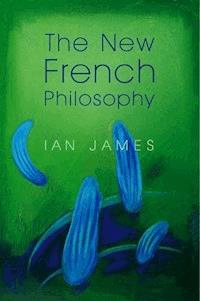
This book gives a critical assessment of key developments in contemporary French philosophy, highlighting the diverse ways in which recent French thought has moved beyond the philosophical positions and arguments which have been widely associated with the terms 'post-structuralism' and 'postmodernism'. These developments are assessed through a close comparative reading of the work of seven contemporary thinkers: Jean-Luc Marion, Jean-Luc Nancy, Bernard Stiegler, Catherine Malabou, Jacques Rancière, Alain Badiou and François Laruelle.
The book situates the writing of each philosopher in relation to earlier traditions of French thought. In differing ways, these philosophers decisively distance themselves from the linguistic paradigm which dominated so much twentieth-century thought in order to rethink philosophical conceptions of materiality, worldliness, shared embodied existence and human agency or subjectivity. They thereby open the way for a radical renewal of the claims, possibilities and transformative power of philosophical thinking itself.
This book will be an indispensable text for students of philosophy and for anyone interested in current developments in philosophy and social thought.
Sie lesen das E-Book in den Legimi-Apps auf:
Seitenzahl: 450
Veröffentlichungsjahr: 2014
Ähnliche




















Table of Contents
Cover
Memory
Title page
Copyright page
Acknowledgements
Introduction: The Demands of Thought
1 Jean-Luc Marion: Appearing and Givenness
The overcoming of metaphysics
Phenomenology and givenness
Objections and responses: Being Given and saturated phenomena
Saturation and the self
2 Jean-Luc Nancy: The Infinity of Sense
Infinitude
Art and incarnation
3 Bernard Stiegler: The Time of Technics
Technics and Time
What is to be done?
4 Catherine Malabou: The Destiny of Form
Plastic reading
Cerebrality
Plasticity, writing, and changing difference
5 Jacques Rancière: The Space of Equality
Equality, Althusser and the distribution of the sensible
Politics, democracy, subjectivation
The regimes of art
6 Alain Badiou: The Science of the Real
Being and Event
The situation of contemporary thought
Logics of Worlds
7 François Laruelle: Beginning with the One
Radical immanence and non-philosophy
Equivalence and the material of philosophy
Performance
Democracy and invention
Conclusion: The Technique of Thought
Bibliography
Index
In memory of Ann and Alan Deyermond
Copyright © Ian James 2012
The right of Ian James to be identified as Author of this Work has been asserted in accordance with the UK Copyright, Designs and Patents Act 1988.
First published in 2012 by Polity Press
Polity Press
65 Bridge Street
Cambridge CB2 1UR, UK
Polity Press
350 Main Street
Malden, MA 02148, USA
All rights reserved. Except for the quotation of short passages for the purpose of criticism and review, no part of this publication may be reproduced, stored in a retrieval system, or transmitted, in any form or by any means, electronic, mechanical, photocopying, recording or otherwise, without the prior permission of the publisher.
ISBN-13: 978-0-7456-4805-7
ISBN-13: 978-0-7456-4806-4(pb)
ISBN-13: 978-0-7456-8128-3(Single-user ebook)
A catalogue record for this book is available from the British Library.
The publisher has used its best endeavours to ensure that the URLs for external websites referred to in this book are correct and active at the time of going to press. However, the publisher has no responsibility for the websites and can make no guarantee that a site will remain live or that the content is or will remain appropriate.
Every effort has been made to trace all copyright holders, but if any have been inadvertently overlooked the publisher will be pleased to include any necessary credits in any subsequent reprint or edition.
For further information on Polity, visit our website: www.politybooks.com
Acknowledgements
I would like to offer my warm thanks to all those who have helped with the production of this work, in particular Sarah Lambert at Polity Press. Special thanks are also due to John Thompson, who commissioned this project and to the three anonymous readers of the manuscript whose comments were of enormous help in the production of the final draft. For the various ways in which they have helped, supported or inspired, I would like to thank Martin Crowley, Barry Everitt, Gail Ferguson, Alison Finch, Peter Hallward, Leslie Hill, Michael Holland, Christina Howells, Jonathan Miles, Gerald Moore, John Mullarkey, Hannes Opelz, Dan Smith, Chris Watkin, James Williams and Emma Wilson. In particular, I would like to extend special thanks to Andrew Benjamin, Adriana Cavarero, Griselda Pollock, Max Silverman and Samuel Weber for helping me to formulate some key issues at a decisive moment in the completion of this work. I am also very grateful to the University of Cambridge and to Downing College for the period of research leave which allowed me to complete this book. I would like to express my infinite gratitude to Ruth Deyermond, without whose support, both intellectual and personal, it would not have been possible to research and complete this project. Lastly, I would like to dedicate this book to the memory of Ann and Alan Deyermond, whose generosity, warmth and kindness are greatly missed.
Introduction: The Demands of Thought
To speak of the ‘New French Philosophy’ is to make the claim that thought may have decisively transformed or renewed itself. It affirms a discontinuity or rupture, a break between a thinking which came before and one which comes after. Such a claim immediately raises a number of different questions which are themselves philosophical: questions relating to the very possibility of novelty itself, to causality and determinism, or to the nature of transformation or change.1 It also raises questions relating to the distinctiveness or identity of a specifically French, rather than, say, a broader European, philosophy and to the possibility of aligning a diverse range of thinkers according to a shared logic or paradigm of renewal.
To complicate matters further the question of the ‘new’ has also been one of the central preoccupations of French philosophy itself since at least the 1960s.2 As the American philosopher Dan Smith has shown, the conditions or the production of the ‘new’ is a key concern of Gilles Deleuze’s philosophy of difference and, as Deleuze himself suggested on a number of occasions, one of the fundamental questions posed more generally by his contemporaries (Smith 2007: 1, 19 n. 2). This is easily borne out with reference to the other major figures of French philosophy who rose to prominence in the 1960s and then came to dominate French thought in the decades which followed; figures such as, for example, Jean-François Lyotard, Jacques Derrida and Michel Foucault.
Lyotard, for instance, conceived the ‘event’ as that which contests received modes of discourse and requires that existing ways of thinking be transformed. His conception of the event has been described as ‘the founding moment of any postmodernism’ (Malpas 2003: 99). Likewise, in one of Lyotard’s most important works, The Differend, the ‘differend’ itself is understood as an instability of language and discourse which, if we give it its due, will institute ‘new addressees, new addressors, new significations and new referents’ and will admit into language ‘new phrase families and new genres of discourse’ (Lyotard 1988: 13). Similarly, in Derrida’s Spectres of Marx, the motifs of the messianic, of the undecidable and of the incalculable are all orientated towards the possibility of incorporating ‘in advance, beyond any possible programming, new knowledge, new techniques, new political givens’ (Derrida 1994: 13). This major late text of Derridean philosophy demonstrates clearly that one of the central concerns of deconstruction is ‘to produce events, new effective forms of action, practice’ (Derrida 1994: 89). At different times and in different works, Deleuze, Lyotard and Derrida will all use the term ‘event’ in order to designate the emergence of the radically new into the field of thought, practice or historical becoming. The ‘event’ is also a term used by Foucault in his archaeology of knowledge and his thinking of epistemic breaks developed in The Order of Things (Foucault 2002). For Foucault, the question of the new is posed in terms of discontinuity, or the way in which ‘within the space of a few years, a culture sometimes ceases to think as it had been thinking up till then, and begins to think other things in a new way’ (Foucault 2002: 56). The key question he poses is that of ‘how is it that thought has a place in the space of the world, that it has its origin there, and that it never ceases to begin anew?’ (Foucault 2002: 56).
Foucault’s question is one which frames this book and the specific formulation of its title, The New French Philosophy. It is also a question that continues to be posed in an insistent and sometimes urgent manner by all the thinkers who are discussed here: Jean-Luc Marion, Jean-Luc Nancy, Bernard Stiegler, Catherine Malabou, Jacques Rancière, Alain Badiou and François Laruelle. In different ways, all these philosophers continue to be preoccupied with the question of how something new might enter the world. They are concerned with questions of transformation and change, with the emergence of the unexpected, the unforeseeable or the uncategorizable. They are concerned with the possibility of contesting existing forms in the name of invention and creation, of reformation and renewal. Posing the question of how thought may have its place and origin in the space of the world, and yet nevertheless may never cease to begin anew, Foucault suggests that the process of renewal ‘probably begins with an erosion from the outside, from a space which is, for thought, on the other side but in which it has never ceased to think from the very beginning’ (Foucault 2002: 56). In their different ways, each of the philosophers discussed here seek to rethink the relation of thought both to worldly existence or appearance and to what might be termed ‘the outside’. In each case, albeit it still in different ways, the emergence of the ‘new’ or the possibility of change or transformation can be understood as an ‘erosion from the outside’, as an exposure to an instance of excess, an excess over the finite limits of conceptual or categorial determination.
Insofar as all the philosophers discussed here can be seen to continue the preoccupation with the new which is so central to the work of Deleuze, Lyotard, Derrida and Foucault, the title of this book could be considered something of a misnomer. The question of the new and its advent is itself far from new. By the same token, five out of the seven figures discussed here began to establish their careers in the 1970s and are not ‘new’ in the sense of being a young generation beginning to write in the first decade of the twenty-first century. Badiou and Laruelle were both born in 1937, Nancy and Rancière in 1940, and Marion in 1946. All of these five are still alive and publishing works today but all of them are, to varying degrees, in the latter part of their careers as philosophers (and mostly retired from their university positions). Only Stiegler (b. 1952) and Malabou (b. 1959) are of a younger generation and, although well established, can be placed in ‘mid career’. Perhaps most importantly for the purposes of this book and its potential readership, all these figures have become more widely known in the anglophone academic community over the past ten to fifteen years and their work has, over the past ten years, been more widely available in English translation.
Despite the strong sense of continuity with the generation of philosophers that can be associated with the names Deleuze, Lyotard, Derrida and Foucault and, very broadly, with the problematic labels ‘post-structuralism’ and ‘postmodernism’, all of the thinkers discussed here can be viewed as a successor generation. This might not always be the case in strict age terms; Badiou, after all, was born only seven years after Derrida. Nevertheless, even on these terms, Deleuze, Foucault and Lyotard (born 1925, 1926 and 1924 respectively) are far more clearly of an earlier generation. What will become clear throughout this study is that the five older philosophers – Marion, Nancy, Rancière, Badiou and Laruelle – all begin to establish their distinctive positions in the 1970s and begin publishing their major works of philosophy in the 1980s and 1990s (and continue to do so today). The two younger philosophers, Stiegler and Malabou, begin publishing their major works in the 1990s and their philosophical projects are still very much ongoing. However helpful these indications may or may not be, it should be underlined that simple calculations of generational difference and age cannot be enough, in themselves, to establish a plausible argument about the renewal or transformation of French thought over the past three decades.
The argument of this book is that, beginning in the 1970s, the French philosophers discussed all, in different but decisive ways, making a break from the thought of the preceding generation. The difficulty in making such an argument is that attention to the difference and specificity of each thinker must be balanced with what they might, however loosely, share. The danger, of course, will be that quite divergent developments of thought will be assimilated to a unified paradigm which in fact blurs or misrepresents the specificity of each thinker. A very preliminary rehearsal of this book’s argument might run as follows: in different and sometimes directly opposing ways, and beginning in the 1970s, the philosophers treated in this book explicitly distance themselves from the linguistic paradigm which informed much of what has gone under the name of structuralism and post-structuralism and which can be associated with diverse terms: with the order of signifiers, signifieds and of the symbolic, or with the categories of discourse, text, and writing (or arche-writing). They do so in the name of a systematic attempt to radically rethink questions of materiality and the concrete, together with questions of worldliness, shared embodied existence and sensible–intelligible experience. They can all be said to rethink the status of the ‘real’, of worldly appearance, or to re-engage in new and highly original ways with the question of ontology.
Before pursuing a rehearsal of this argument in anything but the cursory and preliminary manner just given, it may be useful to consider some of the broad surveys of contemporary French philosophy which have been published to date and some of the questions which are raised by them. John Mullarkey’s Post-Continental Philosophy: An Outline (Mullarkey 2006) is without doubt the most ambitious and fully developed attempt that has been made to date to argue for a paradigm break within the development of contemporary French thought. Post-Continental Philosophy brings together four philosophers, two of whom are also discussed in this book. They are Gilles Deleuze, Michel Henry (1922–2002), Alain Badiou and François Laruelle. As Mullarkey himself points out at the very beginning of the introduction, his work does not address something that is, or which has already occurred, but rather something that ‘is unfolding, an event in the making’ (Mullarkey 2006: 1). More precisely, the book takes as its premise the claim that a certain moment in the ongoing development of French thought might be accorded the status of an ‘event’. The moment he identifies is 1988, a year which sees the publication in French of important texts by each of the philosophers he discusses: Deleuze’s The Fold (Deleuze 2006), Badiou’s Being and Event (Badiou 1988; 2005b), Henry’s Voir l’invisible [Seeing the Invisible] (Henry 2009), and an important discussion between Laruelle and Derrida on the possibility of a science of philosophy (Mullarkey 2006: 11). The event that he identifies is a change in philosophical thought which is centred on the question of immanence. More precisely this ‘event’ marks an attempt by philosophy to articulate ‘an embrace of absolute immanence over transcendence … to make immanence supervene on transcendence’ (Mullarkey 2006: 1). Post-Continental Philosophy argues, both persuasively and powerfully, that this attempted embrace of immanence leads to a realignment of French thought with naturalism and with the life sciences, with mathematics and with the reaffirmation of ‘philosophy as a worldly and materialist thinking’ (Mullarkey 2006: 2).
As will become clear, this book broadly reaffirms Mullarkey’s arguments relating to the realignment of French thought with a non-reductive naturalism and the life sciences, with mathematics and with a worldly and materialist thinking.3 Yet stark differences also present themselves and these relate to the question of the ‘canon’ of philosophers which have been chosen, to questions of periodization (i.e. the identification of 1988 as a key date), as well as to the adoption of immanence as the sole principle governing the realignment of French philosophy over the past thirty years. It certainly is true that nearly (but not) all of the thinkers here can be seen to affirm what might be called the immanence of material life and to this extent Mullarkey’s argument is borne out well by many of the analyses offered here.4 Whether it be Marion’s thinking of givenness and the auto-affection of the flesh, Nancy’s thinking of the ‘trans-immanence’ of sense, Malabou’s conception of a material or metamorphic ontology, or, indeed, the different conceptions of immanence that can be found in Badiou and Laruelle, the question of immanence will be returned to throughout this study.5
This book differs from Mullarkey insofar as it takes the idea of a break from the linguistic, textual or discursive paradigm of (post-)structuralism as its initial premise and locates the beginnings of this break in the 1970s.6 The broad shift towards a thinking of immanence is certainly a result of this, but not all the thinkers discussed here can easily be said to be thinkers of radical or absolute immanence (at least not to the same degree) and, as will become clear, a range of other important philosophical shifts can be seen to follow on from this break: a re-engagement with the question of ontology as has already been mentioned, but also a sustained renewal with the question of the subject and of subjectivity, with questions of community, politics and political change, and with questions relating to the aesthetic and aesthetics. Within the logic of the break from structuralism and/or post-structuralism, the thought of both Deleuze and Henry arguably offer indispensable resources to some of the thinkers treated here (e.g. the influence of Deleuze and Henry on Laruelle or of Henry in particular on Marion).7 To this extent, it could be argued that they represent an important, and specifically French, trajectory of thought which can be traced from Bergson which is of decisive importance for the generation of thinkers treated here but that they do not belong to this generation (and have been excluded on these grounds).
It should be clear that the question of inclusion or exclusion is of central importance when it comes to constructing an argument relating to what may be contemporary or ‘new’ within a body of thought. A shorter account of this field has been given by Peter Hallward in his introduction to a special edition of the journal Angelaki published in 2003 and entitled ‘The One and the Other: French Philosophy Today’ (Hallward 2003b). Although shorter than Mullarkey’s full-length work, Hallward’s introduction is very inclusive and wide-ranging and takes in thinkers from across the span of the twentieth century, including well-known figures such as Bergson, Sartre, Deleuze, Henry and Levinas, and less well-known thinkers such as Henry Corbin (1903–1978). It also includes a number of thinkers who may be said to be of roughly the same generation as those treated here but who do not feature in this study, e.g. Clément Rosset (1939–), Christian Jambet (1949–) and Guy Lardreau (1947–2008). Rather than argue for a localized or specific ‘event’ within recent French thought (as does Mullarkey) or for a break or discontinuity with a preceding generation (as is the case here), Hallward suggests that much philosophy in the twentieth century is marked by an affirmation or privileging of the singular, of singularity, and of the creative principle of singular individuation or becoming: ‘If anything holds the field together, if anything (beyond the contingency of languages and institutions) allows us to speak here of a field … then it is the continuous persistence of singularity as the strong polarizing principle of the field as a whole’ (Hallward 2003b: 5).
However, taking Henry’s thought as more or less paradigmatic of this privileging of singularity and creativity, Hallward goes on to argue that this field has consistently affirmed ‘an immediate and non-relational process of individuation’ and with that a ‘radical refusal of mediation or representation’ (Hallward 2003b: 9). This leads him to conclude that: ‘Recent French philosophers came to embrace a singular conception of thought to the degree that they judged the world incapable of redemption’ (Hallward 2003b: 22). On this basis, he suggests that French thought has developed a highly non-relational mode of thinking and has entirely lacked an account of worldly and mediated relationality. He therefore concludes that the task of those wishing to continue the tradition of French thought today will be to provide a ‘relational alternative’ (Hallward 2003b: 23). If there is to be a break or an event within thought then, for Hallward at least, this is one which thought must now anticipate and take up as a challenge in order to re-engage with the world and its possible transformation.
It is arguable that many, if not all, of the seven thinkers discussed in this study have sought to take up this demand of thought, that of re-engaging with the world and with the question of relationality, and have done so in various ways and at various key moments from the 1970s onwards.8 More importantly, though, what this brief survey of Mullarkey’s and Hallward’s accounts shows is the extent to which any attempt to characterize ‘French philosophy today’ and to articulate what is or is not ‘new’ within this tradition is itself a philosophical argument which entails philosophical decisions and judgements. As was indicated at the beginning of this introduction, to speak of the ‘New French Philosophy’ is to raise questions which are themselves philosophical. To do so is also implicitly to stake out a position and make a series of philosophical arguments. As has been indicated, the principal argument of this book is that, despite their obvious differences from each other and despite the fact that this remains a field defined by major lines of conflict, argument and polemical opposition, all the thinkers treated have come to reaffirm what one might call the ‘materiality of the real’ in the wake of the preceding generation’s focus on language and signification.
Yet any attempt to make such an argument or to characterize the field of contemporary French philosophy more generally will, of course, also define itself as much by those thinkers who have been excluded as by those who have been included. This study, for example, excludes a number of important philosophers who are all of the same, or similar, generation as those who have been included. Rosset, Jambet and Lardreau have already been mentioned but one could also offer a long list of other key figures, for example, Étienne Balibar (1942–), Jacques Bouveresse (1940–), Pierre Macherey (1938–), Michèle Ledoeff (1948–), Philippe Lacoue-Labarthe (1940–2007) and Monique David-Ménard (1947–).9 Younger philosophers such as Quentin Meillassoux (1967–) who have more recently begun to publish significant work might be mentioned.10 Important thinkers who have for some time been associated with the philosophy of science or with Science and Technology Studies are also key points of reference here and have, to date, been accorded varying degrees of recognition: Bruno Latour (1947–) would feature most prominently in this regard, as would Dominique Lecourt (1944–) and Michel Serres (1930–). What should be clear from such a long (and far from complete) list of exclusions is that the present study makes no attempt whatsoever to be exhaustive in its overview of contemporary French thought or, indeed, to give an account of the recent development of philosophy in France from an institutional or disciplinary perspective.11
What links all the thinkers who have been included here is a specific set of continuities and discontinuities with the work of the preceding generation of philosophers. It is on the basis of continuity (marks of influence, continued concerns, instances of repetition) and of discontinuity (specific gestures of critical distance, differentiation, and ruptures or breaks) with the generation of Foucault, Deleuze, Derrida and Lyotard that this study identifies something which could be called the ‘New French Philosophy’. In this context, the innovations explored within this book can be assimilated to a broad and shared paradigm of renewal and innovation rather than to an emergence of radical novelty. By the same token, some of the thinkers treated here (e.g. Badiou and Laruelle) do seek to proclaim their radical novelty and these positions and their related claims are explored critically rather than being taken at face value.
Throughout the first four chapters, the figure of Derrida perhaps looms largest. Marion’s engagement with, and distance from, Derrida is discussed at some length in chapter 1. Nancy, Stiegler and Malabou were very closely associated with Derrida, either as younger colleagues, collaborators or former students (or, indeed, all three). The relation of each to deconstruction is marked in the discussions of chapters 2, 3, and 4, as is their decisive self-distancing from key moments of Derridean thought. It is arguably on these key moments of distancing or divergence that they all build their own highly distinctive philosophical positions and come to sharply differentiate themselves from deconstructive or more broadly ‘post-structuralist’ concerns. In the final three chapters, a figure of great importance that has not yet been mentioned occupies a key position of influence. He is the structuralist-Marxist philosopher Louis Althusser (1918–1990).12 Both Rancière and Badiou were closely associated with, and heavily influenced by, Althusser at the very beginning of their careers. In different ways and to different degrees each makes a break from Althusserianism in the 1970s, a break which, as will become clear, can also be framed as rejection of the linguistic paradigm that underpinned its structuralist orientation. Laruelle is a slightly more difficult figure to position in relation to the preceding generation. On the one hand, he is clearly marked and formed by philosophies of difference, and in particular by Deleuzian philosophy and Deleuze’s thinking of radical immanence (but also, as mentioned earlier, by the thought of Henry). At the same time, he describes his thought as a ‘non-Heideggerian deconstruction’ and, from the 1980s onwards, develops his ‘non-philosophy’ as a radical break from the philosophies of difference (e.g. Deleuze, Derrida, Lyotard) of the preceding generation and, of course, from philosophy more generally. Then again, as is argued in chapter 7, Laruelle’s conception of a ‘science’ of philosophy and of science more generally can be aligned with an Althusserian structural conception of science or theory.
It should be clear, then, that the continuities and discontinuities with which this study engages are both multiple and complex and, within the context of seven short chapters being devoted to seven individual philosophers, there is no claim to have given exhaustive treatment of these. However, the key discontinuity that has been already identified in preliminary fashion, that is to say, the break from the linguistic paradigm of (post-)structuralism, is articulated in different, more or less explicit ways, by each of the philosophers discussed. The argument is made in a polemical manner by Badiou in a seminar given originally in November 1977 and published in French in 1982 in The Theory of the Subject (Badiou 1982; 2009e). He identifies the anti-humanism of the 1960s generation (citing Foucault, Lacan and Althusser) with their privileging of the category of discourse and their orientation according to a linguistic paradigm. He clearly identifies the structuralist attempt to think beyond the category of the human with its claim that language is the condition of possibility for the production of human subjectivity or experience per se (i.e. with the argument that the human as a category is an ‘effect’ of discourse). It is this privileging of the paradigm of language and discourse that Badiou directly and polemically challenges (Badiou 1982: 204; 2009e: 187–8). He suggests that this paradigm is a form of ‘linguistic idealism’ and states flatly: ‘the world is discourse: this argument in contemporary philosophy would deserve to be rebaptized “idealinguistery” ’ (Badiou 1982: 204; 2009e: 188). The linguistic idealism of structuralist conceptions of discourse is challenged by Badiou in the name of materialism and the demand that thought re-engage with the material world: ‘it is materialism that we must found anew with the renovated arsenal of our mental powers’ (Badiou 1982: 198; 2009e: 182).13 Arguably Badiou’s mathematical turn, discussed in detail in chapter 6, is precisely the ‘renovated arsenal’ which he calls for in this 1977 seminar which so polemically demands a renewed materialism and a break from the linguistic idealism of structuralist discourse.
This break from the structuralist paradigm, effected in the name of a renewed materialist thought, is also an inaugural moment of Rancière’s philosophy and is discussed at length in chapter 5 (in relation to his decisive rupture with Althusser). Rancière’s break from Althusser and the Althusserian conception of ideology is, very much like Badiou’s criticism of 1960s anti-humanists, framed in terms of a specific rejection of the category of discourse. This is made explicit in his 1974 work Althusser’s Lesson: ‘Ideology is not simply a collection of discourses or a system of representation’ (Rancière 1974: 252–3; 2011c: 142). As chapter 5 argues, Rancière’s subsequent conceptions of the ‘distribution of the sensible’, of historical and political agency or community, and his thinking about art and the aesthetic, all can be seen to follow on from this decisive break with Althusser and with the structuralist-linguistic paradigm.
Such a break can also be seen in key works of the 1970s written by Nancy and Laruelle, albeit with very different outcomes. In, for instance, Ego Sum (Nancy 1979), Nancy criticizes the return to a dominant position of the category of the subject and identifies this most prominently with the privileged status enjoyed in this period by Lacanian psychoanalysis.14 However, this return of the subject is also identified more broadly with the structuralist paradigm, specifically with the instances of ‘Structure, Text, or Process’ (Nancy 1979: 11). It is identified also with the adoption by philosophy of the notion of the symbolic and its alignment with disciplines (anthropological, sociological) exterior to philosophy (Foucault is cited in this point; see Nancy 1979: 12 n. 2). Ego Sum has as its task the attempt to uncover beneath the ‘anthropological profusion’ of symbolic, textual, or structural subjects an instance that would be ‘not a subject, nor the Subject, we will not name it, but this book would like it to name itself: ego’ (Nancy 1979: 13). The instance that Nancy identifies in Ego Sum via a reading of Descartes’s cogito is a singular and bodily site of enunciation and existence which is prior to, or in excess of, the symbolic order, and in excess of any possibility of theorization by (psychoanalytic) discourse (see James 2006: 58–62). Nancy’s philosophical arguments relating to this bodily and ungrounded site of exteriority, excess or exposure open the way for all his later formulations around questions of community, embodiment, shared existence and his ontology of the singular plural (discussed in chapter 2).
By the same token a break from a linguistic or textualist paradigm is marked in the very title of Laruelle’s 1977 work Le Déclin de l’écriture [The Decline of Writing] (Laruelle 1977b). Laruelle, like Badiou and Rancière, explicitly articulates the theoretical and philosophical aspiration of his work around a demand for a materialism (Laruelle 1977b: 8). Specifically, he aligns the motif of the ‘decline of writing’ with ‘a materialist critique of textual and linguistic codes’ (Laruelle 1977b: 14). The work as a whole could be characterized as a full-frontal attack on the very category of ‘text’ and the structuralist paradigm which privileges such a category. This is borne out in polemical statements such as: ‘text must be stripped of the ontico-ontological primacy with which structuralist ideology and the majority of “textual” ideologues comfort themselves’ (Laruelle 1977b: 222). From this demand, Laruelle takes as his task the attempt to think materiality as being in excess of theoretical or transcendent criteria, and therefore as ‘material immanence’, and as an exteriority or heteronomy ‘more radical than that of the symbolic chain’ (Laruelle 1977b: 43, 76). Le Déclin de l’écriture is still heavily marked by Laruelle’s attachment to 1970s’ libidinal philosophy and a machinic conception of desiring production (clearly demonstrating the influence of Deleuzian philosophy). His break from the philosophies of difference in the 1980s, his shift into the register of non-philosophy and his championing of the absolute immanence of the One is, however, clearly shaped by the anti-structuralism and anti-textualism of 1970s’ works such as Le Déclin de l’écriture (as discussed in chapter 7).
The three other thinkers discussed here can also very clearly be seen to take a distance from the organizing paradigm of text or writing which form the objects of the 1970s’ polemics of Badiou, Rancière, Nancy and Laruelle. This is most clearly marked in the title of a recent work by Malabou, Plasticity at the Dusk of Writing (Malabou 2005a; 2010b). Strongly echoing Laruelle’s formulation relating to the ‘decline’ of writing, Malabou’s book gives an overview of the development of her concept of plasticity from the 1990s onwards. The wider contemporary significance of the concept of plasticity, Malabou suggests, lies in the fact that ‘writing’ is no longer the key paradigm of our time (Malabou 2005a: 36; 2010b: 15). The figure of writing, she goes on to argue, found its legitimation in structuralism, but also more generally in the linguistics, cybernetics and genetics of the mid-twentieth century (Malabou 2005a: 108; 2010b: 58). The thinking of plasticity which is developed by Malabou is, once again, placed in the service of the demand to think a ‘new materialism’ (Malabou 2005a: 112; 2010b: 61) (as discussed in chapter 4). This sense of a shift away from the paradigm of text or writing is explored again in the work of both Marion and Stiegler. In chapter 1, it is located clearly in Marion’s insistence that givenness is anterior to any economy of writing or difference (conceived in Derridean terms as différance and as an economy of arche-writing or the inscription of the trace).15 In chapter 3, it is located in Stiegler’s argument that technics and the specific memory traces embodied in tools and technical prosthetics more generally is a ‘putting into actual play’ of différance or of the Derridean trace (Stiegler 1994: 240; 1998: 234). In very different ways, therefore, Malabou’s plasticity, Marion’s unconditional givenness (in the auto-affection of flesh), and Stiegler’s conception of the technological rooting of temporal experience all represent attempts to think a fundamental materiality of human life which is prior to or in excess of any economy of discourse, text, writing or of the symbolic.
The fact that an affirmation of materialism can be identified across all the thinkers discussed here and aligned in each instance with an unambiguous break with or distancing from a linguistic, structuralist, textualist or discursive paradigm is striking. What might be even more striking in relation to the polemics of Badiou, Rancière, Nancy and Laruelle in the 1970s is that the questions of materialism and materiality were, of course, already central to the (post-)structuralism they sought to repudiate. Whether it be the materiality of the signifier as championed by the Tel Quel group (see ffrench 1995: 110, 122, 138), the materiality of the word or of discourse posited by Lacan (Lacan 1988) or the material practices of ideology thought by Althusser (Sharma and Gupta 2006: 103), it cannot be said that the bodies of thought that can be associated with structuralism lacked a concern with the ‘material’. Yet, as these indications clearly show, the concern for materiality in this context was often a concern for the materiality of discourse, of language and of the symbolic which might then form or inform material practices. Such a linguistic materialism is perceived by all the thinkers here to be unable to account for a more fundamental materiality: of givenness in the auto-affection of the flesh (Marion), of sense of and embodied existence (Nancy), of technical prosthetics and their constitution of a temporal world (Stiegler), of plasticity (Malabou), of the sensible and its distribution (Rancière), of immanent inconsistent multiplicity (Badiou) and, finally, of the absolute immanence of the One (Laruelle).
The call for a new materialism articulated in the thought of the seven philosophers treated in this book is developed in different ways by each. It leads to highly original attempts to rethink the question of ontology or of being (Nancy, Stiegler, Malabou, Badiou). It leads to the rethinking of the status of the immanent real as an instance which is in excess of ontology or any horizon of being whatsoever (Marion, Laruelle). The demand for a material worldly thinking also leads many of these philosophers to re-engage with the question of political relationality and community and to rethink these instances in new and original ways, whether it be Nancy’s thinking of community and his ontology of the singular plural, Rancière’s conception of sensible community, or Badiou’s more recent thinking of the logic of worldly appearance (to name but three examples). The concern with the new, with transformation and change, is also, as was indicated at the beginning of this introduction, a key aspect of all the thinkers discussed here. Such a concern is most often expressed in terms of political change and an attempt, in the work of philosophy itself, to think the conditions of political transformation and to affirm, facilitate or bring about political change itself (this is true for all the philosophers discussed here with the exception, perhaps, of Marion and Laruelle).16
Linking many of these philosophical innovations is also a sustained attempt to re-engage with the question of the subject and to resituate something which might still be called subjectivity within a pre-symbolic/linguistic and material dimension. All of these philosophers can be said to engage in diverse ways with the question posed by Jean-Luc Nancy namely, ‘Who comes after the subject?’ (Nancy 1991f). After the destruction, deconstruction or dissolution of the traditional subject of metaphysics that has been the task of so much philosophy unfolding in the wake of Nietzsche, Heidegger and structuralism, how is thought to reconceptualize the reality of human agency and subjective consciousness? This question is posed in relation to the themes of embodiment and bodily existence (in Marion, Nancy, Malabou, Rancière, and in the later Badiou). It is posed also in relation to problems of political subjectivity or ‘subjectivation’, and to politically inflected arguments relating to individuation (in Stiegler, Malabou, Rancière and Badiou). Indeed, the question of the subject, rethought as an embodied, ‘fleshy’ instance, or as a material process of collective identification or differentiation, is posed in a manner which is inseparable from the wider demand for a material worldly thought to which these philosophers in their different ways respond.
From this, it can also be argued that the philosophers discussed here under the rubric of the ‘New French Philosophy’ are a long way from renouncing the political radicalism which is often associated with the 1960s generation of thinkers that preceded them.17 Indeed, the re-engagement with the material and with the worldly can most often be framed within the context of a response to the situation of the contemporary world in the final decades of the twentieth century and first decade of the twenty-first. This is born out arguably in Nancy’s thinking of community and of the political, Stiegler’s critique of hyper-industrial society, Malabou’s questioning of the ‘neuronal’ organization of contemporary capitalist culture, and both Rancière’s and Badiou’s quite similar conceptions of political subjectivation.
It could be argued that these philosophers do not just simply reject the ideological orthodoxies of what might more or less conventionally be called contemporary ‘neo-liberal’ capitalism and its accompanying political forms. They also reject the political ontology implicit in these orthodoxies. They reject, of course, the conception of the subject as an autonomous self-grounding instance (the subject of metaphysics so repeatedly deconstructed in the twentieth century). Such a conception of subjectivity could arguably be said to persist and to inform contemporary liberal thinking about rational agency, about ‘choice’, and about the exercise of economic and individual freedom. They reject also the ontological assumptions regarding worldly relationality implicit in any conception of the human as homo economicus. It is not, it should be stressed, that these philosophers are anti-democratic. If they address the question of democracy they most often argue that what we need is better or more fully evolved democratic thinking and democratic agency or forms (see, for example, Nancy 2008a; 2010c; Rancière 2005a; 2006b). It may be that, in their different ways, these thinkers understand that the ideological orthodoxies and implicit ontology of liberal capitalism are simply not philosophically sufficient or even plausible means to describe what fundamentally, really and actually, unfolds in human agency and shared relational existence.18 It may also be that if, in the wake of the Cold War, the orthodoxies of liberal capitalism have enjoyed a significant degree of global hegemony, then our future crises (political, economic, environmental) are likely to be crises of these ideological and philosophical orthodoxies as well as of the political forms they represent.
In light of this, it could be said that the task of philosophical renewal taken up by the seven thinkers presented here is as much orientated towards the future as it is predicated on a logic of continuity and discontinuity with the past. They might all be united by a shared sense that the destruction or deconstruction of metaphysics, subjectivity, or traditional notions of being, truth and knowledge, is a necessary (and unfinished) but certainly not sufficient gesture to meet the demands of contemporary thinking. Instead, subjectivity, ontology, truth, epistemology, as well as questions of universality, ethics and politics, all must be thought anew in an affirmative and constructive, rather than deconstructive, manner.
Yet, in spite of all that these thinkers might arguably be said to share, their respective bodies of work are clearly marked by strong divergences, by incompatibilities, and by at times highly polemical forms of opposition. This is most clearly evident in the break that Badiou and those broadly aligned with him (such as Žižek, Meillassoux, Hallward) proclaim with respect to the legacy of phenomenology and philosophies of difference or finitude. It also manifests itself in Laruelle’s attempt to identify an invariant structure of philosophy per se, to assimilate all forms of (post-)phenomenology or philosophies of difference to that structure, and to oppose to these his own conception of ‘non-philosophy’. While this book accords a high degree of innovation and originality to all of the thinkers it discusses, such affirmations of radical novelty need to be treated with some caution and even with a degree of critical distance or philosophical scepticism. In the case of Badiou, this is because, by his own admission, his mathematical turn and its accompanying formalism can be placed within a continuous trajectory of French thought that would take in such figures as Jean Cavaillès, Jean-Toussaint Desanti and, more immediately, Lacan and Althusser (see chapter 6; in particular, Lacan’s demand for a mathematical approach to the real as affirmed in his seminar of the 2 December 1971 is in direct continuity with Badiou’s approach). At the same time, his claims relating to the emergence of radical novelty in contemporary philosophy need to be understood in the context of his thinking about the need to ‘split’ any given situation into two (again, see chapter 6). It is also true that many of Badiou’s key concerns with, for instance, multiplicity, undecidability, excess and the advent or the ‘event’ of the radically new are also central preoccupations of the preceding generation of post-structuralist thinkers he ostensibly opposes. By the same token, his stark difference from, and polemical opposition to, a contemporary thinker such as Jean-Luc Nancy belies key similarities between the two philosophers: again a concern with multiplicity, but also an (albeit very differently inflected) return to the discourse of ontology and to the categories of, for instance, truth and universality (see Nancy 1990a: 13; 2003c: 5; 1993a: 25; 1997e: 12; 2002a: 69, 75; 2007c: 60, 62). Similar objections could be raised in relation to Laruelle’s attempt to decisively oppose his non-philosophy to the work of his contemporaries and their immediate predecessors.
It should nevertheless become clear that each of these thinkers meets the demands of contemporary thought in very different ways. They are therefore treated separately in individual chapters and are presented broadly speaking on their own terms. The aim of each chapter is to give a critical-philosophical overview and interpretation of each on the basis of close reading of texts. In each case, the presentation will aim to highlight the strengths of each philosopher, the significance of their achievements and, in particular, their originality and the distinctiveness of their respective philosophical innovations. The discussion will also, however, indicate some of the problems or limitations associated with the distinctive positions of each thinker. The presentation aims to be accessible but, at the same time, to do some justice to the complexity of the thought under discussion.
As Peter Hallward has remarked, contemporary French philosophy has all too often been associated with an excess of unnecessary complexity, with ‘a daunting if not arcane difficulty and sophistication which restricts access to insiders only’ (Hallward 2003b: 1). What should become clear as these discussions unfold is that these philosophers seek to renew the way in which they think, to transform the manner in which they come to write philosophy itself. This attempt to renew the style, techniques and procedures of philosophical writing is itself intimately connected to the renewal and transformation of thought that each thinker pursues. The French philosophies presented here are highly ambitious in their attempt to renew the claims, possibilities and transformative power of philosophical thinking. The renewal of philosophical thinking, however, can only be achieved in the transformation of the techniques of thought itself.
Notes
1 On the question of the ‘new’ and its distinctness from questions of transformation, change, causality, determinism and emergence, see Dan Smith, ‘The Conditions of the New’ (Smith 2007: 1).
2 As Smith points out, Deleuze also traces this preoccupation back to Bergson’s philosophy of creation (Smith 2007: 19, n. 2). One might also align this preoccupation with the assimilation of Nietzsche in France from the late nineteenth century onwards and with the question of the trans-valuation of values (see Douglas Smith 1996) or with the assimilation of Hegel and Hegelian dialectical thought (see Baugh 2003). Likewise the French reception of Heidegger from the mid-twentieth century onwards can be viewed as a preoccupation with the new in the context of the Heideggerian ‘destruction’ of ontotheology.
3 A contemporary shift towards a renewal of materialist thinking has also been the subject of New Materialisms; see Coole and Frost (2010).
4 For a more fully developed discussion of immanence and transcendence, see chapter 7 of this study.
5 Stiegler might be said more obviously to remain within a thinking of the ‘quasi-transcendental’, albeit in a different manner than Derrida; see Stiegler (2001b: 254).
6 It may be interesting to note that, in France the distinction between structuralism and post-structuralism has not had much currency with the differences between the two being viewed as different inflections within or of structuralism as a whole. This is not a distinction marked in Dosse’s History of Structuralism; see both volumes of Dosse (1997).
7 At a specific moment of his career Deleuze specifically aligns his thought with structuralism; see for instance the essay published in French in 1972, ‘How Do We Recognize Structuralism?’ in Deleuze (2004a: 170–92).
8 Hallward’s is a powerful argument which forcefully makes a demand upon the way we may read or engage with the tradition of twentieth-century French thought. In terms of the thinkers discussed in this book, it might best be applied to the non-philosophy of François Laruelle (chapter 7), or perhaps Marion’s philosophy of givenness (chapter 1). However, it could be argued, approaching Hallward’s argument from an entirely different perspective, that, despite its clear privileging of the singular, much French thought of the twentieth century has persistently engaged with the question of relationality, whether it be the question of self and other posed by existential phenomenology in the wake of Kojève’s reading of Hegel (e.g. Sartre), the very same question posed in a post-phenomenological mode (e.g. Levinas), or the question of differential relations posed by structuralism. No doubt the asymmetrical relation (of non-relation) between self and other, or between the space of the same and that of alterity, is precisely the kind of (non-)relation that Hallward is criticizing in his demand for a more mediated ‘alternative relationality’. Responding more directly to his specific framing of this question, one might also question whether the ‘singular’ in much French thought from the 1960s onwards is not always a differential relation, i.e. whether singularity is not always produced as a relation of difference with and between other singular instances. On this question as it is raised in Deleuzian thought, see Smith (2007: 11).
9 Many of these figures are included in the excellent ‘Key Biographies in Brief’ in Alan Schrift’s Twentieth-Century French Philosophy; see Schrift (2006). For a broad account of twentieth-century French philosophy, see Gutting 2001; for Gutting’s account of more recent French philosophy, see Gutting 2011.
10 Meillassoux is the author of one important work to date, After Finitude (see Meillassoux 2010). He is a former student and close colleague of Alain Badiou (chapter 6).
11 Again, Alain Schrift’s book is excellent and most illuminating in this regard and the appendix ‘Understanding French Academic Culture’ is particularly instructive. By focusing on institutional relations and dynamics, Schrift’s book marks a major step forward in the Anglo-American reception of French thought; see Schrift (2006: 188–208).
12 Althusser was a dominant intellectual figure in France and beyond throughout the 1960s; his thought will be discussed at greater length in chapter 5 and in relation to Rancière’s early career.
13 In the context of this repeated rallying cry for a ‘new materialism’, it is worth noting in advance that the imperative of all these thinkers is to think materiality itself outside traditional conceptions of ‘matter’, whether conceived of as substance and as a relation of matter to form, or in any distinction between matter and ‘mind’ or ‘spirit’. In none of these thinkers will the material be re-conceptualized as ground or foundation.
14 For a full discussion of Ego Sum in Nancy’s critique of the ‘return’ of the subject in the 1970s, see James (2006: 49–63).
15 In the 1970s, Marion does not so obviously engage in polemics against structuralism. He does, however, clearly mark his difference from Derrida and the thinking of différance in works such as The Idol and Distance. The motif of ‘distance’ he suggests does all the anti-metaphysical and anti-ontological work that différance can be said to do (Marion 1977: 286; 2001b: 232).
16 Laruelle, as is made clear in chapter 7, is directly concerned with questions of liberation and emancipation, but these are couched in less obviously political terms. Marion also approaches the question of the political more obliquely in the context of his thinking of the saturated phenomenon of the ‘event’.
17 The ‘new philosophers’ of the 1970s have often been associated with a return to a more liberal Kantianism and a shift away from the Marxian non-conformist leftism of French thought rooted in the 1960s and in the immediate aftermath of May ’68. For a persuasive critique of these philosophers, see The Mediocracy: French Philosophy since the 1970s (Lecourt 2002). See also Mark Lilla’s anthology, New French Thought: Political Philosophy (Lilla 1994). The thought anthologized in Lilla’s book has been described well by Eric Alliez as spanning the space ‘between a liberal-conservative neo-Tocquevillian paradigm, an allegedly progressive ethics of communication and a republican philosophy of human rights’ (Alliez 2010: 10).
18 Malabou’s engagement with the finding of contemporary neuroscience is of particular interest in this respect.
1
Jean-Luc Marion: Appearing and Givenness
Jean-Luc Marion’s philosophy of givennness stands as perhaps one of the most important recent and contemporary contributions to phenomenology in France. Along with the thought of Michel Henry (1922–2002), Marion’s work has radicalized key aspects of Husserlian and post-Husserlian philosophy. It has also opened up new and original, albeit highly disputed, possibilities for phenomenology in the wake of structuralist and post-structuralist critiques of phenomenological thought. His publications since the 1970s can be divided into three separate but closely interrelated areas: besides the phenomenological work already mentioned, he is an important, and in France widely recognized, Descartes scholar, and he is also the author of a number of works of theology. In 2008, he was elected to a chair at the Académie Française. Outside of France, however, it was as a theologian that Marion first became widely known.1 Until recently, his work on Descartes has been less recognized in the anglophone academic world and he has been best known as an important figure working at the intersection of phenomenology and theology.
Yet, as Christina Gschwandtner has persuasively argued, Marion’s work on Descartes is of great importance for both his theological and phenomenological writing and shapes the concerns of both in decisive ways.2 In this context, the overall scope of his philosophical output needs to be assessed in terms of his position both within a specifically French scholarly and philosophical tradition as well as within a broader French appropriation and transformation of German thought. Marion was schooled in philosophy under Jean Beaufret at the Lycée Condorcet,3 he studied at the École Normale Supérieure, and then at Paris IV-Paris-Sorbonne under Ferdinand Alquié (1906–1985). Alquié was an important philosophical commentator on Descartes as well as a thinker who engaged with a wide range of modern philosophy. Marion’s writings on Descartes are clearly influenced by Alquié, as they are by Étienne Gilson (1884–1978), another key French scholar of Descartes and of medieval and early modern thought more generally. At the same time, Marion’s thinking emerges from within the context and milieu of French engagements with Nietzsche and Heidegger in the 1970s and, decisively, from his sustained engagement with Husserl.
Much of the more negative criticism of Marion’s work to date has come either from theologians unhappy with the way in which his theology deviates from more orthodox strands of the discipline – deviations which arise largely from his philosophical engagements – or from phenomenologists who perceive his work in this area to be too contaminated by his theological concerns. Derrida also responded, directly but more indirectly as well, to aspects of Marion’s theological and phenomenological writing.4 Most prominently, Marion was one of a number of figures (including, amongst others, Michel Henry, Paul Ricoeur and Emmanuel Lévinas) accused by Dominique Janicaud of aligning phenomenology too closely with theology in a ‘theological turn’ which, Janicaud polemically asserted, threatened to undermine the true method and scope of phenomenological thought.5




