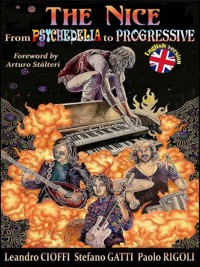
Leandro Cioffi, Stefano Gatti, Paolo Rigoli
The Nice
from Psychedelia to Progressive
Original paintings and cover by Stefano Gatti
Table of Contents
Introduction
Chapter 1
Chapter 2
Chapter 3
Chapter 4
Chapter 5
Chapter 6
Chapter 7
Chapter 8
Chapter 9
Chapter 10
Chapter 11
Chapter 12
Conclusion
Appendix A
Appendix B
Appendix C
Introduction
The Nice are usually compared to the more famous Emerson, Lake & Palmer (ELP), the group that Keith Emerson formed in 1970 after the end of his brief but intense artistic career with Dave O'List, Lee Jackson, and Brian Davison. While they failed to reach the peaks of the commercial success of ELP, The Nice made an important contribution to music, which risks becoming lost in the mists of time.
Creating a Facebook group dedicated to Keith Emerson (Emersonology - Keith Emerson Lovers) has given us a great push to delve deeper into the musical journey of this extraordinary preeminent rock music figure, first and foremost The Nice, the band that led into the most significant part of his long artistic career.
In this work, we have attempted to illustrate the defining elements of the band's artistic and personal journey, attempting to delineate the extent of their influence on the public, as well as on contemporary musicians and those who would come after them.
We chose to use almost exclusively classical vintage documents: hundreds and hundreds of articles, news clippings, interviews, and reviews. We also received valuable assistance from contacts with some of the key figures and witnesses, particularly the late friend and band technician Barrington ‘Bazz’ Ward, to whom the book is deeply dedicated.
Our thanks naturally go to the key participants in that extraordinary adventure: Brian Davison, Keith Emerson, Lee Jackson and David O’List.
“Vita brevis, ars longa, occasio praeceps, experimentum periculosum, iudicium difficile [1]”.
Hippocrates
◆◆◆
"Nice, a precious project that caused a sensation. It struck me with the passionate warmth I clearly felt in the reinterpretations of classical music. It was never a performance intended to "produce an impression," but, on the contrary, there was always a transparent and genuine pleasure in playing those pieces, extracting their contemporary value... light years away from their moment of birth, yet intact, through the passion of rediscovering them in a contemporary style. The founding idea was poetic and at the same time rigorous, without getting bogged down in a cold syllogism".
Vittorio Nocenzi, keyboards player of the Italian progressive rock band Banco, Prog Italia Magazine, September 2019
I love you, Keith
Arturo Stàlteri (Italian pianist, composer and radio host)
A lot of printing releases have been dedicated to Keith Emerson, either alone or with Lake and Palmer. The same cannot be said for The Nice.
So, let's welcome this book that, through the vicissitudes of the historic band, tells the artistic story of someone I consider one of the greatest artists of the twentieth century.
Rich in detail and narrated like a fascinating novel, this book by Stefano Gatti, Leandro Cioffi and Paolo Rigoli is headed to become an extraordinarily important document, an item that any lover of the acrobatic English keyboardist will not be able to ignore from now on.
I personally grew up with Emerson: as a teenager, while preparing for my piano diploma, I studied with the same dedication and tenacity Johann Sebastian Bach's Preludes and Fugues, Clementi's Etudes... and ELP compositions like Take a Pebble or Infinite Space.
The Nice cleared the way to a new era in music: no band before had reinterpreted the great classical tradition like them. Keith Emerson was able to preserve the depth of the great repertoire of the past, infusing those already powerful melodies with his own very modern personality; no reticence, no shyness in front of Tchaikovsky or Sibelius, no hesitation in bringing together Bernstein and Dvorak. To the same extent, his interpretations of Dave Brubeck, Bob Dylan, and Tim Hardin are second to none!
Whether he threw himself onto the Hammond organ, the Moog Synthesizer, or the piano, Emerson was an absolute conqueror of the instrument, which meekly bent to his wildest desires.
Well, I realize I'm overlooking Lee Jackson, David O'List, and Brian Davison, his faithful companions, who brilliantly indulged him, being aware of the unique talent they were dealing with. I hope you'll forgive me: when I speak (or write) about my idol, I fall into a veritable trance.
What a nasty surprise you gave us all, Keith, on that cursed March of 2016! I confess that I still find it hard to forgive you, even though I understand you would never have accepted the idea of not being able to maintain that superhuman technique, which made me tremble every time I attended one of your concerts!
And I love you: you made my life more exciting, you taught me how to experience music with freedom, protecting me from that dangerous risk of academicism that comes after years at the Conservatory.
Bach, Mozart, Chopin, and Debussy would surely have loved and respected you... but not just them.
Chapter 1
The beginnings: P. P. Arnold & Her Nice
May - August 1967
In the second half of 1966, the British rock scene underwent significant changes, triggered by the arrival of new bands destined to become historic ones. Cream debuted in June 1966, Jimi Hendrix a few months later, while Pink Floyd began performing their songs live at venues like the UFO Club in London at the end of the same year.
The music changed, the lyrics changed, the attitude and dress code changed, and the live shows changed. It was no longer enough to simply make people dance and have fun; it was necessary to capture attention and offer something new, unexpected, and exciting, expanding the musical and communicative content beyond the normally accepted limits of pop music. From the United States as well, were generated records that sounded decidedly innovative. On the one hand, the folk-rock of Dylan and The Byrds, on the other one, the California psychedelic scene of Jefferson Airplane and the Grateful Dead, plus the experimentation and orchestration of The Beach Boys and Frank Zappa.
The most successful and talented groups, like The Beatles, The Rolling Stones and The Who, held up well in front of the urgent need for innovation, modifying their sound and facing the change themselves. Albums like Revolver, A Quick One, Aftermath, and Between the Buttons updated their sound and, in some cases, pushed forward to a change. Many other groups, however, became obsolete almost overnight and saw their concert fees dramatically drop, that main source of income for those unable to consistently deliver hits.
Among these were Gary Farr & The T-Bones, who offered excellent R&B with a touch of soul, and The V.I.P.'s, who postponed their inevitable demise thanks to their success in countries like Germany and France. Both groups shared a keyboard player, whose skills were noted by some music industry insiders.
Keith Noel Emerson was born a Scorpio on November 2nd, 1944. His mother, Dorothy, like many pregnant English women, was evacuated further north due to the war and ended up giving birth in Todmorden, West Yorkshire. The family returned to their home in Worthing, Sussex, when Keith was two years old.
Emerson spent his childhood in a peaceful environment despite a modest economic situation. His father, Noel, a telephone technician with hobbies like play the accordion (a stunning Scandalli), guitar and piano, instilled in his son a passion for the latter instrument, even though Keith had a brief tenure by playing the guitar, which he later gave up. It was Noel who sent his son to his first piano teacher at the age of 7 years.
As a teenager, Emerson was a voracious listener of radio music programs, developing a fondness for pianists like Floyd Cramer and Joe Henderson, and for the ragtime music of Winifred Atwell. He saved himself from school bullies by captivating them with the songs of Jerry Lee Lewis and Little Richard.
In his first piano competition, he came... third, but his skill began to emerge, and he earned a few pennies playing at his aunt's dance studio, where he developed remarkable improvisational skills by stretching and contracting pieces to suit the needs of his lessons.
He was about seventeen when his father encouraged him to listen to jazz musicians like Art Tatum and Fats Waller, prompting him to successfully audition for the Worthing Youth Swing Orchestra. From there, along with that band's drummer and bassist, he formed the Keith Emerson Trio [2] in 1963, spending their time between dance hall performances and home recordings ("for personal use") that include standard and original pieces. A collector would later recover these recordings in the form of an acetate and they were released (with Keith's blessing) first on vinyl in 2015 and later on CD.
Even though he clearly sensed that his future would be in music, in obedience to his father he joined Lloyd's Bank initially as an IBM systems operator (a job that bored him to death). He later asked to be moved to the office but with increasingly less concentration on his work (also due to the late hours in the clubs) and was finally fired after being discovered reading the latest issue of the Melody Maker newspaper.
After a night out playing with his trio in a dance hall, he spots a musician with a portable Bird organ. Thinking about the impact that listening to Jimmy Smith have had on himself, he decides he must have one and on his 20th birthday, he goes to Portsmouth with his father to buy it. The seller makes him try the much more intriguing Hammond L-100. In the end, Noel Emerson agrees on the superiority of the instrument and signs the paperwork to make the purchase in instalments[3]. Keith begins to use it for background music in bingo halls and later joining the Black Aces[4] and shortly thereafter that forming aquartet calledJohn Brown's Bodies[5]that plays the hits of the period.
Their primary base was the Pop Inn in Brighton, along with other venues, where Emerson found a way to make his mark in some jam sessions with Brian Walkley, drummer for the successful group called The T-Bones. Walkley invited Emerson to audition for the band in September 1965, as they were looking for a good keyboard player. Gary Farr, the leader of the band, gave him a firm thumbs up. This entailed moving the Hammond from the living room of Emerson's house during concerts and then relocating it at night, a decidedly complex operation given the musicians' state of drunkenness.
Keith then decided to leave home and move to London to tour Britain with the group. Later that same year, a new bassist joined in, Keith “Lee” Jackson [6], with whom Emerson immediately struck up a friendship.
In 1966 the atmosphere in the band becomes heavy, as tensions increase due to declining offers of live work. Anticipating the pending disbandment of the group, Keith leaves to join another rock-blues group, The V.I.P.'s, with whom he records an E.P. that is released only in France (editor’s note - consisting of the tracks Stagger Lee / Rosemarie / Late Night Blues, Fontana 460 219 ME, 1967). The band starts touring Germany and France where is very much respected.
The crazy live act that would later become a trademark of Emerson's performances was created during his time with The V.I.P.s. During a concert in France a brawl broke out in the audience, triggered by the audience's consumption of alcohol and other substances. Keith initially stops playing but is overcome by the energy of the situation happening in front of him. His way of “participating in the event” is to merge with this wave of general violence, not taking his reaction out on another human being but on the instrument he was playing, the Hammond L-100.
At this moment the instrument receives the Emersonian “cathartic fury” as it is whirled and twisted around triggering a series of frenetic explosions from the internal reverb unit. The Hammond starts to emit shocking sounds, sometimes creaking, sometimes deep resonant tones as if it has a life of its own. The effect on the atmosphere inside the venue is almost magical: everyone stops fighting each other to see what the hell this excited musician was up to and eventually everyone knows peace. “You have to do it again, that was incredible!” was the band's unanimous exhortation right after the concert.
1.1 Paris, mid-April 1967
The V.I.P.'s at that time consisted of Mike Harrison (vocals), Greg Ridley (bass, backing vocals), Luther Grosvenor (guitar), Mike Kellie (drums) and Keith Emerson (piano, Hammond organ), the latter having joined a few months earlier.
After years of moving up the ranks in their homeland, The V.I.P.’s [7] received some attention at the end of 1966, but only in continental Europe. In France, their single I Wanna Be Free / Don't Let It Go, recorded before Emerson joined the group, was a moderate success reaching number 25. Their future, however, was uncertain. Their last concert was scheduled to take place in Paris before returning to England. However, back home the music scene was rapidly changing, and the group, who hadn't played there since December 1966, had few live bookings scheduled there.
After the concert Keith Emerson was joined by an acquaintance, Mickey ‘O’ (editor’s note - real name Mickey Oram), who had been a roadie for his previous band, The T-Bones. He was currently working as a driver for the American singer Patricia 'Pat' Ann Cole, aka P.P. Arnold, who had moved to England and was looking for a band to go out on the road with her to promote her second single release, The First Cut Is the Deepest.
The 7” single was released on the Immediate Records in April, thanks to the goodwill of Mick Jagger, lead singer of the Rolling Stones. Backing Arnold in live performances was the group Four of a Kind, essentially The Blue Jays separated from Ronnie Jones, with whom Arnold had performed as a duo in early 1967.
Now, Immediate Records was targeting a song written by the already famous Cat Stevens. His producer, Mike Hurst, had been in the studio with Arnold for the recordings, while the orchestration was entrusted to the legendary Arthur Greenslade, who had worked with the Kinks, Chris Farlowe, and others, with his most famous arrangement being Goldfinger sung by Shirley Bassey. For the B-side, the choice fell on a song written by Mike Hurst and Andrew Oldham, one of the two owners of Immediate.
The new P.P. Arnold single was released on April 21st and immediately sales took off, thanks in part to a better promotional strategy used by her label. The previous day, Pat had appeared on Top of the Pops, the highly popular BBC TV show. She also received a major boost from Radio London (the famous pirate radio station operating from a ship outside territorial waters), where the song entered the charts even before its official release [8].
During those days, P.P. Arnold was still being accompanied at some concerts by the Four of a Kind band, but ─ supported by Immediate and in particular by Oldham ─ the singer decided to seek out other musicians less tied to soul styles, aiming to present a more adventurous and dynamic live sound.
Mickey O's suggestion immediately struck Emerson as a huge opportunity. Emerson could choose the musicians with whom he could build something new and exciting, leaving all possibilities open. Nevertheless, for this to happen, the new group needed to have its own space and identity, even if it was still in development.
A week later, he went to Pat's house and found a Fender Rhodes waiting for him, an instrument he had never played before. It didn't take long for Arnold to realize she was dealing with a great talent, and mindful of her time with the Ike and Tina Turner Band, where the backing musicians would perform for the first half hour while waiting for the two stars to arrive, she gladly accepted the offer to do the same with her new backing group.
Before entrusting Emerson with the task of putting together a band for her, P.P. Arnold gave him a few singles to listen to and prepare the musical accompaniment for the songs she would perform live.
1.2 The birth of the group
Time is tight, but Emerson already has one name in mind. First and foremost, his friend, roommate, and former T-Bones bandmate, bassist Lee Jackson.
The man destined to become The Nice's singer and bassist, Keith Joseph Anthony Jackson, was born under the sign of Capricorn on January 8th, 1943, in Newcastle upon Tyne. Left-handed, he grew up in a music-loving family (his father was a violinist). During his adolescence, he was captivated by the spirit of rock 'n' roll and convinced himself that his instrument of choice was the electric guitar.
The revelation of his true destiny came after seeing the film The Girl Can't Help It (1956), which featured various artists of the time (including Little Richard). Having seen a particularly charismatic bassist at work during the screening, he switched to the four-string bass guitar, specifically a Gibson, with which he began performing as early as 1958 with various bands (Sputnik, Dynamics) that played skiffle [9] music.
During his experience with The Valiants he began to assume his stage name Lee, after reading a book on the American Civil War, and becoming passionate about the exploits of the ‘rebel’ Southern general Robert E. Lee. Furthermore, it often happened that in the groups he played in there was very often a Keith.
In the mid-1960s, he had periods of unemployment followed by collaborations with prominent figures, albeit as a ‘substitute’ for their regular bassist, as was the case with Alexis Korner's band and John Mayall's Bluesbreakers. On this occasion, Mayall's group stayed at Jackson's home during the Newcastle tour days, much to the chagrin of Lee's sister, who saw her sofa occupied by a certain Eric Clapton, slumped over to recuperate.
Meanwhile, he worked a series of disparate temporary jobs (train driver's assistant, clothing store clerk), until he learned through Melody Maker about an audition for Gary Farr and the T-Bones, where he met Keith Emerson for the first time and performed with him and the band. It was New Year's Eve 1966.
For the role of guitarist, Keith initially considered Luther Grosvenor of The V.I.P.'s, whose innovative ideas he admired. The offer fell through because Grosvenor preferred to stay with his current band, which was signed to Island Records.
Ultimately, the choice fell onto David O'List, at the suggestion of Melody Maker journalist Chris Welch, who occasionally played drums during rehearsals for The Attack, the band in which the guitarist worked.
The youngest member of the band, born in London on December 13th, 1948 (Sagittarius), spent his childhood in Chiswick, West London. Having inherited his father's passion for the guitar, he enrolled at the Royal College of Music in Kensington, where he studied trumpet and piano for four years. Having become a fan of the early Rolling Stones in 1964, he increasingly devoted himself to the guitar and began to gain experience in bands, starting professionally in 1966 with Richard Shirman and his Soul System, which soon changed its name to The Attack. With this line-up, O'List recorded three singles, the B-side of one of which, Anymore Than I Do also credited to the guitarist, was favourably reviewed in Melody Maker by Chris Welch. Thanks in part to the support of the influential DJ John Peel, who chose the song's guitar intro for his broadcast segments, Dave's future seemed particularly bright.
So much so that, in the same days he received an offer from the then-unknown Keith Emerson to join The Nice He was also asked to join John Mayall's Bluesbreakers, a bluesman who had already been very popular for over a year, to replace Peter Green. He would later explain his choice for P.P. Arnold's backing band as the promise of greater creative freedom.
In the presence of an ecstatic Chris Welch at the O’List house, the future keyboardist of The Nice demonstrated his talent by playing Brubeck pieces on the upright piano.
As for the drummer, the initial idea of involving Alan Turner of the T-Bones ended after just one rehearsal because his style was not considered suitable for the group's ideas.
It was then Emerson himself who involved Ian Hague, born on July 22nd, 1944. Coming all the way from Brierley Hill (West Midlands), he began playing drums as a child, captivated by the spectacular drum roll of the National Anthem. Throughout his career, he had played in Don Spencer's bands and Chris Farlowe's Thunderbirds [10], demonstrating remarkable chemistry.
After a brief stint with The Nice, fate dealt him the unfortunate experience of losing three fingers in a car accident. However, he proved that, with great tenacity and extensive physiotherapy, he was able to play again within a few months.
After a few weeks of intense rehearsals at London's White Hart, a club famous for hosting the Detours (later The Who), the band debuted after seeing Pat at the rehearsals only once or twice. A very bold move!
The choice of the group's name was decided by Arnold herself. Her love of the sketches of American comedian and singer Lord Buckley, an eccentric character who influenced artists such as Lenny Bruce, Frank Zappa, and Bob Dylan brought her to one of his acts was called The Nazz, a reference to Jesus of Nazareth. Since naming a group after a divine figure seemed a bit risky, the singer suggested changing it to The Nice.
Interestingly, around the same time in Philadelphia, Todd Rundgren and Carson Van Osten decided to call the band they were forming The Nazz. Their first concert took place on June 18, 1967, as the opening act for the Doors at Town Hall in Philadelphia.
Shortly thereafter, another band decided to call themselves The Nazz. Once they discovered the existence of another group with the same name, they settled on Alice Cooper.
The keyboardist would later say that he wasn't entirely convinced by the name at first, because it lacked a precise meaning. In short, he feared people would react to the band's name by asking, “The Nice? The Nice what?”.
The singer had initially wanted a larger group with trumpet and tenor saxophone. During his search, Emerson had some difficulty finding the right musicians, and when he did find one, it ultimately came to nothing. So, by mutual agreement, they decided to leave The Nice as a quartet.
Unfortunately, no audio or video recordings of The Nice concerts with P.P. Arnold have emerged to date and we have to settle for the few brief newspaper reports, the memories of some spectators and a few photos.
Many things happened both inside and outside the group's life during the four months of their partnership with Arnold. The numerous concerts in and around London and around England, benefited the singer's fame and success but also saw the role of The Nice gradually expanded from a simple supporting group to an autonomous entity with a small but ever-growing number of fans who began to attend the concerts just to listen to them.
1.3 The repertoire
One of the first songs the group worked on for the opening part of the show was Billy’s Bag, an instrumental piece written and recorded by Billy Preston in September 1964 and included on the album The Most Exciting Organ Ever, released in August 1965.
Another song is Silver Meter, written for the John Patton's group by his drummer Ben Dixon and released in 1963 on the Blue Note label. It's an instrumental that Emerson had already recorded in the studio with The T-Bones in September 1966, a recording that is still unreleased, but that was performed live. It provides a suitable basis for organ and electric guitar improvisations, which would lead to it being recorded by The Nice for their debut album under the title War and Peace.
The Nice gradually introduce into their setlist songs that appeal to them and that can be creatively reworked, for example Morricone's La Resa Dei Conti, Bob Dylan's She Belongs to Me, sometimes even very recent ones, such as The Beatles' A Day in the Life, A fistful of Dollars (again by Morricone) and Aries - The Fire Fighter by Mort Garson.
The practice of reworking and, in some cases, completely redefining pieces composed by others, improvising over them without any kind of barrier, certainly had a jazz root. It would remain a characteristic of The Nice in the following years, although the emphasis would shift more toward classical music, with the innovative approach to the arrangements remaining intact.
Let's not forget that bands inspired by the blues or rhythm and blues did something similar, often using songs written by overseas bluesmen. From this point of view, Cream and Jimi Hendrix were certainly a point of reference for The Nice.
Within a few years, with the establishment of progressive rock, the dogma ─ somewhat utopian ─ that to be "creative" you must necessarily limit yourself to perform self-composed pieces, began to take hold. This prejudice likely contributes still today to the relegation of The Nice, the very one group that should be considered among the major precursors of the genre, to a sort of limbo.
It's worth dwelling on some of the pieces used by the group, highlighting how The Nice's initial set without Arnold can be seen as a sort of laboratory, to find and develop ideas, to cement their understanding and, essentially, to lay the foundations for a possible entirely independent adventure.
Aries - The Fire Fighter was later recorded by the group for a BBC session. The album from which it is taken, The Zodiac - Cosmic Sounds, was introduced to the British public (including many musicians) by John Peel on his show Perfumed Garden, which was aired on Radio London between May and August 1967. Chris Welch, who followed The Nice from their first cry until their dissolution, writes that this piece allowed Emerson to understand how to best combine organ and drums.
Dylan's She Belongs to Me, released in 1965, would often be a part of The Nice's post-P.P. Arnold setlist, with an arrangement that set a precedent for many contemporary groups. It can be heard on the December 1967 recordings The Swedish Radio Sessions and on their 1969 studio/live album release.
Finally, A Day in the Life is a Beatles song included in their famous Sgt.Pepper’s Lonely Hearts Club Band, a contemporary released album that shook the world music scene and generally considered to be very hard to perform live (The Beatles were no longer performing but their songs were covered by many artists).
The Nice often played two sets a night, the setlists with P.P. Arnold included material such Sweet Soul Music by Arthur Conley (1967), Lay This Burden Down by Mary Love (1967), Nowhere To Run by Martha And The Vandellas (1965), Respect by Aretha Franklin (1967), One Step At A Time by Maxine Brown (1965), You Keep Me Hangin’ On (1966), Love Is Here and Now You’re Gone (1967) by The Supremes, Goin’ Out of My Head (1964) by Little Anthony and the Imperials and songs recorded by her for the Immediate label including The First Cut Is The Deepest, Everything’s Gonna Be Alright and, later, The Time Has Come.
Among these, the group would continue to perform You Keep Me Hangin’ On for some time, which had since returned in vogue with the release of the psychedelic version by Vanilla Fudge in June 1967.
1.4 Live debut
The first published article on the formation of The Nice appeared in the New Musical Express (NME) on May 13th, 1967. That issue included an interview with P.P. Arnold, on the very day her new single entered the NME charts. In the interview, she announced that she had formed a four-piece group called The Nice, who would accompany her on tour, and that she hoped to add a trumpet and tenor saxophone player.
The first time the singer and the band actually rehearsed together dates back to at least a few days, because legend has it that the band's name was chosen during a van ride to the White Hart in Acton. The recollections of the various musicians involved are very muddled. Keith and Davy recall that the name was chosen while traveling to the venue of the first concert in Bristol.
Other locations cited for that first gig include the Isle of Wight, Hounslow, and, indeed, Acton. Lee remembers the van ride because it was the first and likely the last time they travelled together. This fact supports our hypothesis that it wasn't a real concert, but a rehearsal. Documents from the time confirm that P.P. Arnold's first concert with The Nice took place a few weeks later, at the end of May.
Respected journalist Roy Hollingworth, a prominent figure in Melody Maker, reviewed the May 29th concert at the Clouds in Derby, mentioning The Nice and stating that it will be their third concert with the American singer. The previous two are scheduled for May 27th at Glastonbury's Town Hall and, what would be their first ever, May 26th at the Assembly Hall in Aylesbury.
The first official recording, still unpublished, was made for the important BBC broadcast called Saturday Club which was aired on May 27th. Three days earlier, on The Worthing Gazette, following information from Keith Emerson's mother [11], it was possible to read: “This group, The Nice, has been in existence for about a month. Six numbers were recorded for the Saturday show on Monday and the BBC will choose four of them for the broadcast”.
An interview with Pat appears in the NME on June 3rd: "Now I have my own group, The Nice. You like the name? I think it’s nice. They’re a good group: the organist came from The VIP’s, the guitarist from The Attack, the drummer from Chris Farlowe, and the bass from the T-Bones. Also, while I was just in Germany I found a second singer for the group, a little guy who looks exactly like Mick Jagger but sings like Ray Charles. How about that?!" (Editor's note - in reality this last idea would have soon come to nothing).
The first review appears in Melody Maker (July 1st, 1967), which concerns the concert at the Bluesville Club, Manor House on June 16th, with a showtimes at 7.30 PM and a second one at 11.00 PM. The singer is dressed in a green velvet trouser suit and offers “a highly professional act, both entertaining and exciting. The audience really warmed to P.P. Arnold, ably backed by her four-piece group The Nice” (review by Tony Slaughter).
Two weeks later, Chris Welch [12], in Melody Maker, commented on the concert held on July 7th at The White Hart Club, Acton, where the group had their first rehearsals: “At the White Hart, Acton, on Friday, they worked and sweated and even turned-on a hot sultry audience to hand-clapping ‘loonerama’. A few menacing Acton lads decided to indulge in fisticuffs at one point, ignoring the prophets of flower power, but it didn’t affect the group’s great performance, or the performance of a car of Nice fans who freaked-out on the dance floor with wild abandon.
Organist Keith Emerson has tremendous technique and uses ideas from his classical training into wild organ-shaking solos. Lee Jackson with bells and Geordie accent grooves on bass guitar [13], and Ian Hague rocks the drums. Guitarist David O’List is fast developing into a solid style and is aiming to break out of the Hendrix - Clapton influence. He played some excellent solos on numbers like Fistful of Dollars[14], Billy's Bag and Day in the Life. Pat, an explosion of talent joined her lads for a riot of soul sounds. She has tremendous power and range and get a deserved ovation for her performance of Going Out of My Head. Forget the rest ─ dig Pat, Dave, Keith, Lee and Ian and feel nice!”.
Sometimes Pat is late for the show and The Nice have to extend their performance or even play the first of two sets on their own. The first time this happens, the band has to dip into songs like Gay Gordons (a Scottish dance) and Tico Tico. Keith jokingly talks about this in his autobiography, as well as having to improvise a fifteen-minute-long blues jam.
Immediate Records realizes the band's potential and Andrew Oldham personally goes to see them in Southampton, the concert where Rondo is performed for the very first time. The next day, The Nice are called into his office and, with some fear of being fired, they discover instead that the boss wants to offer them a contract as an independent band.
The most important event of their short career is approaching, their participation in the Windsor Festival, which will be held on August 13th. At the last minute they also manage to get permission to play a solo show in a side tent.
Digging into their meagre funds, they decide to play their cards right. They ask Sandy Sarjeant to be on stage while they play. Sandy is a television star thanks to her appearances as a dancer and announcer on the popular BBC show Ready, Steady, Go! and also on the German show Beat Club.
Somewhat embarrassed she dons a costume that makes her appear naked while dancing around the Hammond, miming sadomasochistic scenes with Keith. For this reason, Keith had bought a whip. This unusual prop wouldn't be wasted in a one-off use. Lee Jackson would pay the price in subsequent concerts.
To complete the effect, the all-round technician Bazz buys some smoke bombs to place inside the Leslie Speaker; the rotation inside would release the smoke. Not to be outdone, Lee Jackson rents an ancient samurai costume.
Their set is scheduled for around 8.00 PM, while the group Pentangle play on the main stage. At the beginning of the concert, a sizable crowd was already there to watch them, but after the explosions and smoke, many journalists and some members of the audience move towards the side tent until it fills up. What they see and hear will convince them to stay and, in effect, will represent a major opportunity towards being The Nice and no longer just P.P. Arnold's support band.
After finishing their performance, even before completing their set with Pat's repertoire on the main stage, they all know they can handle the stage in front of an audience that came to the concert only to hear their strange and innovative offering.
In Melody Maker, Chris Welch described The Nice's performance in his famously sharp and effective style, saying that he had never seen a group captivate the audience in such a theatrical and thunderous way.
Pat's UK permit expires at the end of August and the singer, buoyed by her success, wants to keep the promise she made to her two children: to return to the United States and then come back to London with them.
On August 16th, a recording session was organized at Olympic Studios, produced by Mick Jagger and featuring many established session musicians and future music stars. Vocals were handled by P.P. Arnold and Rod Stewart, drums by Mick Waller, guitars and bass by Ron Wood and Keith Richards, piano by Nicky Hopkins, and Hammond by Keith Emerson, while the brass section that usually accompanies Georgie Fame was on board too.
The songs chosen were Come Home Baby and Working in the Coalmine. Apparently, Jagger wasn't entirely comfortable with the role of producer and, after some disagreements with Rod Stewart, sought advice from Jimmy Miller. After long and exhausting recording sessions, Jagger eventually clashed with Oldham and left, taking the tapes with him.
Years later, the song Come Home Baby would appear on an obscure compilation entitled Rod Stewart and the Faces on the Springboard label, although the session was actually intended for a P.P. Arnold album. Due to the poor mixing, it's extremely difficult to hear Emerson's Hammond.
Towards the end of August P.P. Arnold and The Nice played the Cosmo Club in Carlisle and a local newspaper reviewed the two sets with great enthusiasm: “She is the greatest”, by adding “with great backing from The Nice the most colourful group on the scene (clothes wise)”.
1.5 The last show with Pat and the entrance of Brian Davison
While it's unclear exactly when The Nice played their first concert with P.P. Arnold, the last one is more certain. It took place on August 28th, 1967, at the Flamingo Club in London. It was the last show with the singer but the first with the new drummer, Brian Davison, who's entrance in the group had been supported by the omnipresent Chris Welch.
It was a difficult evening for Brian who was completely out of his depth with Pat's pop-soul repertoire. To remedy the situation during the performance, the engineer and roadie Bazz (he was a drummer as well in his youth before an accident prevented him from continuing on that path) provided guidance to Brian on what he should do during the various songs.
Chapter 2
The dawn of The Nice
September - December 1967
The collaboration with the American singer ended without acrimony after about four months and around sixty concerts, but the final word was not yet written because shortly thereafter, The Nice helped Pat on some studio recordings.
The change of drummer was decided as soon as the band signed to Immediate Records, the first major independent British label. It was run by a large family with many ideas and creativity, but very little financial management skills and clarity from Oldham and the Calder, the owners.
They certainly left plenty of room for the artists to express themselves, encouraging them to write their own material and, if not slavishly copy it, to take credit for what others had written.
Ian Hague, who had joined the band during the months supporting P.P. Arnold, didn't seem particularly suited or enthusiastic about the genre The Nice were proposing on their own, and so a replacement on drums was needed.
With that separation looming, someone more flexible and creative was needed.
Brian Davison, a Gemini, was born on May 25th, 1942 in Leicester, his parents' having taken temporary refuge following the bombing of London. He returned to live with his family in the capital city as soon as he could, acquiring his passion for music from his uncle, a jazz-loving percussionist, who gave him his first drum kit.
After a period of half-hearted secondary school studies, he got a job as delivery driver at the London Evening Standard, while also trying to make the most of his free time by continuing to practice the drums by listening to the records by Art Blakey and Max Roach.
Following a call from his friend Terry Goldberg, in 1964 Brian joined, with some hesitation (being a jazz enthusiast) the pop group The Rock Shakes, which later renamed itself the Mark Leeman Five.
It was during this time that he was given the nickname ‘Blinky’, which the drummer had never liked. This stemmed from a corruption of the name of one of his idols, Art Blakey. His musical partners began to point out his affinity with the jazz drummer's style, but this quickly escalated, with Brian being labelled a sort of "Blakey on the blink."
The band recorded the 7” single Portland Town / Gotta Get Myself Together (1965) with production by Manfred Mann, but was forced to split up some time after the death of the leader Mark Leeman (aka John Ardrey) following a car accident.
After some less than stellar experiences with other bands (The Habits, Mike Cotton Band), Brian had the opportunity to play for a short time with Attack together with Dave O’List, one of his future partners with The Nice.
In August 1967, The Nice, who had already admired Brian's work with the Mark Leeman Five, contacted him and assigned him Hague's job in the band after a brief audition to the tune of Rondo at the Bermondsey Boys Club.
At that point, the group's career was about to take a new turn, and this was the perfect moment for Davison, who, after just one concert with P.P. Arnold, realized he wasn't cut out for the singer's pop-soul style, but was eager to express his full potential.
After a few days of intense rehearsals, The Nice performed their solo debut with the new line-up on August 31st.
The following day, they played at the Big C club in Farnborough. The idea of announcing their first concerts as "P.P. Arnold's former band" wasn't a great success; this attracted a crowd of mods and soul music lovers, who were disconcerted by the group's sound and ultimately protested vigorously against the organizers, asking for their money back!
In Melody Maker on September 16th, 1967, Emerson himself talks about that concert: “It’s going down very well at most places. But at Farnborough one night we came up against a ‘soul scene’ and when we’d finished the DJ said: «Now let’s hear some real music» and put on Hold On, I’m Comin’ by Sam and Dave”.
In that same article, written by Chris Welch and titled Hold On, Here Come The Nice, the journalist reports the words of Lee Jackson: “For want of a better word, I suppose you could call us a psychedelic group, but we’d rather you didn’t. We are just trying to play the things we like and to be original. And it’s not a weak or pretty sound. It’s very hard hitting and powerful. The boys are all playing very well. Davey is blowing everybody’s mind on guitar and when Blinky played a drum solo at Southampton recently I wanted to stop and applaud him myself”.
Throughout September and October, The Nice secured gigs at some of London's top clubs, including Klooks Kleek, the Speakeasy, Middle Earth, and especially at the Marquee, where the T-Bones and The Mark Leeman Five had often played. They debuted at the latter club on Monday, October 2nd, with a series of Monday dates running until the end of November.
Attending these first concerts was a keyboard player who would leave his mark on the so-called “Canterbury Sound”, Dave Sinclair (Caravan, Camel, Matching Mole…) who in the preface written for the book Keith Emerson Interviews released in Japan in 1992, recalls: “The Hammond organ is an amazing instrument and I realized that in the Wilde Flowers when I was playing a Vox Continental.
It sufficed for that sort of thing, but what happened in 1967 was a track called Whiter Shade of Pale by Procol Harum, and I just loved the sound of the organ on that. Then I hitched up to London to see The Nice. I saw Keith Emerson attacking his Hammond organ, which was, of course, the L-100, the smaller one.
So, I worked for months and months to try and get the money to get a Hammond organ, which I eventually did get in September 1967. Anyway, I got the organ but I couldn’t afford a Leslie cabinet, which gave it that extra beautiful choral sound. I didn’t have money for that, so all I had was just the organ. So, I started experimenting a bit with that”.
Another great keyboard player of that movement, Dave Stewart (Egg, Hatfield and the North, National Health, Bruford, …), echoes him, and elaborates further the analysis and compliments: “I was still at school in 1967, but beginning to wish I wasn’t.
One escape from the irregular Latin verbs, insoluble quadratic equations and all the other meaningless drudgery of academic life was to go to The Marquee Club on Monday evenings to watch The Nice. You could see good bands at the Marquee virtually every night ─ Spooky Tooth, Jethro Tull, Blodwyn Pig ─ but The Nice were our favourite.
Two of my chums and I used to rush to the club straight after school, in order to be the first in the queue for front row seats when the club’s manager (a rather strict, bespectacled man named John Gee) threw open the doors. I can’t remember how much it cost to get into that little room in Soho… ten shillings and sixpence? Four guineas? Three hundred pounds? I didn’t care, and would gladly have sold my grandmother to Portuguese slave traders to raise the cash to see The Nice. The band members were all pretty interesting. Two of them, Brian ‘Blinky’ Davison (the drummer) and Lee Jackson (bass & vocals) seemed impossibly ancient (in fact, they were probably in their late twenties). We liked the guitarist, a beak-nosed, cadaverous individual named David O’List, who wrenched tortured notes from his Telecaster.
But the focus of attention was the lean, athletic organ player with the jaw-length hair. His name, we quickly learned from the expectant buzz that ran round the Marquee whenever he walked on stage, was Keith Emerson. Keith did things with the Hammond organ that made our jaws drop.
When he wasn’t actually playing the thing, he would climb on it, leap over it, stick knives in it, whip it, lie underneath it, turn it on and off, flail his arms up and down the keys, crash the reverb spring, bash its innards with a drum stick and generally behave like a lunatic. Although at an age when such displays of mayhem were bound to make a big impression, we couldn’t help but notice that Keith’s playing was pretty special, too. His ability to compose and improvise, working jazz and classical elements into a powerful rock style, and his instinct for creating stunning original sounds set him apart from any keyboard player I had heard before.
In fact, in his blending of the physical and the cerebral, he reminded me of another favourite musician, Jimi Hendrix. Keith did for rock keyboards what Jimi Hendrix did for the guitar ─ I don’t think you can pay someone a much higher compliment than that! In my humble way I went on to play a bit of keyboards myself, and of course the first serious instrument I got was a Hammond L100, just like Keith’s.
We’ll draw a veil over the injuries I sustained trying to emulate my hero ─ cuts to the hands from attempted windmill keyboard sweeps, near-concussion and severely bruised pride when a trailing leg caught on the music stand during a failed leap over the organ, the endless bashed fingers and lifelong backaches caused by lifting this heavy instrument up flights of stairs into gigs. But what the hell… it was worth it.
I’m proud to have been influenced by such a great musician as Keith Emerson, the man who single-handedly (well, double-handedly actually) put keyboards in the spotlight”.
An interesting article about the group was published on October 13th by author Barbara Marylin Deane in The News and offers us a behind-the-scenes look with some tasty details: “The Nice spend about two afternoons each week practicing at a youth club in London very near to my home (editor’s note - in the East End), in fact (no wonder they found it easy to pop in on one occasion). At this club they mix business with pleasure, they play table tennis and football with the kids. The children love them. A youth club leader, Howard, told me some revealing truths about that Emerson character: «He runs straight to the piano and knock us all out with almost religious sounds ─ he is a great musician ─ fantastic»”.
Some statements from The Nice themselves are also interesting. Brian says he agreed to join the group because he found musicians who truly have something to say. Lee, for his part, adds that they play progressive music, writing about 50 percent or more of their material.
2.1 In the studio
October is the month dedicated to their first recordings, which show the group working on three fronts. First, recording material for a single and an album under their own name, then a radio session for the BBC and finally helping P.P. Arnold record her first LP.
The first original piece written by Emerson and Jackson is Azrial [15] (Angel of Death), which already reveals one of the characteristics that would accompany the keyboardist throughout his long musical career: the citation of classical themes, functional to the musical and lyrical "story".
For his part, David O'List had the song Going Back ready, which would be partially completed by Emerson's music. In October 1967, the two songs were recorded and would form the two sides of the first single, released on November 3rd: The Thoughts of Emerlist Davjack / Azrial (Angel of Death).
The songs are credited to Emerlist Davjack, an acronym formed from the initials of the four musicians' surnames, an idea of Lee Jackson’s. In reality, once released on the albums (the group's first and third), the credits will be adjusted: O'List / Emerson for The Thoughts of Emerlist Davjack and Emerson / Jackson for Azrial.
The title change for side A appears to have been influenced by the fact that Lee Jackson was obsessed with a book, recently published for the first time in the UK, Quotations of Chairman Mao Tse-Tung (better known as The Little Red Book).
Journalist Hugh Nolan of the weekly paper Disc & Music Echo had the opportunity to listen to the recordings the group was working on at Olympic Studios and reports on them in the October 21st issue. Among the mentioned pieces are The Thoughts of Emerlist Davjack, Flower King of Flies, Dawn and Azrael.
Whilst recording their debut album, The Nice also collaborated with P.P. Arnold and her producer Mick Jagger for the realization of the singer's first LP.
The start wasn't the most promising, as upon the arrival of Jagger and his partner Marianne Faithful, Lee Jackson was caught (on purpose?) eating a Mars chocolate bar. In the weeks leading up to the sessions, reports had appeared in the English tabloids about Mick's inappropriate use of the bars with his partner! Marianne immediately left indignantly, while Jagger stayed behind.
In addition to The Nice, other session musicians are also present, most notably the guitarist Caleb Quaye. As it had already happened during his one concert with Pat in August, Brian Davison was unable to connect with the type of compositions (in this case, songs written by P.P. Arnold), and as a result, Jon Hiseman is called in to take his place.
In the end, the group did what they were asked to do, but when they listened to the finished product, they noticed that some parts had been changed from what they had played, to the point that the musicians themselves were left doubting their own presence on the songs they had worked on.
In any case, on the album, entitled The First Lady of Immediate, Mick Jagger produced the songs Am I Still Dreaming?, Though It Hurts Me Badly and Treat Me Like a Lady. If you listen to these tracks, it's easy to identify some typical phrasing by Emerson and/or O'List.
In any case, after this brief period of exile during the Olympic Studios sessions for P.P. Arnold, The Nice were directed to accelerate their journey and without hesitation Brian was put back in the game.
October 18th & 19th, 1967, BBC Radio Sessions, Top Gear[16], UK
The BBC sessions were produced by Bernie Andrews and broadcast on the 22nd of the same month [17]. The songs recorded were Flower King of Flies, Azrael, Sombrero Sam [18], Tantalising Maggie, Rondo, and The Thoughts of Emerlist Davjack.
Fortunately, some of the recordings can be heard on the BBC Sessions album, released by Castle Music in 2002.
The only complete piece is Sombrero Sam, as Flower King of Flies and Rondo have been edited. The former features a great rhythmic performance by Lee Jackson and, especially, Brian Davison (a great jazz enthusiast), and beautiful interweaving of organ and guitar, alternating with effective unisons. In the central section, during the solo, Emerson briefly quotes the main theme from the soundtrack of the film Lawrence of Arabia.
Little can be said about the version of Rondo, which is cut just seconds after the guitar solo begins. In an unofficial recording, John Peel's voice can be heard announcing the song as a Dave Brubeck cover. However, on the album, we know that the record company credits the song to Emerlist Davjack, rather than just the arrangement.
Some more interesting insights can be gleaned about Flower King of Flies thanks to an unofficial, lower-quality but a complete sound source. A decidedly sparser, yet extremely effective, version featuring a beautiful organ effect in the middle section and an enigmatic finale.
Chris Welch's push for the group continues with an article titled "Magnificent Seven Drummers", which appeared in the Melody Maker on October 14th. As previously indicated, Welch, a non-professional but highly competent drummer, dedicates the article to whom he considers the seven best British percussionists: Mitch Mitchell, Brian Bennett, Keith Moon, Jon Hiseman, Ginger Baker, Blinky Davison and Bobby Elliott.
His comments about Brian help us understand some of the distinctive characteristics of his style: “He is rated by all his fellow drummers including Mitch Mitchell, Mike Rugg, Peter York and Keith Moon. But since his original group, the Mark Leeman Five, broke up a year ago, he has been moving from group to group without getting proper exposure. Now fans are being reminded of Blinky's technique and drive again. He has joined the successful new group, The Nice. A very intense and highly involved player, conditions have to be right for him to turn-on fully.
Then he can play solos that would blow all other opposition off the stand. But while solos are important, Blinky is one of the few group drummers seriously concerned with the musical output of his group. He will play anything and everything to help along his fellow musicians. His early favourite players included Art Blakey and Elvin Jones. But now he is more interested in Jack DeJohnette and Terry Clarke [19]”.
Welch's opinion is confirmed by other journalists as well, like Hugh Nolan on Disc & Music Echo, October 21st, 1967: “He’s probably Britain’s most creative drummer who can generate intense excitement or build gentle atmosphere with equal facility”.
And Keith Altham (Record Mirror May 15th, 1971): “Davison and his music deserve to succeed if no other reason than he is a unique phenomenon among rock drummers ─ a percussionist who does not try to go in through one ear and battering out. His works is very much like a style he defined for another musician Jack DeJohnette in the Charles Lloyd Quartet. «He plays in feathery gusts ─ says Brian ─ rippling out from a centre or like the seeds of a dandelion blown into the wind. He is the master of finesse ─ a drummer who can make me cry just to listen to him»”.
Gary Gomes, a critic and musician, expresses very beautiful words on the site All About Jazz [20] to celebrate Brian shortly after his death: “Davison himself was a master drummer, one of the three or four best rock drummers I ever saw live. Stylistically, he drew inspiration from jazz drummers (Art Blakey and Jack DeJohnette in particular) and was the first link between rock drummers like Keith Moon and more sophisticated intellectual drummers in the progressive rock vein like Bill Bruford.
Davison's style could be eruptive, as in pieces like Daddy, Where Did I Come From? in which he sounds like Keith Moon, with a little more polish, to America, in which he does a polished roll followed by a fast as lightning snare break, to the 1969 Fillmore recording of Country Pie in which, to quote a late drummer friend of mine, «He sounds like he has three hands!».
Other examples of the talent that he brought to The Nice were, his speed and flexibility in the 2nd and 5th movements of the Five Bridges Suite, in which he provided a darting hi-hat introduction, followed by polyrhythmic support that I have never heard any other rock drummer attempt, his light and jazzy touch on pieces like Little Arabella on Ars Longa Vita Brevis and The Nice's cover of Sonny Rollins' St. Thomas.
He was also one of the first rock drummers to attempt 5/4 time (Azrael, Angel of Death the b-side of The Nice's first single, and Azrael Revisited), and handled tricky rhythmic changes easily (One of Those People).
Table of Contents
Chapter 1
Chapter 2
Chapter 3
Chapter 4
Chapter 5
Chapter 6
Chapter 7
Chapter 8
Chapter 9
Chapter 10
Chapter 11
Chapter 12
Appendix A
Appendix B
Appendix C
Landmarks
Cover