


Erhalten Sie Zugang zu diesem und mehr als 300000 Büchern ab EUR 5,99 monatlich.
- Herausgeber: Crown House Publishing
- Kategorie: Ratgeber
- Sprache: Englisch
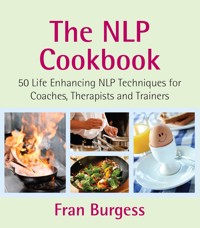
The NLP Cookbook is a veritable smorgasbord of NLP and related techniques gleaned from some of the greatest names in the field and adapted to provide an encyclopaedic resource for all therapists, coaches, change agents or health professionals.Fran Burgess uses the metaphor of cooking to describe the process of bringing together the best ingredients in NLP and selecting them carefully in order to produce some mouth watering results. The recipes are grouped into sections depending on their purpose. Quite a few focus on how to shift state, with some of these targeting specific states like acceptance and anxiety. These are followed by recipes that seek to develop behaviours and skills, and others that address beliefs and identity. There is then a wide range to choose from which deal with goals, relationships and the process of change.The beauty is that most of them can be used time and again for different circumstances and contexts, so they never wear out. Each recipe is prefaced by an introduction, giving you some background to its source and evolution. You are provided with its ingredients, should you be interested in its engineering, plus timings and materials required, and if it is suitable for working solo, or with a partner. Novice cooks can follow the recipes slavishly whereas those with more experience can adapt a recipe, adding a little something here, removing a little something there. This is not magic. They understand the chemistry that underpins the cooking process. They know what happens when you put this with that, now or later.
Sie lesen das E-Book in den Legimi-Apps auf:
Seitenzahl: 184
Veröffentlichungsjahr: 2012
Das E-Book (TTS) können Sie hören im Abo „Legimi Premium” in Legimi-Apps auf:
Ähnliche

















The NLP Cookbook
50 Life Enhancing NLP Techniques for Coaches, Therapists and Trainers
Fran Burgess
Contents
Title Page
Introduction
The Recipes
State
1 The State Booster
2 The State Collage
3 The Resource Builder
4 Safety and Vulnerability
5 Sad to Glad
6 Body Talk
7 The Accepting Process
8 Total Acceptance
9 Developing Presence
10 Building Excellence
11 Inspiring a Task
12 Modelling Your Anxiety
13 Anxiety Animal Magic
14 The A (Anxiety) Team
15 Balance of Power
16 A Powerful Story
17 Stuff Happens (Part 1)
18 Stuff Happens (Part 2)
Behaviours and Skills
19 It’s the Way You See ’Em
20 Strengthening Performance
21 Getting Better
22 Managing Wellbeing
Beliefs
23 Space Cadet
24 Time Traveller
Identity
25 Who Am I?
26 Role Modelling
27 Developing a Part
Goals
28 Deciding Your Goal
29 Finding Purpose
30 Aligning Goals
31 Push and Pull
Relationships
32 Leonardo’s Arm
33 Surviving a Relationship
34 Where Am I Here?
35 It Takes Two
36 Co-aligning Conflict
37 Sponsoring Another
38 Fine Tuning Sponsorship
39 Developing Your Inner Coach
40 Conflict Resolution
Change
41 Healthy Compromise
42 Today to Tomorrow
43 The Song of Change
44 The Collage of Change
45 Breaking Free
46 Box 9
47 Letting Go
48 Game of Life
49 The Gamer’s World
50 Building the Team
Last Word
Appendix 1: Modelling Card Sorts
Appendix 2: Quick Reference Table
Bibliography
Thanks
Index
Copyright
Introduction
You are in for such a treat.
This NLP Cookbook will appeal to the NLP diner within you. Whether you are already using Neurolinguistic Programming to explore with friends and family or you are working professionally with NLP as a manager, coach, trainer or therapist, you are certain to discover much here to support your practice. Even if you have just been introduced to NLP, you will find ways to stretch your thinking and extend your skills. How far you take it is down to you.
Why a ‘cookbook’? I have been thinking about how techniques are constructed for a few years now, and every time I began to explain what I wanted to do, I would resort to a cooking metaphor as the simplest explanation – which is all very strange given that culinary skills are not high on my list of accomplishments!
NLP is known for its techniques. In fact, NLP is often described as a toolkit offering unique tools for different purposes. Whilst NLP is much more than this, it certainly is true that NLP techniques can deliver extraordinarily powerful experiences. You will no doubt have many stories of your own to back this up. Yet the range of tools to choose from is still fairly limited – even after 40 years – and most are found within the basic NLP repertoire. Few new techniques have made their way to the marketplace. The danger is that this can leave many practitioners with a feeling of ‘what now?’ before moving off to pastures new.
Now you are about to be spoilt for choice. As a result of a really simple model I devised, I am delighted to offer you this collection of original ‘recipes’, with supportive commentary and materials. Your Explorers will have even more opportunity to extend their flexibility, improve their relationships and work towards their goals.
All the recipes have been tested, and modified, as a result of the feedback I’ve received. I have also tested each of them myself – a fascinating personal journey, let me tell you. In fact, I can’t recommend this process highly enough, although I say so myself! The feedback has been really satisfying.
It is great to dip into. There may be a particular exercise I can use for a course, or I may just take the approach and adapt it to what I’m doing.A trainer
I used one of the exercises the next day with a client, and it worked tremendously well. I was really glad I had a copy.A therapist
There was a particular issue that I was wanting to resolve. I took several of the techniques and worked through them. It was remarkable what emerged and how easy it was.A learner
We have begun to use these recipes in our practice group as a way of directing our skills. It is refreshing to get our hands on new materials. When’s the next one due?An NLP practitioner
The Recipes
The recipes on offer deal with different problem areas. Quite a few focus on how to shift state, with some of these targeting specific states like acceptance and anxiety. These are followed by recipes that seek to develop behaviours and skills, and others that address beliefs and identity. You have a wide range of recipes to choose from which deal with goals, relationships and the process of change. The beauty is that most of them can be used time and again for different circumstances and contexts, so they never wear out.
As the Guide, your job is to take your Explorer through the process. To help you, each recipe is prefaced by an introduction which gives some background to its source and evolution. You are then provided with the ingredients: the level of skill required to get the most from the process, those involved – the Explorer and/or the Guide – plus timings and resources required. For the technically minded, details of the construction are given.
The instructions are written as a script for you to read directly to your Explorer. Sometimes you are offered some additional direction and supportive comment, alongside your Explorer’s instructions. Some of these techniques don’t need a Guide. If this is the case, then the Explorer can work independently, at his or her own pace, keeping the process private and spontaneous.
Where some of the techniques require your Explorer to walk into different spaces, if you have enough room, you’ll get a far richer experience if you allow them to do this.
I strongly suggest that you follow the structure of the questions as they are written, since they are constructed for a purpose – to take your Explorer’s attention to a particular place. However, if you have a streak of burning independence and choose to go your own way, all will not be lost. You will certainly generate something new and, who knows, it may make for an even more powerful and useful experience.
Novice cooks, like me, tend to follow recipes slavishly, knowing that disaster lies just behind the sloppy measuring or omission of an ingredient. However, there are cooks who earn my undying admiration and envy who can intuitively adapt a recipe, adding a little something here, removing a little something there. This is not magic. They understand the chemistry that underpins the cooking process. They know what happens when you put this with that, now or later – a wisdom still to be gained where I’m concerned in the kitchen!
And so it may be with you. You might already have lots of NLP experience and are able to adapt processes to address whatever is emerging for your Explorer. If you, as the Guide, want to add a different twist in response to your Explorer’s awareness, please feel free. If, however, you don’t have these skills yet it is wiser to stick with the stages as they appear.
Some of the techniques highlight the need for advanced levels of skill. If, as a beginner, you attempt them then it is unlikely you will attain the desired results. Whilst your Explorer will instinctively know how to protect him or herself from your relative lack of skill, it is best not to put them in that position in the first place. For this same reasoning, I leave making flaky pastry and soufflé to the experts there is only so much my friends’ digestion should be expected to tolerate!
Future Applications
There are some people who can read a recipe and know exactly how the dish is likely to taste. So some of you may be able to skim through this book and already be aware of the potential experiences on offer.
If you have a particular goal in mind, a targeted audience or a specific problem that needs addressing, then you are likely to find at least two or three recipes that will fit your purpose immediately, or ones that can be easily adapted. In Appendix 2 you will find a comprehensive table recording the model type, the delivery method, linguistic and neurological frames used for each recipe, so you can quickly select those that suit your purposes. Who knows, you could find yourself looking at a ready-made workshop! Glad to be of service.
And it won’t take long for you to realise that ingredients, models and processes can be chopped and changed. Once you have mastered cooking your model in the Provençal sauce of say submodalities + time, you can opt to place a different model into this mix. Conversely, you may choose to take your model and give it a different treatment, cooking it with triple description and mentors instead. Whilst there are 50 recipes here, you have at your fingertips many more – opening the door to a mind-blowing potential repertoire, which is never-ending.
Honour Your Sources
You are welcome to take these techniques out into the wider world – there is no point in keeping them to yourself. If you do, and I would be delighted if you did, then I ask only one thing:
Honour your sources.
If you find yourself including any of this material formally or informally into your work, I ask that you name the source and the originator. Similarly, if this material has inspired you to want to develop a process further, then claim your place as the developer and reference the source. In this way we can maintain the fabulous lineage we have been given in a respectful and honourable manner.
Feedback
Whilst all the recipes in The NLP Cookbook have been tested thoroughly, everyone is different and unique. If you find that a particular process didn’t work for you or your Explorer, then I would be really interested to learn what happened and what you did. Whilst I think I have been realistic about skill level requirements, I may be guilty of being over-optimistic. Anyway do let me know, by emailing me – [email protected].
Personal Review
You may choose to go through these recipes as part of your personal development, which I would really recommend. Decide how you want to record your work. You may be happy to work directly onto your computer or you may prefer writing by hand, either on loose paper or in a journal bought specially for this journey. You may identity a particular format and stick to that for each day’s work. You may select one exercise a day or do as many as you have time for that morning. Personally, I preferred to feel free to write as little or as much as I wanted. I also found that other conversations were emerging as a result of the exercises, which I also recorded.
Along the way natural punctuation points emerged when I would stop and reflect on the significant insights and emergent themes. I didn’t want to lose the gems that were presenting themselves. I wished to keep tabs on my discoveries and to make myself accountable for them as well.
So taking time to stop and review really consolidates your learning and rewards your commitment to your process of self-discovery. To this end, I am suggesting you record the following elements:
1 Date
2 You may also want to include what else has been happening to you that day/week to provide context
3 Technique – number/title
4 Answers to questions
5 Key insights
6 Emerging themes
7 Emerging outcomes
8 Identified actions
And Finally
I do hope this book fuels your appreciation of NLP. I would be heartened to learn that it inspires you to further reading, takes you to a practice group or finds you registering for more training.
NLP is an area of practice that has to be used and experienced before it comes alive. Learning about it and knowing the theory is like keeping cookery books on your coffee table. A dog-eared recipe book is a thing of joy, as it conjures up all the people who have enjoyed the benefits of the cooking. These recipes are offered to be consumed, again and again, for all your Explorers to come.
Enjoy. Have fun with your discoveries. And raise a glass to the many thinkers and developers who have made this possible for you.
Guidance Notes
Being a Guide your gift is to give your Explorer your full attention, so that in turn he or she can focus solely on what is happening for them, This means that you are not overly distracted by reading the next instruction or worrying about how you are doing.
If you are a relative newcomer to NLP, then you might like familiarise yourself with these guidelines. Even if you are an experienced practitioner, it is worth reminding yourself yet again of how to be with your Explorer.
1 The Explorer determines what happens in the exploration. All the information lies within the Explorer, not the sheet of paper holding the instructions.
2 A recipe or written instructions are merely an idealised account of what to do. If the Explorer doesn’t seem to fit the recipe, then no amount of shoehorning will make it better. Either abandon the process and go on to something else, or if as a Guide you are particularly skilled, go with other options and see what more usefully emerges.
3 This is not a social situation. Your feelings and wellbeing are of no relevance to the Explorer. Gently dissuade your Explorer from the need to seek reassurance from you, and to break eye contact. Encourage him or her to trust in their own internal responses.
4 Resist the urge to talk about whatever comes up and suppress your nosiness. Let your Explorer be free to explore uninterrupted by your opinions.
5 You may want to record the Explorer’s words so that you can use them as auditory anchors and refer to them during the process.
6 Go at your Explorer’s pace. Wait till your Explorer fully focuses on the outside world and seems ready to move on. Only then introduce the next question or next step.
7 Resist the desire to rescue. Tears can be a sign that your Explorer is touching on something important. Stay with it, and you will reap the rewards. Rushing in with a paper hankie, believe it or not, is hindering not helping! (It is more likely to be about you wanting to make yourself feel better.)
8 At the same time, your job is to keep your Explorer resourceful. If your Explorer becomes overwhelmed, you know the remedy is simple. Invite him or her to step out of the situation, and ask him or her to literally give a shake or look up at something, preferably some way off.
9 Always check that your Explorer desires the outcome the technique is offering and is happy to go through the process. Really look out for any signs of incongruence. Your Explorer may feel obligated to go down a particular route or be putting pressure on themselves.
10 Avoid getting out of your depth. Your Explorer may have chosen a particularly difficult topic. Remember to stay resourceful yourself and know that you can refer on. Most of the time your Explorer knows how to keep safe – the number of ‘don’t knows’ are usually a bit of a clue.
11 Finally, use the calibration process wisely. Each technique offers a before and after scale. If there is not much improvement, then you may want to go back and revisit some of the stages on the way.
12 And finally know you can be tender, fierce and playful as you support Explorers in attaining priceless information about themselves.
The Recipes
The Recipes
The Treats in Store
You will find this collection of techniques sorted under their purpose, so that you can quickly go to the ones that most suit your needs. Hopefully this will direct your searches and also help you to select a combination of techniques to meet an overall goal.
The techniques are grouped under the following eight headings:
State: general and specific
Behaviours and skills
Beliefs
Identity
Goals
Relationships
Change
Information Chart
THE INGREDIENTS
The Purpose
Description
The Conditions
Time, resources, who, skill level
The Delivery Method
Kinaesthetic, auditory, visual, cognitive
The NLP Frames
Neurological, linguistic
You’ll notice that each recipe carries a table of information (like the one above) giving some details about how to work with it, as well as letting you know what is included to allow it to create the effects it does. This technical information is for the NLP techies amongst you, so don’t be put off if it doesn’t resonate with you.
State
1 The State Booster
Technique devised by Fran Burgess
This is a delightful and insightful process that came to me whilst I was on a workshop run by Judith Lowe and Judith DeLozier. It enables us to self-model and retrieve our own internal wisdom that is there for the asking.
I was exploring ‘power’ and what I believed about it, since I’ve been having a running conversation with the nature of power off and on for most of my life. Tying in with experiences I had with another changework process (actually the ‘Stuff Happens’ technique in Recipes 17 and 18) I identified that for me power was like the Gherkin building in London – don’t ask me why! Once I had established this, I then knew I had thoughts about buildings – as does Norman Foster its designer and creator. So the process was born.
Your Explorer can choose any state that he or she would like to understand further. As the Guide, record all their responses word for word. If you’re working on your own, note down your thoughts as you go along.
Those of you in the know will recognise that this is based on the use of metaphor and a couple of modal operators from the Meta Model framework.
THE INGREDIENTS
The Purpose
Suitable for developing a desired state
The Conditions
Time: 20 mins
Resources: None
Who: G + E
Skill Level: Easy
The Delivery Method
Cognitive: Questions
The NLP Frames
Neurological: Metaphor, mentor
Linguistic: Meta Model
The Technique
1 Think of a situation that is coming up for you when you would like to be more of a particular state – for example, confidence or assertiveness.
The Explorer can choose any state he or she wants.
2 As you think of this event:
How much [state] do you currently have in this situation? (1 low–10 high)
3 Now think back to a time when you felt the state that you’re looking for here. Make sure you select one that fits for the situation you’re facing – you don’t want to over- or underdo it.
What metaphor sums up this feeling? It is like … X.
Encourage your Explorer to trust his or her instincts and go with the first idea that comes up.
4 Taking this metaphor, answer each statement with at least three responses to each:
An X can be … it can be … and it can be …
An X can’t be … it can’t be … and it can’t be …
An X doesn’t have to be … or have to be … or have to be …
An X does have to be … or has to be … or has to be …
Write down your Explorer’s answers.
5 Now, go to the creator of your metaphor (if it was a building then you would select the architect) and answer the questions again:
An X can be … etc.
An X can’t be … etc.
An X doesn’t have to be … etc.
An X does have to be … etc.
6 Step fully into the metaphor and hear your answers again.
Read out your Explorer’s answers.
7 Imagine being in this situation once more.
What are you doing and saying now?
What are others seeing and experiencing?
What is your level of [state] now?
8 As you think of this event once more:
How much [state] do you now have in this situation? (1 low–10 high)
2 The State Collage
Technique devised by Fran Burgess
This is another way to help your Explorers develop a desired state in a pleasing and simple way. It appeals to those who enjoy working with images and pictures. And if they don’t, then this might just be your answer to jogging their system into becoming more alert, by activating a less habitual representation system.
It works on several levels. Your Explorers are physically involved in choosing images and so are combining touch with sight. They are working in the present and at the same time have an eye on the future. Within the structure of the technique, they are looking to bring past, present and future together to strengthen their internal understanding of what their chosen state means for them.
Then, by strategically placing the completed picture to catch their eye, they will be continuously tickling their unconscious mind as the picture continues to send its desirable message, leaving the unconscious mind to get on with the rest.
You could also consider asking them to combine sounds and work through the process in an auditory way, which might make for some interesting music!
THE INGREDIENTS
The Purpose
Suitable for developing a desired state
The Conditions
Time: 20 mins
Resources: Magazines, newspapers, pictures
Who: E
Skill Level: Easy
The Delivery Method
Visual: Collage
The NLP Frames
Neurological: Metaphor, time




