


8,49 €
Mehr erfahren.
- Herausgeber: The History Press
- Kategorie: Lebensstil
- Sprache: Englisch
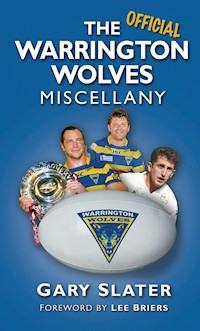
The Warrington Wolves Miscellany is the definitive set text for every fan of the world famous Wire. Packed with facts, fun, gossip, nostalgia and conjecture, it looks back over 135 years of glorious history to celebrate the personalities, victories and controversies of the sport's biggest name. Handily pocket-sized to pull out in the middle of those pub arguments over who was the fastest, dirtiest or biggest, this book will not only tell you who scored the most tries, kicked the most goals or won the most trophies, but also who earned the most red cards, which former player still haunts the town and who was sent off twice in one match. Put down your pie and pick up a copy.
Das E-Book können Sie in Legimi-Apps oder einer beliebigen App lesen, die das folgende Format unterstützen:
Veröffentlichungsjahr: 2012
Ähnliche


















To Warrington fans: who know how to celebrate victory and defeat
CONTENTS
Title Page
Dedication
Acknowledgements
Foreword
Greatest Victory
The Halliwell Jones Stadium
Getting Shirty
That’s Entertainment
Money, Money, Money
Things They Said
Record Buys
Record Sales
Founding Fathers
Around the Grounds
The 100 Try Club
Player of the 1880s – Tommy Barnes
First Fixture List
Motley Crewe
Sprinting to Warrington
League of Nations
Great Scots
An Ireland Race
England, Wales and Great Britain
World Cup Winners
Big Bans
Let There Be Light
Sports Day
Talking Turnstiles
Death by Misadventure
Dial M for Merger
Player of the 1890s – Fair Barber (1893–7)
First Trophy
Brothers in Arms
Generation Game
Made in Wales
Captain Morgan Trophy
Primrose and Blue
Boots and All
Strike Action
Roll of Honour
Try and Try Again
Numbers Game
Nicknames
Player of the 1900s – Jack Fish (1898–1911)
Drop Goal Kings
Record Crowds
Crowd Pleasers
Taking an Early Bath
In the Bin
New Technology
High Fives
Player of the 1910s – George Thomas (1903–14)
Man of Steel
Top Tens
Blasts From the Past
Age is Only a Number
Globe Trotters
Lance todd Trophy
Points Make Prizes – Part I
Harry Sunderland Trophy
Player of the 1920s – Billy Cunliffe (1914–30)
Name Games
Good Friday, Bad Friday
Points Make Prizes – Part II
Supersubs
Superfan
Sevens Up
Shirt Sponsors
Five Sent Off
Four Sent Off
Pick! Pick!
Lifesavers
King Coal
Queen’s Honours
Silent Tribute
Murphy the Mouth
Marathon Men
Player of the 1930s – Billy Dingsdale (1928–40)
Strange But True
Four Great Comebacks
Four Great Escapes
The Wigan Walk and the Wigan Run
Hall of Fame
Dream Debuts
Player of the 1940s – Albert Johnson (1939–51)
Most Goals
Hat-Trick Heroes
Most Appearances
Losing Streaks
Final Misery
Player of the 1950s – Brian Bevan (1945–62)
Gang of Four
Winning Streaks
War Heroes
Most Tries in a Season
Five Record Defeats
Seventh Heaven
Clean Sheets
Wolfing It Up
Nasty Nazis
On Your Bike
Never Relegated
Worst Starts to the Season
Player of the 1960s – Parry Gordon (1963–81)
Double Trouble
Two Fond Farewells
What Warrington Have Won
Value for Money
Fight Club
Grapple Tackles
Great Britain Calling
Great Britain Tourists
Hole in One
United we Stand
Football Crazy
Crikey, Kikey!
Top Draws
Narrowest Defeat
No Place Like Home
We Are the Champions
Champions for 19 Hours
Most Goals in a Season
League Versus Union
Player of the 1970s – John Bevan (1973–86)
Injury Time
Best of Enemies
Longest Match
Shortest Match
Lancashire Lads
Mr Reliable and Friends
Players of the 1980s – Mike Gregory (1982–94)
Tall and Short
Fat and Thin
Cup Kings
Kicking Kings
Derby Days: Wire V Chemics
Player of the 1990s – Mark Forster (1983–2000)
30 Points in a Match
Strike Rate
Finest Front Rows
Beating the Aussies
Player of the ‘Noughties’ – Lee Briers (1997–)
Short But Sweet
Leading Try-Scorers for Every Position
Coaches
Super League Dream Team
Love Match
Smoking Hot
Fastest Sending Off
Further Reading
Copyright
ACKNOWLEDGEMENTS
Lee Briers, a great player and a great bloke, wrote a fascinating foreword which I am sure you will enjoy. Eddie Fuller set up and took the photograph of Lee on the front cover, much to his embarrassment, and has now been the club photographer for an incredible 40 seasons. Thanks also to Stan Lewandowski of the Warrington Wolves Past Players’ Association; Mike Parsons and his team at the Warrington Guardian; Neil Dowson and Andy Topham at the Warrington Wolves and everyone who knows me. Neil read and corrected the original manuscript while another Neil, Neil Ormston, helped with the statistics. Here’s to many more seasons in the sun.
FOREWORD
That’s me in the middle on the front cover after breaking Steve Hesford’s points-scoring record against Swinton in May last year. All the fuss was a bit embarrassing to be honest and I didn’t really want to be carried by Moz (Adrian Morley) and Garreth Carvell but they made it a special occasion and it is one of the things I will look back on when I finish my career and think, ‘wow, that was pretty good.’
Going into the game I knew I was close to the record, I think I needed 35 points, but I didn’t believe for one minute that I was going to break it in that one game and score 44 points. I just thought that I would knock off as many points as I could. It was a shame for Swinton, who lost 112–0, but their players never gave up and kept going right to the end. We spoke to the Swinton guys afterwards and told them not to get too downhearted because we were putting big scores on Super League sides at the time.
Moz and Garreth are brilliant props. Moz’s record speaks for itself. He has been around a long time and played on both sides of the world and Garreth has come into some great form after being underrated. In fact, all the pack we have now make my job much easier. I’ve been blessed with good half-back partners as well – Allan Langer, Andrew Johns, Nat Wood, Richie Myler and Michael Monaghan have all been a joy to play with.
Nat was the funniest player I’ve played with. He was a real prankster and he loved to play tricks on people. He is back in Australia now, running his own business and doing very well and we still keep in touch. He was responsible for the funniest moment I’ve had at Warrington when he scored that try against Wigan at The Halliwell Jones Stadium in 2004 and ran through the stand. That was bizarre but it was quite funny and apparently he asked a Wigan fan for a bite of his hot dog on the way.
Winning the Carnegie Challenge Cup at Wembley against Huddersfield Giants in 2009 and Leeds Rhinos in 2010 was special for everyone involved. Against Leeds, I collected the Lance Todd Trophy as man of the match which was a bonus for myself, but you win cups as a team. I was lucky enough to be the man of the match but you don’t win finals without everybody playing really well.
Tony Smith, the Warrington coach, has made a big difference. His man-management is fantastic. He treats every player differently and knows how to get the best out of them. He also comes from a successful background, with Leeds and Huddersfield. He knows how to win and has given us that belief.
I have won things late on in my professional career and my amateur career with St Helens Crusaders was the same. It was only at under-15s and under-16s that we started winning trophies. It was a strange old weekend when I joined Warrington in 1997. I signed on the Friday and then went back to my hometown club St Helens on the Sunday and we got a pasting but I have never once regretted signing for Warrington and I think that is the main thing. I have enjoyed every minute of it and long may that continue.
Rugby league has taken me all over the world, to Scotland, Wales, France, Australia and New Zealand, and I’ve met people of different nationalities, beliefs and faiths and it is not often that you meet a bad person in the game. All the players are really good blokes and enjoy the camaraderie. I have been all over the world playing for Warrington and there aren’t many jobs you can do that in.
I’ve also been to the House of Lords for the All-Party Parliamentary Rugby League Group annual dinner and that was a brilliant day too. Paul Cullen and I were shown all around parliament and at one point Margaret Thatcher was sat literally ten metres away from us. Then we had dinner and I received the group’s player of the year award. It was a great day and I really enjoyed it. It was a shame we were playing a couple of days later because it would have been nice to get a few cheap drinks in. I couldn’t believe how cheap their ale was!
All the way through school, all I ever wanted to do was be a professional rugby league player and my school work took second place unfortunately – I regret that a bit now but I always wanted to be a rugby player.
My advice to young players today would be to enjoy it, learn as much as you can and listen to your coaches and if you do that you won’t be far off. I want to go into coaching myself but not for a few years yet. I am having too much fun playing. Enjoy the book.
Lee Briers, Warrington’s record points-scorer, 2012
GREATEST VICTORY
23 August 2000, 7–4
Warrington Wolves’ most important victory was not achieved on the pitch, on the training ground or at Red Hall in Leeds, the headquarters of the Rugby Football League. It happened in the council chamber when Warrington Borough Council’s planning committee voted 7–4 in favour of the club’s application to build a new ground, in partnership with Tesco, on the site of the former Tetley Walker brewery.
That vote was not the end of the process – it led to a public inquiry the following May – but without it there would not have been a new stadium. In the build-up to the planning committee meeting, the club staged an emotional question and answer session at the Parr Hall on 17 July 2000, showing a virtual reality video of the new ground.
The late Peter Deakin, who was the club’s chief executive at the time, also wrote to all season-ticket holders, ‘I cannot underestimate the importance of a new stadium to the future of the club. It is only with the creation of the People’s Stadium that the club will be able to satisfy Super League’s impending facility requirements and develop the revenue streams to allow the Wolves to realise our potential as a top level Super League club.’
A decade on, following back-to-back Challenge Cup wins in 2009 and 2010, the outstanding success of The Halliwell Jones Stadium is there for all to see.
THE HALLIWELL JONES STADIUM
A colleague in London once asked me if Halliwell Jones was a former Warrington player, perhaps a Welsh scrum-half from the 1960s? The truth, of course, is that Halliwell Jones is an authorised BMW and Mini dealer which agreed a 10-year deal for the naming rights of the stadium. In May 2011, Halliwell Jones signed a 6-year extension to that contract until 2017. The stadium and the accompanying Tesco Extra store were built by Barr Construction. It took them just 43 weeks to build the stadium at a cost of £8 million. Work started on 9 December 2002 and was completed on 6 October 2003.
The North Stand is the main stand and is all-seater, with a capacity of 3,200. The East Stand (the Martin Dawes Stand) is also all-seater, with a capacity of 2,398. The South Stand (The Halliwell Jones Stand) is a standing terrace with a capacity of 4,000. Finally, the West Stand (the Doodson Stand) is also a standing terrace, with a capacity of 3,200. There are 226 disabled and carer places.
The pitch is the maximum size allowed (120 metres by 74 metres) with a 3-metre run-off. The stadium has five changing rooms, for home and away first teams, home and away academy teams and one for the officials. The stadium has been a no smoking venue since 1 January 2006 following a poll of supporters when 63 per cent voted for the measure.
GETTING SHIRTY
When Warrington Wolves played Castleford Tigers at The Halliwell Jones Stadium in May 2011, they wore a special camouflage kit to mark the club’s Armed Forces Day. The club donated £5 from every replica camouflage kit sold to charity – namely Help for Heroes and the Mercian Regiment Benevolent Fund. The camouflage certainly fooled Castleford as Warrington won 62–0. A generation earlier, in September 1987, Warrington forgot to take their kit to Castleford for a league game and had to borrow a reserve strip from the home team. The change of colours did not seem to do them any harm, on that occasion either, as Warrington won 40–30. Warrington made a special kit for their match against Australia in November 1994 but the Rugby Football League ruled that they could not play in it. Some supporters still bought it, however, and proudly wear it to this day.
THAT’S ENTERTAINMENT
Super League and summer rugby brought about a new era in pre-match entertainment, including the Starlites, a sensational dancing ensemble, although not every supporting act was as well received. Irish twins Jedward, fresh from X-Factor, were booed off at The Halliwell Jones Stadium before the Harlequins match in February 2010. For fans of a certain age, however, the most memorable pre-match music is ‘Entry of the Gladiators’ by Julius Fucik, which still evokes memories of Brian Bevan and the boys trotting out on to the Wilderspool pitch.
MONEY, MONEY, MONEY
From the 1880s onwards, Warrington have been paying their players and quite right too. The players – to use a modern expression – put their bodies on the line for the club and deserve to be rewarded for their time and commitment. Forward Will Randles played for Warrington in the late 1880s and early 1890s and then trained the team for 7 years. He said that in his day winning pay was two tuppenny vouchers worth two gills of ale while losing pay was just one tuppenny voucher for one gill of ale. This beer money was soon replaced by the real thing. In 1895/96, rugby league’s first season as the Northern Union, players were limited to a ‘broken time payment’ of 6s a day. ‘Broken time payments’ were made in lieu of work, so players had to have a full-time job, otherwise they couldn’t play. This wasn’t a game for slackers, ne’er-do-wells or, worst of all, professionals. In today’s money, that 6s a day is the equivalent of £100.
THINGS THEY SAID
‘It’s a girl – and I’m playing.’
Paul Wood’s message to Tony Smith after his wife gave birth to a daughter on the morning of the match against Crusaders in 2011 – he played and scored two tries
‘Alex Murphy got sent off and one of the Castleford lads tried to break my ribs.’
John Bevan recalls his debut in September 1973
‘It wasn’t the same as Warrington. We even had to wash our own kit!’
Brian Glover on his move to St Helens in 1970
‘I find myself watching him to such an extent that I forget that I’m on the field too.’
Albert Johnson on Brian Bevan
‘I have a wife and child, and I am only a working man. I was offered £100 down, and I couldn’t resist it.’
Billy O’Neill after signing for Warrington from Cardiff in October 1908
‘If Brian Bevan had been a cricketer he would have been knighted. If he’d been a soccer player he’d have got the OBE. If he’d been an actor he’d have got an Oscar.’
Oscar-winner Colin Welland
‘My signing-on fee was a small lemonade, a cigar and a pat on the back – and I didn’t even smoke!’
Ernie Brookes (1902–20) on signing for Warrington
‘The Warrington spectators are the worst spectators in England.’
Batley’s Welsh winger, Wattie Davies, after being sent off at Wilderspool in September 1901
‘My attitude was “get your retaliation in first” and I wasn’t the only player like that in those days.’
Joe Price explains the laws of the jungle in the 1960s and ’70s
‘He always wore the same socks. Well he played for 20 years so it wasn’t the same socks for 20 years, but you know what I mean.’
Jeanette Lane, Brian Bevan’s daughter, in 2008
‘He came back from his honeymoon twice to go training.’
Jeanette Lane again, in 2008
‘If you didn’t win, you didn’t eat.’
Paul Cullen, recalling the days of winning pay and losing pay, 1999
‘Let’s hope Brett Hodgson gets back into the team quickly otherwise my goal-kicking record will be gone as well.’
Steve Hesford in 2011 after Lee Briers had broken his club points-scoring record
‘I didn’t see his face but I would recognise the boot anywhere.’
Ray Price after being kicked in the head by a supporter during a fracas in the 1954 GB tour of Australia
RECORD BUYS
£100: Warrington paid £100 to the Wales international forward Billy O’Neill when they signed him from Cardiff in October 1908.
£700: Warrington paid St Helens £700 in September 1934 to sign their international forward Jack Arkwright.
£1,450: Warrington paid Liverpool Stanley a world record £1,450 to sign their international full-back Billy Belshaw in October 1937. Warrington also agreed to find a job for his dad, something that was not publicised at the time.
£4,600: Warrington paid Widnes a world record £4,600 to sign their Lancashire centre Albert Naughton in November 1949. St Helens, in fact, offered £5,000 but Naughton, quite understandably, wanted to come to Warrington.
£12,500: Warrington paid Leigh £12,500 in August 1971 for forwards Geoff Clarkson and Dave Chisnall. Chisnall was valued at £8,000.
£75,000: Warrington signed Widnes scrum-half Andy Gregory in January 1985 in a ‘world record’ £75,000 deal. Widnes received Warrington’s £70,000 transfer-listed forward John Fieldhouse plus a ‘substantial’ cash sum. The transfer was not recognised as a world record deal because it was not cash only.
£200,000: Warrington paid St Helens £200,000 in July 2004 for Great Britain centre Martin Gleeson, even though he was serving a four-month ban at the time for betting against his own team.
£290,000: Warrington paid Salford City Reds £215,000 up front for England scrum-half Richie Myler in September 2009 with a further £75,000 to follow as various targets were reached. It was a record fee for a teenager (he was still only 19) and a record fee for a scrum-half.




