


Erhalten Sie Zugang zu diesem und mehr als 300000 Büchern ab EUR 5,99 monatlich.
- Herausgeber: The Lilliput Press
- Kategorie: Geisteswissenschaft
- Sprache: Englisch
This volume sheds new light on the life and works of Jack B. Yeats, the talented painter and poet too often overshadowed by his older brother William, through a collection of previously published and unpublished letters from John Butler Yeats to his son Jack, and from Jack to his father, John Quinn, 'The Man from New York', and Sarah Purser. Introduced by Bruce Stewart of the University of Coleraine, the work includes essays on Jack B. Yeats by editor and Sligo-man Declan J. Foley, organizer of three John Butler Yeats seminars in Chestertown, upstate New York (JBY's burial ground), as well as by other scholars of Jack B. Yeats.
Sie lesen das E-Book in den Legimi-Apps auf:
Seitenzahl: 394
Veröffentlichungsjahr: 2009
Das E-Book (TTS) können Sie hören im Abo „Legimi Premium” in Legimi-Apps auf:
Ähnliche



















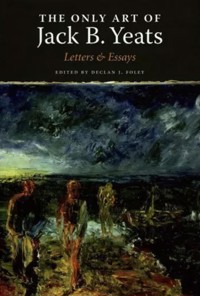
THE ONLY ART OF Jack B. Yeats
Letters & Essays
EDITED BY DECLAN J. FOLEY
This book is dedicated to the memory of Susan Mary Pollexfen Yeats (1841–1900), that most unacknowledged and all-important person – the silent and shadowy genesis to all this creativity – wife, above all mother, who through her story-telling awakened the imaginative process in her gifted children, ‘Willy and Lily and Lollie and Jack’ (G.K. Chesterton’s description). Susan Mary Yeats was buried in grave No. 13, Row E,
Section T, Acton Rural Cemetery, London, on 3 January 1900, aged fifty-eight years.
Union Place, Sligo, the site of the Pollexfen home at the time of Susan’s marriage to John Butler Yeats © Gerry Foley 2009
Contents
Title Page
Dedicaion
Epighraph
Acknowledgments
Foreword by Bruce Stewart
Men of destiny: John Butler Yeats and his son Jack B. Yeats Declan Foley
I Letters of Jack B. Yeats to Sarah Purser: 1888–9
Mr Yeats and Mr Waddington Leslie Waddington
II Letters of Jack B. Yeats to John Quinn: 1903–11
Eamonn Andrews interviews Jack B. Yeats on Radio Éireann
Frisky minds: Jack B. Yeats, Bishop Berkeley and a soupçon of Beckett John Purser
III Letters of John Butler Yeats to his son Jack B. Yeats: 1909–10
John Sloan: The artist in modern life John Loughery
IV Letters of John Butler Yeats to his son Jack B. Yeats: 1912–13
Jack B. Yeats and the stencil Hilary Pyle
Sketches from the letters of Jack B. Yeats Arnold Harvey
V Letters of John Butler Yeats to his son Jack B. Yeats with a letter of Jack B. Yeats to John Quinn: 1914
Irish Modern: Jack B. Yeats and the Armory Show Betsy Fahlman
VI Letters of John Butler Yeats to his son Jack B. Yeats: 1915
A part of or apart? The possible influence of European Expressionism on Jack B. Yeats Giovanna Tallarico
VII Letters of John Butler Yeats to his son Jack B. Yeats: 1916
Yeats at Petitpas’: The path to a picture Avis Berman
VIII Letters of John Butler Yeats to his son Jack B. Yeats: 1917–18
‘Of loyal nature and of noble mind’: Jack B. Yeats and his siblings Maureen M. Murphy
IX Letters of John Butler Yeats to his son Jack B. Yeats: 1919
Jack Yeats and Dublin Róisín Kennedy
X Letters of John Butler Yeats to his son Jack B. Yeats: 1920–2
Notes
Glossary of names
Appendix I: Jack B. Yeats: Chronology
Appendix II: Commentary by contemporaries
Appendix III: Some notes on references
Appendix IV: A miscellany
Bibliography
Notes on contributors
Copyright
Civilizations were let down from heaven in the dawn of history, and we find the laws of Moses and Manu and other primitives all whispers from heaven to earth. Then kings began to put themselves in place of heaven, and after the kings came the aristocracies, and after the aristocracies the oligarchies of the wealthy, and now there appears a place in the sun for the average man moulding his own destiny in harmony with his neighbours, and that is what the world has long awaited and been in travail to get, and if we can inspire Irishmen in this fever of the world to co-operate, to work together to save their country, we may make Ireland a country worth living in …
Æ, ‘Notes of the Week’, The Irish Homestead 19 May 1917, pp. 588–9.
There is no padding in this book except the padding of the hoof. At the same time I write this Book because I want a couple of million (pounds) quickly, and as it may be the last Book written in the world it should have a very large sale. Though it may be the last Book it is quite likely that lectures will be arranged and Broadcast. They will be given entirely by the fair sex, interesting but monotonous.
About a name for this book. I was making some notes one day while travelling in a train through the boggy country in Ireland when a melodeon player opposite me asked me if I wouldn’t stop writing and ‘give out a tune’ and he handed the melodeon towards me. ‘I have no ear,’ I said. ‘Ah, to hell with ears,’ he said, ‘I play with my body. Are you writing a book?’ he said. ‘Well I am making notes for one,’ I said. ‘What are you going to call it?’ he said. ‘I don’t know yet,’ I said. ‘Call it Sligo. It’s the name of a town,’ he said, ‘the only in Ireland I was never in. I was near it once but I stopped on the brink and took the long car with a unicorn yoked to it for a town called Ballina. Call it Sligo, it ought to be a lucky name.’ So Sligo it is. When he asked me to play a tune he pronounced it Chune, a very good way too. If they give me music to my grave I will sooner they will call it a Chune to Toon: there is a want of dignity about the word ‘Toon’ and I would not look forward to it.
Extract from Sligo by Jack B. Yeats (London: Wishart & Company 1930), p. 40.
Acknowledgments
First and foremost, my sincere appreciation of William M. ‘Bill’ Murphy, who passed away on 26 September 2008, and Hilary Pyle. Of particular importance is Bill Murphy’s creation of the research facility in The Schaffer Library Special Collections at Union College, Schenectady, New York.
The late Michael B. Yeats for his encouragement and permission to use material from his grandfather and uncle. Ellen Fladger, Librarian, Special Collections of Schaffer Library, Union College, for copies of the letters of John Butler Yeats to Jack B. Yeats. Terry Tuey, Library Assistant, McPherson Library, Special Collections, University of Victoria BC, for copies of the letters of Jack B. Yeats. Thanks also to: Sarah Cash and Ila Furman, Assistant Registrar, Corcoran Gallery of Art, Washington DC; Marie McFeely, Rights and Reproductions Officer, Picture Library, The National Gallery of Ireland, Dublin; Angela Minshull of Christie’s Images Ltd, London; Anna Monroe and Emma Mee of DACS, London. John Glendon of RTÉ, Dublin, Ireland, for the interview between Jack B. Yeats and Eamonn Andrews; Eoin McVey and Madame Editor Geraldine Kennedy of The Irish Times for permission to reproduce Arnold Harvey’s article; Michelle Archer at Waddington Gallery, London; Dr Declan Kiely at the New York Public Library, Dr Maureen E. Mulvihill, Princeton Research Forum, Princeton NJ.
The essayists for their contribution to this publication; my brother Gerald (Gerry) Foley Jnr for his drawing; Frank Bennett Jnr for editorial advice and the Glossary of Names; Don Gillen of Sligo and Rosses Point. Amanda Ryan, the Heritage Council of Ireland, for the grant that made this work possible. My sister Marea Walsh and Mrs Anna France, London, for their proofreading and encouragement; Carole Pesner, Kraushaar Galleries, New York, for permission to reproduce Yeats at Petitpas’; the owner of The Last Corinthian; Ann Saddlemyer and Cathy Fagan for their encouragement and support. My sincere appreciation of Antony Farrell at The Lilliput Press, Dublin. Lastly my wife Helen and our youngest son Gerald Foley III for their patience.
Design for a Mountain Backcloth for ‘The King’s Threshold’, 1913 (National Gallery of Ireland, Dublin), ink, pencil and watercolour on card, 24.8 x 37.5cm © Estate of Jack B. Yeats, DACS 2007; Stencil Portrait of J.M. Synge, 1905 (Royal Library, Windsor Castle), indian ink on paper, 20 x 13 cm © Estate of Jack B. Yeats, DACS 2007; Stencil Portrait of John Butler Yeats, 1900 (Sligo County Library and Museum), watercolour on paper, 33 x 21.5cm © Estate of Jack B. Yeats, DACS 2007; The Circus Coachman, c.1903 (private collection), gouache and watercolour on paper, 71 x 54.5cm © Estate of Jack B. Yeats, DACS 2007; A Stevedore, 1900 (courtesy of The Niland Collection, The Model Arts and Niland Gallery, Sligo), watercolour on paper, 11 x 8cm © Estate of Jack B. Yeats/ARS(NY)/DACS 2007; A Political Meeting, 1905 (courtesy of the Niland Collection, The Model Arts and Niland Gallery, Sligo), pencil and watercolour on paper, 21 x 29 ins (53.34 x 73.66cm) © Estate of Jack B. Yeats/ARS(NY)/DACS 2007; The Circus Dwarf, 1912 (private collection), oil on canvas, 91.5 x 61cm © Estate of Jack B. Yeats/ARS(NY)/DACS 2007; The Barrel Man, 1912 (private collection), oil on board, 35.5 x 23cm © Estate of Jack B. Yeats/ARS(NY)/DACS 2007; The Strand Races, West of Ireland, 1895 (courtesy of The Niland Collection, The Model Arts and Niland Gallery, Sligo), watercolour on paper, 11.5 x 68.5cm © Estate of Jack B. Yeats/ARS(NY)/DACS 2007, 2006; The LastCorinthian, 1910 (Christie’s Images Ltd, private collection), oil on canvas 15 x 11 ins (38.1 x 28 cm) © Estate of Jack B. Yeats/ARS(NY)/DACS 2007; John Sloan, Yeats at Petitpas’, 1910 (courtesy of Corcoran Gallery of Art, WashingtonDC, Museum Purchase, Gallery Fund, Accession No. 32.9), oil on canvas, 26 3/8 x 32 ins.
Foreword
BRUCE STEWART
For Declan Foley, in editing this gathering of hitherto unpublished Yeats letters – artist-father to artist-son and vice-versa – the aim is to ‘introduce Jack Yeats to another generation’. He is also, no less consciously, bent on staking a claim to the genius of the Yeatses on behalf of his native town. In so doing he is bringing it all home to Sligo in a constructive and engaging way, supplementing the previously unseen letters with a number of scholarly papers that provide a cultural commentary to match the texts, adding new depth to our understanding of the relationship. Compared to W.B. Yeats, Jack was relatively inexpressive but also free from the habit of mythological inflation. In balance he was probably an equal reflection of his father; more precisely, his father understood him no less well, perhaps seeing him more as a Pollexfen than a Yeats. They shared the art of painting. And, where WBY needed to be restrained (‘You would be a philosopher and are really a poet’), Jack needed to be encouraged (‘Remember that all the great artists have been shameless plagiarists’). The chief interest of this correspondence is the insight that it gives us of that nurturing relationship, and of the two men’s very real affinity and friendship; it also deepens our understanding of JBY the father and the man through his letters to his son.
Declan argues that Sligo was important to the Yeatses. As with the letters reproduced here, it is a two-way process. Sligo claims the Yeatses because the Yeatses claimed Sligo as part of their imaginative existence. The result is an organic bond which, in their working lives, they rendered indissoluble. This is not as obvious as it might seem. Take, for instance, the thesis that J.P. Frayne advanced in his introduction to Collected Prose (1970): ‘Yeats needed an independent body of undeveloped myth close to English and Irish experience yet sufficiently strange to his contemporary readers so as to seem novel and original.’1 For Frayne, then, WBY espoused Celtic mythology ‘because it was fresh, unexploited, non-Christian, and remote, as well as because it had, to use his favourite phrase, “stirred his imagination”’: ‘He did not have to use these myths in his poetry, in the sense that they were not an essential part of his culture or upbringing. He had not encountered them during his sentimental education in Howth or Sligo, a lack which he lamented in later life.’2
What are we to make of this? WBY went to great lengths to establish the literary myth of a spiritually-privileged Ireland. (Irish Catholicism did the same on the other side of the house.) The folklore he explored was, he claimed, part of a ‘pagan mystery’ that ‘hides and reveals some half-forgotten memory of […] an ancient wisdom’,3 while its bearers – the peasant story-tellers from whom he and Lady Gregory collected legends in the smokey cottages of the west of Ireland – were ‘visionaries’, ‘poets’ and ‘dreamers’, transmitting an ‘ancient knowledge’ in coded form for future generations.
Once, in an evangelical mood, he called Irish folklore ‘the Bible, the Thirty-Nine Articles, and the Book of Common Prayer’ of the movement,4 while in 1894 he pronounced: ‘The recent revival of Irish literature has been very largely a folklore revival, an awakening of interest in the wisdom and ways of the poor, and in the poems and legends handed down among the cabins.’5 The trouble was, the code is either far too complex to be broken or too simple to be required, and no ancient philosophy ever disclosed itself to Yeats through folklore studies, whether ‘in excited reverie’ or otherwise. Later writers on the subject, such as Donal O’Sullivan, would take satisfaction in exploding his idea that ‘the genius of Gaelic Ireland possesses some peculiar occult or esoteric quality’, noting that ‘the very term Celtic Twilight is now commonly accepted as expressive of this supposed characteristic’. O’Sullivan lays a mine beneath the foundations of Yeats’s new church when he says: ‘It must here be stated categorically that a survey of Gaelic literature as a whole discloses no ground whatever for such a belief.’6 If W.B. Yeats got that wrong, what, then, did he get right?
The Yeatses and Pollexfens were, broadly speaking, members of a class known by the hyphenated term ‘Anglo-Irish’, meaning that their bloodline was English, their religion Anglican Protestant, and their home Ireland. Brendan Behan wittily defined the typical example of the species as ‘a Protestant on a horse’. Yet, even if one of the early Yeatses rode a charger at the Boyne (though on which side is a matter of conjecture), his descendants were not on the whole a horsey set. Instead, they were members of the servitor class: parsons and lawyers to the ascendancy rather than landed aristocrats and soldiers such as the Gore-Booths of Lissadell, who ‘rode to harriers’, in Yeats’s phrase, or General Gough, who conquered maharajahs and whose equestrian statue was blown up so often in the Phoenix Park. (His Dublin country house is now a Radisson Hotel.)
While the Pollexfens of Sligo doubtless kept horses for the usual purposes, their proper mode of conveyance was the steamship – passenger vessels and freighters large enough to sail from western Ireland to Britain but distinctly smaller than the ocean-going liners of the day. The limited scale of that enterprise made them a Sligo family business rather than a British company trading into Ireland. In this sense their Irishness was more comparable to that of Messrs Harland and Wolff than to that of the Yeatses of Sandymount from whom WBY inherited a loathing of the ‘black north’. (The historical connection between Sligo and Belfast was less nugatory than it now appears.) As such, they were precluded from the ‘gentry’ society of the Gore-Booths and the Coopers. No matter how elevated within the Protestant world of Sligo shopkeepers, they inevitably remained ‘townies’.
John Butler Yeats, who fostered patrician associations in the tenaciously perpetuated name, Butler, of Ormond fame, went to school with George Pollexfen and married his sister Susan. In one place he tells WBY that he courted her in the absence of objections from her parents and with the assistance of his friend – a bald enough description of the match that bred the ‘last romantic’. In a far more famous letter he described his role as progenitor in a sentence that his son would not forget: ‘I myself am eagerly communicative, and when my son first revealed to me his gift of verse, “Ah!” I said, “Behold I have given a tongue to the sea cliffs.”’7 This is something more than a bon mot. Apart from the allusion to the taciturnity of the distaff side it adverts to the procreative act by which JBY introduced the missing genetic code that liberated the inarticulate soul of the Pollexfens – a family that had undergone a curious transmogrification from low-church Anglicans to Irish spiritualists influenced – if not in fact conditioned – by the Mary Battles of the Irish countryside. Yet the resonance of JBY’s sentence does not stop there. In the act of paternity, he imparted his verbal gifts not only to the mute Pollexfens but to an entity that had previously lacked the power of expression or possessed it only in the inarticulate cries of gull and cormorant. Or so the argument goes, characteristically eliding the voice of Gaelic Ireland.
To grasp the force of this assertion is to banish the pragmatism of John Frayne as Berkeley banished the empiricism of John Locke. Considered as voice and eyes of the western seaboard, the works of William Butler and Jack Yeats were not simply subjects chosen randomly for their possible market value but the result of hard-wired connection and a very real ‘sense of place’; in-dwelling of the landscape, a way of seeing and feeling that took its rise from chromosomal structures at the foundations of their being. In later years, as the new letters show, JBY kept pace with the changing phases of his sons’ Irishness as well as with his own. Of Jack he said: ‘He is ever careful to preserve a certain roll and lurch in his gait, that being the mark of the Sligo man’, as Declan Foley reminds us in his introductory essay.
The question of being Irish no less than Anglo-Irish was ever present for JBY – somewhat antagonistic positions that he resolved in his own personality and hoped others would learn from him. So also was the conflict of the Protestant and Catholic traditions, not alone in Ireland but in Europe, and many of his more perilous sentiments derive from this: ‘The real object of Protestant teaching is to make a boy behave even tho’ no one is watching him. The whole effort of Catholic teaching is to keep a boy under closest scrutiny night and day, and by their confessional they can carry spying into the reaches of the poor lad’s soul.’8
In an Irish context this is apt to cause offence. When applied to the Petitpas sisters in New York, it seems more benign: ‘The Protestant saved himself by “faith”, and the Catholic by “good works”. That partly accounts for the French heart.’9 It is also arguably true; and if true of the Petitpas’ Normandy origins, why not so of Ireland also? What it chiefly shows is an alertness to different forms of civilization and an attempt to establish an optimum balance between them in modern Irish life, albeit from an Anglo-Irish standpoint.
Richard Ellmann offered some mitigation for this when he wrote: ‘One can be grateful that J.B. Yeats, though he had aristocratic prejudices too, stood always on the side of humanity.’10 But it was not simply humanity that JBY brought to his reflections; it was a definite, if unpopular, conception of Irishness sometimes called Radical Toryism, and some remarks of his quoted by R.B. McDowell and W.B. Stanford in their book on John Pentland Mahaffy illustrate it well.
Our feelings were curious and though exceedingly selfish not exclusively so. We intended as good Protestants and Loyalists to keep the Papists under our feet. We impoverished them, though we loved them; and their religion by its doctrine of submission and obedience unintentionally helped us; we were convinced that an Irishman, whether a Protestant or Catholic, was superior to every Englishman, and that he was a better comrade and physically stronger and of greater courage.11
This is by no means the tame essence of the Anglo-Ireland (to borrow a phrase from Joyce). It is the attitude epitomized by Bishop Berkeley in the famous phrase ‘We Irish’, particularly beloved of WBY. It is also the attitude that permitted JBY to offer a barrage of opinions on the main protagonists in World War I, as it loomed in the summer of 1914, distinguishing the Germans and the English on the world stage in these terms: ‘I am extraordinarily anxious to see German militarism crushed. England humiliated would not mean for me the end of the world. I could survive seeing her taste a little of that humiliation which she has considered it her mission to inflict on everybody else, after all I am an Irishman first and a British citizen after’ [italics added].12
Some might deny him his right to claim the name of Irishman but not Declan Foley, as the spirit that informs this volume amply demonstrates. Meanwhile, in Northern Ireland today, the entitlement to call oneself Irish or British or both is enshrined in the Belfast Agreement. To that extent the solution that JBY sought has finally emerged, not from the Irish Troubles that he witnessed but the later Troubles of our own time.
It is impossible to speak highly enough of the art-historian contributions to this collection charting the Yeatses’ involvement in the Armory Exhibition of 1913 and related matters. Hilary Pyle’s modestly titled ‘Jack B. Yeats and the stencil’ may be singled out as a triumph of close attention to the materials of his art while one of the more intriguing pieces – indeed, something of a loose cannon – is John Purser’s speculative paper on the ‘Irishness’ of Bishop Berkeley’s Idealist philosophy, which he traces to features of Gaelic-Irish grammar. It would appear that the Gaelic world-view posits a different sense of the relation between subject and object, the two being indissolubly related in the stative form of the language. Hence Berkeley’s famous esse estpercipi translates as Bítear mar go n’airítear (meaning literally, ‘It does be because it is perceived’) – which can be seen as an extension of the tendency to locate the ontology of anything in the moment of perception.
The enthusiasm that Jack Yeats felt for the life of Berkeley by Hone and Rossi, for which WBY wrote the introduction, leads Purser on a philosophical path that fetches up at Yeats’s inscrutable remark about ‘our proper dark’ in ‘The Statues’ – perhaps the fullest embodiment of his Berkeleyan attachment. Jack Yeats’s paganism is Purser’s central concern here, but this does not prevent him from reflecting on an Irish preoccupation with bicycles equally discernible in the novels by Jack Yeats, Sam Beckett, and Flann O’Brien. Here is a theme, he tells us, which might make for a mini-dissertation. Something more, I suspect, if an enquiry into the anti-empiricism of Berkeley were to produce a composite explanation of those three writers’ engagement with the Cartesian cogito and the anti-rational, anti-apiarian tendency in the Yeats frères. (Interestingly, Hugh Kenner advanced down this road a little in his analysis of Beckett’s fiction forty years ago.)
There is probably no greater testimony to the Irishness of the Yeatses than John McGahern’s appreciation of the vitality and interest of JBY’s letters which, as he tells us in his preface to the last published collection, gave him pleasure for many years. ‘They can be gossipy, profound, irascible, charming, prejudiced, humorous, intelligent, naïve, contradictory, passionate. They are always immediate … In abolishing time and establishing memory, the letters of John Butler Yeats go straight to the very heart of affection.’13 It is out of just such affection for the Yeatses that Declan Foley has put together this additional resource.
The publication history of JBY shows something like a rising curve of Irish addiction to the letters of Yeats père. After an early, and somewhat familial, tribute in the sixty-page Passagesfrom the Letters of John Butler Yeats edited by Pound and issued by Cuala Press in 1917, there followed Further Letters edited by Lennox Robinson in 1920 (also from Cuala Press). This was followed by a much larger selection edited by Joseph Hone for Faber as J.B. Yeats: Letters to his Son W.B. Yeats and others, 1869–1940, which was reprinted by Secker & Warburg in 1983 before being reissued in an abridged version by Faber with an introduction by John McGahern in 1999. Some letters of JBY to Lady Gregory appeared in Irish Renaissance: A Gathering of Essays, Memoirs, and Letters from the ‘Massachusetts Review’ edited by Robin Skelton and David R. Clark (Dolmen Press 1965), while William M. Murphy edited Letters from Bedford Park: A Selection for Cuala – actually Dolmen – Press in 1972. The letters in the present volume are those that William M. Murphy transcribed but did not use and which he kindly permitted Declan Foley to publish. Those from Jack Yeats have been copied from the Special Collection of the University of Victoria Libraries. Correspondence with the library staff reveals that they are unable to clarify the provenance of that collection, though an interest in the painter seems to have been evinced as early as 1945, to judge by the earliest items in their catalogue.
Jack B. Yeats’s letters are engaging in a way that suggests that the Pollexfen taciturnity, like the loquacity of the Yeatses, could itself be turned into a form of eloquence. The younger son liked best to talk about the things he sketched and painted rather than to reflect upon his manner of doing so. There is a frustrating letter here in which the father commends the son on ‘one of the most interesting letters I ever got from you’.14 Unfortunately we are not privileged to see that letter in which he seemingly expressed doubts about his own originality – doubts that JBY adroitly lays to rest in his reply, which I have already quoted.
In the main, Jack Yeats’s correspondence reveals a nigh-myopic focus on the here-and-now (those boy-boxers fighting on a ‘piece of toast’ in London) with the fantasticated vision that Samuel Beckett so admired. It also reveals the artist who once declared – in sentences always quoted by Melanie le Brocquy when asked about her sculpture – ‘Art doesn’t need any explanation. It does not matter who I am or what I am and people may think what they like about my paintings.’ Surely this is the original of Beckett’s famous saying: ‘If people want to have headaches among the overtones, let them. And provide their own aspirin’ – and in the famous letter that goes on: ‘That’s all I can manage, more than I could.’15 In putting together this marvellous collection, Declan Foley might make the same assertion with the equal proviso that his ‘can’ and ‘could’ have proved very good indeed.
Notes
1. John P. Frayne (ed.), Uncollected Prose by W.B. Yeats, vol. 1: First Reviews and Articles, 1886–1896 (London: Macmillan 1970), p. 47.
2. Ibid.
3. ‘Away’ in Robert Welch (ed.), W.B. Yeats: Writings on Irish Folklore, Legend and Myth (London: Penguin 1993), p. 317.
4. ‘A Literary Causerie’ in ibid. p. 17.
5. Frayne, Uncollected Prose, p. 326.
6. Donal O’Sullivan, Songs of the Irish (Dublin: Browne and Nolan 1967 [1960]), introduction, p. 11.
7. J.B. Yeats, Early Memories: Some Chapters of Autobiography (Dublin: Cuala Press 1923), p. 20. W.B. Yeats retells it rather differently: ‘We have ideas and no passions, but by marriage with a Pollexfen I have given a tongue to the sea cliffs.’ (W.B. Yeats, Autobiographies [London: Macmillan 1955], p. 23.)
8. Quoted in Frank Tuohy, Yeats (London: Thames and Hudson 1976), p. 123.
9. JBY to Jack, 19 August 1916.
10. Richard Ellman, W.B. Yeats, The Man and the Masks (London: Faber 1960 [rev. edn]), p. 181.
11. W.B. Stanford and R.B. McDowell, John Pentland Mahaffy: Biography of anAnglo-Irishman (London: Routledge 1972), p. 120.
12. JBY to Jack, 1 September 1914. Against this must be set another letter in which JBY ponders what Sinn Féin madness leads Pádraic Colum to admire the Germans: ‘He does not really admire them, only tries to do so.’ (JBY to Jack, 7 April 1916.)
13. John McGahern, introduction in Joseph Hone (ed.), John Butler Yeats: Letters to his Son W.B. Yeats and others, 1869–1922 (London: Faber 1999), p. 24.
14. JBY to Jack B. Yeats, 9 December 1919.
15. Samuel Beckett to Alan Schneider in Ruby Cohn (ed.), Disjecta: Miscellaneous Writings and a Dramatic Fragment (New York: Grove 1984), p. 109.
Men of destiny: John Butler Yeats and his son Jack B. Yeats
DECLAN FOLEY
To live is not merely to breathe, it is to act; it is to make use of our organs, senses, faculties, of all those parts of ourselves which give us the feeling of existence.
Jean-Jacques Rousseau
Men of Destiny, 1946, is a beautiful oil painting by Jack B. Yeats, which today hangs in the Yeats Museum in the National Gallery of Ireland. The setting is Rosses Point, County Sligo, and depicts three men clad in traditional clothing alighting from a boat and walking in single file. The background is of beautiful clouds in the sky. To me, it is reminiscent of other men and women of destiny, ancestors of the Yeatses and Pollexfen families, who stepped on Sligo shores. Coincidentally, both families share common etymological roots in the words ‘dweller’ and ‘gate’. When we come into contact with the immense body of work by the Yeats family, we are introduced not alone to a vast network of contemporaries, but a fascinating insight to the Ireland of their time. Once through the gate of the Yeats clan, there is no turning back, for we have become dwellers within the myth, the lore, and the fact of the Yeats legacy.
This book is to commemorate the fiftieth anniversary of the death of Jack B. Yeats on 28 March 1957 in Dublin. Work on the Yeats family will always find its own time for publication; the whereabouts of The LastCorinthian was unknown and turned up after the intended date! It is not an academic biography. It is not a voguish deconstruction of the man, but rather an appreciation of Jack B. Yeats – who he was, what he did, and why we should value him. Hilary Pyle and William M. Murphy through their significant work on the Yeats family have produced not only many volumes of enjoyable reading, but also the inspiration for present and future scholars to study the lives and work of John Butler and Jack B. Yeats. Other people have published books and essays on Jack including John Purser, Terence de Vere White, Ernie O’Malley, Brian O’Doherty, Nora A. McGuinness and Brian P. Kennedy. By comparison his brother the poet William Butler Yeats is widely acclaimed. Indeed there is a veritable library of criticism of his life and work. Yet, the ongoing study of the life and work of his younger brother Jack B. Yeats is, to some extent, lamentably and greatly overlooked, as is that of their father John Butler Yeats. By a strange coincidence, two women important in Jack’s life – his wife ‘Cottie’ and his mother Susan – have never been subjects of biographies. This is a great loss to those who are not acquainted with the magnificent work of both these ‘men of destiny’. Whilst some of the letters written by John Butler Yeats to his son Jack have been previously published or cited in other works, this is the first collection of the letters in one book.
In September 1996 I visited the grave of John Butler Yeats in Chestertown, New York, and was struck by the topographical resemblance between this small town in upstate New York and the forests and woods of Sligo. This uncanny similarity was the reason that Jeanne R. Foster decided to bury John Butler Yeats in her ancestral town, in the midst of the Adirondack Mountains, far away from his nation and home. When John Butler Yeats died in New York City on 3 February 1922, his beloved friend Jeanne R. Foster immediately telegraphed the Irish government: ‘Send a battleship to bring the body of John Butler Yeats home to Sligo for burial.’ Alas, at this same moment, two other great Irishmen of destiny, Arthur Griffith and Michael Collins, were striving to preserve the newly created and fragile Irish Free State. The new State did not possess a battleship, let alone a rowboat, to send to America for the body of John Butler Yeats. The response: ‘This request will have to come from the family.’ The family accepted Jeanne Foster’s offer of a grave in the Foster family plot in Chestertown, New York.1 In 1991 I contacted Andy McGowan, president of the New York Yeats Society, with the idea of holding a seminar on John Butler Yeats in Chestertown.
His immediate and very positive response included contact details for William M. Murphy (1916–2008), author of Prodigal Father: The Life of John Butler Yeats(1839–1922), the first major tome on the life and times of JBY. Suffice to say that within a few days I had a complete panel of speakers for the first ever John Butler Yeats Seminar. It was clearly stated to all speakers that WBY was not to be the topic of any paper given; John and Susan Yeats and their other three children, Lily, Lolly and Jack, were to be the centrepiece. With the generous assistance and guidance of the Town of Chester Historical Society, we had a most wonderful weekend on 6–7 September 2001, in what has since sadly been described as the last weekend of innocence in the USA.
William M. Murphy and Richard Londraville in conversation with me described the event as an ‘epiphany’; their Joycean description was completely apt. It was indeed a magical weekend, out of which emerged ProdigalFather Revisited: Artists and Writers in the World of John Butler Yeats,2 a book that included many of the seminar papers and other essays. This book was launched on 16 March 2003 (the 164th birthday of JBY) by the then mayor of Sligo, Councillor Tommy Cummins, at 12 West 44th Street, New York, where John B. had the use of a studio (his own painter’s atelier) in 1909. Many of us felt his spiritual presence there that happy day.
In September 2004 the second John Butler Yeats Seminar was held at Chestertown; a third such gathering was held 22–3 September 2007, to commemorate the fiftieth anniversary of the death of Jack B. Yeats. In 2005, I had mentioned to Hilary Pyle and William M. ‘Bill’ Murphy that something should be done to mark the anniversary. And so it was that, after the mutual exchanging of ideas, the seed of this little book began to emerge. I suggested that such a volume might include letters from his father and essays by Jack’s biographers and others, who had published books on Jack’s writing. With the kind assistance of Bill and Hilary, I set about the task. Bill provided a selection of transcripts of letters from JBY to Jack from New York. These are part of the vast collection of Bill’s ‘Yeatsian Papers’ at Union College, Schenectady. The response from the other essayists was immediate and enthusiastic.
The title of this book, The Only Art, has its origins in a 1947 Radio Éireann interview of Jack by Eamonn Andrews, a noted Irish television and radio presenter, a household name in both Ireland and the UK. During the interview, in response to a question about his paintings, Jack replied in his lilting gravelly Sligo accent: ‘I dislike the word art as to painting. There is only one art and that is the art of living. Painting is an occupation that’s in that art and that occupation is the freest of all the occupations of living.’3
In a sense, this commemorative book is about introducing Jack B. Yeats to a new generation. Jack B. Yeats the man, and his works, are an important part of Irish culture, and not only should they be more widely known, but should also be remembered as part of the psyche of the new Irish nation. Also, just as his father had played a role in the awakening of art in the USA, so too did Jack B., through his participation in the famed Armory Exhibition,4 organized by John Quinn in 1914. In life Jack B. Yeats was overshadowed by his elder brother, W.B. Yeats. He was at least the equal of, perhaps even more gifted than, his famous brother, in imagination, intellect and Irish ideology.
The entire Yeats family was every bit a Sligo family, it had the spirit of that county in its very genes, not alone from the Pollexfens of Sligo but from the Yeats family who were also from there. John B. Yeats’s father William Butler Yeats was reared in Drumcliffe, County Sligo, where his father John Butler Yeats had been rector since 1811. In the 1831 Sligo Trade Directory under the heading ‘Nobility, Gentry and Clergy’ the last entry reads: ‘Yates, Rev. John, Drumcliffe’. In the same directory under the heading ‘Alphabetical List’ appears ‘Middleton and Pollexfen, Ship Agents, Rope Manufacturers, &c, 15, Quay Street’. On 16 March 1839 John Butler Yeats was born in Tullylish, County Antrim, his father being then rector of the parish. The year 1839 is known historically as ‘The year of the big Wind’,5 how portentous this was! After the family had moved to London they regularly availed of free travel between Liverpool and Sligo on the Pollexfen and Middleton ships that plied between the two ports. At the sight of John Butler Yeats arriving at the Clarence Basin, Liverpool, the crew would throw their hands up in despair, as whenever JBY travelled with them the ship was sure to encounter foul weather.
The contact JBY made with the Pollexfen brothers at boarding school on the Isle of Man continued the Sligo connection. When John Butler Yeats fell in love with Susan Pollexfen in 1863, the Pollexfen abode was No. 3 Union Place, one of four large terraced houses. It was from here that Susan left for St John’s Church to be wed; incidentally their marriage entry gives this address for bride and groom. JBY noted the Pollexfens, who like the majority of Irish Protestant families kept the Sabbath seriously, would spend Sunday afternoons seated in their living room, in silent and deep thought: no doubt suppressed poets: ‘The family gathered in force and sat together in one room, and all disliking each other, at any rate alien mutually, in gloomy silence broken only by the sound of [Mrs Pollexfen’s] turning over the leaf of a book, or by the creaking of someone’s brace, or by a sigh from George Pollexfen.’6 In his autobiography JBY further expanded this eccentric family: ‘This curious solitariness was characteristic of the whole family. I myself am eagerly communicative, and when my son first revealed to me his gift of verse “Ah!” I said, “Behold I have given a tongue to the sea cliffs.”’7
To this giftedness from the maternal side was added the unique artistic talent from their father’s side. JBY had illustrated his own individuality by his decision to reject the legal profession, as he had earlier rejected religion as a vocation, committing himself instead to the capricious fortunes of portrait painter. To the family, especially the Pollexfens of Sligo, and friends, this was an apparently naïve and reckless decision. Today, we can rejoice in JBY’s decision, which not only gave to the arts a most interesting and diverse family, but helped enrich humanity through the work of his children. ‘Willy and Lily and Lollie and Jack’8 witnessed great debates and discussions among visitors from the world of art and academia at their childhood home in Bedford Park, London.
Æ, that myriad-minded man, wrote: ‘I admire John Butler Yeats as an artist as much as any, but I feel that Nature’s best gift to him was a humanity which delights in the humanity of others.’9 On Jack B. Yeats his comments were equally admiring:
The man of talent can only acquire merit by hard work, and it is proper, therefore to be concerned about drawing, values and whatever else may be so mastered, for it is in this way he who has original genius can yet come to make us happy by his interpretation of natural beauty. The methods by which the man of genius achieves his effects are almost undecipherable … Now, Jack Yeats has this touch of genius which makes purely technical criticism appear trivial.
No other person by taking thought could arrive at the same result … However it is, he manages to charge his figures with sentiment. That pilot of his who comes ashore looks as if he returned from the Spanish Main, from gazing on glittering islands, from treasure-hunting, and his pockets might be stuffed with gold moidores. Remote centuries and a tribe of romantic ancestors come ashore with him. Jack Yeats can also invest the earth, bare of humanity, with poetry of its own.10
Hilary Pyle cites the following in her biography of Jack B. Yeats: ‘That lesson of self-concerning silence he learnt doubtless from being left so much to himself in his Sligo home, alone with his grandparents, who … never thought of meddling with their grandsons’ freedom.’11
‘Grandparents, gentle, affectionate, were the best education for him,’ observed his father in the Christian Science Monitor of 2 November 1920:
There is a river meandering through the town of Sligo, spanned by two bridges. Beneath one of these bridges is a deep pool always full of trout. Jack told me that he has spent many hours leaning over that bridge looking into that pool and he regrets that he did not spend many more hours in that apparently unprofitable pastime. My son’s affection for Sligo comes out in one small detail. He is ever careful to preserve a certain roll and lurch in his gait, that being the mark of the Sligo man.
In a letter of September 1940 to James A. Healy, Jack wrote, ‘There is a rope of Sligo elemental air and the strands of it are so light that they can never be broken by the human will.’ Sligo was always a part of his life as this extract from a letter by JBY to Lady Gregory in 1898 further illustrates: ‘Jack does not know his Ireland outside Sligo. A hurried rush through the country is bad for work, and especially in the case of Jack, who is contemplative and sensitive and finds all his ideas in that direction.’12 Lady Gregory, commenting on her artistic guests, said of Jack B. Yeats:
Jack Yeats came on occasions but he was most at home with the workers around the estate, joining them in the pub and standing them a drink, so different from his brother. And gentle John Masefield, the seafarer. He had grown up beside woods in England and felt at home here. I should have been content to have had him and Jack Yeats here for six months of the year, but a few weeks of their wives made me hide in the woods.13
Terence de Vere White described ‘the personality of Jack B. Yeats’ in Jack B. Yeats: A Centenary Gathering:
About the time I heard disrespectful comment about Yeats’s latest pictures, I had entered Trinity College and had joined the College Historical Society. Jack Yeats used sometimes to come and take the chair at its meetings and even stayed on to supper on ceremonial occasions. He was a familiar figure to older members, and I recall a cry – ‘Tell us about Mark Twain!’ – when he got up to speak. I cannot remember anything he said on the two or three occasions he presided; nor even the Mark Twain anecdotes. But I thought at the time there was something very appropriate to his personality in the idea of Twain; and I still think that if Yeats had a predominating facet it was a character in the world of Huckleberry Finn. He was rather sailor-like, but like a sailor in a boy’s story.14
I admire the lives and work of the Yeats family of Sligo. I look at each of them as individual and I suggest that anyone who studies them does likewise. Each of us is formed as an individual and is given a unique talent for our own benefit and that of the world in which we live. From an early age the Yeats children absorbed the magic of Sligo, its beauty, its people, its traditions, and then went on to portray it in their own magical individual ways. In particular, I like the boyhood of Jack Yeats in Sligo town. I myself was born there in 1950. The town of Sligo had remained virtually unchanged in topography with continuity in the generations of families from the schooldays of Jack B. Yeats to the time of my own childhood. This was due to the accumulative effects of the War of Independence, the ensuing Civil War and two world wars. Many of the things that Jack had participated in as a child in Sligo, such as going to the circus, observing people at fairs and horse races, were familiar to us. There were two blacksmiths’ forges beside my grandmother’s house in Burton Street and as children we often sat in the open window of Hamilton’s forge, watching the horses being shod. After school we would get a ride around town with the delivery men on horse-drawn carts as they delivered goods. The town abounded with ‘characters’ with such delightful sobriquets as ‘Biddy the Crow’ and ‘Paddy the Greek’ McCarrick, who on once being asked his name by an irate parson replied in staccato: ‘They call me “Paddy the Greek” because I’m a brother of Archbishop Makarios!’ There was also ‘Cairo’ Burns and many others too numerous to mention.
Then there was the man who slew a salmon, a pheasant and a rabbit with the one bullet, on the banks of the Garavogue River. The salmon leapt out of the river as he shot at the bird, and the rabbit stood up on hearing the crack of the rifle! This same man remarked to an uncle of mine during the Irish Civil War in 1922 that he had to sleep on the ‘grass virgin’ one night, unable to travel home as a bridge had been blown up by the Irregulars. I recall as a child watching with amazement the ubiquitous town crier Ned Kelly, a native of Boyle, County Roscommon, clad in top hat and frock coat, ringing a large hand bell to gain the attention of the public, as he proclaimed whatever great event was forthcoming. The action and words were repeated as he strolled through the streets of Sligo town announcing forthcoming dances, festivals and so on.
The close-knit seaside village of Rosses Point, where along with family and friends I spent many enjoyable summer days, was much the same in my youth as it was in the 1880s. (Sadly the imaginary Celtic Tiger has done some damage.) It is a village of seafarers to the present day, where Deadman’s Point, Memory Harbour, and the only Sligoman never to tell a lie, the Metal Man,15 await you. Lily Yeats wrote to a friend in 1938, ‘He is a figure of romance to all children – generations of those who like us had the good fortune to know Sligo in childhood.’16 Jack mentions the ‘pilot and the music’ in his writings, and one of his earliest paintings is titled Memory Harbour. It depicts the village of Rosses Point like a pirate’s map of old, with a ship anchored in Memory Harbour and alongside it a lighter.




