


8,39 €
Mehr erfahren.
- Herausgeber: Eye Press
- Kategorie: Lebensstil
- Sprache: Englisch
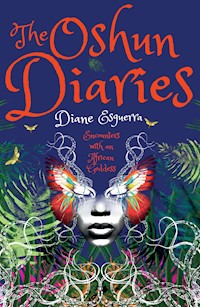
High priestesses are few and far between, white ones in Africa even more so. When Diane Esguerra hears of a mysterious Austrian woman worshipping the Ifa river goddess Oshun in Nigeria, her curiosity is aroused. It is the start of an extraordinary friendship that sustains Diane through the death of her son and leads to a quest to take part in Oshun rituals. Prevented by Boko Haram from returning to Nigeria, she finds herself at Ifa shrines in Florida amid vultures, snakes, goats' heads, machetes, a hurricane and a cigar-smoking god. Her quest steps up a gear when Beyoncé channels Oshun at the Grammys and the goddess goes global. Mystifying, harrowing and funny, The Oshun Diaries explores the lure of Africa, the life of a remarkable woman and the appeal of the goddess as a symbol of female empowerment.
Das E-Book können Sie in Legimi-Apps oder einer beliebigen App lesen, die das folgende Format unterstützen:
Veröffentlichungsjahr: 2019
Ähnliche


















Published by Eye Books
29A Barrow Street
Much Wenlock
Shropshire
TF13 6EN
www.eye-books.com
First edition 2019
Copyright © Diane Esguerra 2019
Cover design by Sophie Pasiewicz and Sally Crombie
All rights reserved. Apart from brief extracts for the purpose of review, no part of this publication may be reproduced, stored in a retrieval system, or transmitted in any form or by any means, electronic, mechanical, photocopying, recording or otherwise without permission of the publisher.
Diane Esguerra has asserted her right under the Copyright, Designs and Patents Act 1988 to be identified as author of this work.
British Library Cataloguing in Publication Data
A catalogue record for this book is available from the British Library
Printed by CPI Group (UK) Ltd, Croydon CR0 4YY
ISBN 978-1-78563-148-1
For DavidMy first reader – always
No one can hope to create a lasting structure. What I can offer is to provide a brief glimpse of this immense world for others; like a vast landscape at night, lit up for a fraction of a second by lightning. The creation of the world happens continuously. Everything dies into a new birth.
Adunni Olorisha
The twenty-first century will be the century of Africa.
Those who suffer most earn the right to the greatest happiness.
Learn from Africa! Follow Africa!
Only then will the world change, will the new dawn of humanism come.
Daisaku Ikeda
Contents
Introduction
Part 1 – Africa: The Sacred Groves
Oshogbo
High Priestess
River Goddess
Artist
Gin & Drums
Orisha
Harmattan
Dangerous Waters
Colour-blind
Wild Swimming
Red Sky at Night
Igbeyawo
Stalker
Things Fall Apart
Parallel Lives
Adiós & Auf Wiedersehen
Part 2 – America: The Sacred Orisha Gardens
Dark Matter
Shango
La Paloma Blanca
Sculpture Park
Meet the Ancestors
Oshun’s Welcome
Ola Olu
Spaced Out
At Home with the Neimarks
Maze Meditation
Birdlife
Sisterhood
Gator Jaw
Hurricane Hermine
San Agustín
Washington Oaks
Natura
Woman of Wisdom
Labor Day
Ye Ye Ye O
Afterword
Glossary
Acknowledgements
About the author
Junkie Buddha preview
Introduction
I can see her out of the corner of my eye, slouching against the window, her elongated face etched with sadness. Those heavy-lidded eyes of hers stare at me, reproachfully.
Guilty, once again, of neglect, I fetch a rag and a bottle of extra-virgin olive oil from the kitchen. I lay her gently on top of last week’s newspapers. Starting with her hexagonal top-knot I slowly make my way down her skinny, cinnamon body, rubbing oil into pouting lips, pointy breasts, twerky buttocks, and bandy legs which hover above tiny, shoeless feet. Trickiest of all to oil are her slender fingers which clutch a bag of cowry shells, and, hidden beneath the beaded waistband, her secret female places. After all these years she and I have grown to know each other pretty well.
She never wanted to come here in the first place.
‘Bin twice round the world’, the British Airways courier announced when he dumped her on my Brighton doorstep twenty years ago.
‘Thank-you so much, I’d given up hope of ever seeing her again. She’s been missing for seventeen days now.’
‘Yeah, completely lost track of this one, we did. Gave them a laugh in Missing Cargo though…told me they’d never lost a goddess before!’
She’d only just fitted into the trunk I’d bought especially for her and her alone; all 111 centimetres of her hardwood self. Her base, which bore the name of the sculptor and master woodcarver who created her – Kasali – was bashed about a bit, but to my relief she herself remained unblemished.
In Oshun State, Nigeria, a region famous for growing indigo and using it as a dye, I’d selected her from Kasali’s litter of hand-carved Yoruba gods. Outside his humble studio shack close to the Sacred Groves of Oshogbo, Kasali explained that he was, in fact, Arelagbayi: born into a family which hands down from generation to generation the sacred craft of carving images of the gods of the Yoruba – black Africa’s largest ethnic group.
Fixing me with his gaze he told me that the spirit of the goddess Oshun had possessed him during the process of carving this particular image.
‘We all born child of one orisha. Oshun – she your goddess now,’ Kasali said, handing her to me with tender reverence. ‘It good give her many offering. She get plenty power.’
Three days later Oshun and I checked in at Murtala Mohammed airport in Lagos. And ten hours after that, with a sinking heart and kicking myself for not bothering with travel insurance, I’d waited, in vain, for her to appear on the Heathrow luggage carousel. Believing I’d lost her for seventeen days certainly helped me value her more. Perhaps that is what she’d intended all along.
Suitably oiled and shiny once again, I return the tardy goddess to her corner of the room. Above her hangs a small watercolour painted by my sister, Sally, an artist, in honour of Oshun’s eventual arrival on these shores all those years ago: a fat, black woman, her arms outstretched, is flying through the third-floor arched window of our Victorian apartment and into our living room. Beneath her red, billowing dress Sally had scrawled Mammy Water Visits Brighton.
The goddess continues to stare at me sulkily. We both know she’d rather be elsewhere. The Caribbean, Latin America, Cuba, Brazil – maybe even the States. Anywhere that she would be suitably venerated. Anywhere, in fact, bar cold, old colonialist England. Best of all, I know she’d rather be back home in Africa.
I consider Kasali’s suggestion of an offering. If I were to lay something indigo-coloured at her feet to remind her of home…a bunch of agapanthus, perhaps – or even a scrap of denim. I decide, in the end, to place her next to my Buddhist altar. Indigo is mentioned in the writings of Nichiren Daishonin, the 13th-century Japanese Buddhist priest whose teachings I follow: If one dyes something repeatedly in indigo, it becomes even bluer than the indigo leaves. The Lotus Sutra is like the indigo, and the strength of one’s practice is like the deepening blue. The Japanese god of ai (indigo) is called Aizen Shin and the spoken word ai means both indigo and love. Oshun is, after all, a goddess of love. It could, likewise, be said that the deeper you penetrate the mysteries of this energy known as Oshun the more intensely her fierce uniqueness shines through.
As mesmerising as she is, Kasali’s wooden image of Oshun is a mere simulacrum of the real thing. Years before I acquired her I’d had a surprise, fleeting encounter with the goddess herself.
But I hadn’t travelled to her Oshogbo birthplace that first time with the intention of seeking out Oshun; I’d ventured there in the hope of meeting someone else.
Part 1
Africa: The Sacred Groves
Oshogbo
Memory is visceral. All I can recall, about the drive into the southern Nigerian town of Oshogbo that November afternoon in 1986, is the screech of worn tyres on khaki-coloured roads, the all-pervading dust, the torrid heat and the rivulets of sweat trickling down the back of the albino driver’s neck. After the 150-mile drive from Lagos on a gridlocked highway I was desperately thirsty and dying for a pee. So intent was I on finding somewhere to satisfy my bodily needs that I scarcely took in my surroundings. Victorian explorer Henry M Stanley used ‘dark’ in the title of his book Through the Dark Continent to describe that which is mysterious and unknown. Little did I realise, that day, that this would be the start of my journey into a dark, hidden Africa.
Pulling up outside her home – if you could call it a home – was a different matter. After all these years the image of that baroque, semi-dilapidated, Portuguese-colonial edifice, with alien-like carvings clinging to its walls, remains soldered to my brain.
Something in me hesitated before knocking on her front door; a crisis of confidence, I suppose. I’d given no thought as to how I was going to present myself to the woman I’d travelled all this distance to meet. As an English writer and performance artist with a keen interest in anthropology? The ex-wife of an architect working in Lagos? The truth of the matter is that on that first visit my motive for wanting to meet her was essentially a monetary one. I was broke. I hoped that this woman whose door I was now banging on would be a worthy enough subject to merit a documentary proposal.
‘Come away. Your persistence may anger her,’ Ebis advised, leading me gently back to the car. ‘Let us take some refreshment and return later.’
In the windowless, earthen-floored bar with its ineffective plastic fly-screen and unwiped tables we sipped Fanta and chewed on stale Lincoln biscuits.
I let out a sigh. ‘I can’t believe I’ve come all this way for nothing.’
Ebis smiled. ‘No journey is ever wasted.’
We hadn’t known each other long. A Nigerian radio journalist and DJ, Ebis had offered to accompany me on this recce to Oshogbo, and had helped me hire our driver and his rusty Peugeot. A year or two older than I, the handsome, gap-toothed young man had once been a Christian preacher – until the desire to expose corruption in public office and the lure of African Reggae had proved too irresistible. He’d interviewed me the week before about the forthcoming production of my play at Nigeria’s National Theatre in Lagos. We’d hit it off immediately.
‘If it weren’t for the bloody British Council,’ I grumbled, ‘I wouldn’t be here today.’ Much to my annoyance and that of the theatre, the British Council in Lagos, which had initially expressed a keen interest in backing the play, had now decided they didn’t want to have anything to do with it. We’d been depending on their support. Production money was scarce and I knew if the play were to go ahead I’d earn peanuts. The BBC script unit had recently expressed an interest in any proposals I could come up with – including documentary ones. I was eager to have a project up my sleeve to take back to England.
Ebis and I were sharing a second bottle of Fanta when a young man in a striped agbada strolled into the bar. He stared at us for a few moments and then walked over to our table.
‘Excuse me. I saw you outside the house in Ibokun Road. I know whom you are seeking. Have you tried the Sacred Groves? She may be working on the shrines today or participating in rituals.’
I looked up at him, hopefully. ‘No. Where are these groves?’
‘In the rainforest on the edge of the town. I can accompany you if you wish.’
Ebis turned to me and nodded. It was worth a try. We all piled into the car.
‘My name is Femi’, the young man said, extending his hand and gripping ours tightly in return.
‘And what will we discover there, Femi?’ asked Ebis.
Femi grinned. ‘You will be sure to discover gods there. It is their home.’
I felt a rush of excitement. ‘And will we find her there too?’
‘Maybe,’ he sighed ‘but she may not wish to speak with you. She does not always welcome tourists.’
‘Well I’m certainly no tourist’ I was unaware how arrogant I sounded until I realised the two guys were laughing at me.
A strange mood descended as we entered the Sacred Groves. Apart from the rustling of leaves and birdsong, silence reigned. I sensed I was being propelled into another world; an intense, primeval world, yet, simultaneously, a world that was light and benign. The further we strolled through the groves the more enchanted I became.
Some of the sculptures dotted amongst the trees were human in both shape and scale, others, in clearings, were the opposite: as tall as trees – bizarre, oblong shapes in wood, cement and metal, sprouting unfamiliar limbs which stretched up to the sky. Unlike anything I’d ever seen before, their sheer artistry and preternatural beauty mesmerised and intrigued me. I looked around. I could certainly sense a presence – or presences.
What are these sculptures all about, Femi?
‘They are shrines of the orisha – the gods and goddesses of Ifa.’
‘And what is Ifa, exactly?’
‘In a nutshell, it is the 7,000-year-old religion of the Yoruba peoples.’
‘Did it originate here?’
‘Not here, but in the ancient Yoruba kingdom of Ilé-Ifè nearby.’
We came to an opening beside a river. A Yoruba woman dressed in a white robe was sitting on the river bank cracking open a pile of kola nuts.
‘Is that her?’ I asked, breathlessly.
‘No, that is not her,’ Femi replied. He wandered over to the woman and said something in Yoruba. She shook her head.
He turned to me. ‘She has not come to the Groves today.’
‘Please ask where she might be.’
They conferred again. The woman simply laughed and shrugged her shoulders.
‘It is possible she is travelling,’ Femi suggested.
‘So who was that woman in white, if it wasn’t her?’ I whispered, as we walked away.
‘She is the priestess who guards the shrine over there.’ He pointed to a Gaudiesque, cave-like structure which I would later discover symbolised both a womb and the gate to eternity.
‘Can I go inside it, Femi?’
‘Yes, but the madam will expect you to place in her hand some recompense for protecting and cleaning the sacred space.’
Ebis rattled around with the change in his pockets. I walked over and handed the woman a five naire note.
At first glance the inside of ‘the cave’ was something of a disappointment. Devoid of the relics, ornaments or candles I’d somehow been expecting, it appeared to be nothing more than a dusty, empty shell. Then, all of a sudden, I felt suffocatingly hot, sweaty and grimy. My pulse started racing and I began to hyperventilate. Instead of sitting down, I ran, on an impulse, to the river bank, where I knelt down and plunged my face, head, chest, arms and hands in the clear river water.
I was unaware, at the time, that this river was the Oshun River – the birthplace of the river goddess herself – or that it was her shrine I’d just entered. But what I do remember, after bathing my upper body in the water, is being taken over by a powerful feeling of connectedness to everything around me; a kind of euphoric love-fest, the like of which I’d never known.
‘Your eyes are shining,’ Ebis remarked, as I dried my face on my T-shirt.
‘Perhaps she has been touched by the goddess,’ Femi laughed.
‘Who or what exactly, is this goddess?’ I was bursting with curiosity. We sat beside the shrine and Femi explained that Oshun was one of the sixteen primary orisha. So important was she that the Nigerian state we were in had been named after her, too.
Femi looked at me. ‘Oshun is a particular favourite with women. She also goes by the name of Mammy Water.’
I plied him with question upon question until he glanced at his watch and abruptly stood up.
‘She has the answers to your questions. You will need to return to her house in Ibokun Road. Please, I must leave now to meet my fiancée from work.’
‘We can drop you off,’ Ebis offered. ‘Where does she work?’
‘Back in town; in the offices of an indigo warehouse.’
‘And you? Femi, what is your occupation?’
His smile faded. ‘I am training to be an engineer but my studies at Ibadan University have been halted because the lecturers have not been paid for seven months.’
We commiserated with Femi as we drove back into the town, and shared our concerns about the sorry state of the country and the appalling level of corruption in government.
After dropping Femi off, Ebis and I returned to the house in Ibokun Road. I knocked on the door, more gently this time, but there was still no response.
‘Perhaps you are not yet ready,’ said Ebis, with a knowing laugh; the kind of laugh Africans come out with when they’ve grasped the deeper reality behind an impasse such as this one, which westerners, like myself, so often take at face value.
High Priestess
My curiosity in this Oshogbo woman had been aroused the week before. I was sipping warm beer on my friend Boye’s sweltering, candlelit balcony – courtesy of yet another Lagos blackout – when his eyes suddenly flashed with excitement.
‘There is someone you should check out while you are still in the country, Diane.’
‘Oh yes?’
‘A high priestess of the goddess Oshun, no less. She lives in the town of Oshogbo. Virtually single-handedly, she has been battling fundamentalist Christians and Muslims, and has managed to bring about a revival of the Yoruba faith of Ifa. Her power, it is said, is formidable.’
I was surprised to hear this from Boye – Dr Bamgboye Afolabi, to give him his correct title – as he was the leader of the Nigerian branch of the Buddhist organisation I belong to.
‘How did you hear about her?’
‘My mum is the Aare Iyalode of Oshogbo – the second-in-command to the head of all the women in Oshogboland.’
‘Wow! I’d like to meet your mum and this priestess.’
‘They say she is also an artist.’
‘Her name is…?’
‘Adunni Olorisha.’
Ten days after our visit to Oshogbo, Ebis called me from Abuja where he’d just been posted on a three-month-long secondment. To save me another possibly fruitless trip he’d offered to make the journey to Abuja via Oshogbo and attempt to interview the high priestess on my behalf.
‘I met with her...very powerful,’ he murmured, with an unfamiliar note of sternness in his voice. The phone line was dreadful. The only other words I could make out were ‘frightened’ and ‘witch’ before the line went dead, as it so often did in Nigeria.
Ebis frightened? I was perplexed. I had him down as someone with masses of courage. A few days before he left for Abuja we’d been escorted out of a restaurant where we were having lunch as one of ‘the big boys’ – as Ebis called the businessmen and politicians whose corrupt practices he exposed on his radio show – had demanded his removal. Ebis claimed this happened quite frequently. I suspected the Abuja secondment was for his personal safety.
I also recalled how unusually quiet the normally ebullient Ebis had been in the Sacred Groves, and wondered if this had something to do with his upbringing. For Nigerian Christians, all traditional religions were taboo, and often denounced as witchcraft or devil worship. His call both piqued my curiosity and left me wondering what I might be letting myself in for.
A few days later, I headed, once again, for Oshogbo – this time alone. The drive down in a rattling old VW Beetle was even slower and hotter than the previous one. By the time the driver pulled into Oshogbo, anxiety was flooding through me at the prospect of both meeting – and of not meeting – this High Priestess.
I knocked politely on the door; this time it opened. A Yoruba woman of middle-age, her hair in braids and holding a besom-like broom stood in the doorway and stared at me with silent suspicion.
‘Adunni?’ I asked, believing this to be her.
‘Who are you?’ she demanded, accusingly. I gave her my name and a few brief details.
‘Wait!’ she commanded, closing the door in my face. She returned a minute or two later and motioned to me to come inside.
I followed her up some steps to a large, dark studio filled with canvases, carvings and melted candles. Weathered-looking books lined a couple of shelves. Strange drawings and scribbles covered the faded-blue walls. The woman who had let me in nodded in the direction of a slender, behatted figure, dressed in black, who had her back to me and was staring out of the window. Turning slowly, she walked towards me, extending her hand. Her hair was dyed black and black eye-liner encircled her eyes, but her skin, I noticed, was white.
As a young teenager I’d feasted on the novels of Rider H Haggard – until I grew a little more world-savvy and found his racial slurs and imperialist agenda irritating – and here I was, confronted by a formidable, white, She-like high priestess in the depths of Africa. This one clearly hadn’t bathed in the flame of life, which promised eternal youth, like Haggard’s Ayesha, but she still stirred something in the depths of my imagination. And I sensed I was, without doubt, in the presence of another She who must be obeyed.
Getting to know the high priestess wasn’t easy. She was never one for small talk.
‘I’m not quite sure how I should address you. What does Adunni Olorisha mean, exactly?’
‘Beloved of the gods.’
‘Should I call you that?’
‘Adunni is fine. Please, be seated.’ She pulled out a three-legged stool from under a bench but remained standing herself.
‘Your accent, Adunni, it sounds German.’
‘I was born in Austria. Why are you here?’
‘I…I think I experienced the power of Oshun in the Sacred Groves when I splashed my face in the river… A surge of energy – like an electric current – flowed through me, along with a feeling...’ I paused to allow my embarrassment to surface ‘…of love for everyone and everything… It left me wanting to know more about Oshun and the orisha…and you and your work, Adunni.’
She turned away and yawned. She’d heard it all before; many times.
‘I’d really like to write about your work in the Groves and I think a documentary might...’
‘And why are you here in Nigeria?’ she interrupted, impatiently.
I explained how, after my divorce, my young son Sacha’s Colombian father, Roberto, who was the partner in a French-Colombian architectural practice, had moved out to Lagos to open an Africa office. So that Sacha could continue to see his father, we agreed that Roberto would pay for our flights and Sacha and I would spend his school holidays out there.
‘Your son is on holiday in November? That is unusual.’
‘No. This time I’m here without him because I’m about to start rehearsals for a play I’ve written called Victoria Island.’
‘And what is this play of yours about?’ She looked remotely interested for the first time.
‘After a few trips out here the grimmer aspects of Nigeria started to get under my skin...’
‘Grimmer aspects?’
‘…The widespread corruption; the armed robbery; public executions on Lagos’ Bar Beach...the girls pressured by poverty into becoming sex workers in dives like Club 21...the behaviour of many British and European contractors, along with their workers and their wives who came over with the oil boom...’
‘Why did you call this play Victoria Island?’
‘Because Victoria Island is where many of the expats and the wealthy Nigerians in Lagos live…’
‘I know Victoria Island.’
‘…Well, its bland modern buildings and leafy avenues provide the perfect setting for the play. Some of the expats living there and in Ikoyi behave like they’re Lord and Lady of the Manor. They treat their stewards like dirt...’
‘Victoria Island is a swamp,’ she remarked. ‘The British colonial government created its landmass on swampland beside the Atlantic Ocean to halt the breeding of mosquitoes.’
‘I…I didn’t know that…but it intrigued me,’ I continued, ‘how quickly people can change when given the chance to lord it over others, and how some can cave in so easily to the lures of money and illicit sex.’
‘And so you decided to write a play about it.’ She pulled up a chair and sat down.
‘Yes, but I didn’t expect to be acting in it myself.’
‘So why are you acting in it yourself?’
Only then did it dawn on me that she was interviewing me. I knew, instinctively, that she wanted to ascertain whether I was a worthy enough subject upon whom to expend her precious time.
Nervously, I went on to explain how not one of the few white actors living out there would agree to perform in either of the two white roles. ‘Strong meat for this part of the world’ was how one posh actor had described the script.
‘Three actors have already been cast for each of the four Nigerian roles,’ I told her, ‘but once they, the director and the stage crew have been paid, the theatre doesn’t have enough money left to bring actors over from England – or even to properly pay me.’
‘Job sharing amongst Africans is common. It is one of the ways they look after one another. Despite the oil wealth enjoyed by one per cent of the country, very little of it trickles down to the ninety-nine per cent below.’
‘I agree with that in principle,’ I replied, ‘but it puts up costs. I’ve trained as an actress and the only way the play is going to happen is if I perform in it myself. Fortunately, my brother, Neil, who has had a little acting experience, has agreed to play the white male role.’
I didn’t mention that I had no work lined up in London once the run had finished. And that was why I was there. Tentatively, I raised the subject of a documentary proposal again. She stood up and walked over to the window.
‘What you experienced by the river that day was nothing! Nothing!’ She sighed. ‘During the Oshun festival the crowds become wild on Oshun energy. Even the horses are possessed.’
‘I’m sure that would provide great footage…’
‘If you really want to know this orisha’s power it is necessary to engage in rituals.’
She registered my involuntary shudder.
‘I’ve heard that animal sacrifices take place during these rituals… I’d find that difficult, I’m afraid… I’m a vegetarian, you see.’
‘So am I,’ she replied, ‘but you have to understand that the shedding of blood is a symbolic shattering of the boundary that exists between human and orisha. The sacrifice enables us to connect on the same plane. The animals themselves consider it an honour to spill their blood for a god or goddess.’
‘Mmmm… I’ve been known to faint at the sight of blood – animal and human.’
She shook her head. ‘Europeans are a barrel of neuroses and complexes, aren’t they, my dear?’
I nodded – feeling very small. She could see into me. As much as I admired Adunni and her work, if the truth be known, Ebis wasn’t the only one. I was more than just a little in awe of her. I was scared shitless.
She continued to stare out of the window for what felt like an age. I knew she was making up her mind. Finally she turned to face me.
‘To have written this play of yours you must be a woman of some courage, but still you are fearful and doubt yourself. You have had a taste of the energy of Oshun and she could be a source of strength to you, if you allow her. Leave me now. I have work to do. But you may return to visit when your play is over.’
Fear pestered me throughout the rehearsal period of the play and into the run itself. I didn’t, at that time, know enough about the workings of Oshun to avail myself of her supportive energies.
Before we moved into the theatre, rehearsals took place on the stage of an outdoor arena in the searing heat of downtown Surulere. I was rodent-phobic, and seeing rats the size of cats creep along the arena walls freaked me out. I fought a few confidence-shredding battles with the director, Sam, who was also a well-known TV actor with ego and alcohol issues. And the opening night itself was very nearly a disaster.
For most occasions of any significance in Nigeria, an official opening ceremony is demanded – which usually involves a very long, very formal speech by a local worthy. The person invited by the director to perform this duty was a bigwig, alhaji chief whom I hadn’t even met. He kept the cast and audience waiting for an hour before phoning the theatre to say there had been a flood and that he couldn’t make it as the road was full of potholes. The audience was growing restless. In desperation, the director cast his eye around the auditorium and noticed an imposing-looking gentleman who had stood up to remove his jacket and was folding it over the back of his chair. On an impulse, Sam went over to this stranger and asked him if he would introduce the play. By fortuitous coincidence the gentleman in question was Boye, my Buddhist doctor friend, whom I’d invited to the first night along with his wife, Akua.
During the run itself l had to learn to relinquish control and be prepared for the totally unexpected. By British standards the play would have been X-rated, so I was shocked one afternoon when I came on stage for a matinee performance to see that the auditorium was full of schoolkids. Based on a satirical one-liner, you should not smoke that nasty stuff, directed at a character smoking weed, the headmaster, believing the play, which he’d seen the night before, carried a virulent anti-drugs message, had herded along the entire school. The kids found every scene hilariously funny.
Another time I walked into the dressing room and discovered the three Nigerian actresses who had each been allocated the lead female role physically fighting each other over whose turn it was to go on stage that evening; a nightmare to have to sort out just before a performance.
Overall, the production was a rewarding, fun experience though, and I learned a great deal. Even a row which flared up between myself and my usually passive brother somehow enabled him to get truly under the skin of the character he was playing and resulted in a brilliant, final performance. In retrospect, though, I came to understand why the British Council wanted to stick with the likes of Shakespeare and Dickens as cultural exports, and even why priggish white actors hadn’t wanted to be associated with the play; it hit a few too many raw nerves.
By the end of the run I’d spent long enough immersed in the less savoury, political and social side of Nigerian life and I was more than ready to begin exploring the spiritual.




