


13,99 €
Mehr erfahren.
- Herausgeber: Spellmount
- Kategorie: Geisteswissenschaft
- Sprache: Englisch
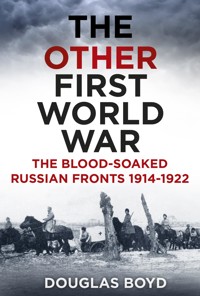
Winston Churchill called it 'the unknown war'. Unlike the long stalemate of the Western Front, the conflict 1914–18 between the Russian Empire and the Central Powers was a war of movement spanning a continent – from the Arctic to the Adriatic, Black and Caspian seas and from the Baltic in the west to the Pacific Ocean. The appalling scale of casualties provoked strikes in Russia's war industries and widespread mutinies at the front. As the whole fabric of society collapsed, German money brought the Bolsheviks to power in the greatest deniable dirty trick of the twentieth century, after which Russia stopped fighting, eight months before the Western Front armistice. The cost to Russia was 4 million men dead and as many held as POWs by the Central Powers. Wounded? No one has any idea how many. All the belligerent powers of the Russian fronts were destroyed: the German, Austro–Hungarian and Russian empires gone forever and the Ottoman Empire so crippled that it finally collapsed in 1922. During four years of brutal civil war that followed, Trotsky's Red Army fought the White armies, murdering and massacring millions of civilians, as British, American and other western soldiers of the interventionist forces fought and died from the frozen Arctic to the arid deserts of Iran. This is the story of that other First World War.
Das E-Book können Sie in Legimi-Apps oder einer beliebigen App lesen, die das folgende Format unterstützen:
Veröffentlichungsjahr: 2014
Ähnliche








ALSO BY DOUGLAS BOYD
HISTORIES
April Queen, Eleanor of Aquitaine
Voices from the Dark Years
The French Foreign Legion
The Kremlin Conspiracy
Blood in the Snow, Blood on the Grass
De Gaulle: The Man Who Defied Six US Presidents
Normandy in the Time of Darkness
Lionheart: The True Story of England’s Crusader King
NOVELS
The Eagle and the Snake
The Honour and the Glory
The Truth and the Lies
The Virgin and the Fool
The Fiddler and the Ferret
CONTENTS
Title
By the Same Author
Abbreviations
Introduction
Part 1: Serbia and Macedonia
1 First Shots
2 Poor Little Serbia!
3 Mayhem and Massacre in Macedonia
Part 2: The Clash of Giants
4 On the Ground
5 In the Air and at Sea
6 Signals Failure on the Line to Tannenberg
7 The Galician Graveyard
8 The Great Retreat
9 Treachery and a Plea for Help
10 The Greatest Crime of the War
Part 3: 1916 – The Last Chance Campaign
11 The Very Model of a Modern Russian General
12 Brusilov’s Plan
13 Brusilov Goes it Alone
14 Breakthrough
15 Last Train to Budapest
Part 4: Revolution
16 Iskra – The Spark
17 Blood in the Streets, Cards on the Table
Part 5: The Wars after the War
18 Neither War nor Peace
19 We’re Here Because We’re Here
20 The Biggest Battlefield of All – Siberia
21 The Rainbow of Death
22 Who Won?
Acknowledgements
About Notes and Sources
Plates
Copyright
ABBREVIATIONS
BSF
British Salonika Force
CP
Central Powers, German and Austro-Hungarian empires 1914–18
CSEF
Canadian Siberian Expeditionary Force
HID
Hungarian Reserve or Honved Infantry Divisions
IVF
Imperatorskii Voyenno-Vozdushny Flot – Imperial Russian Air Force
NKVD
People’s Commissariat for Internal Affairs – Soviet law enforcement agency
OHL
Oberste Heeresleitung – German High Command
OAK
Oberarmeekomando – OHL counterpart in Vienna
INTRODUCTION
At the height of the Cold War 18-year-old men in Britain had to do two years’ obligatory military service. My first year in RAF uniform was spent at Joint Services School for Linguists (JSSL), an extraordinary institution run by the three armed services but staffed by civilian instructors who turned out three ‘intakes’ a year of linguist/technicians capable of real-time eavesdropping on radio transmissions of Soviet ground, air and naval forces. In those pre-satellite days, the theory was that analysis at Government Communications Headquarters (GCHQ) of our handwritten logs would ensure NATO was prepared for any Warsaw pact invasion. Happily, it was never put to the test.
Our instructors at JSSL included a Red Army general, a Czech officer who had flown in the RAF during World War Two, an Estonian divorce lawyer, a Russian prince who became an Orthodox monk, a few rather nutty Russian ladies and Poles, Ukrainians and Balts – many of whom had survived terrible experiences during and after the October Revolution, the purges that followed, the Second World War and the Cold War. The ten months spent in daily contact with them taught us much more than just a language. Some students fell in love with Russian literature; others with the language; in me it inspired a fascination with Russian history, especially the bloody conflict between the Russian Empire and the Central Powers in Eastern Europe 1914–1918.
In contrast with the well-documented hostilities on the Western Front, this other First World War has been largely a mystery to the English-speaking public. Place names like Passchendaele, Ypres and Vimy Ridge were tragically well known to the general public after the Great War, as it was called, yet it would be hard for a Westerner to point on a map to Durrës, Przemyśl, Strij or Dvinsk, although names of some sites of appalling atrocity like Kosovo have sadly become familiar, and for the same reasons, much more recently. Researching sources in the combatant countries can be frustrating because even Russian military historians refer to this conflict as zabytaya voyna – the forgotten war. It is, for them, overshadowed by the Revolution that ended it and the bitter civil war that cost millions more lives immediately afterwards, followed by the famines of collectivisation that killed yet further millions and the Stalinist purges and the deaths of 30 million Soviet citizens in the Second World War.1
The conflict along the frontiers between the Russian Empire and the Central Powers – the German and Austro-Hungarian empires – was called by Westerners ‘the eastern front’. For those millions who fought and died there, it was a war bitterly contested on three main fronts stretching for a thousand miles and named from the perspective of St Petersburg/Petrograd, the ‘northern front’, the ‘western front’ and the ‘south-western front’. For clarity in this book, these names will be used for the Russian fronts and the hostilities in Western Europe will be called the ‘Western Front’.
The conflicting priorities of the Russian army commanders seemed sometimes devoid of any common strategy. As far as the Western Allies were concerned, the role of Russia was to drain manpower away from the enemy forces on the Western Front at critical moments when the full force of the German armies might have broken through the Allied lines or blocked a new offensive.
Understanding of the Russian war is made difficult because many place names have changed and borders shifted: Lemberg in Austrian Galicia became Ukrainian Lviv, then Polish Lwów and is again Lviv in Ukraine; Memel, then in East Prussia, is now Klaipeda in Lithuania, and so on. But what’s in a name? as Shakespeare asked. Nearly 9 million men marched off to fight ‘for King and Country’ in the First World War, and one in ten paid with his life, yet Britain’s reigning monarch King George V bore the very German family name of Saxe-Coburg und Gotha until 25 April 1917, when it was thought more politic to change it to the very British ‘House of Windsor’. For the same reasons his relatives the Battenburgs likewise changed their German name by translating it literally into English as Mountbatten.
The ‘official’ war in Eastern Europe ended eight months earlier than in the West after Berlin resorted to what is now called ‘a deniable dirty trick’, smuggling Vladimir I. Ulyanov, aka Lenin, out of neutral Switzerland and back to Russia, resulting in his country’s premature exit from the war under the Treaty of Brest-Litovsk, signed on 3 March 1918. That allowed the Central Powers rapidly to move twenty-three divisions to the Western Front, to serve there in the final months of the war. It was a brilliant gamble that might have cost the Allies victory, had not sufficient American men and materiel arrived in Europe in the nick of time.
After the war in Europe, Britain and France slowly re-built themselves – although France was never the same country again – and the US was virtually unaffected. In the east, the war destroyed all four principal belligerents – the German, Austro-Hungarian, Ottoman and Russian empires – altering the course of world history. By the time of Brest-Litovsk, an estimated 3.7 million Russian soldiers lay dead beneath the battlefields and 3.9 million more were held as prisoners of war, in addition to all the wounded and with at least another million civilians also killed. The shattered empire of Tsar Nicholas II was reduced to anarchy, famine and a civil war where every weapon including massacre, torture and poison gas was used against combatants and civilians alike.
The Western Allies despatched expeditionary forces to Murmansk/Archangel, the Baltic, Ukraine, the Caspian Sea and Siberia. Thousands of UK troops, US servicemen, Canadians, French, Belgian and Japanese personnel were there tasked initially with safeguarding the vast accumulation of Allied materiel intended for the Imperial Russian war effort. After the Revolution they found themselves fighting Soviet forces for four years alongside some very dubious local allies.
During those years, what had been the Russian Empire was reduced to a closed world of terror where no one was safe, nothing worked, and only half the necessary minimum of food was produced for the starving population. The Finns, Poles, Ukrainians and the Baltic states took up arms to win independence from Russia. In Ukraine and Siberia, Churchill’s interventionist force, the Czechs and Slovaks who had banded together in the Czech Legion and three separate White armies joined in a ‘rainbow of death’ with the Tambov Blue Army, the Polish Blue Army, the Ukrainian Green Army and the anarchist Black Army of anarchists fighting the Reds. The sequences in the film Doctor Zhivago showing armoured trains thundering along the Trans-Siberian railway, spreading death and destruction for thousands of miles across Central Asia, give some impression of the geographical extent of the terror.
Every war has its lunatic episodes. Unaware how little time he and his family had left to live, Tsar Nicholas II spent his days after replacing his uncle Nikolai as supreme commander of the Russian armies in visiting churches, kissing icons and honing his skill at the game of dominoes. His consort the Tsarina – like him a grandchild of Queen Victoria – was hated by the Russian people because she was German, and was known to be more grief-stricken over the assassination of her ‘mad monk’ Grigorii Rasputin than the suffering of the millions at the front, where her loyalties were never certain. Asked one day by a courtier why he looked miserable, the young tsarevich Alexei replied, ‘When the Germans are beaten, Mama cries. When the Russians are beaten, Papa cries. When should I cry?’2
NOTES
1. Professor I.V. Narskii of Chelyabinsk State University on http://regiment/ru./Lib/C/130.htm.
2. R.H. Lockhart Memoirs of a British Agent London, Putnam 1934, p. 104.
PART 1
SERBIA AND MACEDONIA
1
FIRST SHOTS
A good day to start weeping would have been 28 June 1914, in Sarajevo, the administrative capital of the province of Bosnia-Herzegovina, annexed by Austro-Hungary only five years earlier.1 The scheduled big event of the day was the planned visit to the city of Archduke Franz Ferdinand of Austro-Hungary, accompanied by his wife, Countess Sophie Chotek von Chotkova und Wognin. Ironically, the archduke had been against the annexation of the province in view of the precarious domestic situation of the dual monarchy.2
A strange series of events was to relegate the actual visit to the sidelines – and that’s where the weeping began.
Franz Ferdinand was paying a courtesy visit to the town because he had been nearby observing the annual manoeuvres of the imperial army in his capacity as Generalinspekteur der gesamten bewaffnetenMacht or Inspector-General of all Austro-Hungarian armed forces. A nephew of the 84-year-old Emperor Franz Joseph, Franz Ferdinand had inherited a vast fortune at the age of 12 and gone on to fame and prospective fortune after his cousin Crown Prince Rudolf of Austro-Hungary shot his mistress, Baroness Vetsera, before committing suicide in the imperial hunting lodge at Mayerling on the night of 29 January 1889. Emperor Franz Joseph then named Franz Ferdinand’s father heir presumptive of the dual monarchy. When he, in turn, died of typhoid fever, that honour came to Franz Ferdinand, who was groomed to become emperor one day. Despite all that, he became known as ‘the loneliest man in Vienna’ because he had fallen passionately in love with Countess Sophie and refused to marry any of the available ladies of more suitably elevated rank at the court. Finally given permission to marry Sophie by the ageing and extremely reluctant emperor, the couple produced three children who were debarred from the succession as offspring of a morganatic marriage.
Allowing Sophie, promoted to the rank of duchess, to accompany him into Sarajevo was a small compensation for the fact that she was not allowed to appear beside her husband at the court in Vienna, or even to ride in the same carriage there, because her social status placed her below all the archduchesses. Since the visit to Sarajevo was not a court function, Franz Ferdinand could choose for once to be seen in public with his beloved wife at his side. It was a lethal gesture of affection, respect and consideration for her current pregnancy.
The royal couple arrived in Sarajevo by train. With the army on manoeuvres nearby, it would have been easy for the archduke to have detached sufficient troops to line the route of the six-car motorcade through the city but he decided it would be more diplomatic in this restless and predominantly Slav province of the empire not to antagonise the local population. He also made a point of having the canvas roof of his car put down so that the crowds waiting along the route could get a good view of him and Sophie. For similar reasoning, both decisions would be echoed in the run-up to the assassination of US President John F. Kennedy at Dealey Plaza in the hostile city of Dallas on 22 November 1963. The confusion in the news media immediately following these two assassinations was because the major news organisations of the day had sent no reporters or correspondents to cover either visit, despite the hostility to Kennedy of many powerful people in Dallas and the insensitivity of Franz Ferdinand visiting Sarajevo on the 525th anniversary of the Battle of Kosovo, in which the army of neighbouring Serbia was defeated by a Turkish army, ending Serbian independence for more than four centuries.
Yet, should anyone have been thinking seriously of the archduke’s security on that day in June 1914? The answer is yes, because this was the heyday of assassins. In peaceful Britain, Queen Victoria survived no fewer than seven known attempts on her life. In 1861 Russia’s Tsar Aleksandr II was killed in the fifth attempt on his life. The French president had been assassinated in 1894, two prime ministers of Bulgaria in 1895 and 1907, Emperor Franz Joseph’s wife Elizabeth in 1898, the king of Italy in 1900 and King George I of Greece only fifteen months before the fateful day in Sarajevo. Even closer to Sarajevo, the king and queen of Serbia had been murdered in their bedroom by a clique of their own officers in 1903. They were shot several times, hacked at by sabres and an axe and the queen’s partly dismembered body was tossed over the balcony into the garden below. It was altogether a messy double murder for a gang of professional soldiers.
The list of European royalty, politicians, high officers of state and other public figures who succumbed to assassination in those years is long. The preferred weapon was a hand-gun; the second choice, because less reliable although more dramatic, was an ‘infernal machine’ or what we should today call an improvised explosive device – in other words, a bomb, often home-made, thrown by hand in a public place.
There was another reason to be especially prudent that summer day, which was the first anniversary of the defeat of 1389 since the liberation of Kosovo in the Second Balkan War only one year previously. Nor was that the last Balkan war: in June 1914 Muslim Albania was invaded by Orthodox Bulgaria and its main port Durrës was besieged. A local Croatian notable had indeed warned Countess Sophie that an official visit on such a date invited trouble, but she had brushed off his warning because all the people she had previously met on her visit to Bosnia-Herzegovina had shown ‘so much cordiality and unsimulated warmth’.3
Shortly after ten o’clock on that warm, sunny morning, to the plaudits of the crowds, the motorcade was slowly proceeding along the embankment of the River Miljacka, known as the Appel Quay, towards Sarajevo’s city hall. On their left were the warrens of the bazaar, unchanged since the Middle Ages, and where the imperial couple had strolled as tourists a few days before, unmolested by anyone. From the hillsides above Sarajevo, villas set in gardens and orchards looked down on the scene: a peaceful town whose European architecture was repeatedly interrupted by the minarets of mosques, a reminder that this had until recently been Ottoman territory. Indeed the mayor who greeted Franz Ferdinand at the station was Fehim Effendi Čurčić, still wearing a fez with his European suit.
The archduke and his wife were in the second car, a 1911 Gräf und Stift double phaeton luxury limousine owned by Lt Colonel Count Franz von Harrach, who was in the front passenger seat. At the wheel was Harrach’s best driver, Leopold Lojka. Seated in the jump seat facing the imperial couple was General Oskar Potiorek, military governor of the province.
As the car drew level with the first of five Serbian terrorists spread out along the route, he lost his nerve and failed to throw his bomb. Each member of the team had a two-and-a-half pound bomb made in the Serbian state armoury in Kragojevac. Four of them also had a revolver from the same source and all were carrying poison, with which they were supposed to commit suicide, if captured.4 A little further along the quay, a second terrorist named Nedjelko Čabrinović did throw his bomb at the car just opposite the main police station, but his timing was faulty and it bounced off the folded roof,5 to explode beneath the following vehicle, injuring about a dozen passengers and bystanders, some seriously.
In the target car, the only damage was a small cut from a shard of metal on Sophie’s cheek. The archduke was unharmed. Lojka attempted to accelerate away, only to stall the engine because the throttle was set to a sedate processional speed. Managing to re-start the motor, he continued with the remaining undamaged cars to the city hall, passing three other conspirators, none of whom took any action. They mingled with the now restive crowds, uncertain what to do next. Čabrinović swallowed his poison – which burned his throat but failed to kill him – and leapt over the balustrade, hoping to escape by swimming across the river. Owing to the summer drought, the water was only a few inches deep, so he landed on the river-bed 26ft below the balustrade and was quickly seized and bundled away by two civilians and two policemen, after being relieved of his automatic pistol.
On arrival at the town hall, the archduke greeted the mayor with: ‘I come on a friendly visit and someone throws a bomb at me.’ However, in the rigidly protocol-ridden society of the time, the reception passed with an exchange of polite addresses, after which Franz Ferdinand and Sophie left within the hour. The archduke decided, with nineteenth-century courtesy, to visit and console the injured victims of the explosion in the hospital, but his wife was understandably frightened that another attempt might be made on their lives. Her fears were pooh-poohed by General Potiorek. Asking with barely concealed sarcasm whether the royal couple thought the city was full of assassins, he got back into the car with them, to make his point that there was nothing to fear.
Lojka was not told of a last-minute change of route because protocol dictated that an adjutant should have given him the instructions. Unfortunately, the adjutant was lying injured in the hospital and no one thought to defy protocol by talking to the lowly chauffeur. So, halfway along the route, Lojka followed the car ahead, which had made a wrong turn. Potiorek yelled at him to stay on the main street, but it was too late. The car, having no reverse gear, had to be pushed back around the corner with the gear stick in neutral.6
By sheer coincidence, the third terrorist was eating a snack on the pavement just 5ft away from where the royal car was briefly immobilised. Dropping his food, 19-year-old Gavrilo Princip whipped out his Belgian-made Browning FN 7.65mm automatic pistol and fired two shots at point-blank range, hitting the pregnant Countess Sophie in the abdomen and wounding Franz Ferdinand in the neck, severing his jugular artery. The time was 11.15 a.m. The archduke’s plumed hat fell off, scattering green ostrich plumes all over the rear of the car. Either Count Harrach or Potiorek seized the stricken man by his uniform collar to support him in his seat. Franz Ferdinand could hardly speak, although Harrach afterwards said he had murmured to Sophie that she must live for the sake of their children. On the car’s arrival at the governor’s house, thought to be safer than a hospital, she was found to be already dead. Her husband died shortly afterwards.7
As the car headed away from the scene of the attack, Princip attempted to commit suicide by swallowing his poison, but was arrested and hustled away by police, to save him from angry people who had seen the attack and wanted to lynch him. After a commendably correct trial in Sarajevo, the Austrian judge commented: ‘The young assassin was under-sized, emaciated, sallow, sharp-featured. It was difficult to imagine that so frail-looking an individual could have committed such a serious crime.’8 Princip was sentenced to twenty years’ imprisonment, which was the maximum legal penalty for murder committed by a person less than 20 years’ old. By 25 July 1914 all the other conspirators were also in custody, except one who escaped. Only one of the prisoners, aged 23, was hanged after trial because the youth of the others – all less than 20 years old – forbade their legal execution. Princip died of complications after amputation of an arm because of tuberculosis four years later in a hospital near his prison.
News of the assassinations spread rapidly in Sarajevo, leading to violent anti-Serb demonstrations that evening and the following day. Croats and Muslims looted Serb-owned shops and attacked Serbian schools, churches and newspaper offices. The violence rapidly spread to other parts of the Austro-Hungarian Empire.
Princip, Čabrinović and the others were not acting on their own initiative. They were members of a team of six terrorists handpicked by Colonel Dragutin Dimitrijević, head of Serbian military intelligence, who was also the leader of the terrorist organisation Ujedinjenje ili Smrt – meaning Union or Death. Under the nom de guerre of the Black Hand, this undercover organisation whose founders had conspired with the officers who murdered the king and queen of Serbia in 1903, was formed in 1911 and dedicated to uniting all Serbian-speaking people of the Balkans by violent means in a Greater Serbia. Black Hand recruits were inducted in a ceremony copied from the Freemasons, held in a dark room before a mysterious hooded figure, where they swore an oath of absolute obedience on pain of death:
I swear by the sun that warms me, the earth that nourishes me, before God, by the blood of my ancestors, on my honour and on my life, that I will execute all missions and commands without question and take the secrets of this organisation to the grave with me. May God and my comrades in this organisation be my judges if, knowingly or not, I should ever violate this oath.9
By 1914 the Black Hand had several thousand adherents, all male, young and living in Serbia, Bosnia-Herzegovina, Macedonia and Bulgaria. It ran courses in firearms, explosives, sabotage and espionage. Although a ‘secret organisation’, its existence was common knowledge in the gossipy café society of Belgrade, where many army officers were recruited into its ranks. Serbian frontier guards included many sympathisers, which made travel into and out of the country easy for the members on clandestine missions. It was a sergeant in the frontier troops who smuggled across the frontier a suitcase containing the bombs and firearms used in the Sarajevo assassinations.10 In the province of Bosnia-Herzegovina a number of separate underground societies grouped under the banner of Mlada Bosna – young Bosnia – associated themselves with the Black Hand.11
When Serbian Prime Minister Nikola Pašić had first learned that this terrorist organisation was plotting to assassinate Franz Ferdinand in Sarajevo, he did try to warn the imperial government in Vienna through Austro-Hungarian Finance Minister Leon Bilínski on 21 June, because Bilínski was responsible for the administration of Bosnia-Herzegovina. Yet, the warning was couched in language so diplomatic and circumlocutory that it was not acted upon.12 Never has diplomatic ambiguity led to greater loss of life.
News of the double murder reached newsrooms in London – then usually quiet at midday on a Sunday – a couple of hours later in a telegraph message from Reuters news agency:
Two shots. Sarajevo, Sunday. As the archduke Francis Ferdinand and his wife the Countess of Hohenberg [sic] were driving through the streets here today a young man, stated to be a student, fired two revolver shots at their motor car. Both were mortally wounded and died from their injuries within a few minutes.13
The news must also have reached newspaper offices in Vienna from Reuters at the same time, but the job of passing it on to the elderly Emperor Franz Joseph was long delayed because the strict etiquette of his court dictated that only certain people could speak to certain other people, who could speak to someone who could address the emperor, and not all the links in this chain of protocol were immediately available on a Sunday afternoon.
On 3 July at an official requiem mass for the victims in Belgrade, Prime Minister Pašić assured the Austrian minister that his government would ‘treat the matter as if it concerned one of our own rulers’. As historian Christopher Clark comments: ‘The words were doubtless well meant, but in a country with such a vibrant and recent history of regicide, they were bound to strike (the Austrian diplomat) as tasteless, if not macabre.’14
Two days later, on Sunday 5 July an official of the Austrian Foreign Office was assured by Kaiser Wilhelm II in Berlin that Germany would support Austria in dealing with Serbia, even if it led to war. Wilhelm was in the habit of uttering unwise remarks and making snap judgements that were the despair of diplomats. In a celebrated interview during his 1909 holiday on the Isle of Wight, reported by his host Sir Montague Stuart-Wortley, he had used the phrase, ‘You English are as mad, mad, mad as March hares,’ which hardly increased his popularity in Britain. Yet, his off-the-cuff undertaking to Austria must be his most regrettable and unstatesmanlike assertion.
A sense of unease pervaded those in the know in Vienna. On 15 July TheTimes printed a report from its correspondent in Vienna which gave the first hint to the British public that the assassinations were to have serious repercussions:
A feeling of uncertainty which is affecting the public, is affecting the Vienna Bourse most adversely. Very heavy falls of prices were noted all round yesterday and, although during the early part of today a recovery took place, it is apprehended that it will not prove lasting.15
One week later, the Times correspondent in Vienna was reporting:
There is a general feeling today that the end of the period of uncertainty as to what Austria-Hungary will officially demand of Serbia is approaching, if not impending.
Yet the Manchester Guardian’s correspondent was calm:
Vienna is notoriously the most jumpy capital in Europe, and the talk about war between Austria and Serbia is surely not to be taken seriously.
He was wrong. An Observer leader told a different story:
Experienced critics of foreign affairs have long been convinced that the Great War, if it ever came at all, would come with utter unexpectedness. Suddenly, in the Near East, a cloud that seemed no bigger than a man’s hand threatens the blackness of tempest that overwhelms nations.
The British government was seemingly not yet worried that yet another assassination in the Tumultuous Balkans would embroil it. Yet TheTimes was one step ahead:
War fever in Vienna. French pessimism. Germany the key to the situation. British naval manoeuvres. Orders to First and Second Fleet.16
On the reasonable assumption that the principal assassins had been recruited and trained for their mission in Belgrade, the Austro-Hungarian Foreign Minister drafted a harsh ultimatum to Serbia, relying on the assurance of the Auswärtiges Amt, or German Foreign Ministry, that it would prevent Russia from stepping in to protect its Serbian ally, should the argument escalate. The possibility of escalation was clearly considered because, although the terms of the ultimatum were approved internally on 19 July, it was not delivered in Belgrade until the evening of 23 July, nearly four weeks after the assassinations.17 The day was deliberately chosen because the French president and prime minister were travelling home from an official visit to Russia and thus in no position to concert any immediate reaction with the Tsar’s government in St Petersburg under the Franco-Russian mutual defence pact.18
Kaiser Wilhelm II was a grandson of Queen Victoria and cousin of Tsar Nicholas II, as was Britain’s King George V. His complicated attitude to his British cousin was epitomised by his publicly expressed hurt that the British people did not love him, yet a number of paintings of great British victories at sea decorated his royal yacht, aboard which he departed for his habitual Nordreise – a summer cruise of the Norwegian fjords with a clique of all-male friends, none of whom displayed any great alarm at the turn events were taking.
There was a treaty dating from 1879 between Berlin and Vienna, under which each partner undertook to support the other in the event it was attacked by Russia. Yet, Austro-Hungary had not been attacked, so the Kaiser instructed his Foreign Office to inform Vienna that the double assassination possibly merited a temporary occupation of the Serbian capital Belgrade, but not a full-blown war. Unfortunately, Germany’s Acting Foreign Minister Arthur Zimmermann19 had already encouraged Emperor Franz Joseph in Vienna to avenge the death of his adopted heir with a declaration of war on Serbia.
In a gesture of pan-Slav solidarity for ‘poor little Serbia’, on 24 July Tsar Nicholas II initiated the ‘Period preparatory to War’ – so-called in the hope that Vienna and Berlin would not consider it a mobilisation as such. Repairs were put in hand on the inadequate railways in the west of the country; reservists were recalled; troops on manoeuvres hurried back to base; the garrisons of all fortresses in the Warsaw, Vilnius and St Petersburg military districts were put on a war footing; all leave was cancelled; millions of horses were re-shod; the imperial navy recalled all ships to harbour, there to be manned and provisioned for combat; potential enemy aliens were arrested; the Imperial Russian Air Force – which was the second largest in Europe, after France – was ordered to the west.20 The list was endless and its meaning clear, not least in Berlin where, on 29 July the government warned St Petersburg that continuing mobilisation of Russian forces, under whatever title, would lead to German mobilisation.
Having Russia on-side, Belgrade replied to the Austrian ultimatum the following day, accepting all but two of the conditions but refusing to dismiss any allegedly compromised officials before further investigation and also withholding permission for Austro-Hungarian officials to conduct their own investigation in Serbia. Although Pašić did offer to submit these two issues to international arbitration, in the absence of an unconditional acceptance of the ultimatum Austro-Hungary promptly severed diplomatic relations. Franz Joseph signed a declaration of war in the morning of 28 July and a partial mobilisation of armed forces took place. In Belgrade those foreign residents still present made hasty plans to leave, as did many well-to-do families with second homes in the country or relatives who could accommodate them further away from the frontier. That they were right to do so was demonstrated that very day when two Serbian steamships carrying military materiel on the Danube were boarded by Austrian troops and seized as prizes. Serbian engineers blew up bridges to impede an invasion. On the following day, Austro-Hungarian artillery bombarded the Serbian capital.21
In the Balkan wars of 1912 and 1913, Serbia nearly doubled its size, acquiring territory by force of arms from its Ottoman-governed neighbours. Mass rapes and massacres of non-Serbs in the annexed territory were witnessed by Greek, Turkish, Bulgarian and Albanian diplomats as well as French and British consulate staff.22 Yet Britain and France had managed to restrain Tsar Nicholas II from getting involved in those wars and Germany had similarly restrained Austro-Hungary. The Kaiser had therefore been hoping to keep this new dispute on the level of a yet another local Balkan conflict. He was certain that Serbia would back down, that Britain would refuse to get involved and that France and Russia did not want war.23 Yet he now found himself trapped by the mutual defence treaty with Vienna into authorising a 24-hour ultimatum on 31 July, requiring the Russians to stand down their forces on the border and cease mobilisation. At the same time, an 18-hour ultimatum was sent to the French Foreign Office at the Quai d’Orsay in Paris, demanding an undertaking that France would remain neutral in the event of war between Russia and Germany. On the same day, Austro-Hungarian Commander-in-Chief Count Franz Conrad von Hötzendorf had cold feet at the way things were getting out of control after receiving messages from the Kaiser, German Chancellor Bethmann-Hollweg and Foreign Minister von Jagow and urging Vienna not to waste, by invading Serbia at this juncture, forces that would be needed in the coming war with Russia.
In all this chaos of preparation for war, most of the British media remained calm. The Manchester Guardian declared that its readers cared nothing for the problems of Belgrade. The Daily News saw no reason why British lives should be lost in a quarrel that was none of our business, as did the Yorkshire Post. The Times alone argued in favour of intervention. The British Foreign Secretary Sir Edward Grey – a man who preferred bird-watching and hill-walking to the cares of the high post he occupied – voiced his opinion that the French government was allowing itself to be drawn into a Balkan war, which Britain had always avoided, and would continue to do so.
Neither ultimatum evoking a reply within the time limits, on 1 August Germany ordered general mobilisation and declared war against Russia, prompting France, in turn, to order a general mobilisation.
On 3 August Germany declared war on France, having demanded the right to move troops across neutral Belgium, to whose defence Britain was committed. That night German forces crossed the Belgian frontier, prompting Sir Edward Grey to say: ‘One by one, the lamps are going out all over Europe.’ On 4 August Britain declared war. On the following day, German troops entered Luxembourg. A flurry of last-minute diplomatic moves attempted to prevent the escalation but by 12 August – less than seven weeks after the assassinations in Sarajevo – Europe was divided into two armed camps. The Western Allies – Britain, Belgium, France – with Russia, Serbia and Montenegro were able to call on about 9.5 million men against 8 million men in the armies of the German and Austro-Hungarian empires.24 As far as artillery was concerned, there was rough parity at 8,000 guns each. However, although Russian guns were not inferior, calibre for calibre, the tsarist armies had a significant insufficiency of shell at the outset of the war.
On the other side, the Triple Alliance of 1882, confirmed as recently as 1912, made Italy a treaty partner of Germany and Austro-Hungary although the country was a signatory also to conflicting treaties with France and Russia, in part because it viewed Vienna’s activities in the Balkans as hostile. On 2 August 1914 the Italian prime minister announced that his country would remain neutral, since neither of the two other partners in the Alliance had been attacked by Russia or France. Italy took the next step eight months later at an unheralded meeting in London on 26 April 1915. In return for an immediate loan of £50 million and on the understanding that Britain would support Italian annexation of Austro-Hungarian territory after the end of the war, representatives of the Italian government undertook to declare for the Allies. The following month saw General Luigi Cadorna’s armies launching massive attacks on Austro-Hungary that cost 60,000 casualties in the first two weeks. By the end of the year Italian casualties had risen to 300,000 men. In the meantime, on 2 September 1914 Russia’s old enemy Turkey had declared for the Central Powers in the hope of recovering territory lost to Russia in nineteenth-century wars. By then, the German navy was blockading the Baltic, hemming in the Russian Baltic Fleet and capturing the Aland Islands. In the Black Sea that November German and Turkish warships shelled Russian ports, including Odessa and the important naval base at Sevastopol. Although one fairly large-scale naval battle took place off Sevastopol, the main purpose of the German and Turkish warships was to interdict Russian imports of war materiel and food by this southern route. Casualties included a British steamer sunk near Odessa by a German submarine in August 1915.
It has been said and written that the two shots fired by Princip were the first shots of the First World War, but history is never so simple. If indeed they were the spark that ignited the powder keg – a metaphor that is often used – why was it primed and ready to blow?
Throughout the nineteenth century the major Continental powers expanded economically thanks to new technology and also geographically by, like Britain, grabbing colonies across the world. At the Congress of Berlin in 1878 the African continent was literally carved up by European statesmen drawing straight lines on a map, many of which defied linguistic and ethnic groupings, and still cause wars and loss of life today. The rapidly increasing tax base made possible by industrialisation also enabled the Continental powers to afford large standing armies which were equipped with recoilless artillery using the newly invented smokeless powder. More powerful than the old black powder, this propellant also enabled rifles to be fitted with magazines that speeded up the rate of fire and the muzzle velocity of smaller-calibre bullets. Water-cooled machine guns – of which the gas-operated Maxim and its derivatives were the most efficient – had revolutionised colonial wars, enabling a small crew tending one machine gun to kill hundreds of spear-wielding natives.
Since Britain and France had already entered into what was called the Entente Cordiale, the Franco-Russian pact turned this into a three-way power block known as the Triple Entente. Although increasingly powerful since unification under Bismarck and Kaiser Wilhelm II’s programme of ship-building to create a navy large enough to challenge Britannia’s rule of the waves, Germany saw itself as surrounded by hostile powers. Every school in the country had wall maps showing the Fatherland encircled by arrows representing enemy threats. Even the Baltic Sea was shown with arrows representing the British and Russian navies threatening death from seaward. For geographical and linguistic reasons, Germany formed its alliance with Austro-Hungary in 1879 despite political differences: the newly unified Germany was ultra-nationalistic and the rulers of the Austro-Hungarian Empire had good reason to fear that the nineteenth-century wave of nationalism contained the seeds of its destruction.
When France, still smarting from the loss of Alsace and Lorraine to Germany in 1871, allied itself with Russia, this meant that Germany would find itself conducting a war on two fronts, should it invade either neighbouring state. The German General Staff therefore adopted Count Alfred von Schlieffen’s plan, which was to allocate about 90 per cent of its armies to invade France, leaving only 10 per cent initially to hold the Russian front. Although modified and arguably flawed by Schlieffen’s successor General Helmuth von Moltke, the plan predicted France’s defeat in six weeks, during which time Russia would slowly mobilise. After France’s capitulation, sufficient divisions were to be rushed from the Western Front to nip off the Russian salient of eastern Poland. Crucial to this was the German railway network, which had expanded rapidly since unification of the Reich. Now that it was possible to move whole armies across vast distances many times faster than the pace of a marching man, a general could afford to take these new risks, but they were still risks.
As agreed at the Congress of Berlin, Bosnia-Herzegovina, which had previously been part of the Ottoman Empire, became an Austrian protectorate, although not an integral province of the Austro-Hungarian Empire. Its population consisted of a majority of Orthodox Serbs, with significant minorities of Roman Catholic Croats and Balkan Muslims, whose families had converted to Islam to curry favour with their overlords during the years of Ottoman domination. Austro-Hungary knew that Serbia, which had gained territory from the Ottoman Empire in the recent wars, also had designs on its new protectorate, inhabited by fellow Slavs. Landlocked Serbia wanted union with Montenegro,25 which had its own sea coast but had long been separated from it by the Ottoman sanjak of Novi Bazar, a buffer zone created to frustrate Serbian expansion in this direction. The majority of Bosnians and Montenegrins spoke dialects of the Serbian language, so there were strong ethnic and linguistic links.
Serbia and neighbouring states in 1914.
From 1893 until his murder in 1903, King Alexander of Serbia trod what turned out to be a personally fatal path of compromise with the government in Vienna in the hope of not provoking Austria-Hungary into invading, while at the same time relying on the pan-Slav sympathies of tsarist Russia as the best insurance against such an invasion. After his assassination, no one in Belgrade dared to defy the Serbian extremists’ claims to Bosnia-Herzegovina.
However, the chaos produced in Turkey by the Young Turks’ revolt in 1908 against the autocratic rule of Sultan Abdul Hamid II left the Ottoman Empire unable to resist Austro-Hungary annexing Bosnia-Herzegovina into the empire as a fully integrated province on 6–7 October 1908. So, when the Ottomans lost their Balkan provinces in the wars of 1912 and 1913, Serbia, Montenegro and Bosnia-Herzegovina made an ethnic and linguistic bloc that was divided by political frontiers. When Vienna decided to hold the June 1914 manoeuvres near Sarajevo as a show of strength to pan-Serb extremists, this was taken by them as a challenge which led directly to the murders of Franz Ferdinand and Sophie on 28 June.
The above history-in-a-nutshell is a very simplified account of all the pressures in the region that culminated in the mobilisations of summer 1914.
NOTES
1. This was actually accomplished with Russian approval, in return for Vienna supporting Russian access to the Bosphorus.
2. C. Clark, The Sleepwalkers: How Europe Went to War in 1914 (London: Allen Lane, 2012), p. 109.
3. Clark, p. 370, quoting V. Dedijer, The Road to Sarajevo (London: Simon & Schuster, 1967), p. 10.
4. Clark, p. 54.
5. Some accounts aver that Franz Ferdinand batted the bomb out of the way so that it fell behind his car.
6. Alternatively, if there was a reverse gear, the chauffeur stalled the car in engaging it.
7. There is an excellent animated reconstruction of the events on www.youtube.com googleable under Film of Sarajevo Assassination.
8. Clark, p. 381, quoting J. Remak, Sarajevo (New York: Criterion, 1957), pp. 194–6, 198.
9. Clark, p. 39 (abridged).
10. Ibid, p. 57.
11. Ibid, pp. 39–41.
12. Ibid, p. 60.
13. Newspaper quotations from John Simpson, Unreliable Sources, (Macmillan Digital Audio, 2010), disc 1.
14. Clark, p. 390.
15. Ibid.
16. Simpson, Unreliable Sources, disc 1 (abridged).
17.Manchester Guardian of 24 July 1914.
18. The Triple Entente was the product of the Franco-Russian alliance file://localhost/ebcid/com.britannica.oec2.identifier.IndexEntryContentIdentifier%3FidxStructId=172569&library=EBof 1894, the Anglo-French Entente Cordiale of file://localhost/ebcid/com.britannica.oec2.identifier.IndexEntryContentIdentifier%3FidxStructId=188822&library=EB1904 and an agreement between Britain and Russia in 1907.
19. Foreign Minister Gottlieb von Jagow was absent on honeymoon.
20. Clark, pp. 275, 478–9.
21.Manchester Guardian 29 July 1914.
22. Clark, pp. 44, 113.
23. Various sources quoted in Clark, p. 515.
24. Including reservists.
25. This is the old Venetian name, a direct translation of the Serbian Crna Gora, both meaning ‘black mountain’, and will be used in this book to avoid confusion.
2
POOR LITTLE SERBIA!
There are many more modern claimants to have originated the saying ‘in war, the first casualty is truth’, but it seems the honour must go to the Greek dramatist Aeschylus, who put the thought into words 2,500 years ago. One of the first things a government does after declaring war is to demonise the enemy and paint itself and its allies whiter than white, so the rallying cry among the Entente powers in 1914 was ‘Poor Little Serbia’, evoking the image of Germany and Austro-Hungary as big, bad bullies. Reinforcing that image, German-language newspapers in those countries carried a cartoon of a large mailed fist crushing the upstart neighbour, with the caption Serbien muss sterbien – a jolly play on words, meaning ‘Serbia must die!’
The Serbian armies were so ill equipped that Austro-Hungary considered it could invade and occupy the whole country in less than four weeks. The timing was vital: that victory had to be achieved before Russia could transport reinforcements to Serbia and reach the front. It was also hoped in Vienna that diplomatic channels could be used to synchronise a Bulgarian attack on Serbia from the east with the Austro-Hungarian invasion from the north and west.
Vienna therefore made the July ultimatum deliberately unacceptable to Serbia. After Belgrade accepted eight of the ten demands, Austro-Hungary declared war in a telegram sent on 28 July 1914 and began bombarding Belgrade the following day by land-based artillery and monitors on the River Danube. At this stage, some 270,000 men in three out of the six Austro-Hungarian armies were stationed on the Serbian frontier under Plan B – for Balkan war – but 2nd Army was only available until the end of August, when it was due to disengage and be sent to the Russian front in Galicia under Plan R for Russland.1
The expression ‘Austro-Hungarian armies’ implies some degree of homogeneity, but they were drawn from a number of mutually antipathetic races; the late Franz Ferdinand had often protested when Hungarian officers insisted on speaking incomprehensible Magyar among themselves in his presence. Many officers and the majority of ‘other ranks’ drawn from the eleven nationalities of the empire spoke neither German nor Hungarian, using no fewer than fifteen different mother tongues. This meant that, after the first wave of hostilities when junior officers had a high casualty rate, the command chain was to be complicated by many of their replacements having no common language with their troops. The majority of these newcomers in the officers’ messes were university-educated middle-class German-speakers who mocked the accents, customs and cultures of Hungarian, Czech and other officers – and their own men.
As to the rank-and-file, wearing a variety of comic opera uniforms, soldiers of the vassal races included assorted Czechs, Slovaks, Croats, Poles, Italians and others more desirous of throwing off the Austro-Hungarian yoke than fighting for the dual monarchy, had they been given any choice. Many of them also had linguistic links with ‘the enemy’. The Bosnian Serbs fighting in Austro-Hungarian uniforms spoke the same language as the Serbian troops confronting them and the Catholic Croatian soldiers, who were traditional enemies of the Orthodox Serbs for religious reasons, spoke a language very similar to Serbian and mutually intelligible with it.
With a population one-twelfth as large as that of the Austro-Hungarian Empire, the Serbs could muster some 450,000 soldiers upon full mobilisation, but roughly one in three had no weapon or even a proper uniform, which was seized upon by their Austro-Hungarian captors as justification for executing them as guerrillas, unprotected by the rules of war. Conventionally it was thought, all other things being equal, that an attacking force needed to be three times larger than the defenders, so it seemed at first that Serbia might be able to hold out, fighting as it was on familiar ground and ‘for home and family’. However, one-third of the Serbian forces had to be deployed in the east of the country in case Bulgaria seized the chance to invade and re-occupy territory lost in the recent wars. The 1st, 2nd, 3rd and Užice armies, totalling around 180,000 men, were deployed in defensive positions near Belgrade, their capital which sat uncomfortably adjacent to the Croatian border. Fighting with them were Serbia’s only initial allies – between 40,000 and 50,000 Montenegrin militia fighters.
Serbia did hold two trumps. Its officers and men had recent campaign experience in the Balkan wars, whereas the Austro-Hungarian officers up to general headquarters level lacked actual experience of combat. Conrad was hardly the warrior type, but a shy and reclusive man whose love-life was a masochistic relationship with a powerful married woman. Respected as a theoretician and teacher, he had never held a command under war conditions. Yet at the time of the annexation of Bosnia-Herzegovina he had stated that Serbia was a breeding ground of disaffection in the southern Slav areas of the empire, and argued publicly for a pre-emptive strike against Serbia no fewer than twenty-five times in 1913. It was all to no avail: Emperor Franz Joseph declared that he was a man of peace and refused to listen to this kind of talk.2 Partly because of the emperor’s pacifism and partly due to the permanent disarray that characterised Austro-Hungarian government, the empire spent on military preparations about half of what Russia, France or Germany did.3
Secondly, Serbia knew in detail the Austrian invasion plan, which had been betrayed by Colonel Alfred Redl. Having by drive and persistence risen from humble origins to become head of Austrian counter-intelligence, he had been blackmailed as a homosexual and bribed by Russian agents from 1903 to 1913 into feeding all Austria’s military secrets, including its order of battle and mobilisation plans, to St Petersburg. The Russians, in turn, passed on to Belgrade anything that concerned it. He also betrayed his own agents to Russian counter-intelligence and discredited any Russian citizens offering to spy for Austro-Hungary. Due to a mix-up in the German and Austrian postal services, a letter containing money that was addressed to him under an alias in Vienna was opened. German counter-intelligence then informed Redl’s own service, which staked out the main post office. When Redl appeared to claim his letter, he managed to escape, but was later arrested and left alone with a loaded revolver – the traditional way of allowing an officer to ‘do the decent thing’. He did, committing suicide and depriving his former subordinates of any chance to interrogate him in detail.
Spying had traditionally been regarded as a dirty business, best left to the lower classes, who could be shot without compunction when caught, but the late nineteenth and early twentieth centuries were the age of the gentleman spy. Even more extraordinary than Redl’s case was that of Wilhelm Stieber. Born in 1818 to a Lutheran pastor whose wife, Daisy Cromwell, came from the English nobility, Stieber refused to follow his father into the Church and was cut off without money after deciding to study law. This led to a career in the criminal police and eventually to setting up for unified Germany’s first chancellor Otto von Bismarck a pan-German counter-espionage and military intelligence organisation. Yet, for fifteen years 1859–74 Stieber worked in Russia – Germany’s traditional enemy – where he was instrumental in founding the Okhrana or tsarist secret police, charged with tracking down, among others, German spies.
Despite Austro-Hungary’s Plan B invasion of Serbia being compromised by Redl, for a combination of geography and logistics they remained largely unchanged. The nominal commander-in-chief of all Serbian forces was Prince Regent Alexander, but Serbia’s best military brain was Marshal Vojvoda Radomir Putnik, who was both elderly and in poor health. So much so that, on the fateful day when the declaration telegram arrived in Belgrade, he was receiving hospital treatment in Budapest. Briefly arrested as an enemy alien, he was freed and allowed to return home on the personal order of Conrad von Hötzendorf, although whether this was an act of nineteenth-century courtesy to a gallant opponent or to ensure that Serbian forces were commanded by a sick man, is unknown. In the event, Putnik did a good staff job, working from a hospital bed in Belgrade.
On 12 August 5th and 6th Austro-Hungarian armies commanded by General Potiorek crossed the Croatian border and moved into Serbian territory. Wanting a rapid victory as a birthday present for Emperor Franz Joseph, Potiorek attacked prematurely when only half his forces were in position in the hilly country of western Serbia, to fight what was known as the Battle of Mount Cir. Cir was actually a range of mountains dividing Potiorek’s two armies, which needed to capture the fiercely defended crests in order to support each other. Back in Belgrade, Putnik had been expecting a more logical attack into the rolling plains of the north but, once he realised Potiorek’s move was the main attack, he ordered Serbian 2nd Army to link up with the smaller 3rd Army to drive the invaders back across the border. After four days of combat, the Austro-Hungarians were forced to retreat. For such a small-scale and short campaign, casualties were relatively heavy: 18,500 for the Austro-Hungarians, plus 4,500 men taken prisoner, and 16,500 on the Serbian side. Even more unpleasantly, Austrian troops under General Lothar von Hortstein took civilian hostages in and around the town of Šabac, where as many as 4,000 of them were massacred according to reports that are difficult to verify.




