


Erhalten Sie Zugang zu diesem und mehr als 300000 Büchern ab EUR 5,99 monatlich.
- Herausgeber: The History Press
- Kategorie: Geisteswissenschaft
- Sprache: Englisch
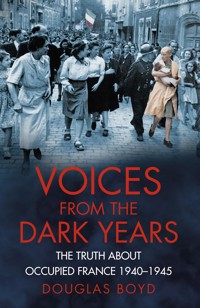
The key to getting on with our closest Continental neighbours is to know the truth about what they endured during the German Occupation in the Second World War. Forget the films and television dramas about the Resistance; here is the true picture of the Occupation. This often chilling history, based on previously unpublished accounts by men and women who lived through it, tells how they went cold and hungry while Edith Piaf and Maurice Chevalier made their fortunes. Whole towns were destroyed and thousands killed by British bombs. Collaboration earned Marshal Pétain and Pierre Laval death sentences after the Liberation, whereas French police who sent thousands of women and children to the gas chambers at Auschwitz went unpunished, as did the gendarmes who guarded French concentration camps and handcuffed hostages for the firing squads. Over 70,000 children were fathered by German personnel in France while 1.6 million husbands and lovers languished in POW camps, but if only half the French women whose heads were shaved at the Liberation were accused of 'horizontal collaboration', what were the others punished for? And what about the many thousands of French lives saved by two courageous Germans?
Sie lesen das E-Book in den Legimi-Apps auf:
Seitenzahl: 641
Veröffentlichungsjahr: 2015
Das E-Book (TTS) können Sie hören im Abo „Legimi Premium” in Legimi-Apps auf:
Ähnliche











‘Having no literary pretensions, I never intended to publish my notes. Yet now, when so many want to forget it all happened, we must go on record.’ Pierre Mignon, farmer, patriot and survivor of the extermination camps
‘History tends not to repeat itself exactly. Next time, it could be worse.’ Renée de Monbrison, who wore a yellow star in the Occupied Zone
‘If I could not be your sword, at least I have been your shield.’
Marshal Philippe Pétain, in his last message to the nation before being abducted to Germany by the SS in August 1944
‘Everything I did was for France and the cause of peace.’
Pierre Laval, shortly before he was executed for high treason at Fresnes prison on 15 October 1945
ACKNOWLEDGEMENTS
Many people contributed to the research for this book by reliving with me their experiences during the dark years of the German occupation of France. They recalled moments of anguish and joy, of shame and triumph, of fear and elation. They unearthed personal papers, showed me treasured mementoes and lent precious documents, manuscripts, photographs and books on trust. Many said at the end of our meeting, ‘I haven’t helped you much’, but research is like an iceberg: it is the nine-tenths below the water-line that gives balance and perspective.
From Bordeaux in the south-west of France to Schirmeck in Alsace, survivors asked to remain anonymous after telling me things they had never divulged to anyone else. To them goes my greatest gratitude. Among those I can thank, in Tarn-et-Garonne, Andrée Fourcassié, née Giraud, was my unassuming guide to the misty timescape of the past, opening doors I should never otherwise have known existed; Chantal Fraïsse welcomed me to the Archives Municipales of Moissac; Joseph and Paulette Gouzi offered hospitality, shared memories and lent precious unpublished documentation; Jean-Claude Simon made available photographs of the Maison de Moissac rescue operation; and Françoise Blanchard, née de Monbrison, unlocked the rich resource of her family’s published and unpublished records of the occupation.
In Paris, Naomi Wilson shared her research for a PhD thesis on women’s experience of the occupation. In Gironde, Christian Chabrier, Jacques de La Bardonnie, Cathérine and Robert Hestin and many other neighbours and friends dug into their personal memories; Trudi Higgins supplied correspondence from Ste-Foy-la-Grande; Maj. Len Chaganis unearthed material on Operation Cockade; and the wife of dying hero Henri Salmide (formerly Heinz Stahlschmidt) put aside her grief to talk to me. In Lot-et-Garonne, Guy de La Bardonnie generously shared both published and unpublished resources. In Charentes, Philippe Delaurain gave me the benefit of his encyclopaedic knowledge of the occupation, as well as access to his unsubsidised museum Le Musée de la Poche, which told so well the story of the Royan pocket of resistance until it had to close for lack of funds. And fellow BBC-pensioners Don Craven and Brian Johnson helped me track down the Morse Vee-sign used for so many broadcasts to Occupied Europe.
With good reason, historical writers thank the spouses or partners who tolerate the solitude imposed by their craft and their spending more time with the dead than the living. For a person as sociable as Atarah, this is doubly hard; her enthusiasm and active support is more valued than she imagines. Among my predecessors on the research trail, American historian Robert Paxton deserves acclaim for first shining the light of enquiry on the dark years at a time when nobody in France wanted to talk about them. On a professional plane, my thanks go to agent Mandy Little for getting the first edition published and to commissioning editor Mark Beynon, editor Rebecca Newton, proofreader Alwyn Harrison and designer Jemma Cox at The History Press for this edition.
AUTHOR NOTE
1. All translations are by the author, unless otherwise attributed.
2. All reasonable steps have been taken to clear copyright material. If any copyright has been inadvertently infringed, please write to the author, care of the publisher.
3. All photographs are from the author’s personal collection, unless otherwise stated.
CONTENTS
Title
Quote
Acknowledgements
List of Abbreviations
Introduction
Part 1
Defeat and Occupation
1 From Sitzkrieg to Blitzkrieg
2 Pétain Quells the Panic
3 An End to the Killing
4 ‘Trust the German Soldier!’
5 Behold the Man!
6 The Lie that was True
7 The Number of the Beast
Part 2
Life, Love and Loot under Pétain’s New Order
8 Clearing up the Mess
9 Of Cheese, Plays and Books
10 Of Bread and Circuses
11 Courage of a Quiet Kind
12 Culture and Crops
13 Saving the Children
14 The Women’s Ordeal
15 ‘We have Learned of the Scenes of Horror …’
16 The Protests Gather Strength
Part 3
1944 – The Beginning of the End
17 Soap and Sabotage
18 Casualties in the Great Game
19 Happy New Year!
20 Dancing in the Dark
Part 4
The Price of Liberation
21 Atrocities on Both Sides
22 Murderous Midsummer
23 ‘Hell is the Other People’
24 A Carpet of Women’s Hair
25 Death of a Town
26 After the War was Over …
Further Reading in English
By the Same Author
Plates
Copyright
LISTOF ABBREVIATIONS
BCRA
Bureau Central de Renseignements et d’Action (eventual title of the London-based co-ordinating centre of Gaullist intelligence networks)
BEF
British Expeditionary Force
CGQJ
Commissariat Générale aux Questions Juives – main body charged with enforcing anti-Semitic laws
CNR
Conseil National de la Résistance
EIF
Eclaireurs Israélites de France – the Jewish Scout movement
ERR
Einsatzstab Reichsleiter Rosenberg – Nazi cultural agency
FFI
Forces Françaises de l’Intérieur – Free French forces inside France
FTP
Francs-Tireurs et Partisans – left-wing Resistance movement
GFP
Geheime Feldpolizei – German Military Police
GP
Groupe de Protection – Pétain’s bodyguard
LVF
Légion des Volontaires Français contre le bolchevisme – French volunteers fighting in German uniform on the eastern front
MSR
Mouvement Social Revolutionnaire – a fascist movement
OKW
Oberkommandantur der Wehrmacht – German Army High Command
PCF
Parti Communiste Français – French Communist Party
PPF
Parti Populaire Français – Doriot’s extreme pro-German party
PQJ
Police aux Questions Juives – special anti-Jewish police force
RG
Renseignements Généraux – French equivalent of Special Branch
RHSA
Reichshauptsicherheitsampt – Himmler’s umbrella organisation running the SS and SD
RMVE
Régiment de Marche de Volontaires Etrangers – temporary Foreign Legion regiment of volunteers in 1940
RNP
Rassemblement National Populaire - Déat’s extreme right-wing party
SD
Sicherheitsdienst – Amt VI of RHSA covering external security
SNCF
Société des Chemins de Fer Français – French state railway system
SOL
Service d’Ordre Légionnaire – forerunner of the Milice
SPAC
Service de Police Anti-Communiste – anti-Communist police units
STO
Service de Travail Obligatoire – organisation of compulsory labour in the Reich
UGIF
Union Générale des Israélites de France – umbrella organisation by which the Germans organised the fate of the Jewish community
INTRODUCTION
The seed of this book was sown at a diplomatic reception in Bordeaux by an elderly Englishman, who confided to me out of earshot of the French guests that he first saw the city through the bombsight of an RAF Lancaster during the Second World War. When I asked whether he had been targeting the immense bomb-proof shelters, constructed by the Todt Organisation for the long-range German submarines that wrought havoc among the Atlantic convoys, he laughed: ‘With all that Jerry flak coming up at us, all I cared about was dropping my load and getting back home in time for breakfast.’
Since befriending a French assistant from Normandy while at school in Canterbury, I had known that RAF strategic bombing raids killed thousands of innocent French civilians during the war and destroyed entire towns, but it was not until after meeting the bomb-aimer that this book took shape as an account of the occupation of France, not as seen from London and Washington, but as lived by the French people.
President John Francis Kennedy observed that the great enemy of the truth is very often ‘not the lie ... but the myth, persistent, persuasive and unrealistic’. Due to the way the media were used for propaganda purposes in wartime, two contradictory myths became the accepted bases for the history of the occupation. In France, people said that Lord Gort’s British Expeditionary Force (BEF) had fought ‘to the last drop of French blood’ before running away in 1940. Conversely, standing alone against German-dominated Europe, Britain fortified itself with the counter-myth that the French army had cracked and run because our erstwhile allies lacked moral fibre.
‘It would never happen here,’ people boasted, forgetting how Britain’s cleverest and most privileged sons voted by 275 to 153 at the Oxford Union in 1933 that ‘this House would not fight for King and Country’. So it could well have ‘happened here’, but for the 20 miles of water between a largely unprepared Britain and her abandoned Continental allies.
Similarly, it is easy to pretend that the British would never have collaborated if conquered, yet London in the 1930s saw street fighting between fascists and communists and window-smashing of Jewish-owned shops. Long into the Second World War many Britons of all social strata were both anti-Semitic and either supported Hitler or wanted an accommodation with him.
On screen and in print, the German occupation of France is polarised as a period when the French people united against its alien occupiers and a handful of traitors working for them. The truth is that about 1 per cent of the population was actively pro-German and about the same proportion was committed to resistance before 1944. Finding work, food and heating, tilling one’s fields or running a business, or simply trying to keep a family together, were so time-consuming in that era of shortages, fear and repression that most French people could do little about the occupation except take François Mauriac’s advice: ‘Have eyes that see nothing.’
The largest single organised faction of the essentially urban resistance was the French Communist Party (PCF). Yet, controlled from Moscow by the Comintern, it hampered the French war effort for the first twenty months of the war in line with the non-aggression pact signed between USSR and Germany in August 1939 as a prelude to the two signatories carving up Poland. Similarly, in Britain the communist Daily Worker was banned for its defeatist stance.
When Hitler ignored the pact and invaded USSR in June 1941, the PCF leadership was instructed by Moscow to launch a campaign of assassination of German personnel and thereby provoke retaliation by the execution of hostages. On 13 August, two communist activists hacked a German soldier to death with bayonet and chopper. Eight days later, 22-year-old Pierre Georges, who styled himself ‘Colonel Fabien’, gunned down an inoffensive Kriegsmarine sub-lieutenant in a Metro station on his way to work at a naval clothing store.
A deadly cycle of assassination and reprisal was launched. This had nothing to do with French interests. Moscow’s aim was to tie down in a restive France many thousands of German troops who could otherwise have been sent to the eastern front. The Comintern always played a long game, and the second aim of its strategy was to divide and confuse the French people, leading to a power vacuum at the end of the war, in which the tightly-disciplined PCF could take over the government by political means or armed uprising.
The Maquis was altogether different, being initially composed of autonomous bands of young Frenchmen who took to the hills and forests to escape conscription for labour service in Germany. As a neighbour of mine recalled, ‘What could we do when young men with guns knocked on the door at night, demanding clothes and food against handwritten receipts they said would be redeemed by General de Gaulle after the Liberation?’
Despite lengthy negotiations and extensive bribery by de Gaulle’s emissary Jean Moulin, charged with uniting the mutually hostile factions of the Resistance into one integrated command structure, internecine conflict between the various political groups continued. Only after the Liberation were the myths of concerted heroic resistance to the invader invented to unify a divided nation.
Charles de Gaulle has rightly become the symbol of resistance to the German occupation of his country, but when it began he was just a substantive colonel, stranded with a handful of companions in a country whose language he did not speak very well and whose policies he often rightly mistrusted. To most of his compatriots, he was a runaway correctly condemned in absentia by a court martial to a traitor’s death.
Thousands of French servicemen in Britain after Dunkirk rejected de Gaulle’s appeal and chose to return home even when this lay in the Occupied Zone. Their legitimate head of state, Marshal Philippe Pétain, was a First World War hero and a popular and respected political figure of the inter-war years. Many of his original policies were laudable, if naïve – and yet the cruelty of his regime has become legendary. ‘I hate lies,’ he said just after the Armistice to a population disillusioned with its leaders. ‘I think of those who are suffering, of those who do not know where tomorrow’s food is to come from, of the children who will not hear this year the church bell of their own village.’
How could the man who said that go on to cause the death of so many of his citizens, including men who had lost their sight and limbs to win the same medals that decorated his own uniform? The marshal was old and too tired to stay on course when manipulated by more devious colleagues. Yet what perverted his policies above all else was the absolute power with which his fellow-politicians voted to invest him. When the National Assembly killed the Third Republic at Vichy, making Pétain a dictator, one solitary voice cried out, ‘Vive la République, quand même!’
Politics makes strange bedfellows, but no pair more disparate than Pétain and Philippe Laval have been harnessed together by its exigencies. Prime Minister Laval seems to epitomise the schemer avid for power who cares not whence it comes. A socialist deputy and lawyer who made his reputation successfully defending left-wing activists against the interests of the 200 families said to own France, he avoided military service 1914–18 and slipped around the semi-circular Chamber of Deputies to sit with the Conservatives, causing one enemy to comment that such a 180-degree turn was to be expected from a man whose name read the same from left or right. The energy with which Laval promoted the worst excesses of the Vichy regime earned him death by firing squad. Few mourned his passing, yet he argued to the last that he had acted throughout the occupation as a pacifist and patriot.
The term ‘collaborator’ came after the Liberation to mean a particular form of treason exemplified by Pétain and Laval. If French citizens, actively pro-German from political conviction, anti-Semitism, or because they thought Hitler was bound to win the war, were definitely collabos, what of the companies that made vast profits from the occupation and the great wine chateaux who slaked the German thirst for claret, burgundy and champagne? In Paris and other big cities, luxury commerce thrived and huge, untaxed fortunes were made on the black market while the aged and poor suffered hypothermia and malnutrition, yet many profiteers bought protection from one Resistance group or another and were never accused of any crime.
It was undoubtedly collaboration of the most shameful kind when uniformed Paris policemen rounded up 12,884 people in the summer of 1942 – including 4,051 children who were brutally separated from their mothers and left terrified in a huge sports stadium with no food, water or usable toilets – as a prelude to being herded into cattle trucks, destination Auschwitz. But did Louis Renault, who avoided a probable death sentence after the Liberation by dying from injuries sustained in prison while awaiting trial, have any choice about making vehicles for the Wehrmacht? The alternative was to see his factories dismantled and his workmen sent to Germany.
Lower down the social scale, if the only work available in coastal villages of the Occupied Zone was labouring on the Atlantic Wall, why should a man with a wife and children to feed have refused it, even had he been given the choice? In the Free Zone, if the only job a woman could find was as a shorthand-typist or telephone switchboard operator in a Vichy government department, did that make her a collaborator? And what about all the men who wore the many uniforms of Pétain’s regime in the police, gendarmerie, the Army of the Armistice and as miliciens?
An estimated 105,000 collabos were murdered without trial during the Liberation and the purge afterwards. Yet, Vichy civil servant François Mitterand accepted the post of editor of L'Oréal-owned magazine Votre Beauté as a first step up the ladder that led to presidency of the Republic 1981–95, when he is said to have actively impeded the investigation of collaborators like wartime Interior Minister René Bousquet and Maurice Papon, who signed the arrest warrants that sent the Jews of Bordeaux to die in cattle trucks and gas chambers.
What can one say of the role played by the Catholic Church? Some priests were active in the German cause, blessing French volunteers who fought for Hitler; others gave their lives gladly in fighting the occupation while the Church hierarchy long turned a blind eye to the excesses of Vichy’s anti-Semitism in keeping with the Vatican line that Nazi Germany was a bulwark for Christianity against the godless hordes in the east.
Researching this book has been the more difficult because military defeat and occupation are regarded as shameful and fighting a powerful oppressor always seems heroic. Yet, was it heroic for communist Maquis chief ‘Kléber’ Chapou to defy the orders of his Résistance superiors on the day after D-Day and order his private army of 400 maquisards to massacre forty German soldiers in Tulle – and then run away to let SS Division Das Reich hang ninety-nine uninvolved local men next day and despatch another 100 to concentration and extermination camps where most of them died?
It was undoubtedly heroic for French men and women to risk their lives by helping downed Allied airmen because the price they paid, if caught, was imprisonment, torture and death – not only for themselves but also for spouses and children. Was all their suffering militarily justifiable, when weighed against the fact that only nineteen of those airmen ever flew again in combat? And what about the many thousands of memorials all over France commemorating young men who died after the Normandy landings in 1944, fighting armoured cars and tanks with Sten guns and ammunition parachuted from RAF aircraft? Did their deaths serve any militarily justifiable purpose, or were they pawns in a cynical British deception operation?
Well over 60 per cent of the French nation then lived in rural areas, so hitherto unpublished accounts of the lives of my neighbours and acquaintances living in the small towns and countryside of south-western France are as valid as better-documented incidents in Paris, Bordeaux and Lyon. Against all the odds, Pierre Mignon – a patriotic farmer from a village 10km from my home – returned from the dead to write a memorial to the comrades whose emaciated corpses he left stacked like firewood in the camps, or who were shot by the roadside during the final lunatic death marches. In the preface to his account of betrayal and torture that took his courageous friends to agonised deaths in Germany, he wrote modestly: ‘I made some notes afterwards, so that my children would know what happened to us.’
Contrary to what the reader might think, those who shared memories with me and lent souvenirs and precious keepsakes for my research were not boasting. Imprisonment, torture and starvation leave a lifelong burden of shame on their victims that makes talking about their suffering extremely difficult. In all the years since her public humiliation during the Liberation, I was the first person to whom Marie-Rose Dupont spoke of that awful Sunday when her head was publicly shaved for the ‘crime’ of falling in love with a man in German uniform.
In France, the four years of the occupation are called les années sombres – the dark years – literally because of the shortages of fuel and frequent power cuts, and figuratively because few French people want to talk about them, even seven decades later. Yet, recording the experience of the occupation is vitally important at a time when encyclopedias and school books are being rewritten to present a sanitised view of recent history for students in the currently united Europe. Memorials to those who died during the occupation are sometimes reworded during refurbishment. A bald statement like fusillés par les Allemands – shot by the Germans – might offend today’s European partners and thus becomes ambiguously tués par les Hitlériens or even more anonymously tués par l’Occupant. So when the survivors die in silence, old myths become new truth.
I began this work in a spirit of scepticism not improper in a historian, yet as it progressed I was frequently humbled by the courage of ordinary French men and women who followed their consciences at a time when doing so invited torture and death for oneself, one’s friends and loved ones. Their memories are harrowing, but we owe them a hearing before those memories are lost forever.
Douglas Boyd, Gironde, France,
Summer 2014
PART 1
DEFEAT AND OCCUPATION
1
FROM SITZKRIEGTO BLITZKRIEG
The Berliner Sportpalast was as near as one could get in 1939 to the ambiance of a twenty-first-century rock concert. Spotlights played on thousands of upraised arms giving the Hitler salute, the huge red-white-black banners and the Nazi aristocracy on the platform. The hall was packed with the uniformed Party faithful and a sprinkling of soldiers, airmen and sailors on leave. The PA system was cranked up as high as it could go. After several underlings had spoken, top-of-the-bill Adolf Hitler thumped the rostrum on the dais to wind his audience up to the usual fever pitch. The text of his sermon was fear – the fear of the Blitzkreig machine that had destroyed Poland and was about to be unleashed on the Western Allies.
Hamming it up, the Führer posed the question in so many Dutch, Belgian, French and British minds: ‘“When is he coming?” they ask.’ The audience was silent as he paused and scanned the hall, as though seeking the answer among his followers. Then, with his impeccably theatrical sense of timing, he said, ‘I tell them, don’t worry. He’s coming all right!’
‘Sieg heil! Sieg heil! Sieg heil!’ The chanting and roars of applause rang out over radios throughout Europe – yet another exercise in the war of nerves in the autumn and winter of 1939–40. The waiting period before the bloodshed was deprecatingly called ‘the phoney war’, but was also punningly christened the ‘bore war’ by the soldiers in Lord Gort’s BEF on the western flank of the Allied line in France because nothing much seemed to be happening on the ground. With similar humour, the men in field-grey on the other bank of the Rhine called it der Sitzkrieg in contrast with their Blitzkrieg conquest of Poland the previous September.
Reporting to HQ of 2nd French North African Division at Toul in Lorraine, reservist Capt Barlone found the lack of clothing, arms, ammunition and vehicles ‘disastrous and scandalous’. There was a general assumption in the officers’ mess that if it came to a shooting war, France would somehow muddle through. The twin problems, as he saw them, were that the General Staff was everywhere preparing for the static war of 1914–18 and thus had no defence in depth against fast-moving, modern mechanised columns. Even rations were inadequate: the army was supposed to live off the land by slaughtering animals belonging to the evacuated civilian population and looting their crops and fruit. When temperatures in Lorraine dropped below −36°C that winter, Barlone's men were sleeping in barns, where their horses’ bodies were the only source of warmth.1
One astute observer of the Parisian scene as the shooting war drew nearer was American publisher Thomas Kernan, managing editor of the French edition of Vogue. Well-connected and welcome in all the best places, he watched the final rounds in the game of musical beds that had been a feature of French political life under the two empires and three republics which had succeeded each other since the Revolution. When in March 1940 Prime Minister Édouard Daladier – Chamberlain’s co-signatory to the disastrous Munich Agreement that had given Hitler the green light to invade Czechoslovakia in 1938 – resigned the premiership, Kernan knew that Daladier’s hand had been forced by the Comtesse de Portes, Paul Reynaud’s scheming and ambitious mistress.
Daughter of a rich merchant in Marseille, Hélène Rebuffel had married Comte Jean de Portes for the title and social standing that went with it, enabling her to set up her own salon in Paris. There, in 1929, she met Paul Reynaud, a lawyer making his way up the political ladder. Short, poorly dressed, nervous in speech and uncomfortable in manner, Reynaud was not her type – until he was made Minister of Finance the following year after predicting the Wall Street Crash well ahead of the event. His second great political success was as Minister for the Colonies, after which gossip said that Hélène de Portes intended to make Reynaud the ruler of France, so that she could rule it through him. Pre-war France, where women did not have the vote and were debarred from political office, was nevertheless a country where ambitious and intelligent women exercised considerable political power in the traditional way.
Daladier’s own mistress was the coolly attractive daughter of a rich sardine packer, who had married the Marquis of Crussol for his title – to the dismay of the aristocratic Crussol family. It was at her salon that Daladier fell victim to her charms. André Tardieu, founder of the Republican Centre movement was bedding Mary Marquet, a star of the Comédie Française – which is where Yvon Delbos, Foreign Minister in the Popular Front government, found his stately brunette mistress Germaine Rouer. Georges Mandel, who had been chef de cabinet to Clemenceau, found his blonde, buxom mistress Béatrice Bretty there too. At the time he was French delegate to the League of Nations, Paul Boncour wrote to his mistress Magda Fontanges, ‘When I think of your lovely body, I don’t give a damn about Central Europe.’ Rather embarrassingly, the letter was read out in evidence when she was on trial for shooting Comte Charles Chambrun.2
Watching all the moves, Kernan saw the Comtesse de Portes increasingly worried as Reynaud became more and more reliant in the developing crisis on his astute friend and chef de cabinet Gaston Palewski. Her best hope of regaining control over him was to marry her lover. Reynaud was 52 – exactly twice her age. Father of one child and separated from his wife, he was unable to get a quick divorce under the existing law and the law could only be changed by the Minister of Justice. Paul Reynaud was that minister, but for him to upset the Church by altering the law for his own benefit was too near the knuckle, even in the Third Republic.
So the comtesse had a little tête-à-tête with her rival the Marquise de Crussol. After some fencing between these two powerful women, Portes proposed to Crussol that it would solve both their problems if Reynaud were moved down to his old post as Minister of Finance, where he would present less of a threat to Daladier. Georges Bonnet, a member of the pals’ club whose disastrous pro-Munich policy had cost him the Foreign Ministry, could then be made Minister of Justice – in gratitude for which Bonnet could sort out the divorce law, enabling the comtesse to marry Reynaud. Voilà!
Bonnet’s law of 29 November 1939 reduced the waiting period for divorce from three years to one, but with Reynaud gathering support from both the left and the right the Marquise de Crussol complained to the Comtesse de Portes that she was not keeping to the deal they had agreed. When Hélène de Portes explained that the problem was Palewski’s influence over Reynaud, against which she was powerless, Palewski’s time was up because the marquise instructed her lover Daladier to pressure Reynaud into replacing him with two less savvy advisers named Lecca and Devau. Both comtesse and marquise heaved sighs of relief, but when Daladier’s hold on power slipped in March 1940, Reynaud became prime minister anyway. Enjoying their success and their rivals’ discomfiture, both he and his mistress were unaware that on the stage set for the comedy of musical beds, a folie à deux tragedy was about to be played, with her in the principal role.3 Demonstrating his ability to sniff the wind of change, Palewski wrote off the lot of them and later slipped across the Channel to become a crucial figure in the Gaullist movement both during and after the war.
Not every foreigner in the French capital was interested in the political scene. In the spring of 1940, a dilettante Englishman named Dennis Freeman returned to his beloved Parisian home after wintering in Switzerland. His diary is full of more mundane things: the gardeners setting out bedding plants behind the cathedral of Notre Dame and in the courtyard of the Louvre; magnolias blooming in the Avenue Gabriel and the leaves on the chestnut trees that had never looked greener and fresher. Less overcrowded and emptier of motor traffic than in previous years, the capital exuded a peculiar air of nostalgic beauty, with smartly-dressed women on the Champs Elysées wearing colourful flowered dresses and pretty hats, as though thumbing their delicate noses at the men in field-grey lurking across the Rhine. A typical passage was:
A new and trivial comedy by Cocteau made its appearance at the [Théâtre] Bouffes. Médée by Milhaud, with décor by André Masson, was produced at the Opéra on the stage which a few days earlier had been filled by Maurice Chevalier and Gracie Fields. People still went to the theatres and music halls. The Parisians dined out as usual – the Germans, we were constantly told, would sooner or later starve. At least three-quarters of the night clubs had closed, but the few remaining open were full. The guignol puppet theatre in the Luxembourg with new [villains] Messrs Hitler and Goering, was a big draw. There were even races at Longchamps and the Entente Cordiale was weekly cemented by some inter-allied sporting event.4
If that does not sound like a capital preparing for war, Freeman complained that, on three days a week, no meat could be bought, except for sucking lamb which was classed as fish for some reason. Coffee and sugar, when they could be found, cost far more than the previous year. With no hard liquor to be had on Monday, Wednesday and Saturday and no pastry or confectionery on Tuesday, Thursday and Friday, those addicted to rum babas could enjoy them only on Sunday. Restaurants were permitted to serve only one meat dish of 100g per person, and the clients got butter only with cheese or sardines.
By the end of the cool spring of 1940 coal and wood were almost unobtainable in Paris. A law had been passed limiting the period during which central heating might be used. Only government-monopoly cigarettes were available in the tabacs. World-famous luxury goods stores in the main thoroughfares had shut down and many Metro stations were closed. With only a reduced service of buses, taxis were scarce and at night practically unobtainable. Several times a week Freeman heard anti-aircraft guns in action, by night and by day.5
Five hundred kilometres to the south, spring came a little earlier than to Paris. The town of Moissac on the River Tarn, near its confluence with the mighty Garonne, was not a place where people worried much about perfume, jewellery and fancy cakes. Known throughout France as the centre of production of Chasselas dessert grapes, the town had its normal population of 8,000 already swollen by an influx of refugees from the Spanish Civil War, welcomed by its left-of-centre mayor Roger Delthil, who intoned the Internationale as often as the Marseillaise at public events. He was also senator for the département of Tarn-et-Garonne – in France it is still quite usual for one man to hold several public offices simultaneously. After war was declared in September 1939, Delthil reminded his fellow citizens that when disastrous floods had swept homes away and caused many deaths in 1930, the country had been generous in its financial support for reconstruction. On all the hoardings, a notice read:
We have been asked to welcome 1,500 compatriots, women, children and men above military age who have been obliged to flee the atrocities of a war that has been thrust upon us. These unfortunate people of all classes have had to leave their homes with nothing. They will arrive in Moissac completely unprovided for. The municipality will find or requisition the necessary accommodation.
I am counting on the patriotism of the people of Moissac, whose sons are doing their duty on the frontier. I am counting on them also because when misfortune struck our town in 1930 all France in an admirable groundswell of solidarity sent us many millions. We have a debt to pay. We shall pay it.
Roger Delthil, Mayor of Moissac, Senator of Tarn-et-Garonne
By 12 September 1939 municipal employees had requisitioned 1,910 blankets, 400 stoves, 400 oil lamps and all the basic necessities to see the expected flood of refugees through the winter. An eighteenth-century town house at No. 18, Quai du Vieux Port was opened as a reception centre for them. Known as ‘La Maison de Moissac’, it initially housed eleven refugees from Germany, Austria and the Saarland.
The 1,500 refugees predicted by Delthil for the first wave from the north and east of the country turned out to be 2,000, increasing the population of Moissac by 25 per cent. Despite this, local people carried on with their lives. In 1870 and 1914 German guns had shelled Paris, but Moissagais families, except those with a man in uniform, showed little interest in a war to be fought hundreds of kilometres to the north. As he would many times in the next four years, the prefect of the département decried the insular attitude of these peasants concerned only with their land and with selling their produce at the best price.
The bubble burst on 10 May 1940, when Hitler launched a three-pronged attack on Holland, Belgium and France. The French had a very efficient intelligence network all along the front that reported troop movements across the Rhine, and signals from their agents in neutral Luxemburg the previous day had warned of the arrival there of storm-troopers disguised as tourists. Woken at 1 a.m. to hear the latest reports, the French Commander-in-Chief General Maurice Gamelin muttered, ‘Take no action,’ and went back to sleep.
Each side had used the eight months of bluff and counter-bluff to build up front-line strength. A major reason for Hitler prolonging the phoney war was that Polish heroism had shot down or severely damaged 30 per cent of the Luftwaffe’s aircraft and Goering needed time to replace pilots and aircraft before launching a new aggression in the west.6 By the beginning of May, with the eastern front secured politically for the moment by the Ribbentrop-Molotov non-aggression pact, Hitler was able to deploy along Germany’s western front 135 divisions, including twelve Panzer divisions with 2,439 tanks and a total of 3,369 warplanes.7
Facing them were 104 French divisions and just fifteen divisions of the BEF, which should have been more than enough to fight a defensive battle in prepared positions, without counting the Dutch and Belgian armies and fortifications that would absorb the first German thrusts. The British government had promised its French allies to build the BEF up to thirty-two divisions and eventually forty-five, but not before 1941 at the earliest.8 Although French tanks outnumbered the German armour 4:3, less than a third of these were in mobile armoured units due to the failure of the General Staff to rethink this tool of modern warfare along the lines argued for more than a decade by a cavalry colonel named Charles de Gaulle.
Ninety per cent of French artillery pieces dated back to the First World War. 55th Infantry Division, defending the key city of Sedan, did not have a single anti-tank gun capable of stopping a Panzer.9 Thanks to the Depression and the pacifist stance of inter-war governments, particularly Leon Blum’s left-wing Popular Front, the French air force was also poorly equipped. Flying off grass fields with their outdated motors fuelled by 70 or 87 octane fuel, its pilots went up against Messerschmidts and Stukas of the Blitzkrieg-tested Luftwaffe, with little on their side but courage and willingness to die for their country.
It is not true that the French General Staff placed all its faith in the supposed impregnability of the Maginot Line fortifications running along the Franco-German frontier from Switzerland in the east as far as Belgium in the west, but that is perversely where its best troops were stationed – and not in the unfortified stretch at the western end of the line.
When Hitler had invaded Poland the previous September, British journalist Nicholas Bodington had been with the French armies on the Alsace-Lorraine frontier with Germany. Taking advantage of the inevitable thinning of the forces ranged against them, the French General Staff had ‘straightened the line’ by ironing out a few kinks, in the process annexing thirty-six German villages which became briefly French after only a few salvoes of artillery from the retreating defenders. It seems that this early success engendered a false sense of superiority in Paris.
In the summer of 1940, with the left flank of the Allied line anchored on the Channel coast and entrusted to Lord Gort’s BEF, the space between it and the Maginot Line was filled by some very second-rate French units, rotated so often that their officers did not know which units were on their flanks, while the men they commanded were less acquainted with their weapons than the picks and shovels they were using to construct makeshift blockhouses and trenches in a too-little, too-late attempt to extend the Maginot Line westwards on the cheap.
It was to this stretch of the front between Longwy at the north-west end of the line and Sedan that General Franz Halder had pointed on a map at OKW – the German Army High Command – six months earlier. ‘Here is the weak point,’ he said. ‘Here we have to go through!’10 Launched on 10 May, the northern thrust of the German attack sliced through the Dutch army, while the central drive took the panzers deep into Belgium and the southern prong of Hitler’s trident drove through the Ardennes Forest of southern Belgium and Luxembourg like an arrow pointing straight at Sedan.
General Erich von Manstein’s Fall Sichel, or Operation Sickle, was a classic, fast-moving, massive Panzer offensive with close air cover – that essential feature of successful Blitzkrieg, which the chiefs of both the RAF and the French air force thought a misapplication of air-power. By coming through the theoretically impassable Ardennes forests, Manstein wrong-footed the Allied defence so brilliantly that, three days after the start of the offensive, his advance units were in France.11 Holland surrendered to the inevitable on 15 May. Hearing the news, Premier Paul Reynaud took one look at the war map and telephoned the new British Prime Minister Winston Churchill to say, ‘The battle is lost.’
Far from the sound of the guns, on 18 May Mayor Delthil warned the stunned inhabitants of Moissac to expect a new wave of refugees from the north and east. It was almost a relief for him to have something so mundane to worry about after the weeks of rumours about parachutes dropping on remote areas, of women seen struggling along country roads carrying cases so heavy they must have contained weapons, and were obviously storm troopers disguised as nuns – and of mysterious aircraft engines heard at night. At least the refugees were real.
On 28 May, Belgium also surrendered to avoid further useless loss of life. What else could King Leopold’s government have done? One unique political gesture of the little-respected Belgian politicians was to rush through a law authorising the destructions of étatcivil records of Jewish children to give them the names of non-Jewish adoptive parents. No count exists of how many young lives this saved.
After the panzers of the two northern thrusts regrouped and swung southwards, they poured through the weakest point in the centre of the Allied line. Judging the Battle of France lost, Lord Gort began withdrawing the BEF to the coast in preparation for evacuation by sea before the line of retreat was cut. They nearly missed the boat, literally, after General Heinz Guderian’s tank columns reached the Channel coast near Abbeville on 20 May and swung north to cut off the British from the ports of Calais and Dunkirk. However, Hitler ordered Guderian on 24 May to halt on the canal line just outside Dunkirk while the Luftwaffe wiped out the men on the beaches – which it failed to do. By the end of the seaborne evacuation 198,000 British and 140,000 French and Belgian soldiers, sailors and airmen had crossed the Channel to safety. Such was the elation in Britain that Churchill had to warn his people ‘not to ascribe to this deliverance the character of a victory’.
NOTES
1. D. Barlone, A French Officer’s Diary (Cambridge: CUP, 1942), pp. 8–11.
2. T. Kernan, France on Berlin Time (New York and Philadelphia: Lippincott, 1941), pp. 223–9.
3. Ibid., pp. 229–31.
4. C.D. Freeman and D. Cooper, The Road to Bordeaux (London: Readers’ Union & Cresset Press, 1942), pp. 12, 13.
5. Ibid.
6. A. Hillgruber, Hitlers Strategie: Politik und Kriegführung 1940–41 (Bonn: Bernard & Graefe, 1965), p. 38.
7. Figures quoted in E.R. May, Strange Victory (New York: Hill & Wang, 2002), p. 477.
8. Ibid., p. 309.
9. Ibid., p. 388.
10. Ibid., p. 229.
11. Ibid., p. 309.
2
PÉTAIN QUELLSTHE PANIC
The Germans did not have it all their own way. Among French commanders who bloodied their nose more than once was Colonel Charles de Gaulle, France’s premier advocate of tank warfare. The success with which he practised what he had preached in books between the wars earned a citation from Weygand:
An admirable leader, daring and energetic, on 30 and 31 May he attacked an enemy bridgehead, penetrating more than five kilometres into the enemy lines and capturing several hundred prisoners and valuable materiel.1
However, in the chaos of the German breakthrough not even officers like de Gaulle could do much at the front, so he was recalled to Paris by Reynaud and appointed Under-Secretary for War in a government that was numbed at being abandoned by its only ally.
Reynaud still had 2 million men under arms in the area of conflict but, having taken losses of 92,000 dead and over 200,000 wounded in the brief campaign – against German losses roughly half as severe – his cabinet was irrevocably divided over the course of action to pursue. A minority of six ministers supported his plan to fight on and eventually withdraw to French North Africa and continue the war from there, but Reynaud’s political credit was all but spent. Exactly two months earlier, on 28 March 1940 he had signed an agreement in London under which both British and French governments undertook not to negotiate peace terms unilaterally. Renault had signed without first seeking the approval of his cabinet, which made his signature unconstitutional and not binding on the French government. In any case, as President Lebrun argued after the war at Pétain’s trial, Britain had unilaterally vitiated the agreement on two counts: she had never committed her air force to the common cause and she had withdrawn her ground troops from the conflict without consultation.
In Paris hardly anyone of consequence, inside the cabinet or elsewhere, believed it was still possible to stop the German advance. The great hero of 1914–18, Marshal Henri-Philippe Pétain, told the American Ambassador on 4 June that he firmly believed the British would shortly sign a pact with Germany.2 Although Charles de Gaulle was despatched to London on 5 June with the acting rank of brigadier, there was little he could do there at this stage.
A majority of thirteen ministers in Reynaud’s cabinet wanted to sue for terms immediately, never mind what pieces of paper had been signed with the British, who in their consideration had deserted France in her hour of need. Their position was strengthened by Marshal Pétain as vice-president of the Council of Ministers and General Maxime Weygand, who had replaced Gamelin as Commander-in-Chief of the army after the disastrous first week of the invasion. France’s two senior soldiers, they saw no alternative to an armistice, providing it ‘did not stain French honour’3 or involve handing over the intact French navy, built up and modernised by Admiral of the Fleet Xavier-François Darlan, despite the pacifist policies of inter-war governments.
With the army in full flight and no prepared positions to fall back on, there was nowhere the French army could stand and fight with any reasonable chance of holding a line against so fast-moving an enemy. There was also the question of morale. In the First World War, France and the British Empire each mobilised between 8 and 9 million men against the Central Powers, but the total French casualties had been twice as high as those for the whole Empire. From a population of 40 million, France lost 1,357,800 men killed, with 4,266,000 wounded and another 537,000 taken prisoner or missing in action. At the other end of the scale, the decisive but late entry of the USA into the war cost only a total of 323,018 American casualties, including 116,516 dead.4
So, by November 1918 one out of ten French citizens ofall age-groups and both sexes was a casualty in one way or another, without counting the hundreds of thousands made homeless by the fighting and the concomitant disruption to family life. Coming as it did after the revolutionary wars, the wars of the two empires and the Franco-Prussian war of 1870–71, the First World War traumatised the whole nation. Long lists of names on war memorials in small villages all over France testify to the slaughter of all the adult males in many families. In the southern départements, telephone directories show as many Italian and Spanish surnames as French ones, thanks to the flood of landless younger sons who came from Italy and Spain between the two world wars to replace the dead youth of France by marrying local girls otherwise condemned to lifelong spinsterhood.
In addition to the demoralising scale of French casualties, there was another factor in the war-weariness of French soldiers by 1917 and 1918 that caused widespread and brutally repressed mutinies. For the British, Empire and American forces fighting on their flanks, the war was destroying a foreign land they would forget soon after returning home, whereas the poilus were fighting in a wasteland where formerly their farms, villages and cities had stood – but which was so torn and cratered by the bombardments that it seemed impossible for street lines to be traced with certainty, let alone homes rebuilt or fields poisoned with chemicals ever made fertile again.
It would have been surprising if, after only thirty-two years, the survivors of that carnage and their sons had wished to repeat the experience, once abandoned by their allies and having a totally justified lack of faith in their divided leaders, a disrupted command structure, virtually no working communications, outdated weapons and grossly inadequate air cover.
Paradoxically, to defend the country they loved, many foreign residents volunteered to fight for France. Accepted as combatants only in the Foreign Legion, they were formed into Régiments de Marche de Volontaires Etrangers (RMVE with numbering upwards of twenty), to distinguish them from the ‘old’ Legion, shipped over from North Africa in this hour of need. 22 RMVE listed men of forty-seven nationalities, but 25 per cent of them were Republican refugees from the Spanish Civil War. Both they and the east Europeans in these temporary regiments included a high percentage of communists, which made their officers consider them politically unreliable. Issued inadequate kit and weapons or none at all, they were held in reserve until after the invasion and then thrown into the line to sink or swim, poorly trained and ill-equipped. Yet their combat record was no worse than that of many regular regiments.5
In Alsace behind the Maginot Line, eminent Parisian surgeon and army reservist Joseph Gouzi worked day and night in a well-organised mobile surgical unit, moving from one pre-planned position to the next, but things were not like that in the centre of the line. Dennis Freeman and his friend Douglas Cooper enlisted in the French army as ambulance drivers and found themselves in the headlong rout, driving badly wounded men to improvised hospitals where doctors and patients were always on the point of being re-evacuated as the enemy pressed closer. On 7 June at Oigny, Freeman noted:
The villagers could not have left so very long before, for the little gardens looked well tended and there was an air of orderliness and well-being about the place. It was difficult to reconcile the ceaseless thunder of the distant guns and the busy movement of the doctors, infirmiers and stretcher-bearers with the rural scene. Cottages had been transformed into dressing-stations. The simpler operations were performed in the forge.6
From time to time, the two English volunteers crossed paths with compatriots. On 8 June near Troyes, Cooper noted: ‘Outside in the street I found several English soldiers [from] the Pioneer Corps, whose duty it was to follow the RAF around, making landing-grounds for them, and digging reservoirs for petrol. Now that most of the English airmen had left, they themselves were expecting to be moved any day:
The Germans had reached Forges-les-Eaux and were pressing on towards Rouen and the Seine. They seemed to be advancing everywhere. Weygand had issued a proclamation: Nous sommes en dernier quart d’heure [meaning, a quarter of an hour to go, with victory in sight] but the roads were horribly congested. The stream of refugees had swollen to considerable proportions in the space of an afternoon and there were not only lines of people on foot and in cars, but in addition a large assortment of barking dogs of all sizes, goats, cattle and poultry they were taking with them. Heavy military vehicles too were on the move and when I looked closer I saw petrol tankers, radio cars and the ground staff of airfields going south. It was an alarming sight.7
On 9 June Charles de Gaulle returned to his office in Paris after a meeting with Churchill in London in time to hear General Héring as military governor of the capital declare that the city would be defended street by street. The following day, Italy declared war on France and moved troops across the border, Mussolini intent on occupying as much of the country as possible before the inevitable armistice. Hearing the news in London, Churchill is said to have remarked maliciously, ‘It’s only fair. We had them on our side in the last war.’8
From Paris, the government fled south-west – away from the Germans – over roads choked with refugees. General Héring, ordered not to defend the capital after all, requested to be relieved of his redundant post and given a combat command. The art treasures of the Louvre Museum and the bullion reserves of the Banque de France had gone during the phoney war – the former to various chateaux in the Loire Valley and the latter spread far and wide in North America, Martinique and French West Africa. As it had during the German invasions of 1870 and 1914, the government continued its flight from Tours towards Bordeaux, with politicians and civil servants sleeping in their official cars by the side of roads lined with abandoned horse-drawn and motor vehicles. During the brief halt in Tours, Reynaud made a desperate appeal to the United States for air support, which fell on deaf ears.
On the night of 13 June the Parisian suburban hospital at Orsay was staffed by seven desperate nurses caring for eighty sick and elderly patients, plus refugee casualties. With no proper meal for days and only a few hours’ sleep, they asked a passing army major what to do about the patients who could not be moved when the time came to evacuate the others. ‘Give them a last injection,’ he replied. ‘Morphine or strychnine is best.’ Too exhausted to think any further, four of the nurses prepared the fatal doses and administered them, rather than leave seven aged patients behind. The intended act of mercy cost them between one and five years’ imprisonment when they were sentenced in May 1942.
North of Paris, Freeman and Cooper in their ambulances were stopped in Sens by a general trying to rally some troops, who asked whether they had any maps he could borrow. A general without a map! It was unreal – as was their experience of driving into Sens with a naked, screaming, delirious wounded man being tended by a wounded African soldier, to find:
the café at the big crossroads full of people leisurely sipping their aperitif. Busy housewives laden with their baskets were completing their weekend shopping and in the courtyard of the Hôtel de Paris opposite the cathedral the tables with their chequered cloths and gay umbrellas were already laid for the evening meal.
The vast courtyard [of the hospital] presented an extraordinary spectacle. Hundreds of ambulances, parked without any attempt at order, were being loaded and unloaded at the greatest possible speed. Nurses, doctors, medics and stretcher-bearers … looked tired and bewildered by the unmanageable influx of new cases that had suddenly been flung upon them. Some drivers who had been waiting to unload for some time [and] had just been told that they were to go on to Auxerre, sixty kilometres distant.9
The German advance was so rapid that, no sooner had a hospital been set up than it had to be evacuated. Ordered back to Sens, Freeman and Cooper drove through the night without lights against the press of military and civilian traffic fighting its way southwards. The two Britons found what had been a calm provincial town the previous evening transformed:
Every available inch of space was occupied by some kind of vehicle … being loaded ready to leave. The food shops were besieged; everyone was scrambling to purchase as much as possible. One sensed a feeling among the people that they might not see food again for many days. There were no newspapers to calm their fears, no garages to attend to repairs, no petrol to help them on their way, and no police to control them. Desperate, they seemed unable to decide whether to fight for the food they needed now, or take a risk and escape before the arrival of the Germans. In the space of one hour, Sens had become a ville en panique.10
It was not the only one. While the driver of a van taking all the municipal records of the Paris suburb of Boulogne-Billancourt was desperately searching for petrol, two deserting soldiers hijacked the vehicle and disappeared with the registers of births, marriages and deaths.
Heading back the way they had come, Freeman and Cooper passed columns of African and Vietnamese troops, the latter carrying their kit on sticks over their shoulders. Unable to find a refuelling dump, the two Britons took the risk of filling up their petrol tank from a pump at a service station that was already blazing from a bomb. From time to time they met up with comrades from the same unit and a group of English women volunteers driving ambulances financed by a large American acting as their commandant.
On 14 June at 5.30 a.m. the first German units drove through the Porte de la Villette and into the heart of Paris beneath clouds of black smoke from fuel dumps set on fire by the retreating French army. The previous afternoon two French officers with a trumpeter had met the Germans at Sarcelles and confirmed that the city would not be defended. With most of the capital’s food supplies coming from the north, where the disruption to road and rail traffic was total, 700,000 Parisians who had not fled watched the enemy from behind closed shutters and drawn curtains, venturing out only when the sparkling clean mobile kitchens of the German Winterhilfe organisation began dispensing hot soup and bread for the asking. It would be well into the autumn before all the other 2.1 million residents returned, less the more prudent Jewish ones.
Inhabitants of Orléans who had defied orders to flee found it impossible to replace lost documents after the municipal records and Joan of Arc’s house went up in smoke during German air raids on 14 and 15 June. The telephone system was destroyed. Had it been working, there was no one in local government offices to deal with the problems of 3,000 families whose homes had been destroyed. The various departments were dispersed in Nontron, Tulle, Guéret, Millau, Bordeaux, Toulouse, Tonneins and Marmande – and would stay there until 17 July.
With water and gas mains ruptured, fires smouldered everywhere for the next two weeks, causing more destruction. Streets were blocked by collapsed buildings. There was no electricity and no food. The French army had blown up the Joffre and Georges V road bridges – which did not prevent the incoming Wehrmacht from using the intact Vierzon railway bridge to cross the River Loire, but the disruption for normal traffic was so great that clearing up by French prisoners of war and unemployed Parisians was to last eight months. In nearby Neuville-aux-Bois the only medical care for refugees streaming in was provided by the wives of generals Ecot, Berre and Velle, whose ambulance had run out of petrol there, Madame Ecot literally taking a hat round each morning to beg money for food.
That month, a record 1,212 million francs were withdrawn before the savings banks put up their shutters. The Finance Ministry, finding itself stuck at Avoine near Saumur with the Germans approaching, paid a street-cleaner to burn banknotes to the value of 25 million francs. The prefect of the Nord département having demanded several million francs for the immediate needs of his population cut off from the rest of France by the German advance, the government loaded the money aboard two Glenn-Martin aircraft that were shot down as unidentified by a British ack-ack battery near Lille. Of the six crewmen, only one managed to parachute to safety through the clouds of whirling banknotes. Millions were lost, the Prefect eventually signing a receipt for only 240,000 francs.11
South of Orléans, the remaining inhabitants of Poitiers dismantled the makeshift barricades erected by men of 274th Infantry Regiment and sent the mayor out with a white flag to inform the approaching Germans that the town would not be defended. A few miles away at Le Blanc, veterans from the First World War beat up sappers trying to destroy the bridge over the River Creuse and stamped out the sputtering fuses before the charges blew. At St-Benoît-sur-Loire, 54-year-old surrealist poet Max Jacob refused to flee because St-Benoît had neither bridges nor factories meriting German bombardment. The decision to stay put was to cost this long-term friend of Picasso his life.




