


Erhalten Sie Zugang zu diesem und mehr als 300000 Büchern ab EUR 5,99 monatlich.
- Herausgeber: The History Press
- Kategorie: Geisteswissenschaft
- Sprache: Englisch
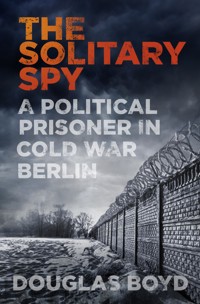
Of the 2.3 million National Servicemen conscripted during the Cold War, 4,200 attended the secret Joint Services School for Linguists, tasked with supplying much-needed Russian speakers to the three services. After training, they were sent to the front lines in Germany and elsewhere to snoop on Soviet aircraft in real time. Posted to RAF Gatow in Berlin, ideally placed for signals interception, author Douglas Boyd came to know Hitler's devastated former capital. Pulling no punches, he describes SIGINT work, his subsequent arrest by armed Soviet soldiers, and how he was locked up without trial in solitary confinement in a Stasi prison. The Solitary Spy is a unique first-hand account of the terrifying experience of incarceration and interrogation in an East German political prison, from which Boyd eventually escaped, one step ahead of the KGB.
Sie lesen das E-Book in den Legimi-Apps auf:
Seitenzahl: 418
Veröffentlichungsjahr: 2017
Das E-Book (TTS) können Sie hören im Abo „Legimi Premium” in Legimi-Apps auf:
Ähnliche











THE SOLITARY SPY
ALSO BY DOUGLAS BOYD:
Histories:
April Queen, Eleanor of Aquitaine
Voices from the Dark Years
The French Foreign Legion
The Kremlin Conspiracy: 1,000 years of Russian Expansionism
Normandy in the Time of Darkness: Life and Death in the Channel Ports 1940–45
Blood in the Snow, Blood on the Grass: Treachery and Massacre, France 1944
De Gaulle: The Man Who Defied Six US Presidents
Lionheart: The True Story of England’s Crusader King
The Other First World War: The Blood-Soaked Russian Fronts 1914–22
Daughters of the KGB: Moscow’s Cold War Spies, Sleepers and Assassins
Agente – Female Spies in World Wars, Cold Wars and Civil Wars
Novels:
The Eagle and the Snake
The Honour and the Glory
The Truth and the Lies
The Virgin and the Fool
The Fiddler and the Ferret
The Spirit and the Flesh
This book is dedicated to the memory of all the political prisoners detained in the Stasi’s Lindenstrasse Interrogation Prison in Potsdam, and to our predecessors who suffered there under the KGB from 1945 to 1952 and under the Gestapo from 1933 to 1945.
Cover Illustrations: Front: Old prison wall in Siberia (locrifa/Shutterstock);Rear: ‘Unity Bridge’ during the Cold War (Author).
First published in 2017
The History Press
The Mill, Brimscombe Port
Stroud, Gloucestershire, GL5 2QG
www.thehistorypress.co.uk
This ebook edition first published in 2017
All rights reserved
© Douglas Boyd, 2017
The right of Douglas Boyd to be identified as the Author of this work has been asserted in accordance with the Copyright, Designs and Patents Act 1988.
This ebook is copyright material and must not be copied, reproduced, transferred, distributed, leased, licensed or publicly performed or used in any way except as specifically permitted in writing by the publishers, as allowed under the terms and conditions under which it was purchased or as strictly permitted by applicable copyright law. Any unauthorised distribution or use of this text may be a direct infringement of the author’s and publisher’s rights, and those responsible may be liable in law accordingly.
EPUB 978 0 7509 8290 0
Original typesetting by The History Press
eBook converted by Geethik Technologies
ACKNOWLEDGEMENTS
Like most writers, I have a retentive memory, but there would have been gaps in this narrative without the assistance received from several former comrades-in-arms of JSSL Intake 35.
John Fuller gave me a copy of his unpublished memoir and kindly allowed me to quote from it. John Anderson climbed several times into the loft – an activity not recommended at our age – to consult letters he had written home during National Service. Similarly, Alan Bamber perused many letters to his then girlfriend, whom he later married, and sent me digests. Duncan Brewer, Harvey May, John Toothill, Colin Priston, Brian Howe and Gerry Williams also racked their brains to check my recollection of specific events, while John Griffin displayed impressive powers of instant recall on the telephone. Ron Sharp suffered most, being awoken many times to be grilled before his breakfast over details of which I was less than 100 per cent sure – a technique I had picked up in the Lindenstrasse Prison.
My neighbour, former Coder Special Gareth Mulloy, has been a tower of strength, lending material and plundering his own and other coders’ memories. The staff of the Bundesbeauftragte der Unterlagen des Staatssicherheitsdienstes der ehemahligen Deutschen Demokratischen Republik in Berlin were not just helpful, but extremely sympathetic, as was Gabriele Schnell at the former interrogation prison on Lindenstrasse in Potsdam, who gave me access to her archives of personal accounts of the Stasi’s victims.
In Berlin, Dave Manley’s widow Ingrid was a great help, digging back into her tangled past and arranging a visit to the former RAF Gatow, now the Luftwaffe Museum with its impressive collection of military aircraft, where the last German commandant was our guide and a fund of information.
It would be ungrateful indeed not to thank also my predecessors at JSSL, Geoffrey Elliott, Harold Shukman and Leslie Woodhead, whose fascinating books about times and places where I was not have been a precious resource.
In the production of this book, I have once again been immensely helped by the great tolerance of my wife, Atarah Ben-Tovim, living with a historian who is mostly ‘somewhere and sometime else’. Jennifer Weller has again been a great support, not least for the maps. At The History Press, I thank commissioning editor Mark Beynon, who first suggested that I write this book, editors Lauren Newby and Vanessa Le, and marketing executive Rebecca Barrett.
CONTENTS
List of Illustrations
List of Abbreviations
Foreword
Introduction
Part 1 – 2.3 Million Men
1 The Reason Why
2 The Joint Services’ Schools for Linguists
3 Bodmin
4 Basic Training
Part 2 – School for Spies
5 Rabota Really Does Mean Work
6 Svobodnoye Vremya – Which Should Have Meant Free Time
7 From Ucheniki to Kursanty – The Sheep from the Goats
8 The Groans of Gruesome Goblins
Part 3 – Berlin Days
9 The Story so Far
10 In the Heart of Hitler’s Reich
11 Extra-Curricular Activities
Part 4 – One Man’s Story – Solitary in Potsdam
12 The Slippery Slope
13 A Sense of Belonging
14 April Fool!
15 The Promise of a Girlfriend
16 Visitors from Moscow
17 A Meeting with the Boss
18 Going Back
19 Other Prisoners’ Lives
20 Ex Bello Frigido in Pacem
Further Reading in English
Places to Visit
Notes and Sources
LIST OF ILLUSTRATIONS
1 The author in 1958. (Courtesy of Brian Howe)
2 Three old spies. (Author’s collection)
3 Ritual end-of-square-bashing photo. (Courtesy of Ron Sharp)
4 JSSL Crail plaque. (Courtesy of RAFling)
5 Klop wedding scene. (Courtesy of Ron Sharp)
6 Klop wedding scene. (Courtesy of Ron Sharp)
7 Occupied Germany. (Author’s collection)
8 Refugee stream. (Author’s collection)
9 Berlin, 1944. (Author’s collection)
10 Trümmerfrauen. (Author’s collection)
11 Divided Berlin. (Author’s collection)
12 Aerial view of Gatow. (Author’s collection)
13 Gatow barrack. (Author’s collection)
14 Gatow Signals Section. (Author’s collection)
15 Honecker and Mielke. (Author’s collection)
16 Normannenstrasse Stasi HQ. (Author’s collection)
17 Mielke’s desk. (Author’s collection)
18 Spontaneous demonstration. (Author’s collection)
19 Albrechtshof down platform. (Author’s collection)
20 Albrechtshof up platform. (Author’s collection)
21 Lindenstrasse Prison façade. (Author’s collection)
22 Interrogation room. (Author’s collection)
23 Lindenstrasse interior courtyard. (Author’s collection)
24 Lindenstrasse punishment cells. (Author’s collection)
25 Lindenstrasse author’s cell. (Author’s collection)
26 Lindenstrasse author’s cell interior. (Author’s collection)
27 Glienicke Bridge in Cold War. (Author’s collection)
28 Glienicke Bridge spy swap. (Author’s collection)
29 Glienicke Bridge now. (Author’s collection)
30 Marienborn Checkpoint. (Author’s collection)
31 Linguist’s certificate of discharge. (Courtesy of John Fuller)
32 Warning to discharged linguist. (By kind permission of Ron Sharp)
LIST OF ABBREVIATIONS
AC1
Aircraftman First Class
AC2
Aircraftman Second Class
AFN
American Forces’ Network broadcasting organisation
A level
Advanced (higher) level of General Certificate of Education
AMP
Air Member for Personnel
AMT
American Military Train
BAFV
British Armed Forces Voucher (forces currency)
BMT
British Military Train
BRIXMISS
British Military Mission
BStU
Bundesbeauftragte der Unterlagen des Staatssicherheitsministerium der ehemaligen Deutschen Demokratischen Republic (Stasi archives)
CND
Capaign for Nuclear Disarmament
CO
Commanding Officer
CPGB
Communist Party of Great Britain
DDR
Deutsche Demokratische Republik (Stalinist East German state)
DF
Direction Finding
DI
drill instructor
EOKA
Ethniki Organosis Kiprion Agoniston (Anti-British Greek Cypriot underground fighters)
GCHQ
Government Communications Headquarters
GDR
German Democratic Republic
GRU
Glavnoye Razvedatelnoye Upraveleniye – Soviet military intelligence organisation
HUMINT
Human Intelligence, i.e. spies
HVA
Hauptverwaltung Aufklärung – External espionage arm of the Stasi
ICBM
intercontinental ballistic missile
IED
improvised explosive device
IM
inoffizieller Mitarbeiter (Stasi informer)
IRA
Irish Republican Army
JSSL
Joint Services School for Linguists
J/T
Junior Technician (rank)
KGB
Komityet Gosudarstvennoi Bezopasnosti – Soviet Committee of State Security
LAC
Leading Aircraftman (rank)
MfS
Ministerium für Staatssicherheit – Ministry of State Security of GDR
MO
Medical Officer
MP
Military Police
MT
Motor Transport (Section)
NAAFI
Navy Army and Air Force Institutes (cash canteen and shop on military premises)
NATO
North Atlantic Treaty Organisation
NCO
non-commissioned officer
NKVD
Narodny Komisariat Vnuktrennikh Dyel – Soviet State Security organisation pre-KGB
NSA
National Security Agency
NVA
Nazionale Volksarmee
OHMS
On His/Her Majesty’s Service
OKW
Oberkommando der Wehrmacht – German Army High Command
O level
Ordinary (lower) level of General Certificate of Education
POW
Prisoner of War
PTI
Physical Training Instructor
RAF
Royal Air Force
RIAS
Rundfunk im Amerikanischem Sektor – Radio in the American Sector of Berlin
RN
Royal Navy
RTO
Railway Traffic Office(r)
RTU
Returned to Unit
SAC
Senior Aircraftman (rank)
SAS
Special Air Service
SED
Sozialistische Einheitspartei Deutschlands – Socialist Unity Party of GDR
SIGINT
Signals Interception
SOE
Special Operations Executive
SOXMISS
Soviet Military Mission
SSEES
London University School of Slavonic and East European Studies
Stasi
Staatssicherheitsministerium – Ministry of State Security of GDR
TICOM
Target Intelligence Committee Missions
USSR
Union of Soviet Socialist Republics
VHF
very high frequency
Wop
wireless operator
WRNS
Women’s Royal Naval Service
FOREWORD
On 7 June 2014 Ben Farmer, defence correspondent of the Daily Telegraph, reported that the Ukrainian crisis had exposed a critical shortage of Russian-speakers in Her Majesty’s forces, so that senior intelligence staff had been trawling veterans’ groups to find retired linguists prepared to don headphones again and help fill in as interceptors, of which the Commons Defence Select Committee reckoned there was a shortfall of 700 posts. There was, therefore, little possibility of real-time SIGINT (signals interception) if Downing Street’s barbs aimed at President Putin finally provoked a reaction in the bullring of realpolitik. The reason was that, for the past two decades, language training in the forces had apparently concentrated all its resources on Arabic, Farsi and Pushtu.
In May 2016 Douglas Chapman, MP for Dunfermline, stated in Parliament, ‘There are now only fifteen members of Her Majesty’s armed forces who can speak Russian to a reasonable level’.1 That news would have come as a shock to retired National Service Russian linguists like the author and also to the ‘regular’ linguists who replaced us when National Service was abolished. However, intelligence gathering has changed massively since we snooped in real time on Soviet Air Force traffic in Gatow and elsewhere. Among the 5,000-plus operators at GCHQ in Cheltenham, one would hope that there are more than fifteen men and women who speak and understand the language of President Putin.
One would similarly assume that the armed forces of the Russian Federation have trained thousands of competent English-speakers. And yet, on the day after the shooting down of Malayan Airlines flight MA17 over Ukraine on 17 July 2014, a senior Russian Air Force general showed radar plots of its flight route, which indicated that the aircraft had been diverted by Kiev Air Traffic Control from the ‘safe corridor’ used by all civilian flights and that the missile had come from Ukrainian Government forces. His commentary in this important broadcast was translated with great difficulty by a female officer, whose command of English was less than fluent.
Of course, SIGINT has changed. The British Government’s Intercept Modernisation Programme was announced in 2009 to ‘allow communications data capabilities for the prevention and detection of crime and protection of national security to keep up with changing technology’. In this time of data mining, instead of pencils and log pads, black boxes entitled ‘deep packet sniffers’ are used to suck in and sort out every Internet connection, text message, phone call and credit card use of everyone on the planet via snooper satellites, so that when an ISIL terrorist in Iraq calls his mum in the UK an alarm bell rings in Cheltenham. So, that’s all right, then.
Or maybe not – algorithms, not human operators, now decide what is important traffic and what is not. Yet, even the massive computers at the National Security Agency (NSA) in Fort Meade, Maryland, can crash, like the time in 2003 when they were all offline for three whole days. Was the hacker responsible one of the team traced to IP addresses in China that hacked into the Pentagon several times in 2007? Nobody talks about it.
But it is worth wondering whether the fate of the world will one day hang on the use of the last-resort hotline connecting the Oval Office in the White House and Putin’s bunker beneath the Moscow Kremlin. It would be sad if neither president could find anyone on his staff linguistically equipped to talk to the guy at the other end of the line.
Douglas Boyd
South-West France, 2017
INTRODUCTION
On the evening of 1 October 2008 a heterogeneous group of tourists assembled in the private dining room of a beer cellar in the centre of Berlin, literally a stone’s throw from the Kaiser Wilhelm Gedächtniskirche, a landmark at the eastern end of the fashionable Kurfürstendamm. Built by Kaiser Wilhelm II in the 1890s, this large church was substantially remodelled by British bombs on the night of 23 November 1943. With only the spire and part of the entrance left standing, it was afterwards dubbed with typical Berliner wit ‘der hohle Zahn’ – ‘the hollow tooth’. Originally due to be demolished at the end of the Second World War, it was left standing instead as a memorial – to what exactly is uncertain.
The eight men in the group assembling in the beer cellar had all served in Britain’s Royal Air Force, but were not responsible for the damage, being ex-National Servicemen who had been conscripted during the Cold War and served on the ground in Berlin, then known as ‘the divided city’ because it was split into French, British, American and Russian sectors, the whole surrounded by the bleak, no-go vastness of the self-styled German Democratic Republic – the least democratic and most repressive Stalinist state in Eastern Europe (see map, p. 24).
Five of the six women present were wives of the men. The sixth was the widow of one of their comrades. Ingrid Manley was a Berliner, born and bred, whose groundwork had done much to make the visit a success, but she was not the reason why this reunion was being held in Berlin, which since 1990 was once again the capital of a united Germany. That decision had been taken at the previous year’s reunion dinner, as the most fitting way to mark the fiftieth anniversary of the men’s arrival in Berlin on 23 July 1958. That it was being held two months late was due to the quirkiness of reunion ritual: the date having been graven in stone as conveniently near the end of the summer vacation, back when most of the attendees were at university in the years following their demobilisation from the RAF half a century earlier.
At the top of the table, John Anderson had been a head teacher in the Midlands and was still an active Methodist preacher. Next to him, Alan Bamber was a retired IT specialist from the West Country. Dave Bruce was older than the others, his call-up having been deferred while he qualified as an accountant in Aberdeen. John Fuller was a Church of England priest. Brian Howe, a retired teacher from Bristol, was the British organiser of the 2008 event. Colin Priston, the tallest, literally by a head, was a former Hong Kong civil servant. Still with the accent of his native Bradford, John Toothill had for many years been the warden of the Lake District National Park. Douglas Boyd, author of this work, had been a BBC Television producer and impresario before becoming a novelist and going straight as a historian for the past twenty years.
There were five men missing from the group assembled in the beer cellar. Retired company director Ron Sharp was at home in London, where his wife had not long to live. Harvey May was in parts unknown – fittingly for a man with a long career in British Airways behind him. Sometime Jesuit novice Gerry Williams was not well enough to travel. Retired head teacher John Griffin was otherwise committed. Of the others, there was some dispute over which held the record for non-attendance at the reunions. It was the only ex-regular in our intake, Duncan Brewer, who had certainly never been to a single one. Two men from the group had died: Nottingham solicitor Dick Moffat and globe-trotting Dave Manley, whose last years had been spent working for the European Union in Kazakhstan.
Other diners looking in might well have wondered what bonds of personal chemistry could have brought together those eight men at what was, for most of them, an annual reunion, for which the venue changed each year. The answer is: their shared experience as spies, snooping on the massive armed forces of the Soviet Union and other member states of the Warsaw Pact during the long period after the Second World War when the world was poised on the brink of nuclear war (of which the acronym was MAD – standing for Mutually Assured Destruction). They were, in short, survivors of Intake 35 of Britain’s top-secret Joint Services School for Linguists (JSSL).
The programme of other activities arranged by Ingrid included a tour of central Berlin and a visit to the former RAF airbase at Gatow, where the men had served. Some were going on afterwards to visit other places of interest in Germany before heading home. The author’s itinerary included a railway station where he had been arrested by men with loaded guns and the former political prison in Potsdam where he had subsequently been held incommunicado in solitary confinement under interrogation by the Staatssicherheitsdienst – the secret police of a government that had no diplomatic relations with Great Britain – and, even more terrifyingly, by officers of the KGB.
PART 1
2.3 MILLION MEN
1
THE REASON WHY
Lenin’s foundation of the Communist International, or Comintern, in March 1919 launched a clandestine struggle to destroy the Western democracies from within by industrial sabotage, infiltration of their trade unions, and subsidising armed rebellion, especially in colonial countries.1 However, the Soviet Union ended the Second World War against the Axis powers with huge, well-equipped armies and air forces that had advanced into Europe and occupied territory many hundreds of miles to the west of the former Soviet borders, giving supremo Josef Stalin the military power to continue the expansion of the Russian Empire by less subtle means. The political pressure on the British Prime Minister and the US President to ‘bring the boys home’ had no counterpart in the USSR, ruled by the General Secretary of the Communist Party of the USSR, whose vague title masked Stalin’s total power over 170 million Russians, other Slavs, Balts, Caucasians and Asian races in the Soviet Union.
At the Potsdam Summit Conference in July 1945 – only two months after the final German surrender – the new US President Harry Truman and the new British Prime Minister Clement Attlee realised that Stalin intended to ‘adjust’ the southern frontier of the USSR, shared with Russia’s traditional enemy Turkey, as though it had been an enemy belligerent in the Second World War, during which it was neutral. Iran being known to have substantial reserves of oil, Stalin also intended to keep significant Soviet forces in that country, through which massive amounts of Western materiel had been delivered to the Soviets during the war.
The agreed date for withdrawal of Western and Soviet forces from Iran was 2 March 1946, on which day British forces in central and southern Iran began to withdraw, but Soviet troops stayed put in the north of the country, not leaving until May 1946 – and then only because Iran was the first country to use the UN Security Council to resolve the deadlock. This was a shot across Stalin’s bows, proving the observation a century earlier by British Foreign Minister and Prime Minister Lord Palmerston:
It has always been the policy and practice of the Russian Government to expand its frontiers as rapidly as the apathy or timidity of neighbouring states would permit, but usually to halt and frequently to recoil when confronted by determined opposition; then to await the next favourable opportunity to spring upon its intended victim.2
Keeping a wary eye on the US Sixth Fleet deployed in the eastern Mediterranean, Stalin did just that, reluctantly complying with the UN resolution.
On 5 March 1946 Britain’s wartime premier Winston Churchill, who had failed to be re-elected in the 1945 General Election, made a speech at Fulton, Missouri, in which he contrasted the realities of life in the Soviet Union with the Anglo-Saxon tradition of civil freedoms epitomised in Magna Carta, the Bill of Rights, the principle of habeas corpus, trial by jury, English common law and the American Declaration of Independence. He went on to say:
A shadow has fallen upon the scenes so lately lit by the Allied victory. Nobody knows what Soviet Russia and its Communist International organisation intend to do in the immediate future, or what are the limits, if any, to their expansive and proselytising tendencies. I have a strong admiration and regard for the valiant Russian people and for my wartime comrade, Marshal Stalin. There is deep sympathy and goodwill in Britain – and, I doubt not, here also – towards the peoples of all the Russias and a resolve to persevere through many differences and rebuffs in establishing lasting friendships. We understand the Russians need to be secure on her [sic] western frontiers by the removal of all possibility of German aggression. We welcome Russia to her rightful place among the leading nations of the world. We welcome her flag upon the seas. Above all, we welcome – or should welcome – constant, frequent and growing contacts between the Russian people and our own people on both sides of the Atlantic.
It is my duty however – for I am sure you would wish me to state the facts as I see them to you – to place before you certain facts about the present position in Europe. From Stettin in the Baltic to Trieste in the Adriatic an iron curtain has descended across the Continent.3 Behind that line lie all the capitals of the ancient states of Central and Eastern Europe. Warsaw, Berlin, Prague, Vienna, Budapest, Belgrade, Bucharest and Sofia, all these famous cities and the populations around them lie in what I must call the Soviet sphere, and all are subject in one form or another, not only to Soviet influence but to a very high and, in some cases, increasing measure of control from Moscow.4
Churchill’s oratory was such that the nineteenth-century metaphor ‘Iron Curtain’ was thought by many to be his own creation on the spur of the moment, so graphically did it describe the fate of the Central and Eastern European countries occupied by Soviet troops. Russia’s Central Asian and Caucasian possessions had historically enjoyed few links with the West, but the Baltic States, Czechoslovakia, Hungary and Poland had been part of Europe geographically, politically and culturally – as had been Eastern Germany and Austria, Bulgaria, Romania and Yugoslavia. Now, they were like a fast vanishing mirage: geographically still of the Continent but politically distant as their puppet governments imposed by Moscow punished brutally all dissent and any unofficial contact with the West brought severe sanctions.
During a US Congressional debate on 16 April 1947 the American financier and presidential adviser Bernard Baruch labelled the stand-off between the Soviet bloc and the Western democracies for the first time as ‘the Cold War’. Political commentator Walter Lippmann picked up the apt expression and used it as the title of a book. By September, it was in use worldwide because it exactly described the increasingly dangerous tension between the two power blocs, in which the temperature was kept below flashpoint for half a century thanks to nuclear weapons, ensuring that this new kind of war was waged on political, economic and propaganda fronts by the major ‘belligerents’ and would turn hot only on the periphery of their spheres of influence in the form of proxy wars, notably in Korea, Malaya, Vietnam and Africa – and in the Cyprus emergency 1955–59 and the Suez invasion of 1956.
The complete Sovietisation of Central and Eastern Europe began in Russian-occupied Germany and Austria, plus Poland, with Czechoslovakia losing its democratic freedoms in February 1948 and Hungary after the elections of May 1949. The essential technique used was the same everywhere. As recounted by Wolfgang Leonard, one of Walther Ulbricht’s team of puppet leaders in the Soviet zone of occupied Germany, they were told by him not to appoint Communists as head of any public authority except the police. The population was deliberately misled about the Soviet takeover by the selection of respected bourgeois figureheads from other parties, who could be controlled behind the scenes by their deputies, all of whom were Communists. Thus, there was an appearance of democracy in local and national governments, but control lay firmly with the Moscow-dominated Communist Party in each country.
The West’s response to this was the North Atlantic Treaty Organisation (NATO), founded on 4 April 1949 and numbering among its member states Belgium, Canada, Denmark, France, Iceland, Italy, Luxembourg, the Netherlands, Norway, Portugal, the United Kingdom and the United States. Greece, Turkey, West Germany and Spain joined later.
As preparation for NATO, Britain’s Socialist Government led by Clement Attlee brought in the National Service Act of 1948, which introduced for the first time in Britain universal peacetime conscription for all physically fit men aged 18 or over. Being protected from invasion by sea in all directions, the United Kingdom had traditionally relied upon the Royal Navy to police the seaways, and kept a far smaller standing army than most European countries, which had extensive land frontiers to defend. The passing of the Act put 2.3 million young British men in uniform, at first for eighteen months, then from 1950 to 1960 for two years of their lives, followed by three years on the Reserve, liable to recall should the Cold War suddenly heat up. The last conscripts were finally demobilised only in 1963. Of these young men, almost 2 million served in khaki, with 433,000 in RAF blue-grey and a mere handful in the Royal Navy’s bell-bottoms and Jack Tar caps. For the majority of conscripts, especially during endless months of fatigue duties in the army, the enemy was boredom, summed up in the maxim, ‘If it doesn’t move, paint it white. If it does move, salute it.’
Tens of thousands of conscripts did, however, see active service abroad, many of them with the British Army of the Rhine occupying the British zone of occupied Germany. By 1951 British and Commonwealth forces were also engaged in the Korean War (1950–53) alongside predominantly US and South Korean forces and contingents from many other countries, in a war whose grim monochrome images in magazines like Picture Post were far from the genial, jokey world of the TV series MASH. Certainly for 13-year-old boys like the author, aware that they too would be in uniform in just five years’ time, they were scary.
Because the USSR was a member of the United Nations Organisation, US pilots flying Lockheed F-84 and Republic F-80 jets who got into close-quarters dogfights with MiG-15 jets painted in North Korean or Chinese colours, were warned not to speak about the white Caucasian pilots flying them,5 who were Second World War Soviet fighter aces sent by Stalin with the 3,000-plus men of his 64th Fighter Corps. Although wearing Chinese uniforms and ordered to use only their basic Korean on the radio, the Russian pilots occasionally resorted to swearing in their own tongue when in a tight corner – which was a bit of a give-away when the transmissions were intercepted. And intercepted they were, as when one pilot announced in March 1953 to a comrade, ‘Stalin umer’ – ‘Stalin has died’.
During that war the Royal Navy kept at least one aircraft carrier on station, as did the Royal Australian Navy. Other Commonwealth countries also sent warships. A National Serviceman named Bill Tidy – later to become a famous cartoonist – found himself detailed off to control the loading and unloading of merchant shipping at one important Korean port. Placed in charge of 2,000 Japanese dockers, he rose to the occasion but, wearing only a corporal’s stripes, was surprised at first by the excessive traditional Japanese respect shown by his work force to their two-stripe ‘general’.6
Less fortunate young Britons found themselves fighting in the hostile winter climate of the Korean mountains against human waves of North Korean and Red Chinese soldiers, most famously at the vehicular ford across the Injin River, a traditional invasion route targeting the South Korean capital, Seoul. On 22 April 1951, 650 men of the Gloucestershire Regiment found themselves attacked from all sides by a complete division of 10,000 Red Chinese soldiers. Equipped with no radios, the Chinese commanders transmitted orders by bugle call, causing a British bugler to be ordered to sound various British Army calls in the hope of confusing the enemy.
They certainly confused his own side. Just forty of the ‘Glorious Glosters’ escaped back to their own lines, leaving over 600 men dead, wounded or force-marched as prisoners of war (POWs) to death camps and brainwashing sessions on starvation rations in the north.
A contributory factor in the disaster was said to be a British commander back at headquarters telling his American opposite number, ‘Things are getting a bit sticky at the ford’. The typical tight-lipped British understatement was misinterpreted as meaning that massive US artillery support was unnecessary when it might have given the besieged men a chance to break out.
Soviet expansion into Central and Eastern Europe post-1945.
In 1953 Soviet infantry and tanks were used on the streets of Germany’s divided capital to suppress the 17 June uprising against Moscow’s puppet government of the so-called German Democratic Republic (GDR). Western forces watched across the Potsdamer Platz, but did not intervene. Although direct conflict between the two superpowers was generally avoided, French forces in the colonies of Indochina fought their own war against the Communist Viet Minh from 1946 to 1954, when Washington’s refusal to actively support the government in Paris saw that war fizzle out after the massive French defeat at Dien Bien Phu in May 1954. Having allowed the French colonial and Foreign Legion forces to bleed to death in Indochina, Washington then sent more than half a million American troops to Vietnam after France signed a peace treaty with Ho Chi Minh, thus prolonging the agony of the Vietnamese people by nearly two decades of increasingly industrial-scale destruction and killing, in which millions died, but open conflict between the superpowers was again avoided.
The United Kingdom’s parallel ‘hot war’ was in Malaya (1948–60), where the British-trained Malayan People’s Anti-Japanese Army of guerrilla fighters had been disbanded in December 1945. Despite various incentives to hand in their weapons, some 4,000 mainly Chinese fighters controlled by the Malayan Communist Party went underground – actually under the trees of the jungle – fighting an anti-colonial war to drive out the returning British authorities. The conflict was never officially dubbed a war because London insurance companies would not have compensated the British owners of tin mines and rubber plantations that were sabotaged and destroyed. So it was quietly agreed that this was to be called ‘the Emergency’. It became more than an emergency when the defoliant Agent Orange was sprayed from the air as a weapon of war onto jungle sheltering the insurgents and onto civilians’ crop fields – provoking genetic damage which is still blighting a third generation of sufferers – and in the process providing President Kennedy with a precedent for using Agent Orange in Vietnam with even worse effects.
Commonwealth troops from as far away as Fiji and Rhodesia were drafted into Malaya where, despite an amnesty offered to the guerrillas in the jungle in September 1955, the war that dared not say its name continued.
On the other side of the globe in Hungary, virtually an entire nation rose up against Soviet oppression and the Soviet-controlled secret police in October and November of 1956 in a rebellion that cost 2,500 Hungarian lives and countless injured. Nearly a quarter of a million Hungarians grabbed the moment when the frontier was unguarded to flee into Western Europe and claim political asylum.7 It was at this point in the sometimes hot Cold War that the author and his coevals entered the lists, although not as combatants.
In a turf battle between the British external intelligence organisation known as the Secret Intelligence Service (SIS) and the domestic counter-intelligence service designated MI5, the latter won the job of carrying out counter-intelligence in Malaya. (Knowledge of this curious arrangement would later enable the author to identify an MI5 watcher at JSSL Crail.)
After the Malayan Emergency ended officially on 31 July 1960, Britain’s National Servicemen who were unfortunate enough to become involved in this dirty war were reborn as the unlikely heroes of the light-hearted 1969 film The Virgin Soldiers.
National Servicemen also risked being killed and had to kill others in Kenya during the Mau Mau uprising (1952–60) and in the Franco-British-Israeli Suez Invasion (October–December 1956). Although Prime Minister Sir Anthony Eden famously told the House of Commons that the invasion was not a war but just ‘a state of armed hostilities’, young Britons died, were wounded or suffered post-traumatic stress there. A 19-year-old Liverpudlian friend of the author, while on night sentry duty in a British camp near Suez, saw an intruder crawl under the perimeter wire, challenged him, received no reply and fired one shot, killing the Egyptian dead. Sixty years later, he is still traumatised by the memory of that night.
2
THE JOINT SERVICES SCHOOLS FOR LINGUISTS
When the Cold War began – or, in historical perspective, recommenced in 1945 after the end of the Western Allies’ uneasy alliance with the USSR against Nazi Germany1 – Britain’s three armed services had very few commissioned officers and hardly any other ranks who could speak the language of the new enemy. Some tuition in Russian had been previously conducted in the forces, including an intensive course for regular army officers at King’s College London, completed by a four-month total immersion spell with Russian émigré families in Paris or elsewhere in Western Europe. Although the millions of refugees, then dubbed ‘displaced persons’, in Europe could furnish plenty of interpreters, the urgent need for forces personnel who could themselves speak Russian led to the first large-scale training scheme to produce Russian-speakers: in 1945–46 Anglo-Russian academic Professor Elizaveta Hill planned and ran a six-month course in Cambridge for about 200 Russian-language interpreters, required to serve in liaison capacities on the staff of the Allied Control Commission in occupied Germany. At the University of London’s School of Slavonic and East European Studies (SSEES) twenty servicemen and four women also attended a course that continued to supply small numbers of service personnel competent in Russian and other East European languages.
In 1949, when the continuing need for large numbers of Russian-speakers was obvious, the Ministry of Defence began to study ways of setting up courses to train National Service conscripts. After the outbreak of the Korean War in June 1950, the duration of compulsory military service for men aged 18 and over was extended from eighteen months to two years, giving sufficient time for in-depth Russian language training followed by a period of service in the field as ‘war translators’ and a longer course for ‘interpreters’, who would then be available for recall during their time on the Reserve after their full-time service had ended. An eventual figure of 4,000-plus National Service Russian-speakers was thought adequate. In addition, the Air Ministry laid on four twelve-month courses for up to forty regular officers and other ranks, mainly from the RAF.
In 1949 the first language school in the series later designated Joint Services Schools for Linguists opened in Kidbrooke, south-east London, transferring to Coulsdon, near Croydon, two years later, where it continued until 1954.2 In October 1951, after much committee toing and froing, courses commenced for the two levels of student at JSSL Bodmin in Cornwall. When this camp closed, JSSL Crail in Scotland functioned until 1960, also supplying small numbers of Polish and Czech linguists. Perhaps because students were drawn from all three services, the total number trained in the several JSSLs is surprisingly not known. The most reliable estimates vary between 4,182 and 4,270. The higher-level ‘interpreter’ courses run at London and Cambridge universities were fed by the highest scorers in a major test sat by all students after six to eight weeks at JSSL.
Civilians often scorn the military way of doing things, when usually the problem lies with the politicians in charge. However, for once, the urgency of the situation and the inadequacy of the existing language training facilities impelled an efficient approach on both planes, Prime Minister Attlee and his Socialist Cabinet giving the go-ahead for one of the most impressive training schemes of any armed forces anywhere. It was thought that the brunt of a future Soviet attack would be by air, with the major burden of response falling on the RAF, which would need more trained Russian-speakers than the army, with the Royal Navy requiring only a few linguists, designated Coders Special, to serve aboard warships confronting the Soviet Navy. In the RAF, Russian graduates of JSSL were designated Linguist A, but there was also tuition at RAF Tangmere, near Chichester, where small numbers of Mandarin-, Cantonese-, Polish-, Czech- and later Hungarian-speaking linguists were produced, designated Linguists B for Cantonese, C for Mandarin, D for German, and so on.
However, the majority of the armed forces’ language students were studying Russian. Being an inflected language, it is far more difficult for English-speakers to acquire than French or Spanish. Even German and Latin, inflected languages commonly taught in British schools at the time, use the same alphabet as English, whereas Russian is written in a modified Greek alphabet, has many grammatical peculiarities that do not come easily to Western Europeans and verbs with perfective and imperfective ‘moods’ that often do not resemble each other – e.g. idti and khodit, both of which mean ‘to go’, as do a confusion of other verbs, depending on whether one is walking, travelling in a vehicle, once or several times, etc., etc.
That there are no definite or indefinite articles also takes some getting used to, and the converse is also true, one female Russian instructor asking the colonel in the mess at JSSL, ‘Would you please pass water’. Odyin, meaning the number one, takes the nominative case of its noun, which seems logical, but dva, tri and chetyrye, meaning two, three and four, take the genitive singular; and subsequent numbers use the sometimes baffling genitive plural.
Just when the student has got to grips with that, he learns there are alternative numerals, starting yedinitsa, dvoika, troika for one, two, three, and so on. Since the student linguists were mostly being trained for interception of SIGINT traffic, where critically important encoded messages were usually expressed in five-number groups, Russian numerals had to become – as the modern cliché has it – part of each student’s DNA.3
With almost all the National Service recruits lacking even basic knowledge of any Slavonic language, let alone of an eastern Slavonic tongue written in Cyrillic script, there could be no equivalent of a three-month brushing up of school-learned A level French or German for service use. Quite logically, the training scheme of what were initially referred to as ‘war interpreters’ was divided at the outset into an advanced interpreter’s course and an academically lower-level linguists’ course. The interpreters’ courses, on which the students wore civilian clothes, were conducted in small groups in association with London and Cambridge universities and lasted the full two years of National Service. Being designed to produce Reserve officers fluent in Russian to the point of being capable of liaison duties, administration of occupied territory or taking command of thousands of POWs in the event of a shooting war, they were intensive to the extent that most alumni considered the work far harder than their subsequent university courses. The lower-level linguists’ course lasted seven and a half months and produced SIGINT operators with better than A level command of Russian grammar, pronunciation and comprehension, including a fair vocabulary of words like mashinostro’itelny zavod (machine-tool factory) and nizhny krai oblachnosti (cloud base) which one would not need for reading Tolstoy or Dostoyevsky. In addition, the students needed specialist technical training to intercept and log in real time, during their second year of service, clipped Soviet military radio transmissions frequently larded with obscenities – which also had to be learned – and partially inaudible due to bad reception. At each of the two levels, the JSSL method was extremely well thought out and effected with the minimum of ‘bull’ and discipline from 1951 to 1960.
The vast majority of the students on JSSL courses were not wearing uniform by choice, but any natural resentment at their forcible conscription was tempered by the awareness that their service lives were among the best that could be enjoyed by National Servicemen, although mentally very demanding. Weekly tests were built into the schedule and failure on more than one due to lack of application or the intellectual inability to keep up was automatically punished by the dreaded initials RTU, standing for Returned To Unit – i.e. the world of ‘blanco and bull’ – for the rest of one’s service. For many students, in addition to learning Russian, JSSL acted as a finishing school in which they mixed daily with other young men from all social backgrounds, who went on to become ambassadors, actors, writers, barristers, journalists, poets, painters, university professors of many disciplines, a Governor of the Bank of England, a BBC Controller of Music, MI5 and SIS officers, the director of the National Theatre Sir Peter Hall, and a director and deputy director of Government Communications Headquarters (GCHQ). Traitors George Blake and convicted paedophile Geoffrey Prime, the latter uncovered due to his sexual crimes, were also graduates of JSSL.
Of the four alumni who became nationally famous playwrights, neither Michael Frayn nor Alan Bennett found material to use in their plays in the fourteen-hour days they had spent studying on the interpreter course. Yet Jack Rosenthal wrote the successful 1992 TV film, Bye Bye, Baby, based on his time as a Coder Special.
Dennis Potter turned his experience of several months as a linguist working in the War Office for MI3(D) deciphering soiled Soviet ‘toilet paper’ into the script of the 1993 television series Lipstick on your Collar.4 Among the attributes of modern life with which the cash-strapped Soviet armed forces did not provide for their millions of men was toilet roll, so soldiers relieving themselves on exercises were in the habit of tearing up recently outdated code books and other documents for use as ‘bumf’. Potter confessed that he and his comrades wondered how the soiled sheets of paper arrived so fast in Whitehall.
The answer lies in Operation Tamarisk, in which the officers assigned to BRIXMISS – the British Mission permitted (with some harassment) to travel around the Soviet zones of occupied Germany and Austria as observers – stopped at open-air latrines that had been used on Warsaw Pact exercises and scooped up the sheets which, presumably after being sanitised, were flattened out on the desk of Potter and his comrades to reveal who-knows-what dirty secrets.
The quid pro quo for BRIXMISS was SOXMISS, composed of Soviet officers similarly allowed to travel more or less freely in the Western zones of the two occupied former belligerent states. Other trained army linguists posted to MI10 yawned their way through Russian newspapers and magazines in the soporific search for they were not quite sure what. Although the author’s comrades in RAF uniform did not complain of this, apparently many army linguists had to interrupt their shifts in the set rooms to ‘clean the bogs’ – surely one of the greatest wastes of money in military history.
Finding Russian-language instructors for JSSL was not, at the time, too difficult. A few were British officers who had acquired Russian before or during the war. In time, some were themselves the product of JSSL; but the majority of teaching staff were fluent Russian-speakers of Slav, Baltic or other Eastern European origin. They were an odd bunch of refugees in two generations. The younger ones were fugitives from post-war Soviet ‘justice’ who had managed to make it to Paris or Britain without being handed back to Stalin’s murder squads in Central Europe,5 plus some more recent defectors who had successfully made a home run. The older generation were educated men and women of bourgeois or noble origin who had escaped to the West during or just after the October Revolution. Among the more colourful were an ancient, moustached cavalry colonel, who limped with a wooden leg in place of his own, lost while fighting the Reds in the Russian Civil War, and a countess who always dressed in black because she was in lifelong mourning for Tsar Nikolai II and his family, murdered at Ekaterinburg in July 1918.
As to premises for a hush-hush school for spies, Britain was littered with unused military camps, abandoned since the war. The first choice was Kidbrooke in south-east London, where the RAF set up a modest Russian language school for regular officers and NCOs as early as 1946. Commanded by Flight Lieutenant Wood, it aimed to produce thirty trained linguists a year in a twelve-month programme, but this output was soon proven manifestly insufficient for eventual Cold War conditions.
By 1950 a Ministry of Defence Working Party on Russian linguists approved a two-tier approach. It was thought that Cambridge University could host as many as 300 student interpreters, with a further 150 being trained at London University, but the main priority was to train many hundreds of men for SIGINT, the interception and logging in real time of the radio traffic of Soviet and other Warsaw Pact armed forces. Whereas the interpreter courses occupied virtually all the obligatory two years’ service, it was vital for the linguist students to complete their training much faster, so that they could put in several months of SIGINT work before they were demobbed.
There were, of course, many Russian-speakers in Western Europe who could have performed these tasks but, for security reasons, it was not considered a good idea to have foreigners in such top-secret activity, particularly if they had relatives living in the target countries and could thus be pressured into betraying details of their work. The JSSL tutors of foreign origin might also be subject to pressure but, since they were involved only in instructing in Russian language, history and culture and were not supposed to know what specialist technical training their students received after leaving JSSL, nor the work they did after posting to Berlin-Gatow, Butzweilerhof near Cologne, Cyprus, Hong Kong or the many other listening posts on secure services premises across the world and afloat on the Baltic and other seas, there were few secrets the tutors could betray.
This was a time of austerity in Britain – food rationing did not end until 4 July 1954 – so the cost of setting up tuition facilities and staffing them was under close scrutiny. The Treasury’s allocation of £200,000 to get the project off the ground made this far-sighted plan the equivalent of a multi-million pound initiative in today’s money. In 1951 Clement Attlee’s Socialist Government sponsored the Festival of Britain to mark the centenary of Prince Albert’s 1851 Grand Exhibition as a way of declaring that the United Kingdom had recovered from the devastation and cost of the Second World War. There was also talk of it heralding ‘a new Elizabethan age’ because HRH Princess Elizabeth, who would become head of state at her coronation in June 1953, was already frequently making public appearances instead of her increasingly ailing father, King George VI.
In September of that year the first two JSSLs were installed in camps at Bodmin in Cornwall and Coulsdon, near Croydon. The Coulsdon contingent was accommodated in huts that dated back to the First World War, belonging to the Brigade of Guards Depot, and stayed in use until 1954. As alumni have commented rather smugly, the mostly bespectacled and untidy JSSL students were a bizarre contrast with the ‘shaved-scalp, razor-creased and shiny-booted neighbours’ on the other side of the camp.6 But the intellectual stimulation of the course did not generate body warmth, and the makeshift huts were so unbearably cold in winter that students used to glean reusable lumps of clinker from the pathways of the Guards Depot in the hope of getting some heat out of the ancient cylindrical stoves. JSSL Coulsdon closed in February 1954 after a final parade had been inspected by no less a person than the Director of Military Intelligence – surely rather a give-away, since no staff member or student was supposed to know the point of the training.




