


Erhalten Sie Zugang zu diesem und mehr als 300000 Büchern ab EUR 5,99 monatlich.
- Herausgeber: Mercier Press
- Kategorie: Geisteswissenschaft
- Sprache: Englisch
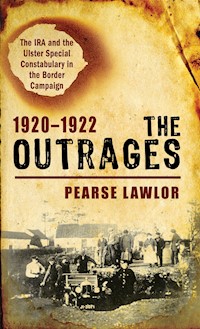
'The Outrages' gives an account of the major incidents, now slipping from local memory, as the War of Independence escalated from attacks on RIC barracks into internecine atrocities. The many lives lost in each border county are chronicled with factual accounts of attacks and reprisals, the impact these events had in Westminster and how Churchill, Craig and Collins reacted. Included are the events leading to the creation of the Ulster Special Constabulary and an in-depth account of the shooting of Specials at Clones railway station, the slaughter of eight unionists in a single night in south Armagh, the cover-up after Specials left three innocent nationalists dead and two wounded in Cushendall, and the litany of reprisal killings from Camlough to Desertmartin. Details of attacks on the Great Northern Railway and other networks, not previously published, provide a unique insight into the problems faced by railwaymen and by the government. A must read for anyone interested in this period of Irish history and a treasury for genealogists.
Sie lesen das E-Book in den Legimi-Apps auf:
Seitenzahl: 507
Veröffentlichungsjahr: 2011
Das E-Book (TTS) können Sie hören im Abo „Legimi Premium” in Legimi-Apps auf:
Ähnliche



















MERCIER PRESS
3B Oak House, Bessboro Rd
Blackrock, Cork, Ireland.
www.mercierpress.ie
http://twitter.com/IrishPublisher
http://www.facebook.com/mercier.press
© Pearse Lawlor, 2011
ISBN: 978 1 85635 8064
Epub ISBN: 978 1 85635 9665
Mobi ISBN: 978 1 85635 9658
This eBook is copyright material and must not be copied, reproduced, transferred, distributed, leased, licensed or publicly performed or used in any way except as specifically permitted in writing by the publishers, as allowed under the terms and conditions under which it was purchased or as strictly permitted by applicable copyright law. Any unauthorised distribution or use of this text may be a direct infringement of the author’s and publisher’s rights and those responsible may be liable in law accordingly.
Contents
Preface
1920
Unrest in Derry – many dead
Shantonagh barracks bombed
Police in gun battle as Newtownhamilton barracks burned
RIC wounded during attack on Crossgar barracks
Trouble at Cullyhanna leaves two dead
Man shot attacking Cookstown barracks
Frank Carty, O/C South Sligo, captured
The railway crisis
Transition of the UVF to Special Constables
Sir Basil Brooke and the Ulster Special Constabulary
Cardinal condemns Dundalk shooting
Further violence in Dundalk
Drumquin barracks attacked
Further Outrages on the railways
Unionist homes attacked
District inspector shot dead
Tempo barracks attacked
RIC shot in Derry
The Battle of Ballinalee
RIC sergeant shot in Ballymote
Newry head constable shot
Camlough barracks attacked
Camlough attack brings reprisals
Swanlinbar shooting
1921
New Year in Ballybay
RIC shot at Ballinalee
Attack on Camlough Specials – more reprisals
Ambushes as military seek to control Donegal
Special Constable dies in hunt for postman killers
RIC sergeant shot in Armagh city
Three die at Stranoodan
Ulster Special Constabulary fire on RIC in Clones
Clonfin ambush claims many lives
Ambush at Wattlebridge
Warrenpoint shooting
Attack at Ballyhaise railway station
Mountcharles ambush leads to reprisals
Frank Carty in Derry jail break
Roslea burns after attack on Special Constable
The IRA take revenge for burnings in Roslea
The IRA take revenge
Sheemore (Ballinwing) ambush, Carrick-on-Shannon
Ambush at Selton Hill, Leitrim
Attack on Richill station
Ballymote shooting
Donegal barracks attacked
Carrickmacross barracks survives attack
Informers executed
More violence in Derry
Specials shot on way to church
Ballinamore RIC shot
Outrage at Falkland’s Crossing
Reprisals after RIC sergeant shot in Dromore, Tyrone
Special shot in Newry
Two shot at Arva, Cavan
Clonmany Tans missing
Major incident at Lappinduff
Events in Letterkenny
Another death at Ballinalee
Specials ambushed at Mullaghfad
Attack on police patrol, one dead
More shot in Camlough district
Clergyman the latest victim
Ballybofey man dies in ambush
Belturbet man killed in bomb blast
Swatragh attack
County Armagh Special shot – reprisals follow
Shootings and reprisals in Dundalk
Peace hopes dashed as troop train ambushed at Adavoyle
Farmer shot at Buncrana
Special Constable shot in Newry
Woman shot dead – Specials suspected
Four more deaths in South Armagh
‘Tit for tat’ killing in Newry
Truce, 11 July 1921
Shooting at Ballycastle barracks
Michael Collins in Armagh
Two die in Derry jail
1922
Arrest of ‘Monaghan footballers’
Specials in south Derry raids
Shooting at Clady
Many kidnapped in IRA invasion
Butlersbridge blacksmith shot
More Specials sent to border
‘Unfortunate incident’ at Clones station
Special shot by own at Kinawley
Specials enforce own boycott
Specials stop dance
Two Specials shot – reprisals follow
Incident at Moyola Bridge
More trouble at Adavoyle
Specials prime target of IRA
Fermanagh border on full alert
Presbyterian minister survives attack by Specials
Catholic priest harassed by Specials
Attacks leave two Specials dead – reprisals expected
Adavoyle raiders back on track
Unionist homes in County Tyrone attacked
Northern offensive
Police patrol attacked – three dead – reprisals follow
Martinstown barracks attacked
The Desertmartin reprisals
Battles at Pettigo and Belleek
Another Special in accidental shooting
Newry shooting sparks sectarian killings
Royal Ulster Constabulary take control
Cardinal Logue stopped by Specials
Unfinished business in South Armagh
Eight die in single night at Altnaveigh and Lisdrumliska
Two Specials die in County Armagh ambush
Three dead and two wounded by Specials in Cushendall
Harassment of Cardinal Logue praised in Twelfth speech
Specials shoot another Desertmartin man, bringing total to five
Specials in the dock
Legless Specials found not guilty of arson
Specials die in ‘friendly’ fire
Major train crash at Castlebellingham
The holly and the ivy
PHOTO SECTION
Epilogue
Notes
Bibliography
Websites
About the Publisher
To Maura, Chris, Marie and Claire
PREFACE
For the people of Ulster the events taking place in the rest of Ireland during 1918–19 had little impact on their lives. It was something they read about in the newspapers. These events, however, signalled the birth of the Irish Republican Army (IRA) and the start of the War of Independence. As attacks on the Royal Irish Constabulary (RIC) gathered pace, the ripples of the violence spread northwards and by 1920 the war was on the doorstep, often literally, of the nationalist and unionist population in Ulster.
The war in the northern and border counties would have an additional dimension to that in the rest of the island. Unionists had armed themselves in 1912 as the Ulster Volunteer Force to resist ‘by all means’ nationalist rule in Ireland and by 1920 had reorganised to combat increasing attacks by the IRA. There was also a latent sectarianism, which bubbled to the surface each year during the Twelfth of July celebrations, and this had a significant impact in raising tensions, as religious animosity was added to the mix.
The Outrages seeks to record as accurately as possible the incidents and the killings by both sides during the period 1920–22 in the border counties and Northern Ireland and, for perhaps the first time, provides an open and frank account of the creation and activities of the Ulster Special Constabulary. Many of the incidents and atrocities committed by both sides in this area have been airbrushed from history, often as deeds best forgotten, or have disappeared from memory. Others, to the present day, remain firmly embedded in the psyche of northern nationalists and unionists as part of the ‘what aboutry’ of recent Irish history, where accusations on one side are answered with ‘well what about the time you …’ on the other.
Events in Belfast around this time, including the 1920 pogroms, have already been documented and I have written in The Burnings 1920 about the pogroms in Lisburn, Banbridge and Dromore. This book provides a new insight into life and death outside of Belfast, in rural Ulster and the towns and cities in the northern counties caught up in the conflict during 1920–1922. Some of the earliest IRA activity took place in County Donegal during 1919 and attacks on RIC barracks steadily increased, but it was in Derry that the full impact of the War of Independence registered with the northern unionist population. 1920 was to be the start of one of the worst and bloodiest periods of violence in Ireland’s history.
1920
UNREST IN DERRY – MANY DEAD
The changes in the political landscape of Ireland hit home when, for the first time since the siege of Derry in 1689, unionists lost control of Londonderry Corporation in the local government elections in January 1920. Following on from the landslide victory of Sinn Féin in the 1918 general election, this was a major blow to unionists in the city. The Irish Parliamentary Party and Sinn Féin councillors combined to ensure the election of Alderman Hugh O’Doherty, a Catholic, as lord mayor. O’Doherty went on record to say that he would not attend any function where there was liable to be a loyal toast. His view was that it would be the people of Ireland as a whole, not the ‘Protestants of Ulster’, who would decide the future of the island. This antagonised loyalists in the city and played to their fears that they might be abandoned when partition came. Unionist resentment and ill-feeling led to growing skirmishes with nationalists within the city.
In April 1920 republican prisoners captured in earlier skirmishes were being brought to Bishop Street jail, located in an interface area. The taunting between nationalist and unionist crowds gathered in the area became more aggressive as stones were thrown, and soon progressed to hand-to-hand fighting. This went on for an hour before spreading to other streets. The RIC barracks at Leckey Road came under attack by nationalists and at least six of the attackers suffered gunshot wounds. A couple of days later, with the Ulster Volunteer Force taking part in disturbances, shots were fired into the mainly nationalist Bogside district.
Because there were ex-servicemen among UVF ranks, they were able to persuade the British soldiers in the city to side with them. During a riot in Bridge Street, soldiers of the Dorset Regiment turned their guns on the nationalist crowd, which included women and children, to disperse them. The nationalists saw the partisan approach adopted by the British army in the city and reacted a few days later, on 15 May 1920, by attacking two soldiers on patrol. This led to further, full-scale riots.
The trouble culminated in an invasion of the Bridge Street area by armed UVF men on the same day. This time armed nationalists returned fire. As the police tried in vain to restore order, they too came under attack. Catholics were evicted, or fled, from unionist districts and vice versa. One of the casualties of this four-hour gun battle was Detective Sergeant Denis Moroney from the RIC Special Branch. He was shot as he, along with other police, pursued rioters along the quay.
The police and the military turned a blind eye to the activities of the UVF when, also on 15 May, armed and masked, they took control of Carlisle Bridge over the River Foyle, held up traffic and questioned pedestrians. Everyone stopped had to declare their religion. Any Catholic on the bridge at this time was assaulted.
The violence in the city continued and on Sunday 13 June a group of nationalists out walking at Prehen Woods, just outside the city, were attacked. This triggered further violence in the city. Rioting started in the nationalist Long Tower Street and Bishop Street, and by the end of the week had spread to a nationalist enclave of Union Street and Cross Street in the Waterside district on the other side of the River Foyle. Nationalist-owned homes were attacked, ransacked and set on fire on the night of Friday 18 June. The Derry Journal said that, ‘the streets had the appearance as if an avenging army had passed through them, so great was the destruction caused’.¹ Nationalist residents sought to escape across the river by ferry boat as the UVF still controlled the Carlisle Bridge, the only route across the Foyle, but the boats came under fire. It might have been expected that troops from the Dorset Regiment in the nearby Ebrington barracks would provide some protection, but residents later reported that men in military uniform had taken part in the attacks. The situation was rapidly descending into civil war.
On Saturday night the presence of troops and police on the streets did not prevent a loyalist mob from opening fire on the nationalist Long Tower at 9 p.m. Fire was directed from vantage points on the city walls and from the unionist enclaves of Fountain and Albert streets. The UVF took control of the Diamond and Guildhall Square and from Derry’s walls fired into the Bogside. The IRA, defending the nationalist area, were unable to equal the superior firepower of the loyalist UVF. The police called for reinforcements from Ebrington barracks, but a detachment from the Dorset Regiment did not arrive until two hours later, by which time four nationalists and one unionist had lost their lives. The trouble spread to William Street where a number of unionist-owned businesses were looted. The military immediately announced a curfew and replaced the loyalist gunmen, putting heavy-duty machine guns in position and unleashing a hail of fire into the Bogside, killing six more nationalists.² Far from bringing the situation under control, this only served to exacerbate it.
There was a calm of sorts on Sunday, but on Monday that changed with the killing of a Protestant. In the early hours of Monday, Isabella Waugh, owner of the Canadian House Hotel, heard the sound of marching feet and, looking out of her bedroom window, saw a military patrol marching up John Street. She was about to return to bed when she heard a whistle being blown and saw people going out onto the street. Curious, she stayed at the window and then heard a shot being fired. She noted the time: 5.30 a.m. She saw James Dobbin coming from the direction of Foyle Street, and as he approached the hotel she saw two men, later identified as Hugh McFeely and Robert Doyle, call on Dobbin to halt and put his hands up. She watched as McFeely (Feely in some reports) put a revolver to Dobbin’s side and fired. Dobbin slumped to the ground and the two men started to kick him. When they finally stopped she heard McFeely say, ‘That’s enough for him. We’ll throw him in the Foyle.’ She watched in horror as the two men grabbed Dobbin’s legs and dragged him away, his head bumping on the square setts of the road. They took him through the railway gates and threw him into the river.³
Later in the day the UVF resumed their checkpoint on Carlisle Bridge and openly patrolled, ignoring the presence of police. On Monday evening, they launched an attack on Bridge Street.
In the interim the IRA’s Derry City unit, which had neither the manpower nor the resources to compete with the firepower of the UVF, the RIC and the military, called for assistance. Peadar O’Donnell, responsible for the IRA in neighbouring County Donegal, responded, bringing men and weapons into Derry city.4 As a battle raged over the next two nights, a more confident IRA managed to displace UVF snipers firing from St Columb’s College on Windmill Hill, resulting in an estimated twenty UVF casualties. They then took control of the college and prevented the vantage point being used to fire into nationalist areas. This was the first effective action by the IRA in the city, and the deaths of loyalists tempered the UVF-organised violence. One of the victims was Howard McKay, son of the governor of the loyalist Apprentice Boys of Derry. When 1,500 extra soldiers were brought into the city on 23 June, the violence eased. The death toll of both nationalists and unionists in the city had reached forty.
Derry loyalists took advantage of the increased tension leading up to the 12 July celebration to stir up emotions in Belfast. At a meeting of the ultra-loyalist Belfast Protestant Association at the Workman & Clark shipyard in Belfast, a Derry loyalist told the assembled crowd how Sinn Féin had taken control of Londonderry Corporation. That, coupled with attacks on the nationalist community in Banbridge, Dromore and Lisburn, and a speech made at the ‘Field’ in Finaghy, when Edward Carson addressed thousands of Orangemen, resulted in the outbreak of unprecedented sectarian violence on 21 July in Belfast.
SHANTONAGH BARRACKS BOMBED
On the evening of 15 February around thirty IRA Volunteers, under the command of Eoin O’Duffy and Ernie O’Malley, attacked the RIC barracks at Shantonagh, a junction on the Great Northern Railway Company’s railway network in County Monaghan.5 A number of prominent Volunteers including Dan Hogan, James McKenna, Terry Magee, Charlie Emerson, John McCann, James Flynn, Phil Marron, P. J. Daly and Matt Fitzpatrick were involved. Located seven miles from Castleblaney, the barracks was a substantial building usually manned by six officers. With help from the Latton Volunteers, approach roads had been either trenched or blocked with felled trees to prevent reinforcements reaching the barracks during the attack. The final act was to cut the telephone wires, left to the last, as a dead telephone wire was an indication to the police that an attack might be about to take place in the vicinity.
Wearing white armbands for identification, the Volunteers moved in. They gained access to a building adjoining the barracks and planted gelignite in the wall to blast their way in. The sound of the explosives being placed in the wall most probably alerted the RIC, who had retired for the night. They immediately took up defensive positions with their rifles at loopholes in the walls and at the sandbagged windows.
Around 2 a.m. the Volunteers opened fire on the barracks and called on the RIC to surrender. The request was greeted with return fire. The RIC were prepared to put up a fight. There was a stand-off for a considerable period and eventually the order was given for the gelignite to be prepared for detonation. A final call was made for the policemen to surrender or be blown out of the barracks. There was no response. Inside the barracks, the two sergeants – Graham, a Protestant who had only been in post three days, and Lawton (Lawson in some reports), a Catholic – debated what to do. Lawton feared for his life if he surrendered, as he had been responsible, while at another barracks, for the arrest of a large number of Volunteers. As they discussed the matter, there was the sound of three long blasts on a whistle. The order to detonate the bomb had been given.
The bomb blew a gaping hole in the wall of the barracks, bringing the upstairs floor crashing down. The Volunteers climbed in through the rubble to find the policemen in a state of shock, covered in dust and some buried in the debris. The Volunteers set about collecting as many rifles and revolvers and as much ammunition as they could. Their haul included a Verey pistol and twelve hand grenades. By 5 a.m. the IRA had disappeared into the night with their captured weapons.6 They used a stolen car to transport the weapons and had left an escape route free from obstructions. All went well until the car ran out of petrol near Clones. Despite this setback, everyone made it back home and the weapons were secured.
Four of the RIC officers – Sergeant Lawton and Constables Gallagher, Murtagh and Roddy – were later treated for their injuries in Carrickmacross hospital. Sergeant Graham later said that he had walked the nine miles to Carrickmacross to seek medical attention, as he had been unable to drive because the road was blocked with felled trees. Constable Nelson and Sergeant Graham survived uninjured.
While the capture of police barracks in other parts of Ireland had become a regular occurrence, this was the first RIC barracks in Ulster to be captured by the IRA. Its capture led to the closure of other isolated barracks in Inniskeen, Cullaville and Clarebane. In May that year, the IRA burned all the abandoned barracks.
The military and RIC devoted considerable resources to tracking down those who had taken part in the attack. By mid-March Eoin O’Duffy, Dan Hogan, Phil Marron, Johnny McCabe, Jimmy Winters, Jack McCabe, George McEnearney, Tom Clerkin, Frank Fitzpatrick, Frank Sheridan, Tom Heuston, James McKenna and Matt Fitzpatrick had all been arrested and taken to Crumlin Road jail in Belfast.
POLICE IN GUN BATTLE AS NEWTOWNHAMILTON BARRACKS BURNED
A year after a raid on Adavoyle Orange Hall on 7 January 1919 to obtain guns, a few miles away in the village of Newtownhamilton, a more ambitious plan was implemented. The Volunteers planned to bluff an entry into the RIC barracks, to overpower the police and take their stock of weapons and ammunition. If everything went according to plan they would then burn the barracks.
Early in February forty men dressed in British army uniforms marched up to the large two-storey barracks and demanded admission. The officer on guard duty, unaware of any military patrol in the area, was suspicious and refused entry. As the men waited outside, a crowd started to gather in the mainly loyalist village. The group then marched away, the locals unsure of what was happening.
However, they returned later with a more audacious plan that had all the hallmarks of twenty-two-year-old Francis Thomas Aiken from Carrickbracken, Camlough, who was the commander of the 4th Northern Division of the IRA.
On the night of Sunday 9 May, six police officers and the sergeant’s family had settled down for the night. The shutters were in place on the lower windows of the Newtownhamilton RIC barracks, and the steel bars on the windows and the barbed wire along the front of the building gave them some sense of security.
Outside over 200 IRA men under the command of Frank Aiken were engaged in blocking all roads into the village with felled trees. Telegraph and telephone wires had been cut and men stood in the shadows in Newtownhamilton Square to prevent anyone approaching the barracks to alert the police about what was taking place. With the village sealed off, the IRA took up positions in disused houses opposite the barracks. Frank Aiken, after the previous failure to take the barracks, was determined that this time he would succeed.
At 12.30 a.m. the attack began and the sleeping village was awakened by gunfire directed at the barracks. Those who were tempted to put their heads out of windows or doors to see what was going on were dissuaded by shots fired along the streets. After the first fusillade, there was silence as the police were called on to surrender. The response was a hail of fire from the barracks.
Inside the barracks, the sergeant’s wife, Mrs Traynor, brought her two daughters away from the front of the building to a safer location. She returned, crawling along the floor, and assisted her husband and his five constables by supplying them with ammunition. Fearing the worst, she began to prepare bandages.
The gun battle continued for two hours with no sign of the police surrendering or being dislodged from their barracks. With a barrage of covering fire, Volunteers gained entrance to a public house that formed part of the barracks building. The owner, sixty-year-old bachelor Patrick McManus, a retired policeman, was taken to the back of the pub, bound and held in an outhouse. Inside, holes were knocked in the wall that separated the pub from the barracks. With sticks of gelignite and detonators stuffed in the holes and fuses lit, the IRA withdrew. The resulting explosion breached the wall and the IRA, with weapons blazing, entered the barracks. The police had retreated to the back of the barracks where they again resisted the onslaught of fire. Called on again to surrender they refused, realising that it was a life or death battle. Little had been gained by breaking into the barracks as the police continued to fight, forcing the IRA to withdraw.
In an innovative move, Aiken had brought a new weapon with him – the humble potato sprayer, a portable metal container that could be strapped to the back of the operator allowing him to pump liquid with one hand and direct the spray through a tube and nozzle with the other. With the police pinned down, the barbed wire along the front of the barracks was cleared away and men with sprayers filled with petrol or paraffin began to spray the flammable liquid through the smashed windows, on the front of the building and on the barracks’ door. A match was thrown and the building erupted in a mass of flames. The fire quickly took hold, burning through the upper floor and igniting the rafters. The police, forced to evacuate the building, moved, along with Mrs Traynor and her children, to the yard and outbuildings at the rear of the barracks.
With the building well alight, the roof about to collapse and dawn fast approaching, the IRA knew that the flames were bound to alert other police or military in the area, if the sound of gunfire had not already done so. The roadblocks would delay their arrival, but their presence would hinder the Volunteers’ withdrawal. At 5 a.m. the beleaguered police realised that it was silent and that the IRA had departed. They had again failed to obtain arms and ammunition from this barracks and had to be satisfied with its destruction.
The police had made a valiant effort to protect their barracks and their bravery was recognised later that year on 19 November, when Sergeant James Taylor (55) and Constables Michael Doyle (27), Richard Gray (27), Robert McWhirter (31), William Small (27) and Foster (first name and age unknown) were awarded 1st Class Favourable Records and a Constabulary Medal.7
RIC WOUNDED DURING ATTACK ON CROSSGAR BARRACKS
In June there was a serious, albeit botched, attack on the barracks in Crossgar in County Down. Newspaper reports that 200 or 300 Sinn Féiners had carried out the attack in the early hours of Tuesday 1 June alarmed unionists in the county. Roger McCorley from Belfast led the attack along with local man Hughie Halfpenny from Loughinisland.8
Following the usual pattern of cutting telegraph wires and barricading approach roads, the IRA began their attack. They broke into the homes of Michael Morrison and Robert Dickson on either side of the barracks, which formed a terrace in Downpatrick Street, the main road through the village. The noise alerted the RIC officers, and Sergeant Fitzpatrick and Constables Carey, Collins, Murphy, Ramsey and Wilkie grabbed their rifles to take up positions at the steel-shuttered and sandbagged windows of the two-storey barracks.
Meanwhile, the IRA men drilled holes for explosives in the adjoining walls of the barracks. The plan was to breach the walls, to pump petrol into the barracks and then to toss in a Mills hand grenade to set the petrol and the barracks on fire. As the drilling continued, the police frantically sent up Verey distress lights, which lit up the whole area. On the opposite side of the street, the IRA had taken possession of a house that happened to be Constable Wilkie’s home. From there they opened fire on the barracks; Sergeant Fitzpatrick was seriously wounded in the chest and Constable Carey grazed by a bullet. Residents in the street, awakened by the noise, peered cautiously through their windows at the battle that was taking place in the street.
The plan to blow up the barracks went wrong. The Volunteers lacked a basic knowledge of explosives. The gelignite that had been placed in the walls had not been properly tamped, with the result that when it was detonated the explosion blew back, causing minimal damage to the barracks but blowing out the windows in the adjoining houses. As daybreak approached, two hours after the attack had started, the IRA made their escape on bicycles, leaving behind their sledgehammers, crowbars, gelignite, petrol and a sprayer. It was not until around 9 a.m. the following morning that Sergeant Fitzpatrick was evacuated and taken by lorry to the County Infirmary. He survived and retired after a full period of service a few weeks later.9
TROUBLE AT CULLYHANNA LEAVES TWO DEAD
On Sunday evening, 6 June, RIC Sergeant Timothy Holland, Constable Raisdale (Rossdale in some reports) and Constable Rafferty, all from Crossmaglen barracks, were in Cullyhanna to police an outdoor entertainment event in the village. At around 8.15 p.m. the sergeant was standing between McGreeney’s public house and the school, near the barracks which had been burned out in an attack on 5 April. The crowd, in good humour, singing and shouting, was beginning to drift off home. The sergeant was probably unconcerned when a group of men walked into the middle of the road more or less in front of him but, without any warning, shots were fired, wounding him in the arm and stomach. He managed to return fire before taking refuge in the public house. Constable Raisdale, who had been close by, was also wounded and he too took refuge in the pub. Prepared to put up a fight, Sergeant Holland asked Raisdale to reload his revolver, but the attackers had gone.
Sergeant Holland took seven direct hits before he got to the safety of the public house and Constable Raisdale received a bullet wound to his head. Later a doctor’s report described brain matter protruding from his head. It is unlikely in those circumstances that he could have helped his sergeant reload his revolver.
Constable Rafferty was set upon by the crowd, his revolver stolen, and he was severely beaten before making it to safety. He never recovered from the trauma of the beating and the shooting and had severe mental problems for the rest of his life.10 A civilian, Peter McCreesh, from Annaduff, Forkhill, was struck by the gunfire and died. A man named Donnelly from Whitecross was wounded.
The policemen were taken the twelve miles to Dundalk infirmary in a passing motor car. When Sergeant Holland’s wife, Mary Josephine, rushed to his bedside, he told her, ‘I forgive the man who shot me and I want you to do the same.’11 He died on 9 June and the following evening his remains were taken to the Friary church in Dundalk. The next day, after the funeral mass, his coffin, draped in a Union Jack with his belt and tunic on top, was placed on a gun carriage drawn by six black chargers provided by the Royal Field Artillery. Twelve artillery soldiers, with arms reversed, headed the cortège as it made its way to the railway station where the coffin was placed on the 10.22 a.m. train for Belfast.
Large crowds gathered at the Great Victoria Street railway terminal to wait for the arrival of the train and to watch as the coffin was carried to a waiting hearse. There was a natural curiosity in Belfast at this time about the shooting of an RIC officer. The execution, by the IRA, of another RIC officer, Divisional Commander Lieutenant Colonel Gerald Ferguson Smyth in Cork in July that year and the assassination of District Inspector Oswald Ross Swanzy in nearby Lisburn in August brought unprecedented sectarian violence to the streets of Belfast.12 However, funerals such as that of Sergeant Holland soon became almost a daily event in the city and the curiosity factor quickly waned.
Sergeant Holland, a thirty-seven-year-old with five children, was interred, with full military honours in Belfast’s Milltown cemetery.13 His wife, living in Cavendish Street, in the Falls Road district of Belfast, later lodged a compensation claim for £10,000 in respect of the loss of her husband. She was awarded £2,600.
At the inquest into the deaths of Holland and McCreesh, Head Constable Gallagher from Dundalk claimed that Sergeant Holland had been able to return fire and had hit his assailant, allegedly Peter McCreesh, several times in the stomach. This testimony was later rejected when it was confirmed by Dr Cronin that McCreesh had been hit in the back, as he fled the scene of the shooting. Patrick McCreesh, Peter’s brother, said that he and Peter were sitting on a wall opposite the police and when they heard the shots he said, ‘It’s time to get out of here.’ Peter had been shot as he was running away. Patrick described seeing Sergeant Holland firing from his revolver as he walked backwards to take cover. Fr Gogarty, who had attended to the wounded and dying officers in the public house and given the last rites to Peter McCreesh and Sergeant Holland, said that he had heard between eighteen and twenty-two shots fired during the incident.
As always, there was another version of the incident. This version recorded that when the crowd was drifting off, they were singing songs termed as ‘seditious’ and were taunting the police on duty.
All that we can be certain of is that some members of the crowd were armed and opened fire on the police, who returned fire, and it appears that no one was ever charged with the shooting.
MAN SHOT ATTACKING COOKSTOWN BARRACKS
There was an upsurge in attacks on RIC barracks. In one such attack, on 17 June, when local Volunteers assisted by others from Dungannon and Keady attempted to take Cookstown barracks, they met with stiff resistance from the police. In a brief gun battle, one of the Volunteers, Patrick Loughran, received a bullet wound in the stomach from which he later died. He was the first IRA man to be killed on active service in the six counties.14
There was, however, more to this attack than meets the eye. Constable Bernard Conway, a native of Cliffony, County Sligo, whose brother Andrew was a leading member of the IRA in north Sligo, had been serving in Cookstown barracks. Also stationed in the barracks with him were Thomas Hargaden, Denis Leonard and John O’Boyle, all from the west of Ireland and all sympathetic to Sinn Féin. They had decided to help the IRA raid their barracks. The date set was 17 June and the time 2 a.m. Although Conway and O’Boyle were on temporary duty at nearby barracks that night, it was decided to proceed with the plan. Leonard quietly came downstairs about 1 a.m. and, as arranged, unlocked the back door. Thomas Hargaden was on night duty in the barracks, and when the IRA arrived he allowed himself to be tied up. Leonard directed the IRA to the arms and ammunition store and helped gather up the weapons. While the rest of the police in the barracks slept, one of the Volunteers tried to enter the bedroom of Head Constable Henry O’Neill, who woke and called out. Shots were fired. The other policemen in the barracks were then alerted and engaged with the IRA, shooting Patrick Loughran.
The attack was reported to the RIC in nearby Dungannon and a number of officers set out to assist their colleagues. On the way, they encountered a car coming from the Cookstown direction and flagged it down. In the car was the wounded Patrick Loughran. He was taken to Dungannon hospital, but he needed an urgent operation and was transferred to the Mater Hospital in Belfast, where he later died.
Constable Leonard was dismissed from the force and the three other constables resigned three months later.15
FRANK CARTY, O/C SOUTH SLIGO, CAPTURED
Sligo, the home county of Constable Conway, had also experienced attacks on both barracks and the homes of unionists in the search for weapons. One of the most active Volunteers in this area was Frank Carty, from Clooncunny outside Tubbercurry, who had been a member of the Irish Republican Brotherhood (IRB) before the 1916 Rising. He had made a name for himself when one October night, as he was returning by train to Sligo, he found himself in the same compartment as a British soldier making his way home on leave. He decided to disarm the soldier, took his rifle from him and dropped it out of the window as the train approached Collooney station. When he got off the train at Collooney he walked down the track, recovered the rifle and took it home.
He became the commandant of the 1st Battalion of the Tubbercurry Volunteers, and under his leadership they were successful in raiding the homes of unionists and capturing arms and ammunition. However, on a raid on the home of Colonel Alexander Perceval at Templehouse, things went wrong.
It was decided to try to catch the Perceval family off guard by launching a raid mid-morning, and the opportunity came at 10.30 a.m. when the colonel and Hugh Bracken, his gamekeeper, left the house, got into a car and drove off. The Volunteers approached the house armed with a sledgehammer to break down the front door, but when the door refused to yield they had to break in through a window. The colonel’s wife, despite being pregnant at the time, put up a spirited defence, threatening the intruders with a spear, and even as she was being tied up managed to rip the mask off one of the Volunteers. A number of small arms and shotguns were found and taken away.
When the police were informed about the robbery they conducted a number of follow-up raids in the Tubbercurry area and arrested fourteen men, including Frank Carty. He was later identified by Mrs Perceval as one of the raiders and was remanded in custody in Sligo jail. His trial was adjourned on a number of occasions, as Mrs Perceval was ill, having had a miscarriage.
While in custody, Carty learned that he was to be sent to Derry for trial and he knew that he would have no chance of being acquitted so an escape plan was hatched. It was an ambitious plan as the military barracks was only half a mile from the jail and there were two well-manned police barracks in the town. Nevertheless, on the night of 26 June, Volunteers from Sligo town and from north and south Sligo joined forces to free Carty. The men from south Sligo arrived in two cars, which were parked not far from the cemetery, and made their way on foot through the fields towards the jail. The men from Sligo town had earlier obtained long ladders and these had been hidden near the jail. The plan was to use the ladders to scale the prison wall and to use rope ladders to climb down the other side.
Roads leading to Sligo were blocked and large iron gates were placed across the road leading up to the jail. With everything in place, thirteen Volunteers climbed up the ladder and entered the jail. Two, Liam Pilkington and Seamus Devins, overpowered the night patrolman and the warder in charge of the alarm bell. As a sympathetic warder had provided details of the layout of the jail, they knew exactly where to go and where the night staff would be located. The next step was to go to the prison governor’s residence, wake him and demand that he provide them with the keys to the cells. He did so and was tied up.
The Volunteers went to Carty’s cell and released him. It had been decided that it would be too risky and too slow for the fourteen men to climb the rope ladder to make their escape so at a prearranged signal the main doors of the jail were smashed in. It was said that the noise could be heard all over the town. By 1 a.m. Carty and his rescuers had disappeared into the night.
Surprisingly, given the close proximity of the military barracks to the prison and the noise made as the prison doors were smashed open, it was some time before the alarm was raised. When it was finally sounded a lorry load of soldiers was dispatched to the jail. As they rushed to their destination, in the dead of night, they ran into the heavy iron gates that had been placed across the approach road to the jail and crashed, injuring a number of soldiers. Meanwhile, Frank Carty was on his way to a safe house in the Coonacool district. He remained ‘on the run’, spending a lot of time in secret dugouts in the Ox mountains west ofTubbercurry.
The IRA in County Sligo were particularly keen to get their hands on some gelignite and the Volunteers in Ballymote/Gurteen came up with an ingenious plan. They knew that gelignite was used for blasting at a quarry outside Ballymote but the problem was that when a consignment was taken there it was escorted by a large number of RIC. They would have to find a way to get the RIC off guard in an ambush situation. The plan was to stage a mock funeral. Thady McGowan and the battalion O/C, M. J. Marren, were both carpenters so they made a coffin and had it varnished.
When the next consignment of gelignite was to be brought to the quarry Volunteers took up positions, under cover, at a sharp bend on the approach road. About thirty other Volunteers gathered nearby and four of them hoisted the empty coffin onto their shoulders. The remainder, with caps removed, lined up behind the coffin in a funeral procession and slowly made their way down towards the bend in the road. They knew that when they met the RIC patrol the policemen would dismount from their bicycles, remove their caps and stand respectfully at the side of the road while the cortège passed. They would then throw the coffin to the ground and, with the support of the men in hiding, disarm the police and make off with the gelignite. That was the theory, but the problem was that on that particular day the RIC did not turn up.
As they stood around smoking cigarettes and wondering what to do, Mr Kirwin, the county engineer, came up the road in his car. He stopped at the sight of the funeral procession and was held at gunpoint. When his car was searched, they found gelignite. Kirwin had decided that an escort would not be necessary that day. He was relieved of the gelignite and allowed to proceed.
Had the original idea gone to plan there was every possibility that the coffin would have found an occupant.
THE RAILWAY CRISIS
One of the more significant elements of the War of Independence was the refusal by Irish railway workers to transport government forces, munitions or military supplies. In a politically motivated industrial action the railway workers declared the ‘munitions strike’ in May 1920. Support was not universal, with railway staff in the north-eastern part of Ireland dividing predictably on religious and political grounds, adding to the sectarian strife in the north of Ireland. The strike continued until December 1920, when the railway companies set about dismissing strikers. Skilled men such as engine drivers were later re-employed on condition of signing an undertaking that they would obey orders and do their duty in future.
However, the trouble for the rail network in Ireland was only beginning, as the IRA set about implementing a policy of attacks on trains to intercept mail as part of intelligence-driven operations and later as part of the economic war on the north of Ireland which became known as the Belfast Boycott. The violence that had erupted in Belfast and other towns, such as Banbridge and Lisburn, resulted in the expulsion of Catholic workers from the shipyards and factories and from their homes. To bring pressure on the British government to help alleviate the suffering of these nationalists, the Sinn Féin government in Dublin introduced a boycott on goods produced in the towns where the nationalist population suffered most. Bishop McCrory and the Catholic church supported the boycott.
The IRA set about enforcing the strike and the boycott in what became known in Britain as the Railway Crisis. Attacks on trains became an ongoing and increasing problem. One of the earliest incidences occurred on 2 June at Donaghmore, outside Dungannon, when members of the 2nd Northern Division of the IRA held up the night mail train, having moved into and taken control of the village. The train was stopped and the mail searched before it was permitted to continue its journey to Derry.
In County Cavan, the IRA were also gathering intelligence by raiding mail trains. The railway line from Clones to Cavan passed through the isolated station of Ballyhaise, a surprisingly large station given that it was not close to a town. Its main purpose was to provide a branch line to Belturbet. On 24 June Volunteers took control of a signal box and ordered the signalman to bring the Clones to Cavan mail train to a stop in the station. Waiting at the footbridge was another group, and when the train came to a stop the driver, fireman and guard were held at gunpoint. The Volunteers then began a leisurely search of the mail on board, taking with them letters addressed to the RIC. A considerable sum of old age pension money, also in the mail van, was left untouched. With the mission accomplished, the train was permitted to proceed and the Volunteers melted into the countryside.
The first incident where railway staff in County Fermanagh refused to transport British soldiers took place at Enniskillen on 28 June. A company of soldiers arrived at Enniskillen on the 1.30 p.m. train from Ballyshannon and crossed the platform to continue their journey to Sligo on a Sligo, Leitrim and Northern Counties Railway train. When they had taken their seats, the driver refused to take the train out of the station if they remained on board. There was a heated discussion between the officer in charge and the engine driver, who was adamant that the train would not move unless the soldiers got off. The officer eventually ordered his men to leave the train and marched them to Enniskillen military barracks. The train then pulled out of the station.
While the refusal of railwaymen to transport military, armed police and military supplies received popular support among nationalists as a means of paralysing the British war machine in Ireland, there were incidences where the IRA enforced the strike through intimidation. Intimidation of railway staff came from two sources. The railway companies dismissed staff sympathetic to ‘the cause’ who refused to man certain trains. Those who were lukewarm to ‘the cause’ or those who opposed it were subject to intimidation by the IRA.
In Dundalk, on 5 July, two drivers – Quigley from Seatown and MacDonald from Hill Street – were threatened and shots were fired at their houses as a warning that they would be in line for severe punishment if they continued to work trains carrying armed police or soldiers. On the same day driver Heuston and fireman Kennedy were taken from their beds at 1.30 a.m. and driven away in motor cars. It was assumed that it was because they had worked a train in which police travelled, but the real reason may have been to prevent them from manning an early morning train taking police or military to the Cavan assizes.
Other threats came via the BelfastNews Letter. In an article about the railway strike it commented, ‘Dundalk has always been a disloyal railway centre and the transfer of the repairing shops to Belfast or Portadown has been mooted more than once …’ The threat was that the giant railway workshops, a major employer in Dundalk, would be transferred to a loyalist area if the strike continued.
On 13 July five railwaymen, foreman porter David Conn, ticket checker J. Montgomery, fireman Edward Douglas and guards John McNeill and Hugh Kierans, were taken from their homes or lodgings in Clones at gunpoint, blindfolded and driven away in motor cars. It was speculated that the men had worked trains conveying munitions or armed military or police, or had taken the place of men dismissed for refusing to do so. The men later, when questioned by newspaper reporters, said that they had been taken across a lake but did not know where they were held. They were in fact held captive in a small cottage on an island in Lough Erne not far from the family home of Matt Fitzpatrick and his brothers.16 The men were kept there for forty-eight hours and forced to sign an undertaking that they would not take the place of any men dismissed by the Great Northern Railway Company for refusing to transport armed police or military. Blindfolded, they were taken back across the lough to Butlersbridge, County Cavan, and released.
Ambushes on the railway in the north of Ireland became an almost daily occurrence. The drivers had to decide whether to stop when faced with red signals or to ignore the signals and drive on. On 15 July a driver faced such a dilemma. The 12.40 a.m. goods train on its way from Dublin to Belfast was approaching Adavoyle station, north of Dundalk, when the driver saw three red lights held up by men standing at the crossing gates, which were closed against him. The driver, realising that it was an ambush, increased speed and smashed through the wooden crossing gates, sending the Volunteers scattering in all directions. It was an unsuccessful night for the Adavoyle Volunteers. The engine was undamaged and the sixty-five wagons rolled over the crossing and into the night.
On 17 July a night goods/mail train was making its way to Derry. At 1.20 a.m. five men entered the signal cabin at Donaghmore station and forced the signalman to set the signal at red to stop the train in the station. When it came to a halt about fifty IRA men appeared out of the darkness and held up the train crew, all Derry men heading home to finish their shift. They were made to kneel on the platform and swear that they would not work any trains containing munitions or military stores. The mail sorters in the mail van were held at gunpoint as the raiders seized letters addressed to police headquarters at Omagh, Derry and Enniskillen and any envelopes marked ‘On His Majesty’s Service’. The whole incident lasted just over an hour and they made a leisurely departure, driving off in waiting motor cars. A couple of bags of general mail were later found discarded on the railway line between Carrickmore and Pomeroy. The bags contained about 600 letters, postcards and circulars. The letters had been opened and marked with the inscription ‘PBC – IRA’ – presumably ‘Passed by Censor – Irish Republican Army’.
What was significant about these raids was that large numbers of armed men could assemble without being disturbed by the police. Not only were the IRA confident about not being challenged during the night, they were also sufficiently confident to conduct daylight attacks. Engine driver Bernard Duffy had driven a Dundalk to Derry train carrying twenty-five armed RIC men. The guard on the train, Andy Breslin, refused to work the train when he saw the RIC men get on board and was subsequently dismissed. He may have informed the IRA that Duffy had been the driver.
On the morning of 17 July, Duffy pulled into Inniskeen station at 6.45 a.m. with a train packed with passengers heading for the Ballybay fair. Volunteers who had mingled with the crowds on the platform quietly approached the engine and, producing revolvers, ordered Duffy and his fireman, Edward Kerr, both Dundalk men, down from the footplate and escorted them out of the station. The only person to witness this was the stationmaster and, possibly considering that discretion was the better part of valour, he ignored what was going on. It was only when a railway inspector on the train, who became concerned about the delay in departing, approached the stationmaster that he learned of the kidnapping. The stationmaster drew his attention to a motor car that contained the driver and fireman as it passed over a visible stretch of road almost a mile from the station. The other Volunteers had made off on bicycles. Both men were released the following day, having signed an undertaking not to carry munitions, armed police or military.
Not all drivers got off as lightly as Duffy. The following Monday morning, 19 July, engine driver Michael Magee left his home in Barrack Street, Dundalk, and made his way to the railway station where he was to take the 8.45 a.m. train to Enniskillen. As he walked across town, he was accosted on Jocelyn Street by six youths armed with revolvers. They took him to Gogarty’s yard in nearby Francis Street, pulled off his jacket and shirt, tied his hands behind his back and gagged him with a handkerchief. They then poured tar over him, left him lying on the ground and ran off.
He managed to free himself and, still covered with tar, continued on his way to work. When he reached the railway station he borrowed a shirt from a member of staff at the station and, determined not to let the IRA get the better of him, got onto his engine and took his train to Enniskillen where he was able to get the tar removed. He later stated that the reason for the attack was that he had conveyed troops to their camp the previous week. The chairman of the Great Northern Railway later told the chief secretary for Ireland that ‘a driver has been tarred and feathered … not withstanding which he drove his engine despite his deplorable condition and generally speaking the staff know that it is safer to refuse to work government traffic than to do their duty’.17
The IRA kept up the pressure on railway workers at Dundalk and shortly after the attack on Michael Magee they visited the signal cabins at Dundalk station and forced the signalmen to sign the now familiar undertaking. This was not an option to be taken lightly, as refusal to work such trains would lead to instant dismissal from what was a good and steady job. On 24 July a Dublin to Belfast troop train was held at signals when three signalmen refused to pass it. They were immediately suspended.
Drivers had various ways of dealing with the transport of troops. On the same day as his colleagues in Dundalk refused to pass the troop train, a Dundalk driver in Enniskillen was to take a hundred men of the Rifle Brigade from Enniskillen to Dublin, so when all the soldiers were on board he simply uncoupled the carriages containing the soldiers and drove off leaving them stranded in the station. He was also suspended.
While the IRA threatened railway staff because they transported armed police or military, the UVF threatened an engine driver because of his perceived political affiliations. John Somers arrived in Banbridge at 2 p.m. on 24 July with a Newcastle to Belfast goods train. When he brought his train to a halt a number of men approached his cab and ordered him onto the track. He was taken away at gunpoint and bundled into a commandeered car. Somers was known to have Sinn Féin sympathies and made no secret of his support for the party. It was only when he was taken to an unknown destination that his UVF kidnappers discovered he was a Protestant. He was returned to the station unharmed and ordered not to return to Banbridge.
On the evening of 29 July, the Bundoran to Dublin goods train was held up at Newtownbutler and the guard, Wallace, was taken from the guard’s van by the IRA and driven off. The destination was not known at the time, but in all likelihood he was taken across the narrow stretch of water to Derrykerrib island in Lough Erne. His crime had been to take the place of a guard who had refused to work a troop train. He was later released unharmed.
The month of July ended with driver Frank McPhillips and fireman Kirkwood being abducted when their train was stopped at Newbliss at 10.30 a.m. The men were taken away in two cars and later returned unharmed. A passenger named Hamill on the train, a railwayman with experience as a fireman or an engine cleaner, went up on the footplate and monitored the engine until a back-up crew arrived on the next train from Dundalk over an hour later.
The attacks on goods trains did not inconvenience the public greatly, but delays on passenger trains, such as that experienced at Newbliss, resulted in the IRA losing sympathy from nationalists caught up in these events. The whole issue of the strike divided railway staff on political and religious grounds, none more so than those employed on the Great Northern Railway. At meetings of railwaymen in Newry in early August it was claimed that 75 to 98 per cent of the GNR staff were ‘prepared to handle munitions or any other government traffic handed to us for conveyance’.18 The IRA reacted to this announcement a few days later on 8 August, when the 10 p.m. train from Warrenpoint entered Newry’s Edward Street station. When fireman William McKee from Ballinacraig and driver Edward Fulton (50), 7 Caulfield Place, Newry, alighted from the footplate both men were held at gunpoint. They were tied back to back and their jackets ripped open. One of the gang then proceeded to tar both men with a brush. The tar had been stolen the previous night from Newry Council’s yard. When the sound of the approaching footsteps of the night watchman was heard the gang threw the two men onto the ground and ran off.
A young man was later arrested and the following morning, with a military escort of about thirty soldiers, he was taken from Edward Street to Goraghwood where he and the escort party changed to a train arriving from Dublin. When the driver of the Dublin train saw the armed soldiers, he refused to continue on the journey. The train sat in the station for almost half an hour until a Newry driver arrived and the train eventually proceeded to Belfast.
Events in Dundalk took a sinister turn when a gun was used to enforce the strike. Engine driver Owen McKeown from Dublin had taken a train from Dublin to Dundalk and was sitting in a hut at the station waiting to take a return train at 1 a.m. when three armed men approached him. He was ordered out of the hut and shot in the leg. It was later discovered that he had been wrongly accused of driving a troop train.
Signalmen played an important part in frustrating the transportation of troops. On 12 August two special trains brought a battalion of the Argyll and Sutherland Highlanders to Enniskillen via Clones. The signalman at Clones refused to clear the trains through Clones junction and was immediately dismissed. The delayed trains eventually made it to Enniskillen, where the soldiers were welcomed with the pealing of church bells playing Scottish airs. Attacks on trains by the IRA were to continue, but a plan to challenge the ability of the IRA to conduct these and other attacks was beginning to evolve.
TRANSITION OF THE UVF TO SPECIAL CONSTABLES
The UVF, a superbly well-organised and equipped, albeit illegal, organisation, known as Carson’s Army, had been formed in 1912 to resist ‘by any means’ the introduction of Home Rule in Ireland. The Great War had taken Home Rule off the political agenda and many UVF members fought and died in the 36th Ulster Division. With the ever increasing threat from the IRA in 1920, meetings were taking place in Orange halls throughout the north of Ireland to reorganise the UVF. The identification of the crown forces with the UVF was endemic and had been the case since the force was founded. Capt. F. Hall, military secretary to the UVF, recalled in May 1914:
At Lisburn, the signal to mobilise was given on the factory hooters, when they sounded a sergeant RIC (Roman Catholic) and four constables (Protestant) were just having their tea. The four constables dashed upstairs, put on plain clothes and were off. They went to the local Battalion Commander and asked if it was business or only a test mobilisation. He assured them it was only a test. ‘Oh well!’ they said, ‘then we needn’t lose our jobs yet!’ and went back and got into uniform.19
Six years later, the UVF was again active in Lisburn and adverts to recruit new members were placed in the local newspaper. While rioting in Lisburn in July had resulted in the looting of nationalist-owned shops and general destruction, riots in the following month were more sinister. In a methodical manner loyalist rioters set about looting and burning practically every nationalist-owned business and home in the town. Those that could not be burned because they were part of terraced houses had their furniture taken out and burned in the street. There was complete anarchy in the town as the local RIC was unable to contain the violence, and even when four detachments of soldiers were brought in they were largely ineffectual as it appears they were ordered not to open fire under any circumstances. The officer in charge of the soldiers, Sir Hacket Pain, was responsible for the logistics of the transfer of UVF guns and ammunition smuggled into the north of Ireland, and also played a major role as chief of staff of the UVF.20 Knowing that one of their own was in charge, the rioters ignored the army’s presence and continued with what could be only described as ethnic cleansing.
The problem facing Lisburn urban council was that the rioters, drunk on looted alcohol, were completely out of control, and unionist-owned businesses were being consumed by flames from attached nationalist businesses. The UVF failed to control the loyalists, some flocking in from outlying districts to take advantage of the complete breakdown of law and order to loot and steal. Council officials, under the chairmanship of Dr George St George, a local surgeon, convened a meeting on Saturday 28 August, in the town’s Assembly Rooms ‘to consider the advisability of enrolling Special Constables for the preservation of peace and the protection of property in the urban district’ according to the Lisburn Standard.




