


66,99 €
Mehr erfahren.
- Herausgeber: John Wiley & Sons
- Kategorie: Geisteswissenschaft
- Sprache: Englisch
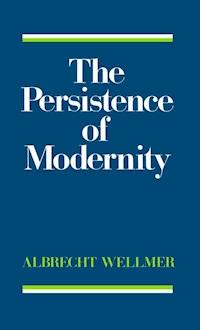
In this timely new book Wellmer intervenes in the highly topical debates on modernity and post-modernity. Discussing the work of Adorno, Habermas, Peter Burger and Jean-François Lyotard, among others, he offers a penetrating analysis of the aesthetic, ethical and philosophical dimensions of the modern era. In opposition to those who view post-modernity as a sign of post-enlightenment, Wellmer makes a reasoned plea for a re-examination of the goals of emancipatory Enlightenment and explores its implications for the appreciation of modern art forms.
Sie lesen das E-Book in den Legimi-Apps auf:
Seitenzahl: 529
Veröffentlichungsjahr: 2015
Ähnliche



















English translation © Polity Press 1991Essays 1, 2 & 3 first published in Germany in Zur Dialektik von Moderne und Postmoderne. Vernunftkritik nach Adorno © Suhrkamp Verlag,Frankfurt am Main 1985
Essay 4 first published in Germany in Ethik und Dialog. Elemente des moralischen Urteils bei Kant und in der Diskursethik, © Suhrkamp Verlag, Frankfurt am Main 1986
This translation first published 1991 by Polity Press in association with Basil Blackwell
Reprinted 2007
Polity Press65 Bridge StreetCambridge, CB2 1UR, UK
Polity Press350 Main StreetMalden, MA 02148, USA
All rights reserved. Except for the quotation of short passages for the purposes of criticism and review, no part of this publication may be reproduced, stored in a retrieval system, or transmitted, in any form or by any means, electronic, mechanical, photocopying, recording or otherwise, without the prior permission of the publisher.
Except in the United States of America, this book is sold subject to the condition that it shall not, by way of trade or otherwise, be lent, resold, hired out, or otherwise circulated without the publisher’s prior consent in any form of binding or cover other than that in which it is published and without a similar condition including this condition being imposed on the subsequent purchaser.
ISBN: 978-0-7456-0538-8
British Library Cataloguing in Publication DataA CIP catalogue record for this book is available from the British Library.
For further information on Polity, visit our website: www.polity.co.uk
Contents
Introduction
1 Truth, Semblance, Reconciliation: Adorno’s Aesthetic Redemption of Modernity
I
II
III
IV
V
VI
VII
2 The Dialectic of Modernism and Postmodernism: The Critique of Reason since Adorno
I Introduction
II Exposition
III Intermezzo (Stretto)
IV Development (1): Modern Art and the Negation of Meaning
V Development (2): The Critique of Reason and its Subject
VI Development (3): Towards a Metacritique of the Critique of Identitary Reason
VII Reprise
VIII Coda
3 Art and Industrial Production: The Dialectics of Modernism and Postmodernism
I
II
III
IV
4 Ethics and Dialogue: Elements of Moral Judgement in Kant and Discourse Ethics
Introduction
I A Kantian Exposition
II A Critique of Discourse Ethics
III Towards a Mediation betwen Kantian and Discourse Ethics
Notes
Index
Introduction
The essays collected in this volume explore various aspects of what might be called the spirit of modernity and its vicissitudes. I argue for a conception of modernity which is wider than that of many postmodernists, a conception according to which the critique of metaphysics or, to use Adorno’s phrase, the ‘explosion of metaphysical meaning’ does not signify the end of modernity, but the deepest concerns and the most difficult tasks of the modern spirit itself. If there is one single thread running through the four essays of this volume, it would be the thesis that modernity is for us an unsurpassable horizon in a cognitive, aesthetic and moral-political sense. This thesis, not surprisingly, entails the further thesis that the critique of modernity has been part of the modern spirit since its very inception. If there is something new in postmodernism, it is not the radical critique of modernity, but the redirection of this critique. With postmodernism, ironically enough, it becomes obvious that the critique of the modern, inasmuch as it knows its own parameters, can only aim at expanding the interior space of modernity, not at surpassing it. For it is the very gesture of radical surpassing – romantic utopianism – that postmodernism has called into question.
Consequently I shall argue that postmodernism at its best might be seen as a self-critical – a sceptical, ironic, but nevertheless unrelenting – form of modernism; a modernism beyond utopianism, scientism and foundationalism; in short, a postmeta-physical modernism. A modernity beyond metaphysics would be a new ‘Gestalt’ of modernity; perhaps we are witnessing the emergence of such a ‘Gestalt’. A postmetaphysical modernity would be a modernity without the dream of ultimate reconciliations, but it would still preserve the rational, subversive and experimental spirit of modern democracy, modern art, modern science and modern individualism. In its moral and intellectual substance it would be the heir and not the end of the great tradition of European Enlightenment. A second modernity, perhaps, with a memory and a new understanding of the temptations and perversions that have haunted the modern spirit – totalitarianism, nationalism, scientism, ‘instrumentalism’ – and, at the same time, with a new, non-identitary understanding and practice of the democratic universalism and pluralism that is part of the modern tradition itself.
In the essays collected here I have explored various aspects of such a ‘postmodern’, non-identitary rethinking and recapturing of the modern spirit. The first three essays explore internal relationships between aesthetic modernism and the critique of identitary reason as well as what I have called the dialectics of the modern and the postmodern. The first essay, on ‘Adorno’s aesthetic redemption of modernity’, is a critical reinterpretation of Adorno’s aesthetics. I suggest a ‘stereoscopic’ reading of Adorno which aims at ‘translating’ the basic parameters of his thought into the conceptual framework of a post-utopian philosophy of communicative reason. In the essay ‘The dialectic of Modernism and Postmodernism’, a critical examination of Adorno’s and Lyotard’s accounts of aesthetic modernism provides the starting-point for a metacritique of the postmodernist critique of identitary reason and its subject. Drawing on arguments from Wittgenstein and Habermas I try to show that a ‘non-identitary’ moment is already inherent in the structure of ordinary communication and reasoning. The critique of identitary reason -exemplified again by Adorno’s critique of ‘identifying thought’ – is then turned into an argument for a non-formalistic, ‘plural’ conception of rationality which would correspond to a ‘postmodern’ conception of democratic pluralism and universalism. The essay on ‘Art and Industrial Production’ explores the dialectics of modernism and postmodernism in the narrower field of architecture and industrial design. Finally, in the last essay, ‘Ethics and Dialogue’, I try to delineate the contours of a post-foundationalist dialogic ethics which would transcend the false opposition between universalism and contextualism. This essay was inspired by, but has turned into a critique of, Habermas’s discourse ethics as well as of the so-called consensus theory of truth.
In spite of the common thread running through the four essays in this volume, they are in another sense, i.e. as to their topics and the occasions of their writing, quite heterogeneous. In particular, there is a dividing line between the first three essays, all of which deal broadly with various problems in modern/postmodern art and aesthetics, and the fourth essay, which is an essay in moral philosophy. Perhaps instead of speaking of a common thread connecting the four essays with each other I should rather speak of an overlapping of themes and motifs – particularly with respect to the first three essays – and a similarity of perspective which links all the essays together. It is this common perspective which I have tried to articulate in the first part of this Introduction.
1
Truth, Semblance, Reconciliation:*
Adorno’s Aesthetic Redemption of Modernity
It is Theodor W. Adorno above all others who has explored the ambiguities of modern culture, ambiguities which reveal not only possibilities for unleashing aesthetic and communicative potential, but also the possible death of culture itself. Not since Schopenhauer and Nietzsche (with whose aesthetics and epistemology, incidentally, Adorno’s thought secretly communicates) has a philosophy of art had so lasting an impact on artists, critics and intellectuals as that of Adorno, at least as far as Germany is concerned. The traces of his influence on the consciousness of those concerned with modern art, whether in a productive, a critical or merely a receptive capacity, cannot be overlooked. This is true above all of music criticism where, as Carl Dahlhaus says, it was really only Adorno who ‘defined the very level on which it is possible to talk about modern music at all’.1 In recent music criticism, Adorno’s authority can be felt even where music has gone beyond the boundaries that Adorno had drawn for it; I am thinking here of H.K. Metzger’s defence of the ‘anti-authoritarian’ music of John Cage, for example.2 On the other hand, while Adorno’s mode of thought, indeed the entire cast of his intellectual response to art, has left its mark on the consciousness of artists, writers and intellectuals, his Aesthetic Theory has fared less well in the spheres of academic philosophy of art and literary theory. After some ten years of critical response to Adorno’s aesthetics, it appears that only fragments and remnants of his work in this area live on in philosophical, literary and musical scholarship. It is not the esoteric nature of the Aesthetic Theory that has hampered its reception. The problem lies rather in its systematic aspects: Adorno’s aesthetics of negativity has revealed its rigid features; something artificial has become visible in his aporetic constructions, and a latent traditionalism has become apparent in his aesthetic judgements. As so often happens in philosophy, the critics (or at least those who do not regard the matter as over and done with) have divided the booty amongst themselves; fragments of that complex interrelationship of negativity, semblance, truth and utopia, in terms of which Adorno conceived artistic phenomena, are to be found for instance in Jauss’s reception theory, in Bürger’s sociology of literature, or in Bohrer’s aesthetics of the ‘abrupt’ (‘Ästhetik der Plötzlichkeit’). But this is not simply the result of an eclectic appropriation of Adorno’s ideas, as is apparent from the philosophical critique of Adorno, particularly those critiques of the systematic aspect of Adorno’s aesthetics which have been undertaken by Bubner, and by Baumeister and Kulenkampff.3 It seems to me indisputable that these criticisms of Adorno’s work are at least partially correct. They nevertheless leave a sense that the conclusions arrived at are not commensurate with the object of their inquiries, as if the actual substance of Adorno’s aesthetics eluded them. This is the danger inherent in any partial critique, i.e. one which does not tackle the object in its entirety. It might be possible to avoid this danger in the case of Adorno’s aesthetics if one could release its central categories from their dialectical stasis and set them in motion from within the system itself, as it were. The necessary precondition for achieving this is not the attenuation of criticisms which have been made of Adorno, but the focusing of their combined energies. This is the direction in which I shall try to proceed in this essay.
I
The Dialectic of Englightenment by Adorno and Horkheimer remains a fundamental text for understanding Adorno’s aesthetics. It is there that the dialectic of subjectivization and reification is developed and the dialectic of aesthetic semblance at least intimated. The mutual interpenetration of these two sets of ideas is the dynamic principle at work in the Aesthetic Theory.
As far as the Dialectic of Enlightenment is concerned, the extraordinary character of the book is derived not simply from the concentrated literary quality of its prose with its lightning-flashes of illumination, but from the extraordinary audacity of the attempt to merge two disparate philosophical traditions, one which leads from Schopenhauer, via Nietzsche, to Klages, and another which runs from Hegel, through Marx and Max Weber, to the young Lukács. Lukács had already integrated Weber’s theory of rationalization into the critique of political economy; the might be understood as an attempted Marxist appropriation of Klages’ radical critique of civilization and reason. Thus the progressive stages of emancipation from nature and the corresponding phases of class domination (Marx) are both interpreted as stages in the dialectic of subjectivization and reification (Klages). For this purpose the epistemological triad of subject, object and concept has to be reinterpreted in terms of a process of repression and subjugation in which the repressor – the subject – also appears as the victim. The repression of inner nature with its anarchical lust for happiness is the price paid for the formation of a unified self, which was itself necessary for the sake of and the control of external nature. The notion that concepts are ‘ideational tools’ in the service of a subject conceived essentially as a will to self-preservation, which uses them to control and subdue reality, is one which goes back not only to Klages, but to Nietzsche and even Schopenhauer. Formal logic, according to this view, is not an instrument of truth, but merely the mediating link between the unity of the subject – the ‘ego principle that founds the system’ (ND 36/26) – and the concept, that ‘pre-arranges’ and effectively ‘truncates’ reality (cf. ND 21/9). From the outset, the spirit that brings about conceptual objectivation and systematizes according to the principle of non-contradiction acquires the character of instrumental reason by virtue of its very origins in the ‘splitting of life into the mind and its object’ (DoE 279/234). This instrumental spirit, which is itself a part of the living world, is ultimately capable of articulating itself only in categories of a nature; as an objectifying principle, the instrumental spirit is in its very origins of itself, and being oblivious of itself, establishes itself as a universal system of delusion, a closed universe of instrumental reason.
Lesen Sie weiter in der vollständigen Ausgabe!
Lesen Sie weiter in der vollständigen Ausgabe!
Lesen Sie weiter in der vollständigen Ausgabe!
Lesen Sie weiter in der vollständigen Ausgabe!
Lesen Sie weiter in der vollständigen Ausgabe!
Lesen Sie weiter in der vollständigen Ausgabe!




