


7,00 €
Mehr erfahren.
- Herausgeber: The Lilliput Press
- Kategorie: Geisteswissenschaft
- Sprache: Englisch
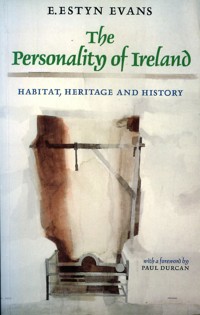
This classic study of Irish culture, extensively illustrated with photographs, maps and drawings, and reissued with a new foreword and an updated bibliography, gives a detailed yet panoramic view of Ireland. It follows in the great tradition of French historiography, adding the testament of landscape, antiquities and folk custom to that of document-based history as a primary source of knowledge of our past. It is a justly acclaimed, stimulating work of instruction, entertainment and enlightenment.
Das E-Book können Sie in Legimi-Apps oder einer beliebigen App lesen, die das folgende Format unterstützen:
Veröffentlichungsjahr: 1993
Ähnliche



















THE PERSONALITY OF IRELAND
HABITAT, HERITAGE AND HISTORY
E. ESTYN EVANS
THE LILLIPUT PRESS
Contents
Title Page
List of illustrations
Foreword by Paul Durcan
Preface to revised edition, 1981
I Habitat, heritage and history: an anthropogeographic view
II The Irish habitat
III The Irish heritage
IV The personality of Ireland
Appendix: Facts from Gweedore
Postscript
Bibliography
Index
Plates
About the Author
Copyright
List of illustrations
Plates
1 The Antrim coast road and chalk cliffs near Glenarm2
2 Creevykeel court grave, County Sligo
3 Remains of the forecourt of Clontigora court grave, County Armagh
4 Poulnabrone portal grave in the Burren, County Clare
5 Decorated stone basin, Knowth passage grave, County Meath
6 New Grange passage grave, County Meath, entrance stone3
7 Carrowkeel passage grave cemetery, County Sligo
8 Fossil spade ridges, Clare Island, County Mayo34
9 Prehistoric cultivation ridges, Carrownaglogh, County Mayo
10 Digging lazy beds with a loy, County Cavan
11 The Hill of Tara, County Meath
12 A County Down landscape near Hillhall in the Lagan Valley35
13 The remains of St Michael’s Monastery on the Skellig Rocks, County Kerry66
14 Drumlin landscape, south Armagh
15 Kearneystown clachan, County Donegal
16 Ballard clachan, Glencolumbkille, County Donegal
17 Former openfield (infield) at Ballintoy, north Antrim67
18 Traditional Donegal house with roped thatch
19 An ‘extended family’ in a Gweedore clachan about one hundred years ago98
20 A Donegal byre-dwelling towards the end of the last century
21 A crowded clachan in the Gweedore district of County Donegal, c. l880
22 ‘Riders to the sea’, the Aran Islands, County Galway, c.193099
Figures
1 Two views of Ireland19
2 Caledonian and Armorican convergence22
3 Fragmented hills, drumlins and lowland bogs23
4 A drumlin cluster in County Down27
5 Distribution of early forms of megalithic tombs28
6 Religious confusion on the Ulster border30
7 Distribution of enclosed farmsteads (raths) covering approximately the first millennium A.D.51
8 Traditional peasant house types54
9 Types of rural settlement, 1832–4056
10 The Gweedore district90
11–14 The townland of Beltany Upper, Co. Donegal102–3
Tailpiece: a Bunbeg curragh, from Facts from Gweedore110
Foreword
‘Itook a course of history at the University College of Wales nearlyhalf a century ago,’ writes Evans, ‘but found it so myopic in itsinsular view of the world…that it was a relief to turn to geography.’
In 1971, at the age of twenty-seven, I enrolled in University College Cork with the intention of taking a degree in English Literature but I found my course also myopic and the teachers aloof and in my first-year exams I received poor marks, especially in poetry. Luckily I had taken a course also in archaeology where I came under the tutelage of Professor M.J. O’Kelly, excavator of Newgrange, who re-introduced me to the reality of my native land, to the poetry of geography, anthropology, geology, folklore, and to the name and work of E. Estyn Evans. Thanks to O’Kelly’s encouragement, I abandoned English Literature and took my degree in archaeology and medieval history.
It was early in the course of O’Kelly’s first-year lectures that he introduced us to Evans. There was a certain timbre in O’Kelly’s voice whenever he cited Estyn Evans; it was the timbre of respect tinged with admiration and affection. We students sensed that for O’Kelly this name was a special name – the possessor of qualities which O’Kelly himself embodied and which he sought but rarely found amongst his colleagues: a catholic curiosity in learning of all kinds, a Protestant commitment to field work, a reverence for the wisdom of ordinary people.
Reading Evans I became aware of him as being, like O’Kelly, a scholar, a humanist, a teacher, a communicator, a field worker, a pioneer in Irish studies.
I well remember the excitement I felt at the first publication in 1973 of The Personality of Ireland. Reading it I knew I was reading one of the most important books of my life. It enabled me to jettison much of my own cant and prejudice and to articulate suspicions I had been having for many years about the murderous mythologies of an Irish racial purity. It was a small wisdom book and I knew it, and I felt lucky and privileged to have read it.
I remember also in 1973 communicating my enthusiasm for ThePersonality of Ireland to a distinguished academic in Cork and how, to my shocked naïveté, he poured droplets of scorn on Evans. I should know – he hinted darkly – that while Evans was a competent geographer he was ‘a crypto-Unionist’. To this day I remember the sunny smile on the great academic’s face and I knew I was being touched by the fingers of that evil which has destroyed almost all possibility of normal life and growth in this island in my lifetime. It is primarily Evans’s passion as a scholar that is his hallmark but what also gives The Personality of Ireland its edge is the author’s sense of writing and living in the context of our Irish nightmare. He makes explicit observations: ‘If we take the longer view, we see them [the two communities in the north] as a potential source of enrichment through cross-fertilization, both in Ulster and in all Ireland. To achieve this, it seems to me, one should first look towards the renewal of regional consciousness in the old province of Ulster, and to a culturally productive borderland.’
Evans was a Welshman who was a poet of place, a singer of transhumance, and who became more of an Ulsterman that the Ulster people themselves. He was a European whose heroes were Bloch, Febvre, Braudel – names which to a student in Ireland in 1973 were as exciting as Camus, Heidegger, Kazantzakis. He was a materialist with a spiritual sense of life so that as a scholar in the pages of this book he is ‘Dancing at Lughnasa’. He had an instinctive as well as intellectual grasp of the affinity between Gaelic Ireland and African culture. He was an environmentalist who believed with all his heart and conscience that a landscape and a people cannot be understood except in relation to each other. He had the courage to be a Darwinian in Ireland and to say as well as understand that ‘in Christian doctrine, human destiny was envisaged as independent of the earthly environment, which was a temporary abode to be endured rather than adored.’ A genuine Irish heretic, he thought for himself; a rare bloom on the rose tree of Irish thought.
As a Welshman also, Evans is one of that inspiring company of foreigners who were Irish patriots: Robin Flower, Micheál MacLíammóir, George Thomson, Eric Cross. In his love of detail of Irish life he was a kind of Chekhov for whom Ireland was his beloved and maddening Cherry Orchard. He could write as passionately about the Irish rural house as about the Irish hostility to trees. If Claudio Magris were to compose an Irish ‘Danube’, one of his holy source books would have to be The Personality of Ireland by E. Estyn Evans.
Paul Durcan
16 June 1992
Preface to revised edition, 1981
I have taken the opportunity presented by the publication of this paperback edition – which was recommended by several reviewers of the hardback edition, published by the Cambridge University Press in 1973 – to correct some factual errors which were also pointed out by reviewers. It is essentially a reprint, but I have expanded some sections in the light of new information and the findings of recent research. I have also increased the number of illustrations, and in this and other ways the Blackstaff Press has co-operated to make the book more attractive to the general reader than the somewhat austerely academic hardback. I am grateful to several friends for providing illustrations, and particularly to Mr Noel Mitchel, Dr Alan McCutcheon and Dr Desmond McCourt, and to Mr Cecil Newman for permission to use his splendid colour photograph of the Mourne Mountains on the cover. I am deeply indebted to Mr John Campbell, lecturer in geography at Queen’s University, who has given me great assistance in many ways in the preparation of this paperback revision.
There is a growing demand for books dealing seriously with the land, the people and the cultural history of Ireland going behind and beyond political history. How can the evil happenings in Northern Ireland, now in their twelfth year, possibly be explained or justified? Yet the continuing destruction of buildings, including many of historic importance, the appalling human suffering, can apparently be justified by appeals to political history or pseudo-history, to ancient hatreds and the most primitive instincts. Having lived through ‘the troubles’ which the people of Northern Ireland have endured for twelve years, I have been deeply impressed by the resilience this divided community has shown, demonstrating a remarkable stability in the face of bombings, indiscriminate violence and sectarian murders which might have been expected to lead to civil war.
Here a little personal history will be in place. I have lived in Belfast for over half a century and have many connections with friends and institutions both in Northern Ireland and in the Republic of Ireland. My training in geography and anthropology and my archaeological interests should have given me an objective view of Ireland, its landscapes and its peoples and cultures. Although I never learnt the Welsh language, I was brought up in a Welsh-speaking home, a Presbyterian manse on the Anglo-Welsh border, and became familiar with two cultures, one Welsh and Nonconforming, the other English and Anglican. I attended primary school in a picturesque Shropshire village which had all the established trimmings, a medieval church and a resident squire and deer-park, and I went to secondary school in Wales and then to University College, Aberystwyth. I have no recollection of ever meeting a practising Catholic, but because my parents were Liberal in politics, in the tradition of Welsh Nonconformity, I was well aware of – and generally in sympathy with – the movement for Irish Home Rule.
As a student I had taken part in several archaeological excavations in Wales and Wiltshire, and some of my first contacts in Belfast were with the archaeological sections of two venerable societies – the Belfast Natural History and Philosophical Society and the Belfast Naturalists’ Field Club. Together with another academic, Oliver Davies, I very soon became involved in a programme of archaeological exploration and excavation which took me to every corner of Northern Ireland, and these interests soon extended into the Free State. At the same time, as Head of the Department of Geography which I had established at Queen’s University in 1928, I was engaged in a programme of geographical fieldwork and for many successive years took parties of students on intensive local studies of selected areas in all the major regions of Ireland. These parties always included a fair proportion of Catholic students among the Protestants and all found a common interest in exploring the Irish countryside and investigating the marks of habitation, cultivation and enclosure left on the landscape by successive occupants since prehistoric times.
When the outbreak of war in 1939 curtailed our more active investigations, I occupied my leisure in recording details of country life, crafts and customs, relating them to the Irish environment. In 1942 I wrote my first Irish book, Irish Heritage, with the encouragement of my publisher Harry Tempest of Dundalk, who also co-operated with me in the publication of Mourne Country (1951). I became convinced that a significant factor in what is sometimes called the essential unity of Ireland, besides the unities of climate and landscape – notably the dominance of proudly independent scattered farms and the weakness of long-established village communitieswhich make the country seem foreign to the Englishman, has been the retention, persisting in many areas into modern times, of certain attitudes towards the world and the otherworld, of traditional customs, beliefs and seasonal festivals which had often assumed the guise of Christian piety, but which had their origins in the Elder Faiths of pre-Christian times. (One of the most obvious differences between England and Ireland today is the high level of Sunday observance in Ireland, whether among Roman Catholics or Presbyterians.) It was the conviction that the traditions and folkways of the countryside are a common bond and source of interest to all sections of the Northern Ireland community that led me to promote the establishment of a folk museum, now the Ulster Folk and Transport Museum at Cultra, County Down.
As a geographer, with interests in the land and what I call unrecorded history, as revealed by archaeology, anthropology and ethnology and by field studies of the cultural landscape, I have long advocated a broader approach to history, and that was the substance of the Wiles Lectures delivered at Queen’s University in 1971 and published as The Personalityof Ireland in 1973. My plea for a broader and less political view of Irish history has recently had the powerful support of Dr F.S.L. Lyons, Provost of Trinity College, Dublin, who has been called ‘the most perceptive Irish historian of our time.’ In The Burden of our History (the W.B. Rankin Memorial Lecture given at the Queen’s University of Belfast in 1978) he summarised the new approaches to Irish history that are now being made, covering every aspect of life and culture and challenging many long-established myths.
If what might be called the old view of the role of geography in history was a negative one – in which geography was not part of history but merely the place where it happened to have taken place – it was less dangerous, because less emotive, than the naive conception of geography’s place in history apparently held by some pious nationalists who see Ireland as a God-given island which was predestined to be the home of a single nation. What would Scottish and Welsh nationalists say if they were told that the sister isle was similarly predestined by the mere fact of its insularity to house one nation and no more? Discussing various views on Irish cultural and political unity in his recent book, Culture and Anarchy in Ireland, 1890-1939, Dr Lyons concludes that what is emerging is a realisation that cultural unity and cultural diversity have co-existed in Ireland throughout history – and I might add prehistory. I would suggest that its cultural diversity springs not only from the diversities and difficulties of its geography but also from its very insularity, for the island has attractive harbours on all sides, and intrusive cultures, from megalithic times onwards, have established bridgeheads linked on the east with western Britain and France, on the north with Scotland, and on the south and west with the nearest parts of Europe. In some ways one may see the four historic provinces as a reflection of this diversity. The patriotic Irishman’s picture of the Irish past tends to be coloured by his hopes for the future, and by the dream of Irish unity. Most dangerous in its consequences was the appeal made by Patrick Pearse to the heroic tales of Ulster to support his plea for bloody sacrifice and for the glorification of violence in the pursuit of political ends.
Those who are familiar with the historic strength of the Elder Faiths find it difficult to accept the pious assumption that the early missionaries quickly converted the mass of the Irish people to Christianity. Professor R.A.S. Macalister of University College, Dublin, a Gaelic enthusiast turned cynic, used to say in private that the number of believing Christians in the early centuries of Christianity could probably be reckoned by counting the number of Irish saints. The endurance of the Elder Faiths in some mountainy parts of Ireland to this day is well illustrated in the advice given not long ago by a County Tyrone countryman to Michael Murphy, a collector of folklore: ‘Give priests and old thorns their dues, and leave them alone’. The Elder Faiths are part of the Irish heritage. It was cultural diversity and cross fertilisation between pagan and Christian that brought into being what will always count as Ireland’s greatest cultural achievements in the Golden Age of the seventh and eighth centuries: the Books of Durrow and Kells, the Ardagh Chalice, the great Celtic monasteries and countless works of art and architecture.
It comes as a shock to be told that the high level of devotional piety among the Irish people had its origins in what Professor Emmet Larkin has called the ‘Devotional Revolution’ of last century, which was part of the modernising movement following the Great Famine. Estimated regular attendance at mass of little more than 30 per cent of the population rose sharply after 1850 to a figure of over 90 per cent. Before 1850 attendance was very low in Gaelic-speaking areas where it frequently fell to 25 per cent: ‘native Irish culture is not the source and strength of modern Irish piety’. To quote Professor Larkin again, it was only after the Great Famine that ‘the mass of the Irish people became practising Catholics’. While accepting the view that the reforming zeal of Paul Cullen, appointed Archbishop of Armagh in 1849, had much to do with this, he sees a deeper cause in the reduction of poverty and violence in the Irish countryside, in the general modernising movement, and in the profound emotional shock of the Great Famine. Moreover, for the best part of a century the Irish people had been steadily losing their identity in losing their native language and heritage, and they were to find a new identity in the Catholic faith, which became a substitute symbolic language. The old idea that there was a common Irish identity indifferent to religious belief was thus superseded by the concept that Catholicism was the essence of Irishness. With the abandonment of the Irish language and the Irish heritage, supported by the strong advocacy of Daniel O’Connell, the Catholic faith came to be seen as the main distinguishing mark of the Irish people; and this had the unfortunate consequence of convincing northern Protestants, many of whom had espoused the cause of Irish nationalism, that one of the aims of the Repeal Campaign was to promote the cause and power of the Catholic faith.
Professor David Miller, in his study of ‘Irish Catholicism and the Great Famine’, states that the figures for formal attendance at mass before the Famine hide the fact that the Elder Faiths, which had been only partly taken over by Christianity, were still strong. He suggests that it was the manifest failure of their protective magic, demonstrated in the tragedy of the Great Famine, which led to the full acceptance of the Catholic faith. What is emerging from recent studies is a realisation of the significance and long survival of Ireland’s Elder Faiths.
The eminent authority on the ancient laws, Professor D.A. Binchy, in a recent article on ‘Irish History and Irish Law’ discussing continuity and discontinuity in Irish culture, concludes that it is in the traditional customs and festivals, pre-Christian but Christianised, of early medieval Ireland that the Gaelic inheritance lingers on. He attributes this to the remarkable cross-fertilisation between pagan and Christian customs that took place in the early centuries of Christianity. In contrast, ‘the old native system of law has disappeared without leaving a single trace. The very idea of a republican form of government would have been repugnant to it.’ Yet nationalist politicians adhere to the fiction that the Irish Republic is the embodiment of traditional Gaelic aspirations, and an apparent continuity has been supported by annexing and misusing an extinct Gaelic terminology. The concept and the institutions of the nation-state were, ironically, imported from England and combined with an equally alien republican form of government copied from France and the U.S.A.
The old Gaelic political system was rural and hierarchical, based on small territorial units, the túatha, or petty kingdoms, some of which have survived as baronies. When documentary evidence becomes available in the seventh century there were as many as 150 such kingdoms. They were often grouped together in larger units which were constantly changing. From about the middle of the ninth century the primacy of Tara was generally accepted, in theory at least, but it was only in the eleventh century, after the never-to-be-forgotten defeat of the invading Norsemen at Clontarf in 1014, that the high-kingship, owing much to the reign and renown of Charlemagne, became a reality. The King of Erin is a theme in folk tales rather than a significant fact in history.
E. Estyn Evans
January, 1981
Note to the Lilliput Edition
For their part in helping with this reissue, the publisher would like to thank John Campbell for his invaluable bibliography, lopped here into the space available; Anne Tannahill of Blackstaff Press for her goodwill in permitting use of material from the 1981 edition; David Evans for suggesting, and sourcing, the painting on the cover; T.P. Flanagan for his use of the same; behind all, Gwyneth Evans, whose encouragement and kindness has been a cornerstone to the enterprise.
I
Habitat, heritage and history
an anthropogeographic view
I have been given the opportunity and the privilege of presenting to historians, and particularly to Irish historians, some thoughts on – and some illustrations of – the relationships between geography and history. I am well aware that my brand of anthropogeography, which is that of H.J. Fleure and Carl O. Sauer, is currently out of fashion, and that a preoccupation with relevance and prediction, and recently with perception and the behavioural environment, has led to a drift away from a genetic approach to human geography, and from historical explanation. Most of my geographical colleagues would say that the pressing problems of the modern world are more than enough to occupy them, and that history can be trusted to look after the past. Leaving aside the difficulty of deciding when the present becomes the past, and leaving aside also the question whether, in modern Western society, history need be a guide to action, study of the past cannot but give perspective, and the wider and deeper the perspective the better our understanding of the present. My concern is with environment as a factor in human history, and although I might have wished that someone better versed in recent methodological developments had been chosen to present the claims of my subject to historical scholars, it must be admitted that the current passion for enumeration tends to restrict the interests of the younger generation to a short time span. Quantification, because of an inevitable lack of data, can give only a limited understanding of the past, nor can it be applied to some of the most precious ingredients of civilisation.
Looking at one of the most heroic attempts to reach what I take to be the ultimate goal of history – that is, universal human history – even a young geographer could find abundant material to patch some of the environmental holes in the majestic canvas of Toynbee’s work, A Study ofHistory. His most perceptive geographical critic, O.H.K. Spate, regards Toynbee’s understanding and handling of geography as the weakest part of his study. The anthropologist, too, takes exception to his arbitrary selection of twenty-one societies, past and present, as exemplars of civilisation, leaving out of the reckoning, as the concern of anthropologists, ‘over 650’ other human societies. Toynbee apparently took his figure of 650 from Professor Hobhouse, although Professor Leyburn had estimated the number of world societies at over 12,000. This is anyhow a false dichotomy. Even supposing that the anthropologist is concerned only with primitive societies, where are we to draw the line? Most modern societies have a ‘primitive’ as well as a ‘civilised’ side, and heritage, or unrecorded history, is an essential part of all cultures. Moreover, by treating his twenty-one civilisations as isolates, Toynbee minimises the significance of diffusion.
In dismissing environmental determinism, only to substitute his own brand, which Spate sums up as ‘the determinism of relatively unfavourable environments’, Toynbee makes easy game of such recent advocates of climatic control as Ellsworth Huntington. But he turns more readily to the ancient world – for theories of environmental causation have a respectable classical ancestry – and many of the views he so readily demolishes are taken from Greek and Roman writers. This is an extreme illustration of a risk all would-be synthesisers face: the reliance on outmoded and often secondary authority when working in fields other than their own. But they must also face prejudice in venturing to tread on territory which carries the property mark of other academic disciplines. Toynbee was attacked by the learned on almost all sides, and his experience suggests that – if I may malappropriate a No Trespass notice I once saw in an American wood-lot – ‘Survivors will be persecuted’. Another fate may await lesser mortals who dare to trespass, and that is to be watched by those on the other side of the fence with an air of detachment and indifference.
The theme I have chosen, however, calls for many border forays or rather let me say for trans-border co-operation. I am pleading the cause of a trilogy of regional studies, of habitat, heritage and history: that is of geography, anthropology (in its widest sense, including the behavioural sciences, as well as prehistory) and recorded history (including social and economic history). I take the view that all these subjects can be regarded as parts of human history, as various approaches to the study of the evolution of man and society on this earth. Of course they all have their own objectives, and I am suggesting that they should interpenetrate rather than amalgamate. Even assuming that it were practicable to make a combined subject for educational purposes, on the model of some approaches to undergraduate studies in the humanities, I believe more would be lost than gained if academics were to be drawn away from their specialist fields, but they should be aware of what is going on beyond the fence: it is at the fences, along the borders, that discoveries are likely to be made. In such broad fields of study, wrote Julian Huxley, discussing not the past but the future of man, ‘we must envisage networks of cooperative investigation…the social sciences as a whole cannot escape the pressure towards integration’,1 and he makes a plea for a common terminology and an end to technical jargon. Certainly some of the mistrust and misunderstanding of the other fellow’s subject arises from the fashion of using terms which bring obfuscation rather than clarification. One suspects that these specialist vocabularies are sometimes designed to win academic respectability rather than to facilitate communication. I shall shun them.
By habitat I mean the total physical environment, and by history the written record of the past. I would define heritage in broad terms as the unwritten segment of human history, comprising man’s physical, mental, social and cultural inheritance from a prehistoric past, his oral traditions, beliefs, languages, arts and crafts. It seems to me that there is no ideological gap between anthropology and conventional history in so far as they are concerned with the human experience. Lévi-Strauss regards them as ‘indissociables’. Many anthropologists, however, have been hostile to history, partly no doubt because of the extravagances committed by the so-called historical school of anthropology. The functional anthropologists in particular have been critical of historical reconstructions and conjectural history. Since anyhow British anthropology has been primarily concerned with ‘primitives’ and British academic history with the peoples of Britain and Europe there has been little common ground. Anthropologists, however, are increasingly busying themselves with European communities and with the peasant peoples whose ‘little tradition’ persists alongside the ‘great tradition’ of the élites which has provided the stuff of recorded history. Moreover, the collection of popular traditions, oral literature and folk customs which was part of the Romantic movement has been transformed and systematised under the inspiration of Scandinavian scholars into the academic discipline of ethnology or folklife, enriching and illuminating the content of recorded history. The folk movement, too, is part of history in another sense, for it inspired nationalist revivals in many European countries, not least in Ireland through the Anglo-Irish literary movement and the Gaelic League. Already in late eighteenth-century Belfast, the United Irishmen, mainly Presbyterians, were steeped in Irish tradition, folk music and antiquarianism; and ‘the idea of an “Irish nation”, indifferent to religious rivalries, rooted in history…takes its rise in the Belfast of the late eighteenth century’.2 But while folklife as an academic discipline has long been recognised in Scandinavian countries, Ireland has had to wait until 1971 to see the first Department of Irish Folklore established, in University College, Dublin.
Prehistoric studies won academic status much earlier, even in Ireland, having passed from the Romantic phase of antiquarian exploration to the stage of scientific classification and excavation in the course of last century, primarily in Denmark and England. The prehistoric time-scale overlaps with the historic, for the mass of the world’s population has remained non-literate down to recent times. Many academic historians, however, still attach little importance to archaeological evidence, even when it relates to historic periods, and accord to it at best a subsidiary role, ignoring or disbelieving the view expressed so long ago as 1881 by J.R. Green: ‘archaeological researches yield evidence even more trustworthy than that of written chronicle, while the ground itself…is the fullest and the most certain of documents’.3
Green, we may notice, found geography an equally indispensable aid to history and felt that, to give an adequate account of Anglo-Saxon settlement, he was obliged to consider and map the distribution of marsh and woodland in lowland England. His views on the relevance and usefulness of these sources were exceptional. Into the present century, wrote R.G. Collingwood, ‘it was felt that unwritten sources of history could give valid results only on a very small scale and when they were used as an auxiliary arm to “written sources”; and only about low matters like industry and commerce, into which an historian with the instincts of a gentleman would not enquire’.4 In Ireland, according to George Petrie, there had once been even more prejudice: not only the antiquities but also the history of the country previous to the Anglo-Norman invasion ‘were considered to be involved in obscurity and darkness such as no sane mind would venture to penetrate’.5 In recent years, with the refinements of palaeobotanical techniques and radio-carbon dating (C14, which historians have been known to take as a reference to the fourteenth century), prehistory has acquired a chronological scale of considerable depth and accuracy to guide and inspire excavation; and the reconstruction of many aspects of the economy, material culture, art, settlement forms and burial rituals of successive periods is now a commonplace of excavation reports. If archaeology can make no claim to obtain information on human thought and emotions, save inferentially, herein, for some enthusiasts, lies its advantage over written history. When conventional history takes over, the prehistorian Harold Peake used to say, the story gets blurred by the prejudices of men who write it.
Geography has now won almost universal recognition in the universities, though characteristically Ireland came late in the field, and if its methodology is constantly changing, its broad concern – the areal differentiation of the world and its peoples – has been a matter of enquiry and speculation since classical Greek times. Its immemorial symbol is the map, but although geographers like to have their fingers on the map and their feet on the ground, they cannot but be aware of philosophical aspects of their subject, of the mystery as well as the reality of man’s place in nature. Geography was described by the pioneer American conservationist, G.P. Marsh, as both a poetry and a philosophy. Anthropology has not yet found a place in the universities of the Irish Republic, but after long advocacy of their kinship with geography, both anthropology and archaeology have chairs at Queen’s University, Belfast. It is part of my purpose to show how history can profitably co-operate with these sister subjects in regional research. We who practise these relatively new academic disciplines should remind ourselves that historians, economists and other social scientists have also had to fight for the general admission of their subjects into British universities, and that less than fifty years have passed since Professor Tout could claim that the battle for the recognition of history was as good as won.
The serious professional study of Irish history, one of its practitioners has recently said, is barely a generation old, and much of its scholarly output relates to the activities of politicians, many of them English. Until recent times, indeed, writers of what was termed ‘Irish history’ seem to have been preoccupied with the morbid phenomena of British rule in their country: ‘1169 and all that’ done into academic prose. I have found this kind of history confusing and repellent, a record of violence and corruption if sometimes of heroism and vision, and it is an irrelevancy that some of the personalities involved, we are told, hated the corruption they were forced to practise. I have wondered whether Lord Acton could have had this sort of Irish history in mind when he said, as has been reported, that he was turned to gloom by the contemplation of the affairs of men. But I am not a trained historian. I took a course of history at the University College of Wales nearly half a century ago, but found it so myopic in its insular view of the world – even though the course was regarded as an enlightened innovation, however inappropriate in a Welsh College, called Colonial History – that it was a relief to turn to geography and to be plunged forthwith, by H.J. Fleure, into the loess and the cultures of north China in the company of Ferdinand von Richthofen. Academic history, it seems, was slow to break away from the view of Bishop Stubbs that history meant the history of the British parliament and constitution. No doubt there are some Englishmen who would defend this definition, but Professor Gordon Childe, an Australian, was reacting strongly against such an interpretation, as well as against the theological model of history, when he brought his book What Happened in History (1942) to an abrupt end with the spread of Christianity in the ancient Mediterranean world. One could wish that he had given us a new Childe’s History of England.6
No prehistorian did more in his time than Childe to extend the scope of history, to make it the history of man on earth, the scientific study of all sources of information on the human past. A prehistorian and a geographer, H.J.E. Peake and H.J. Fleure, made a similar approach in The Corridors of Time (1927–56), and Professor Grahame Clark has been for many years a leading exponent of world prehistory. Because of the limitations of the evidence, those prehistorians who have looked for uniformities – they hesitate to call them laws – have tended to lean towards environmental or cultural determinism. Deprived of any knowledge of the creative spirit of prehistoric personalities, they have not subscribed to the Great Man theory of history, and have been more concerned with processes than events. On the whole, the conceptual framework of archaeologists has been technological or ecological, though few go so far as to claim that these factors controlled institutions and beliefs. Childe’s near-Marxist insistence on the significance of technological and economic change contrasts with the comparative neglect of material culture in many anthropological studies of modern primitives. Thus Evans-Pritchard, in his celebrated work on the Nuer, deals fully with social life and political institutions but remarks that he is ‘neither desirous nor capable of describing technological procedures’.7 Those anthropologists, however, who see material culture and technology as an objective test of the degree of civilisation, linked with mental aptitudes and social development, point out moreover that language must have referred to concrete things before it could be extended into the realms of ideas and ethics. Improved technology and associated ideas must enlarge vocabulary and lead to linguistic modification. Language change in prehistoric times, which seems to have been not infrequent before languages became firmly enshrined in religious phrases and tied to localities among sedentary communities, would probably have been facilitated and speeded by technological innovation. This has a possible bearing, as we shall point out, on the vexed question of the spread of the Celtic tongue in Ireland.
Here I would put in a plea for the inclusion in our general academic system of training in the use of manual and visual skills. An obsession with book-learning has tended to divorce education from reality and led teachers to disregard or even despise the educational content of the cultural environment; and nowhere is this more evident than in scholastic Ireland. It is true that school education has come to include instruction in the experimental verification of scientific method, but field observation is relatively undeveloped as a tool for cultivating an awareness of the cultural heritage. A practical knowledge of simple technology would not only provide young people with a creative environmental link, but give them also a sympathetic understanding of the human past and of the ‘primitive’ folk of the contemporary world. I have always found it an advantage, in studying rural life in Ireland, to participate in any agricultural or craft process I wished to understand and describe, and it will be remembered that the French agrarian historian, Marc Bloch, wrote his classic books as a farmer who could plough, who knew the feel of the land and the smell of hay and manure. He was able to look beyond the legal and institutional framework of agrarian systems, interpreting them on the ground and in the intimacy of small regions. In much the same way I have tried to read the rural landscape and have come to see it as the key to the continuity of Irish history.
It is on climatological grounds that environmental determinism has been most strongly argued by geographers and others. Scandinavian archaeologists in particular have been wedded to the idea of climatic change as a potent factor in human destiny, and their pioneer palaeobotanical researches, relating vegetational and cultural change to climatic deterioration, seemed to confirm, for example, the native legends of Fimbulwinter. There seem to be instances, in critically marginal climatic environments such as Greenland, where climatic oscillations and their vegetational responses have had dramatic consequences, but as we shall see, some prehistoric vegetational changes as revealed by pollen studies can plausibly be interpreted in terms of man’s interference with the balance of vegetation. The influence of climate on man and his societies has been a matter for speculation since classical times, and interest in the topic has by no means been confined to geographers. One recalls the famous dictum of Montesquieu: ‘the empire of the climate is the first, the most powerful, of all empires’. It was the thesis of Ellsworth Huntington that great civilisations have been located in regions enjoying climates which he thought favourable; and he made climatic oscillation the prime mover of nomads in his imaginative work, The Pulse of Asia, (1907). But there is no end to climatic correlations. Of the many inane examples given by various authors I need cite only the uncomfortable conclusion of S.F. Markham, that ‘up to the 15th century, every Jew of importance was born on or near the 70°(F) isotherm’.8 Single-factor causation is rarely proved, and climate, however dramatically it may display its forces, is but one element of the total environment of man. To isolate it is not only, in the words of Vidal de la Blache, ‘morceler ce que la nature rassemble’, but also to ignore the cultural heritage of the society it is supposed to control.




