


6,99 €
Mehr erfahren.
- Herausgeber: Corvus
- Kategorie: Gesellschafts- und Liebesromane
- Sprache: Englisch
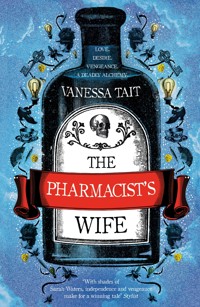
A dark and thrilling tale of Victorian addiction, vengeance and self-discovery, perfect for fans of Sarah Waters, Jessie Burton's The Miniaturist and Sarah Perry's The Essex Serpent. Love. Desire. Vengeance. A deadly alchemy. When Rebecca Palmer's new husband opens a pharmacy in Victorian Edinburgh, she expects to live the life of a well-heeled gentlewoman. But her ideal turns to ashes when she discovers her husband is not what he seems. As Rebecca struggles to maintain her dignity in the face of his infidelity and strange sexual desires, Alexander tries to pacify her so-called hysteria with a magical new chemical creation. A wonder-drug he calls heroin. Rebecca's journey into addiction takes her further into her past, and her first, lost love, while Alexander looks on, curiously observing his wife's descent. Meanwhile, Alexander's desire to profit from his invention leads him down a dangerous path that blurs science, passion, and death. He soon discovers that even the most promising experiments can have unforeseen and deadly consequences... Reminiscent of the works of Sarah Waters, this is a brilliantly observed piece of Victoriana which deals with the disempowerment of women, addiction, desire, sexual obsession and vengeance.
Das E-Book können Sie in Legimi-Apps oder einer beliebigen App lesen, die das folgende Format unterstützen:
Veröffentlichungsjahr: 2018
Ähnliche


















Vanessa Tait grew up in Gloucestershire. She went to the University of Manchester and completed a Master’s degree in Creative and Life Writing at Goldsmiths College. Her debut novel, The Looking Glass House, was published in 2015. The Pharmacist’s Wife is her second novel.
First published in Great Britain in 2018 by Corvus, an imprint of Atlantic Books Ltd.
Copyright © Vanessa Tait, 2018
The moral right of Vanessa Tait to be identified as the author of this work has been asserted by her in accordance with the Copyright, Designs and Patents Act of 1988.
All rights reserved. No part of this publication may be reproduced, stored in a retrieval system, or transmitted in any form or by any means, electronic, mechanical, photocopying, recording, or otherwise, without the prior permission of both the copyright owner and the above publisher of this book.
This novel is entirely a work of fiction. The names, characters and incidents portrayed in it are the work of the author’s imagination. Any resemblance to actual persons, living or dead, events or localities, is entirely coincidental.
10 9 8 7 6 5 4 3 2 1
A CIP catalogue record for this book is available from the British Library.
Hardback ISBN: 978 178 649 2708
Trade paperback ISBN: 978 178 649 2715
E-book ISBN: 978 178 649 2722
Printed in Great Britain
Corvus
An imprint of Atlantic Books Ltd
Ormond House
26–27 Boswell Street
London
WC1N 3JZ
www.corvus-books.co.uk
For Tristan
CHAPTER 1
Edinburgh, 1869
Perhaps it was her shoes that were making a dent in the afternoon. Because, look there, a little monkey on a gold chain, pulling up its knees in time to the brass band that Alexander had hired; and there, the cymbals crashing away and the trombone glinting in the uneven sunlight. And see, a little further off, stalls selling saloop and whelks and whatnot, and people gathered round them, drawn from either end of Edinburgh; it was all very gay. And the pharmacy itself was looking swish, its broad window polished to a glint and – and this was the proudest part – the name above it, written very bold, in gilt lettering on the wooden board, Palmer, which was Rebecca’s name, too, these last six months, though she still could not get used to it.
The pharmacy, everyone said, would be the making of North Bridge – the road that ran between the Old Town and the New, connecting the rich part of Edinburgh with the poor. It would draw its customers from the slums and from the toffs, and take advantage of both. As Mr Badcock said, they ought not to care who’d owned the shillings before, just so long as they all flowed in their direction.
But still, and Rebecca was sad to notice it, the pump-a-rum of the trombone beat almost the same rhythm as the pulse in her big toe. She flexed her feet upwards to take the pressure off them that way, but if she leaned back a little on her heels t’would be even better … but that was too far! She had almost tipped over, she must clutch at her husband’s arm to right herself.
‘What on earth are you doing?’ said Alexander, pulling his arm away.
Rebecca snatched back her hand and clasped her fingers together. ‘Just …’
But Alexander was looking at her feet and frowning. ‘You have got your shoes stained, after all the trouble.’
‘Stained?’ Rebecca had only walked the short distance from their brougham to their place here at the front of the crowd. But she had got the heel hooked on the step – had she marked it then? She could not see without craning down to look, which would not look elegant, standing up here, as she was, as they were, she and her husband, on show. Or the shoe had got marked by the water that gathered in the indents of the pavement, hard to avoid, impossible to see. Their leather was so soft and pale and would stain as easy as a blush.
‘’Tis a pity, after all the trouble that was gone to in the measuring of your feet. All you have had to do was stand, after all,’ said Alexander, rubbing at his chin.
‘I can clean them for you, madam,’ said Jenny. ‘If you like.’
‘I don’t know how, when she is wearing them,’ her husband said.
‘Thank you, Jenny. P’raps it can wait until we get home.’ The shoes were stained, Rebecca saw it now: an uneven mark thrown carelessly over the knuckle of her smallest toe. She blinked. She was not made to wear such shoes, she had known it even as she pulled off her old black boots to make way for them, back at the house. Such pale and slender shoes should not go on her great feet, and now she had proven it, for she could not even get out of a carriage without ruining them.
‘I have brought a handkerchief,’ said Jenny, turning her face so that Alexander would not hear.
Rebecca swallowed. She did not know if her maid meant for her shoes or for her eyes. She must not cry – she was not crying! Not today. She shook her head at Jenny, tried to smile and spread out her gaze.
They stood in front of a crowd of about sixty, and now that she looked she saw that Mr Badcock had been right. A group of women from the New Town, their parasols trimmed with lace, were at the front, nodding in time to the band, but to the side of them an old lady whose skirt was held up by string – from the Old Town, of course – was staring hungrily at the food stalls. As well as those there were a number of actors, swells, tramps and other types of a more middling sort, and a dog who could have been from anywhere. It must have been attracted by the smell of burning sugar, for the first batch of lozenges Lionel had made had been ruined and thrown away behind the shop.
Try again, Rebe, ’tis a proud day, you said it yourself! Rebecca turned to her husband. ‘It is going very well, isn’t it, Alexander, just as you planned?’
‘Mr Badcock is not here yet,’ he said, picking a hair from his trousers between finger and thumb and pursing his lips.
‘But, still, it’s a proud day, Al, that’s for sure!’ Rebecca smiled hard.
Where other men sprouted beards and moustaches Alexander had nothing but skin. Even the place where his whiskers should have been was bare. Beards trapped disease inside them, he said, and made men ill. (Mr Badcock maintained that on the contrary, beards trapped bacteria on the outside and prevented them getting in.) Rebecca did not hold either opinion, she only knew that when Alexander was angry all that bareness made his face terrible.
‘I beg your pardon?’ he said now, his lips tighter than ever.
Rebecca had made another mistake even as she’d tried to rectify the last. She knew what it was, and how stupid she had been to risk his displeasure! She palpated her toes against the soles of her shoes, as if she could drain away the heat from her face. Other wives had affectionate names for their husbands! She knew of a woman who called her husband Flossie, though he was not light and airy but short and fat. Rebecca had planned to try out a more familiar name for her husband today, but she saw now what she ought to have seen all along: it did not suit him, did not suit him at all.
After waiting so long … Rebecca shut her eyes and shook her head to banish the word waiting, but it was no good: it was there already, plump and falsely bright, with its ting on the end. She set her teeth and stared over at the whelk stall and forced the word to dissipate … After waiting for more than two years she had been saved from spinsterhood and all the humiliations that went with it by Alexander Palmer, proprietor of a fine pharmacy on North Bridge.
Yes, that was right. That was the story that she would tell and she would feel better for it. And now her father had died she could wait no longer, for her house was sold and everything in it was gone. But she had Mr Palmer, a husband many women would envy, and how lucky she had been to be chosen by him, just by chance, on the street!
But in the anxiety of preparing for today, she had forgot to eat. Eating, that may be counted upon as the opposite of thinking. And now a good smell was coming across from the food stalls; some of the people of Old Town had no kitchens, and this was as good a place as any to set up trade, catering for the stomach as the pharmacy would cater for the rest of their needs.
‘I only meant, Alexander, you must be very proud. It is exactly what you hoped for – all this – is it not? And I wondered … I thought, perhaps I may get a cone of whelks. I forgot to breakfast, in the rush of the morning.’
‘Whelks?’
‘It is unconventional, I know, but I have a fondness for them.’
‘It would not look right to eat. Not street food, not here.’
‘Well, I would not—’
But Alexander twitched impatiently. ‘There he is at last,’ he said. And in front of them Mr Badcock was indeed stepping out of his brougham on his tiny feet and shouldering his way between the backs of the crowd with surprising agility.
‘Ah, John, you are late.’
‘Mrs Palmer.’ Mr Badcock caught up her hand and brought it up towards his great beard, pushing his lips down on the back of her glove. ‘A great day, a great day. I am late, I was in a desperate hurry, I was almost afraid I had missed it all!’
Alexander consulted his pocket watch. ‘No, you have not missed it. I would not start without you, as it is your money that has gone into it.’ He nodded in the direction of the large glass doors of the pharmacy with their polished brass handles, still shut.
Mr Badcock raised his eyes to heaven. ‘The good Lord would not let me miss such a day; He would not allow that to happen. And may it be the start of many great days.’ He brought the tips of his fingers to his chin and moved his lips silently. Then he wrinkled his nose and his eyes snapped open. ‘I suppose they,’ he motioned towards the food stalls, ‘are a good thing, to draw people in. But I wonder if the smell is healthy?’
‘Mrs Palmer is asking for whelks,’ said Alexander.
‘Oh no,’ said Mr Badcock, ‘you cannot eat whelks! Not at all, not you, Mrs Palmer, I am afraid. They operate on women in unfortunate ways. They contain certain minerals – zinc, say – which have properties of an aphrodisiacal nature. Spermatozoa, of course, contain zinc. So if a man eats whelks, he becomes more of a man. But a woman ingesting such a compound, hmmm, may also become more of a man! It would not be the natural order of things. An army of marauding women … Ah – and who is this?’ Mr Badcock asked, turning to the maid.
‘This is Jenny, my new maid.’
Jenny made a curtsy. Mr Badcock took up her hand, as if it were a great extravagance. ‘Charming,’ he said, though he stopped short of kissing it.
Jenny blushed and tried to smile. Rebecca pressed her hand to her stomach. Other women were eating at the stalls: those two there, slurping down their saloop from tin cups; that old lady in the faded hat at the eel stall, spooning jelly into her mouth from a filthy bowl. And at the whelk stall, a woman in a green dress. Her coat and hat were trimmed with matching brown feathers from a rarely seen bird, an owl perhaps. She was as thin as the most excoriating fashion demanded and yet her chin worked up and down as she spooned the rubbery whelks into her mouth.
The woman must have felt Rebecca’s eyes on her because she turned. She had the kind of face that was a resting place for the eyes, the kind of face that threw all other faces into unevenness. But her skin was too pale, almost colourless; she had not pinched her cheeks to redden them. Her teeth were uneven. And as she leaned over to get a napkin, Rebecca saw a stain spreading down from the armpit of her dress like a high water mark.
She had a mole on her cheekbone that was smooth, like a flattened piece of chocolate, and it struck Rebecca that she had seen it before.
‘She is here,’ hissed Mr Badcock. ‘I told her not to come.’
The front of the woman’s hair was frizzed up into a fringe that sat high up on her forehead. The back was plaited into loose coils and wound round and round and twined through with ribbon. She blinked.
‘Who is she?’ asked Rebecca.
The woman took a few steps towards them; Rebecca caught a glimpse of her leather boot poised beneath her high hem.
But Alexander gripped hold of Rebecca’s arm and turned her towards the pharmacy. ‘Stop the band, Mr Badcock, now!’
Mr Badcock pivoted away and gesticulated at the bandleader. ‘Stop playing this instant! Yes?’
The crash of the cymbals died in the air, the trumpet was put out, the monkey stopped dancing. Rebecca and Alexander came to the pharmacy’s window with just enough time for her to see the cut of Alexander’s cheekbones and the blunt outline of his jaw. Her own face was less resolute, a badly made image on a glass negative. The hurry had made Mr Badcock pant, the edge of his breath had something milky in it.
Now Alexander spoke: ‘Thank you to everybody for making the journey to North Bridge. We hope you enjoy our modest entertainments.’ He nodded to the brass band. ‘And we further hope that you will all use the occasion to visit our new pharmacy, which we have equipped with the very latest medicine.’
‘As well as medicine loved for generations,’ put in Mr Badcock. ‘All the traditional cures to which you are used. You will find something for everybody here!’
‘Thank you, Mr Badcock. And now, without further ado, let us declare the pharmacy open!’
They turned and watched Lionel as he made a swagger of opening the door with his great black key. Then five of them went inside, followed by a small crowd of every type.
‘Is he the apprentice?’ asked Jenny, as Lionel went up and down the ladder fetching things for them all.
‘Lionel? Yes. I think he will do well here.’
‘He is very smart,’ said Jenny.
‘I shall tell him so.’
‘Oh no, madam, please don’t,’ said Jenny.
‘Lionel, you are smart today!’ Rebecca called out to him.
‘For the Grand Opening, I should say so, Mrs Palmer. This came all the way from London.’ He pulled the edges of his waistcoat together, pushed out his bony chest and grinned.
‘London! Just for today?’
‘Oh, I’ve a cousin who is down there, in the clothes trade.’ He looked at Jenny. ‘Have you been to London, miss?’
‘No. I have only just got to Edinburgh a few weeks ago, and that is noisy enough.’
‘Aren’t there many carriages and people where you are from?’
‘None at all, for I live at the end of a track in the middle of a field. Lived, I mean.’ Jenny stood as stoutly as always, her hands clasped easily in front of her, but the tips of her ears were pink.
‘A sea sponge, Lionel, please, for the lady here!’ called Alexander. ‘I told you to fill the jar this morning.’
‘I don’t suppose there are boys like Lionel, either, in Argyll,’ Rebecca said.
‘Not many. A waistcoat like his does not do around sheep.’
Across the room Alexander said: ‘I did tell him, this morning, to fill the jars. I hope the boy will improve as time goes on.’
‘He is just a boy, yes?’ said Mr Badcock. ‘You can mould him to suit your needs.’
‘His mother relies upon him,’ Rebecca cut in, for she had been responsible for Alexander taking him on. ‘She swears he is a good boy.’
‘Mothers ought to think their sons good,’ said Alexander.
‘Except yours, hmmm?’
Alexander’s pale skin flushed, very slightly, along his cheekbone. ‘Let us not mention my mother today, John.’
‘She was not invited?’ said Mr Badcock.
‘She was not invited, no.’ Alexander blinked once and passed his hand over his eyes. ‘She does not often leave her house. As for my apprentice – I do not have need of a dandy in the shop. I have need of a worker.’
Lionel ran his hand through his hair and wiped his palms on the back of his trousers so that Alexander could not see. ‘Of course, Mr Palmer. I only thought—’
‘Stop toying with the boy, Alexander,’ said Mr Badcock. ‘You will not get the best from him if he is afraid of you. Will he, boy, eh?’
Lionel shook his head, and then nodded it, and took a step back towards the counter, for the door had opened and the pharmacy was all at once filled with noise. A woman had come in with her baby, who was arched away from her hip and screaming. Dark circles hung under the woman’s eyes.
‘I cannot put him down and I cannot pick him up!’ she shouted over him. The baby started to sob harder, as if he understood. His face was all over red and twisted with fury or desperation. His cries came in a rhythm, as if he was praying to a foreign God: Allah, Allah, Allah!
‘What can I do for you?’ said Alexander.
‘My friend told me you could give me something to help the baby. The Quietness, she called it, though I don’t know its proper name.’
‘Good afternoon,’ said a voice quietly at Rebecca’s shoulder. It was the woman in the arsenic-green dress. When she spoke the tip of her nose waggled alongside her lips a little, as if her skin was pulled too tight. Rebecca glanced at her husband, to see if he had noticed. But the baby had taken all of his attention. She saw Mr Badcock smile, and almost wink at Alexander, and Alexander in his turn, reach over and tap Lionel on the shoulder.
‘Oh,’ said Rebecca. Close to, the woman was more beautiful, and more ragged. Her face was glossy but without health. Her skin was translucent, the bones very near the surface. There was a hole in the top of the first finger of her glove and Rebecca could see the end of a nail, and the dirt trapped under it.
‘My name is Evangeline – or Eva, as I have come to be known.’
‘Oh,’ said Rebecca again. ‘And I—’
‘I know who you are. You are Rebecca. I dare say I know a lot more about you than you do about me!’ Sweat broke out over Eva’s face. ‘Or at least, I know your husband. In a professional,’ she swallowed on the word, ‘sense.’
‘Oh?’ said Rebecca. ‘How’s that?’ She felt the first flutter of fear in her chest.
‘And Mr Badcock! Both men! I’m afraid I am not making myself clear.’ Eva was smiling in her stretched way and shaking her head, but even in this moment of awkwardness her cheeks remained a blanched white.
The noise still went on. ‘Ah the poor wee bairn,’ said Jenny. But she was looking at Lionel, who was reaching up for a slender bottle full of dark liquid, with Godfrey’s Cordial written on the side. His shirt had escaped his trousers and a bony hip poked out from beneath.
‘Now now, there we are,’ Alexander was saying. ‘No need to cry. It will soon be better. There is treacle in it to make it sweet for the children. No more than twelve drops a day.’
‘I am so glad to make your acquaintance, I have oft wondered about who would be Mr Palmer’s wife, and here you are, of all people!’
‘Of all people?’ Rebecca said. A pulse had set up in her toe once more; it was like a heartbeat.
‘I wondered if you would like to call on me one day? I have so few friends and – I know this is very irregular, but if you do, call on me, I mean, I had something in particular I wished to ask.’
‘How do you know my husband?’
The mother was trying to rock the baby and twist the stopper from the medicine at the same time. She leaned and tried to sit the baby on the opposite hip. ‘Allah, allah, allah!’ he cried.
‘I was a regular visitor to the other place, and we struck up an acquaintance.’ She shivered and Rebecca could see her skin pimple where it met the air, between her glove and her sleeve.
Eva meant Alexander’s previous pharmacy, which had been owned by someone else. The flutter in Rebecca’s chest became something worse. She looked again at her husband. But Alexander was twisting the bottle open for the mother, instructing her, tapping the top of the bottle with his index finger.
Rebecca thought that Evangeline would move away towards Alexander, but she did not. Rebecca could feel her trembling as they stood, hip to hip.
‘Have we met somewhere before?’ Perhaps she had seen Evangeline at the last pharmacy, or perhaps, and this was worse, she had seen her hurrying away from her house at night, running out of the back door as she came in the front.
Eva sneezed into her handkerchief and her large blue eyes filled with water. ‘Perhaps we have! We could think on it, if you came to see me.’
Rebecca stared. What boldness! She felt her colour rise.
But Eva’s manner was not gloating. ‘I was often at the other place. We may have caught sight of each other. I have an ailment, you see. I expect it will be the same in here. Though I am not allowed to get—’ Eva stopped herself by pushing down on her mouth with her filthy glove. She looked afraid, her eyes darting over to Alexander again.
Alexander was poised with the dropper just above the baby’s mouth. The baby twisted away, fearing mistreatment. But Alexander managed to get a taste of the medicine on his lips, and when the baby tasted how sweet it was he turned his face back towards the dropper.
Suddenly the noise fell away. The baby sucked on the dropper as if it were a nipple. Rebecca heard Mr Badcock say quietly: ‘I told you it would work, this situation on the bridge.’
Eva said: ‘I live on Blackfriars Street, number nine.’ She opened her reticule and riffled through it. Rebecca caught a glimpse of a mirror and something torn out of a newspaper, and a small blue bottle, with no stopper. ‘Here, this has my address.’ She held out a handwritten card, jabbing the corner of it, in her hurry, into Rebecca’s wrist.
Evangeline seemed so urgent, so ardent, and Alexander, who had turned at last, so angry, that Rebecca snatched the card and hid it up her sleeve.
‘Remember to call ahead to let me know you are coming. Otherwise I shan’t know—’
‘Evangeline?’ Alexander’s voice, in the quiet, was terrible. ‘What a surprise to see you here. Are you ill again, that you could not wait?’
‘A little,’ she stammered out. ‘I had not expected to be—’
‘Neither had I expected it.’ He turned his eyes on Rebecca. ‘There is no need for you to be here now, wife. You may go home.’
Mr Badcock took hold of Eva’s wrist. ‘Now, now; have you been a naughty girl?’
‘I am sorry, truly I am!’ Out of the corner of her eye Rebecca saw Eva blush at last, suddenly and effectively, as far up as her forehead.
‘Go home, wife,’ said Alexander, taking hold of Rebecca’s shoulder and turning her towards the door. ‘Do not wait up for me, I shall be back late.’
Rebecca turned against his hand. ‘Alexander!’
‘You are tired,’ said Alexander. ‘Your maid will take care of you.’
‘Yes, sir,’ said Jenny, hurrying to be by her side.
‘Oh please, husband!’ cried Rebecca. ‘She told me!’
‘Who told you?’
‘Eva – Evangeline told me!’ Alexander stopped walking and grew very still. ‘She told you what?’
‘That – that – she knew you!’
‘And what else?’
‘That is all – but why would she, and you—’
‘Then she told you nothing. She is sick, as you can see.’ Inside the pharmacy Eva had been overcome by sneezing and trembling. ‘She has a cold, she has come for medicine. As everyone does. She was a regular visitor to me in my last place of work. I hope to get much new custom that way. But,’ he tightened his grip on her arm, ‘I do not want you talking to her, if you should see her again, here or anywhere. Do you understand?’
‘Why? Why not?’
‘Because she is the wrong sort of woman for you to know. Go home now, and do not expect me. There is a great deal for me to do here and that boy will not be much help.’
But after Alexander had turned away, Rebecca still stood outside the pharmacy, staring in. Alexander had not gone in to his chores, but was braced into a corner of the shop with Evangeline, taking no notice of the other customers at all. He stood so close to her that the brim of Eva’s bonnet pressed against Alexander’s forehead.
‘Should we get home, then?’ said Jenny, the black clouds pressing down on them both.
Alexander’s cheeks were flushed and he was talking to Eva urgently. With each word Evangeline blushed and flinched, but she did not take her eyes from his face.
‘Perhaps we ought to go. If Mr Palmer sees us still here …’ Jenny went on.
‘Mr Palmer,’ said Rebecca, her heart cold, ‘has forgotten all about us.’
She stood for a moment more, as if she would gorge on the sight, though with every second that passed she felt more sick, until at last Jenny took hold of her arm and pulled her away.
CHAPTER 2
Rebecca sat at her dressing table, put her fingers to her forehead, stretched out the thin skin between them, and started to cry. She could not bear to look at her reflection, so instead she sobbed towards the silver-backed hairbrush, with its long black hairs still caught between the bristles.
‘Should you like me to take off your shoes?’ said Jenny. ‘You’ve been half hobbling since we left the pharmacy.’
‘I had dreamed …’ She sniffed. ‘I had dreamed of today! And how proud I would be to see Alexander standing behind his own counter at last. And now everything is ruined.’
Jenny began to ease off Rebecca’s shoes. ‘You did see that, though, didn’t you, madam: Mr Palmer standing behind his own counter? Times will be good now, surely they will.’
‘But how can they be good, when he has betrayed me? You saw them together! He and that woman in the green dress, that Evangeline.’ She pressed her forehead into her hands and squeezed her eyes shut.
‘I saw them,’ started Jenny, ‘but I did not hear what they were saying.’
‘You did not need to hear! I have never seen Mr Palmer talking that way, to anyone. Not to me. And she is so beautiful.’
‘She may be a customer, as she said, who is always ill, and he knows her that way.’ Jenny looked up and put her hand on Rebecca’s knee. ‘Don’t fret so.’
‘Jenny, you are trying to comfort me, thank you for it. But my husband would never talk to a customer that way. He hardly talks to anyone – except Mr Badcock. No, she is his mistress, I am sure of it!’
Jenny took up a pillow and shook it out. ‘Even if you were to be right,’ she said carefully, ‘it would not be so uncommon, so as I’ve heard.’
‘Aye, not uncommon, you are right. But I have not been married above six months!’
‘But even that is not so rare,’ said Jenny, settling the pillow against the headboard and smoothing it.
‘I don’t think, at fifteen, and coming from the middle of nowhere, you ought to know what is common, should you?’
Jenny said stoutly: ‘The middle of nowhere is as filled with vice as a city brothel. More perhaps.’
‘Oh!’ said Rebecca. ‘I dare say you are right.’
‘I think you should rest, madam,’ said Jenny, passing her a handkerchief.
‘Rest? I do not think I can, not yet.’ Rebecca stood up and gazed through the window. A skivvy shook out a rug from the opposite house; it was still only the middle of the afternoon. Rebecca sighed. ‘You know, Jenny, I have worked so hard on this house, before you came, trying to get it right. Trying to get myself right, to be a good wife, as Mr Ruskin says. But I find that I am wrong for it somehow. Alexander only hates me the harder I try.’
‘You are not wrong for it, madam! I don’t see how you can be. I think perhaps …’ Jenny turned away to the bed again to straighten the sheet. ‘It’s no’ but a period of adjustment. I am sure Mr Palmer will come back to you, husbands usually do.’
Rebecca sighed again. ‘Aye, perhaps you are right. I had not expected it, not today.’
‘Your feet look awful sore, madam, even behind your stockings. Shall I fetch some cream?’
‘Oh yes, that would be grand, Jenny, thank you.’
But when she was alone Rebecca felt her heart grow low, almost into her stomach. She cast her mind back over her marriage. What detail, what deed, signified that Alexander was lost? Why, only six months ago she had thought herself happy. During their brief engagement Alexander had taken her to a coffee shop and it hadn’t mattered that the cruet stand was broken, or that the paint had been peeling, or that the waiter had slapped down their mugs hard enough to spill them, because his knee had been pressing into hers under the table and above it he had leaned forward and almost taken her hand. Rebecca had taken the press of him as complicity, a sign of a shared future.
‘My real work,’ he’d said to her, rolling the r, and she’d noticed how the woman at the next-door table had sent him an admiring look, ‘is not in the pharmacy dispensing medicine, but in the laboratory above it.’
‘In the laboratory?’ she’d said, dipping her head to her cup.
‘I intend to invent new medicines up there. And with them I will make a name for myself. Who knows, I may even become a member of the Royal Society of Chemists! That would be a very fine person to be married to, don’t you think?’
‘Oh yes! Like Mr Bird,’ she’d said.
‘I don’t think Mr Bird is a member of the Society, even though, it’s true, he is a chemist.’
She’d laughed then, embarrassed. ‘I only meant that Mr Bird invented his custard in the laboratory above his pharmacy, and now it is sold all over the world.’
‘And now he is rich, you mean to say. Yes, I dare say money will flow from my inventions, and we shall be rich, if you like.’
And Rebecca had dropped her eyes to her cup again and stirred her coffee. For he had found her out: she would like to be rich; that was why women married – some of them, was it not? Being rich wasn’t a sin.
‘Illness is nothing more than a body out of kilter,’ he’d continued. ‘’Tis a wrong to be righted and it’s my business to put the body back in balance. Similar to algebra. Do you know algebra?’
Rebecca had nodded her head, a little vaguely. Her governess had not mentioned it.
‘If I can get my formulation right, I can get the body right, and even the mind, too, if it is depressed, say, or overwrought.’
But perhaps, after all, the press of his knees had only signified that the table was too small. There was to be no shared future, not now that Alexander was with another woman. Even now he could be prigging Evangeline in the back of the pharmacy, her green skirts up around her waist, his bowler hat knocked from his head and rocking on its top beside them.
Jenny came back, pushing open the door with her foot. She was carrying a tray with some food on it: a mackerel with blackened skin and cold potatoes, and the lotion she had promised for Rebecca’s blisters.
‘Oh Jenny, thank you. That is thoughtful. I am hungry, awful hungry, now that I see the food.’
‘I thought you would be. Shall I set it on the table?’
Rebecca nodded. ‘But do not go, not quite yet. I don’t think I am ready to be alone. Won’t you sit with me while I eat?’
‘I still have the fire to light,’ said Jenny. ‘I hadn’t the time earlier.’
‘No need for that now. Won’t you sit?’
So the girl sat on the edge of the easy chair and blushed, and put her hands between her knees, and watched Rebecca eat.
‘You must be hungry also,’ said Rebecca.
Jenny shook her head.
‘But I think you must be. Will you have some? Look, you have given me a heap of potatoes I cannot possibly finish. And that mackerel is big enough for two.’
‘Oh no, madam – I couldn’t!’
‘If you mean that a maid ought not to eat with her mistress, never mind! There is no one here to see.’
The girl looked, and frowned. ‘If you are sure. I don’t think Mrs Bunclarke—’
‘Never mind Mrs Bunclarke. Eat – please.’
Jenny picked up Rebecca’s fork and began to eat, shyly at first, biting the tip of the fork with her teeth, and then more boldly.
‘We are alike, aren’t we, you and I?’ Rebecca said.
‘Are we?’
‘We have both come here almost as strangers, and do not know quite where we are.’
‘Aye, madam,’ said the girl, ‘perhaps.’ A lock of hair had fallen forward over her face, the colour of sand, the same colour as the beaches she’d left in Argyll. Perhaps her home had stained her somehow.
‘Are you happy here?’
‘Aye, madam, as happy as can be.’
Rebecca did not know if she meant she was as happy as it was possible to be, or as happy as it was possible to be under the circumstances, having left her family two days’ journey away, and the croft where she had lived all her life. ‘You must be homesick. I will not take it as an insult. I am homesick too, though I know not what for!’ She thought of the house she had left, which was not hers any more, but sold to pay her father’s debts: empty, cold, full of ghosts. Her father had died in it so recently she had fancied she could still see the edges of him if she came suddenly into a room.
‘Sometimes I am homesick, aye,’ said Jenny, pushing her hair back up into her cap. ‘But most of the time I am glad to be here. I never thought I should leave the croft and come to Edinburgh. There are enough carriages here to fill up the whole world, I think! Somebody is always about, even at eleven o’clock at night. At home, darkness falls, and that is that.’
Rebecca smiled. ‘You are unusual then. But I am glad for it.’
Jenny glanced out of the window, as if to check she was still in Edinburgh. Darkness had not yet fallen but the heat had gone from the day. ‘I’d best be off,’ she said, rising.
‘No need to go just yet!’ Rebecca’s eyes fell on the newspaper, neatly folded over, that Jenny had put on the tray.
‘Aye, I thought, seeing as Mr Palmer did not come home ...’ said Jenny, following her glance.
Alexander always read the newspaper first, over breakfast, but today he’d not had the time. Once Rebecca had taken it before he had read it, and got some grease on it, and he had been angry. Red spots had stood out on his cheeks and she had thought for a moment – though of course he would never – she thought for a moment that he would strike her.
But Alexander would be home late tonight, he had told her as much … prigging.
Rebecca took up the paper carefully. ‘Thank you, Jenny; that will pass the time very nicely. Only, p’raps I will wipe my fingers first.’ She rolled each finger on the napkin. ‘Shall we take a look at what is happening in the world, what do you say?’
‘Oh, yes please,’ said Jenny, who had got up only because she thought she ought, and had no wish to return alone to her little room at the top of the house.
‘Oh, look there: The Edinburgh Seven Petition the University. I have been following them with interest.’
Jenny squinted down. ‘Oh yes?’
‘Just imagine it, seven women in amongst thousands of men!’
‘Oh yes!’ said Jenny.
A cart rolled by outside, its driver very angry. ‘Shall I turn over?’ said Rebecca.
‘If you like, madam,’ said Jenny.
‘I mean, have you finished?’
‘Finished? Oh no, madam, I cannot read.’
‘Oh! Oh yes, of course. Well, I can read for both of us.’ Rebecca spread the paper in front of them. ‘And, if you should like it, p’raps I could teach you a little, shall I?’
Jenny looked doubtful. ‘But what use is there in reading, for me?’
‘What use? I think to know about the world. Or to read the railway timetable. Or a book, for fun.’
‘But I have no time to read.’
‘Well, if I, if I lighten your load, what do you say? P’raps the grate does not have to be blackened every week. And if the silver has not been used then there is no need to get it out and polish it.’
‘But if Mrs Bunclarke sees me sitting idle—’
‘I shall tell her you are not sitting idle but learning to read.’
A dog howled from a yard nearby, shut out or in. Rebecca turned to the front of the paper. ‘Now, come here, look, this is the first letter: A. It goes up and down just like a wigwam. The normal type of a looks like this, see.’
‘There are two sets of letters for every sound?’ said Jenny. ‘Why?’
‘Capitals start off sentences, and names, but never mind them now. Let us keep to the more usual version of a, here.’
They went through the first five letters of the alphabet, trying to find them. After that Rebecca read aloud from the article, pointing out the letters whenever she came to them.
‘The Edinburgh Seven Petition the University. It is a particular feature of our modern age that our female friends now take up cudgels and clamour to be allowed into the hallowed precinct so long belonging only to men. In our city of Edinburgh, seven women are knocking on the door of our university and …’ Look, there is an a, see how it sounds, ah, as in hallowed.’
‘You mean to say that it has two different sounds? A and ah?’
‘Oh dear! I think I am not teaching it right. One is the sound of the letter, the other of the letter when it is in a word. Let us stick to finding the letters for today, shall we?
‘Seven women are knocking on the door of our university and, demanding entrance, for the study of medicine. We beg to point out to our readers—’
‘There is an a,’ said Jenny, pointing to demanding. ‘I see it! And there, and there. For so long it has all just been scrawls on a page, or a shop front, I have not been able to find anything in it, but look, an a!’ She put her fingertips to her chin in a steeple and grinned.
‘Good, now can you find a b here? Have a look, I will read: ‘We point out to our readers that these women represent the first women of all Mankind to beg matriculation at a University. Soon will come a time perhaps when our species ought more properly to be known as Womankind, if our elders will not faint dead away!’
‘Imagine that!’ said Jenny. ‘Women learning to be doctors. Do you think it right?’
‘It would be like visiting Africa, or somewhere else where everyone is different. But I think women might want other women to attend them if they are ill.’ Rebecca’s doctor had been almost deaf, his ears blocked up with sprouting hairs. Her mother had made her visit him during her menses, because she had fainted. He had made her strip naked, to see if her womb was distended.
‘Can you find a b?’ she said.
‘Is that it, there?’
‘Beg. Quite right, bravo! B has this sound: buh.’
‘There are the Pyramids,’ said Jenny, pointing to a photograph halfway down the page. ‘I love stories about Egypt. Will you read that one?’
‘Egypt!’ Rebecca shifted uneasily. ‘Are you sure? It may be very dull.’
‘Oh no, I love the sphinxes, ever since I was a child. Won’t you read it?’
Rebecca swallowed. ‘Very well then. The long labour of the Suez Canal is almost at an end, carried on in spite of Great Britain’s laudable objections to the working conditions of the Muslim Lascars, which has been found to be deplorable. Look, another b.’
‘There is a b, and a c in that word. What does it say?’
‘Forced.’ Rebecca found her hand was shaking.
‘But where is the sound of kuh?’ asked Jenny.
‘Well, the c has a kuh sound and a suh sound. I’m afraid I am not doing very well for you, Jenny! It is hard to remember the rules when I learned them so long ago.’
‘But you are, Mrs Palmer. I am so grateful to you. Look now, I can see the shape that is an a, and a b, and a c. ’Tis like, I don’t know, panning for gold in sand. Will you read on?’
‘Yes, of course.’ Rebecca put her hand on her chest to rub away the anxiety. She could not let the girl down, when she had promised to teach her to read.
‘Even the infidel ought not be expected to carry extortionate loads of rocks on their backs in the burning sun all day. Thousands have already died under the execrable circumstances of forced labour, which was little more than slavery. Though Britain has put an end to this practice, sanctioned by the French, many more men are expected to die before the canal is finished.’
Rebecca put down the paper. If her hands shook any more she would crumple the sheets and Alexander would discover her. ‘No sphinxes, I am afraid, and I find myself tired, all of a sudden! We can continue tomorrow if you like, for I am glad to teach you.’
Jenny blushed. ‘Of course, madam. I don’t wish to put you to trouble. Would you like help with your gown?’
The maid stripped her mistress of her gown and her petticoats and her corset and her chemise, until Rebecca was as bare as a twig. She shivered and put her arms over her breasts.
‘Thank you, Jenny, just put my nightgown on the bed there and I will get into it.’
Even now, in summer, the sheets had a chill to them if there was no fire in the room. She was trembling only down to the chill, only that.
Rebecca had thought that by marrying Alexander she would be a house with a room in the middle of it that would be locked. She had hoped that if the room were locked for long enough she would forget it was even there, and not miss it. That would, she thought, be a fair price to trade for a dark space shut up in the centre of her. But if she was trembling over a foolish little newspaper article, perhaps she had not guarded it well enough.
Rebecca had expected to sleep the night through, because of her exhaustion, but some hours later – in the middle of the night, it seemed – her eyes flew open. It took her a few moments to understand that someone was in the room with her. She sat up, bunching the bedclothes in her fist. His skin was dark, she could only make out the hollows of his eyes and cheeks.
He had come back at last!
No, no, not him, of course not. She rubbed her eyes.
Her husband. Breathing through his mouth. He had come back, yes – only from the pharmacy, and from Eva. Her heart, jolted awake, started to beat against her chest and she put her hand to it, like a woman surprised, in a painting.
But would he smell of Eva, taste of her? Or had Eva thwarted him in some way, that he was now coming to her?
‘What time is it?’
‘It is late.’
It was too dark to see the hands of her clock. But the darkness had paled now that Rebecca’s eyes had been open for a moment. Through the gap in the curtains she could see the sky lined with light, as if drawn over with a pen with silver ink in its nib.
‘I do not know the time, Rebecca, why do you ask?’ Alexander sat down on her bed and pulled at his shoes. He got one off and it dropped to the floor with an animal thump.
‘Where have you been?’ she asked.
‘At the pharmacy, and then with John Badcock.’
‘For all this time?’ She hated the querulous tone her voice had taken on.
But he was struggling with his buttons, and did not hear it. ‘We were toasting our success. Help me, would you?’ He sat back heavily on his hands.
Surely if he had gone to Eva he would not now be coming to her! Not a man of nearly forty. She turned to him and unfastened his top coat. The night air still clung to his hair. Now that she had taken off his coat she could feel his chest under it, not big but unyielding, and she faltered then, her breath catching in her throat.
He was her husband, after all, and one that many women would die for.
Alexander went to lay his coat on the back of the chair. Now he turned to his jacket, which he managed himself, and his collar, and his waistcoat, and laid them all on top. The back of the chair, in the half-light, looked like a pair of ribs which, the further Alexander disrobed, grew more and more like a living thing, watching them both.
At last he stood there in his pulled-up socks, his undergarments and his vest. He sat down heavily on her bed, chaffing the skin of her thigh with his weight. She wriggled away awkwardly to the other side of the mattress, though she could not get far, it was quite narrow and bounced her towards him, as he fell back.
Now, though, as they lay there side by side, their ribs rising and falling, Rebecca’s mind jumped about. A snatch of the song that the band had played, how the sun had glanced off the puddles. The china shepherdess on the shelf at the foot of the bed had no sheep. She had not seen any sheep in the china department.
Without turning over, her husband placed his hand on her breast. His fingertips pressed against her ribcage and the palm of his hand put pressure on her nipple through the thin fabric of her nightgown.
Rebecca ought to have bought some sheep! The pretty little shepherdess twisted her head back under her bonnet as if she were looking for them.
Alexander let go of her breast, propped himself up on his elbow and started to pull the bedclothes down in a series of jerks.
‘Shall I?’ said Rebecca, also propping herself up and trying to help him. The blankets had been tucked in too tight. But he shook his head, and with a final pull he threw them all the way down past Rebecca’s feet.
The air was chilly. She longed to be back under her bedclothes. But her white voluminous gown was revealed now in the brightening morning, like some giant grub. Her feet, at least, were self-composed, the toes of each of them companionably angled towards each other. They almost seemed not to belong to her. The cream Jenny had brought had eased the redness, which was as well, because Alexander was touching them, squeezing her instep as he had done her breast. He still wore his vest, as bright in the dimness as the hair that curled out from under his arms was dark. He bent forward and put his lips to the middle of her feet, and then his teeth, biting into them as if into a ripe pear.
Rebecca gasped. Alexander ran his hands up her ankles, circling the bone with his fingers. Then he pushed her nightgown up her legs, his fingers palpating her thighs, moving inwards, moving and rubbing, circling and dabbing, his breath coming faster.
Rebecca closed her eyes, the strangeness of air circulating between her legs made her think of being outside. She was lying on the lawn, she knew by the way it curled out from the house that it was Gabe’s lawn, with her legs exposed. Pray God their mothers would not see them! Fingers were touching her thighs and stroking and at each touch pleasure sprung upwards to tug at her between her legs.




