


9,99 €
Mehr erfahren.
- Herausgeber: Momentum Forge Books
- Kategorie: Ratgeber
- Sprache: Englisch
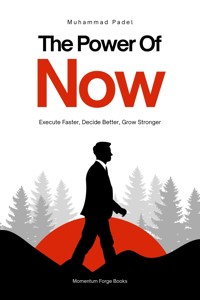
The Power of Now: Execute Faster, Decide Better, Grow Stronger is the ultimate playbook for professionals overwhelmed by the chaos of modern work. It tells the story of Maya Chen, a mid-level manager suddenly thrust into uncertainty after losing her job. Her life of routine and spreadsheets shatters, but with the help of her mentor, Theo Park, she discovers a practical system to transform panic into purpose, overwhelm into momentum.
Explore the groundbreaking Now Ledger method — a step-by-step, actionable framework designed to help you:
- Name and manage your "Jolt" moments, shifting away from anxiety-driven multitasking to focused action
- Time-box your attention into "Now Windows," small, protected periods optimized for high-impact work
- Offload your mental clutter into categorized lanes, preserving your capacity for critical decisions
- Define clear "Done" criteria, so progress is visible and momentum tangible
- Identify and sweep away "frictions," the hidden obstacles that drain productivity without you noticing
- Build a Focus Architecture that transforms scattered effort into consistent, reliable outputs
- Sell without cringe by crafting conversations that center on clear problems, credible proof, a bold promise, and an easy path forward
Whether you are a founder, manager, or professional looking to reclaim your attention and turn daily decisions into massive results, The Power of Now offers a disciplined, no-fluff system. It shows you how to stop spinning and start shipping, converting fragmented hours into a compounding engine of growth.
Inside, you'll find checklists, templates, and rituals that are easy to apply immediately, including:
- The Now Ledger steps to regain control in moments of crisis
- Techniques for audit and removal of productivity "sand in the gears"
- A scalable Minimum Operating System to reduce errors and speed deliveries in your team
- Momentum loops for managing wins and losses effectively
- A clear framework for turning features into compelling value conversations
Das E-Book können Sie in Legimi-Apps oder einer beliebigen App lesen, die das folgende Format unterstützen:
Veröffentlichungsjahr: 2025
Ähnliche

















The Power of Now: Execute Faster, Decide Better, Grow Stronger
Chapter 1: The Jolt—Maya Chen Meets the Now Moment
The email subject line said Quick chat? with the question mark like a hook. When Maya Chen clicked Join, her director’s face appeared in a neat rectangle: sympathetic eyes, a practiced sigh, three corporate talking points. The words reorg and difficult decision slid across the glass. Then the words that hit bone: your role. Eliminated.
At thirty-eight, Maya’s life had been one long spreadsheet of contingencies. She could tell you her retirement number to the dollar, her vacation days through Q4, the six vendors on her next rollout, and the time she woke up every weekday without setting an alarm. Her calendar ran like a commuter train set: color blocks, routes, predictable stops. The Jolt ripped up the tracks.
The call ended. The rectangle went black. Her apartment was too quiet. Her hands searched for something to touch and found the edge of her dining table, the smooth wood suddenly vast. Inside, her mind bolted forward in all directions—rent, taxes, her mother’s prescription renewal, LinkedIn, health insurance, the way silence sounded when you didn’t know the next meeting.
There’s a moment panic disguises itself as planning. It speaks in 50-item lists and open tabs and breathless resolve. It tells you that if you hold the entire future in your head, you’ll be safe. She wrote a list. It sprawled. She opened tabs. They multiplied.
Her phone buzzed: Theo Park.
They’d met years back when she was a junior project manager and he was the outside consultant the CTO swore by. He had a knack for walking into a mess and finding the lever everyone else overlooked. He also had a way of making Maya feel seen in rooms where calm voices got drowned by urgency theater.
Saw the news, his text read, no punctuation. Coffee?
They met at a small table by the window of a cafe that did not care about layoffs. An espresso machine hissed like an indifferent dragon. Theo—black T-shirt, notebook, that steady alertness that had never felt performative—leaned forward.
“How are you in your body?” he asked.
“I don’t know,” Maya said, surprised to notice her left foot tapping hard under the table. “Everything’s… loud.”
He nodded. “That’s the Jolt. It’s designed to hijack your attention. It tells you the future is what you need to manage. It’s wrong.”
He uncapped a pen. On the brown paper lining the table, he drew a rectangle and partitioned it into four columns with fast, sure lines.
“I’m not going to tell you it’s going to be okay,” he said, eyes on the paper. “I’m going to give you a tool. You can make it okay with the next ninety minutes.”
He wrote at the top: The Now Ledger.
“The Now Ledger is a way to force the future to wait its turn,” he said. “It’s simple. But simple is not the same as easy, especially when you’re flooded. Ready to practice it right now?”
She exhaled. “Okay.”
What follows is both their conversation and a set of steps you can try in the exact kind of moment when trying anything feels like too much.
Step 1: Name the JoltTheo tapped the paper. “Your nervous system hates ambiguity. When you name what happened, you remove some of its power. Use plain words.”
He wrote: Lost job today at 10:02 a.m.
“Say it out loud,” he said.
“I lost my job today at 10:02 a.m.,” Maya said, and felt the sentence land in her chest.
Step 2: Open a Now Window“Decide how long your Now is,” Theo said. “When you’re activated, ninety minutes or less. We’re going to work inside that box only.”
He wrote: Now Window: 45 minutes.
“Forty-five is enough time to do something real and short enough to feel safe,” he said.
Step 3: Two-Minute Offload“Now we empty your head,” Theo said. “Two minutes. Everything trying to be ‘urgent’ goes on the page. Don’t evaluate. It’s a dump, not a plan.”
He set a timer. They wrote: severance details; COBRA; call Mom; update resume; message two ex-colleagues; rent due; 401(k) rollover; LinkedIn banner; cry; run; clean inbox; budget; reassure Grace (neighbor); buy printer ink (?); check state unemployment website; coffee; nap.
When the timer chirped, Maya put down the pen. The list looked like an all-caps screen.
Step 4: Sort Into Four LanesTheo drew headers above the columns.
Left to right, he wrote:
- Now (1–3 actions)- Next (today)- Not-Now (this week)- Not-Ours (never or not you)
“The offload is a raw materials pile,” he said. “We’re going to sort it. You can only put one to three items in Now, because Now is sacred.”
Together they sorted. “Buy printer ink” went to Not-Now. “Reassure Grace” went to Next. “Cry” stayed off to the side; Theo let it sit without labeling. “Message two ex-colleagues” went to Next. “Update resume” tempted the Now column, but Theo shook his head.
“If the Now action is too big, you’ll stare at it,” he said. “We’re looking for a keystone action—small size, high leverage.”
“What’s high leverage?” Maya asked.
“High leverage is something that changes the surface area of luck,” Theo said. “It’s something that, once done, makes ten other things easier.”
He glanced at her. “Are you open to contracting?”
Maya blinked. Her brain was still on job boards. “Maybe?”
“Your skills are packaging, sequencing, and de-risking outcomes,” he said. “Those are agency skills. The market buys outcomes, not resumes. If we spend Now on a resume, we reinforce the job frame. If we spend Now on direct value, we begin to build a different frame.”
He wrote in the Now column: Make a punchlist of three outcomes I can deliver in 2 weeks.
Then: Identify 5 people who know people who could need one of these outcomes.
And: Draft one 5-sentence message.
Everything else shifted to Next or Not-Now. “COBRA” went to Not-Now with a note: set reminder tomorrow 10 a.m. “Call Mom” went to Next. “Run” stayed in Next. “Budget” moved to Not-Now.
Step 5: Define Done in Evidence“For each Now item,” Theo said, “define Done as something observable. If you can’t take a photo of it or read it back to me, it’s not Done yet.”
“Notice we didn’t write ‘reach out to five people,’” he said. “We write one message. Momentum comes from one clean example.”
He slid the pen to Maya. “You write. Your hand teaches your brain you’re in charge.”
Step 6: Friction Sweep“Before you start, scan for speed bumps,” Theo said. “List the friction you expect in the next forty-five minutes.”
They wrote:
- Perfectionism: what if the outcomes aren’t good enough?- Distraction: texts, email.- Doomscrolling: job postings.- Energy dip.
“For each, pre-decide a move,” he said. They wrote:
- Perfectionism -> Use a 50-word cap. Stop at three; better drafts later.- Distraction -> Airplane mode until timer ends.- Doomscrolling -> Close all tabs but doc; put sticky note on screen: Future can wait.- Energy dip -> Stand up every 15 minutes, one stretch. Sip water.
Step 7: Start the Clock“Set your timer to 45 minutes,” he said. “Protect the box. Work the order you wrote.”
Maya’s thumb hovered over the phone screen. “When I start, it feels real,” she said.
“It is real,” Theo said. “All progress is here-and-now flavored. Everything else is a story.”
She hit Start. The Now Window opened.
Here is what she wrote in the first ten minutes.
Outcome 1: Stand up a one-week delivery plan for a SaaS onboarding audit that identifies friction in first session, prioritizes fixes by impact, and provides a playbook for a 10% trial-to-paid bump.
Outcome 2: Create a sprint-based roadmap for a beta launch with stakeholder alignment, risk register, and weekly demo cadence designed to surface blockers early and keep comms clean.
Outcome 3: Design a lean operational reset for a 5-person team, including a role/responsibility map, meeting compression, and a two-week experiment to cut status time by 50%.
She paused, surprised by how quickly her hands had found the old motion: break the nebulous into brass tacks.
Fifteen minutes in, she listed five names with one line each: Priya (former VP Product; needs launch discipline), Dan (runs a startup studio; always hunting operators), Sophie (friend in HR network; knows team leads in chaos), Oscar (VC scout; sees portfolio fires), Len (ex-client PM; moved to a Series B).
She wrote the message in five sentences.
Subject: Quick one—could your team use a 2-week operational sprint?
Dan—In the next two weeks, I’m running micro-sprints that deliver a specific outcome (ex: a clean onboarding audit with prioritized fixes or a beta-launch cadence that surfaces blockers early). It’s hands-on and scoped: I come in as an operator for 10 business days, produce the plan, run the meetings, and leave you with a simple keep-the-gains playbook. If someone in your orbit is in that “too busy to fix the busy” phase, would an intro be useful? If nothing comes to mind, no worries—I’d value your read on whether this pitch is clear. Maya
She looked at Theo, startled by the feeling under the fear. It wasn’t relief. It was agency.
“This is the Now Ledger,” he said, leaning back. “It’s not about paper. It’s about attention with a spine. When everything is loud, the Ledger makes a narrow corridor where you can carry something heavy.”
Try this now:
- Write one sentence that names your Jolt.- Open a Now Window of 30–45 minutes.- Offload your brain for two minutes.- Sort into the four lanes and pick one to three Now items.- Define Done in something you can observe.- Sweep for friction and pre-decide a move.- Start the clock.
If it helps, write only with a pen. The physical act slows the spin and makes your mind less slippery.
By the time her timer chimed, the first column had three checkmarks. Maya’s body still hummed with adrenaline, but the hum had a rhythm. She set the pen down and realized her foot had stopped tapping.
“What about the rest?” she asked, looking at the other columns, at the life she could not stop thinking about resuming.
“We’ll get there,” Theo said. “You’ll run two or three Now Windows a day. The Ledger will start to change what ‘urgent’ means. And we’re going to make a move that aligns your skills with the market you actually want.”
He flipped to a clean page and drew the rectangle again. This time, he wrote a single line across the top before the columns: 30-Day Outcome.
“You can look for another role,” he said. “You’re good at that game. But you’re also missing an option that’s right under your hands. A micro-agency is just a way to turn what you already do into productized sprints with edges. It’s you, plus clarity, plus a clock.”
Maya watched the letters form. Micro-agency. The word made her stomach tilt and her shoulders lift. Fear and excitement often wear the same jacket.
“Thirty days,” Theo said. “That’s not a trap; it’s a shape. We’re not committing to a forever identity. We’re running an experiment with stakes. The first week is discovery and packaging; the second is outreach; the third is delivery; the fourth is proof and refit. The Ledger runs the days.”
He slid the page toward her and placed the pen on the line where he’d left space after 30-Day Outcome. “Write in your own words what this is,” he said. “Short. Specific. Measurable enough to know if we hit it.”
Her hand hovered. Through the window, a bus sighed and swallowed strangers. Somewhere, someone else’s calendar pinged. She could feel the inertia of familiar paths pulling her back toward job boards and formatted bullet points. The Ledger stared up like a small door into a room she had not yet walked into, a room that would require a different kind of courage than polishing her resume ever had
Her pen touched the paper.
30-Day Outcome: Book and deliver two 10-day operator sprints for small product teams (≤12 people) and secure two pieces of proof (testimonial and metric). Target revenue: $8,000–$12,000. Have a simple one-page offer live and a repeatable outreach list of 25 names.
She looked up.
Theo nodded. “Good. That’s specific enough to know if we hit it. Now we add edges.”
“What are edges?” she asked.
“Edges are the rules that keep your experiment from turning into a swamp. They limit scope, increase trust, and make decisions faster. Without edges, the Jolt will leak into your work.”
He drew bullets under her line.
- Who it’s for: Seed to Series B product teams with a leader who knows what hurts.- What it is: A 10-business-day sprint to deliver one operational outcome (pick from three).- What it isn’t: Recruiting, long-term staff augmentation, or building features.- How it works: Day 0 scoping call; Days 1–9 run; Day 10 handoff and playbook.- Price and terms: $4,000–$6,000 per sprint, 50% upfront, 50% Day 6. If misfit by Day 3, stop and refund remaining days.- Channels: Warm intros first, then targeted founders/operators. No job boards.
“This is your offer skeleton,” he said. “Every yes or no sits against these edges. They protect your time, your margin, and your sanity.”
She smiled, small and real. “I like rules.”
“We’ll give your rules teeth,” he said. “Done in Evidence, at the 30-day level.”
Under her outcome, he wrote:
- Two signed scopes with start and end dates.- Two invoices paid as per terms.- One-page offer link exists and is sharable.- One testimonial screenshot and one metric chart.- A list of 25 contacts in a spreadsheet with status (intro, call, proposal).- Habit: two Now Windows/day, 5 days/week, tracked.
“Now we zoom back down to today,” he said. “Our attention stays in the narrow corridor, but with a compass pointing 30 days out.”
Her phone buzzed on the table—Sophie’s name. She flipped it face down and exhaled.
Theo watched her do it. “That’s the Ledger running your phone, not the other way around.”
They set another Now Window for 35 minutes. “We’re going to draft the one-pager,” Theo said. “It’s a crude artifact that changes conversations.”
Step 8: Make an Offer Page Ugly First
“Ugly first?” Maya asked.
“Pretty is for later. Today, we need a dock where opportunities can tie up.”
They sketched sections on paper:
- Who this is for- The three outcomes (from her earlier list)- How it works (Day 0 to Day 10)- What you get (artifacts, cadence)- Price and terms- How to start (reply, 20-minute scoping call link)
She wrote fast:
For small product teams in the “too busy to fix the busy” phase. In 10 business days, I act as a hands-on operator to deliver one of three outcomes: a clean onboarding audit with prioritized fixes; a beta launch cadence that surfaces blockers early; or a lean operational reset that cuts status time. We start with a 20-minute scoping call. I run the meetings, build the plan, execute with your team, and leave you with a simple keep-the-gains playbook. Price: $4–6k per sprint (scope dependent), 50% upfront, 50% on Day 6. If we determine by Day 3 that it’s not a fit, we stop and I refund the remaining days. To start: reply here or book a call .
“Good,” Theo said. “Now, not later, put it where it can be seen. Cloud doc with a shareable link or a simple one-pager site. No design, just words.”
They created a bare-bones document, copy-pasted the text, and titled it: Two-Week Operator Sprints for Product Teams. She set the permissions to Anyone with the link can view.
“Done,” she said, surprised at the lightness of it.
“Not done,” he said gently. “Add your name, a photo, three lines of credibility.”
She typed: Maya Chen—10+ years in SaaS ops and product delivery. Led cross-functional rollouts for Series B–D teams. I like turning chaos into cadence.
“Good enough,” Theo said. “Ship the link to yourself. That’s an easy win and one less friction later.”
She did.
Try this now:- Draft an ugly-first one-pager for your offer. Use the sections above.- Host it somewhere you can share with one link.- Add three lines of credibility you can say without shrinking.
“Now the calls,” Theo said. “Discovery is not for selling. It’s for understanding if the problem and the edges match.”
He wrote a five-step call outline:
- Situation: “What are you building? Who’s involved?”- Pain: “Where is the friction showing up in the week?”- Evidence: “What happened last week that makes you think this needs to change now?”- Desired outcome: “If we’re successful in 10 days, what will be measurably different?”- Offer and fit: “Here’s how the sprint works; does that match your constraints?”
“And a simple close,” he added. “If it matches: ‘Would you like me to send a one-page scope with dates and price?’ If it doesn’t: ‘I know someone who might be better—want an intro?’”
Maya copied it into her notes.
Her second Now Window ticked down. She sent the five-sentence message with the new link to Dan first. Then to Priya. Then Sophie. She adjusted the subject line for each person with a specific hook.
She hesitated on Oscar. “I feel like I’m asking for a favor,” she said.
Theo shook his head. “You’re offering an option that reduces their headaches. Keep your language honest and clean.”
She sent it.
When the timer chimed, she didn’t want to stop. That impulse—ride the wave—wasn’t always helpful.
“Close the window,” Theo said. “The box gives you rest. You earn the next one.”
She put the pen down, palms flat, feeling the grain of the paper. Her body noted the boundary and unclenched a hair.
“What about everything else?” she asked. “COBRA. Rent. My mom.”
“We schedule the life-admin Now Windows,” Theo said. “One at 10 a.m. tomorrow for benefits, one at 3 p.m. for budget. Twenty-five minutes each. ‘Not-Now’ is not ‘never.’ It’s ‘not in this window.’ You’ll be shocked what gets done when it has a box.”
He flipped back to the first Ledger and circled “Call Mom” in the Next column. “Five minutes. After this coffee. That’s a nervous system task, not an operational one.”
She nodded, throat tight.
Theo leaned back. “One more thing. When the Jolt returns—and it will—you’ll want to jump lanes. So we add three micro-resets.”
He wrote:
- Three breaths with a count: in 4, hold 4, out 6. Twice.- Name three things you can see, two you can touch, one you can hear.- Stand, shake your hands, walk to the sink, sip water.
“These take under a minute,” he said. “Then you write the next Now Window. Ritual beats willpower.”
Try this now:- Write a 30-Day Outcome with edges.- Define Done in Evidence for the 30-day level.- Draft your ugly-first one-pager and host the link.- List five people and send one five-sentence message with the link.- Note three micro-resets and keep them where you’ll see them.
Her phone buzzed again. Dan: “This is timely. We have a portfolio team mid-beta and it’s messy. Can you talk at 2 tomorrow?” She felt the hit of adrenaline, but underneath it, something steadier.
“Yes,” she typed. “Will send a calendar invite and a one-page outline.”
Theo watched her face settle. “Here’s how you prep without spinning. We’ll build a Scope Sketch.”
He drew another rectangle.
Scope Sketch (for a 10-day sprint)- Project name: Beta launch cadence for .- Dates: , .- Outcome metric: e.g., 3 demos held, 80% of blockers surfaced by Day 5, daily status under 8 minutes.- Cadence: Daily 20-minute stand; Mon/Wed/Fri 30-minute risk review.- Artifacts: Risk register, stakeholder map, comms template, end-of-sprint playbook.- Roles: Client lead, me, team reps (Eng, Product, Support).- Risks and mitigations: e.g., low attendance -> calendar hold + automated agendas.- Price and terms: $X; 50% upfront; opt-out by Day 3.- Next step: 20-minute scoping call to validate.
“Keep it to one page,” he said. “You’ll use the call to fill the blanks. You send it after the call as a proposal, with dates and price slotted.”
She wrote quickly, letting placeholders sit. It didn’t have to be perfect. It had to exist.
“And we protect your energy,” Theo added. “Two Now Windows tomorrow. Not six. The urge to make up for lost time is the Jolt in a blazer.”
She laughed, first time that day.
They paid for the coffees. Outside, the air had the after-rain smell of damp concrete and cut grass. Maya pulled out her phone, took a breath, and called her mother.
“Hi, Ma.”
Her mother’s voice, always a mix of care and inventory. “How are you?”
“I lost my job today,” Maya said. “I’m okay. I have a plan. But I wanted to tell you.”
A pause, then the sound of something placed carefully on a counter. “Do you need money?” her mother asked, blunt.
“I don’t think so,” Maya said. “I’m starting my own thing. Just for now, maybe longer. I’ll keep you posted.”
“You always make a plan,” her mother said, and Maya could hear the pride under the worry. “Eat something.”
“I will.”
She hung up and looked at the sky that had decided to be blue again.
At home, she set up her ledger in a cheap spiral notebook, one rectangle per page. The left margin had dates already printed; she added small boxes for checkmarks. The physical ritual soothed her, as promised.
She wrote tomorrow’s plan:
Now Window 1 (10:00–10:35): Benefits admin- Done in Evidence: Screenshot of COBRA options; calendar hold for enrollment; note on state unemployment steps.
Now Window 2 (1:00–1:45): Dan call prep- Done in Evidence: Scope Sketch filled; invite sent with link; discovery questions printed.
She closed the notebook and put it on the table where her laptop would see it first thing. She made a simple dinner, set an alarm for a morning run, and went to bed with the kind of tired that had edges instead of fog.
Educational Interlude: When the Jolt Hits Again
You’ll likely wake at 3 a.m. with your brain staging an unhelpful parade. Use this sequence:




