


Erhalten Sie Zugang zu diesem und mehr als 300000 Büchern ab EUR 5,99 monatlich.
- Herausgeber: Crown House Publishing
- Kategorie: Ratgeber
- Sprache: Englisch
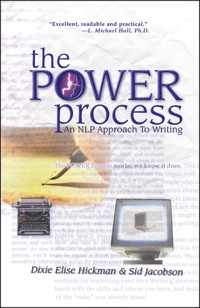
Distilling the essence of what makes a writer successful, The POWER Process applies the NLP model to writing in all forms. This invaluable aid and reference guide will revolutionise and energise your approaches to writing. " The authors have pioneered new ground ... excellent, readable and practical" L. Michael Hall PhD
Sie lesen das E-Book in den Legimi-Apps auf:
Seitenzahl: 352
Veröffentlichungsjahr: 1997
Das E-Book (TTS) können Sie hören im Abo „Legimi Premium” in Legimi-Apps auf:
Ähnliche


















The POWER Process
An NLP Approach To Writing
Dixie Elise Hickman & Sid Jacobson
Table of Contents
List of Figures
1.1 The Neuro-Logical Levels
2.1 Basic Communication Model
2.2 The Communication Process
2.3 POWER Previewing SPACE
3.1 The Structure Of Sensory Experience And State
3.2 Comparison Of Pavlovian Conditioning And NLP Anchoring
3.3 Three Perceptual Positions
3.4 Interaction Of Sub-Modalities
3.5 The Anchoring Chain
3.6 Breaking The Anchoring Chain
3.7 Designer State Worksheet
5.1 Cause-Effect Visuals
5.2 Street Scene A
5.3 Street Scene B
5.4 Creating Perspective In Street Scene B
5.5 Perspective In An Outline
5.6 Informal Perspective Outline
5.7 Speech Dynamics Outline
5.8 Generic Plan Sheet For Reports
5.9 Task Analysis Worksheet
5.10 Plan Sheet For Questionnaire
5.11 Complaint Investigation Report Plan Sheet
5.12 Job Application Letter Plan Sheet
5.13 Comparison/Contrast Grid
5.14 Tree Diagram
5.15 Street Map Of Speech
5.16 Town Square Map Of Speech
7.1 Hierarchy Of Editorial Elements
Acknowledgments
We give special thanks to Glenn E. Oehms, who developed the POWER SPACE model, and to the many students, workshop participants, and corporate clients over the years who have helped us develop, fine-tune, and verify the usefulness of the ideas in this book.
No book on NLP is complete without acknowledgment and thanks to Richard Bandler and John Grinder, co-developers of the ever-expanding technology of Neuro-Linguistic Programming. Their genius, collective and individual, has seldom been matched in the field of human behavior and systems thinking. The same goes for Leslie Cameron-Bandler, Judith DeLozier, the late Todd Epstein, David Gordon, especially for his work in the craft of metaphor development, and Robert Dilts, who is responsible for many of the useful NLP ideas in this book, including the Neuro-Logical Levels.
Thanks, too, to the folks at Crown House Publishing, for their care for details and their persistence through technological difficulties.
Individually, Dixie adds her appreciation to her family for their support and encouragement, especially husband Glenn Oehms, daughter Kyla, and parents, Mac and Billy Hickman, and to Sid for his collaboration and efforts in finding the right home for this book.
Sid gives special thanks to his wife and long-term companion Cindi Jacobson for putting up with him all these years and to his parents, brothers, in-laws, nieces, nephews, and other extended family, for the same reason. Permanent appreciation is extended to Dixie and Glenn for their contributions and hard work in making this book, and the idea in it, a reality.
Sid also thanks and acknowledges the intelligence and collective talent of the writer’s group he participated in for several years: guide, writer, and poet Kay Murphy, poet Laura Miller, Denise Chetta, Brian Hannon, Dr. John Willis, and his closest and dear friend of many years, Claudia Barker. Some of these have since published some truly beautiful work. He hopes to continue in that vein.
Preface To POWER
Another book on writing? Will this one be any different from the others? Yes. And yes, this one has something the others are missing. The POWER Process? The title of this book isn’t just a catchy phrase meant to sell books. It’s a reflection of the techniques we’ll teach you. We aren’t promising you fame or fortune. We do promise to get you writing better, faster, easier and more often. By the way, you’ll have more fun, too.
WHAT THIS BOOK IS ABOUT
The POWER Process works; we know it does. This model has been tried and proven consistently. We began with analyzing the writing process of successful writers, people who are effective and efficient, and discovered some important elements they had in common. We compared their patterns with those of people who have trouble writing. Then we distilled out the necessities in the process, packaged them in a form easily taught and learned, and gave it to others. Their improvement in writing has shown us how well we have done.
What you won’t find here are rules of grammar, sentence diagrams, and other standard fare. Nor will you find invention techniques and artificial writing assignments. We assume you already have something to say, and you want to say it better. That’s why you picked up this book. What you will find here are methods for improving your own thinking processes, getting in touch with the skills and talents you have, and making better use of the “rules” you already know.
HOW THIS BOOK DIFFERS FROM OTHERS
There are things in this book never before included in any book on writing, as well as new combinations of more familiar things.
First on the list of differences is Neuro-Linguistic Programming (NLP for short). Essentially, NLP is a model of human communication. It was developed to study the elements of excellence itself, regardless of the subject or activity. It gives us the tools to build the best possible model(s) of anything that works well. We use NLP in everything we do. It guarantees our effectiveness.
Second is a simple, but not oversimplified, model of what to do when you write, a model based on what effective writers actually do and how they use their thinking processes while they do it. Drawing on current research in the processes of writing and creativity, we go beyond those models using the tools of NLP, and package the result so that you can use it. Best of all, although you will be using the same thought processes as truly effective writers, you will be able to maintain and even enhance your own personal style.
Third, this book will actually get you writing as you go through it, step by step. No matter how incapable or how stuck you think you are, we’ll guide you through the same steps that create successful results for others, and you will create them as well. These steps take place inside your head and in your behavior, as well as on your paper or your word processor. And the process is self-reinforcing in nature. It feeds on its own success. So as you step through the work book experiments, use the material you are actually working on—or wish you were working on. This book will help you unlock your creative juices and release the power of your ideas.
Fourth, while this is primarily a book about writing, you will find yourself applying these principles and techniques to other areas of your life. You may even surprise and delight yourself as the learning from this book automatically expands into other parts of your thinking and behavior.
Fifth, these new styles of thinking you learn will not only get you writing but will also teach you a lot about yourself and people in general. Writing is a very personal thing, and anything that makes you a better person can make you a better writer.
Finally, you will be building enjoyment into the learning and writing process. When you enjoy what you are doing, you learn it faster, do it more, do it better, and want to do it again and again. That doesn’t mean we’ll take all the work out of writing. Good writing will still take time and effort. But it can also be a lot of fun.
HOW TO USE THIS BOOK
This book is designed so that you can read it at your leisure, use it as a work book to actually guide yourself through a writing project, and keep it handy as a reference guide for handling special problems or situations.
There’s a second Preface that describes our ethics and attitudes toward you. Then in Part I: POWER Sources, the first two chapters give you a general overview of what we’ll be working with. The Context of POWER introduces our model of the writing process. It also explains why many writers run into writing blocks; it’s very easy to lose awareness of the complete context of your writing. The Power of NLP explains some techniques for using your brain more effectively and gets you started on using it to write more effectively.
The next four chapters in Part II: The POWER Process take you step by step through the POWER process. We’ll introduce you to some other writers who’ve solved their writing problems using our methods to make their writing more comfortable, more streamlined and more effective. Then we’ll guide you in using these methods as you step through the process with your own writing project. These exercises will literally install effective writing strategies in your thought processes, both conscious and unconscious, and in your behavior. You will learn to elicit your own best states of mind for certain tasks and train yourself so that you can get into the proper frame of mind when you want to.
Part III: POWER Applications deals with special kinds of writing and how the POWER process can be applied or adapted to such situations as literary writing (fiction, poetry, and drama), business correspondence, and school papers. In the Appendix you’ll find extra worksheets, answers to the most common questions and problems people have with writing, and a streamlined quick-reference guide through the POWER Process. And finally, there’s a brief bibliography for more specialized concerns and for further exploration of NLP.
Although we recommend starting at the beginning and reading and working on through with a specific writing project, you may want to go ahead with the first two chapters while you decide how you want to apply it first. Or you may want to work on several projects at the same time. However you begin, this is a book to be used—and enjoyed. So read on, and more POWER to you!
Part I
POWER Sources
Chapter Two
The Context Of POWER
Communication doesn’t happen by itself, in a vacuum. There is always a context. That is, somebody wants to get a message to somebody else by some means in some kind of circumstance. And communication isn’t really a thing, it’s a process. That is, somebody has to send the message, and somebody has to receive it. One familiar model looks like this:
Figure 2.1Basic Communication Model
THE COMMUNICATION PROCESS
Communicating isn’t as simple as the diagram makes it seem, though. Let’s take a closer look at the process, considering some of the possible problem points. Messages can be sent in many ways, of course—words (spoken or written), music, movement (dancing, fighting, unintentional body language), sculpture, etc. Since this book is about writing, however, we’ll concentrate on that.
The Writer’s Part
To get very far into the writing process, a writer must first be inspired by an idea. That a writer needs an idea may seem obvious to you now, but many writers have been stuck because they really didn’t have anything to say. This situation is all too common in school, with assigned topics. Many people have gotten the notion that they “couldn’t write” because they couldn’t produce essays about topics they found to be irrelevant.
Suppose the idea is there, though. We began this book with clear ideas about writing—how to make it easier, more comfortable, more effective, efficient, and fun. Next, after the idea, a writer needs some basic tools—pencil and paper, word processor, or some other tool. Well, yes, how simple. But haven’t you ever lost an idea because you couldn’t find a pencil—and had forgotten why you wanted it by the time you found it? Dixie loses more good poetry lines that way. They come while she’s out walking, and by the time she’s arrived home…. Or maybe you’ve put off writing because it would be easier once you got to your own familiar computer? Dixie’s guilty there, too. She hates to think about having to re-type things.
Assuming the idea and tools are there, next the writer has to encode it—to put the idea into words. And yes, obstacles to the process may arise here, too. Ideas aren’t always born in words; sometimes we get pictures in our heads, or feelings we want to express. Probably everyone has experienced the frustration of impoverished code—of having a great idea but no words to express it. That’s one of Sid’s bugaboos. He gets great pictures in his head, but he can’t draw, so he has to translate his pictures into words.
Interference can come from outside the process itself, too. Sid can’t write until he’s washed all the dishes. That’s only true for his own dishes, however; he’s never compelled to clean Dixie’s kitchen. Once started, though, suppose the writer is happily putting wonderful words on paper, and the phone rings. Or the power goes out. Or it becomes time for another appointment of some sort. Or bedtime. Life, including other people, goes on and seldom agrees to wait until we finish the next sentence. Fortunately, good writers have strategies to take them right back to where they were in the process when they were interrupted. Interruptions may delay things, but they don’t have to disrupt the writing process. We’ll show you how to do it, too, so your interruptions will no longer be disruptions.
The Message Alone
Even if the writer completes the writing, communication hasn’t happened yet. Only the first stage of the process has been completed. The message still has to get to the reader and be decoded. Between mail service and filing systems on people’s desks, many misadventures are possible for the message. In the case of this book, before it got to you, we had to sell it to a publisher, who in turn had to package and market it so that you could select it in the store or catalog.
The Reader’s Part
Let’s suppose that the message has indeed made it to the final stage of the process. It is in the hands of the intended reader, who is eager to decode it—to take the words and turn them into the idea the writer intended to convey. For example, when you bought this book, how did you picture yourself using it? What did you tell yourself? What memories about writing came up that prompted you to look at it? Then how did you become sure this book would solve your writing problems? And how has that scenario progressed so far?
As a reader, you are subject to the same kinds of interferences as the writer was. Your phone rings, too. Fatigue sets in. Or your big labrador retriever bounds in to play, pretends the book is supper, and …
Subject matter itself can be an interference for some people. Writing is a prime example. Some people have such negative feelings about writing that they can hardly bear to think about it, much less read a book about it. Since one of our main objectives is to make writing more comfortable for you, we’re especially conscious of that one.
Once you actually start decoding—reading—the message, language may again be a problem. What if we’ve used unfamiliar words? Is there a dictionary handy? Would you stop reading to look up a word you were unsure of? Really?
A more insidious problem occurs when the writer uses a word to mean something different from the meaning the reader thinks of first. Dixie recalls a down-home example. She had a new babysitter for her fourteen-month-old child and called home to check on things. The sitter was reassuring—they’d had lunch, Kyla was napping, and then, “She’s starting to wake up now. Oh, oh, she’s ill. Let me go.” Click. With visions of her child sick and crying, Dixie hurriedly closed down her office and raced home. Kyla and the sitter were cheerfully coloring. No sign of distress. Questioned, the sitter said, “Oh, no she’s fine. She was just whiney, a little cranky, you know.” Yes, ill-tempered. Dixie got the message all right, but not the right message. The picture in her head didn’t match the picture the sitter had intended to convey.
Communicating In Context
Taking into account the complexity of influences in the writing process, a more realistic model of the communication process might look like this:
Figure 2.2The Communication Process
It may seem that in the normal course of everyday life, so many things can interfere with communication, that our ever understanding each other is a miracle. Well, yes, it is, rather. Fortunately, we believe in miracles. One miracle is that an awareness of the complexity of human communication is a strong tool for making our communication effective. Communication always happens in a context.
Trying to communicate without considering the context is like trying to communicate in a vacuum. Do you remember how much life exits in a vacuum? Right—none! When we try to write in a vacuum—without an awareness of the context of our communication—not much happens. That’s why we place our model of the writing process in the total context of communication, and we begin each writing project with previewing: getting a look at the specific context for this writing task.
THE POWER MODEL OF THE WRITING PROCESS
Many people have tried to define the process of writing. One of the most popular models has three steps: prewriting, writing, and rewriting. Another has nine steps. We could probably create a new model of the writing process for each writer, each one slightly different; there is no ONE WAY that must be followed. Yet there are certain basic patterns every successful writer follows.
The model we use has five major steps, with one of them subdivided. It paces the process, in general terms, used by every successful writer we know. The five steps are Previewing, Organizing, Writing, Evaluating, and Revising; we call it the POWER model.
Previewing
The first step in the writing process is previewing. In this stage you look over the writing situation—your communication context—before getting bogged down. The better the job done in this stage, the less time is spent later, undoing or redoing what you’ve written. Because this stage is so important, we’ve subdivided it into five components: self, purpose, audience, code, and experience—SPACE.
Self is a good place to begin. Who are you, the writer? We all wear many hats, and we choose which of the many facets of our personality we will display in any given situation. Your personal identity—who you are at your core and in your soul—is complex and too vast to find complete expression in any one given context. Your role is that part of you that needs expression in this situation. Begin by clearly defining for yourself the role you’re playing in this context, the image of yourself you want to project.
Purpose is the next consideration. Why are you writing? When the writing is done, and when the reader has finished it, what do you want to happen? Sometimes we have more than one purpose; there may be one overt purpose and one or more secondary ones. Understanding your own motivations improves your chances of getting what you want.
Audience (more fully—audience analysis) is obviously a critical factor, yet it is the one element most frequently overlooked. Since writing is essentially a solitary task, it’s easy to lose sight of the context of the communication itself, especially of that person on the other end of the process. Yet audience awareness (hence analysis) should have a strong impact on your writing.
Code is your next consideration. Code refers to the means by which you present your message. In the writing process, we use words; you must decide what level of language to use. Format is also a consideration of code. Are you going to write a memo or a letter, a formal report or a list? You may even decide a phone call would be more appropriate than writing.
Experience is the last element in the previewing stage. What personal experience do you have with the content of your message? Do you have enough information in your head or in books or files at hand, or do you need to gather more information, perhaps by making a phone call to an expert or by doing library research?
You’ve probably realized that these previewing components are all interrelated, as illustrated by the diagram below. Your experience is dependent on your role, which is influenced by your purpose, which is connected to your audience, who will determine your language code. All these factors will affect the amount and kind of detail or experience you use.
Figure 2.3POWER Previewing SPACE
Working through these elements translates into ease of writing in the rest of the process. Later, we’ll help you do it systematically to start you on your way to becoming a POWERful writer.
Organizing
Getting your information organized is the second step in the writing process. Given your audience and purpose, what arrangement of your material will be most effective? If the previewing process hasn’t made organizing seem almost automatic (it often does), we have some tools that will help.
Writing
We call the middle stage of the process writing, although you may very well have done some writing in the first two steps. In this writing stage, you produce your first draft. The object of writing the first draft is to get all the information you want to include out of your head, note cards, or files and onto paper. You want to collect your thoughts in one place, externally, so that you can see the message independently from yourself (the message sender).
Evaluating
Once you have a draft of your message, you can look at it objectively and evaluate it. Does it say what you meant? Will your audience read it the way you intended? Will it accomplish your purpose? Could you make it more effective?
Revising
Evaluating your writing will usually lead you to the final step. Revising means seeing again, and then you rewrite to reach your new vision. Finally, you look at the surface of the writing, correcting any errors that might distract a reader from your message. Although grammatical sophisticates maintain an unfocused awareness of such things automatically, you’ll want to save deliberate proofing for spelling, punctuation, or grammar slips for the very last act in the writing process.
All of this may seem quite complicated—and it is. But like most other complex tasks in life, with a little practice and organization, it can become simple and automatic.
POWER DYNAMICS
As you think about your own writing process, you’ll probably recognize these steps. Of course, the process can be drawn out or contracted, depending on the length and complexity of the writing task. For instance, for a brief thank you note to your Aunt Minnie, you will probably preview, organize, draft, and evaluate in your head; your first actual physical writing will come at the revising step. On the other hand, a formal application for a grant will probably go through several drafts and multiple evaluations.
We present this model in a linear fashion, as if writers move sequentially from previewing, to organizing, to writing, to evaluating and to revising. Overall, we do. But as you further compare this model and your own writing process, you may become aware of some looping movement, some recursion and repetition. The important thing to remember is that writing is a process involving both physical and mental activity. This book will guide you through the process, step by step, concentrating on how to make the process work for you. As you look at the model, you’ll see the acronym POWER SPACE. Writing is indeed a tool of power, and we’ll show you how to develop your own writing power. As you follow our suggestions throughout the writing process, you’ll begin to regard a blank piece of paper not as something intimidating, but as the power space for your ideas.
Chapter Three
The POWER Of Neuro-Linguistic Programming
Having an understanding of the writing process is one thing. Actually getting into the process comfortably and effectively, is, for many people, quite another. This chapter will introduce you to the techniques we can use to get ourselves in gear, to motivate ourselves to really do what we intend to do. You’ll learn how you can tap your own powers of concentration and your best internal resources to accomplish the things you want to do.
INTRODUCTION TO NLP
“Neuro WHAT?” is the usual response when we say “Neuro-Linguistic Programming” to the uninitiated. That is one of the reasons it has that name: it fosters curiosity. “Neuro” pays tribute to the brain, that marvelous organ that controls so much. “Linguistic” acknowledges the power of language on the way we think. “Programming” puts the emphasis on the way we direct our brains to function. Once the confusion about the name passes, people find one of the most fascinating sets of tools they have ever experienced. Although NLP will soon be familiar to all literate people, we recognize that it is presently unknown to most. Out of the many books and articles available on NLP, we’ve included some of our favorites in the bibliography.
Of course you don’t need all the techniques and models of NLP to be an effective writer. But some of them can help tremendously. We’re going to introduce you to NLP techniques for motivation, creativity, decision making, objectivity, and other universally useful components. Then we’ll show you how to use them to make yourself a more effective writer.
Like any specialized field, NLP has its own jargon—shorthand names for labeling certain sets of experience. Here are some of the most important:
States Of Consciousness
State of mind, state of awareness, mood, etc. are all roughly synonymous with state of consciousness. From now on, we’ll simply call them states. For our purposes, we are interested in particular states—for example, the right state of mind for writing, for getting organized, or for being creative. The important thing is that we learn a method for distinguishing one state from another, so that we can explore its usefulness, modify it as we see fit, control it, and get it whenever we want.
Actually, we all go in and out of many states of consciousness all the time. Probably hundreds each day. These are what are called natural states, though this probably isn’t the most useful term. Neither is the term “altered state,” since that almost makes them sound unnatural. Some states are easier to tell from others, however, just in our own experience of them. So it is usually best to talk about that experience of being in a particular state as compared to some other. That’s what we’ll be concentrating on here.
This brings us to the method for identifying particular discrete states. The elements that help us define a given state of consciousness are based on the five senses: visual (sight), auditory (hearing), kinesthetic (feelings), olfactory (smell), and gustatory (taste). In a particular state of mind, external sensory detail is less important than our internal experience. In our system, visual refers to our internal pictures, auditory to our internal sounds, kinesthetic to feelings (both tactile and internal), and olfactory-gustatory




