


16,99 €
Mehr erfahren.
- Herausgeber: John Wiley & Sons
- Kategorie: Fachliteratur
- Sprache: Englisch
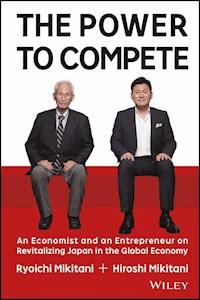
"If you're as interested in Japan as I am, I think you'll find that The Power to Compete is a smart and thought-provoking look at the future of a fascinating country." - Bill Gates, "5 Books to Read This Summer" Father and son - entrepreneur and economist - search for Japan's economic cure The Power to Compete tackles the issues central to the prosperity of Japan - and the world - in search of a cure for the "Japan Disease." As founder and CEO of Rakuten, one of the world's largest Internet companies, author Hiroshi Mikitani brings an entrepreneur's perspective to bear on the country's economic stagnation. Through a freewheeling and candid conversation with his economist father, Ryoichi Mikitani, the two examine the issues facing Japan, and explore possible roadmaps to revitalization. How can Japan overhaul its economy, education system, immigration, public infrastructure, and hold its own with China? Their ideas include applying business techniques like Key Performance Indicators to fix the economy, using information technology to cut government bureaucracy, and increasing the number of foreign firms with a head office in Japan. Readers gain rare insight into Japan's future, from both academic and practical perspectives on the inside. Mikitani argues that Japan's tendency to shun international frameworks and hide from global realities is the root of the problem, while Mikitani Sr.'s background as an international economist puts the issue in perspective for a well-rounded look at today's Japan. * Examine the causes of Japan's endless economic stagnation * Discover the current efforts underway to enhance Japan's competitiveness * Learn how free market "Abenomics" affected Japan's economy long-term * See Japan's issues from the perspective of an entrepreneur and an economist Japan's malaise is seated in a number of economic, business, political, and cultural issues, and this book doesn't shy away from hot topics. More than a discussion of economics, this book is a conversation between father and son as they work through opposing perspectives to help their country find The Power to Compete.
Sie lesen das E-Book in den Legimi-Apps auf:
Seitenzahl: 306
Veröffentlichungsjahr: 2014
Ähnliche


















Table of Contents
Title Page
Copyright
Introduction: Japan Again
Chapter 1: The Power to Innovate
Japan Again
The Keys to Revitalizing Japan
Keidanren's Raison D'être
The Nature of Innovation
Schumpeter's Contribution
Building Infrastructure
Business Innovation
Summary
Chapter 2: The Power to Operate
Workforce Fluidity
Privatization
Lifetime Employment
Escaping Lifetime Employment
Immigration Problems
Why English Needs to Be a Common Language in Japan
Growing the Population
Summary
Chapter 3: The Power in Questioning Abenomics
History of Abenomics
Independence in Finance
The Optimal Inflation Rate
Halting the Rise of Interest Rates
What to Do About Our 1-Quadrillion-Yen Debt
The Pros and Cons of Abenomics
Summary
Chapter 4: The Power of the Low-Cost State
The High Cost of Governance
How to Reform the High-Cost Structure
Addressing the Japanese Disease
The United States and Individualism
The Impotent Bureaucracy
Internationalizing the Bureaucracy
Creating Think Tanks
Political Appointees
What It Will Take to Improve the Bureaucracy
Summary
Chapter 5: The Power to Succeed Overseas
The Decline in the Number of Students Studying Abroad
Escaping from the Galapagos Effect
The Future of Journalism
Media in the Internet Era
The Importance of Liberal Arts
Ryoichi Mikitani's Experiences Abroad
Summary
Chapter 6: The Power to Educate
Uniform Japanese Education
The Education of the Mikitani Family
What the Education System Needs
Higher Education
What People Study in University
The Founding of Rakuten
The Evaluation System for Teachers
The Need for Strategy in the Japanese Education System
Summary
Chapter 7: The Power to Build Brand Japan
Brand Power
The Demonstration Effect
Brand Value at the National Level
Foreign Nationals Working in Japan
Making Japan Attractive to Foreign Nationals
Japan and the Trans-Pacific Partnership
Summary
Conclusion: What Is the Power to Compete?
Japan Uniquely Incorporates and Interprets Cultures
Competitiveness as a Platform
The Global Logistics Revolution
Summary
Epilogue
Acknowledgments
Index
End User License Agreement
Pages
ix
x
xi
xii
xiii
1
2
3
4
5
6
7
8
9
10
11
12
13
14
15
16
17
18
19
20
21
22
23
24
25
26
27
29
30
31
32
33
34
35
36
37
38
39
40
41
42
43
44
45
46
47
48
49
50
51
52
53
55
56
57
58
59
60
61
62
63
64
65
66
67
68
69
70
71
72
73
74
75
77
78
79
80
81
82
83
84
85
86
87
88
89
90
91
92
93
94
95
96
97
98
99
100
101
102
103
104
105
106
107
108
109
110
111
112
113
114
115
116
117
118
119
120
121
122
123
124
125
126
127
128
129
130
131
132
133
134
135
136
137
139
140
141
142
143
144
145
146
147
148
149
150
151
152
153
154
155
156
157
158
159
160
161
162
163
164
165
166
167
168
169
170
171
172
173
174
175
176
177
178
179
180
181
182
183
184
185
186
187
188
189
190
191
192
193
194
195
213
214
215
216
217
218
219
220
221
222
223
224
225
Guide
Cover
Table of Contents
Begin Reading
THE POWER TO COMPETE
An Economist and an Entrepreneur on Revitalizing Japan in the Global Economy
Hiroshi Mikitani
Ryoichi Mikitani
Cover image: Hiroshi Noguchi
Cover design: Seiichi Suzuki
Copyright © 2014 by Hiroshi Mikitani. All rights reserved.
Published by John Wiley & Sons, Inc., Hoboken, New Jersey.
Published simultaneously in Canada.
No part of this publication may be reproduced, stored in a retrieval system, or transmitted in any form or by any means, electronic, mechanical, photocopying, recording, scanning, or otherwise, except as permitted under Section 107 or 108 of the 1976 United States Copyright Act, without either the prior written permission of the Publisher, or authorization through payment of the appropriate per-copy fee to the Copyright Clearance Center, 222 Rosewood Drive, Danvers, MA 01923, (978) 750-8400, fax (978) 646-8600, or on the web at www.copyright.com. Requests to the Publisher for permission should be addressed to the Permissions Department, John Wiley & Sons, Inc., 111 River Street, Hoboken, NJ 07030, (201) 748-6011, fax (201) 748-6008, or online at www.wiley.com/go/permissions.
Limit of Liability/Disclaimer of Warranty: While the publisher and author have used their best efforts in preparing this book, they make no representations or warranties with the respect to the accuracy or completeness of the contents of this book and specifically disclaim any implied warranties of merchantability or fitness for a particular purpose. No warranty may be created or extended by sales representatives or written sales materials. The advice and strategies contained herein may not be suitable for your situation. You should consult with a professional where appropriate. Neither the publisher nor the author shall be liable for damages arising herefrom.
For general information about our other products and services, please contact our Customer Care Department within the United States at (800) 762-2974, outside the United States at (317) 572-3993 or fax (317) 572-4002.
Wiley publishes in a variety of print and electronic formats and by print-on-demand. Some material included with standard print versions of this book may not be included in e-books or in print-on-demand. If this book refers to media such as a CD or DVD that is not included in the version you purchased, you may download this material at http://booksupport.wiley.com. For more information about Wiley products, visit www.wiley.com.
ISBN 978-1-119-00060-0 (cloth);
ISBN 978-1-119-00114-0 (ebk);
ISBN 978-1-119-00115-7 (ebk)
IntroductionJapan Again
We are in a worldwide period of tremendous change, driven by the global information technology (IT) revolution. But not all of Japan has embraced the transformation. The sad truth is that few Japanese political, business, or governmental leaders understand where we are and where we are going. In many important ways, Japan today is the same as it was in the Edo period, when our country was closed off to the world and the leaders of the shogunate1 paid no mind to the changes happening abroad.
Even though we are seeing massive global changes in the IT industry, Japan as a whole seems unable to participate in the process. We drift aimlessly. The IT revolution has created structural shifts that are bringing the world together as if it were one continent. And yet, in Japan, people continue to prefer conventional frameworks, believing that we should enjoy a separate, isolated kind of Galapagos island. People here do not even try to consider the current global reality. This is as true for cell phones as it is for corporate governance and international accounting standards. I believe that the old guard's refusal to allow society to change only results in lowered productivity and weaker competitiveness for Japan.
Nowhere is this problem more obvious than in our government bureaucracy, which has become so bloated and rigid that it should really be called state capitalism. The continuation of the bureaucracy-led economy can only create a situation in which innovation is stifled; it will not inspire economic growth. And as the Japanese economy decelerates, the national debt continues to swell. It is difficult to imagine that this country has a future if we maintain the current spiral of loss in which the public is forced to swallow tax increases just so the government can somehow get by.
Japan is a country of rich traditions, culture, and philosophies cultivated over a 2,000-year history. We also excel in advanced technology and creativity. We need to share this intellectual and technical wealth. We must not limit our ambitions to our own small national borders and become a country of exclusion. Japan should instead become a country of greater openness, one that accepts a variety of people and cultures, and is attractive to people everywhere. This calls for two intertwined goals: (1) We must work to become the wealthiest country in the world; and (2) we must also strive to become a safe and peaceful country with highly advanced science, technology, and culture.
My work with the Japan Association of New Economy is aimed at achieving those goals. First, we must eliminate anachronistic regulations. At the same time, we must develop innovative businesses and services through the use of the Internet and other IT, and connect that innovation to the economic growth of Japan.
The second Abe2 administration, inaugurated in December 2012, created three councils—the Council on Economic and Fiscal Policy, the Industrial Competitiveness Council, and the Regulatory Reform Council—to act as the “control towers” for the economic revitalization plan popularly called Abenomics.3 As a member of the Industrial Competitiveness Council, I have had the opportunity to debate a growth strategy, the third arrow of Abenomics. I combined my thoughts as a business leader on that debate into a proposal entitled “Japan Again.”
While working on these issues of government and growth strategies, it occurred to me that I wanted to write a book about the topic. And I knew early on whom I would ask to be my coauthor: my father. My dad, an economist and a professor emeritus at Kobe University, had often been my debate partner and sounding board as I explored issues around the Japanese economy. He passed away in late 2013, but before that happened, we engaged in a series of discussions about the future of Japan and the global economy. The result of those debates is this book. My father was instrumental in helping me to understand where we are now, what has led us to this place, and what we must do going forward for Japan and for the larger global economy. It is my honor to share that thinking with you here, in the hopes of continuing the important global conversation he and I started.
Allow me to take a moment to introduce my dad: Ryoichi Mikitani was born at the start of the global economic crisis of 1929 in Nada-ku, Kobe. After graduating from the Graduate School of Economics at Kobe University, then called Kobe University of Economics, he chose the path of researcher, and from 1972 until his compulsory retirement as a public employee in 1993, he was a professor in the Graduate School of Economics at Kobe University. He specialized in financial theory and U.S. economic theory, and he served as president of the Japan Society of Monetary Economics. From there, he moved to the faculty of economics in the Graduate School of Economics at Kobe Gakuin University. He retired in 2002.
My dad was an international economist, which is a rare occupation in Japan. He studied at a language school in his teens, and he was fluent in both English and German. He easily passed the test for the Fulbright Scholar Program, which is known to be a difficult trial, and in 1959, at the age of 29, he entered the Graduate School of Arts and Sciences of Harvard University in the United States. There he studied U.S. economics, then a cutting-edge subject, and he also grew close with James Duesenberry, who was famous for his work on the demonstration effect, as well as Paul Sweezy, known as a Keynesian economist who was well versed in Marxian economics. At the same time, my dad immersed himself in tomes such as the Chinese military text The Art of War and The Analects of Confucius, becoming well versed in both Western and Eastern philosophy. The depth of his knowledge was absolutely amazing. I continue to have nothing but respect for the profundity of his insight and ability to see things for what they are. It may be more appropriate to introduce him as a philosopher or intellectual rather than as an economist.
Now for a few words about me: I was an unruly child and never one to get good grades, but my dad never had an unkind word for me. Even when I transferred out of my private junior high school after finding it difficult to fit in, he respected my feelings and supported me. Many times, when I found myself at a personal crossroads—when I graduated from Hitotsubashi University and was unsure about whether I wanted to go into research or become a businessman; when I quit my job at the Industrial Bank of Japan [currently Mizuho Bank]; when I founded Rakuten; when I tried to buy Tokyo Broadcasting System (TBS)—I always visited my dad in Kobe to hear his suggestions. Like my wife has been, my dad was a long behind-the-scenes counselor to me as I faced important decisions in life.
If he had been a traditional parent, I suppose that I could have expected advice like “Stop trying to do things differently from other people.” But Dad always supported me, telling me that if I believed something to be essentially correct, I must do it. Naturally, he always reminded me that if I was going to do something, I had better do it right.
As an entrepreneur, I am the sort of person who prefers to understand things in an intuitive way and make top-down decisions. I have previously referred to the process by which I make decisions as a game of catch between my left and right brain. When I started to feel intuitively that I was going to do something, I would go and play this game of intellectual catch with Dad. I would listen to his rational way of thinking and his questions about what my ideal outcome would be and what my experiences in the past had been like and, in the end, I always felt that I was able to transform my intuition into a feeling of certainty.
My parents were living close to me, so I could go ask for Dad's opinion whenever I wanted. But I knew I could not expect him to act as my counselor forever. He was 83 when I approached him to work on this book with me. I thought long and hard about our grand theme this time—the future of Japan—and then I asked my dad for his opinion on my ideas. In total, I had 17 different conversations covering a broad range of topics with Dad, starting in April 2013 and continuing for the following seven months. He passed away on November 9, 2013.
As we worked together on this book, it was our hope that it would help people to recognize the current difficult situation faced by Japan, as well as offer a vision for a brighter future and a road map to get there. Even as I grew up and remained close to him as an adult, there were many times when I did not fully understand what Dad's job as an economist entailed. The debates we had, for me, produced a series of revelations. We spent a lot of very valuable time together.
And so before I close, I want to emphasize the deep gratitude I feel toward my dad, my mom, and my entire family. Because Dad was not in good health toward the end of our conversations, he was joined each time by my mom, Setsuko, who helped us in various ways, including preparing documents for the meetings and organizing things. I am indebted to them all. Please enjoy the book we prepared together.
Hiroshi MikitaniChairman and CEORakuten, Inc.August 2014
1
This was the Japanese feudal government headed by a shogun in the Edo period (1603–1868).
2
Abe is Shinzō Abe, the 57th (2006–2007) and current Prime Minister of Japan, serving as the second Abe cabinet since December 2012.
3
Abenomics consists of three arrows: (1) a massive fiscal stimulus measure, (2) more aggressive monetary easing from the Bank of Japan, and (3) a growth strategy by structural reforms to boost Japan's competitiveness.
Chapter 1The Power to Innovate
Japan Again
Hiroshi Mikitani (“Hiroshi”):
Lesen Sie weiter in der vollständigen Ausgabe!
Lesen Sie weiter in der vollständigen Ausgabe!
Lesen Sie weiter in der vollständigen Ausgabe!
Lesen Sie weiter in der vollständigen Ausgabe!
Lesen Sie weiter in der vollständigen Ausgabe!
Lesen Sie weiter in der vollständigen Ausgabe!
Lesen Sie weiter in der vollständigen Ausgabe!
Lesen Sie weiter in der vollständigen Ausgabe!
Lesen Sie weiter in der vollständigen Ausgabe!
Lesen Sie weiter in der vollständigen Ausgabe!
Lesen Sie weiter in der vollständigen Ausgabe!




