


Erhalten Sie Zugang zu diesem und mehr als 300000 Büchern ab EUR 5,99 monatlich.
- Herausgeber: The History Press
- Kategorie: Geisteswissenschaft
- Sprache: Englisch
'Extraordinary and thrilling ... This story should be known to every man, woman and child' - Lemn Sissay In 1868, British troops charged into the mountain empire of Ethiopia, stormed the citadel of its monarch Tewodros II and grabbed piles of his treasures and sacred manuscripts. They also took his son – six-year-old Prince Alamayu – and brought the boy back with them to the cold shores of England. For the first time, Andrew Heavens tells the whole story of Alamayu, from his early days in his father's fortress on the roof of Africa to his new home across the seas, where he charmed Queen Victoria, chatted with Lord Tennyson and travelled with his towering red-headed guardian Captain Speedy. The orphan prince was celebrated but stereotyped and never allowed to go home. The book also follows the loot – Ethiopia's 'Elgin Marbles' – and tracks it down to its current hiding places in bank vaults, museum store cupboards and a boarded-up cavity in Westminster Abbey. A story of adventure, trauma and tragedy, The Prince and the Plunder is also a tale for our times, as we re-examine Britain's past, pull down statues of imperial grandees and look for other figures to commemorate and celebrate in their place.
Sie lesen das E-Book in den Legimi-Apps auf:
Seitenzahl: 409
Veröffentlichungsjahr: 2022
Das E-Book (TTS) können Sie hören im Abo „Legimi Premium” in Legimi-Apps auf:
Ähnliche




















About the Author
Andrew Heavens has worked for newspapers and press agencies for almost thirty years, including six years as a reporter and photographer in Ethiopia and Sudan. He grew up in Nigeria, Kenya and Egypt, and lives in London. The Prince and the Plunder is his first book.
To Amber, Rawdon and Esther
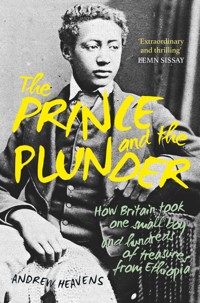
Front cover illustration: Alamayu at Rugby. (Courtesy of Special Collections and Galleries, Leeds University Library)
First published 2023
This paperback edition first published 2025
The History Press
97 St George’s Place, Cheltenham,
Gloucestershire, GL50 3QB
www.thehistorypress.co.uk
© Andrew Heavens, 2023, 2025
The right of Andrew Heavens to be identified as the Author of this work has been asserted in accordance with the Copyright, Designs and Patents Act 1988.
All rights reserved. No part of this book may be reprinted or reproduced or utilised in any form or by any electronic, mechanical or other means, now known or hereafter invented, including photocopying and recording, or in any information storage or retrieval system, without the permission in writing from the Publishers.
British Library Cataloguing in Publication Data.
A catalogue record for this book is available from the British Library.
ISBN 978 1 80399 650 9
Typesetting and origination by The History Press
Printed and bound in Great Britain by TJ Books Limited, Padstow, Cornwall
eBook converted by Geethik Technologies
Contents
List of Illustrations
Preface
Map of the Horn of Africa
PART ONE: THE PRINCE
1 Home
2 Breakdown
3 War
4 Plunder
5 Exile
6 Arrival
7 Interludes
8 Retreat
9 Lessons
10 The Funeral Psalm
11 Return
PART TWO: THE PLUNDER
Alamayu
Tirunesh
Tewodros
‘The Abuna’s Crown and Chalice’
The Dig
6,450 Animals and a Human Skull
The Kwer’ata Re’esu Icon
The Book Liberator
The Tabots
Alamayu’s Remains
The Directory
The Maqdala Plunder, Still Missing
The Maqdala Plunder, Returned
Notes
Select Bibliography
Acknowledgements
List of Illustrations
p. IX Alamayu’s signature, dated 1869 (Ian Shapiro collection)
p. XI Mural of Tewodros in Addis Ababa (author’s photo, courtesy of Reuters)
p. XII Portrait of Alamayu by the London Stereoscopic and Photographic Company, c. 1868 (author’s collection)
p. XV Map of the Horn of Africa featuring key sites from the story (d-maps –www.d-maps.com/carte.php?num_car=5502)
p. 18 View from a point near the King’s House, Maqdala (Illustrated London News, 1868)
p. 21 Boys playing genna on top of Maqdala, January 2004 (photo courtesy of James Ball)
p. 30 Stern’s confrontation with Tewodros (from I Prigionieri di Teodoro, 1870)
p. 39 The European prisoners on Maqdala (from I Prigionieri di Teodoro, 1870)
p. 42 Britannia confronts Tewodros (Punch, 1867)
p. 59 Action of Aroge, from Record of the Expedition to Abyssinia, vol. II (New York Public Library)
p. 65 Attack on Maqdala, from Record of the Expedition to Abyssinia, vol. II (New York Public Library)
p. 71 ‘King Theadore after death’, photographs of the Abyssinian campaign (1867–1868) (Yale Center for British Art, Paul Mellon Fund)
p. 79 ‘Son and heir of King Theodore’, photographs of the Abyssinian campaign (1867–1868), albumen prints (Yale Center for British Art, Paul Mellon Fund)
p. 81 Maqdala in flames (from I Prigionieri di Teodoro, 1870)
p. 84 Alamayu (Illustrated London News, 1868)
p. 90 ‘Captain Speedy’, photographs of the Abyssinian campaign (1867–1868) (Yale Center for British Art, Paul Mellon Fund)
p. 103 Alamayu in Malta by Leandro Preziosi (Giovanni Bonello collection)
p. 110 ‘Prince of Abyssinia sketched at St Davids station’ by Tucker (Devon Record Office; found by Dr Ghee Bowman)
p. 117 Speedy and Alamayu photographed by Cornelius Jabez Hughes on the Isle of Wight (Ian Shapiro collection)
p. 123 Alamayu on the Isle of Wight by Julia Margaret Cameron (Museum of Fine Arts, Houston)
p. 129 Tewodros’s charger Hammel (Ian Shapiro collection)
p. 131 Maqdala robes on display in the South Kensington Museum, 1868 (The Gentleman’s Magazine)
p. 132 ‘Abyssinian trophies’ on display (The Gentleman’s Magazine)
p. 167 Class photo, Rugby School, 1876 (Sandy & Caroline Holt-Wilson collection)
p. 168 Detail of class photo, 1876 (Sandy & Caroline Holt-Wilson collection)
p. 168 Detail of class photo, 1877 (Sandy & Caroline Holt-Wilson collection)
p. 170 Alamayu at Rugby (courtesy of Special Collections and Galleries, Leeds University Library)
p. 186 Alamayu photographed after death, 1879 (courtesy of Special Collections and Galleries, Leeds University Library)
p. 201 Alamayu’s necklace (© The Trustees of the British Museum)
p. 204 Tirunesh’s dress (The Victoria & Albert Museum)
p. 208 Images showing Tewodros just before and after his death (from I Prigionieri di Teodoro, 1870, and Illustrated London News)
p. 212 Richard Pankhurst with Tewodros’s amulet in Addis Ababa, 2002 (author’s photo)
p. 215 ‘A portrait of the emperor’ in selections of the Gospels of Matthew and Mark (British Library OR 733)
p. 217 ‘The Abuna’s Crown’ (Illustrated London News)
p. 217 ‘The Abuna’s Chalice’ (Illustrated London News)
p. 220 The dig at Adulis (Illustrated London News)
p. 221 Artefact from Adulis (Illustrated London News)
p. 227 The Kwer’ata Re’esu icon in 1905 (The Burlington Magazine for Connoisseurs)
p. 231 Seymour McLean, 2002 (author’s photo)
p. 236 Ethiopian delegation at Waverley Station, 2002 (author’s photo)
p. 245 Richard Pankhurst and Dr Hassen Said from the Institute of Ethiopian Studies, Addis Ababa, 2005 (author’s photo)
Preface
Our hero is an Ethiopian prince called አለማየሁ. It seems pretty well established that the closest English version of that name is Alemayehu. This book is going for something simpler – Alamayu – because that is how he wrote it, as far as we can tell from the few scraps of paper left with his handwriting. There is a handful of letters out there. The scholar–collector Ian Shapiro also found his signature written out on a slip of paper in a Victorian album of autographs.
It is a young boy’s faltering handwriting; you can still see the pencil guidelines and the false stops and starts on the ‘l’ and the ‘a’. If he was reading this book – and he would have just passed his 161st birthday around now – there is a good chance that this is the version of his name he would recognise on the page.
Whenever his name comes out of other people’s mouths and other people’s pens, the book will keep their spellings inside quotation marks, if only to show that even those closest to him never quite got it right. Alam-Ayahoo, Alam-ayahu, Alamaeo, Alamaeio, Alamagub, Alamaieo, Alámàio, Alamaya, Alamayahu, Alamaye, Alamayo, Alamayon, Alamayoo, Alamayou, Alamazoo, Alamees, Alemayahu, Alemayehu, Alemayu, Alumaya – they are all Alamayu.
I first heard his name when I was a reporter in Ethiopia in the early 2000s. There were images of his father – Ethiopia’s great nineteenth-century King of Kings Tewodros II – all over the place: scrawled on school buildings, printed on T-shirts, reproduced endlessly on cards stuck on car windows in the modern capital Addis Ababa, in the old city of Gondar and in his base in Debre Tabor, east of Lake Tana. Those pictures showed a stern, muscular man with long braided hair, staring into the distance with lions lying at his feet and flags or cannons in the background.
A super-sized statue of Tewodros with a giant spear loomed over tourists and travellers at Gondar Airport, also known as Atse Tewodros Airport. In some parts of Addis and in the Rastafarian neighbourhoods of Shashamane, his face was daubed on walls next to other global icons of Black power and dignity, among them Emperor Haile Selassie, Martin Luther King and Bob Marley.
Mural of Tewodros in Addis Ababa.
This was Tewodros as African giant, the man who forcibly united his country after decades of chaos, then took on the growing imperial force of Great Britain. His coronation in 1855, as the historian Bahru Zewde wrote, ‘inaugurated the modern history of Ethiopia’.
Next to all that, his son remained a bit of a footnote, a tragic ‘and finally’ to Tewodros’s story. Alamayu was Ethiopia’s own lost boy, the prince who, according to the repeated tellings of his short tale, was snatched away from his mountain home by invading British soldiers and taken to the cold, cold shores of Great Britain. Search for him now online and you’ll see him on his journey. There he is again and again, row upon row of images of a little boy, a sad-eyed schoolboy of the English Midlands, a young man. The backgrounds change – a plain in Ethiopia, a photographer’s studio in Malta, a drawing room in Victorian England. But one thing rarely shifts: his expression. In most of the pictures he stares straight ahead or sometimes a little to the side, wherever he is directed. He has the same good looks, the same straight-backed dignity, a sense of poise. And then there are his eyes and his mouth that naturally falls into the mildest of frowns, his separation from everything and everyone around him, his almost constant sadness. He became a myth, an icon of sadness.
Portrait of Alamayu by the London Stereoscopic and Photographic Company, c. 1868.
That icon still evokes strong emotions. ‘Whenever I see a photograph of Alemayehu I can stare at it for hours. There is always something so tragic in his pose,’ Elleni Centime Zeleke, a professor of African studies at Columbia University, wrote in a poetic essay in the journal Callaloo. ‘When Alemayehu sits for a photo he already looks like a dead memory. It is as if he already understood his fate, as did his photographers.’ In 2007, the government in Addis Ababa formally called for Britain to return Alamayu’s remains to Ethiopia. One otherwise hard-bitten rebel-fighter-turned-government-minister dug deep as she tried to explain what was driving the campaign. It wasn’t about politics or calculated reparation. At the heart of it was something much simpler, something that any parent could understand. Alamayu, the lost boy, the lost prince, just had to come home. ‘I am saying this as a mother,’ she told the journalists gathered around her.
The images and iconography of Alamayu are powerful, but the details of his life have largely only been sketched in outline. This book is an attempt to fill in some of the gaps, go beyond the folktale and follow Alamayu’s journey from the Ethiopian highland fortress of Maqdala out across the sea. He did not leave many words. Many books would apologise for their lack of first-hand material from their main subject. Here though, that is one of the main points. At the start of his journey he was a child, so other people spoke for him. Other, mostly European, people made decisions for him. Much of the time you are left weighing up other people’s competing accounts of what happened. Very occasionally you can see the real boy through the cracks in an unguarded smile in a photograph or an overheard snatch of conversation, a flash of defiant humour, a sign of a strong and determined will. This book looks through those cracks and uses objects to fill in some of the story – Alamayu’s possessions, as well as other things that should have been his possessions but were kept from him, and the hundreds of objects of loot and plunder that the British soldiers brought back from their invasion.
He spent more than half his life in Britain, so this is as much a book of forgotten British history as Ethiopian history. It is a story that starts before Alamayu was born, with an encounter between Britons and Ethiopians in the middle of the nineteenth century, in the decades between the end of Britain’s dealings in African slavery and the start of its wholesale scramble for African territory, when the direction that future relations would take was still not set in stone. Somewhere in the middle of it all there is our lost prince, a young queen and a pile of missing treasure. There is also the story of a relationship between Britain and Ethiopia that burned bright, then faltered, then collapsed in disaster. It all happened a long time ago now. But in many ways we are still getting over it.
A few words on words:
This book refers to ‘Ethiopia’ wherever it can and the archaic ‘Abyssinia’ only occasionally, mostly when it crops up in quotes and other people’s references. For simplicity’s sake, both names are used to refer to the same territory in the Horn of Africa – north of modern-day Kenya, south of modern-day Sudan and Eritrea – though I know that drives a dump truck through a whole host of important geographical and historical demarcations. Most of the action here takes place in the northern part of modern-day Ethiopia.
The monarch is Tewodros, not the anglicised version Theodore or Theodorus; his mountain fortress is Maqdala, not the anglicised Magdala. I have tried to follow the historian Bahru Zewde in the transliteration of other names, apart from Alamayu, who remains Alamayu.
Map of the Horn of Africa
Featuring key sites from the story.
Part One
The Prince
Chapter One
Home
‘Here [in the happy valley] the sons and daughters of Abissinia lived only to know the soft vicissitudes of pleasure and repose, attended by all that were skilful to delight, and gratified with whatever the senses can enjoy … The sages who instructed them, told them of nothing but the miseries of publick life, and described all beyond the mountains as regions of calamity, where discord was always raging, and where man preyed upon man.’
The History of Rasselas, Prince of Abissinia
On the first day of March 1841, John Bell set off from Gondar on the lookout for adventure. Leaving the old city’s castles and incense-filled churches behind him, he rode south, down past villages and hills and woodlands, following the winding course of the Angereb River.
Turning a bend in the track, he got a good view of vast expanse of Ethiopia’s Lake Tana spread out in front of him, dotted with island churches and monasteries. The fresh, clear highland air brought everything closer. Out in the glinting water he could make out the grey mass of his first hippopotamus basking on a shoal.
The towering son of a family of roaming British seafarers had already seen more than his fair share of wonders and new horizons. He had been born on Malta, learned French, Maltese and Arabic at the missionary school in Sliema and earned his first living travelling with merchants and explorers, acting as their universal factotum and translator. While still in his twenties, he had decided it was time for some exploits of his own, so he had sailed down the Red Sea, stopped off on the coast of East Africa and climbed up into the near-mythical mountain empire of what was then called Abyssinia. His plan: to find the source of the Nile, to fill in some of those great blank spaces on his maps of the interior, to win a little recognition back home and, above all, to forge his own future.
So that was what he was doing as he wandered south down the edge of Lake Tana. Adventuring had never been easier. Day after day he rode over gently sloping hills in the shade of acacia trees, crossing streams, shooting guinea fowl for dinner and sipping the coffee brewed by his retinue of servants. Barely a week into their journey, the small party wound its way through a hilly, heavily wooded territory, over a stream, past a church and up along a lonely, woody path, bounded on both sides by high bushes. Which is where the bandits struck.
Eight men armed with shields and lances jumped out of the bushes and knocked Bell to the ground. They slashed at his arm as he tried to protect his head. One servant, Gabriote, ran to his side with a sword. Bell got up, pulled out two pistols and held the attackers at bay for a second. Another rush. Bell took aim, but his first pistol misfired. So did his second. He had loaded them two months earlier and they had hung unused by his side during his wandering idyll. He took one of the pistols by the muzzle and used it as a club, lashing out. The men closed in and surrounded them, jabbing with their spears. One raised a lance and stabbed Bell in the face, sinking the point between his eyes. Blood gushed out, nearly blinding him as he floundered on, weaker and fainter. Gabriote, still at his side with five gaping wounds, still trying to keep the men away, began to totter and slumped down. One of the bandits grabbed his sword as he fell. The gang scooped up a few other bits of baggage scattered around and ran off, leaving Bell and Gabriote lying on the blood-soaked ground.
A pause, then the other servants emerged from their hiding places. The two wounded men managed to get to their feet, gather some belongings and slowly, slowly head back to the track, staggering along, falling three or four times along the way. After about half an hour of agonising stumbling they reached the town of Qorata and collapsed at the door of a church.
By sheer luck, a merchant that Bell had met on his way into the country had a house nearby and took them in. One of the attendants gave Bell a cup of the local beer, but when he drank it some of the liquid came seeping out of his eyes. On closer inspection, he later wrote in his journal, the spear thrust into his face ‘was found to have entered the superior part of the nasal bones, to have pierced the superior palate bones and to have run along the superior maxillary bone finally making its exit just below the right ear, most wonderfully avoiding the large vessels placed in that neighbourhood’. Gabriote was in no better state.
After a few days, wounds still healing, Bell had recovered just enough to start making inquiries. It turned out that the eight shifta – a loose term covering a wide range of armed men from bandits to rebels to militia fighters – were under the command of a senior officer serving Ras Ali, that region’s ruler. From his sickbed, Bell demanded investigations, compensation, punishment for the men who had dared to attack the British explorer and his party. What he got in return was a measure of sympathy from his immediate hosts but, beyond that, bemusement. The wheels of Ethiopian politics, it turned out, were not prepared to stop in their tracks to investigate and prosecute a bandit attack on a notoriously bandit-infested road. No one had died. Shifta happens. That was that.
Bell’s merchant friend sent men to the scene of the attack and retrieved one of the pistols dropped in the melee. ‘When I recovered a little I went to see the Ras, and asked him to punish the robbers,’ Bell wrote. ‘He refused, saying they were badly wounded as well as myself. He then dropped the subject declaring he would not hear more about it; consequently I got up and walked out of the place.’
What to do when the rest of the world refuses to play along with the grand narrative running in your head? You can pack up and go home. Or you can keep on keeping on, keep the story running in your own journal and get back on track as the explorer, pushing forward the boundaries of adventure.
A few weeks passed and an Ethiopian noble rode into town, on his way to patch up a rift with Ras Ali. At dinner one night, the noble offered to take Bell along with him on the next stage of his journey and show him some more of the country. Bell said yes and on 4 April, almost a month to the day after his woodland ambush, he jumped on his horse and was back on his way, leaving Gabriote, still badly wounded, behind him.
Time to speed up. Bell was off again, fording streams, riding past old Portuguese fortresses, feasting on raw beef and honey wine, having a blast. He inspected a bog close to Lake Tana, long acknowledged as the source of the Blue Nile tributary of the great river that flowed on hundreds of miles north through Sudan and Egypt out into the Mediterranean. (Europe’s geographers would have to wait another seventeen years for another wandering Brit to head around 900 miles further south and ‘discover’ the source of the White Nile.) Bell suffered from fevers and severe head pains. At one point he sent for someone to bleed him ‘and after much difficulty a monk was found who undertook to perform the operation’. A servant held Bell in a headlock until the veins stuck out. The monk pulled out a razor, held it against Bell’s forehead and tapped it sharply with a stick. ‘The incision being made, the pressure was removed from my throat, and the blood flowed freely which relieved me much, and I soon recovered my usual health.’ Somewhere along the way, the former wanderer called John Bell, scarred and battered, with a spear wound in between his eyes, a hole in the roof of his mouth and a gash across his forehead, decided this was where he wanted to spend the rest of his life.
On one trip out of the country he met another restless Briton in the port of Suez and persuaded him to come to Ethiopia and share in the fun.
Walter Plowden was another towering young man, buried up to his neck in the British establishment. Branches of his family had records dating back to before the twelfth century, with their own ancestral seat and their own ancestral chapel in Plowden Hall in the heartlands of England, in the Shropshire hamlet of, you guessed it, Plowden.
By the age of 19, he had followed his older brothers, father and grandfather by setting up shop in British India and started making his fortune the respectable and brain-deadening way, working for the banking and trading firm of Carr, Tagore and Company in Calcutta (now Kolkata). But it hadn’t worked out. On the way back to England he met Bell in Suez in 1843, a meeting that, in the words of the Plowden family chronicle, ‘altered his mind’. On the spur of the moment, without funds or planning, he decided to jack it all in, rip up generations of family tradition and seek out his own life in Africa.
So this is where he headed with Bell – to Ethiopia, the perfect place for anyone looking to escape the drudgery of balancing figures and counting stock. For Europeans, this was Abyssinia, one of the purported homelands of Prester John, the mythical medieval Christian priest–king whose vast crusading armies had set out with thirteen golden crosses at their head to challenge the surrounding ‘infidels’. Most people realised his riches, fantastic beasts and other glories were fairy tales stitched together by the chroniclers. But the myth still held. Britons were short of facts about Africa in those days and long on legends.
Abyssinia was also supposed to be the last resting place of the original Ark of the Covenant, the chest designed by God himself for the ancient Israelites to hold the Ten Commandments. Plowden had studied the ancient Ethiopian text the Kebra Nagast, or The Glory of Kings, which set out the story of Ethiopia’s first emperor, Menelik – the son of none other than King Solomon and Makeda, the Queen of Sheba – who, it was said, had brought the Ark to Ethiopia from the Temple in Jerusalem. Who knew what other potent biblical treasures were hiding away in some church in the Abyssinian highlands?
The country was also the home of Rasselas, the fictional Abyssinian prince created by the English writer Samuel Johnson. According to Johnson’s bestselling book The History of Rasselas, Prince of Abissinia, published in 1759, the boy lived a gilded life in a ‘happy valley’ where ‘all the diversities of the world were brought together, the blessings of nature were collected, and its evils extracted and excluded’. The youth and his royal siblings were kept there, apart from the rest of the world, and distracted by an endless succession of entertainments and frivolities until it was their turn to take the throne. At the centre of it all stood a palace where a succession of emperors had buried their gold and jewels in hidden cavities. In the British imagination, the courtly glories of the Ethiopian highlands were part Xanadu, part potential asset.
Bell and Plowden embarked on five years of freewheeling wandering. They found no jewels but made do with several lifetimes’ worth of adventures.
Over time their paths diverged. Plowden dreamed of forging a grand alliance between his new home and his old. Throughout his time in Ethiopia, he sent reports back to London singing the country’s praises, touting its fertility, untapped resources and opportunities for trade. He described how its soil could produce all types of grain, tea, coffee, indigo, spices, cotton, peaches, plums and grapes. After rains, ‘beautiful rivulets meander in all directions, resembling the trout streams of England’. There was iron, gold and copper. Plowden’s letters and journal entries created their own fantasy land to rival Prester John’s. In his hands, Ethiopia transformed into a Merrie Olde jumble of courtly romance. Its tej honey wine flowed like mead. Its songs and singers rivalled those ‘of the old Jongleur or Provençal’, ‘the Highland harper or Irish bard’. Its military hierarchies recalled ‘the feudal times, when the great barons were followed to war by all born on their lands’.
Early on, Plowden travelled back to Britain, surviving a Red Sea shipwreck on the way, and made his case to the Foreign Office in person. His efforts paid off and in January 1848, still in his twenties, Plowden was appointed ‘Consular Agent for the protection of British trade with Abyssinia, and with the countries adjoining thereto’. His official base was back on the Red Sea coast in the sweltering port of Massawa, then an outpost of the sprawling Ottoman Empire. But London, initially at least, encouraged him to keep heading up into the highlands from time to time to keep the lines of communication open and watch over the trade and diplomatic treaty he had finally secured with Ras Ali.
John Bell took things even further. He all but forgot his old land and threw himself into his home. He wore Ethiopian clothes and, in the years that followed, married an Ethiopian noblewoman, Woizero Warknesh Asfa Yilma, and started a family. John became Yohannes as he moved on from his early unsatisfactory encounter with Ras Ali and effectively signed up as one of his generals, waging Ras Ali’s wars, charging around the land and leaving nineteenth-century Britain, with all its relentless clanking, steam-powered churn, far behind him.
There was a tricky interlude when it turned out that Bell had backed the wrong man. This was a particularly tumultuous era in Ethiopian politics known as the Zemene Mesafint – a name that has been translated as both the Age of Princes and the Age of Judges, after the era described in the Old Testament Book of Judges when ‘there was no king in Israel [and] every man did that which was right in his own eyes’. Ethiopia’s ancient line of Solomonic leaders had disintegrated into a succession of puppet emperors, and the real powers in the land were the princes, the Rases, who battled endlessly over influence and territory.
Ras Ali, with Bell fighting at his side, was defeated at the Battle of Ayshal on 29 June 1853 by an emerging power – Ras Ali’s own rebellious son-in-law, a minor noble turned shifta turned militia leader known at the time as Kasa, the man who would go on to become King of Kings Tewodros II, the future father of our prince.
Ras Ali fled and, after a few minor skirmishes, faded from history. Bell, as the story goes, took refuge in a church after the defeat and awaited his fate. Kasa heard he was there and called him out to talk. The battle, which could have been the end of this story, turned out to be just a bump in the road for Bell and Britain’s other young representative. Bell smoothly switched his allegiance to Kasa and kept diving in deeper and deeper. Plowden had already been keeping track of Kasa’s rise and had been impressed with what he had seen.
You can still hear the voice of Alamayu’s father crackling with energy through the short letters, messages and orders sent out to allies and enemies. ‘I am Kasa. No one can face me,’ read one early challenge to a rival in the borderlands with Sudan. Kasa had spent his early years in Kwara, west of Lake Tana, right in those border regions, and was always haunted by the threat from the Muslim north – from the Egyptians, the Ottomans or, as he called all of them, ‘the Turks’. He had suffered one major defeat in his early campaigns, when he had pushed north, only to be routed by a well-drilled Ottoman force armed with artillery. Ever since, he had also been obsessed with mastering tactics and acquiring heavy weaponry.
By early 1855, in his late thirties, Kasa had defeated most of his main rivals through a mixture of political manoeuvring, spectacular raids and military daring. So he decided to end the Zemene Mesafint and get himself crowned negusa nagast, King of Kings, over the whole territory. He chose the name of a long-prophesied saviour who would unify the country, defeat its enemies and rebuild its fortunes – Tewodros. The British, skimming over the details and balking at the foreign-sounding name, called him King or Emperor Theodore or Theodorus.
Tewodros promised to end Ethiopia’s relative diplomatic isolation and build foreign alliances. ‘Now you are the child of Christ and I am the child of Christ. For the love of Christ I want friendship,’ he wrote to Britain’s Queen Victoria, one monarch to another.
But he was also cautious about foreign interference. ‘Don’t send us priests and clergy,’ ordered another message stamped with his seal and sent to the French consul at Massawa. The Ethiopians had been Christian for centuries and had their own Orthodox Church and priests, the message said. They didn’t need to learn the religion from anybody, particularly imported Catholic missionaries. But if Europe wanted to send in merchants and craftsmen, he wrote, that was a different matter. Ethiopia would welcome them with open arms, whatever their creed.
‘A remarkable man has now appeared, who under the title of Negoos or King Theodorus, has united the whole of Northern Abyssinia under his authority, and has established tolerable tranquillity,’ Plowden told the authorities in London in June 1855, using his own spelling for negus, or king.
‘The King Theodorus is young in years, vigorous in all manly exercises, of a striking countenance, peculiarly polite and engaging when pleased, and mostly displaying great tact and delicacy,’ Plowden wrote. ‘He is persuaded that he is destined to restore the glories of [the] Ethiopian Empire, and to achieve great conquests; of untiring energy, both mental and bodily, his personal and moral daring are boundless.’
Tewodros had his faults, Plowden went on in his official report: ‘The worst points in his character are his violent anger at times and his unyielding pride as regards his kingly and divine right.’ Plowden watched as a Catholic monk was brought in front of Tewodros and sentenced to death for refusing to recognise the king’s authority. The consul successfully pleaded for the monk’s life but ‘could in no way persuade the King to banish him or release him from his chains’.
Overall, Plowden excused Tewodros’s excesses. His harsh punishments were ‘very necessary to restrain disorder, and to restore order in such a wilderness as Abyssinia’. And generally, Tewodros kept those excesses under control, Plowden said. ‘He has hitherto exercised the utmost clemency towards the vanquished, treating them rather as his friends than his enemies. His faith is signal; “Without Christ,” he says, “I am nothing; if he has destined me to purify and reform this distracted kingdom, with His aid, who shall stay me?”’
There was even more in the gushing report. Tewodros had taken steps to ban the practice of enslaving prisoners of war and other groups in Ethiopia, cut trade red tape and overhauled the military. ‘He wishes, in a short time, to send embassies to the Great European Powers to treat with them on equal terms,’ Plowden told London.
The feelings of admiration were mutual, up to a point. Tewodros knew true believers and useful allies when he saw them and knew how to make them feel special. ‘You and Bell only love me,’ he said in one aside to the consul, recorded in Plowden’s notebooks later published by his brother.
‘If anything happens to me, befriend my son,’ Tewodros told Plowden, taking his hand before heading out on a military excursion. ‘Write to your country; say you had a friend who loved you all, and who intended to send an embassy to you for your friendship and beg them to support my son.’ Plowden promised he would. Alamayu had not been born yet. But Tewodros already had one son from his days in Kwara.
Many European commentators have presented Plowden and Bell as Tewodros’s bedrock, his steadying, guiding – in their words, civilising – hand. There is little to back that up, beyond European condescension. Tewodros may have been interested in the foreigners’ technology, in the head start that the Industrial Revolution had given them in matters military and mechanical. But he had done pretty well by himself before the British turned up. ‘For Teodoros, the foreigners and the Westerners in particular were the barbarians who by some inexplicable dispensation of Providence possessed the knowledge of technological procedures and gadgets,’ wrote Czeslaw Jeśman in his 1966 essay ‘The Tragedy of Magdala’. Tewodros would ‘confide in them and shower all manner of rewards. As long as they served his purpose they were welcome; otherwise they were beneath his contempt.’ Other Europeans who later felt the full force of that contempt said they regularly overheard him referring to white monkeys.
So far, the foreigners were serving Tewodros’s purpose. Europe had sent him explorers and adventurers and he had effectively recruited them. Europe had also sent him missionaries, and he had them exactly where he wanted them. He had stamped out direct efforts to convert Ethiopian Orthodox Christians to foreign brands of Christianity, and only let a few groups of preachers in, on strict conditions. One was a band of Protestants who had promised to focus on teaching craft and technical skills, based in the settlement of Gafat. He had already started persuading them to work with other craftsmen and turn their skills to mending the occasional musket, even casting mortars and cannons. Another band of missionaries that he was less sure about had said they were only interested in converting members of Ethiopia’s Beta Israel group – then widely known by the now-derogatory term Falashas – who lived across the area covered by our story and had followed a strand of Judaism as long as anyone could remember. Fine, Tewodros had said, as long as the missionaries only tried to turn them into Orthodox Christians. Beyond that, his imperial plans were flourishing.
The Brits were also more than happy with the arrangement. Plowden had found his African King Arthur, a wellspring of future adventures and a foundation for his grand plans of British–African engagement. He pressed Tewodros to make the relationship official by ratifying the treaty Britain had already signed with Ras Ali. Tewodros held off from signing any British contract and refused to allow the establishment of a foreign consulate on his territory. Many after him might have wished they had done the same. He said he was inexperienced in such matters and wanted to hear more. Plowden suggested Britain might be able to give the landlocked mountain kingdom its own route to the sea and full control over Massawa. If Tewodros would only accept him as consul, Plowden suggested, he would follow the monarch’s campaigns and share his dangers. That, to put it mildly, is further than today’s British ambassador to Ethiopia would go. Tewodros said he still had to think.
Bell was more than happy with his whole new life. He had got a title – Liqa Mekuas, literally ‘gatekeeper’, a kind of chamberlain. He had his official position close to Tewodros’s tent, shared his food, read him passages from Shakespeare and fought in his campaigns, sometimes dressed up like Tewodros himself so he could act as a kind of body double to deceive their shared enemies, despite the obvious differences in the two men’s appearance. He was ‘Theodore’s Englishman’, The Times later said. ‘There are in all history few instances of a devotion so loyal, so touching in its simplicity and honest bravery as that with which this single-hearted, outspoken Englishman worshipped Theodore.’
The nineteenth century’s imperial powers famously focused on spreading the three Cs – Commerce, Christianity and Civilisation, all on their own terms, of course. The Europeans edging into Ethiopia and other parts of Africa at the time were interested in all three. But they were also there for the romance and the roleplay that their new surroundings allowed them. Junior officers and younger sons from relatively drab backgrounds hitched a ride on Britain’s expansions and reinvented themselves in the wide-open spaces as explorers, masters and adventurers. They revelled in the exotic. Those young men could dress up and work up a whole range of new stories, casting themselves as the central characters. But stories can be dangerous things. They can go badly wrong when you try to force roles on the other people around you. Particularly when the fantasy you have spun crashes into reality.
Five short years later, Bell and Plowden’s fantasy crashed into reality.
A one-line report in The Times, dated 5 May 1860, announced: ‘Her Britannic Majesty’s Consul at Massowah (Abyssinia), Mr. W.C.M. Plowden, is dead.’ Soon, so was John Bell.
Plowden had set off for the coast, his health deteriorating and his leg weak after a bad break, exhausted after years of diplomatic needling that had still failed to produce a treaty or any influx of British investment. ‘Still very weak, but must go,’ read the last entry in his journal.
On his way, a band of rebel fighters surrounded Plowden’s party and took him away. There are various reports of what happened next, none of them reliable as many of the immediate witnesses were soon themselves dead. At some point one of his captors stabbed him in the chest, either during the initial confrontation or a little while later when they thought he was reaching for a weapon. Friends paid a ransom and took him back to Gondar, where Britain’s first consul to Ethiopia died of his wounds, aged just 39. He was buried at a grand funeral, with thirty priests and much of the population of the city attending. You can still visit his crumbling grave.
Tewodros vowed revenge and set off in search of the rebels, with Bell in the advance party. They found them, attacked and ‘a desperate melee ensued’, according to one of the dispatches that made its way back to London. Somewhere in the fighting, Bell killed the leader, the leader’s brother killed Bell, then Tewodros killed the brother. More elaborate versions emerged later, with Bell suffering his fatal wound as he jumped in front of Tewodros to shield him. Whatever the details, Bell died but Tewodros prevailed, killed scores of the rebels on the spot and headed north to chase down their ultimate commander.
Back in London, the civil servants started casting around for a replacement for Plowden, and for some appropriate response to Tewodros’s actions. It was a delicate balance to strike. How to show Britain’s appreciation for Tewodros’s support for Plowden and Bell without directly endorsing the mass killings that followed? Officials on the ground suggested it might be safest to use the language of gifts and found the following on sale in an Indian warehouse:
• One large and one small gold embroidered carpet of Indian manufacture. Price demanded for both, 1,800 rupees.
• Two embossed silver cups (Surat make), 150 rupees.
• A Bohemian glass sherbet service, richly gilt, 500 rupees.
As the months passed, the list of gifts got longer and included a rifle and a pair of revolver pistols. As Chekhov might have said, remember the pistols.
By the end of 1860, Britain’s involvement in Ethiopia was in tatters, but Tewodros was still thriving, politically at least. His beloved wife Tawabach, Ras Ali’s daughter, had died. So he decided to marry again.
The new queen – Alamayu’s future mother – did not leave an account of her life, and other people’s reports barely sketch her in outline. Accounts from the time refer to her by two names, both of them emblematic – Tirunesh, meaning something like ‘you are good, fine, pure, clear, perfect’, and Tiruwarq, meaning something like ‘pure, good, beautiful gold’. Beyond that, a few other details made up her portrait. One, she was very young. Two, she was beautiful. Three, she was pious. One story was repeated again and again in mostly European reports. It describes private encounters, so it is not clear where the details came from. But repeat a story often enough and it becomes a saint’s hagiography. Here’s the version told by the British–French doctor Henry Blanc, who will have his own role to play in the tale:
One day in the beginning of 1860 Theodore perceived in a church a handsome young girl silently praying to her patron, the Virgin Mary. Struck with her beauty and modesty, he made inquiries about her, and was informed that she was the only daughter of Dejatch Oubie,1 the Prince of Tigre, his former rival, whom he had dethroned, and who was then his prisoner. He asked for her hand and met with a polite refusal. The young girl desired to retire into a convent and devote herself to the service of God. Theodore was not a man to be easily thwarted in his desires. He proposed to Oubie that he would set him at liberty, only retaining him in his camp as his ‘guest,’ should the Prince prevail on his daughter to accept his hand. At last Waizero Tirunesh sacrificed herself for her old father’s welfare.
Perhaps unsurprisingly, given how it started, the marriage did not go well. Tirunesh and her aristocratic family, according to Blanc’s account, still saw Tewodros, the former shifta, as an upstart.
‘In the afternoon,’ wrote Blanc, ‘Theodore, as it had been his former habit, tired and weary, would retire for rest in the queen’s tent; but he found no cordial welcome there. His wife’s looks were cold and full of pride; and she even went so far as to receive him without the common courtesy due to her king. One day when he came in she pretended not to perceive him, did not rise, and remained silent when he inquired as to her health and welfare; she held in her hand a Book of Psalms, and when Theodore asked her why she did not answer him, she calmly replied, without lifting up her eyes from the book, “Because I am conversing with a greater and better man than you – the pious King David.”’
One of the few first-hand sightings of the queen was recorded by Henry Dufton, another British adventurer passing through the region. He got the briefest of glimpses of her eyes behind her royal robes. ‘As she was muffled up to the eyes with a superabundance of rich garments, my view was confined to the two brilliant orbs, which, if report be correct, have often returned the withering fire of her royal husband’s. Theodore gives little love to the beautiful daughter of Oubie … Nor has she herself much affection for the man who dethroned her father.’
Around a year after their marriage, the couple managed to have their one child, another son for Tewodros, called አለማየሁ, a name most often transliterated into English as Alemayehu; ‘Alem’ meaning ‘the world’; and ‘ayehu’ meaning ‘I saw’. ‘I saw the world’, typically with a broader sense of ‘I enjoyed life and lived it to the full’, was more often than not meant as a kind of boast by the parents – that they have enjoyed life and lived it to its full. There’s no need to overthink this. It is just a name, not a destiny. But later, the British press would never let Alamayu forget its strange echoes, given the amount of the world that he would go on to see.
The child had not seen much of anything yet. The first place he saw with conscious eyes was the place where Tewodros put him – the place where Tewodros put all of the people and things he wanted to keep secure and out of the way. Ethiopia’s King of Kings kept his son and his proud second wife safe in his mountain fortress of Maqdala, east of Lake Tana, as he rode around the land, pressing on with his campaigns.
View from a point near the King’s House, Maqdala.
Samuel Johnson’s fictional Prince Rasselas lived in ‘a spacious valley in the kingdom of Amhara, surrounded on every side by mountains’, a place of luxury and endless diversions that the young man eventually came to see as a gilded prison. The only way in and out of the valley was a hidden cavern, blocked with ‘massy’ iron gates. The book Rasselas is about his adventures as he escapes the valley with a group of companions and sets out to see the world, think for himself, act for himself and make his own ‘choice of life’.
Flip Rasselas’s valley inside out and you have Alamayu’s home. The prince lived on a mountain in the region of Amhara, surrounded on every side by valleys and twisted ravines. His immediate world was the mountain’s flat summit, a spacious plateau less than a mile long and half a mile across. Most of it was bounded by sheer black basalt cliffs. The main way in was a land bridge up from two lower peaks, then up along a path blocked by soldiers and two sets of gates protected by stone walls and thick thorn hedges. From that approach, Maqdala is still an ominous place, a long rock monolith looming dark on the horizon even in the bright midday sunlight. Seen from any other perspective, from across the gorges and chasms and ravines, it was nothing short of an unassailable fortress, towering over a biblical landscape of near-perpendicular cliffs.
Beyond those were the expanses of the Ethiopian highlands. It is a landscape you really have to see for yourself. Words will only go so far. That whole part of northern Ethiopia is already a vast plateau, the ‘roof of Africa’, thousands of feet above the surrounding deserts and plains. When you finally clamber to the top of that plateau, you find more hills and mountains on top of hills and mountains. The forces of nature have carved out huge gulfs between sections of land that stand out like islands and headlands. There was one ‘joke’ that quickly wore thin when the British soldiers invaded a few years later and marched up from the coast – that if these were the tablelands of Ethiopia, then someone had stacked the tables upside down, with their legs stretching up into the sky. Young Alamayu stood on one of those promontories. If you can take one more fictional counterpart, picture Antoine de Saint-Exupéry’s Little Prince, out on his tiny planet, surrounded by the huge gulfs of space.
When I climbed up to the flat top of Maqdala with a small group in 2004, the path was open and the thorn gates were gone. It still had its brooding presence. There was one church next to a small rise in the ground, a cluster of huts and a large expanse of open ground. A ragged gang of boys charged across it, singing, shouting and chasing a small ball with bent sticks, playing the ancient hockey-like game of genna. There was less room to play in Alamayu’s day. The summit was surrounded by barricades and large parts of it were clustered with buildings, small round huts and larger structures, packed with soldiers, camp followers, court spies and more soldiers. There was a bit more room around the royal compound where Alamayu lived with his mother. A few years later, the British geographer Clements Markham got a last glimpse of their home before his country’s troops blew it to pieces:
The King’s house, where the Queen Tirunesh dwelt with her little boy, was an oblong building of two stories. The ground-floor was used as a granary, and was full of grain, and a staircase outside the building led to a large upper room, supported by pillars down the centre, which had been used as a sleeping apartment. By the side of this large building there were two … circular houses, for the use of female attendants. A row of wooden pillars supported the roof, and between every two pillars there were wooden bedsteads, with a tumbler and decanter in neat baskets, and a small bow for carding wool, hanging on the wall at each bed head.




