


8,49 €
Mehr erfahren.
- Herausgeber: The History Press
- Kategorie: Lebensstil
- Sprache: Englisch
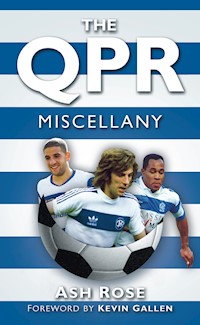
The QPR Miscellany is the definitive set text for every fan of the world famous Rangers. Packed with facts, fun, gossip, nostalgia and conjecture, it looks back over their glorious history to celebrate the personalities, victories and controversies of the sport's biggest name, culminating in their extraordinary return to the Premier League in 2010/11. Handily pocket-sized to pull out in the middle of those pub arguments over who was the fastest, dirtiest or biggest, this book will not only tell you who scored the most goals, what was the largest attendance or who was the longest-serving manager, but also who earned the most red cards and how the club became one of the richest in the world. Put down your pie and pick up a copy.
Das E-Book können Sie in Legimi-Apps oder einer beliebigen App lesen, die das folgende Format unterstützen:
Veröffentlichungsjahr: 2012
Ähnliche


















CONTENTS
Title Page
Acknowledgments
Foreword
When Two Became One
Around the Grounds
Roll of Honour
United Nations
True Colours
All-Time Top-Flight Table
QPR Timeline – The Early Years
Plastic Fantastic
Turkish Delight
QPR Timeline – 1900 to 1920s
Brainiac
Five Great Games
Double Bubble
Loftus Road Legend – George Goddard
Did You Know?
Bigger Than Jesus
Charity First
Numbers Game
QPR Timeline – 1930s & 1940s
Loftus Road Legend – Tony ingham
Did You Know?
Say What, Ollie?
Gotcha!
The 24Th Man
The Managers
Five Great Gaffers
Did You Know?
Star Write-Up
Manic Monday
Mascot Mayhem
Loftus Road Legend – Rodney Marsh
Did You Know?
QPR Timeline –1950s & 1960s
Five Great Goals
TV Stars
International Stage
Hair-Raising
All Kitted Out
Loftus Road Legend – Gerry Francis
Did You Know?
Bowled Over
The Allen Family
Did You Know?
Helping Hands
QPR Timeline – 1970s & 1980s
European Tour
Model Club
Famous Five
Lights on
1967 and All That …
Moves to Merge – I
The 92 Man
Advert Advantage
QPR Timeline – 1990s & 2000s
Next Goal Wins
Internationals
Loftus Road Legend – Stan Bowles
Did You Know?
Not Up for the Cup
Celebrity Rs
Great Brawl of China
Military Man
Team GB
Five More Great Games
Testimonials
Moves to Merge – II
Odd Job Man
Stress Test
Song Wars
International Firsts
Share and Share Alike
From the Stands
Record-Breakers
1976 and All That…
European Record
Five (Not So) Great Games
Taxi!
Loftus Road Legend – Dave Thomas
Did You Know?
Name Game
The Badges
Loftus Road Legend – Alan Mcdonald
Did You Know?
Paying the Penalty
Sports Switch
Perfect Start
The Owners
Loftus Road Legend – Phil Parkes
Did You Know?
Five (More) Great Goals
One-Game Wonders
Rock and Bowles
Average Attendances
Moves to Merge – III
Past It?
Bad Cat
Loftus Road Legend – Les Ferdinand
Did You Know?
Wartime Rangers
Can’t Be Too Careful…
Wild Thing
Sinking Fund
Premier Rs
Star Relative
Goalfests
Merry Christmas
Indian Summer
The Rivals
West Londoners
Pint Please
London Venue
Five Great Hat-Tricks
Hat-Trick Facts
Quick Off the Mark
Number 31
5 Star
93 and Out
World Cup R
The Goal That Never Was
Loftus Road Legend – Kevin Gallen
Did You Know?
Copyright
ACKNOWLEDGMENTS
I would like to thank the following people and publications for making this title and its contents possible. To Kevin Gallen, for his insights, stories of the club and for being kind enough to write the foreword for the title, and to Paul Finney and David Fraser for making it possible. To QPR historian Gordon Macey for his willingness, knowledge and publication Queens Park Rangers: The Complete Record; to Ian Taylor at QPR; publications including The Little Book of QPR by David Clayton; The Sunderland AFC Miscellany by Paul Days; Gas Masks For Goal Posts by Anton Rippon; The QPR Quiz Book by Chris Cowlin and Kevin Snelgrove; Heroes in Hoops by John Marks; Soccer at War by Jack Rollin; websites including indyrs.co.uk, Loftforwords, qprreport and qprnet and to Richard Leatherdale at the History Press for his encouragement.
I would also like to thank Ian Pollard for giving me my opportunity; to my Dad for taking me to Loftus Road for the first time in 1992 and to my Mum and all my family and friends for all their support; and finally to Jo for her love, endless supply of cheese sandwiches and constant belief in me.
Thank you also to QPR for providing so much material and wonderful memories. U RRRRS!
FOREWORD
by Kevin Gallen
I’ve often said that Queens Park Rangers is the ‘biggest, smallest club’ in English football; it’s a special club, a family club where everyone is connected, and it’s essentially my club. I was lucky enough to spend fourteen years of my playing career at Loftus Road, spanning three very different eras. And for a boy who was brought up in Shepherd’s Bush, to play, score and captain the Rs, I really did live the dream.
When my father first moved to London from Ireland in the late 1960s he landed in Shepherd’s Bush and QPR were his local team and therefore became his team, one he still goes to see today as a season ticket holder in the South Africa Road stand. So when my two brothers and I got into football, just like the author of this book, I was taken to Loftus Road and in turn we all became Queens Park Rangers fans. My first game would have to be in about 1979 or 1980, and although I can’t recall who we played on that day, I remember growing up in the 1980s watching a fantastic Rangers team – and one that was very much underrated. As good as the 1976 team was (although a little bit before my time), the sides of the 1980s appeared in an FA Cup final, a League Cup final and even qualified for Europe. I grew up watching stars like Terry Fenwick, Simon Stainrod, Gary Waddock under Terry Venables and later Gary Bannister and John Byrne – players that were really underrated and ones you’ll see mentioned throughout the book.
My own QPR career began when I joined the club a schoolboy in 1988, turning down both Watford and Chelsea to join the team I supported, and later signed professional terms with the club on 21 September 1994 – my seventeenth birthday. At the time Rangers were a top-flight side and boasted players such as Ray Wilkins, Les Ferdinand and Alan McDonald, and under a QPR legend such as Gerry Francis, a great, great team and who for me personally I was in awe of. Having done well for the youth team, I travelled with the first-team squad for the last game of the 1993/94 season and was promoted to the squad for the start of the following season, making my debut at, of all places, Old Trafford on the first day of the campaign. Although we lost the game 2–0, I thought I played well and even had a goal disallowed – something which I still remind the ref that day (Dermot Gallagher) of to this day. From that moment I was lucky enough to play in over 400 games for Rangers and experience three different periods in Rangers history; the last Premier League heyday, the frustrating decline in the late 1990s and the renaissance of the club under Ian Holloway. That team under Holloway was perhaps the happiest time of my Rangers career, as we won promotion to the Championship with a team of great pros and great personalities that had such a bond and one that I was honoured to be captain of. The goal at Hillsborough in 2004 that secured our promotion will go down as one of my favourite QPR goals, along with my strike against Chelsea in 1994 that later spurred the fans’ song about me that I’m so proud to hear every time they sing it.
My career at Rangers ended in 2007, having scored 97 goals for the club with my only regret being that I never quite nabbed a century of goals. But for a local lad to wear the blue and white hoops for so long, and enjoy so many good times for my club I feel incredibly fortunate.
Enjoy the book, it includes some great stories, memorable profiles and facts that I wasn’t even aware of about a truly special club.
C’MON YOU RRRRRs!
Kevin Gallen, 2012
(QPR 1994–2000 & 2001–7)
WHEN TWO BECAME ONE
The origins of Queens Park Rangers Football Club began in 1882, on a newly built residential estate in West London, and the formation of two local youth club teams – St Jude’s Institute and Christchurch Rangers. St Jude’s was set up by local scholars Jack McDonald and Fred Weller for boys of the Droop Street Board School and supported by the Revd Gordon Young, while Christchurch Rangers were formed by footballer George Wodehouse Senior. In 1886, a friend suggested to Wodehouse, who had recently played in a match between the two boys’ sides, that a merger would benefit both clubs and a decision was made to form one football club. However, when the newly combined team played under the name of St Jude’s Institute and used the Institute as its headquarters, many of the Christchurch players claimed they had been victims of a takeover and they walked out angrily. Their response was to set up a rival club called Paddington FC.
It was important that the few remaining members of Christchurch Rangers should feel fully included in the union and to achieve this, a new name acceptable to everyone had to be found. The name Queens Park Rangers was then chosen for the new club, a name suggested by an E.D. Robertson because the teams and majority of the players were based on the Queen’s Park estate of West London. Little did these gentlemen know that this amalgamation would produce a football club that would still be going 125 years later. To celebrate this, a plaque was unveiled at St Jude’s town hall in July 2011 marking the 125th anniversary of the team’s merger. And QPR also celebrated the milestone on their 2011/12 home shirt, with a ‘125’ motif sewn into the back of the collar.
The earliest details of a Queens Park Rangers game are from a first-team friendly in November 1888 that saw Rangers, wearing contrasting blue-halved shirts, beat Harlesden United 4–1. Two years later QPR competed in their first ever competitive match when they played Tottenham Hotspur in the second round of the London Senior Cup. The game finished 1–1 before Rangers lost the replay a week later. Eight years on, in 1898 a decision was made for QPR to become a professional club, and joined the Southern League for the 1899/90 season. In 1920 they finally joined the Football League in the newly formed Third Division.
AROUND THE GROUNDS
QPR hold the title of having had the most home grounds in Football League history, having played in sixteen different locations since their formation.
Welford’s Dairy, 1886–7
Rangers played their games at Welford’s Dairy; on a ground behind the Case is Altered public house in Kensal Rise up to 1887.
London Scottish Ground, 1888–89
They moved to the London Scottish Ground, Brondesbury, in 1888 and stayed there for one season for an annual rent of £20.
Home Farm, 1891
In 1891 the club was on the move again this time to Home Farm located at Kensal Green.
Kilburn Cricket Club, 1892
A year later Rangers spent a season at the Kilburn Cricket Club in Harvest Road.
Gun Club, 1893
Situated in Wood Lane, QPR’s next ground in 1893 was the Gun Club at Wormwood Scrubs.
Kensal Rise Athletic Ground, 1896
1896 saw Rangers take out a 10-year lease on the Kensal Rise Athletic Ground.
Latimer Road, 1901–4
QPR moved to Latimer Road near St Quintin Avenue in 1901. The ground played host to the open-air coronation celebration for King Edward VII, leaving the pitch in a poor condition for the majority of the club’s stay.
Agricultural Showground, Park Royal, 1904–7
The 40,000 horse-ring enclosure at the Agricultural Showground became Rangers’ next ground in 1904. The area had a large grandstand on one side and a smaller one on the south and was their home for three years.
Park Royal Stadium, 1907–17
Half a mile from the Agricultural Showground, the brand new Park Royal Stadium built by the Great Western Railway Company hosted Rs games from 1907 until 1917.
White City, 1912
This was used as a temporary home in 1912 owing to rail strikes.
Loftus Road, 1917–31
Due to Park Royal being turned into allotments during the First World War, Rangers were seeking a new home in 1917 and relocated to the ground of disbanded club Shepherd’s Bush FC in Ellerslie. They re-erected an old stand from Park Royal and altered it to include dressing rooms and an office. It became known as Loftus Road, the name of the road that ran along the eastern edge of the ground.
Highbury, 1930
Owing to crowd trouble the FA closed Loftus Road for two weeks, forcing Rangers to temporarily play home games at Highbury, North London.
White City Stadium, 1931–32
In 1931 Rangers moved to 60,000-capacity stadium White City while keeping Loftus Road as a stage for reserve matches.
Loftus Road, 1933–62
Two years later QPR returned to Loftus Road as the club were losing money, having failed to fill out White City stadium and making a loss of over £34,000.
White City Stadium, 1962–63
1962 saw a second attempt to relocate to White City to increase revenue.
Loftus Road, 1963–present
The move only lasted one season and Rangers moved to the final permanent home back at Loftus Road in 1963.
Highbury, 1984
Rangers were forced to play a 1984 UEFA Cup tie at Highbury due to European Club competition rules preventing games on plastic pitches.
ROLL OF HONOUR
Division One runners-up
1975/76
Division Two/Championship winners
1982/83, 2010/11
Division Two runners-up
1967/68, 1972/73, 2003/04
Division Two play-off finalists
2002/03
Division Three winners
1966/67
Division Three South winners
1947/48
Division Three South runners-up
1946/47
Division Three (Regional) winners
1945/46
Southern League winners
1907/08, 1911/12
Western League winners
1905/06
FA Cup runners-up
1981/82
League Cup winners
1966/67
League Cup runners-up
1985/86
FA Charity Shield runners-up
1908/09, 1911/12
Southern Charity Cup winners
1912/13
West London Challenge Cup finalists
1890/91
West London Observer Cup winners
1892/93
West London Observer Cup runners-up
1893/94
UNITED NATIONS
Since Nigerian-born Tesi Balogun became the first player from outside the UK and Ireland to appear for Rangers, players from all over the world have plied their trade at Loftus Road. Here is a run-down of Rangers’ foreign legion and the countries they were born in.
Argentina – Osvaldo Ardiles (1988–9), Gino Padula (2002–5), Emmanuel Ledesma (2008–9), Alejandro Faurlin (2009–)
Australia – Ned Zelic (1995–6), Andrew McDermott (1996–7), Richard Johnson (2004), Nicky Ward (2006–7)
Barbados – Gregory Goodridge (1995–6)
Belgium – Michel Ngonge (2000–1)
Cameroon – Armel Tchakounte (2005–6)
Canada – Paul Peschisolido (2000)
Congo – Serge Branco (2004–5), Pat Kanyuka (2005–8)
Czech Republic – Jan Stejskal (1990–4), Ludek Miklosko (1998–2001), Radek Cerny (2009–)
Denmark – Kurt Bakholt (1986), Mikkel Beck (2000), Marc Nygaard (2005–8), Sammy Youssouf (2006)
Finland – Antti Heinola (1998–2001), Sampsa Timoska (2007–8)
France – Aziz Ben Askar (2001–2), Alex Bonnot (2001–2), George Santos (2004–6), Eric Sabin (2003–4), Pascal Chimbonda (2011), Armand Traore (2011–)
Germany – Steve Lomas (2005–7)
Ghana – Junior Agogo (2002)
Greece – Georgios Tofas (2011)
Holland – Sieb Dykstra (1994–6)
Hungary – George Kulcsar (1997–2001), Akos Buzsaky (2007–), Tamas Priskin (2010)
Iceland – Heidar Helguson (2008–)
Israel – David Pizanti (1987), Ben Sahar (2007)
Italy – Mauro Milanese (2005–7), Generoso Rossi (2005), Matteo Alberti (2008–11), Damiano Tommasi (2008–9), Samuel Di Carmine (2009–10), Alessandro Pellicori (2009–11)
Ivory Coast – Arthur Gnohere (2004–5)
Jamaica – Bob Hazell (1979–83), Damion Stewart (2006–10)
Latvia – Kaspars Gorkss (2008–11)
Malta – Joe Cini (1959–60)
Morocco – Adel Taarabt (2009–)
Nigeria – Tesi Balogun (1956–7), Dominic Iofa (1990–1), Ademola Bankole (1999–2001), Danny Shittu (2001–6, 2011–), Ugo Ukah (2005–6), Egutu Oliseh (2006–7)
Norway – Petter Vaagan Moen (2011–)
Poland – Adam Czerkas (2006–7), Marcin Kus (2006)
Portugal – Bruno Andrade (2010–)
Serbia – Dusko Tosic (2010)
Spain – Inigo Idiakez (2007), Daniel Parejo (2008), Jordi Lopez (2009)
South Africa – Mark Stein (1988–9), Roy Wegerle (1989–92)
Suriname – Sammy Koejoe (1999–2001)
Sweden – Rob Steiner (1988–9)
USA – Juergen Sommer (1995–8), Frankie Simek (2004)
Venezuela – Fernando De Ornelas (2001)
Zaire – Doudou (2001)
TRUE COLOURS
The blue and white hooped kit of Queens Park Rangers is one of the most distinctive jerseys in English football, but they haven’t always played in those familiar colours. Upon their formation in the 1880s the team wore an Oxford and Cambridge blue halved shirt, with white shorts and navy blue socks. In 1892, when the club began taking part in competitive football, they played in hoops for the first time, but green and white hoops, colours more traditionally associated with Scottish side Celtic. They wore this strip until 1927, but seeking a change in fortune on the pitch the club decided to change the green hoops for blue ones. The change worked as QPR finished in the top half of the league for the next four successive seasons – their most consistent spell since joining the league in 1920.
After winning promotion to Division Two in 1948, Rangers played in an unfamiliar blue version of the Arsenal shirt before reverting back to the blue and white hoops the following campaign, adding hooped socks to the strip for the first time. A spell back in Division Three South between 1952 and 1958 saw Rangers once again drop the hoops in favour of an all-white shirt and blue shorts until finally adopting the hoops for good in 1960. The blue and white hoops have gone through their own changes over the years too, with red being added to each hoop in the 1980s and 2010s, and even a fluorescent yellow piping appearing in the early 1990s. For the 2011/12 season, Rangers can be seen in a simpler shirt with a greater number of hoops then in recent seasons.
Away from home, Rangers have traditionally favoured a black and red variation of the home shirt, often dubbed the ‘Dennis The Menace’ shirt – a term Rangers used to their advantage in 2007, when they teamed up with the long-running comic to launch that season’s new away jersey with a promotion at the club shop that included characters from the Beano wearing the new shirt.
Aside from the common black and red, the away jersey has taken on many forms including the classic red and white quarters of the 1970s, the garish fluorescent yellow and black number from the early 2000s and the 2011/12 mango orange coloured change kit.




