


18,49 €
Mehr erfahren.
- Herausgeber: The History Press
- Kategorie: Fachliteratur
- Sprache: Englisch
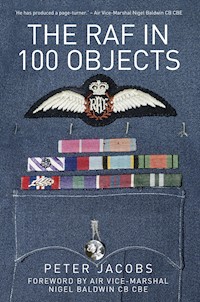
It was in the closing year of the First World War, on 1 April 1918, that the Royal Air Force was born from the amalgamation of the Royal Flying Corps and Royal Naval Air Service. Since then, the RAF has helped lead the world in the development of aviation and air warfare. From the fighters and bombers of the Second World War, through the early jet age and into modern remotely piloted air systems, the last hundred years' development has been astronomical, and the human story no less impressive. Here Peter Jacobs gathers the most poignant objects of the RAF's proud history and displays them together, in full splendid colour, for the first time. Aircraft, memorials, uniforms, equipment, and some items you would never expect – it's all here, ready to be explored.
Das E-Book können Sie in Legimi-Apps oder einer beliebigen App lesen, die das folgende Format unterstützen:
Veröffentlichungsjahr: 2017
Ähnliche

















To all those who serve, or have served, in the Royal Air Force.
First published 2017
The History Press
The Mill, Brimscombe Port
Stroud, Gloucestershire, GL5 2QG
www.thehistorypress.co.uk
© Peter Jacobs, 2017
The right of Peter Jacobs to be identified as the Author of this work has been asserted in accordance with the Copyright, Designs and Patents Act 1988.
All rights reserved. No part of this book may be reprinted or reproduced or utilised in any form or by any electronic, mechanical or other means, now known or hereafter invented, including photocopying and recording, or in any information storage or retrieval system, without the permission in writing from the Publishers.
British Library Cataloguing in Publication Data.
A catalogue record for this book is available from the British Library.
ISBN 978 0 7509 8623 6
Typesetting and origination by The History Press
Printed in Turkey by Imak
eBook converted by Geethik Technologies
Contents
Foreword by Air Vice-Marshal Nigel Baldwin CB CBE
Introduction
1 The First Year
2 Building Foundations
3 The RAF at War
4 Into the Jet Age
5 The Cold War
6 Recent Times
Acknowledgements
Foreword by Air Vice-Marshal Nigel Baldwin CB CBE
SINCE THE THEN director of the British Museum, Neil MacGregor, published his A History of the World in 100 Objects to much acclaim in 2011, the idea has caught on. Waterloo in 1815, a history of birdwatching, American sports, the First World War, the history of Norfolk and a wide range of other subjects have been covered so it should come as no surprise that, approaching the Royal Air Force’s centenary in 2018, one of the most active of modern RAF historians should take on another ‘100 Objects’ task. He has produced a page-turner.
The author, Wing Commander Peter Jacobs, is widely published on RAF matters. I met him in 1996 when he had just researched the Roll of Honour 1939–45 of the nearly 2,000, mostly aircrew, of 50 and 61 Squadrons who lost their lives in the Second World War strategic bombing campaign. The great majority of them were, but not exclusively, Lancaster aircrew. Every year since then, on a June Sunday, Peter and I have stood together at the Squadrons’ memorials at Birchwood near Lincoln (on the site of the Second World War airfield at RAF Skellingthorpe) and in the neighbouring village of Skellingthorpe and joined the villagers and local community leaders to salute the memory of those extraordinary men but also to comfort the small number of survivors – now in their nineties – as they too, with their families, make their annual pilgrimage.
I approached the book with trepidation and soon with a feeling of some shame and inadequacy. I have been fascinated by the RAF’s history, achievements and people since a small boy. With the advantage of the RAF College, Cranwell, the RAF Staff College, Bracknell, and service as a pilot on three of the RAF’s oldest and most distinguished squadrons (IX, 35 and 50 Squadrons) and having been chairman of the RAF Historical Society for over twenty years behind me, I thought I knew a thing or two about our history. Not a bit of it: for example, Object 3 with its story about the RAF roundel was almost brand new to me – certainly the detail was. As I turned the pages, more and more ‘new’ things emerged. A photograph of a SE5a windscreen (Object 7) rapidly leads us into the story of Major James McCudden VC, DSO and Bar, MC and Bar, MM who, at 23 years old and after fifty-seven aerial victories, crashed and was killed on take-off while on a simple delivery flight.
Presenting the 100 objects broadly chronologically, the author captures the reader by using an eye-catching title and photograph to move quickly into telling sometimes a complex story with much clarity in only a couple of pages or so. Wing Commander Guy Gibson’s office, for example, now restored and back in place at RAF Scampton (Object 39), introduces the reader to the 617 Squadron attack in May 1943 on the German dams. Object 44, a humble aircrew scarf, draws the reader into the Lancaster bomb aimer Les Bartlett’s experiences in that awful winter of 1943–44. Les Bartlett was in Flight Lieutenant Mike Beetham’s crew. The latter, eventually the longest-serving Chief of the Air Staff after Hugh Trenchard (see Object 2), is introduced by his forage cap – Object 86. Peter Jacobs knew Sir Michael well and published his biography in 2013. Sir Michael was President of the 50/61 Squadrons’ Association until the day he died in 2015.
In the latter part of the book, the reader is brought up to date with a fine description of the genesis of and the successful build of the RAF Bomber Command Memorial in London’s Green Park which was unveiled by HM the Queen in June 2012 (Object 97) and this story is followed by those of the Red Arrows (Object 98) and that of today’s front-line fighter and multi-role aircraft, the Typhoon (Object 99). Peter Jacobs’ 100-year summary concludes with the story of the Reaper MQ9A Remotely Piloted Air System (Object 100). When our successors continue this venture in 100 years’ time, will that be Object 1 I wonder?
The reader will be struck by the extraordinary advances in aircraft, engines and associated technologies in these 100 years – probably one of the most rapid series of advances in human history. But the reader will also be struck by something that has not changed: the bravery, spirit, determination, and enthusiasm of those who have ‘reached for the sky’ in defence of their homeland.
This book is a culmination of much study and imaginative enquiry. I defy any reader to ‘know it all’. Most will be amazed by the detail and the colour of so many aspects of the RAF’s relatively short life. It is a fine product to help mark the centenary on 1 April 2018 and, in addition, will be a splendid way of introducing a new generation to Her Majesty’s youngest service.
Air Vice-Marshal Nigel Baldwin CB CBE
Chairman Royal Air Force Historical Society
Introduction
ASK PEOPLE TO name their best ten films, or ten favourite pieces of music, and you will get a different selection of answers from every person you ask. The same would also be true if you asked someone to select 100 objects that told the history of the RAF through its 100 years. And so, that was the position I found myself in more than two years ago, when first asked to write this book. I felt privileged, of course, to be given the opportunity to do so, but just where should I start and what should I include?
As I thought more about it, I became increasingly convinced that while individual lists might differ several of the objects would at least be common in theme. For example, I would be surprised if an aircraft such as the Spitfire or Lancaster was missing, or if the Battle of Britain or Dambusters were not included, or if the Red Arrows were not mentioned, or if some of the RAF’s great names from the past were not represented in some way: leaders like Hugh Trenchard, often referred to as the founder of the RAF, Hugh Dowding and Arthur Harris, who had respectively ensured Britain’s survival and then paved the way to victory during the Second World War, and legendary wartime pilots such as Douglas Bader and Guy Gibson. There were always going to be certain parts of the RAF’s long and distinguished history that I felt needed to be included in the book, but would I be able to find suitable objects? This, I felt, would be the biggest challenge of all. And I was right.
There is so much to tell and, for a start, the RAF is not all about aircraft. Indeed, I did not want the 100 Objects to become a book of aircraft – it could so easily have become that – and so I wanted to find many different types of objects that would collectively allow me to tell the story – for example, buildings, vehicles, publications, weapons, uniforms, specialist clothing and equipment, to name but a few. Furthermore, the RAF is a way of life and so I wanted to include objects that helped me cover the ethos and culture of the service, such as music, sport and faith. And, of course, the RAF has always been about its people and so I wanted to find objects that helped me tell the occasional personal story along the way. Because an important part of service life is remembering the past, I wanted to include objects of remembrance and reunion. I also wanted to cover the many different capabilities of the RAF and include other important aspects of the service, such as the role played by women over the years, the value of the reserves and the importance of cadets. I was also mindful from the outset that the book had to be balanced and so the 100 objects would have to be spread across 100 years. For example, I did not want a disproportionate number of personal items from the Second World War at the expense of other significant periods of the RAF’s history – such as the immediate aftermath of the First World War, when the newly formed RAF had to fight for its survival, the policing of the Empire and the development of high-speed flight during the interwar years, and the Berlin airlift, the dawn of the jet age and the Cold War in the difficult years following the Second World War. I could go on but I am sure you get the idea.
The challenge of trying to achieve all of this is obvious, but it was then a matter of going around the country to look for suitable objects. I wanted them to come from as many different places as I could to show just how the RAF’s legacy is being preserved. What I found, in general terms, was that objects tend to be in one of four different types of place. Firstly, they are in museums. The most obvious, of course, are the large national museums, such as the RAF Museums at Hendon and Cosford, the Imperial War Museums (London, Duxford and Manchester), the Science Museum in London and the National Museum of Flight in Scotland. But I also knew there to be many other small museums and collections across the country, usually run by volunteers, where visitors can go to learn about the past. These might only be open at specific times of the year or on certain days of the week, but the Internet is a marvellous tool to seek them out and plan a visit. And so, I went to as many of these as I could in search of finding something that might be different or could not be seen elsewhere. I felt that if I could include just one object from as many of these locations as possible, it would help raise the profile of these marvellous places. The second place to look for objects is on RAF stations. This was particularly rewarding for me. There was more to be found than I expected and it was pleasing to see heritage centres and memorial rooms established on so many bases. These can usually be made accessible to the public with prior arrangement. The third category of where to look is in public places (other than museums), such as in parks. Admittedly, finding objects in this category is not easy and they tend to be memorials, with the focal point often being in London, but they do exist. The final category, and this applies mostly to personal items of interest, is in family or private collections. I wanted to make sure that as few objects as possible fell into this category because I wanted most of the 100 objects included in the story to be accessible to the public.
Having finally found plenty of wonderful objects, far more than are included here, it was then a case of deciding what should be included and what, sadly, would have to be missed. After all, the book is titled The RAF in 100 Objects and so 100 objects it had to be. Decisions had to be made and they were not easy. But having eventually decided on the final 100, I then had to decide how best to present them. There were at least a couple of ways this could have been done, but in the end I felt the story simply had to be told broadly chronologically – from the birth of the RAF to what it has become today. This is done in sections, starting in the latter stages of the First World War when German attacks on London ultimately led to the formation of the RAF. The sections then follow the fledgling new service through the interwar years as it built solid foundations for the future. By the Second World War it was fully established alongside its Royal Navy and army counterparts, and if anyone needed reminding of just how vital the RAF was for the nation’s security then the Battle of Britain surely provided that defining moment. Then, with the country at peace once more, the RAF entered a new and exciting period of the jet age, but peace was not guaranteed for long and soon came the Cold War. The years that followed proved to be tense and uncertain, with the RAF at the centre of the nation’s nuclear deterrent, before the Iron Curtain finally came down. Since then, the RAF has been involved in campaigns and conflicts across the world, either when the UK has operated alone or as part of a coalition force or alliance. The contrast between the first object and the last gives a good indication of just how far the RAF has come.
As its centenary, 2018 marks a significant year for the RAF. It is a milestone that many a century ago could never have foreseen. I feel immensely proud to have served through thirty-seven of those years – more than one-third of the RAF’s history – during which I got to know the service very well. As I said at the start, we will all have our own ideas about what should be included in the 100 objects and what should be left out. These are my 100 objects of choice. Each helps tell a small part of what is a massive story to tell. Collectively, I believe they do. Enjoy the book!
Peter Jacobs
2017
1
The Smuts Report
DECIDING WHAT SHOULD be object number one, and, therefore, what should start the story of the Royal Air Force’s 100 years, was never going to be easy. People will have their own ideas but I have decided to go for a simple document, known as the Smuts Report, as it was this report that was instrumental in leading to the formation of the Royal Air Force.
With German bombing of London during 1917 causing public outrage, the British Prime Minister, David Lloyd George, commissioned a report for the Imperial War Cabinet – comprising the prime ministers and other senior officials of the Commonwealth nations – to co-ordinate military policy. The report was to be prepared by the prominent South African military leader, General Jan Smuts, and was to report on two key issues: firstly, to address the arrangements for Home Defence against the increasing number of enemy bombing raids on Britain and, secondly, to address the air organisation in general and the direction of aerial operations.
In response to the latter, Smuts recommended the establishment of a separate air service. It was a recommendation that was to be accepted by the War Cabinet, with Smuts then asked to lead an Air Organisation Committee to put the recommendation into effect. Much of the detailed work was led by Lieutenant General Sir David Henderson, a senior leader of British military aviation during the First World War, and in early 1918 Lord Rothermere was appointed as the first Secretary of State for Air, with the establishment of an Air Council. And so, it was the Smuts Report, which had recommended the creation of a single air force to hit back at Germany, that led to the amalgamation of the Royal Flying Corps (RFC) and the Royal Naval Air Service (RNAS) on 1 April 1918 to become the Royal Air Force (RAF) under the newly created Air Ministry.
Lesen Sie weiter in der vollständigen Ausgabe!
Lesen Sie weiter in der vollständigen Ausgabe!
Lesen Sie weiter in der vollständigen Ausgabe!
Lesen Sie weiter in der vollständigen Ausgabe!
Lesen Sie weiter in der vollständigen Ausgabe!
Lesen Sie weiter in der vollständigen Ausgabe!
Lesen Sie weiter in der vollständigen Ausgabe!




