


Erhalten Sie Zugang zu diesem und mehr als 300000 Büchern ab EUR 5,99 monatlich.
- Herausgeber: The History Press
- Kategorie: Geisteswissenschaft
- Sprache: Englisch
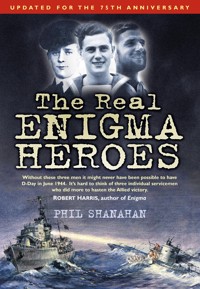
For almost sixty years after their deaths, three men, whose brave actions shortened the Second World War by as much as two years, remained virtually unknown and uncelebrated. Two lost their lives retrieving vital German codebooks from a sinking U-boat. The third survived the war, only to die in a house fire soon afterwards. But it was the precious documents they seized in October 1942 that enabled Bletchley Park's code-breakers to crack Enigma and so win the Battle of the Atlantic. Now recognised as a pivotal moment in world history, three British servicemen made it possible to finally beat the U-boats, but at the time not even their families could be told of the importance of their deeds. Shrouded in secrecy for decades, then recast as fictional Americans by the Hollywood film U-571, this book sets the record straight. It is written in celebration of Colin Grazier GC, Tony Fasson GC, and Tommy Brown GM - the REAL Enigma heroes.
Sie lesen das E-Book in den Legimi-Apps auf:
Seitenzahl: 443
Veröffentlichungsjahr: 2017
Das E-Book (TTS) können Sie hören im Abo „Legimi Premium” in Legimi-Apps auf:
Ähnliche




















THE REALENIGMA HEROES
The author presents Prince Charles and the Duchess of Cornwall with a copy of The Real Enigma Heroes during a royal visit to Bletchley Park.
THE REALENIGMA HEROES
PHIL SHANAHAN
The cover painting of the Petard’s boarding party arriving at the U-559 is courtesy of the artist, Michael Roffe. The sale of the picture in 2001 raised money for the campaign to honour the three men.
Phil Shanahan’s book will be a great source of pride, not only to the families of the men and the communities they came from, but to all those who revere the Royal Navy and its role in preserving our democracy against the evils of Nazism.– Julian Lewis MP, Shadow Defence Minister
An excellent book, written with pace and clarity ... it deserves the widest possible audience.– The Bath Chronicle
The Real Enigma Heroes corrects the historical record.– Hayden B. Peake (writing on the official CIA website)
So much of the subject matter of The Real Enigma Heroes reads like a well-plotted thriller that is hard to know whether to learn from it as a historical book or just enjoy it as a cracking good story … the two main strands of the book – the story of the heroes and Shanahan’s initiative to make them household names – are expertly intertwined and genuinely tweak the emotions.– The Navy News
This 75th anniversary edition of The Real Enigma Heroes is dedicated to my mother, Thelma, who died in 2014 and whom I miss every day.
It is also written in remembrance of Able Seaman Colin Grazier GC, Lt Tony Fasson GC and NAAFI assistant Tommy Brown GM – the real Enigma heroes whose stories inspired me to give so much of myself in their honour.
Finally, I dedicate the book to my late father Jim and the people who continue to enrich my life and who I am so proud to call my family: my wife Claire, who has shared in everything I’ve done since we first met in 1984, my daughter Bryony whose birth was the most meaningful moment of my life, my sister Libby, brother-in-law Neville, niece Sally, nephew James and my in-laws, Ann and Richard Goosey.
First published 2008
Reprinted 2008
This paperback edition 2010
The History Press Ltd
The Mill, Brimscombe Port
Stroud, Gloucestershire, GL5 2QG
www.thehistorypress.co.uk
Reprinted 2013, 2017 (twice)
© Phil Shanahan, 2008
The right of Phil Shanahan to be identified as the Author of this work has been asserted in accordance with the Copyrights, Designs and Patents Act 1988.
All rights reserved. No part of this book may be reprinted or reproduced or utilised in any form or by any electronic, mechanical or other means, now known or hereafter invented, including photocopying and recording, or in any information storage or retrieval system, without the permission in writing from the Publishers.
British Library Cataloguing in Publication Data.
A catalogue record for this book is available from the British Library.
ISBN 978 0 7509 8700 4
Typesetting and origination by The History PressPrinted in Great Britain
eBook converted by Geethik Technologies
CONTENTS
About the Author
Acknowledgements
Prologue
Chapter One Nobody More Deserving
Chapter Two Thrilled To Get a German
Chapter Three He Calls us ‘Suckers’
Chapter Four Hitler’s Chances Dented
Chapter FiveHerald v. Hollywood
Chapter Six An Outstanding Leader of Men
Chapter Seven They Fly Forgotten
Chapter Eight In All Its Shining Glory
Chapter Nine A Hit With the Girls
Chapter Ten A Musical Tribute
Chapter Eleven Comic’s World Exclusive
Chapter Twelve That Deadly Weapon – Soap
Chapter Thirteen The Highest Decoration
Chapter Fourteen Hands Off Our History
Chapter Fifteen Champions of England
Chapter Sixteen The Tide Turns
Chapter Seventeen Stars Shine for Heroes
Chapter Eighteen Our Tommy
Chapter Nineteen On the Map At Last
Chapter Twenty Welcome to the Hotel Colin Grazier
Chapter Twenty-one Taking Fight to War Museum
Chapter Twenty-two A Lucky Ship
Chapter Twenty-three They Got More Than Codebooks
Chapter Twenty-four A Window Opens
Chapter Twenty-five A Monumental Moment
Chapter Twenty-six A Corner of England Forever Germany
Chapter Twenty-seven Anchors Aweigh
Chapter Twenty-eight Raise Your Glasses
Chapter Twenty-nine Grazier Day
Chapter Thirty Hut 8
Chapter Thirty-one A Full House
Epilogue
Bibliography
Index
ABOUT THE AUTHOR
Phil Shanahan has been a journalist for more than twenty years and was awarded the Freedom of Bletchley Park for his efforts in gaining Grazier, Fasson and Brown public recognition. The campaign he led to honour the Enigma heroes won three of the biggest awards for campaigning regional journalism in the UK.
In 2008 he was invited to officially open Hut 8 at Bletchley Park to the public – the very hut where the German Enigma codes were cracked. Phil Shanahan now runs his own copywriting, publicity and photography business, Enigma Communications. He also gives talks on the subject of his book.
For more information on The Real Enigma Heroes and to see a video of the author talking about the story, visit: www.enigmacommunications.co.uk and follow the links to the book. The video can also be viewed on YouTube.
ACKNOWLEDGEMENTS
This edition of The Real Enigma Heroes celebrates the 75th anniversary of the incident.
I am grateful to so many people for their help over the years in connection with both the book and the campaign to honour the men
Firstly, I must thank my fellow members of the Colin Grazier Memorial Committee for their sustained efforts over a long period. I am proud to have worked with Jim Welland, Mary Edwards, Arthur Shakespeare, Joe Bates, Ray Jennings and Bill Wilson. I would like to give a particular mention to my right-hand man on the committee, John Harper, former assistant editor of the Tamworth Herald.
I would also like to thank the previous group editor of Central Independent Newspapers, Sam Holliday, for his support during the campaign, and the current group editor, Gary Phelps, for continuing to back my efforts to keep this important story alive – particularly its connections with Tamworth and Staffordshire.
I received much support from Tamworth Borough Council during the campaign and hope that its staff continue to recognise and capitalise on the significance of this story to the town they serve. To mark the 75th anniversary on 30 October, 2017, we will be unveiling a weatherproof storyboard next to the three-anchors monument in Tamworth.
I would like to thank David Hunter, the council’s senior regeneration officer, and tourism officer Stacy Birt, who has been an excellent supporter of the Grazier story. I would particularly like to thank the generous person who has helped fund the new storyboard, but who has asked to remain anonymous.
I am extremely grateful to Dr Mark Baldwin MA MSc PhD, a specialist in Second World War intelligence and codebreaking, for his thorough checking of my original manuscript. I am similarly indebted to Bletchley Park guide and archivist John Gallehawk.
My wife Claire has accompanied me every step of the way on my Enigma journey and her support, as always, has been invaluable.
Robert de Pass, former First Lieutenant on HMS Petard, gave me permission to use his remarkable photographs. Reg Crang allowed me to quote from his beautifully crafted diary and Eric Sellars also produced a detailed account of the U-559 incident. Indeed I am indebted to all members of the Petard Association and was greatly honoured to have been made an associate member.
I am most grateful to Bletchley Park for all the support given over a number of years. In particular I would like to thank former director Simon Greenish for his enthusiasm and help. It has been wonderful to witness Bletchley’s transformation into an internationally important heritage site. Its finances were very different during my early visits and I still shudder at the thought that at one time it could have been lost to a modern housing estate. I also acknowledge the assistance given by Simon’s predecessor at Bletchley Park, Christine Large, and the new chief executive office, Iain Standen.
I would like to mention the associates and relatives of all three men for the fabulous memories, documents and photographs which helped bring the Enigma heroes to life during our campaign and now also in this book. These will help to ensure that the men will live on in the minds of future generations. A special thank you to Sheena d’Anyers-Willis, Beryl Bauer, Colleen Mason, Margaret Kirk, Joyce Radbourne, Syd Lakin, and Norman and David Brown.
I owe a great debt to international best-selling author Robert Harris, whose comments about the three heroes helped motivate me to campaign on their behalf – as did his novel, Enigma. The team at The History Press provided much assistance – particularly Amy Rigg.
My sincere thanks also go to: T. Adey, L. Allsop, F. Andrews, D. Ansell, J. Aran, J. Arch, R. Arnold, E. Ashley, D. Atkin, M. Atkin, P. Atkin, N. Atkins, Baddesley WMC, H. Bagnall, A. Baker, Commander P.A. Balink-White, the Revd Alan Barrett, J. Bedwell, R. Bennett, D. Bindon, the Rt Revd Michael Bourke, Boots the Chemist, N. Bovey, A. Brightman, A. Brown, H. Brown, S. Brown, J. Bryan, P. Bryan, J. Buckland, Mr & Mrs Burdon, D. Bush, Cambridge Stamp Centre, CAMRA (Tamworth), F. Carnock, K. Carr, F. Carter, J. Cassidy, I. Cauchi, M. Champion, B. Christian,T. Clarke, M. Clempson, J. Cocklen, Colin Grazier Hotel (M. Roberts, R. Lake), Commander C. Colburn, R. Collingwood, R. Collins, R. Cook, B. Coombes, C. Cooper, M. Cooper, J. Copeland, M. Corden, F. Cornock, Courage West Midlands, M. Courtney, K. Crampton, R. Crang, H. Craven, J. Crooks, J. Culshaw, W. Czwarkiel, Dewes Sketchley, E. Dickson, J. Dinwoodie, Cllr P. Dix, Cllr T. Dix, G. Dixon, J.K. & S.M. Dobson, Dosthill Cosmopolitan Club, Mr & Mrs Doyle, J. Draper, J. Driffield, M. Dunn, B. Dunn, C. Egerton, D. Ellingworth, P. Elliott, Dr M. Evans, Captain Featherstone-Dilke, Mr & Mrs Fisher, C. Fitzhugh, G. Forsyth, A. Freeman, D. Freer, W. Garlick, P. Gee, M. Gempson, A. Gibbons, J. Gibbons, I. Gibbons, P. Gosling, R. Gosling, C. Grainger, H. Graven, T. Grazier, S. Greenhall, E. Gregory, M. Griffiths, H. Growen, M. Guise,Y. Guise,T. Guise, M. Handle, N. Hadley,W. Hadley, M. Hakon, J. Hall, W. Hall, A. Hamnett, S. Hamnett, L. Hare, P. Harper, S. Harper, R. Harries, R. Harris, Harry Pounds Shipping Limited (Portsmouth), Mr & Mrs N. Haywood, P. Haywood, W. Haywood, D. Heath, L. Hemus, G. Heritage, K. Hewitt, I. Hilton, S. Hinton, W. Hines, K. Hitchiner, W. Hives, HMS Emerald Association, HMS Porlock Bay Association, P. Holliday, F. Holt, W. Hornsby, A. Howden, HSBC Tamworth, M. Hughes, S. Hughes, A. Hutchinson, P. Hutchinson, Imperial War Museum, A. Jackson, E. Jackson, G. Jackson, L. Jackson, P. Jackson, H. Jakeman, S. Jakeman, B. Jenkins, P. Johnson, Mr & Mrs Jones, J. Kester, Kingsbury Historical Society, J. Kingslake, Mr Lake, T. Langley, F. Lea, T. Lee, Ms Lees, M. Lees, Dr Lewis, Mr & Mrs Lewis, E. Lewis, J. Lewis, M. Lisher, V. Lisher, O. Lewis, Lloyds TSB, B. Lucas, M. Lucas, S. Lunn, V. Lunn, J. Mackness, D. Maugham, J. Maugham, P. Maryon, C. Mason, J. Matthews, B. Mayall, Mr & Mrs McDonald, McLeans Homes, W. Meads, Merchant Navy Association (Tamworth), P. Meryon, Midland Bank, R. Miller, R. Morris, G. Morris, Mr & Mrs Moss, B. Myall, Navy News, the Revd Bob Neale, R. Norris, J. Oates, S. Olley, H. Olley, Mr & Mrs Olley, Captain C. Owen, S. Packard, M. Parsons, M. Passingham, E. Peat, P. Peel, W. Peet, Mr & Mrs Pennell, J. Perkins, Peter Hicks Associates, C. Pickering, Mr & Mrs Pitt, A. Polhemus, Mr & Mrs Pott,T. Potts, M. Powell, G. Preston, Prince of Wales Ex-Service Fund, E. Pugh, F. Pugh, I. Purslow, J. Purslow, W. Pytel, K. Radbourne, L. Ram, RASC, D. Ratcliffe, Rawlett School, J.K. Reavey, J. Reed, E. Reeves, Mr & Mrs Richards, G. Richards, J. Richardson, P. Richardson, M. Richardson, R. Roberts, A. Rogers, M. Romeril, S. Rothwell, Royal Air Force Association (Tamworth), Royal Army Service Corps, Royal British Legion, Royal Corps of Transport Association, Royal Naval Association (California), Royal Naval Association (Coventry), Royal Naval Association (Leamington Spa), Royal Naval Association (Shard End), Royal Naval Association (Tamworth), Royal Naval Association (Welshpool), Sainsbury’s, E. Saunders, Mr & Mrs Scott, Cllr P. Seekings, A. Shakeshaft, B. Shakeshaft, R. Sharp, E. Shave, Mr & Mrs F. Shaw, J. Showell, A. Sidaway, J. Simpson, Mr & Mrs Smith, H. Smith, R. Smith,W. Smith, J. Stacey, Staffordshire County Council, H.Stevenson, Studio One, R. Sulima, Swaddle, M. Tallents, Tame Valley Building, Tamworth Beer Festival, Tamworth Civic Society, Tamworth Co-operative Society, Tamworth Heritage Trust, Tamworth High School Old Girls’ Association, Tamworth Lions Club, Tamworth Music Centre Saxophone Ensemble and Junior Choir,Tamworth Sea Cadets, Tamworth Sons of Rest, R. Tanner, M. Taylor, R. Taylor, F. Thompson, G. Thompson, F. Thurman, J. Tiller, L. Tilley, M. Tilley,T. Tippings, D. Titley, A.Traves, F. Traves, O. Tucker, E. Turner, L. Turner, Two Gates WMC, H. Vann, J. Vernon, P. Vipas,Volunteer Band of the West Midlands Regiment, B. Wallis, R. Warner, A. Warren, G. Warren, Mr & Mrs Warren, D. Whitehouse, J. Whitfield, D. Williamson, Wilnecote High School, B. Wilson, K. Wilson, A. Winters, C. Winters, J. Wood, W. Wood, C. Woodlands, Woolley-Pritchard Sovereign Brass Band, Wrens Association (Colchester), Wrens Association (Norwich), J. Wright, M. Wright, E. Yoemans.
* Sadly several people I have acknowleged are no longer with us. I hope that anybody who has not been mentioned will have the grace to forgive me and remember that the most important thing is what we achieved together for three great, but unsung British heroes.
PROLOGUE
The only thing that ever really frightened me during the war was the U-boat peril – Winston Churchill
For more than seventy years, the bodies of two British seamen have been entombed in a German U-boat on the bottom of the Mediterranean Sea.
Able Seaman Colin Grazier and Lieutenant Tony Fasson drowned moments after seizing Enigma codebooks from the sinking submarine. Their heroism shortened the Second World War by up to two years, saving unimaginable numbers of lives worldwide. Yet the men remained uncelebrated and barely known – even in their home towns.
For decades the huge importance of the material they had sacrificed their lives for remained top secret. Consequently the men were denied the recognition their courage so richly deserved. A sixteen-year-old boy, NAAFI canteen assistant Tommy Brown, who helped them seize the crucial codebooks, escaped their watery grave by a hair’s breadth, only to die in a house fire just two years later. He never knew the massive significance of what he had helped his two colleagues to achieve – world peace.
Historians now acknowledge that the capture of Enigma material from the U-559 on 30 October 1942 was a pivotal moment in the Second World War. The documents enabled Britain’s brilliant codebreakers at Bletchley Park to unscramble German U-boat messages for the first time after a devastating ten-month blackout. The introduction of a four-rotor Enigma machine, together with new versions of German codebooks (the short signal codebook and the short weather cipher), had blindfolded Bletchley for the best part of a year. The U-559 material put codebreakers back on track and thousands of enemy messages were being read each week by the end of 1942. From the autumn of 1943 until the end of the war in 1945, Bletchley Park was producing around 84,000 decrypts per month.
Intelligence arising from the deciphered communications was codenamed Ultra. The information not only revealed the positions of the Germans’ deadly U-boats in the Atlantic, but also where they might be in a few days’ time. It is estimated that this saved 500,000 tons of shipping in the first few months of 1943 alone.
Allied convoys bringing essential supplies, including food from America to Britain, could be re-routed to avoid lethal torpedoes and the tables were turned on the submarines. Under severe attack themselves, the U-boat wolf packs, which had previously been sinking our ships at twice the rate they were being produced, were eventually withdrawn by Admiral Doenitz, the commander of the German U-boat fleet.
The underwater menace, which was threatening to starve Britain into an early surrender, was at last averted. The codebooks taken from U-559 paved the way to victory in the Battle of the Atlantic, a battle which Churchill described as vital to the outcome of the entire war.
Despite all this, when the veil of secrecy surrounding the U-559 incident was lifted in the mid-1970s, no huge fuss was made of Grazier, Fasson or Brown. They remained very much the unsung heroes. In more recent times, Hollywood and the Imperial War Museum have failed to acknowledge these men who directly influenced the outcome of the Second World War, as have several authors and television documentary makers.
I was the deputy editor of Colin Grazier’s home town newspaper, the Tamworth Herald in Staffordshire, and I never heard mention of him until 1998, and then only by chance. I was not alone. Very few people in the town were familiar with his name, not to mention what he died for. I was astonished by this widespread ignorance and decided to launch a campaign to gain proper recognition for Colin and to raise funds for a fitting memorial to be erected in his honour.
It soon became apparent that there were three unsung heroes involved and the Herald found itself carrying the torch for a defining piece of world history. The campaign was to last for many years and led to the newspaper winning the UK’s three biggest prizes for campaigning regional journalism.
I didn’t realise it at the time, but it was also to become the most amazing personal crusade of my life. I was invited to London to accept a special award on behalf of the three men from actress Prunella Scales. The Celebrities Guild of Great Britain’s Unsung Hero Award was one of just six presented during a star-studded ceremony at a Park Lane hotel. It was the first time the Guild had made a posthumous award.
I also had the honour of presenting the Duke of Kent with a memento of the campaign. In December 2003 I had the privilege of being granted the Freedom of Bletchley Park, Churchill’s secret wartime establishment where the Nazi codes were broken, for my work on Enigma. All this for highlighting a story that was sixty years old.
The climax of the campaign was the unveiling of a fabulous sculpture in the centre of Tamworth produced by acclaimed artist Walenty Pytel. The unveiling ceremony was an emotional day attended by close relatives and friends of the heroes, including several men who were on board their ship the very night they lost their lives.
In 2008 the hardback edition of The Real Enigma Heroes was launched at Bletchley Park where it was introduced by Shadow Defence Minister, Dr Julian Lewis. A few months later I was invited back to Bletchley Park to present Prince Charles and the Duchess of Cornwall with a copy of the book. I was also able to show them around an exhibition on the story in the newly restored Hut 8, an historic building which I had been given the privilege of officially opening to the public a few months earlier. Purely because of the Enigma heroes I have been on a journey full of incredible highs.
I’m delighted that The History Press has released this version of The Real Enigma Heroes to mark the 75th anniversary of the mission which falls on 30 October, 2017.
This is the story of a passionate newspaper campaign and the three men who inspired it.
Phil Shanahan, 2017
CHAPTER ONE
NOBODY MORE DESERVING
It is tragic that his sacrifice has gone unrecognised for so long in his home town, and I can’t think of anyone more deserving of a memorial than Colin Grazier – Robert Harris
Deadline was fast approaching. The Tamworth Herald of 27 November 1998 was shaping up to be a solid if not startling edition.
Then a story landed on my desk which was not only going to change the shape of the newspaper that week, but my life for the next decade, and eventually even the very infrastructure of the town. It was the story that was going to grab me more than any other in over twenty years as a professional journalist – and I have worked on some extraordinary stories. It was without doubt the story that has had the biggest impact in the 160-year history of the Herald and one that has since been talked about throughout the world. It was a story that was destined to win the newspaper several national awards. It was to be featured on radio and television. It was to make headlines in The Guardian and even in half a million copies of the Dallas Morning News. It was to be referred to in the House of Commons and in personal letters by the Prime Minister and the Duke of York. It was also to come to the attention of Prince Charles and the Duchess of Cornwall. It is something that I will probably be associated with for life, and frankly I would be proud to be.
We latched on to the story through a chance remark made to one of our reporters. Rob Tanner had been sent to write a feature on retired miner, Frank Andrews, for the newspaper’s nostalgia pages. During the interview Frank told Rob that a Tamworth man who had served with the Royal Navy during the Second World War had ‘virtually won the war’.
I was highly sceptical when Rob returned to the office and passed on this claim to me. ‘If a Tamworth man had influenced the outcome of the war, surely we all would have heard of him,’ I replied.
I didn’t doubt that the man had died heroically for his country, just that he could have had such an impact on world history. As a journalist you get used to hearing sensational claims, and to avoid being gullible you need to be armed with a fair degree of scepticism. I wasn’t going to dismiss this out of hand, but I needed to research the facts before I jumped.
You could say I had serious doubts that sixty years after the Second World War I had only just heard the name of a local man who played a major part in bringing the conflict to an end. If this were true, surely the name of Colin Grazier would have been sung from the rooftops? The more we delved, though, the more intrigued we became and I began to realise that we could be dealing with an underplayed story of global significance.
The first picture of Colin Grazier published by the Tamworth Herald at the news of his death and later when it was announced he was to receive the George Cross.
We were getting close to our deadline and we hadn’t got much time to investigate. It became immediately apparent that if what we had heard was true then Colin Grazier was very much an uncelebrated hero. Certainly nobody had heard of him in our offices. We contacted other people in the town, including several councillors, and drew a blank again.
However, we did manage to contact Reg Crang in Dorset who was listed as the Honorary Secretary of the HMS Petard Association. The Petard was Colin’s old ship and Reg was on board the night Grazier sacrificed his life for his country. Reg was the ship’s sole RDF (Radio Direction Finding, later known as radar) mechanic. He confirmed what we had barely dared believe to be true.
Colin Grazier was just twenty-two when he set sail for the Mediterranean aboard HMS Petard. He had left behind his bride of just two days, Olive, in Tamworth.
Reg described how on the night of 30 October 1942, the Petard had drawn alongside the crippled U-boat, U-559, after an all-day hunt had culminated in the submarine being damaged by a depth charge and forced to the surface. As the German crew swam towards the Petard to escape the sinking submarine, Colin and first lieutenant Tony Fasson jumped naked into the cold, inky black water to make their way to the holed vessel. They were joined on board the U-559 by their young shipmate, Tommy Brown, who should not have taken part in the action on two counts – he had lied about his age to be in the Navy in the first place, and as a canteen assistant he was a non-combatant.
Colin and Tony passed German codebooks up to Tommy from deep within the submarine until it suddenly sank, taking the two men with it. Tommy was positioned on the conning tower when the submarine went down and managed to jump to safety. Two years later he perished in a fire at his home. Initially, we were told he had died rescuing his younger sister from the blaze, but his family later told us that this was incorrect. It had simply been a tragic fire which also claimed the life of his little sister.
For their bravery, Grazier and Fasson were posthumously awarded the George Cross and Tommy Brown the George Medal. Colin had played a part in shortening the war, yet all there was to remember him by in Tamworth was an old photograph hanging on the wall of Two Gates Working Men’s Club, and the inclusion of his name on a memorial board in St Editha’s Church.
As the main newspaper for Tamworth, we were primarily concerned with trumpeting the local man. Later, as our campaign snowballed, we were to champion Fasson and Brown too.
A letter, dated 16 September 1943, informing Olive that the King had approved the posthumous award of the George Cross to her husband.
The slogan used by the Herald to drum up support for the campaign to raise money for a memorial to Colin Grazier.
In our first front-page story, Reg Crang explained that the entire crew had been devastated by the deaths of Grazier and Fasson. The survivors would be old men before they discovered the true significance of the events of that October night in 1942; the full facts remained under wraps for nearly four decades under the terms of the Official Secrets Act.
What I could not comprehend was the fact that nobody had since made a noise about Grazier, Fasson or Brown. They had changed the course of world history for goodness sake, and yet they had never received the recognition they deserved.
I began to think of my father, Jim, who died in 1996. How would I have felt if he had done what Grazier had and virtually nobody in his home town even knew about it? I felt a mixture of excitement at having such a story fall into my lap, but also a sense of sadness and anger about the way these men had been ignored. I was becoming emotionally involved and was about to take on the biggest professional challenge of my life.
Time for that edition was running out and I decided to splash the story on the front page. In doing so I broke a lot of journalistic principles instilled in me during many years in newspapers. It was not a current event. In fact the details had emerged years earlier. I could not understand why the Herald had not turned up the volume for Grazier then, nor why the town remained so ignorant of the full implications of what this man had achieved for the free world.
It seemed that not just Tamworth, but the whole country had been remiss, and we had a chance to do something about it. We had uncovered an event of international significance and few people appeared to know about it. To a journalist this was irresistible!
So on that November day in 1998 I launched a front-page campaign to honour our local hero. It turned out to be one of the best journalistic decisions I have ever made. We contacted the local civic society and explained the story. Chairman Gill Warren immediately offered her support and pledged £500 towards a commemorative plaque.
This was a good starting point and enabled me to use the headline: ‘Recognition at last for town hero,’ on the front of the Herald. However, it seemed to me that a plaque was hopelessly inadequate and I believed we should go much further. I decided to squeeze in a front-page editorial asking whether, given the enormity of what Colin Grazier had done, we should go further. The positive feedback I received was enough to convince me to really go for it, but even then I could never have imagined the momentous developments that would come about as a result.
When the campaign began, Colin’s widow, Olive, was still alive. Sadly, her health was soon to deteriorate. One of my biggest regrets is that she did not live to see the overwhelming public reaction to her husband’s heroism. Olive, who suffered from Alzheimer’s disease in her final years, died before most of the landmarks in the campaign were achieved.
Her sister Joyce Radbourne later told me something that cheered me immensely. Joyce used to visit Olive in the nursing home where she spent her final days. She said Olive was in the main unaware of the efforts being made to honour her late husband. On one occasion, however, she suddenly noticed a feature we had published on the couple’s wedding. She read the article, studied the pictures and welled up. Tears ran down her face and for a few moments she connected with what we were doing. I am very grateful for those few seconds.
The Herald did interview Olive once, shortly before her health declined. She was quoted in a Herald article published on 11 December 1998 saying that she would be ‘proud and thrilled’ to see a memorial to Colin in Tamworth.
The story of Colin and Olive’s love makes his heroic death even more poignant. Their fathers fought side by side during the First World War and the young Olive and Colin played together as children.
In the interview, Olive said:
I lived in Bodymoor Heath and they [Colin and his father] would walk along the canal from Two Gates to visit us. We played together and grew up together and were close for a very long time. As the years went by, I went into service and Colin joined the Navy with his brother. We married at Kingsbury church and we should have been on honeymoon when Colin set sail on HMS Petard. It was so sad that he died like that. He went down so heroically. He was a wonderful man who always looked after others.
Olive was never to see the spectacular monument to the men that graces St Editha’s Square in Tamworth today, but at least we knew we had her approval. It was so tragic that they had only enjoyed two days of married life together when Colin set off from Tamworth railway station to embark on a voyage which was ultimately to change the course of history.
I have since discovered that Colin acted a little strangely on the day he left his new bride at the station. As the train drew up, belching thick clouds of smoke, he kissed Olive and then firmly told her to leave and not to look back at him as the train pulled out. I suppose we will never know whether or not he had a premonition about the hugely significant voyage he was about to undertake.
As the campaign began to gather momentum, Colin’s niece, Colleen Mason, came forward to give us her backing. She said her uncle was ‘one of the nicest people you could ever wish to meet’.
She first heard about the Herald’s initiative from a man in her local newsagents and felt she just had to give it her support. She told us that there had been a small plaque to Colin at the former St Peter’s Church in Two Gates, but she had lost track of it when the church closed. She also revealed how Colin’s name had been read out every Remembrance Day and that a fresh poppy wreath was placed next to his photograph at the Two Gates Working Men’s Club by the Royal British Legion. It amazed me how, unknown to us and right under our noses, a simple and moving ceremony was taking place each year, out of the gaze of the public eye, to honour the man who had helped to end the war. Talk about understated!
One of the men involved in that ceremony was Jim Welland, chairman of the Two Gates and Wilnecote branch of the Royal British Legion. Jim was later to become a very active member of the Colin Grazier Memorial Committee set up to steer our campaign. He told me how each year, while making an annual tribute to Colin, he would hear Olive crying in the background. He was forced to complete the words with a lump in his throat.
More and more people began to contact us about Colin. An old friend of his, Tim Wood, who emigrated to New Zealand, wrote to us from his home in Christchurch. The former RAF man said he wholeheartedly supported our efforts and claimed that without Colin Britain might have been brought to its knees.
The push to honour Colin received a superb boost in January 1999, when the Herald received twenty-three cheques totalling £555. Most of them had been sent by members of the HMS Petard Association after news of the campaign was spread by Reg Crang. Reg had pledged at least £100 on behalf of the association, and was proud that members had responded fivefold.
King George VI sent a signed letter of condolence to Colin’s widow Olive, expressing his and the Queen’s ‘heartfelt sympathy’.
The invitation to Olive Grazier to attend Buckingham Palace so that she could receive Colin’s George Cross from the King. Note the war hero’s widow was only entitled to third class return rail vouchers.
The official confirmation from the Admiralty that Colin Grazier died on 30 October 1942, on war service.
The letter Olive Grazier received from the Royal Navy, informing her that her husband Colin had been killed in action.
‘This is more remarkable considering many of them never knew Colin, having joined the ship after he lost his life,’ he said in his accompanying letter. Another donor, a Mr W. Smith, said the only reason his ship HMS Magpie was able to successfully sink German U-boats was because of the codebooks that Colin and Tony Fasson gave their lives for.
The story had fired me up in a big way, and I began devouring information on Enigma – the Germans’ ingenious method of sending coded messages. One of the early books I read was Enigma, by best-selling international author Robert Harris. The novel was later made into a major film produced by Mick Jagger’s film company and starring Kate Winslet and Dougray Scott.
The book amazed me and my eyes almost popped out of my head when I read the names Fasson and Grazier. I know the plot is a mixture of fact and fiction, but Harris was obviously determined to acknowledge the men whose bravery had such incredible consequences.
The Herald campaign gets under way.
The following extract from Enigma really hit home that we were on to something really worthwhile:
In September, 95 ships were sunk. In November 93…
And then came Fasson and Grazier.
Somewhere in the distance the college clock began to toll. Jericho found himself counting the chimes.
‘Are you alright, old thing? You’ve gone terribly silent.’
‘Sorry. I was just thinking. Do you remember Fasson and Grazier?’
‘Fasson and who? Sorry, I don’t think I ever met them.’
‘No. Nor did I. None of us did.’
Fasson and Grazier. He never knew their Christian names. A first lieutenant and an able-bodied seaman. Their destroyer had helped to trap a U-boat, the U-459 [sic], in the eastern Mediterranean. They had depth-charged her and forced her to the surface. It was about ten o’clock at night. A rough sea, a wind blowing up. After the surviving Germans had abandoned the submarine, the two British sailors had stripped off and swum out to her, lit by searchlights.
The U-boat was already low in the waves, holed in the conning tower by cannon fire, shipping water fast. They’d brought off a bundle of secret papers from the radio room, handing them to a boarding party in a boat alongside, and had just gone back for the Enigma machine itself when the U-boat suddenly went bows up and sank. They went down with her – half a mile down, the Navy man had said when he told them the story in Hut 8. Let’s just hope they were dead before they hit the bottom.
A few paragraphs later Harris touched on the significance of these secret papers and, like the above extract, it is based in fact, not fiction:
At first glance they scarcely looked worth the cost of two men’s lives: two little pamphlets the Short Signal Book and the Short Weather Cipher, printed in soluble ink on pink blotting paper, designed to be dropped into water by the wireless operator at the first sign of trouble. But to Bletchley they were beyond price, worth more than all the sunken treasure ever raised in history.
Again I was amazed that I had only just heard of Colin Grazier. After reading this extract I thought we should contact Robert Harris to see whether he would back our campaign. If we had the support of a prominent author, our quest would gain more credence.
I asked Rob Tanner to contact Harris through his publishers. The author’s response was exactly what we had hoped for. We ran his comments on the front page of the Herald under the banner: ‘It’s time to honour our war hero’, and a sub-headline stating ‘Best-selling author backs Herald push to celebrate town sailor’.
Robert Harris was very supportive of our efforts and told us:
It is tragic that his sacrifice has gone unrecognised for so long in his home town and I can’t think of anyone more deserving of a memorial than Colin Grazier. Unfortunately, at the time of his death, not even his family could be told how significant his sacrifice had been. His actions enabled us to win the Battle of the Atlantic and change the whole course of the war. Without his bravery we wouldn’t have been able to break the Enigma code and D-Day may never have happened in June 1944.
On the front page of that week’s edition I had the confidence to write a bold opinion piece. It ended with a promise we were destined to keep in some style: ‘ … yet in Tamworth, Colin’s home town, he is virtually unknown. The Herald pledges to change that sad fact.’
In January 1999, the Colin Grazier Memorial Committee met for the first time in the Herald’s offices. I was to chair the committee for the next five years. In addition to Herald staff, representatives attended from Tamworth’s Royal British Legion, Royal Naval Association, and Civic Society. The Herald pledged £1,000 to the cause and the Civic Society confirmed its £500 donation.
Cash started to come in from that day onwards. A cheque for £834 was received from the town’s Lady Meadow Restaurant. Owner Stuart Lunn had donated the proceeds from a string of charity bingo sessions. An early contribution also arrived from reader Yvonne Guise whose husband was killed in action in Singapore. Her reaction showed just how people were taking the campaign to their hearts.‘I grew up in the war and feel what Colin did was absolutely wonderful,’ she wrote in a covering letter. ‘When I looked at his face in the Herald, I could have cried because it is such a tragic story.’
In February 1999, a memorial tree was planted in Colin’s honour in Legion Wood, Atherstone, North Warwickshire. The sapling was one of 1,346 planted in memory of individuals killed in the war. The Royal British Legion invited Colin’s niece, Colleen Mason, and Sonya Grazier (widow of Colin’s brother George), to carry out the honours. The Last Post was sounded and the event was attended by various branches of the Royal British Legion. The campaign snowball had started to roll.
CHAPTER TWO
THRILLED TO GET A GERMAN
I was thrilled to get a German in my hands and felt like shaking him to bits – Reg Crang
To keep the Enigma campaign torch burning, I decided to publish a series of eyewitness accounts and use them periodically in the newspaper. Several people who were on board the night Colin and Tony died were still alive. It was obvious these survivors could provide us with dramatic first-hand reports of what had happened. I also felt these articles would help to build up a valuable, historic record of what took place.
Some of these accounts now form part of the Imperial War Museum’s official Enigma records. Others are displayed in an exhibition about the campaign which will open at Bletchley Park in February 2008.
We launched the series with Reg Crang, who had risked disciplinary action for keeping a secret diary while on board the Petard. No other member of the crew was aware of this diary, even long after the war. It was compiled in a set of notebooks recording events soon after they occurred. Journals were forbidden by the authorities in case they should fall into enemy hands. Reg was able to write in complete privacy and maintains nobody ever suspected he was recording events. Reg’s reflections offer a rare insight into life on board the Petard.
On 30 October 1942, the ship was one of four destroyers, also including the Pakenham, Dulverton and Hurworth, sent from Port Said in Egypt to investigate a U-boat sighting by a Sunderland aircraft off Haifa.
Reg had previously been made aware of the urgent need to capture a German submarine by his forceful captain, as he noted in his diary entry of 2 August 1942:
The skipper called me to the bridge at 5am to talk about the poor results from the RDF. Pounding a clenched right fist into the palm of his left, he exclaimed: ‘Crang, I want a U-boat!’ I just muttered that I would do my best and escaped from his awesome presence as soon as I could.
The captain’s words were still in Reg’s mind two months later as sonar contact was quickly established with the U-559 and the destroyers began their merciless depth-charge attack. The dogged German commander of the submarine, Korvettleutnant Hans Heidtmann, used every trick in the book to avoid his pursuers and two of the destroyers eventually broke away, leaving the Petard in control with the Hurworth in support. During a ten-hour attack the ships unleashed 150 depth charges. The U-boat men were so traumatised, they later estimated that 228 bombs had exploded around them.
Reg Crang, who kept a secret diary on board the Petard.
This was the first view the Petard crew got of the U-559 after a ten-hour hunt forced it to the surface. The submarine’s emblem can be seen on the conning tower, caught in the glare of the destroyer’s searchlight. Robert de Pass, an officer on the ship, captured the moment for posterity.
Reg described the onslaught as ‘ferocious’:
The ocean shook violently again and again, with huge eruptions of seawater surging into the air. There was intense excitement among the crew for we all felt confident that our prey could not escape from this fierce bombardment. But no evidence of damage came to the surface and as the hours began to slip away our spirits began to droop.
The U-boat had dived to unprecedented depths, risking the lives of all its crew to escape the pounding from above. Ironically, Reg was later to become a submariner himself and only then truly appreciated the hell the German crew must have suffered that day. On one occasion his submarine Tactician suddenly went into an unexpected dive, and despite the efforts of the crew, sank to the bottom of the English Channel, resting on the mud. After a period of extreme tension, the captain gave the order ‘blow the tanks’ and to the enormous relief of all the men inside, the vessel rose gently back to the surface.
Just imagine then how much more terrifying it would have been to be trapped in cramped, airless, stinking, claustrophobic conditions, and forced to dive to a potentially lethal depth to avoid oblivion. No wonder the occupants of the U-559 were so eager to get out once it surfaced at around 11 p.m., having been finally hit by a Petard depth charge.
Reg’s diary entry for the night conveys both the excitement and the fear he and his crewmates felt when they realised the U-559 had been struck:
I rushed on deck to see the U-boat caught in our searchlights. It was a frightening sight, a dramatic first view of the enemy. Someone shouted, ‘stand by to ram!’ I began to blow up my lifebelt even though I knew it had a bad leak. Then our pom-poms and oerlikons opened up on the conning tower, plastering it with shells. The U-boat was clearly in a helpless condition so we drew in alongside. It was awe-inspiring to be so close to the enemy.
Six decades later, Reg recalled more details which were reported in the Herald:
I was standing on deck at the time and suddenly became aware of the unmistakable smell of diesel oil, quickly followed by a swoosh of turbulent water. Suddenly a searchlight snapped on and the conning tower was caught in a blinding glare. We were so close that we could plainly see a white donkey painted on it.
It has been claimed that the donkey, which appeared so sinister at that moment, was the result of a light-hearted moment among the German submariners. They had apparently eaten meat in Greece, which they thought afterwards might have been donkey and a joker amongst them had got out his paintbrush in an attempt to lighten the mood.
I now believe the emblem, which looks more like a horse to me, was the official symbol of U-boats in the same flotilla as U-559 – the 23rd Flotilla which was founded on 11 September 1941, under the control of Kapitan Frauenheim. The flotilla operated in the eastern Mediterranean. From April 1942, however, the U-559 became part of the 29th Flotilla which had been established in December 1941 under the command of Korvkpt. Franz Becker.
Its operational area was also confined to the eastern Mediterranean. The emblem of the 29th Flotilla was a donkey, but at the time of the incident the U-559 still displayed its old 23rd Flotilla logo, as can be seen in a photograph taken by Robert de Pass, one of the Petard officers, showing the turret illuminated by the ship’s searchlights.
When the survivors began to jump into the water and swim towards the Petard, the sailors lowered rope ladders and netting to allow them to scramble on board. Taking up the story again in his diary, Reg said:
The survivors started to scramble up the ropes but they were so shaken that it was an ordeal. One had terrible stomach wounds and got stuck on the ropes unable to climb further. His comrades tried to help him but he slipped off and drifted away. I leant over and seized one man, pulling him from the water with a big effort.
I was thrilled to get a German in my hands and felt like shaking him to bits. But we pushed them all aft, many of them trembling from their ordeal. But they recovered quite quickly, some becoming cheerful and even arrogant.
They laughed outright at the diminutive size of one of our boarding party, who was only slightly larger than the rifle he was brandishing.
We learned later that the survivors totalled five officers (including the CO) and thirty-five other ranks. So they suffered very few casualties. But soon we were to learn of our own casualties, a tragic loss that left all of us speechless.
While the Germans had been swimming away from the stricken U-boat, Grazier and Fasson were swimming towards it. A boat had been launched to take a boarding party, including Tommy Brown, across to the submarine, but before it got there Fasson and Grazier had stripped naked and swum over to the U-boat. It was to prove a fatal decision for them both.
The boarding party led by Gordon Connell had come back without Tony Fasson and Colin Grazier. They had gone down with the U-boat which sank so suddenly that they were unable to scramble out of the conning tower. The first lieutenant had descended into the control room to rescue documents and secret coding material. This had been handed to Colin Grazier and then to Tommy Brown, who clung onto the U-boat casing while passing the vital material to the boarding party.
This party had just started to jump aboard when the U-boat sank, with the two gallant men still inside. Tommy Brown and Gordon Connell were able to scramble into the seaboat, but had to return with the devastating news:
Jimmy [naval term for a first lieutenant], as we all knew him, was a real man’s man, already a legend on the ship. Handsome and self-confident, yet deadly efficient, he was admired by everyone. He was ready with a joke or a smile for the humblest Ordinary Seaman. We cannot imagine that there is a finer first lieutenant in the Navy.
Interestingly, the very next entry in Reg’s diary (31 October 1942) provides quite a contrast. ‘Early this morning I was rough-handling Germans in the Eastern Med. This evening I find myself a hundred miles into Palestine, dining at a luxury restaurant and driving away in style in a taxi. Great life.’
CHAPTER THREE
HE CALLS US ‘SUCKERS’
He openly calls us suckers for paying over the odds, knowing all the time that we can’t resist what we have been deprived of – Reg Crang
Life on board the Petard was an emotional mix of peaks and troughs, as extreme and unpredictable as the waves she sailed on. At times she passed through the fiery jaws of hell, but on other occasions it was more akin to being on a pleasure cruise with sight-seeing trips in exotic countries and visits to theatres, cinemas and fine eateries. Near-death experiences were interspersed with naked swims in idyllic bays and fabulous sunsets. It was like an ultimate balancing act between joy and despair.
At a Petard Association reunion dinner in 2007, I was told that the antics of the ship’s pranksters could push the boundaries at times – even in sacred places.
One of the crew, Sam Weller, was regarded as the joker in the pack. On one notorious occasion some of the men were invited by the Palestinian police to visit Jerusalem and Nazareth while the ship was being repaired. After a tour of the local bars, the lively and rather inebriated group was led to a dungeon packed with the ‘skulls of the Crusaders’.
When the men got back on board, the outrageous Sam opened his jacket to reveal to his astonished shipmates a skull he had taken as a souvenir. It remained grinning grotesquely on a table in the mess for the remainder of the war. If any of the prisoners captured by the Petard had seen this macabre sight they might have felt they were fighting the devil himself.
There were also times when certain members of the Petard acted in a most ungentlemanly manner. The following extract from Reg Crang’s diary shows that British hooligans are not entirely a modern-day phenomenon. This is what happened when the ship stopped off at Durban on 28 August 1942:
Many of the crew were in a helpless state of drunkenness. Fights broke out and much blood was spilt. Several sailors reached the dockside in a state of collapse. They had to be carried on board. I shudder to think what the kind citizens of Durban think of this behaviour.
My favourite character on board the Petard has to be the ship’s ‘Buffer’ (the chief bo’sun’s mate) who is brilliantly observed in Reg’s diary. He obviously had a personality the size of a house. I just love this entry from 1 June 1944 – particularly the saga of the shaved head:




