



0,49 €
Niedrigster Preis in 30 Tagen: 1,99 €
Niedrigster Preis in 30 Tagen: 1,99 €
Mehr erfahren.
- Herausgeber: DigiCat
- Kategorie: Religion und Spiritualität
- Sprache: Englisch
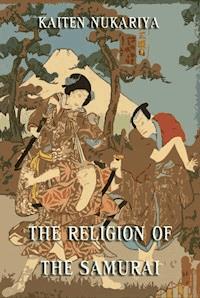
In "The Religion of the Samurai," Kaiten Nukariya delves into the spiritual and philosophical underpinnings of the bushido code that governed the lives of Japan's samurai. Drawing on a rich tapestry of Zen Buddhism, Shintoism, and Confucianism, Nukariya elucidates how these belief systems influenced not merely the warriors' conduct in battle but also their approach to life, death, and honor. Written in a culturing prose that balances accessibility with scholarly rigor, the book serves both as a historical account and a philosophical treatise, providing insights into the moral framework that shaped an entire class of elite warriors. Kaiten Nukariya, a prominent thinker during the early 20th century, was renowned for his efforts to bridge Japanese spirituality with Western philosophical thought. His background in Zen practices and his scholarly pursuit of Eastern religions provided the impetus for this seminal work, allowing him to articulate the significance of the samurai's spiritual convictions in a rapidly modernizing Japan. Nukariya's unique perspective enables readers to comprehend not just the rituals and practices, but also the deep ethical considerations that permeated samurai life. "The Religion of the Samurai" is an invaluable read for anyone interested in Japanese culture, philosophy, or martial traditions. It offers a compelling examination of the intersection between spirituality and the samurai's code, making it essential for scholars, students, and general readers alike who seek to understand the philosophical depths that underpin this iconic warrior class. In this enriched edition, we have carefully created added value for your reading experience: - A succinct Introduction situates the work's timeless appeal and themes. - The Synopsis outlines the central plot, highlighting key developments without spoiling critical twists. - A detailed Historical Context immerses you in the era's events and influences that shaped the writing. - A thorough Analysis dissects symbols, motifs, and character arcs to unearth underlying meanings. - Reflection questions prompt you to engage personally with the work's messages, connecting them to modern life. - Hand‐picked Memorable Quotes shine a spotlight on moments of literary brilliance. - Interactive footnotes clarify unusual references, historical allusions, and archaic phrases for an effortless, more informed read.
Das E-Book können Sie in Legimi-Apps oder einer beliebigen App lesen, die das folgende Format unterstützen:
Veröffentlichungsjahr: 2022
Ähnliche















The Religion of the Samurai
Table of Contents
Introduction
This book explores how inner stillness disciplines outward action, revealing the reciprocal shaping of Zen insight and the samurai way. The Religion of the Samurai by Kaiten Nukariya is a work of religious philosophy that introduces Zen Buddhism through the historical experiences of warriors in Japan and the broader East Asian tradition. Written for an early twentieth-century audience, it offers a structured explanation of doctrines, practices, and ethical ideals without assuming prior expertise. Nukariya situates Zen within a lineage that spans China and Japan, tracing how meditation, discipline, and insight supported a distinctive code of conduct.
As a work of non-fiction, it blends historical survey with philosophical argument to show how a religious discipline informs a social ethos. The organization moves from foundational orientation to subtler reflections on mind, morality, and training, offering signposts rather than technical hurdles. Composed in a formal yet accessible style, the prose addresses readers unfamiliar with monastic terminology while retaining precision where context requires it. Nukariya writes from within Buddhist tradition and speaks to the concerns of early twentieth-century inquiry, aiming to clarify rather than mystify. Descriptions of practice appear as disciplined habits that shape perception, courage, and conduct, so the book reads as both guide and interpretation.
At its core, the book explains what Zen is, how it conceives mind and reality, and why its training proved compelling to a class of professional warriors. Readers encounter sketches of historical development, expositions of key ideas such as meditation and direct experience, and careful distinctions from other schools. Nukariya emphasizes practical realization over speculation, presenting religious life as a way to act with clarity amid risk. The voice is steady, didactic, and persuasive, avoiding sensationalism while making room for illustrative stories and comparisons. The cumulative effect is a guided tour that clarifies without closing inquiry, encouraging readers to test insights in life rather than in abstraction.
Thematically, the book advances a vision of self-mastery grounded in attention, non-attachment, and moral courage. Meditative discipline trains perception to meet uncertainty without panic, so that action arises from clarity rather than impulse. Ethics is treated not as an abstract code but as the outgrowth of insight into change and interdependence. Nukariya links this spiritual poise to the warrior’s craft, arguing that freedom from fixation enables decisiveness, humility, and responsibility. He also underscores the limits of mere speculation, insisting that truth must be realized in living practice. Taken together, these themes frame religion as a path that unites contemplation, character, and effective action.
For contemporary readers, the book matters because it articulates how inner training can sustain ethical clarity under pressure—a concern that spans workplaces, civic life, and personal crises. Its account of attention and non-attachment speaks to an age of distraction, while its emphasis on responsibility resists the caricature of mindfulness as withdrawal. Leaders may find a language for courage that avoids bravado; students of religion gain a case study in how practice shapes character. The cross-cultural frame encourages humility about inherited assumptions, making room for dialogue rather than dominance. Above all, it argues that steadiness is learned, not given, and that such learning can serve the common good.
Reading today also involves recognizing the text as a product of its era, with terminology and comparisons shaped by early twentieth-century debates. Some formulations may feel sweeping or dated, and the focus on warriors can appear narrow by contemporary standards. Approached critically, these features become part of the learning: they reveal how religious ideas were translated for a global audience and how ideals travel across cultures. Using the book alongside other perspectives can deepen understanding of Zen’s diversity and its non-martial expressions. Such contextual awareness need not diminish the book’s value; it clarifies what is historical framing and what remains broadly instructive.
Ultimately, The Religion of the Samurai offers a clear window on a tradition that fuses meditative clarity with purposeful action, and it does so without theatrics. Nukariya presents Zen as a lived discipline capable of tempering fear and vanity, illuminating why a demanding path appealed to those entrusted with decisive choices. The book endures because it treats religion as training for life rather than escape from it. Approached with patience and curiosity, it yields concepts and practices that can be tested in ordinary circumstances. In that sense, its promise is modest and profound: cultivate attention, act responsibly, and allow insight to shape the world you touch.
Synopsis
The Religion of the Samurai, by Kaiten Nukariya, is an early twentieth-century English-language study that introduces Zen Buddhism as the formative spiritual discipline of Japan’s warrior class. Nukariya outlines his purpose: to clarify Zen’s history, principles, and training so that readers may understand its practical character rather than regard it as mysticism or mere philosophy. He situates his discussion within broader Mahayana Buddhism and promises to show how Zen shaped Japanese character and institutions. The work proceeds methodically, combining historical survey, doctrinal exposition, and sketches of practice, with an emphasis on the lived experience of enlightenment and the rigorous discipline that supports it.
After a concise review of Buddhism’s origins, the book distinguishes early schools from the expansive vision of Mahayana, preparing the ground for Zen’s entry. Nukariya highlights ideas such as universal Buddha-nature and the bodhisattva ideal to show why Mahayana emphasizes direct realization alongside compassion. He presents Zen as a discipline that inherits Mahayana’s insight while focusing on immediate awakening through personal effort. The narrative introduces Bodhidharma’s role as the transmitter of a contemplative lineage, not to advance legend but to situate Zen historically. Throughout, doctrine is treated in service of practice, and metaphysics is subordinated to transformative insight.
Turning to China, the study traces the maturation of Chan, describing how monastic communities refined meditation, teacher–student transmission, and skilful means for jolting the mind from habitual patterns. It notes the influence of Chinese culture—particularly the simplicity and naturalness prized by Daoist thought—without conflating traditions. Methods such as seated meditation and paradoxical dialogues are sketched as pedagogical tools used to precipitate awakening. The account emphasizes disciplined training and moral grounding, correcting misconceptions that Zen rejects scripture or ethics. These chapters set the template of a school that privileges realization verified in practice over speculative system-building.
Nukariya then follows Zen’s transmission to Japan, outlining its establishment by figures associated with the Rinzai and Soto lineages and the role of monasteries in shaping national life. He notes how warrior elites patronized Zen for its austerity and psychological training, while the tradition retained a broader religious horizon beyond the battlefield. Distinct approaches are summarized: Rinzai’s use of challenging exercises to catalyze insight and Soto’s emphasis on silent illumination. The narrative underscores institutional discipline, ethical precepts, and ritual life as integral supports, portraying Japanese Zen as both a spiritual path and a formative social force.
With the historical frame in place, the book presents Zen’s central doctrines and methods with clarity and restraint. It explains enlightenment as an experiential breakthrough that affirms inherent Buddha-nature while transforming conduct here and now. Zazen, attentive mindfulness in daily tasks, and, in some schools, koan investigation are analyzed as means to unsettle egocentric fixation. Moral discipline, self-control, and compassion are treated as natural expressions of insight rather than external commandments. Nukariya stresses the necessity of competent guidance and sustained effort, arguing that Zen is neither quietism nor license but a rigorous path uniting wisdom and character.
Beyond doctrine, Nukariya surveys Zen’s cultural imprint in Japan. He links its love of simplicity, immediacy, and restraint to developments in poetry, ink painting, the tea ceremony, garden design, and artisanal crafts, while warning against reducing Zen to aesthetics. The psychological training that fosters presence of mind and fearlessness is related to education and public life. Comparative passages address Western philosophy and religion, emphasizing points of convergence and divergence without forcing equivalence. Case examples and maxims illustrate attitudes cultivated by practice, but the text consistently returns to the primacy of realization over speculation or ornamental appreciation.
The closing chapters consider life, death, and social ethics through a Zen lens, arguing for a way that meets ordinary responsibilities while maintaining inward freedom. Without sensational claims or finality, Nukariya offers a measured appraisal of Zen’s capacity to stabilize minds and refine character amid modern upheaval. The book’s broader significance lies in its role as a systematic, accessible presentation of Zen by a Japanese scholar for an international readership. It remains notable for linking spiritual training, cultural expression, and moral purpose, inviting readers to test the tradition’s insights in practice rather than accept them on authority.
Historical Context
Published in 1913, Kaiten Nukariya’s The Religion of the Samurai appeared in early Taishō Japan, a nation transformed by rapid modernization since the Meiji Restoration of 1868. Japan had recently asserted itself through victories in the Sino-Japanese War (1894–95) and Russo-Japanese War (1904–05), heightening foreign interest in its culture. Buddhism, having weathered the anti-Buddhist haibutsu kishaku of the early 1870s, was undergoing institutional reform and scholarly renewal. Against this backdrop, Japanese Buddhist thinkers addressed international audiences in English, presenting Mahayana and Zen as rational, ethical traditions. Nukariya’s study belongs to this transnational conversation and aims to situate Zen within Japan’s historical experience.
Zen’s deeper background lies in Chinese Chan, which emerged during the Tang dynasty and developed influential lineages under figures such as Huineng and Linji. From Song China, Zen entered Japan through monk-envoys. Eisai (1141–1215) introduced Rinzai practices after travels to China and founded temples including Kennin-ji. Dōgen (1200–1253) studied under the Caodong master Rujing and established Sōtō Zen, founding Eihei-ji in 1244. Zen took root during the Kamakura shogunate, when warrior leaders patronized new Buddhist movements. These transmissions, institutions, and texts furnished the historical framework that Nukariya surveys when explaining doctrine, training, and lineage to readers unfamiliar with East Asian Buddhism.
Under Kamakura and Muromachi rule, Zen intersected with samurai governance and elite culture. Rinzai monasteries occupied prominent places in the Five Mountains (Gozan) system, supported by shogunal and Ashikaga patronage. Sōtō communities, expanded by teachers such as Keizan Jōkin (1268–1325), spread through provincial networks. Zen ideals influenced arts associated with the warrior class and courtly elites, including ink painting, garden design, and the tea culture later epitomized by Sen no Rikyū. While samurai religion drew on Confucian and Shintō currents as well as Buddhism, Zen’s disciplined practice and institutional presence made it a visible component of medieval Japanese life.
Early modern transformations under the Tokugawa shogunate (1603–1867) further structured religious life. The state required household registration with Buddhist temples (the danka or terauke system) to monitor communities and suppress Christianity, entrenching temple networks in administration. Zen schools diversified with the arrival of the Ōbaku lineage from Ming China in the seventeenth century. Monasteries served as sites of education, printing, and cultural exchange, while Confucian learning informed samurai ethics and governance. These institutions and textual traditions shaped the sources and histories available to modern scholars, providing material that Nukariya systematized for an audience seeking clear accounts of Zen doctrine and practice.
After 1868, the Meiji state reorganized religion alongside broader social reforms. Buddhist establishments suffered from the haibutsu kishaku movement but recovered through consolidation, education, and public outreach. The 1889 Constitution proclaimed limited religious freedom, and Buddhist leaders engaged Western scholarship and global forums. Soyen Shaku addressed the 1893 World’s Parliament of Religions in Chicago, and his student D. T. Suzuki began publishing in English in the early twentieth century. Japanese authors framed Mahayana thought as compatible with science and ethics. Nukariya’s decision to write in English in 1913 reflects this effort to explain Zen to an international readership.
By the 1890s and 1900s, debates about national character crystallized around bushidō, the ethical code attributed to the samurai. Works such as Nitobe Inazō’s Bushido: The Soul of Japan (1899) popularized an idealized warrior morality for foreign and domestic audiences. Educators invoked the 1890 Imperial Rescript on Education to emphasize loyalty and filial piety. In this intellectual climate, narratives linking Zen training with samurai discipline circulated widely, though samurai ethics historically drew on multiple traditions. Nukariya’s title participates in this discourse, presenting Zen as a formative influence on martial ethos while situating it within broader Mahayana philosophy and monastic practice.
Nukariya writes as a Zen priest and scholar for readers new to Buddhist sources, organizing material on history, doctrine, meditation, and the lives of eminent masters. He situates kōan practice, zazen, and moral discipline within the Chan-Sōtō-Rinzai heritage, while addressing critiques common in early twentieth-century exchanges with Christian missionaries and Western philosophers. Drawing on canonical texts and traditional biographies, he also adopts contemporary terminology to explain intuition, will, and enlightenment. The book’s accessible English prose aligns with a broader Japanese Buddhist effort to codify and present Zen systematically to global audiences amid growing academic study of religion.
The Religion of the Samurai thus reflects an era of reinterpretation, when Buddhist leaders defended tradition while recasting it through history, ethics, and comparative philosophy. Emerging from Japan’s modern universities and temple networks, the book articulates Zen as both a spiritual discipline and a foundation for cultural identity, echoing contemporary discussions of bushidō and national character. At the same time, its historical surveys and attention to primary sources aim to correct misconceptions and reduce exoticism. In doing so, Nukariya’s work exemplifies early twentieth-century Buddhist modernism and offers a self-conscious critique of shallow stereotypes about Japan and Mahayana Buddhism.




