


28,99 €
Mehr erfahren.
- Herausgeber: John Wiley & Sons
- Kategorie: Fachliteratur
- Sprache: Englisch
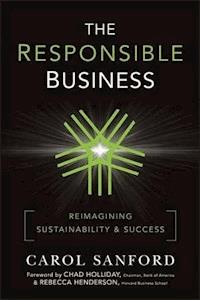
"When most people think of corporate responsibility, they arefocusing on a business's effect on and relationship tostakeholders. A Responsible Business sees stakeholders as fullpartners and meaningful instruments for the evolution of healthiercommunities and more successful businesses." --from the Introduction The Responsible Business offers a new and strategicapproach to doing business that holistically integratesresponsibility into all aspects of an organization, allowing forreturns at every level, business and social. This book goes beyondthe often well intentioned but limited attempts at sustainabilityto present a framework that allows organizations to bringresponsibility into everything they do and re-imagine success. Frominnovation, product development, and production processes tobusiness management, strategic planning, and shareholderdevelopment, the author shows how being a Responsible Business is apractical skill that can be applied day-to-day at every level ofthe business. No longer just the role of a department or the job of CSRprofessionals, successful responsibility and business efforts startat the business level, are then taken to the corporate level, andare finally applied throughout the organization. The ResponsibleBusiness outlines a framework for building a responsibility andconsciousness infrastructure that applies a living systems view tothe business and inspires all of its stakeholders, includingshareholders. Throughout the book, illustrated by examples from technology tomanufacturing, large and small, public and private, Sanforddemonstrates how to make responsibility integral to all aspects ofa business as an engine for innovation, profitability, andpurpose. Praise for The Responsible Business "This is a very significant book. It makes it clear thatbusinesses have a single boss with five interrelated aspects. Thestories are among the crispest, most evocative case histories Ihave seen. The book is for any corporate leader trying to do theimpossible: create a business that recreates the world." --Art Kleiner, editor-in-chief, strategy + business,and author, The Age of Heretics "Carol Sanford offers us a proven, practical, and systems-basedapproach that integrates five stakeholder groups into a businesssystem working as an integral whole. Essential reading for leaderswanting a system framework for sustainability and businesssuccess!" --Otto Scharmer, MIT Sloan senior lecturer; author,Theory U: Leading from the Future as it Emerges; and coauthor,Presence "The Responsible Business challenges many assumptionscorporate leaders, investment advisors, and sustainability expertshave long taken for granted. It provides a road map that can helpinnovative businesses think about how to be trulytransformational." --Sam Ford, Fast Company expert blogger and director,Peppercom "The powerful concepts in The Responsible Business havechanged the process of sustainable development and how communitiestruly thrive. Indeed, these proven approaches will be the roadmapto truly achieve the deepest level of living communities." --Bill Reed, founding member of LEED System andcoauthor, The Integrative Design Guide to Green Building "Critical for re-imagining the future of business. Rarely a daygoes by that I do not call on this way of thinking and looking atthe world. It is useful for taking on the big business decisionsthat so many of us face every day." --Chad Holliday, chairman, Bank of America
Sie lesen das E-Book in den Legimi-Apps auf:
Seitenzahl: 555
Veröffentlichungsjahr: 2011
Ähnliche


















Table of Contents
Cover
Table of Contents
More Praise for The Responsible Business
The Responsible Business Leader Project . . .
Title page
Copyright page
Dedication
A Foreword from the Boardroom
A Foreword from Academia
Acknowledgments
Prologue: A New Business Mind
Introduction: The Responsible Business
About the Author
Part One: The Responsible Business: Reimagining Businesses of the Future
Chapter One Stories from Three Continents
Herban Feast: Caring for Customers
Kingsford: Creating Collaboratively
Colgate, South Africa: Localizing Identity and Destiny
Seventh Generation: Regenerating Planetary Systems
E. I. DuPont: Engaging Shareholder Value
Panning for Gold
Conclusions
Chapter Two Stakeholders as Systemic Collaborators
The Meaning of Stakeholder
Stand in the Stakeholder’s Shoes
Stakeholders Affect Responsibility
Five Key Stakeholders and Their Stakes
Conclusions
Chapter Three Geometry of the Responsible Business
Systemic Stakeholder Framework
The Logic of the Pentad
Integrate Stakeholder Initiatives
Conclusions
Chapter Four Be Value-Adding, Not Value-Added
Value-Added Is Not Value-Adding
Energize Caring Through Value-Adding Processes
Five Stakeholder Imperatives
Conclusions
Chapter Five Making the Responsible Business Pentad Work
Revolutionizing Business Models: Red Hat
From Commodity to Nondisplaceability: Kingsford
Deeply Connect to Your Customer: Herban Feast
Mission-Driven Meets Future-Proof: Seventh Generation
Change the World by Changing the Business: Colgate, South Africa
Conclusions
Part Two: Making It Work: The Map to the Territory
Chapter Six Teaching an Organization to Star
Retrofit an Existing Business
Reverse Phases for a Start-up Responsible Business
Conclusions
Chapter Seven Nonhierarchical Decision Making
Hierarchical Management Is Irresponsible
Self-Organizing Decision Making Is Responsible
Four Self-Organizing Capabilities
Conclusions
Part Three: Irresponsibility Happens: Reframing How Change Works
Chapter Eight Responsibility Running Backward
Running Faster in the Wrong Direction
A 360-Degree Business Perspective
Make Something for Someone
From Backward to Forward Spin
Conclusions
Chapter Nine Our Own Worst Enemies
Turning People Around
Brain Works
Three-Brained Decision Making
Triad of Mental Frames
Familiarity Is the Enemy of Creativity
Incentives Narrow the Mind
Narrower Frames of Reference Cause the Pentad to Spin Backward
Leading from the Purposeful Mental Frame
Personal Development and Critical Thinking Skills
Conclusions
Chapter Ten Cautionary Tales
Design for Prevention and Cure
Six Common Hazards
An Ounce of Prevention
Conclusions
Part Four: The Big Picture of Responsibility
Chapter Eleven A Responsible View of Capital
Stakeholder Return on Investment (ROI)
Conclusions
Chapter Twelve Assessing Responsibility
Systemic Responsibility Indicators
Conclusions
Chapter Thirteen The Future of Responsibility
Getting from Here to There
Alternative Business Approaches
Responsible Investing Within the Current Legal Framework
Conclusions
Epilogue: Developing Capability for Responsibility
Three Capabilities Underlying Responsibility
A Final Reflection
Index
More Praise for The Responsible Business
“I am eternally grateful to the author of this book, Carol Sanford, for giving me the skills to not only build a number of profitable businesses, but to do so responsibly for all the stakeholders along the way.”
—Bob Raynsford, founder and chairman, Agriwise
“Carol is a very early thought leader, way beyond the pack. She has an exceedingly high level of intelligence for working on very complex subjects, with workable approaches. Whole enterprises change permanently for the better. I know. I have been engaged with the work in this book for decades in several successful entrepreneurial start-ups and as an executive in Fortune 500 companies.”
—Pravin Jain, serial entrepreneur, CEO and founder, Synergen Energy
“In The Responsible Business, Carol offers a rare exception to all the hype on CSR, providing practical hands-on advice to launch deep systemic change for your entire organization, your external partners, your investors, your community, and the planet that depends on us all. She and this book are gems.”
—Brad Reddersen, President, SIRA Technologies, Inc.
“In this visionary and hugely exciting book Carol Sanford shares the insights gleaned from a lifetime of working with path breaking businesses. She takes us behind the scenes at companies that have transformed how they think about themselves and the world—and in the process generated not only sustainable prosperity but levels of meaning and commitment that most firms only dream of. This path has the potential to transform our world.”
—Rebecca Henderson, Senator John Heinz Professor of Environmental Management, Harvard Business School
“Carol Sanford gives us a new paradigm for going beyond CSR and SRI to a marketplace where business creates both positive impact on society and the environment and value for shareholders. Who doesn’t want that?”
—Andrew Kassoy, Bart Houlahan, and Jay Coen Gilbert, founders, B Lab
“The Responsible Business advances a most welcome approach that is more encompassing than most work on responsibility, sustainability, and climate change. Yet it is elegantly simple in its execution. It gives hope and meaning on some of the biggest issues of our time. In many parts of the world natural resources are stretched to their limits. The book argues that ecosystems and communities are not “externalities” but part and parcel of the “whole.” This leads to regeneration and revitalization of industries, communities, and ecosystems, building from each unique culture and ecology. It is the new corporate responsibility.”
—Mohamed El-Ashry, Senior Fellow, UN Foundation, former CEO and chairman, Global Environment Facility (GEF)
“An evolution biologist who sees how all sustainable species, in our business world as much as in our greater biological world, must mature from hostile competition to collaborative community, Carol Sanford has written a book brilliantly vital to our future. Any business adopting and practicing her mantra of Agency, Ableness, and Affectiveness will thrive as it contributes to a best possible future for all. Read this book to find out how!”
—Elisabet Sahtouris, Ph.D., evolution biologist; futurist; author, Earth Dance: Living Systems in Evolution
“This is a bold and inspiring book; one of those game-changing books that come around only once in a decade. It will change how I teach organizational behavior and management. I return to different sections repeatedly and gain something new each time.”
—Pam Hinds, Stanford University, Management Science and Engineering; co-director, Center for Work, Technology & Organization
“A Responsible Business thinks strategically, comprehensively, and inclusively with all stakeholders. Carol Sanford’s book provides executives and investors with the tools and examples to build a better world while seeking positive human impact and profit. She shows how the leaders accomplish this for their firms, shareholders, and society.”
—R. Paul Herman, CEO, HIP Investor Inc., registered investment adviser; author, The HIP (Human Impact + Profit) Investor: Make Bigger Profits by Building a Better World
“Developing the potential of every stakeholder (customer and investors as well) in the way you do business is good for business. The Responsible Business presents companies who have done it successfully and illustrates precisely how you can make it part of your strategy, leadership approach, and build it into your work design. Take the high road and feel grounded and successful in doing it.”
—Chip Conley, CEO, Joie de Vivre Hotels; author, Peak: How Great Companies Get Their Mojo from Maslow
“The Responsible Business is a remarkable book that pushes the over-hyped concept of corporate responsibility beyond punitive mandates to innovation solutions deeply grounded in the fundamentals of business. From her broad experience, Ms. Sanford has culled a rich collection of varied, and, quite frankly, enjoyable stories that shed new CSR light on tried and true business directives such as “know and align your stakeholders,” and others like “think and act systemically” more recently introduced into the business canon. Through its business-minded practicality, The Responsible Business will hopefully push corporate responsibility even further: beyond the Corporate Citizenship department and into the profitability-focused boardroom.”
—Drew Banks, head of marketing at Prezi, co-founder of Pie Digital, and coauthor of Beyond Spin and Customer.Community
“The road to corporate responsibility today demands a new level of courage: to recognize that a fundamental change is in the offing, and to act accordingly. Carol Sanford shows us how to put two simple yet essential truths into practice: that we are all part of a single interconnected world, where each part genuinely matters; and that people will take complete responsibility to transform their situation when challenged to look for and create the unexpected right where they are. The Responsible Business shows us how to tap into the hidden potential for practical innovation, and reinforces what every good business leader already knows—that a living spirit of commitment, once activated, renews everything. Read this book to discover its practical secrets.”
—William Isaacs, Senior Lecturer, MIT Sloan School of Management; author, Dialogue and the Art of Thinking Together
The Responsible Business Leader Project . . .
. . . is out to identify as many Responsible Business Leaders on the planet as we can. They often go unrecognized if they are not the CEO. They are everywhere: top to bottom of the business; on every continent; in for-profit and not-for-profit; and in local, provincial, state, and national governments.
They often go against the grain and do what is right by
• Considering customer’s well being in creating products and services
• Considering the uniqueness of people involved in the work as equals in thinking
• Considering suppliers as full participants in the creative process and help improve their lives in the process
• Considering how to create a healthier planet by decisions the business makes
• Considering the uniqueness of each community, supporting distinctive expression and increasing vitality—that is, where their suppliers live, where their distribution is significant, where their business facilities are located
• Considering investors worthy of enduring returns based on understanding what makes a Responsible Business, Responsible Industries, and Responsible Capitalism
Join us in “ID-ing” Responsible Business Leaders around the world. Let’s honor them for their courage and contribution at
www.theresponsiblebusinessleader.com
While you are there, select a free article to spark a conversation with colleagues.
Copyright © 2011 by Carol Sanford. All rights reserved.
Published by Jossey-Bass
A Wiley Imprint
989 Market Street, San Francisco, CA 94103-1741—www.josseybass.com
No part of this publication may be reproduced, stored in a retrieval system, or transmitted in any form or by any means, electronic, mechanical, photocopying, recording, scanning, or otherwise, except as permitted under Section 107 or 108 of the 1976 United States Copyright Act, without either the prior written permission of the publisher, or authorization through payment of the appropriate per-copy fee to the Copyright Clearance Center, Inc., 222 Rosewood Drive, Danvers, MA 01923, 978-750-8400, fax 978-646-8600, or on the Web at www.copyright.com. Requests to the publisher for permission should be addressed to the Permissions Department, John Wiley & Sons, Inc., 111 River Street, Hoboken, NJ 07030, 201-748-6011, fax 201-748-6008, or online at www.wiley.com/go/permissions.
Readers should be aware that Internet Web sites offered as citations and/or sources for further information may have changed or disappeared between the time this was written and when it is read.
Limit of Liability/Disclaimer of Warranty: While the publisher and author have used their best efforts in preparing this book, they make no representations or warranties with respect to the accuracy or completeness of the contents of this book and specifically disclaim any implied warranties of merchantability or fitness for a particular purpose. No warranty may be created or extended by sales representatives or written sales materials. The advice and strategies contained herein may not be suitable for your situation. You should consult with a professional where appropriate. Neither the publisher nor author shall be liable for any loss of profit or any other commercial damages, including but not limited to special, incidental, consequential, or other damages.
Jossey-Bass books and products are available through most bookstores. To contact Jossey-Bass directly call our Customer Care Department within the U.S. at 800-956-7739, outside the U.S. at 317-572-3986, or fax 317-572-4002.
Jossey-Bass also publishes its books in a variety of electronic formats. Some content that appears in print may not be available in electronic books.
Library of Congress Cataloging-in-Publication Data
Sanford, Carol, 1942-
The responsible business : reimagining sustainability and success / Carol
Sanford ; forewords by Chad Holliday and Rebecca Henderson. – 1st ed.
p. cm.
Includes bibliographical references and index.
ISBN 978-0-470-6-4868-1 (hardback)
ISBN 978-0-470-9-4855-2 (ebk.)
ISBN 978-0-470-9-4860-6 (ebk.)
ISBN 978-0-470-9-4861-3 (ebk.)
1. Social responsibility of business. 2. Corporate culture. 3. Strategic planning. I. Title.
HD60.S249 2011
658.4'08–dc22
2010049179
To Mark and Tamara, my children by birth, and Oné Alm, my daughter by choice, as well as Max, my grandson—all who taught me how to love and open my heart
To Charlie Krone, who challenged my thinking and developed my mind to see a world that most people miss. I am grateful daily for his wisdom and commitment to my growth.
A Foreword from the Boardroom
The Responsible Business describes a more complete, connected, and systematic way to think and act on decisions and problems. While I was chairman and CEO of the DuPont Corporation, I had firsthand experience with this way of working and thinking for over twenty years. I had many opportunities to apply it to hundreds of practical problems. In fact, rarely a day goes by that I do not call on this way of thinking and looking at the world. It is useful in most walks of life, and in taking on the big business decisions that so many of us face every day.
Our company, and each leader in it, was much better for it. Our path was unique to us, and in this book you will also learn how others in other organizations applied the ways of working presented here, specific to their businesses, industries, and national cultures. The Responsible Business offers enlightened approaches for leaders from the board of directors to the front lines sales teams, and for government and not-for profits as well.
Please accept two particular challenges as you read this book as areas for great opportunity to improve all of our thinking. I have taken these two on myself.
The Natural Resource Dilemma
In 1950, if you had the nerve to suggest to a general audience that sixty years later humanity would face a monumental natural resource challenge to its very existence, your ideas would have been quickly dismissed by the mainstream of authorities. Yet as the world’s population has expanded from 2.5 billion to nearly 7 billion over the past sixty years, we are pushing the limits of our natural resources. Just consider the approximately 2 billion people who wake up every morning and wonder if they will have enough food and water. That same 2 billion also know they will have no or very limited access to electricity. Just as we have hit the limit of our natural resources, we have hit the limit of thinking in the old way.
Yet at the same time, we are converting science into practical technology at an even faster rate. As the American Energy Innovation Council described, “If today’s computer chips were the same size and cost as they were in 1975, Apple’s iPod would cost $1 billion and be the size of a building.” The question is, how do we focus our scientific might on the really important problems? The foundation of an answer, I believe, lies in the systemic thinking laid out in The Responsible Business.
Highest Ethical Standards
Business is under constant attack in most places in the world. Yet letting the free market work is critical to our success. To earn trust, business must operate to the highest ethical standards. At Bank of America, we have a relationship with one out of every two households in the United States. They trust us with a piece of their future. We must earn that trust every day. Bank of America further maintains that trust by adhering not just to high but to the highest ethical standards and best business practices, and by lending, investing, and giving back to the communities we serve through our environmental initiatives, our philanthropic activities, and our support of the arts and culture.
Businesses go off track and lose the public’s trust when they stop thinking about issues from their essential core. We need the new business mind described in The Responsible Business to redefine what success really means. We cannot “rationalize away” acts that don’t consider all stakeholders. You will find the foundation of the systemic thinking required to take on these challenges more comprehensively portrayed in The Responsible Business than in any other book I’ve ever read.
I am not saying this way of working will be easy. It calls for building a capability that is not common; to consider decisions and learning from a systems view. It will make you think. However, if you apply its ideas, it can help you solve some really big problems like the two I just described. The way of thinking about running a business offered in The Responsible Business is a critical source of possibilities for a re-imagined future.
February 2011
CHAD HOLLIDAY
Chad Holliday is chairman of Bank of America Corporation since 2010; chairman, CEO, and president emeritus of E. I. Dupont Corporation; founder and board member of United Nations Global Compact for Sustainability; and founder and member of the American Energy Innovation Council.
A Foreword from Academia
What role should business play in solving the social and environmental problems that we face? Stubbornly high rates of unemployment, increasing income inequality, and soaring drug and alcohol abuse are straining the social fabric in many communities. At the same time, the evidence that greenhouse gas emissions are heating the planet is continuing to accumulate, we are threatened with worldwide shortages of fresh water, extinction is claiming thousands of species, and toxic chemicals continue to accumulate in our environment—and in our tissues—at alarming rates.
Few suggest that as a society we should not respond to these challenges, but there is little agreement as to how to move forward and less still as to whether business should be at the leading edge of any response. Much of the current debate starts from the premise that the “the business of business is business,” suggesting that private firms will naturally take advantage of opportunities that increase the value of the firm—reducing energy use as prices rise, for example, or introducing “green” products if consumers want them—but that beyond this point managers seeking to act “sustainably” are indulging in philanthropy at the expense of the shareholders, and very possibly at the expense of the long-term viability of the business. Within this framework, many people suggest that our best way forward is to rely on taxes and regulatory mandates to change firm behavior—if as a society we believe it should change—and/or to highlight the fact that the challenges we face are already creating great opportunities for private profit.
The book you hold in your hands suggests that this approach is at best radically incomplete and at worst a fatal distraction. Carol draws on a lifetime of work with a wide variety of companies to argue that when firms focus first on “doing the right thing” and on serving all the stakeholders to whom they are responsible—from customers to employees, to local communities, investors, and the earth itself—they can not only transform their economic performance—dramatically increasing sales, profits, and market share—but also play a central role in healing the social and environmental systems on which we all depend.
At first glance this proposition might seem wildly improbable. If “doing the right thing” and, more broadly, taking advantage of the approaches that Carol describes here has such powerful implications, why isn’t every firm using them? For me this is the sixty-four-thousand-dollar question, and it is precisely what makes this book so potentially important.
For Carol is not the first. There is a long, quiet tradition of work suggesting that there is something radically wrong with the way we run most organizations: that it is indeed possible to unlock huge reserves of energy and creativity and to create firms that outperform their competitors so dramatically they reshape industries. Researchers working within the human potential movement, for example, have focused on changing individual behavior, on developing the capacity for self-reflection, and on the dynamics of small groups. Work in system dynamics has highlighted the power of “system thinking.” Those studying blue-collar work have documented the transformative impact of treating employees as problem solvers and of creating effective cross-functional teams that can in turn create “learning organizations.” Others have focused on the roles that cultures of commitment, purpose, and trust can play in generating and sustaining order of magnitude improvements in performance, and on the importance of focusing on process and qualitative measurement rather than (solely) on short-term quantitative targets. Again and again the stories have surfaced of firms where employees brought their whole selves to work; of environments of trust, respect, and huge creativity; of projects completed in 10 percent of the normal time; of delighted customers; and—often—of very significant economic success.
For years most work in management and economics ignored this work, dismissing it as based on anecdotes or as a function of idiosyncratic circumstances that couldn’t be replicated. Conventional “best” management practice continued to stress a view of the world that saw employees as self-interested “agents” who must be tightly managed with short-term quantitative targets, incentivized with cash bonuses (or threats) to work, and in which the central purpose of the firm is the maximization of shareholder return.
More recently, a combination of the financial collapse, recent work in psychology and behavioral economics, and careful empirical research has focused attention on the shortcomings of the conventional approach. An accumulating body of research confirms that some firms outperform their rivals by very significant amounts, that this difference endures, and that it is correlated with exactly those factors the early literature suggests might be important (Gibbons and Henderson, 2010; Bloom and Van Reenan, 2007). Most important, perhaps, it is becoming only too clear that relying on the conventional wisdom as a solution to the crises we face is problematic, and the risks of serious climate change and environmental degradation only continue to increase.
At this moment of challenge, this book is critical. In the first place, it integrates the individual factors that have been associated with high performance into a coherent whole. Carol suggests that it is unlikely that the piecemeal adoption of single “new” organizational practice can have any great affect, and demonstrates how successful firms adopt a “bundle” of approaches that are mutually reinforcing. Second, she helps us to understand why the seemingly radical claim—that firms have responsibilities beyond shareholder return not only to employees but also to communities and natural systems—may not only be morally plausible but also economically critical.
Carol’s central argument is that focusing attention beyond shareholder return to the relationship between the firm and its other stakeholders triggers a powerful self-reinforcing dynamic. Not only does it move the organization beyond a dangerous reliance on third party market research and outmoded customer characterizations to a holistic understanding of customers and consumers that can unlock powerful opportunities for new products and services, but in explicitly speaking to/working with “the whole person”—social, economic, moral—it unleashes levels of personal and group creativity and ways of working that are transformational. From Carol’s perspective, factors such as “trust,” “commitment,” “work teams,” and “cross-functional processes” are symptoms, not primary causes. Treat your stakeholders as autonomous adults with their own needs and strengths. Trust them, and give them problem-solving responsibility. Let them link their sense of themselves as whole people embedded both in their community and in the natural world to their work and you will see incredible outcomes: a failing regional manufacturer claiming 50 percent of the U.S. market; a subsidiary on the verge of bankruptcy not only roaring back to profitability but changing South African history; one of the world’s largest chemical companies solving seemingly impossible problems.
In describing just how some firms have been able to achieve these kinds of results, Carol also sheds light on two critically important questions. First, she gives us some clues as to why it is that some firms seem able to behave in such productive ways and to reap such great rewards as a result, while others cannot. Carol is reticent about her own role in the cases she describes, but my guess is that having a coach/advisor of her caliber available who “knows the way” may be very helpful. She is a person of tremendous integrity and great personal passion who is able to make deep personal connections and to ask the “right” questions—a gift that, I suspect, makes a tremendous difference to those groups with whom she works. Her case descriptions also hint at the idea that the determined leadership of key individuals can make an enormous difference. Throughout the book we encounter individuals who signal their commitment to acting in new ways by asking new questions, by behaving quite differently themselves, and by following through on their commitments in very tangible ways.
The second question her book addresses is equally central. Carol asserts strongly and consistently that corporations have much wider responsibilities than we commonly assume. There are at least two ways to think about this idea. The first is fundamentally instrumental. One could assert, and much of the book seems to suggest, that firms that adopt this stance are, in the end, much more successful and profitable than firms that focus only on shareholder returns, and that for an organization to focus only on shareholder returns is a mistake, even if one believes that firms do not, in fact, have any inherent responsibility for the wider health of the social and natural communities in which they are embedded. Taken literally this would imply that we should advise even the most hard-bitten, mercenary managers to adopt Carol’s stance—not because they believe it to be true but because it will make them rich. Something about this doesn’t feel quite right!
But Carol is making a more subtle point. I don’t think she would assert that acting “responsibly,” as she defines it, is the only way for a firm to make money. Firms have made money for hundreds of years by actively destroying common resources, or by burning up “natural capital.” Nor do I think she believes that acting ethically always guarantees financial success. Rather she is pointing to the importance of imagination, commitment, and innovation in creating great businesses. I think we know that most of the great high technology-based businesses of the last fifty years were founded and grew great not because the employees wanted to be rich but because they were fascinated by a technology and deeply excited by its potential to meet new human needs. They wanted to change the world—and they did.
Carol is suggesting that something similar is possible in the case of the great transition that we face: that those firms who can learn to act on their deepest moral beliefs and sense of connection will blaze a trail that will not only make them exceedingly rich but that will also build entirely new industries and ways of working. But they will succeed not because they cared primarily about money but because they focused on what matters most—on the customers they serve, on the social and natural communities in which they are embedded, and also, and Carol is quite clear about this, on the needs of the investors who provide them with capital.
Can you change your own business and simultaneously change the world? The stakes are huge: for each of us individually and for our children—and given the news each day it is easy to become discouraged. But this book suggests that the answer to this question is emphatically “yes,” and that business can indeed play a leading role in building a more sustainable society.
Let’s begin today.
February 2011
REBECCA HENDERSON
Rebecca Henderson is Senator John Heinz Professor of Environmental Management at Harvard Business School.
References
Bloom, Nicholas, and John Van Reenen (November 2007). “Measuring and explaining management practices across firms and countries,” Quarterly Journal of Economics
Gibbons, R., and R. Henderson. (2010). “Relational Contracts and the Origins of Organizational Capabilities.” In R. Gibbons and J. Roberts (eds.), The Handbook of Organizational Economics. Princeton, NJ: Princeton University Press.
Acknowledgments
“No man is an island,” John Donne said. And neither is any author. Until I wrote my own book, I never realized the profoundly large and devoted community it requires. Although the stories and experiences in this book are mine and I made all final decisions on content and how it was said, I am grateful to have the most extraordinary set of colleagues and professionals who have made this a much better book.
Ben Haggard should get an award for patience, creativity, and downright determination to ensure every story was rigorously examined. He also contributed to the sections on Earth from his own experience as a permaculture practitioner and member of the Regenesis Story of Place team. He took down every word I said, exactingly, and then restructured and essentialized it to find its elegant essence. I owe him more than is possible to say or pay. On his team was Shannon Murphy, who ruthlessly and lovingly made sure the logic flowed and the arc of the book could be followed. Kit Brewer was the detail czar and creator of the straightforwardness that resulted. I love you all. I also much appreciate Lynn Geri, who first believed I should write some of my life stories and sat with me for hours to discover how to get them out of me. Thank you, dear friend.
Members of the Regenesis team (Pamela Mang, Shannon Murphy, Joel Glanzberg, Nicholas Mang, and Tim Murphy) rearranged their lives and work, repeatedly, ensuring I got the stories, the editing, and the courage to keep my way clear. There were several people who were generous enough to read drafts and sometimes more than once. Endless thanks to Gregor Barnum, Glenna Gerard, Ariyah Desouza, Kala Fleming, and Tom Sprimont. Bob Mang was repeatedly helpful in untangling the web of complexity in order to look at investors as stakeholders. I mostly took all of their suggestions but did sometimes ignore their advice. They did the best they could with a stubborn author and I greatly appreciate their wisdom and precision.
I have loved working with Jesse Wiley, my dedicated Jossey-Bass editor, and his editorial assistant, Dani Scoville, both of whom made it fun and fulfilling to write a book I believed in. Thanks for having confidence in me and my voice and appreciating my positive contrarian messages. Thanks to Drew Banks who got me connected to Jossey-Bass and its amazing creative team. Barbara Hendricks, Dennis Welch, and Rusty Shelton of Cave Hendricks Communications, my public relations firm, graciously worked with the book design and other decisions long before it went to press and then brought their high energy and creativity to managing me as a spokesperson for my ideas. I grew a lot along the way. All of these fine professionals made the creation of this book and communicating about it pure joy.
I must also thank the leaders in this book who trusted me and gave me chances of a lifetime to make a difference, particularly Stelios Tsezos, Will Lynn, Jeffrey Hollender, Chad Holliday, Pravin Jain, and BJ Duft. Working with Paul McNamara is a joy and I appreciate his harking back to his days at Red Hat for a great story. And to the two dozen executives who reflected on their experiences with Google, Apple, and W. L. Gore as clients and suppliers, I hope I pass on the discovery of unheralded examples of responsibility. I also thank Neel Mehta, senior manager of Adsense Sales, for opening doors that made it possible to interpret the history of Google.
Finally, I also want to acknowledge the countless other people in these companies and countries who opened their hearts and minds to this way of working and changed their own lives and the fortunes of their company and country, along with those of their fellow citizens and colleagues. I hold you all in awe.
Prologue: A New Business Mind
I remember the moment vividly. In June 2006 Al Gore had just stepped to the podium in the Walmart convening hall in Fayetteville, Arkansas. The audience roared to its feet, cheering enthusiastically. Two rows down and visibly moved stood Scott Burns, one of the producers of An Inconvenient Truth. The moment was historic and the crowd knew it: one of the world’s least sustainable companies was taking on sustainability leadership. H. Lee Scott, Walmart’s CEO and one of climate change’s most vocal skeptics, had turned on a dime and committed his company to do their part in reversing global warming. Even doubters in the audience were electrified by this monumental shift.
Scott’s passion and commitment inspired the room. “Even the most recalcitrant among us,” he said with an embarrassed smile, “can change and see what they had not seen before.”1 That day I knew that Walmart was serious. This was no lip-service marketing campaign; the company was making a real commitment to increase responsibility and use the mega-distributor’s unprecedented leverage to create global change. It was thrilling—and deeply disappointing.
Lesen Sie weiter in der vollständigen Ausgabe!
Lesen Sie weiter in der vollständigen Ausgabe!
Lesen Sie weiter in der vollständigen Ausgabe!
Lesen Sie weiter in der vollständigen Ausgabe!
Lesen Sie weiter in der vollständigen Ausgabe!
Lesen Sie weiter in der vollständigen Ausgabe!
Lesen Sie weiter in der vollständigen Ausgabe!
Lesen Sie weiter in der vollständigen Ausgabe!
Lesen Sie weiter in der vollständigen Ausgabe!
Lesen Sie weiter in der vollständigen Ausgabe!
Lesen Sie weiter in der vollständigen Ausgabe!
Lesen Sie weiter in der vollständigen Ausgabe!
Lesen Sie weiter in der vollständigen Ausgabe!
Lesen Sie weiter in der vollständigen Ausgabe!
Lesen Sie weiter in der vollständigen Ausgabe!
Lesen Sie weiter in der vollständigen Ausgabe!
Lesen Sie weiter in der vollständigen Ausgabe!
Lesen Sie weiter in der vollständigen Ausgabe!
Lesen Sie weiter in der vollständigen Ausgabe!
Lesen Sie weiter in der vollständigen Ausgabe!
Lesen Sie weiter in der vollständigen Ausgabe!




