


Erhalten Sie Zugang zu diesem und mehr als 300000 Büchern ab EUR 5,99 monatlich.
- Herausgeber: Arena Sport
- Kategorie: Lebensstil
- Sprache: Englisch
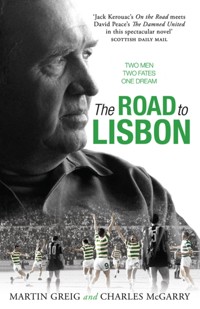
In 1967 Celtic manager Jock Stein stepped from the tunnel of Lisbon's Estadio Nacional and took up a position pitch-side as his team of home-grown players ran out to face the might of Inter Milan, the charismatic superstars of Italian football, in the European Cup final. Celtic were a team forged in Stein's own image, steeled with a relentless industry and integrity by their inspirational manager whose character had, in turn, been honed by the horrors of the deep dark of the Lanarkshire coalfields. Martin Greig and Charles McGarry's extraordinary novel delves to the very heart of that incredible season, telling the story through the eyes of Stein - as he plots and plans and drags his team to the pinnacle of European club football - and those of Tim, an idealistic young fan from the south side of Glasgow, whose dreams of life beyond the decaying slums of the Gorbals are inextricably tied to those of his heroes. The Road to Lisbon is a novel of hopes and dreams, of self-discovery and triumph over adversity ...and of an unerring love with an institution that represents so much more than just a football club.
Sie lesen das E-Book in den Legimi-Apps auf:
Seitenzahl: 427
Veröffentlichungsjahr: 2012
Das E-Book (TTS) können Sie hören im Abo „Legimi Premium” in Legimi-Apps auf:
Ähnliche


















The Road to Lisbon
First published in 2012 by Birlinn Limited West Newington House 10 Newington Road Edinburgh EH9 1QS
www.birlinn.co.uk
Copyright © Martin Greig & Charles McGarry
The moral right of Martin Greig & Charles McGarry to be identified as the authors of this work has been asserted by them in accordance with the Copyright, Designs and Patents Act 1988
All rights reserved. No part of this publication may be reproduced, stored or transmitted in any form without the express written permission of the publisher.
ISBN: 978 1 78027 084 5 eBook ISBN: 978 0 85790 190 3
British Library Cataloguing-in-Publication Data A catalogue record for this book is available from the British Library
Typeset by Iolaire Typesetting, Newtonmore
Acknowledgements
Our appreciation goes to all at Birlinn, especially Pete Burns, who bought into the idea and proved a knowledgeable and trustworthy sounding board throughout. Thanks to agent Mark Stanton, who believed in it from the start. Hugh ‘The Mamba’ MacDonald steered us away from perils and pitfalls, as is his way.
Martin: Huge thanks to Nicola Middleton for loving support, and George and Eileen Greig for doing what they have always done for me. To Neil White for ludicrous football analogies and Alan Partridge-isms . . . and Graeme Broadley, who liked an early draft and fell for Delphine. To John McGeady who provided vital feedback in the early stages. Michael Gormley’s love for the written word first inspired me as a teenager at St Thomas Aquinas Secondary in Glasgow. Without his formative influence, this book would not exist. Finally, to Charles, an exceptional writer and friend. It was an absolute pleasure.
Charles: I am indebted to my family, especially my mother Anne and my late father Charlie, and my dear friend Stuart Rivans, for their unstinting support and encouragement. Thanks to my brother-in-law Bill Wright and Paul Coulter for their invaluable help with our promotional film, and to my sister Clare for helping set it up. To my Uncle Jimmy, whose kindness freed up so much writing time. To Des Mulvey for his inspirational stories. To Mr Gormley, who once advised ‘write what you know’. To Martin for the original idea of The Road to Lisbon. His determination and positivity ought to be bottled and widely distributed.
Contents
Day One
Day Two
Day Three
Day Four
Day Five
Day Six
Day Seven
Day One
Friday, May 19th 1967
Particles of dust swirl in the shaft of sunlight. Steam rises in gentle wisps from the mug in front of me. Outside, in the corridor, footsteps grow louder, louder . . . then fade away. Silence. I look up at the board, read out the names.
Simpson, Craig, Gemmell, Murdoch, McNeill, Clark, Johnstone, Wallace, Chalmers, Auld and Lennox.
The team. My team. My wee team. European Cup finalists. Four down, one to go. Inter Milan. Helenio Herrera. The best team in the world.
I smile to myself, but I have never felt more serious.
I can sense it, see it in their eyes. Confidence, presence, a lightness of spirit. Belief. A steady, unshakeable belief that I have nurtured but that was there already, part of their characters. Belief greater than gallusness – built on expectations of excellence and success.
Two years in the making. Two years of searching, honing, crafting. Panning for gold. Putting the fear of God into them, physically and mentally. I think of the casualties, the ones who wilted, who couldn’t stand the heat, the lash of my tongue. I’d get in their faces, scream, threaten, abuse.
“I’m the boss, I’m the fuckin’ boss. Can you handle that?”
I’d look right into their spittle-flecked faces, into the whites of their eyes.
“Can you fuckin’ handle it?”
Some would crack. Look at their shoelaces. Fold.
“You can’t handle me? I’m just one man. How the fuck are you gonnae handle 100,000 baying for your blood?”
Weak men. Hearts the size of peas. No good to me. No good to Celtic Football Club. Kick them aside, like garbage in the street.
Then, the ones who held your gaze. Not defiantly. Steadily. Who looked right at you. Through you. Never flinched. Then went out and proved you wrong. Went out and rammed those words down your throat.
I needed to know, to search deep into their characters, to get inside their heads. Know what made them tick, what they could handle, whether they would be ready when the moment came. The moment is now.
I have said it all along. Nine months now, banging the same drum. “I think this could be a season to remember.”
1966-67. The season where it all comes together. I watched for the looks on people’s faces every time I said it. Nods. Disbelieving nods.
It’s gone to his head.
Getting too big for his boots, the Big Man.
But it wasn’t swagger. For 18 months, I watched the pieces coming together. Our moment in history awaited us; this was no time for false modesty.
The signs were there. Off-field bonds there for all to see in an on-field unity. An unspoken understanding of each other’s games, controlled aggression, instinctiveness, imagination.
A knock at the door. It is Sean Fallon. The Iron Man. My former playing comrade now my right hand. He speaks in his familiar heavy Sligo accent.
“This time next week we’ll be European champions, eh?”
“Too right, Sean.”
“That’s the boys ready, Jock. Well, Jimmy’s still in the bath. He was covered in suds and singing The Celtic Song when I left him.”
“Tell him if he’s not washed and dried in five minutes flat I’ll fuckin’ drag him out the front door with his trousers round his ankles in front of all those fans.”
Celtic to the core, is Sean, solid as a rock. We have come a long way together. From the moment we met in the Parkhead dressing room in 1951 I could sense his character. With some others I felt a coolness in the handshake, a failure to make eye contact. Not with Sean. Since he first held out his hand, nearly crushing the bones in mine, and I watched those features light up, I knew I was dealing with someone different; someone who would look past background, age, everything; someone whose look searched for the humanity in others. A couple of years later he made me his vice-captain. Our friendship was cemented in Ferrari’s restaurant in Sauchiehall Street, lost afternoons shuffling salt cellars around. Myself, Sean and Bertie Peacock, me talking 19 to the dozen and the other two listening closely, only occasionally interrupting.
“You’ve got it all worked out Big Man,” Sean used to say, as the waitress rescued her salt shaker from the makeshift tactics board.
Now here we are on the edge of making history. The Press having been trying to second-guess my selection. The fans talk about little else. I give nothing away. Before I leave the office, I will wipe the names off the board in case someone spots them. I am completely settled on my starting 11. No injuries, no dilemmas. They have only played together six times, but proved themselves more than capable of coping with anything. It is the same 11 that clinched the title away to Rangers and the Scottish Cup against Aberdeen. Their disciplined performance in the second leg against Dukla Prague in the semi-final was further proof that these were players capable of delivering when the pressure was at its most intense.
I look at the board, scanning the names again. The chosen few. I repeat them.
Simpson, Craig, Gemmell, Murdoch, McNeill, Clark, Johnstone, Wallace, Chalmers, Auld and Lennox.
Silence broken again, this time by the phone.
“John, Bill here. How you feeling?”
“Prepared, Bill. We have the players, we have done the work, and the rest is down to the big man upstairs. And wee Jimmy, of course.”
“Well, at least you know you can rely on wee Jimmy,” laughs Shanks, but then his tone changes.
“John, I’ll never forget two years ago against Inter in the semis. We hammered them in the first leg. The boys were glorious that night. Poetry in motion. Hunt scored early and Anfield exploded. Never heard anything like it, John. 3-1 it finished. We had a goal disallowed too.
“Then the second leg. Two of the worst refereeing decisions in history. They win an indirect free-kick and the boy chips it straight into the goal. The referee gives it. A sick joke. Then Tommy Lawrence bounces the ball on the ground as he prepares to punt it upfield. Their man sneaks in, takes the ball off him and scores. I had to be held back. If I’d got my hands on that referee I would have throttled him.
“I can see his face now, John. As I’m sitting here talking to you, I can picture his face in my mind’s eye. We could have been the first, John, but now it’s up to you. You and your boys.”
“I hear you, Bill. I want to win this trophy for so many reasons. I want to do it in style, too.”
“Ah John, this is your moment. I can feel it. I’ll be there to cheer you on. See you after the game. With that big cup.” He laughs and rings off.
Shanks knows where I am at this moment. He knows the journey. The journey from the blackness. The darkness. Two miners taking on the world; Shankly and Stein, a friendship that has survived no little meddling from the football gods. It is just over a year since we were denied a place in the Cup Winners’ Cup final by Shanks’ Liverpool. I close my eyes and think back to that fateful night. 2-1 down on aggregate but then Lennox scores in the last minute at Anfield to put us through on away goals. Through to the final in Glasgow. No question in my mind that we will win it. Hampden Park. Imagine the size of the crowd! I am hugging Sean when I glimpse it from the corner of my eye. The offside flag. An outrageous decision. Then the final whistle, the recriminations, the bottles raining down. Anger. Disgust. I stand at the side of the park and wait for the Belgian referee, waiting to unleash my fury and desperately trying to avoid Shanks; shunning the handshake that would feel like a dagger through the heart from an old friend.
Bill has his pain. I have mine. Football has decreed that they are intertwined. But redemption is on hand. The phoney war will soon be over.
“How do you go about breaking down the most stubborn defence in world football?” the Press ask me.
Every day the same question and every day the same answer.
“It is not all about the Italians and how they set themselves up. We have a plan, we have a way of playing, we have a philosophy.”
I leave one part out. We have Jimmy Johnstone. I close my eyes again and watch him go, driving at them time and time again. Wearing them down, crushing their spirit. The best defenders in the world reduced to rubble by a little red-haired Scotsman. I can see the joy in his face as he attacks again and again and again, streaked in sweat, skin pinking in the Portuguese sun.
“This is your stage, son,” I will tell him in the minutes before we leave the dressing room. “This is your destiny.”
And Jimmy will respond because the bigger the stage, the bigger Jimmy becomes. A 5ft 4in giant.
January 1965, Stein’s Hibernian reserves v Celtic reserves, Easter Road, half-time.
“Jimmy Johnstone.”
He glances round at me, cautiously.
“Mr Stein,” he replies.
“Jimmy Fucking Johnstone.”
“Yes, Mr Stein.”
“What the fuck are you doing here,” I say.
“Peeing, Mr Stein, same as you.”
Then that wee smile. Part charm, part defiance.
“I know you are peeing, son, but it’s your football talent you are pissing on. What I want to know is what you are doing playing in a reserve game in front of two men and a dog? Never mind pissing into the fuckin’ bowl, you’re pissing your talent down the drain. Not one of those clowns out there could lace your boots, but here you are, on a fuckin’ Tuesday afternoon, running rings round the stiff-ersed defenders that aren’t even good enough to make the Hibs bench . . . and making yourself feel good. Well, you may be happy kidding yourself son, but yer no kidding me. I know you. I’ve seen you play. You should be somebody. You’ll know by now I’m coming back to Celtic. Mark my words, when I get my hands on you, Johnstone, you’ll no know what’s hit you. Now finish yer fuckin’ pee, the second half is about to start.”
I leave him there, still hovering over the bowl. Not smiling anymore.
The road to Lisbon.
Two hours on a plane. Seventeen-hundred miles. The European Cup. The pot of gold at the end of the rainbow. Estádio Nacional. The marble terracing, the perimeter moat, the eucalyptus trees. The coliseum waiting for the lions to be unleashed. And unleashed they will be. This is more than a match. This is attack v defence. This is me v him. Stein v Herrera. Stein’s Scots v Herrera’s world stars. This is the match I have been waiting for, the moment when everything I believe in will hopefully be expressed on an immaculate patch of grass in Portugal. This is about those 11 names on the board but it is about more than that. It is about who they represent. Who I represent. They will travel in their thousands. Planes, trains and any vehicle, roadworthy or not. Anything with wheels will be pointed in the direction of the Portuguese capital. People who have never been beyond Glasgow Cross will be digging out maps of mainland Europe. They will be hanging off cross-channel ferries, careering down country roads in France and serenading bemused Spanish senoritas with their songs.
Ay Ay Ay Ay
Simpson is better than Yashin
And Lennox is better than Eusebio
But Johnstone is better than anyone
Then, the friendliest, most boisterous occupation the city will ever have seen.
I can hear them now, outside the entrance to the stadium, milling around, that low murmur of voices, tense, exhilarated, rising to a roar as their heroes emerge.
It is time. I throw my jacket over my arm and close the office door softly. As I pass down the corridor, my secretary calls me back.
“Mr Stein, it’s very busy out there. Would you like me to organise for the bus to get you at the side entrance? It’ll save you time.”
I look at her and smile.
“No need for that. This is the best bit. The day I slip out the side entrance of this place is the day I chuck it.”
I walk through the front door, emerge blinking into the glorious afternoon sunshine and a huge roar rises up to greet me. The hairs on the back of my neck rise too, my back straightens. I look at their faces. Young men, mainly, hundreds of them. Young, working-class men who have invested their money, their time, their hopes and their dreams, everything in this football club. In its players. In me. Celtic, the centre of their lives, the core of their beings. I plunge in among them. I sign every piece of paper and politely acknowledge every goodwill gesture because I know that these people will make the difference. These people believe in me and believe in my team. My wee team.
“Good luck, Mr Stein. We are with you every step of the way,” cries one young man, his face flushed with excitement.
I shake his hand and look into his eyes.
“Thanks for your support, you have no idea how much we appreciate it.”
“We’ll see you over there, Mr Stein,” he shouts after me. “We’ll see you in Lisbon!”
I get on the team bus bound for Seamill and sit at the front with Sean. As the coach pulls away I glance in the rear-view mirror at my team. My wee team. I see the rows of heads, laughing and joking. I look past them through the back window and see Celtic Park framed there. Then, I whisper to myself again . . .
Simpson, Craig, Gemmell, Murdoch, McNeill, Clark, Johnstone, Wallace, Chalmers, Auld and Lennox.
~~~
I approach Paradise, daring to daydream of adventure and glory.
I wander through the large crowd of well-wishers that has gathered in the car park. We are all charged with this strange new excitement that has been around ever since we reached the final.
Mark – my shadow lately – is easy to pick out due to the fact he’s waving a copy of Aquinas’ Summa Theologica at me. Total redneck in front of all these punters.
“M-m-mind we were discussing God’s essence as being identical with H-H-His existence?” he asks with his familiar stutter.
“Vaguely.”
“W-w-well I think I’ve c-cracked it!”
“I’m pleased for you.”
Now I am known to visit church now and again myself, but tell me later. Much later. Three and a half thousand miles later.
I am rescued by a massive, throaty roar as the squad emerge, but they are off-limits and club officials usher them towards the waiting coach heading for Seamill, the Clyde coast retreat; Celtic’s Lourdes, they call it. I try to pick out the 11 I feel certain he will start with in Lisbon.
Tommy Gemmell, the gallus full-back with the distinctive hooter waves enthusiastically towards us. Jim Craig smiles and gives us the V-for-victory sign. There’s Bertie Auld with his trademark grin, giving the thumbs up.
“Wee Bertie. He’s a hard wee bastard.”
“Aye. H-h-he would kick his granny.”
“He’s a definite.”
Bobby Murdoch, the engine of the side, waves over, a down-to-Earth guy despite being world-class.
“Boaby’s arguably our best player.”
“B-b-better than Jinky? You must be kidding me!”
“Alright, alright. I said arguably.”
John Clark, the classy left-half, looks serious and thoughtful. Then there’s Billy McNeill. Cesar. Our captain. Straight back, dignified, commanding – a massive presence beside Wee Clarky. They’re both on the team-sheet, for sure.
I see Willie Wallace, our prolific inside-right, Stevie Chalmers, the classic Celtic centre-forward, and big John Hughes coming out in a cluster. Any two from three.
“If B-B-Big Jock wants to rummel them up he’ll go with Y-Y-Yogi. But I’ve a f-f-feeling he’ll play S-Stevie and Wispy,” says Mark.
“For once, I think you’re right.”
There’s the goalie, Ronnie ‘Faither’ Simpson, with that wizened face; Scottish Player of the Year. An absolute stick-on.
Not just fine footballers, but fine men too. Men you are glad to believe in, proud to have represent you. Men who all hail from either Glasgow itself or the surrounding area. It’s a bloody miracle. Who do they think they are taking on the might of Inter Milan!
There is Bobby Lennox, always cheery, loves the fans – as skilful and graceful an outside-left as you will ever see, and with the kind of pace that defenders hate. That makes 10 . . .
Jimmy ‘Jinky’ Johnstone bursts from the stadium’s main doors, and a crescendo of good-natured ribaldry goes up from fans and players alike. His shirt tail is hanging out and he grins as he dashes across the car park, stopping to shout over to us. He is hustled away by a steward as a familiar chorus, to the tune of Ging Gang Goolie fills the air:
We’ve got Jimmy-Jimmy-Jimmy-Jimmy Johnstone on the wing, on the wing.
We’ve got Jimmy-Jimmy-Jimmy-Jimmy Johnstone on the wing, on the wing.
He gets onto the coach, waving at us, and I wonder at this cheeky, reckless, ginger-haired midget who strikes terror into the greatest defenders in Europe. Mesmerising, flamboyant, imaginative, and in terms of sheer skill, utterly sublime.
Mark can’t contain himself.
“Jinky’s the m-m-man. If we do this, Jinky will be the man. Eh Tim, know what I mean? Know what I m-m-mean?”
“I think, if I hear you correctly, you are saying Jinky’s the man!”
We burst out laughing and join in again lustily.
Jimmy. Oh Jimmy Johnstone, oh Jimmy Johnstone on the wing!
That’s my side. It’s got everything. Balance, ability, courage, fitness, strength, invention and belief. Belief in one another. Belief in their captain. Belief in their manager. Belief instilled by their manager. Jock Stein. Big Jock. The Big Man. My hero.
Finally he emerges from the stadium, shaking hands. Including mine. The hefty steward doesn’t even try to stop him. He knows better. My mouth is dry. I am struck temporarily dumb. Then I find some words.
“Good luck, Mr Stein. We are with you every step of the way.”
“Thanks for your support, you have no idea how much we appreciate it.”
He says it like he means it. He does mean it. I catch the look in his eye as his huge paw envelopes mine. A look that says he wants to win it for the people that matter. Really matter. Us.
“We’ll see you over there, Mr Stein,” I shout after him, as he hurries towards the coach. “We’ll see you in Lisbon!”
I turn to Mark. Offer him my hand.
“Want to shake the hand that shook the hand of God?”
He bursts out laughing, grabs my hand and then hugs me. We bounce up and down manically like the couple of star-struck kids we are.
I walk Mark to his home in the Gorbals. Gives me a chance to score some blaw. Afterwards I will head back over the river to court. We cut through Glasgow Green to avoid any Tongs but a few of them are hanging around the wee bridge, guarding their border.
“Tim! W-w-what are we g-g-g-gonnae do?” Mark hisses urgently.
“Keep your knickers on. Get ready to do whatever I do.”
The leader is a serious-faced individual with a terrible scar who looks a bit like a youthful Jack Palance. I recognise him from the summer, when the Tongs ruled the waltzers during the carnival. He knows who I am. But he lets us pass unmolested. A miracle.
“H-h-how come they didn’t have a g-g-go?”
“It must be ’cause of the gemme. It’s mesmerised everyone.”
The Gorbals seeps into my nervous system like a narcotic. It’s only a year since we flitted from here to nearby Toryglen but already I sense the hostility from the younger team, not helped by my lengthening hair and increasingly outlandish clothes. But I’m six foot and known.
A Gorbals tenement seethes and teems and pulsates and throbs and hums and buzzes and screams with human life. The air is continually punctuated with the sounds of people. Doors slamming, children shouting, couples fighting, babies crying, dinners cooking, radios blaring, the groans of copulation. Wakes, receptions, parties and sing-songs. Now lots of these buildings have been demolished and the land they stood on lies vacant or is being prepared for high-rise developments.
“I love this place. But they’re murdering it. They’re murdering the Gorbals. The whole community.”
“So w-w-what?”
“Don’t you care?”
“It’s alright for y-y-you. You don’t have to live here any m-more.”
“Fair enough. But what about those auld yins?” I say, nodding towards a boarded-up, half-demolished tenement, where some former residents have congregated. “I saw them dragging auld kitchen tables and chairs into that parlour for a bevvy, just so that they could be together again. Except the parlour no longer has a ceiling, or a roof. Poor bastards. They’re scared.”
“Of w-w-what?”
“Of what’s gonnae happen to them. Of where they’re gonnae go.”
“They’ll get a n-nice house in the schemes.”
“They don’t want to go to the schemes. They want to stay in the Gorbals. Where the spirit is.”
A wee old woman is walking by pushing a pram full of laundry to the steamie, a rain-mate on her head. She has overheard and turns to me with tears filming her eyes.
“They’re knocking down the greatest place on Earth, son.”
“You see?” I ask Mark, vindicated.
He shrugs his shoulders. Mark has a boyishly handsome face, light-blond hair and intense, clear-blue eyes.
“You realise what’s going on here? Why they’re really knocking this place down? They’re tearing apart the auld Irish neighbourhoods. The Calton, the Gorbals, the Garngad. Splitting us up.”
“They’re s-slums, Tim. They need to be torn down.”
“No. We’ve got ourselves educated, radicalised. They’re scared of us. They hate us.”
“You’re being p-p-paranoid.”
“Just because I’m paranoid doesn’t mean they’re no out to get me. Understand this. An entire era is about to end, auld Glasgow is about to slip over the horizon. And something precious will be lost forever.”
Just then we happen by a gaggle of bedraggled, malnourished children, playing in a filthy puddle. They watch plaintively as an ice cream van, painted baby blue and tinkling a cheery tune, motors slowly by.
“Hauw! HAUW JIMMY!”
I run and bang the side to catch the driver’s attention. He stops and clumps towards the serving hatch.
“Five pokey hats pal.”
“You want raspberry?”
“Aye.”
“Two and six, my china.”
I give the children the cones and they skip off merrily back to their puddle.
Mark looks at me. Now it’s my turn to shrug my shoulders. Deep down I know he’s got a point . . .
. . . The darkness. I am 11 years old. The Gorbals. Fifty thousand people crammed into the most densely populated place on Earth: a ghetto of less than a square mile of filthy, rat-infested, jerry-built slums. Our tenement blackened and browned by poverty, worn down by four generations of hard living. The January gloom, the relentless cold. The stink of sewage. I can see it, for Christ’s sake, snaking down the stair. I don’t belong in this place. Hold on a minute – who do I think I am – better than these people? No. Nobody belongs in a place like this. But they see it in my eyes, hear it in the way I try to talk that bit clearer and use a bigger vocabulary, tell it by the fact that I go to the library, the fact that I ask the old Jewish intellectuals in the bathhouse about Marx, the fact that after the summer I’ll be going to Holyrood instead of St Bonaventure’s. The fact that I paint. You think your shite disnae smell! . . .
. . . We amble to Hell’s Kitchen Cafe. Steam, the smell of hot fat, orders being shouted in warm, rough accents and The Who’s So Sad About Us blaring from the wireless. We sit by the window, the bustle of Gorbals life comfortingly close. I choose, Mark takes ages, I make lines with spilled sugar. Eventually he makes up his mind and the waitress comes over; fake gold, a fag on. Friendly but unhygienic.
“Hullo boys, what yous for?”
“Two rolls and sausage, and a mug of strong tea for me; just a plate of soup for the lady,” I grin.
She flashes a row of crooked teeth at me and goes.
Mark’s nose is bothering him. Wants a bloody heart-to-heart.
“How are things between yourself and D-D-D-Debbie?”
It’s been 12 days and . . . 22 hours since it happened. But the question is: was it actually a break-up? I don’t really know because she avoided me for a week and then went to Saltcoats on holiday. Now I’m off to Lisbon. Bloody hell. I cast my mind back. Analyse the events for the hundredth time, events in this very café . . .
. . . She walks in. That familiar feeling. Excitement. The universe is fretted with meaning and I know this because Debbie Sharkey is my girl. Because she is in the same room as me. Because she exists.
She comes over, a serious expression on her face. She looks businesslike and determined in her raincoat. I regard her figure. She is wee and slim, so her breasts are fuller than you remember. Sometimes my eyes are drawn there, in unexpected appreciation.
She smiles weakly. Sits down. No kiss. Excitement turns to dread.
“You okay, Debbie?”
“Yes.”
“What would you like?”
“Coffee please.”
“Cup of coffee over here please, Agnes!”
Smalltalk follows, skirting the issue. What issue? What is it that is troubling me? The coffee is brought over and Debbie stares into it, stirring relentlessly. Usually her eyes, which are hazel, large and clear, fix whoever is addressing her, impressing upon them her quiet self-assurance, honesty and genuine interest in others which I’ve always loved. Not today.
“So what’s this good news of yours?” she asks languidly.
“I’ve got a new job, at Hargreaves!”
“Hargreaves on the Clyde?”
“Aye. They do refitting for merchant vessels. What’s wrong? You don’t seem too impressed.”
She sighs slightly, then looks at me directly. “Tim, this will be your fifth job in two years.”
It’s actually my sixth, but I won’t correct her.
“So?”
“You obviously don’t like it. Working, I mean.”
“You think I’m lazy?”
Her gaze returns to her coffee. “No. I just think you hate working in the yards.”
She’s right, of course. I’d be happier painting. I’d work 80 hours a week doing that – for two bob an hour.
She looks away from the coffee cup and stares out of the window abstractly. I love it when she wears her lovely chestnut-coloured hair up like that. She has a button nose and her chin and mouth sit ever so slightly pronounced forwards. I hate to boast but people say that we make a very handsome couple. She’s got a hundred times more class than the wee hairies Rocky knocks about with.
Rocky. At that moment I become more aware of his presence in a nearby booth. It might be my imagination but I fancy that he’s trying too hard to make out that he’s oblivious to us, talking self-consciously loudly to Iggy and Eddie about banalities.
I need to ask. I don’t want to – Christ knows I don’t want to – but I need to broach the subject.
“Is there something wrong, Debbie?”
Finally she makes eye contact, falteringly.
“I’m really sorry, Tim. But I’m having . . . doubts.”
I try to swallow but my mouth has gone dry. I take a gulp of tepid tea.
“Doubts?”
“About . . . us.”
I should be moved to a torrent of protest, to great feats of logic and persuasion. I possess a canon of evidence as to why we should be together – two glorious years’ worth. Yet I am silent. Only later will I realise why; because deep down I know that you can’t persuade people to feel such things. Because I know that it’s hopeless.
She rises quickly.
“I’ve got to get out of here.”
“But we need to talk.”
“I know. But later. Somewhere else.”
“Debbie!”
She comes back for her handbag. It’s then that I detect it. A glance, no more than that, in which they catch one another’s eye. I know that the bet is lost. I feel a wave of rage. For a split second I fantasise destruction; my smashing the fuck right out of the place, banjoing Rocky, teeth and blood, fearful faces, then self-pity and booze. Anger, livid and ugly, finding its release like poison being drawn from a boil. Then, later, the darkness, except worse this time, much worse.
But my wrath is restrained by the realisation that I might simply be being paranoid – it has been known. I need real proof. And even if it is true, maybe deep down I don’t even blame them . . .
. . . Mark looks subdued. I feel bad for thinking he was just being nosey. There is sadness in his eyes. He cares about me. Cares about a lot of people in fact. I’m always doing that. Thinking the worst of folk.
~~~
1966-67. We hit the ground running. Manchester United in town for a friendly. Charlton, Stiles, Law, Crerand and Best. Charlton strutting, elegant, an aura of greatness; Stiles, all toothless tenacity, the opposite of Charlton, but just as vital; both fresh from World Cup glory with England. The incomparable Denis Law. Greased lightning has nothing on the leaping Lawman, but it is his aggression, his lionheart that makes him the player he is. Crerand, the midfield warrior with the unsinkable spirit. I had him in my Celtic reserve team; I honed his character, polished off the rough edges, sent him in to buy me chips on the way home from training. Look at him now. I would gladly take him back. But the question now is, would he get in the team? My wee team. Then Best, the incarnation of a football god. The long hair, the glint in his eye, but substance as well as style – speed, control, courage, mental and physical toughness; an artist as much as a footballer. United have everything; a great manager too. Matt Busby. A fellow Scot and a former miner. A kindred spirit. A man whose hopes and dreams lay in ruins on an airstrip in Munich eight years ago. A man who lost the core of a great team, but never lost the life-force; who glimpsed the other side, but fought his way back, to health and, ultimately, greatness. A man I am honoured to be in the presence of on this sun-kissed day in the east end of Glasgow.
“Should be a close one today,” says Matt, before kick-off.
“We’ll see Matt, we’ll see.”
But it is not close. We annihilate them. We are faster, stronger and more ruthless. McBride scores and then Murdoch adds another. Bill Foulkes’ own-goal sums up their disarray, before Lennox adds another. 4-1 going on 10.
I watch Charlton look at Stiles, Stiles look at Crerand, Crerand look at Law, Law look at Best. And Best shrug his shoulders.
“It’s just a pre-season friendly, don’t read too much into it,” I tell the Press.
I lie. Manchester United, the great Manchester United, do not play friendlies. It is not in their nature. Every match is a battle. We won the battle fair and square. “Well done, Jock,” says Matt after the game. “Your boys are in good shape.”
“I think this could be a season to remember, Matt. A season to remember . . .”
The fixture calendar has pitted us against Clyde on the first day of the league season. I have not even considered it yet. It is irrelevant. Our season starts against Rangers in the Glasgow Cup.
“Forget about Clyde, forget about the league,” I tell the players. “The summer is over and the season starts now. Today. Against Rangers.”
We may have won the title last year, but the memory of our Scottish Cup final defeat still rankles. It’s sat in my stomach all summer. Like a poison that’s gradually seeped through my whole system, disrupting my sleep, destroying my holiday. Always there. Whenever I closed my eyes all I could see was Kai Johansen sauntering to the edge of the box and firing in the winner. That moment. It’s not just about losing. It’s about losing to Rangers. It fuckin’ destroys me. Overwhelms me. It’s personal. But it fires me up. By God, it motivates me like nothing else in this world. Never again. Never a-fuckin-gain.
Rangers have strengthened over the summer, but we are stronger, too, more confident and better prepared. Before the game, there is none of the usual pre-match banter. The players drift around quietly, going through their preparations. They can see the fire in my eyes. The madness. They know what this means to me. This is war.
I spell it out to them.
“Gentlemen, I want you to think back to the Scottish Cup final last season. I want you to remember Johansen’s goal. I want you to remember how it felt. Remember your disappointment, but then think about how Johansen must have felt. Johansen doesn’t score. It was a one-off, but he will want to do it again. The crowd will want him to do it again. He’ll be charging over the halfway line like a bull. We must be ready for him. Every time he gets up a head of steam, we will be on top of him. Bobby Lennox, you will be up against him, but don’t track him when he goes forward. Sit in that space and when we get the ball back, we will get it to you. Use that pace to tear them apart, Bobby.
“Now, go out there and win. Fuckin’ tear them limb from limb. Destroy them. Or you’ll have me to answer to.”
Billy McNeill opens the scoring and then Lennox starts to enjoy himself. As Johansen pushes forward, Lennox bursts from the traps like a greyhound, time after time. At the final whistle, Lennox grabs the match ball. The hat-trick hero. 4-0.
The season has started . . .
~~~
Iggy has a habit of ‘borrowing’ motors. Jaguars, Triumphs, Rovers, Austins, Fords, ice cream vans – he isn’t fussy. He even nicked a steamroller one time, just a half-hour nocturnal jaunt round a building site.
“Nice throttle action but the steering’s a bit on the heavy side,” he mused.
I suppose he just loves cars but knows he is never going to own one. A couple of times the polis put the chase on him but he was too daring, too resourceful, too quick.
Iggy’s skills meant he was recruited to help the South Side mob on a few jobs. When I heard about this I was worried sick but he played it all down as though he was taking part in Sunday trips down the coast. I think he was seduced by the excitement of it all, the fun. The dough – I don’t think he was particularly interested in it. He ended up giving it away to poor souls or to his poor parents. Anyway, he started to avoid me, tired of my lectures.
On Wednesday he was at the wheel of a 1965 Mark II Humber Sceptre, waiting to cross the Jamaica Bridge into the city centre. The traffic moved off except for the vehicle immediately in front. It was an unmarked car and the cops inside had decided that the face and the paintjob behind didn’t go together.
I take my seat in the public gallery. He is drowning in an oversized collar and tie. Nice to see not one of his big-shot compadres are here. I’m the only one. Got to make sure he’s okay. Got to look after him. Can’t have him ending up like his poor wee brother. Killed climbing a scaffolding trying to escape from the polis when he was 13. The thought of losing him!
“Ignatius Patrick McCargo, you are hereby to be remanded in custody . . .”
That’s it. No Iggy at Lisbon. Just me worrying about him getting sent down for a long stretch. You fucking eejit, Iggy.
As he is led away he looks up at me, a picture of innocence in his ill-fitting suit and grubby plimsolls. But I know that he’s no innocent. I know that he embodies the madness of the Gorbals, even though his family didn’t move there from the Calton until he was 14.
I remember the first time I met him. I was walking along Thistle Street one spring evening, feeling quite merry, when I heard the distinctive tuneless chorus of Gorbals community singing.
Que sera, sera. Whatever will be, will be . . .
The sound was getting steadily nearer. Intrigued, I turned round. A double-decker bus was crawling along behind me.
The future’s not ours to see. Que sera, sera. What will be, will be.
The driver was a striking looking little fellow. With a mop of thick, jet-black hair that almost obscured his vision, and a wide, inane grin, he exuded cheerfulness and mischief. His features were all slightly too large for his face, like the product of a cartoonist’s pencil, and he was clearly drunk. This was the bold Iggy. He brought the bus to a standstill alongside me to let an old woman off.
“Thanks, son. You’ve saved my poor auld legs.”
“No bother, missus,” he slurred, touching the peak of his hat which was tilted ludicrously to one side of his large head. The bus was heaving with people. Everyone singing and having a good time. The party bus.
His attention turned to me.
“Standing room only – no spitting, swearing or calling the driver an eejit!”
As I considered my next course of action my attention was drawn by shouting from down the street.
“HAUW! HAUW! HAUD THE BUS! HAUD THAT FUCKIN’ BUS!”
A fat, sweating man dressed in the drab green of Glasgow Corporation Transport – sans peaked hat – was racing up Thistle Street as though his life depended on it. This was the real driver. Iggy, it would transpire, had stolen – or “borrowed” as he would later insist – the bus while the driver, on his way back to the depot, had popped into The Britannia for a swift half. While he was in the lavvy Iggy had swiped the driver’s hat and keys, which he had imprudently left on the bar-top. Iggy then proceeded to nip outside and drive the vehicle away, stopping regularly just like an official service to take on board passengers, most of whom were drunken revellers like himself.
“RIGHT EVERYBODY – GET FUCKING OFF!”
Such was the real driver’s shame at the theft that he didn’t report it, and instead merely relieved Iggy of his duties. Iggy shambled along Thistle Street and his passengers all duly shambled along after him. The pied piper of Gorbals Cross. He stopped and turned to me.
“Are you coming?”
“Too right!”
~~~
The road to Lisbon.
Where did it start? It started in the darkness. The blackness of a coalmine in Lanarkshire. The moment that lamp went out and the blackness closed in. When I could see nothing. Not even the hand in front of my face, nothing but the inside of my head. And the ever-present threat of death, lurking in every darkened crevasse. A growing sense of fear. The fear of a 16-year-old boy. Terror. Silent terror. Then, finally, the flicker of something else. A determination, a will, a desire to overcome. To stand tall and take my place in the company of men. Real men. Men whose characters were hewn from the black walls of that mine. Men who needed each other, trusted each other, thousands of feet below the ground. Petty feuds and religious rivalries were left on the surface. They silently taught me how to be a man myself.
When the boy became a man . . . that was when the first steps were taken on the road to Lisbon.
And now . . . now I tell my players, “You’re here to entertain. You’re here to make people’s lives better. People who work hard all week. People who work down the mines, in factories and in the yards. People who barely glimpse daylight during the week, who come along and spend their hard-earned money to watch you play. You have the ability to raise their spirits, to give their life meaning. You can be lights in the darkness.”
The darkness. The blackness.
Burnbank. Protestant Burnbank. Protestant Burnbank with its corner of Catholics. Divided communities. ‘Don’t stray into the wrong street . . . don’t look at them.’
‘Them.’ Them and us. Protestant and Catholic. I remember the Cross. Burnbank Cross. The centre of our community. The pubs, the chatter. I remember July 12th. The noise, the colours, the pageantry and the sense of belonging, of community. But I remember something else. An edge, a sneer at the end of sentences. A flash of the eyes. Them and us. I remember the no-go zones. ‘Pope’s corner’ we called one of them, where the Catholics met. Them at Pope’s Corner. Us at Burnbank Cross. Them and us. Protestant Burnbank. Catholic Bellshill. Protestant Larkhall. Catholic Blantyre. Divided communities. Worlds apart.
‘Keep your distance,’ they said, so I did, unquestioningly at first. But things change. Lives change, and you meet people. I met Jean one summer’s evening in Cambuslang. Jean Toner McAuley. The woman who would become the love of my life. A Catholic.
I knew what it meant. From the first moment, I knew the consequences. It meant slinking down back streets on our way home because it was not a good idea to walk down the main street. It meant steering away from the Cross. From the pubs, the chatter. It meant whispers and disapproving, disappointed glances. Turncoat. Jump-the-dyke.
It meant rejection. But rejection by who? People who choose to hate you because of your religion? Fuck them. Fuck them all.
It also meant something more powerful, more meaningful. Not hatred, but love. Not them and us. Just us. Myself and Jean.
Football, my other love, was always there, a constant. Blantyre Victoria then Albion Rovers. Cliftonhill was where I made my name as a centre-half. Where I started to think about football, really think about it. Where I would question everything, study the opposition, find out their strengths and weaknesses, learn to compensate for my own weaknesses. And I had no shortage of those. With my left foot, I had a kick like a mule. My right was only of use for standing on. I developed a neat trick of using my right knee rather than my foot to clear the ball, but even that was capable of letting me down. ‘Yer a one-footed mug,’ would sound from the terraces at Cliftonhill, usually when we were getting beaten. But I had my ways of ushering nippy centre-forwards down blind alleys, of encouraging them to turn the way I wanted them to. It was all thought out, analysed, planned in the most minute detail. It did not make me a world-beater, but it did allow me to cope, even to flourish on occasion.
I looked around me and everywhere saw more naturally gifted players. Players who were born to play football, who knew the game instinctively. Players with the ability to do things out of the ordinary, but who could never quite explain how or why they did it after the event. That fascinated me. I wanted to get inside their heads. I wondered how good players could become even better and how great players could become world-beaters . . . how their natural instincts could be honed to make them an even more potent force. I thought a lot. About football, about tactics, about what motivates different people and about what undermines their confidence. God knows I had plenty of time to reflect on such matters.
Bothwell Pit, Monday to Friday. Cliftonhill or an away fixture on a Saturday. A week spent in the darkness, but a week spent thinking and planning, picking the team in my head. I was not the manager but it became clear that a well-timed word in his ear from me would sway his judgement. He knew that I knew more than he knew. He was right. Soaking everything in like a sponge. Directing play from the centre of defence. And the players looking to me for leadership. The manager looking to me for leadership. A leader of men. It came instinctively and it surprised me at first. It was the first realisation that I could do something different, but I did not know what it meant, what it could lead to.
Albion Rovers v Rangers was the highlight of the season. Cliftonhill bursting at the seams. The blue strip carried an aura. Most of us were Rangers men but we were all footballers, too. I saw no conflict between the two. I looked at my team-mates and I sensed a level of respect that went too far. I did not like it. I was my own man. A professional. I ploughed into 50-50s with relish, took no prisoners. They didn’t like it, the Rangers players. They looked at me as if an unwritten rule had been broken. I just shrugged my shoulders and tackled even harder. Fuck them. It was not about loyalties. It was not about religion. It was about football. Always football.
~~~
The wireless is murmuring something about Muhammad Ali refusing the draft. Other than that there is only the sound of crockery gently clanking and splashing in the sink. She doesn’t hear me come in. I watch her for a while in her tired, solitary routine, surrounded by sad brands, mocked by the faux cheerfulness of cheap detergent labels. I watch her muscular arms as she washes the lunch dishes and some of my painting things, absorbed in thought. Her movements are sluggish and resigned.
“Hi Ma.”
I kiss her.
“Hello son. How are you?”
“Fine. Yourself?”
“Not bad, not bad.”
She sighs.
“What’s up Ma?”
“Nothing son.”
“Where’s my da?”
“In bed.”
“Is he asleep?”
“No. Just a wee bit tired. Go through and see him.”
The room is shaded. Christ crucified looms above the headboard. My father’s odour fills my nostrils. He stirs, aware of me. I speak into the cool silence.
“Why are you in bed Da, are you tired?”
“Naw son. Just a bit cold is all.”
“I’ll put a fire on.”
“It’s alright. There’s no coal anyway.”
“That’s no good Da, staying in bed ’cause you’re cold.”
I want him to complain. I want him to tell me how to make it better.
“Are you going then?”
“Aye. Leaving soon.”
“That’s grand, son.”
I feel bad leaving him.
“Will you see it?”
“Aye. Your Uncle Joe’s bringing round a telly. Might even have a wee dram!”
“That’s great. Think we’ll win?”
“I know we will. The good Lord didn’t bring us this far to lose. Believe me son, Celtic’s special. Anointed.”
The doubt is written on my face.
“Have faith.”
Suddenly he begins coughing violently, bent over, hacking phlegm from his lungs. I rub his back.
“Pass me that linctus son.”
He takes a sip and the coughing abates. His chest heaves; a discordant harmony rises and falls with every breath. He relates a familiar story, as though he has to explain or apologise for the way his health is.
“Those fibres, it was lying around everywhere in the yard during the second war. We used it for fireproofing on the battleships. We even had a snowball fight with it once. It seemed so harmless, like kids’ stuff. Then this new gaffer told us he reckoned it was dangerous, that it gets into your lungs. So after that we didn’t touch it unless we had to. I forgot all about it, then years later, when I started getting breathless, an old workmate of mine made the connection. He had it too.”
Da and Ma – they’ve done so much for us, never complaining. Sometimes I dread having a family. I’d be so worried that I couldn’t hack the graft, on account of the fact that I find it so depressing and boring. Plus I hate the way it fucks up your health. I mean, just look at Da.
“Now, go into my top drawer for me . . . take out that envelope.”
“What’s this?”
“A wee minding. From me and your mammy.”
“I can’t take this; you with no enough for coal!”
He tuts impatiently in his particular way, then speaks with mock sternness.
“There’s no question of us no having enough for coal! Now take it. Enjoy yourself. And make sure you thank your mammy.”
I walk towards him. Grasp his thin, leathery hand. Touch his soft white hair. Kiss his forehead. That wee shrapnel scar, so familiar to me, so emblematic of him. Close my eyes and hold the moment. Remember it. Treasure it. Want to keep him forever.
“Good lad.”
He closes his eyes. I go to leave. Then turn back.
“Da. One question. Favourite-ever Celtic match?”
He instantly comes back to life in a series of grunts and gasps.
“Help me sit up . . . put the wee table light on . . . now, take the bottle out o’ the dresser . . . naw, the next door . . . that’s it.”
He pours us both a whisky, mine in the wee crystal glass, his in his medicine cup. The meagre light illuminates his grey, haggard face. I try not to look upset. At least those hazel Donegal eyes are still sparkling. We raise our drams and drink, me pretending that the spirit doesn’t burn, trying not to choke, trying not to spoil this precious moment of togetherness.
“September 10th 1938. Celtic 6 Rangers 2. I was there, in the Jungle. Celtic scorers: McDonald hat-trick, Lyon double, Delaney. Malky McDonald was magnificent that day, he was a player, son, believe me.”
The room now is a hotchpotch of 40 years of marriage. Relics of five children and umpteen grandchildren, odd books and ornaments, things misplaced and mixed up during half-a-dozen flittings.
He is wistful now, almost whispering.
“But then there was Jimmy Delaney – he was a class apart. Watching a wee winger in a green-and-white hooped jersey take the baw past a big ugly defender – it’s a beautiful thing to watch. It’s Celtic. It’s . . . romance!”
My eyes wander along the ever-growing line of medicines on his bedside table. None of them seem to work. I feel a wave of anger, then a sensation of helplessness and sorrow. My eyes film with water. Luckily he’s not noticing; he’s too focused on his story. I blink and pretend to have been listening.




