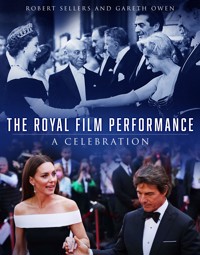
The Royal Film Performance
The Royal Film Performance
A CELEBRATION
ROBERT SELLERS AND GARETH OWEN
Please note that quotations and press excerpts duplicated in the following
pages are from sources dating back to the late nineteenth century onwards,
and consequently the language and attitudes of the day do not necessarily
reflect those of the charity or the authors today.
First published 2025
The History Press
97 St George’s Place, Cheltenham,
Gloucestershire, GL50 3QB
www.thehistorypress.co.uk
© Robert Sellers and Gareth Owen, 2025
The right of Robert Sellers and Gareth Owen to be identified as the
Authors of this work has been asserted in accordance with the
Copyright, Designs and Patents Act 1988.
All rights reserved. No part of this book may be reprinted
or reproduced or utilised in any form or by any electronic,
mechanical or other means, now known or hereafter invented,
including photocopying and recording, or in any information
storage or retrieval system, without the permission in writing
from the Publishers.
British Library Cataloguing in Publication Data.
A catalogue record for this book is available from the British Library.
ISBN 978 1 80399 825 1
Typesetting and origination by The History Press
Printed and bound in Turkey by Imak
EU Authorised Representative: Easy Access System Europe
Mustamäe tee 50, 10621 Tallinn, Estonia
The History Press proudly supports
www.treesforlife.org.uk
Contents
Foreword
7
Introduction
9
Part I: e Royal Film Performance: A History
10
1
e Royal Film
11
2
Foundations (1895–1939)
14
3
War and Peace (1939–45)
23
4
e First Royal Command Film Performances (1946–49)
25
5
Premieres and Television (1950s)
30
6
Evolving Times (1960s and 1970s)
36
7
Flying the Flag (1980s)
44
8
Changing Times (1990–2010)
48
9
Changing and Evolving (2010–24)
59
10 In Focus
68
Part II: Royal Film Performances
72
Appendix: e Film & TV Charity Governance
239
Acknowledgements
240
Foreword
7
of them as special as a festival screening at
Cannes, but only once have I had the privilege
of producing a film selected for the Royal Film
Performance: an experience which honestly
outdoes all the rest of them.
It was 1981, and the film was
Chariots of Fire
,
with the late Queen Mother in attendance. I
have a clear memory of sitting next to her in
the balcony of the Odeon Leicester Square and
being aware of a slightly theatrical ‘shudder’
when David Yelland, playing the then Prince of
Wales, made his first appearance on the screen
– obviously old memories die hard!
It was in every way a totally amazing even-
ing, topped off by a dinner at the Savoy with
a performance by the Cambridge Footlights,
starring, believe it or not, a young Emma
ompson, Stephen Fry, Hugh Laurie and
Tony Slattery.
at was in every sense a Royal Film
Performance to remember, but each year offers
a new film and another special evening at
which the industry gathers with members of
the royal family to celebrate and support the
wonderful world of cinema.
David Puttnam CBE, HonFRSA,
HonFRPS, MRIA,
2025
THE ROYAL FILM PERFORMANCE has always
been a special occasion – I can’t remember
a star, a director, a producer or a writer who
wouldn’t bust a gut to be present, and very
few studio executives who weren’t prepared to
cross the Atlantic to be there. It’s as if an extra
layer of tinsel is added to Tinseltown!
e silent beneficiaries of the evening are
not those who actually meet a member of the
royal family, or whose names or logos are on
the movie, but the hundreds, indeed thou-
sands, of their fellow workers who have fallen
on tougher times. Royal Film Performances
have been held in support of a Film and TV
Charity ever since the very first such occa-
sion in 1946. en called a Royal Command
Performance, that first event was a screening
of Powell and Pressburger’s
A Matter of Life and
Death
, attended by His Majesty King George VI,
as well as Queen Elizabeth and the young prin-
cesses Elizabeth and Margaret.
Since then, there have been a further sev-
enty such events over the years, ranging from
classics like
To Catch a ief
and
West Side Story
to more recent hits like
Titanic
and
Spectre
,
and, most recently, the world premiere of Sir
Ridley Scott’s
Gladiator II
.
I’ve been fortunate to have enjoyed being
part of half a dozen royal premieres, every one
Foreword
Introduction
9
Some of the previous Royal Film
Performances have included memorable titles
such as
Scott of the Antarctic
(1948),
To Catch
a ief
(1955),
West Side Story
(1962),
Born Free
(1966),
Love Story
(1971),
Kramer vs. Kramer
(1979),
Chariots of Fire
(1981),
A Passage To India
(1985),
Titanic
(1997),
Casino Royale
(2006),
e
Hobbit
(2012) and
Top Gun: Maverick
(2022).
It was the centenary of the Film &
Television Charity in 2024 and this book,
which has the full backing of the charity along
with exclusive access to their archives, is a
celebration and testament to the great British
institution and sets out the story in words and
pictures of each Royal Film Performance, while
offering a glimpse into the work of the charity
and its many significant achievements along
the way.
FOR EIGHT DECADES, members of the British
royal family have graced the red carpet to see
the most eagerly anticipated films of the year.
Since 1946, the Royal Film Performance™ has
been an annual highlight of the entertain-
ment social calendar with cinema’s most
famous icons coming face to face with roy-
alty, and it is all organised by the Film and
Television Charity, formerly known as the
Cinematograph Trade Benevolent Fund and
later the Cinema & Television Benevolent
Fund (CTBF). Proceeds from Royal Film
Performances as well as income from other
fundraising events over the decades, such as
cinema garden parties, Filmharmonic movie
music concerts, London (fancy dress) par-
ties, BAFTA comedy lunches, the
Daily Express
Balls, Christmas raffles and much more, have
all helped those working behind the scenes
in film, television and cinema with a range of
practical, financial and mental health support.
Introduction
Part I: The Royal Film
Performance: A History
e Facts of Life
(1961): e Queen Mother meets Peter
Sellers, Brenda de Banzie and, far left, stage-show
producer Vivian Cox.
The Royal Film
11
1971
Love Story
1972
Mary, Queen of Scots
1973
Lost Horizon
1974
e ree Musketeers
1975
Funny Lady
1976
e Slipper and the Rose
1977
Silver Streak
1978
Close Encounters of the ird Kind
1979
California Suite
1980
Kramer vs. Kramer
1981
Chariots of Fire
1982
Evil Under the Sun
1983
Table for Five
1984
e Dresser
1985
A Passage to India
1986
White Nights
1987
84 Charing Cross Road
1988
Empire of the Sun
1989
Madame Sousatzka
1990
Always
1991
Hot Shots!
1992
Chaplin
1993
e Man Without a Face
1994
Miracle on 34th Street
1995
French Kiss
1996
True Blue
1997
Titanic
1998
e Parent Trap
1999
Star Wars: Episode I – e Phantom Menace
2000
How the Grinch Stole Christmas
2001
Ali
2002
Die Another Day
THE ROYAL FILM Command Performance
was introduced as an annual event in 1946,
and aside from a few exceptional years, it
has remained such. Over seventy Royal Film
Performances (as the event is now known)
have taken place since, raising millions of
pounds for the charity:
1946
A Matter of Life and Death
1947
e Bishop’s Wife
1948
Scott of the Antarctic
1949
e Forsyte Saga
1950
e Mudlark
1951
Where No Vultures Fly
1952
Because You’re Mine
1953
Rob Roy: e Highland Rogue
1954
Beau Brummell
1955
To Catch a ief
1956
e Battle of the River Plate
1957
Les Girls
1959
e Horse’s Mouth
1960
e Last Angry Man
1961
e Facts of Life
1962
West Side Story
1963
Sammy Going South
1964
Move Over, Darling
1965
Lord Jim
1966
Born Free
1967
e Taming of the Shrew
1968
Romeo and Juliet
1969
e Prime of Miss Jean Brodie
1970
Anne of the ousand Days
1
The Royal Film
the royal film performance
12
Six months earlier Acres, an American
photographer and pioneering cinematographer
who later developed the first 35mm film
camera, gave a display of moving pictures to
the Lyonsdown Photographic Society at the
Lytton Road Assembly Rooms in his adopted
London suburbs home of New Barnet. It was
the first public film show to an audience in
the United Kingdom. He went on to make
several silent film shorts, including one
about the Oxford and Cambridge Boat Race of
1895, but most significantly, in June 1896, he
filmed Princess Maud’s parents (then Prince
and Princess of Wales) attending the huge
Cardiff Industrial & Maritime Exhibition. e
prince commanded Acres to bring the film to
his home so that it could be screened for the
extended family in a specially erected garden
marquee. at, and twenty other shorts (many
running just a few seconds), including
Tom
Merry – Lightning Cartoonist
,
e Arrest of a
Pickpocket
and
e Boxing Kangaroo
, proved
so popular with the eager audience that they
were run twice. is screening was termed
‘e Royal Film’ by the press of the day.
A year later, on 23 November 1897, the
manager of the Empire Variety eatre,
H.J. Hitchens, presented a selection of
Diamond Jubilee procession films, taken for
the Lumière Cinématographe, to Her Majesty,
Queen Victoria at Windsor Castle, accompa-
nied by a full orchestra conducted by Leopold
Wenzel. e programme comprised fifteen
2003
Master and Commander: e Far Side of
the World
2004
Ladies in Lavender
2005
e Chronicles of Narnia: e Lion, the
Witch and the Wardrobe
2006
Casino Royale
2008
e Other Boleyn
Girl
2008
A Bunch of Amateurs
2009
e Lovely Bones
2010
e Chronicles of Narnia: e Voyage of the
Dawn Treader
2011
Hugo
2012
e Hobbit: An Unexpected Journey
2013
Mandela: Long Walk to Freedom
2015
e Second Best Exotic Marigold Hotel
2015
Spectre
2019
1917
2022
Top Gun: Maverick
2024
Gladiator II
ough the origins of the Royal Film
Performance can be traced half a century
earlier to 21 July 1896, when – during the
infancy of the moving picture and long before
the introduction of sound – forty royal guests
gathered for the impending marriage of
Princess Maud, the youngest daughter of King
Edward VII and Queen Alexandra, to Prince
Charles of Denmark. On the eve of her wed-
ding, they assembled at Marlborough House in
London’s Pall Mall for a film show presented
by Mr Birt Acres.
The Royal Film
13
of
Comin’ rough the Rye
can be seen in the
Peter Sellers comedy movie
e Smallest Show
on Earth
(1957), in which the elderly staff of
the old ‘kinema’ tearfully watch silent films on
their evenings off.
e first full-length feature film to be pre-
sented by command of the sovereign took
place six months later, on 24 February 1917,
when Lew Waren presented
Tom Brown’s
Schooldays
for King George V and Queen Mary
at Buckingham Palace. Appropriately, the film
had been made at Windsor Studios in south-
east London.
It wasn’t until three decades later that the
Royal Film Command Performance was offi-
cially established. e charitable event was
staged in aid of the Cinematograph Trade
Benevolent Fund (CTBF, the forerunner of
the Film & TV Charity). Although it had been
first suggested in 1939, growing hostilities in
Europe prevented it taking place and it wasn’t
until after the war, in 1946, that the idea was
resurrected with Michael Powell and Emeric
Pressburger’s patriotic
A Matter of Life and Death
being chosen. e event was declared a huge
success, and it was agreed it should become an
annual addition to the royal calendar.
Of course, there have been many film prem-
ieres attended by members of the monarch’s
family over the years, but they are not to be
confused with the Royal Film Performance,
as there is – and can only ever be – one Royal
Film of the year.
short films, including
e Czar of Russia in Paris
,
Spanish Dancers in Castille
,
Carnival at Nice
and
A
Scene Taken from a Moving Train Near Clapham
Junction.
Queen Victoria thus became the first
sovereign to ‘command’ a film performance.
e Diamond Jubilee footage was distributed
throughout Britain and the distant territories
of the Empire and quickly demonstrated
just how powerfully film could show the
monarchy in a new, exciting – and immedi-
ate – medium. Queen Victoria’s successors,
Edward VII and George V, both came to the
throne having grasped the potential of film.
In fact, on 13 September 1902, the recently
crowned King Edward VII and his wife, Queen
Alexandra, welcomed their family to Balmoral
Castle to enjoy an evening of Cinematograph
Entertainment short films as part of their
post-coronation summer holiday.
However, it was on 4 August 1916 that the
first full-length feature film was presented
by Royal Command. Cecil Hepworth’s
Comin’
rough the Rye
was shown before Queen
Alexandra in the State Dining Room of
Marlborough House, featuring stars Alma
Taylor and Ralph Forbes in a story based on
the 1875 novel of the same name by Helen
Mathers, the title of which alluded to the 1782
Robert Burns poem ‘Comin’ rough the Rye’.
Coincidentally, Cecil Hepworth had been pres-
ent at the very first ‘Royal Film’ twenty years
earlier, when he was assistant to Birt Acres.
Eagle-eyed film fans might notice that a clip
the royal film performance
14
Palace, adopted the American Biograph system
in March 1897.
e new marvel of ‘animated pictures’
spread rapidly through travelling fairs, show-
men hiring local halls for special shows and
music halls everywhere. Once film had dem-
onstrated its lasting appeal, businessmen
began taking over shops, halls and railway
arches, painting over the windows and other-
wise rather crudely converting them into
full-time cinemas. A slightly more elaborate
variation involved an auditorium resembling
a railway carriage, presenting moving views
(‘Tours of the World’) that had been photo-
graphed along railway lines.
e new medium’s popularity exploded
exponentially across the world, and in Britain,
commercial-traveller-turned-film-pioneer Will
Barker purchased two houses on Ealing Green
in 1902 and created Ealing Studios. is first
purpose-built – and now the oldest – British
film production facility featured original
stages constructed from very tall glass walls
and roofs to make the most of the available
light while keeping out the inclement British
weather. Within ten years, it became the larg-
est film studio in Britain – possibly Europe
– and scores of films were released by Barker’s
Bulldog Films, leading the charge in quality
British movies. Barker paid stage legends a
small fortune to appear in his films, hired a
composer to write music especially for them
and was heralded as a ‘big ideas man’.
THE BIRTH OF CINEMA can be traced to the
Lumière brothers’ Cinématographe in 1895.
French-born Auguste Marie Louis Nicolas
Lumière and Louis Jean Lumière were manu-
facturers of photography equipment who had
patented several processes, most notably ‘film
perforations as a means of advancing film
through a camera’
. ey then devised and built
a camera that could record, develop and project
film, though at the time they regarded their new
creation as little more than a curious novelty!
After they screened a forty-six-second
film,
Workers Leaving the Lumière Factory
, on
22 March 1895 to a private audience of 200
members of the Society for the Development
of the National Industry in Paris, they
next organised a paid public screening on
28 December consisting of ten of their short
films, each running for approximately fifty sec-
onds, and cinema as we know it was born.
e first public performances of films to a
paying audience in Great Britain were at the
Polytechnic in Upper Regent Street, central
London, on 21 February 1896. Consisting of
short films by the Lumière brothers, the pro-
gramme was so successful that it transferred
to the Empire Music Hall in Leicester Square
as one of the top items on the bill. A British
inventor, R.W. Paul, showed films at Olympia
the following month via his rival system,
which was booked into the Alhambra Music
Hall in Leicester Square and elsewhere. e
third major variety theatre in London, the
2
Foundations (1895–1939)
Foundations (1895–1939)
15
reduced prices for children. e best view in
the house, with padded ‘tip-up’ seats, cost four
times as much as the cheapest, basic wooden
benches. However, common to all were
unpleasant odours, dense cigarette smoke and
a lack of fresh air. ese issues were usually
alleviated by opening windows and sometimes
a ceiling dome or sliding roof during intervals.
A cinema-operator licence was not just
based on issues of health and safety; it also
allowed councils to grant or refuse cinemas
according to the content of the films they
presented, thereby indirectly – and, arguably
accidentally – introducing censorship. In 1912,
the British Board of Film Censors (BBFC) was
set up by members of the film industry who
had become frustrated by local government
censorship, which had come to a head with
the release of
From the Manger to the Cross
(1912), following a public and press outcry
about how the life of Jesus should be treated
as sacred and not used for commercial gain
and entertainment – despite many of the
complainants not actually having seen the
film. In fact, when members of the clergy were
invited to a private screening, they said there
was nothing offensive or morally questionable
in it. It was therefore agreed that a profes-
sional industry censorship body was urgently
needed. Within a year of the BBFC’s forma-
tion there were 3,000 cinemas in operation in
Britain and new film studios were poised to
open in Twickenham, Walthamstow, Isleworth,
Meanwhile, to accommodate the picture-
going public’s demand for his and other films,
makeshift cinemas popped up everywhere
from church halls and theatres to some more-
unsuitable structures such as shops and even
fairgrounds, which led to the government
introducing the Cinematograph Act of 1909
requiring premises to be licensed by local
authorities, particularly after nitrate film
fire incidents increased – nitrate film when
projected was highly flammable, and the Act
required the construction of fire-resistant
projection booths (occasionally positioned
behind the screen, thus providing rear pro-
jection). is legislation saw purpose-built
picture houses appearing in almost every
town and village, many with flamboyant
exteriors to catch the eye of passers-by and
with box offices open to the street to take full
advantage of impulse buying. e use of the
word ‘electric’ in some of their names, such
as the Electric Cinema in Notting Hill and the
Electric Birmingham, was also a reminder that
electricity was something of a novelty too –
making a visit doubly appealing.
Performances were usually made up of
short films, including travelogues and news
items, and ran for anywhere between an hour
to ninety minutes (feature films didn’t arrive
until 1914). Seating in these picture houses
rarely accommodated more than a few hun-
dred patrons and offered a range of prices,
commonly starting at 3
d
and rising to 1
s
, with
the royal film performance
16
Provident Institution which was constituted
in February 1924, and just over a year later,
on Tuesday, 7 April 1925 at 3 p.m., the first
General Meeting of the Cinematograph Trade
Benevolent Fund took place at No. 33 Soho
Square, London.
Twenty-five leading members of the film
industry, along with trade press representa-
tive
Kine Weekly
, were present at the meeting,
where Reginald C. Bromhead was appointed
chairman. Bromhead reported:
Subscribers to the Benevolent Fund,
convened for the purpose of formally
adopting the rules which have been
prepared by Mr Brooke-Wilkinson and
myself and approved by the Hon. Legal
Advisers and of electing the Council and
Trustees of the Fund. e Cinematograph
Trades Council has been formed primar-
ily with the object of fostering a Trade
Provident Institution to which employers
would subscribe and to supplement-
ing the benefits to be given thereunder
[…] we are very much indebted to Sir
William Jury as a result of whose dona-
tion of £1000 we were able to hold a
Garden Party last July, which proved
very successful.
e first garden party, the CTBF’s inaugural
event, was held in the Royal Botanical Gardens
on 19 July 1924 and proved a great success.
Catford and Borehamwood to cater for the
public’s growing appetite for moving pictures.
Aside from the BBFC, the fast-growing
film industry was largely unregulated and
quite fragmented, leading in 1915 to the
Cinematograph Exhibitors Association (CEA)
being formed, which was swiftly followed
by the Kinematograph Renters Society
(KRS) coming into being, along with the
Incorporated Association of Kinematograph
Manufacturers (KMA) – all to help co-ordinate
and supervise specific areas of the film
and distribution industry. It soon became
apparent to the organisations’ executives
that thousands of people working in the film
industry, many of whom were described as
‘gifted amateurs’, were on low pay and often
lived in poor conditions.
It was certainly not the wealthy or glamor-
ous business it is today and there were no
trade unions either – not until 1933 – and
mindful of this, three senior members of
the CEA, KRS and KMA decided to formulate
a plan to establish a charitable organisa-
tion, similar to that of the Variety Artistes’
Benevolent Fund (later, the Entertainment
Artistes’ Benevolent Fund), which had been
founded in 1908 to ‘provide care for enter-
tainers who had fallen on hard times or
were suffering ill health’. ose three execu-
tives – E.W. Pashley Peall, Reginald Charles
Bromhead and J. Brooke-Wilkinson – drew
up rules for a National Benevolent Fund and
Foundations (1895–1939)
17
Garden Party) being presented at the meeting,
which itself included a £1,000 donation from
Sir William Jury, head of Jury Imperial Pictures,
a production company and leading renter
(distributor) of British and American films
throughout the colonies.
At the second Annual General Meeting in May
1926, the management of the CTBF was regular-
ised and the first trustees were formally elected:
Sir William Jury, President and Trustee
Reginald Charles Bromhead, Chairman
and Trustee
Alfred Claude Bromhead, Trustee
Headley M. Smith, Trustee
J. Brooke-Wilkinson, Hon. Treasurer
Reginald C.O. Vivash, Secretary
At the fund’s first meeting, nine vice presi-
dents, six life members and eleven annual
subscribers were secured, with subscriptions
varying from 1 guinea to £250. Each of the
three trade organisations became vice presi-
dents, along with a ‘considerable number’ of
local branches of the CEA, with whom the
management and control of the fund was to be
entrusted. It was agreed that vice presidents
would remain in office until the next Annual
General Meeting, where management would
be more formally established, and further-
more it was agreed that ‘the Fund should offer
financial relief without loss of self-respect and
make a sincere effort to help those willing to
help themselves’. A bank balance of £3,676 13
s
2
d
was reported, with a further £2,551 13
s
10
d
(the proceeds from the first Cinematograph
the royal film performance
18
British firm, with film studios at Lime Grove
in Shepherd’s Bush. By 1929, their company
had become a conglomerate, controlling dis-
tribution and exhibition at 300 of their own
cinemas. Incidentally, in 1956, a cinema was
named after Reginald Bromhead inside the
grounds of the Military College at Watchfield
(Shrivenham) in recognition of his service to
the Army Kinema Corporation as chairman.
Reginald C.O. Vivash, meanwhile, had
joined the industry in 1910, first as an exhib-
itor and then in 1913 as a distributor with
Gaumont-British. J. Brooke-Wilkinson was
one of the founders of the Incorporated
Association of Kinematograph Manufacturers,
who was later appointed the first secretary of
the British Board of Film Censors. Sadly, not
much is known about Headley Smith apart
from him being a member of the Cinema
Exhibitors Association. In 1930, John Maxwell,
founder of Associated British Pictures at
Borehamwood, also joined as a trustee.
Meanwhile, in the first year of the CTBF’s
operation, seventy-nine people were awarded
grants. e largest group of recipients were
widows whose husbands had served in relatively
lowly positions such as projectionists, door
A couple of months later, the fund’s second
garden party was publicised in cinema news-
reels with the tagline, ‘Come to the Cinema
Garden Party the jolliest Fete of the Year. You
may be the lucky one to win this Clyno Motor
Car for 2’6.’ e car was raffled by Rootes Ltd of
No. 141 New Bond Street, London, world export-
ers and distributors of the popular Clyno.
Post-event, the British Pathé silent newsreel
reported, ‘eatrical stars give an excellent
entertainment’, in a short film featuring an
audience sitting in the garden as the camera
panned across them, to ladies dancing on the
stage, then around a maypole with ribbons. It
next focused on an actress reciting some prose
on stage, before declaring one of the highlights
to be a ‘film face competition’, the winner of
which was a Miss Henchie, who was described
as having ‘big dark eyes and short dark hair
under a cloche hat’. ough it’s not clear if she
was ever offered a film contract!
e officers of the CTBF were all wealthy,
philanthropic film and distribution executives
who drew no salaries or expenses from the
charity. e Bromhead brothers established the
British subsidiary of the French film company
Gaumont and founded early newsreel Gaumont
Graphic in 1910. Two years later, they opened
a large factory in Shepherd’s Bush, which sup-
plied most positive prints of American and
foreign films for the British market, and within
a decade, the brothers had bought out the
French interests, thus becoming an entirely
Foundations (1895–1939)
19
consistently increased, particularly from the
thirty individual CEA regional branches and
KRS members with renters (distributors)
making handsome and regular donations of
anywhere between £50 and £500.
Yet, as income increased, so did the number
of beneficiaries, and fundraising became
uppermost in trustees’ minds. To this end,
on 10 March 1929, a Sunday benefit concert
was held at the London Palladium and raised
approximately £700; a Trade Carnival was held
at the Astoria Dance Salon on 10 October, rais-
ing some £202 5
s
7
d
, while a second Palladium
Sunday concert took place on 19 January 1930,
generating a further £324 15
s
7
d
.
On 5 November 1930, the film division of
the Federation of British Industries invited
the CTBF to be co-beneficiary with the Royal
National Lifeboat Institution of a gala perfor-
mance of British films showcased for prime
ministers at the annual British Empire and
Dominions conference, which raised a further
£817 2
s
10
d
.
A Sunday evening entertainment pro-
gramme was suggested as a next project
to the fund by the manager of the London
Hippodrome, but the Lord Chamberlain –
mindful of the restrictive Sunday opening
regulations of the time – refused permission,
albeit ‘with regret’.
In the 1931 annual report, salaries of £506
appeared for the first time in the accounts.
is was no doubt due to the need for more
attendants and even a ‘title writer’
. ey received
cash gifts ranging from a few shillings to £5.
e third and last garden party took place
in 1926 – the following year, it wasn’t consid-
ered viable due to the underlying economic
conditions in the UK. Instead, in 1927, the
fund launched a raffle to win ‘hundreds of
prizes’ with the top reward being a Morris
car. Newsreel segments in cinemas sug-
gested audiences could buy a ticket from the
theatre manager or alternatively could send
a postal order for 1
s
to the CTBF’s address in
Shaftesbury Avenue, London, W1.
In that same year, the Film Quota Act
was introduced as a ten-year plan to reduce
American dominance of UK cinemas by
requiring 20 per cent of the films screened to
be British-produced. e Act certainly came
along with the best of intentions, but it was
not a success and was in fact largely criticised
within the industry for the emergence of
opportunistic ‘quota quickies’ – mostly low-
cost, low-quality and quickly produced films,
commissioned by American distributors active
in the UK or by British cinema owners purely
to satisfy the quota requirements. It was
often joked that only the cleaners and cinema
ushers watched them!
Within two years of the Act, the whole busi-
ness saw a massive change with the advent of
‘talkies’ introduced to the UK industry with
Alfred Hitchcock’s
Blackmail
(1929). Cinemas
opened apace and donations to the CTBF
the royal film performance
20
In the meantime, other small fundraising
events took place, and then, on 15 March 1934,
the biggest event to benefit the fund was held.
‘Midnight with the Stars’ was a stage show
featuring film personalities of the day with a
live orchestra at the Empire eatre, Leicester
Square. In a filmed promotion that was run in
cinemas ahead of the event, actor Sir Cedric
Hardwicke said it would feature ‘the great-
est assembly of stage and screen stars ever
gathered together’, and for those unable to
attend, he added, ‘we have prepared a special
gramophone record made by 24 stars, English
and American … the price is one shilling
and sixpence of which one shilling goes to
the Cinematograph Benevolent Fund. ese
records are on sale now at this theatre.’
e event and records raised approximately
£14,000 and it was hoped it might become
a regular extravaganza thereafter. Indeed, a
second ‘Midnight with the Stars’ event was
staged on Wednesday, 8 May 1935 at the
Dominion eatre in London’s Tottenham
Court Road and raised £7,111 14
s
1
d
, including
proceeds from gramophone record No. 2, ‘fea-
turing 27 front rank stars in excerpts from some
of this season’s outstanding successes’. Income
prospects certainly seem bright for that year
with £2,500 arriving in donations too.
By 1935, twenty-nine long-term beneficiaries
appeared in the CTBF’s annual accounts. ese
were people in sufficient need to receive regu-
lar, long-term payments.
staff to help administer the growing numbers
of beneficiaries – again, the vast majority were
widows, receiving single ‘one-off ’ grants.
In 1932, the Federation of British Industries
and the Trades Union Congress both expressed
concern about ‘the menace of Americanisation
by means of film’, suggesting that Hollywood
imports acted as a threat to both Britain’s finan-
cial interests and to ‘English speech, customs,
and cultural standards’ – the very things the
Quota Act of 1927 was supposed to prevent.
In fact, it had already been suggested that
the government should increase the mini-
mum quota of British films to at least 50 per
cent of all cinema presentations to prevent
the majority of box-office takings going to
‘American Syndicates’ – particularly as the
development of sound had already caused
unemployment of artistes, orchestra mem-
bers and theatre stage staff with the rapid
decline of variety theatre. However, with
5,300 cinema screens to fill, it was wisely
suggested that excluding more American
products would leave a massive shortfall in
available films – plus cinemagoers actually
enjoyed seeing lavish American movies.
In February 1935, ‘e Power of Cinema as a
Cultural and Propagandist Force’, a talk chaired
by the trade union leader (and future Foreign
Secretary) Ernest Bevin, suggested that ‘cinema
is one of the most potent instruments for good
or evil that man has invented, so powerful as to
release a cultural force of unrivalled possibilities’.
Foundations (1895–1939)
21
in Twickenham, described as being ‘a place of
safety, peace, happiness and tranquillity set
within over three acres of land’. During the
summer of 1935, Sir William Jury suggested to
Reginald Bromhead that there was a need for
such a convalescence and residential home
for people in the film and cinema business
who were either recovering from serious ill-
ness or might otherwise be made homeless,
particularly by the death of a spouse. e two
men visited Wokingham in September to view
a large house that was for sale. Impressed by
Glebelands and its 15 acres of grounds, and
seeing its potential for perfectly fitting his
brief, the generous Sir William Jury immedi-
ately made an offer to purchase the property
and then gifted it to the fund in perpetuity.
Alterations and improvements were made,
such as central heating being installed, all
supervised by Frank Verity and Sam Beverley,
renowned cinema and theatre architects, who
were behind designs for the Plaza in Lower
Regent Street and the Carlton in Haymarket,
along with the eatre Royal Windsor and
many Paramount cinemas around the UK.
ey carried out work without any cost or
charge to the fund.
Keen that the running costs of Glebelands
should not be a drain on the CTBF itself,
the trustees launched a campaign to raise a
separate income purely for the upkeep and
maintenance of the house and estate. Many
existing donors contributed a few shillings
King George V had been royal patron of the
Variety Artistes’ Benevolent Fund since 1921 and
had stated, ‘e Monarch or a senior member
of the Royal Family, would attend an annual
Performance, in aid of Brinsworth House and
the Royal Variety Charity, once a year there-
after, to demonstrate the Royal family’s love
and support for the entertainment industry and
its associated charity.’
It seemed a natural progression, as the CTBF
and its work grew in stature and awareness, that
the fund should seek a similar royal patronage.
In 1935, Edward, Prince of Wales (later King
Edward VIII) agreed to become patron. However,
by the end of the following year he abdicated,
leading to King George VI ascending the throne,
and he immediately offered his patronage to
the fund.
is exciting news coincided with more
money-raising ideas coming from the trus-
tees including releasing a series of 78rpm
gramophone records called ‘Voice of the
Stars’, between 1935 and 1937, containing vocal
contributions of leading film actors of the
time. Shirley Temple, Will Hay, Jean Harlow,
Max Miller, Jessie Matthews along with Gary
Cooper, Spencer Tracy, Clark Gable, Bette
Davis, Errol Flynn and Bing Crosby appeared,
among many others.
As mentioned, the Variety Artistes’
Benevolent Fund had been established in the
decade before the CTBF, and at its heart was a
beautiful care home named Brinsworth House
the royal film performance
22
to a few pounds, but there were some more
sizeable individual gifts: £3,500 from the
Gaumont-British Picture Corporation Ltd, plus
Mr and Mrs A.C. Bromhead donated £1,000
personally. e CEA offered £1,170 towards
running costs and distributors Columbia
Pictures, Fox, MGM, Paramount, Radio
Pictures, United Artists, Universal Pictures
and Warner Brothers all donated £1,000 each.
Another £1,500 was donated by Associated
British Cinemas and the charity’s own fund-
raising subcommittees. All in all, £27,992 was
raised to comfortably cover the £5,834 annual
operating cost.
Nine months after its purchase, in June
1936 residents were accepted, and a few weeks
later, the Lord Mayor of London Sir Percy
Vincent officially cut the ribbon at Glebelands.
He announced there were already fourteen
occupants (with a capacity for seventy)
and added, ‘e very name of the home so
generously provided by Sir William Jury,
suggests peace and rest and shelter amongst
natural beauty so fitting for the aged.’
In the
Cine-Technician
newspaper, Frank
Canham, one of those first residents, wrote a
letter asking to be remembered by all his old
colleagues, and added how much he would
appreciate visits from any who happened to be
that way (Wokingham).
In further fundraising, the Broadway Melody
Film Ball was held at the Wallington Public
Hall by the South London Branch of the CEA
in April 1936, featuring David Hayes and his
ten Varsity Boys, while 2,500 collection boxes
were distributed to cinemas the following year,
with the tins being passed from row to row,
raising £1,037 during the first year and up to
£11,000 in loose change a decade later.
A further ‘Midnight with the Stars’ gala
was staged on 6 May 1937 at the Empire
eatre, Leicester Square, as well as a regional
performance organised by the Manchester
branch of the CEA at the Paramount eatre,
Manchester, on 2 June the same year.
In 1938, a film-star jigsaw puzzle was adver-
tised in cinemas to benefit the CTBF and paved
the way for plans to be announced for an