


31,99 €
Mehr erfahren.
- Herausgeber: John Wiley & Sons
- Kategorie: Geisteswissenschaft
- Sprache: Englisch
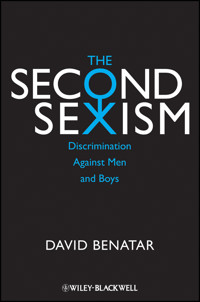
Does sexism against men exist? What it looks like and why we need to take it seriously
This book draws attention to the "second sexism," where it exists, how it works and what it looks like, and responds to those who would deny that it exists. Challenging conventional ways of thinking, it examines controversial issues such as sex-based affirmative action, gender roles, and charges of anti-feminism. The book offers an academically rigorous argument in an accessible style, including the careful use of empirical data, and includes examples and engages in a discussion of how sex discrimination against men and boys also undermines the cause for female equality.
Sie lesen das E-Book in den Legimi-Apps auf:
Seitenzahl: 677
Veröffentlichungsjahr: 2012
Ähnliche




















Contents
Preface
1 Introduction
What Is the Second Sexism?
The First Sexism
Two Kinds of Denialist
Forestalling Some Fallacies
Structure and Method of the Book
2 Male Disadvantage
Conscription and Combat
Violence
Corporal Punishment
Sexual Assault
Circumcision
Education
Family and Other Relationships
Bodily Privacy
Life Expectancy
Imprisonment and Capital Punishment
Conclusion
3 Explaining Male Disadvantage and Thinking about Sex Differences
Beliefs about Males
Questions about the Beliefs
Conclusion
4 From Disadvantage to Wrongful Discrimination
Conscription and Combat
Violence
Corporal Punishment
Sexual Assault
Circumcision
Education
Family and Other Relationships
Bodily Privacy
Life Expectancy
Imprisonment and Capital Punishment
Conclusion
5 Responding to Objections
The Inversion Argument
The Costs-of-Dominance Argument
The Distraction Argument
Defining Discrimination
6 Affirmative Action
Rectifying Injustice
Consequentialist Arguments
Conclusion
7 Conclusion
Does Feminism Discriminate against Men?
Are Men Worse off than Women?
Taking the Second Sexism Seriously
Conclusion
Bibliography
List of Cases
List of Legislation and Other Legal Instruments
Index
This edition first published 2012© 2012 John Wiley & Sons, Inc.
Wiley-Blackwell is an imprint of John Wiley & Sons, formed by the merger of Wiley’s global Scientific, Technical and Medical business with Blackwell Publishing.
Registered OfficeJohn Wiley & Sons Ltd, The Atrium, Southern Gate, Chichester, West Sussex, PO19 8SQ, UK
Editorial Offices350 Main Street, Malden, MA 02148-5020, USA9600 Garsington Road, Oxford, OX4 2DQ, UKThe Atrium, Southern Gate, Chichester, West Sussex, PO19 8SQ, UK
For details of our global editorial offices, for customer services, and for information about how to apply for permission to reuse the copyright material in this book please see our website at www.wiley.com/wiley-blackwell.
The right of David Benatar to be identified as the author of this work has been asserted in accordance with the UK Copyright, Designs and Patents Act 1988.
All rights reserved. No part of this publication may be reproduced, stored in a retrieval system, or transmitted, in any form or by any means, electronic, mechanical, photocopying, recording or otherwise, except as permitted by the UK Copyright, Designs and Patents Act 1988, without the prior permission of the publisher.
Wiley also publishes its books in a variety of electronic formats. Some content that appears in print may not be available in electronic books.
Designations used by companies to distinguish their products are often claimed as trademarks. All brand names and product names used in this book are trade names, service marks, trademarks or registered trademarks of their respective owners. The publisher is not associated with any product or vendor mentioned in this book. This publication is designed to provide accurate and authoritative information in regard to the subject matter covered. It is sold on the understanding that the publisher is not engaged in rendering professional services. If professional advice or other expert assistance is required, the services of a competent professional should be sought.
Library of Congress Cataloging-in-Publication Data
Benatar, David.The second sexism : discrimination against men and boys / David Benatar.p. cm.Includes bibliographical references and index.
ISBN 978-0-470-67446-8 (hardcover : alk. paper) – ISBN 978-0-470-67451-2(pbk. : alk. paper)1. Sex discrimination against men. 2. Men–Psychology. I. Title.HQ1090.B463 2012305.32–dc23
2011038087
A catalogue record for this book is available from the British Library.
To my brothers
Preface
Sexism negatively affects not only women and girls, but also men and boys. While the former manifestation of sexism is widely acknowledged, few people recognize or take seriously the fact that males are the primary victims of many and quite serious forms of sex discrimination. The central purpose of this book is to draw attention to this “second sexism” and to respond to those who would deny that it exists.
It is worth pre-empting the joke that a book about discrimination against males must be a very short book. Although this is a relatively short book, this is not because the scope or seriousness of the problem it discusses is limited. Instead it is (partly) because a longer book is not required to show that there is an extensive and dangerous second sexism.
That said, the book develops, at much greater length, the arguments I advanced in an earlier paper on this topic. The editors of Social Theory and Practice, to which I had submitted that paper, invited four responses. These were published alongside my original article as well as my rejoinder in the April 2003 (vol. 29, no. 2) issue of the journal. I am grateful to the editors of the journal for permission to draw on those earlier papers of mine in writing this book. I also acknowledge the use of material used in Chapter 6 that is drawn but significantly adapted from two other previous works of mine: “Diversity limited,” in Laurence Thomas (ed.), Contemporary Debates in Social Philosophy, Oxford: Blackwell, 2008, pp. 212–225; and “Justice, diversity and racial preference: a critique of affirmative action,” South African Law Journal, 125(2), 2008, pp. 274–306.
The first draft of this book was written while I was a Laurence S. Rockefeller Visiting Fellow at Princeton’s University Center for Human Values for the (northern hemisphere) 2009/2010 academic year. I want to thank the director, faculty and staff of the Center, both for awarding me this fellowship and for making my visit such an agreeable one. I could not have asked for a more stimulating environment in which to conduct my research and do my writing. The Princeton University libraries were also an invaluable resource and I appreciate the assistance provided by the library staff.
My thanks also go to the University of Cape Town for the period of sabbatical leave that enabled me to take up the fellowship and write the book.
Leo Boonzaier, Meghan Finn and Andrew Fisher provided very able research assistance. Jessica du Toit compiled the list of bibliographic references from my endnotes, and detected some typographical errors in the process. I am grateful to have had such excellent assistants.
I presented an overview of the book as the Morris Colloquium Speaker at the University of Colorado at Boulder. At a Laurence S. Rockefeller Fellows Seminar at the University Center for Human Values in Princeton, I presented parts of Chapter 5. In the Admiral Anderson Speaker Series at the United States Naval Academy, I presented the material on women and combat. I am grateful to those who attended these events for their comments.
Kingsley Browne kindly commented on my response (in Chapter 4) to his Co-Ed Combat. He and I still disagree on the question of women in combat, but his critical comments were most welcome. Nannerl Keohane provided helpful written comments on parts of Chapter 5.
I am especially grateful to Don Hubin and Iddo Landau, the two reviewers for Wiley-Blackwell, for their extensive and extremely helpful comments.
Finally, my thanks go to members of my family. The book is dedicated to my brothers.
DBCape Town20 June 2011
1
Introduction
Many men are far more oppressed than many women, and any feminist who was determined to support women in all situations would certainly encounter some where her support of women against men would increase the level of injustice in the world. … No feminist whose concern for women stems from concern for justice in general can ever legitimately allow her only interest to be the advantage of women.
Janet Radcliffe Richards, The Sceptical Feminist, London: Penguin Books, 1994, p. 31.
What Is the Second Sexism?
In those societies in which sex discrimination has been recognized to be wrong, the response to this form of discrimination has targeted those attitudes and practices that (primarily) disadvantage women and girls. At the most, there has been only scant attention to those manifestations of sex discrimination whose primary victims are men and boys.1 What little recognition there has been of discrimination against males2 has very rarely resulted in amelioration. For these reasons, we might refer to discrimination against males as the “second sexism,” to adapt Simone de Beauvoir’s famous phrase.3 The second sexism is the neglected sexism, the sexism that is not taken seriously even by most of those who oppose (or at least claim that they oppose) sex discrimination. This is regrettable not only because of its implications for ongoing discrimination against males but also, as I shall argue later, because discrimination against females cannot fully be addressed without attending to all forms of sexism.
Disadvantage
So unrecognized is the second sexism that the mere mention of it will appear laughable to some. Such people cannot even think of any ways in which males are disadvantaged, and yet some of them are surprised, when provided with examples, that they never thought of these before. Male disadvantages include the absence of immunity, typically enjoyed by females, from conscription into military service. Men, unlike women, are not only conscripted but also sent into combat, where they risk injury, both physical and psychological, and death. Men are also disproportionately the victims of violence in most (but not all) non-combat contexts. For example, most victims of violent crime are male, and men are often (but again not always) specially targeted for mass killing. Males are more likely than females to be subject to corporal punishment. Indeed, sometimes such punishment of females is prohibited, while it is permitted, if not encouraged, for males. Although males are less often victims of sexual assault than are females, the sexual assault of males is typically taken less seriously and is thus even more significantly under-reported. Fathers are less likely than mothers to win custody of their children in the event of divorce. These and other examples will be presented in some, but by no means exhaustive detail, in Chapter 2.
However, demonstrating the existence of male disadvantage is, by itself, insufficient to show that males are the victims of sexism. Not all disadvantages somebody suffers on the basis of his or her sex amount to sexism. By way of illustration, consider the following. The disease called hereditary haemochromatosis is a genetic condition in which the body gradually absorbs too much iron, storing it in major organs. If the condition is not detected in time, serious organ damage and failure can result, often resulting in death. The treatment, if the condition is detected sufficiently early, is regular blood-letting.4 Although both males and females can have this genetic condition, males are more likely to suffer from the resultant disease. This is because females, during their reproductive years, regularly lose blood, and thus iron, during menstruation.5 It thus transpires that menstruation is an advantage for those females with haemochromatosis. But menstruation can also be a disadvantage. Because younger women do lose blood and iron, they are more prone than are men to iron deficiency anemia. Menstruation is thus an advantage for women with haemochromatosis, but a disadvantage for women who are susceptible to iron deficiency anemia. Similarly, the absence of menstruation is a health disadvantage for men with haemochromatosis, but an advantage for men who might otherwise be susceptible to iron deficiency.
The presence or absence of these disadvantages does not demonstrate that males with symptomatic haemochromatosis and females with iron deficiency anemia are the victims of sexism.
Discrimination
To understand the relationship between disadvantage (on the basis of sex) and sexism, there are a number of concepts we need to understand and distinguish. First, we need to distinguish disadvantage from discrimination. The man with haemochromatosis is disadvantaged by not menstruating, but he is not discriminated against. For there to be discrimination the disadvantage must be at least partly the product of agency, or, on some views, of social structures or practices. Thus an individual, an institution or a state might discriminate against people of one sex. Or it might be the case that particular social structures or practices have the effect of favoring one sex over the other. The disadvantage suffered by the man with haemochromatosis is not in itself the product of any of these. For example, nobody forbade or discouraged him from menstruating or removed the uterus he never had, or prevented him from acquiring one.6
We cannot conclude, however, that whenever some disadvantage is experienced as a result of discrimination on the basis of sex that the person suffering the disadvantage is the victim of sexism. This is because discrimination is sometimes entirely appropriate, if not desirable. The word “discrimination” is so often used in its pejorative sense that it is sometimes forgotten that it also has an entirely non-pejorative sense. To discriminate is to recognize a difference or to differentiate. Some discrimination in this sense is both necessary and desirable. Teachers, for example, must discriminate – discern the difference – between good- and bad-quality work submitted by their students. If teachers awarded first-class passes for all work, or failed all work, irrespective of its quality, they would not be acting in an appropriately discriminating way.
Lesen Sie weiter in der vollständigen Ausgabe!
Lesen Sie weiter in der vollständigen Ausgabe!
Lesen Sie weiter in der vollständigen Ausgabe!
Lesen Sie weiter in der vollständigen Ausgabe!
Lesen Sie weiter in der vollständigen Ausgabe!
Lesen Sie weiter in der vollständigen Ausgabe!
Lesen Sie weiter in der vollständigen Ausgabe!
Lesen Sie weiter in der vollständigen Ausgabe!




