


30,99 €
Mehr erfahren.
- Herausgeber: John Wiley & Sons
- Kategorie: Geisteswissenschaft
- Serie: Blackwell History of Russia
- Sprache: Englisch
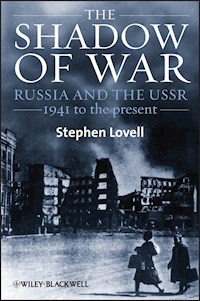
Taking the achievements, ambiguities, and legacies of World War II as a point of departure, The Shadow of War: The Soviet Union and Russia, 1941 to the Present offers a fresh new approach to modern Soviet and Russian history.
- Presents one of the only histories of the Soviet Union and Russia that begins with World War II and goes beyond the Soviet collapse through to the early twenty-first century
- Innovative thematic arrangement and approach allows for insights that are missed in chronological histories
- Draws on a wide range of sources and the very latest research on post-Soviet history, a rapidly developing field
- Supported by further reading, bibliography, maps and illustrations.
Sie lesen das E-Book in den Legimi-Apps auf:
Seitenzahl: 833
Veröffentlichungsjahr: 2011
Ähnliche



















Contents
Illustrations
Series Editor’s Preface
Acknowledgments
Maps
1 Introduction: World War II and the Remaking of the Soviet Union
The War Remembered
After the War: Interpreting Later Soviet History
2 Reform, Reaction, Revolution
Soviet Government and Total War
The Patrimonial Principle of Governance: The Last Years of Stalin
The Succession Problem: Legitimacy without Dictatorship
The Soviet Union as Theocracy: De-Stalinization and After
The Soviet Union as a Democracy
Technocracy and its Limits
Corruption and Governability
Reform to Revolution: Gorbachev and the Collapse
Revolution to Reaction: Yeltsin to Putin
Conclusion
3 From Plan to Market
The Stalinist Economy from War to Peace
The Peasant Question
The Politics of Economic Management
Socialist Markets
Towards Collapse
Kapitalizm
Conclusion
4 Structures of Society
Social Exclusion
Society in Flux
Class and Developed Socialism
Generation and Gender
Reclassing Russia: Society in the Transition
Conclusion: Modernity Manqué ?
5 Public and Private
Stalinist Starting Points
The Rediscovery of the Personal
Building a Soviet Personal Sphere
Policing the Personal
The Late Soviet Period: The Maturation of the Personal Sphere
Post-Soviet Russia: The Hegemony of the Private?
Conclusion: The Personalization of Russia
6 Center and Periphery
Dispersal and Recentralization: The War and After
Geographical Stratification after Stalin
The Rise of the Soviet Regions
Post-Soviet Regionalism
7 National Questions
The War as Crucible of Ethnicity
The National Dimension of De-Stalinization
Modernization and National Consciousness
The Socialist Orient
Being Soviet: A Viable Identity?
Fragmentation and Dispersal
Post-Soviet Nation-building
8 Geopolitical Imperatives
The Postwar Disorder
The Cold War Turns Global
Central and Eastern Europe Revisited
Colonialism Soviet-Style
The Retreat from Empire
Post-Soviet Eurasianism?
Conclusion
9 From Isolationism to Globalization
Xenophobia and Trophy Westernization
After Stalin: The Soviet Union Re-engages the World
The Challenge of Mass Culture
Americanization and After
10 Conclusion: The Second Russian Revolution?
Notes
Guide to Further Reading
Index
The Blackwell History of Russia
General Editor: Simon M. Dixon
This series provides a provocative reinterpretation of fundamental questions in Russian history. Integrating the wave of new scholarship that followed the collapse of the Soviet Union, it focuses on Russia’ s development from the mid-seventeenth century to the present day, exploring the interplay of continuity and change. Volumes in the series demonstrate how new sources of information have reshaped traditional debates and present clear, stimulating overviews for students, scholars and general readers.
Published
Russia’s Age of Serfdom: Russia and the USSR, 1649–1861
Elise Kimerling Wirtschafter
Across the Revolutionary Divide: Russia and the USSR, 1861–1945
Theodore R. Weeks
The Shadow of War: Russia and the USSR, 1941 to the Present
Stephen Lovell
This edition first published 2010 © 2010 Stephen Lovell
Blackwell Publishing was acquired by John Wiley & Sons in February 2007. Blackwell’s publishing program has been merged with Wiley’s global Scientific, Technical, and Medical business to form Wiley-Blackwell.
Registered Office
John Wiley & Sons Ltd, The Atrium, Southern Gate, Chichester, West Sussex, PO19 8SQ, United Kingdom
Editorial Offices
350 Main Street, Malden, MA 02148–5020, USA 9600 Garsington Road, Oxford, OX4 2DQ, UK
The Atrium, Southern Gate, Chichester, West Sussex, PO19 8SQ, UK
For details of our global editorial offices, for customer services, and for information about how to apply for permission to reuse the copyright material in this book please see our website at www.wiley.com/wiley-blackwell.
The right of Stephen Lovell to be identified as the author of this work has been asserted in accordance with the UK Copyright, Designs and Patents Act 1988.
All rights reserved. No part of this publication may be reproduced, stored in a retrieval system, or transmitted, in any form or by any means, electronic, mechanical, photocopying, recording or otherwise, except as permitted by the UK Copyright, Designs and Patents Act 1988, without the prior permission of the publisher.
Wiley also publishes its books in a variety of electronic formats. Some content that appears in print may not be available in electronic books.
Designations used by companies to distinguish their products are often claimed as trademarks. All brand names and product names used in this book are trade names, service marks, trademarks or registered trademarks of their respective owners. The publisher is not associated with any product or vendor mentioned in this book. This publication is designed to provide accurate and authoritative information in regard to the subject matter covered. It is sold on the understanding that the publisher is not engaged in rendering professional services. If professional advice or other expert assistance is required, the services of a competent professional should be sought.
Library of Congress Cataloging-in-Publication Data
Lovell, Stephen, 1972-
The shadow of war: the Soviet Union and Russia, 1941 to the present/Stephen Lovell.
p. cm. – (The Blackwell history of Russia)
Includes bibliographical references and index.
ISBN 978-1-4051-6959-2 (hardcover: alk. paper) – ISBN 978-1-4051-6958-5 (pbk.: alk. paper) 1. Soviet Union–History–1939–1945. 2. World War, 1939–1945–Influence. 3. Soviet Union–History–1925–1953. 4. Soviet Union–History–1953–1985. 5. Soviet Union–History–1985–1991. 6. Russia (Federation)–History–1991-I. Title.
DK266.3.L68 2010 947.085-dc22
2010010020
A catalogue record for this book is available from the British Library.
Illustrations
Maps
Map 1Europe after World War IIMap 2The German assault on the USSRMap 3Administrative divisions in the USSR, 1989Map 4Ethnic groups in the USSR, 1982Map 5Oil and gas pipelines in the USSR, 1982Map 6Ethnic Russians in the former Soviet Republics, 1994Figures
Figure 1.1Stalingrad, summer 1945Figure 1.2Stalin and Zhukov on the Lenin Mausoleum, 1945Figure 1.3A veteran in the schoolroom, 1970sFigure 1.4War memorial, Zvenigorod, west of Moscow, August 2007Figure 2.1Poster “Do Not Babble!” (1941)Figure 2.2Khrushchev in Kuibyshev region, 1958Figure 2.3Gorbachev, Yeltsin and the Kyrgyz president skar Akaev at the 3rd Congress of People’s Deputies, December 1990Figure 2.4Boris Yeltsin speaking in defiance of the coup of August 1991Figure 3.1Peasant girls setting out for the fields, Tver region, 1954Figure 3.2Front cover of satirical magazine Krokodil, no. 33, 1972Figure 3.3“The Komsomol is the Shock Team of the Five-Year Plan” (1969)Figure 3.4Moscow, 1950s: People looking to exchange rooms at the unofficial housing marketFigure 3.5The impact of the shortage economy, Moscow 1991Figure 4.1Party committee meeting at car factory, Ulyanovsk, 1960Figure 4.2A new village in central Russia, 1960: The Khrushchev ideal of rural transformationFigure 4.3The inside of a “sobering-up station” in Cherepovets (Vologda region), 1980Figure 5.1“For the Motherland!” (1943)Figure 5.2A consumer from the Leningrad region tries out the latest model of radio set (the Rodina-47), 1947 or 1948Figure 5.3The interior of a worker’ s apartment, Baku, 1950sFigure 5.4Mass housing overlooked by the Ostankino TV tower (completed 1967)Figure 5.5Postcard “I Love You,” 1950sFigure 6.1Kalinin Prospekt under construction, 1965Figure 6.2Settlement in North Urals, Sverdlovsk region, 1958Figure 6.3Lenin Street, central Magadan, 2007Figure 7.1Tallinn, 1947: An early postwar song festivalFigure 7.2A new city in Uzbekistan, 1968Figure 7.3Muslim veterans of World War II at Friday prayers, Moscow 1999Figure 8.1Fidel Castro with Khrushchev on the Lenin Mausoleum, 1963Figure 9.1Krokodil cartoon, “What People Find Most Striking” (1961)Figure 9.2An African visitor to the World Youth Festival, Moscow 1957Figure 9.3Khrushchev and Nixon give a press conference at the American National Exhibition, Moscow 1959Figure 9.4Advertisement for Stolichnaya vodka, 1978Series Editor’s Preface
In this final volume in the Blackwell History of Russia, Stephen Lovell brilliantly exemplifies the aims of the series as a whole. By integrating well-known information with new approaches stimulated by discoveries in previously inaccessible archives, he presents a fresh synthesis, studded with original insight. By opening his analysis in 1941 and taking it beyond the collapse of the USSR 50 years later, he adopts an unconventional chronological framework that allows familiar material to be interpreted in unfamiliar ways. And by telling the story of the emergent Russian Federation from the point of view of a contemporary historian, rather than from the perspective of the political scientists who have hitherto dominated the subject, he crosses not only a significant chronological divide, but also a disciplinary one.
As Lovell explains, one reason why historians have been slow to make the leap into recent decades has lain in a lack of the sorts of evidence on which they customarily rely. It is a striking contribution of his book to reveal how much such evidence is nevertheless now available to the researcher. Another deterrent to contemporary history has been the longstanding obsession with the inter-war years shared by many undergraduate students of “twentieth-century” Europe. It is true that the history of European integration can sometimes seem insipid by comparison with that of the Europe of the dictators. But in Russia there is no reason to think the latter part of the twentieth century uneventful. And the extraordinary developments of 1989–91 and beyond are scarcely comprehensible without an understanding of the Khrushchev and Brezhnev years (the latter, it transpires, being far from the “era of stagnation” of popular myth). A further virtue of this attractively written book, therefore, is to bring to a wider readership the fruits of the growing body of scholarship – in Russian and other languages – devoted to the period between 1953 and 1991.
The Utopian fervor with which the party leadership tried to revivify the revolutionary tradition after Stalin’s death was matched only by romantic hopes for the regeneration of communism in the late 1980s under Gorbachev – Khrushchev redivivus in the eyes of many. However, this is not a book concerned only with ideology and high politics, and Lovell is properly skeptical of the temptation to divide Soviet and post-Soviet history into periods bounded by the tenures of successive political leaders. Stalinist coercion is a crucial part of his account, but he is just as interested in the destabilizing effects of its sudden relaxation. Moreover, now that historians no longer instinctively conceive social activity in Russia solely in terms of resistance to a repressive, centralized state, there is room not only to investigate the more “normal” contours of everyday life – housing, shopping, work, and leisure – but also to consider its kaleidoscopic variety in the thousands of provincial villages and towns that make up the multi-national Russian polity. Quite what has defined the boundaries of the “normal” in Russia and the Soviet Union is one of Lovell’s major concerns. He has particularly revealing things to say about the formation, by the 1960s, of a distinctive “personal sphere,” whose boundaries were significantly extended after the collapse of the USSR. Religion, gender, and culture (in its widest sense) are all more prominent in the writings of the current generation of scholars than they were in the work of their more materialist predecessors. So they are here. The author’s deep immersion in twentieth-century films and print culture gives him an especially acute sense of what makes Russians tick, what makes them laugh, and how far they have come into contact (and conflict) with Western values. This new cultural emphasis is not to say that hard economics can be ignored in an era in which energy resources have been increasingly crucial to the state’s balance of trade. However, the key contribution of Lovell’s book is not so much to isolate themes for discussion as to explore the connections between them. Economic questions are shown to be inseparable from domestic politics, and both are inextricably linked to the international order shaped by the outcome of the Second World War.
It is that war and its multiple legacies that give Stephen Lovell’s book its distinctive interpretative thrust. On the one hand, victory over fascism was crucial to “the re-launch of the Soviet project” in the 1950s and to the maintenance of both “inner” and “outer empires” until the end of the 1980s. On the other hand, the sacrifices made by the Soviet population in the Great Patriotic War cast a shadow over almost every aspect of the USSR for the remainder of its existence, from its command siege-economy to the best-selling war novels of Iurii Bondarev. A sense of geopolitical vulnerability haunts the Kremlin still. The uneasy balance between menace and opportunity bequeathed by the Second World War is set out in the Introduction and developed in a series of thematic chapters that combine the author’s nose for telling detail with his aptitude for aphoristic generalization. The result is a book like no other. Unique in its combination of accessibility and sophistication, it helps us to see 70 years of Russian and Soviet history with a completely fresh eye. There could be no better way to end the series.
Simon Dixon
UCL SSEES
Acknowledgments
In preparing this book I have had to rely even more than usual on the expertise of various sympathetic colleagues. A nizkii poklon (low doffing of cap) to the people who read sprawling chapter drafts and helped me to fix at least some of their shortcomings: Nick Baron, Donald Filtzer, Yoram Gorlizki, Anne Gorsuch, Catriona Kelly, Kristin Roth-Ey and Kristina Spohr Readman. I also thank warmly the two anonymous readers of the full manuscript.
The most sympathetic colleague of all has proved to be Simon Dixon, the mastermind of this Blackwell series, who has been an unfailing source of good sense and encouragement (and, latterly, of close reading). He has been matched every step of the way by the excellent Tessa Harvey and Gillian Kane at Wiley-Blackwell.
I once more acknowledge the invaluable support of the Leverhulme Trust, whose award of a Philip Leverhulme Prize enabled me to spend half a year making headway with the reading for this book.
Finally, I thank King’s College London, and in particular its Department of History, for providing such a congenial home over the past eight years. My colleagues will be skeptical, but I suspect a few conversations in the Strand building – whether in the prison cells of the third floor or the sun-drenched utopia on the eighth that we now inhabit – have found their way into this book.
MAP 1 Europe after World War II.
MAP 2 The German assault on the USSR.
MAP 3 Administrative divisions in the USSR, 1989. As well as the 15 union republics, this map highlights several of the cities, autonomous republics, okrugs and “territories” (krais) that are mentioned in this book.
MAP 4 Ethnic groups in the USSR, 1982.
MAP 5 Oil and gas pipelines in the USSR, 1982.
MAP 6 Ethnic Russians in the former Soviet Republics, 1994.
1
Introduction: World War II and the Remaking of the Soviet Union
No foreigner needs to spend too much time in Russia to discover how central the war remains to how Russians see themselves even in the early twenty-first century. Most long-term visitors to Russia (whether Soviet or post-Soviet) will have been lectured at some stage on the failure of the Western allies to open a second front before 1944. Hedrick Smith, the highly informative New York Times correspondent in Moscow in the mid-1970s, caught the enormous outpouring of war commemoration on the thirtieth anniversary of victory: in his acclaimed The Russians he subtitled one of the chapters “World War II was only yesterday.” At the same time there were some war-related topics on which Russians were less eager to hold forth: the volte-face in Soviet foreign policy that made Stalin an ally of Hitler between August 1939 and June 1941, the actions of the Soviet political police in Poland and the Baltic states, the extent of wartime cooperation between the USSR and the West (and the extent of Western aid through Lend-Lease).
Opinion polls of the post-Soviet era have consistently placed the Great Patriotic War at the top of Russians’ list of defining historical moments. The October Revolution, by contrast, is now almost an irrelevance. This is not because Russians have abnormally short memories. Rather, it is because the prewar era is too complex and divisive to serve the purpose of historical myth. It is now fast becoming a cliché of Russian textbooks and public discourse to refer to the 1930s as a “complex and tragic era,” as if it is futile even to attempt to establish human agency in the deaths of millions of people. Russia has never had a true moral reckoning with the catastrophes of collectivization and terror, and by now there are reasons to doubt that it ever will.
Another reason why the war scores so highly in the popular consciousness is that its other main rival as a historical milestone, the collapse of the Soviet Union, is not – to put it mildly – seen as an unmixed blessing. Even Russians with no great love of one-party socialism are likely to abhor the way in which the removal of Communist dictatorship led directly to the neglect of Russia’ s national interests and the florescence of crony capitalism.
FIGURE 1.1 Stalingrad, summer 1945.
Source: © Mark Redkin/PhotoSoyuz.
But the prominence of the war in contemporary Russia is not due primarily to the lack of suitable alternative historical markers. It matters in absolute, not relative, terms. It cost the Soviet Union almost 30 million people: somewhere between 24 and 27 million premature deaths and the best part of 3 million other Soviet citizens who were displaced by the war and never returned to the USSR. If further account is taken of the wartime birth deficit, losses may run as high as 35 million. The Soviet population figure at the start of the war – 200 million – was not reached again until 1956.1
Many of the previously most developed parts of the country lay in ruins. Capital losses amounted to about 30 percent of national wealth. War damage had destroyed or disabled close to 32,000 industrial enterprises, 65,000 kilometers of railway, and housing for 25 million people. Infrastructure had all but collapsed. At the end of war, 90 percent of Moscow’ s central heating and around half of water and sewage systems were out of action, while 80 percent of roofs required urgent repairs. Despite the Soviet victory, much of the population endured unimaginable hardship. Household consumption fell from 74 percent of national income in 1940 to 66 percent of a significantly reduced national income in 1945. In 1945, the average peasant on a collective farm received 190 grams of grain and 70 grams of potatoes for a day’ s work. In 1946–7, acute postwar scarcity, compounded by harvest failure and the government’s commitment to industrial reconstruction, brought what turned out to be the last Soviet famine, whose death toll was at least 1 million and possibly a good deal higher.2
The war brought not only death, devastation and hunger but mass displacement and upheaval. During the war, the enemy occupied territory with a prewar population of 85 million (or 45 percent of the total Soviet population). Millions of people were displaced by the German advance. Around 15 million more were moved to the rear in 1941–2; by the end of 1942, more than half of workers and employees in Kazakhstan, one of the principal destinations, were evacuees. An industrial evacuation effort of unprecedented scale and speed was launched within days of the German invasion. In the critical early months of the war hundreds of large factories were relocated – the greatest proportion to the Urals, others to the Volga region, Western Siberia, Eastern Siberia, and Central Asia. Without the evacuated facilities, which included some of the crown jewels of the Soviet defense sector, the war effort would have been all but doomed. Two-thirds of prewar ammunition production, for example, had taken place on territory that would be occupied or wrecked by the enemy. The evacuation of Leningrad’s all important Kirov tank factory had to be completed in late 1941 by air after the city had been isolated by German forces.3
At the end of the war 11.4 million men in the armed forces had to find their way home somehow. Demobilization was a gradual process, but the vast numbers placed immense strain on Soviet society and infrastructure: about 3.5 million men had returned to civilian life by September 1945, 8.5 million by 1948. And then there were the captured enemy combatants. According to the Soviet General Staff, the Soviet Army took 4,377,300 prisoners between 22 June 1941 and 8 May 1945; at the end of June 1945, the Ministry of Internal Affairs gave a figure of 2 million prisoners taken in 1945 alone. Nearly 700,000 Germans from the combat zone were sent home immediately at the end of the war, as were 65,000 Japanese. Thereafter, repatriation would be a slow process that ended only in spring 1950. German prisoners convicted of specific crimes were allowed home only in 1956.
Lesen Sie weiter in der vollständigen Ausgabe!
Lesen Sie weiter in der vollständigen Ausgabe!
Lesen Sie weiter in der vollständigen Ausgabe!
Lesen Sie weiter in der vollständigen Ausgabe!
Lesen Sie weiter in der vollständigen Ausgabe!
Lesen Sie weiter in der vollständigen Ausgabe!
Lesen Sie weiter in der vollständigen Ausgabe!
Lesen Sie weiter in der vollständigen Ausgabe!
Lesen Sie weiter in der vollständigen Ausgabe!
Lesen Sie weiter in der vollständigen Ausgabe!
Lesen Sie weiter in der vollständigen Ausgabe!
Lesen Sie weiter in der vollständigen Ausgabe!




