


8,49 €
Mehr erfahren.
- Herausgeber: The History Press
- Kategorie: Geisteswissenschaft
- Sprache: Englisch
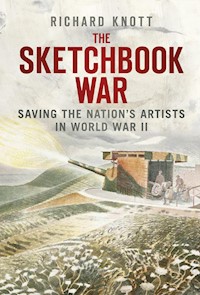
During the Second World War, British artists produced over 6,000 works of war art, the result of a government scheme partly designed to prevent the artists being killed. This book tells the story of nine courageous war artists who ventured closer to the front line than any others in their profession. Edward Ardizzone, Edward Bawden, Barnett Freedman, Anthony Gross, Thomas Hennell, Eric Ravilious, Albert Richards, Richard Seddon and John Worsley all travelled abroad into the dangers of war to chronicle events by painting them. They formed a close bond, yet two were torpedoed, two were taken prisoner and three died, two in 1945 when peacetime was at hand. Men who had previously made a comfortable living painting in studios were transformed by military uniforms and experiences that were to shape the rest of their lives, and their work significantly influenced the way in which we view war today. Portraying how war and art came together in a moving and dramatic way, and incorporating vivid examples of their paintings, this is the true story behind the war artists who fought, lived and died for their art on the front line of the Second World War.
Das E-Book können Sie in Legimi-Apps oder einer beliebigen App lesen, die das folgende Format unterstützen:
Veröffentlichungsjahr: 2013
Ähnliche



















‘Oh, but you should be an artist. I had one with my squadron during the last war, for weeks – until we went up the line.’
Evelyn Waugh: Brideshead Revisited
Acknowledgements
There are many people whom I should thank for their help in writing this book. I am particularly grateful to Christianna Clemence, Edward Ardizzone’s daughter, and his grandson, Tim Ardizzone, for so willingly loaning me correspondence and photographs, as well as being so generous with their time. Mrs Anne Ullmann, the daughter of Eric Ravilious, has also been very supportive and helpful. Vincent Freedman, Barnett Freedman’s son, has been most generous, allowing me to make use of the extensive Barnett Freedman archive at Manchester Metropolitan University. Jean-Pierre Gross and his sister Mary West have been very helpful and allowed me to include photographs of their father. Mary West also kindly sent me the letter which Edward Bawden wrote to her with his fond memories of Anthony Gross, written in 1987. My thanks are also due to the Estate of Edward Bawden for permission to quote from the artist’s letters.
The Special Collections Archivist at Manchester Metropolitan University, Jeremy Parrett, has been extremely helpful in guiding me through the Freedman archive and providing me with a number of photographs. Dr Laura MacCulloch (Curator of British Art, National Museums, Liverpool) has also been a valuable guide. I am also grateful to Sara Bevan at the Imperial War Museum and Colin Simpson, Principal Museums Officer, at the Williamson Gallery, Birkenhead. In addition, I would like to thank the following: Fran Baker, Bruce Beatty, Ronald Blythe, Julie Brown (Towner Gallery, Eastbourne), Ged Clarke, Stephen Courtney (Curator of Photographs, National Museum of the Royal Navy), Betty Elzea, Colin Gale (Archives and Museum, Bethlem Royal Hospital), Hannah Hawksworth (The Royal Watercolour Society), Simon Lawrence (at the Fleece Press), Polly Loxton, Michael MacLeod and Peyton Skipwith.
The following institutions have also been useful in the writing of this book: The British Library, both in London and Boston Spa, Yorkshire, The British Library Sound Archive, The Royal Watercolour Society, The Higgins Art Gallery and Museum, Bedford, the National Museum of the Royal Navy, The Henry Moore Foundation, The Ministry of Defence Art Collection, The Imperial War Museum, The National Archives, Regen-Williamson Art Gallery, Birkenhead, The Walker Gallery, Liverpool, and The Towner Gallery, Eastbourne. I should also like to thank my commissioning editor at The History Press, Jo de Vries, for her enthusiasm for this project.
My wife Vanessa has, as always, been an invaluable and generous confidante in the writing of this book. I am most grateful to her.
Every effort has been made to contact copyright holders. It has not been possible, however, to trace the copyright holders of all the photographs contained in the book and I would be pleased to hear from any copyright holder via the publisher.
Finally, I would like to apologise for any errors I have made in telling this story of my nine war artists. I hope that the great regard I have for them all outweighs any inadvertent mishaps or inaccuracies.
Contents
Title
Quote
Acknowledgements
Introduction
1.
The Secret List
2.
3 September 1939
3.
The Sifting of Names
4.
War Drawings? Theatre of War?
5.
A Cold and Phoney War
6.
Old Battle Ground
7.
Of Scapa Flow and Rearguard Defences
8.
Exhibition, 1940
9.
No One Can Settle to a Work of Art
10.
Out of the Blue
11.
The Lion’s Mouth
12.
‘You’re Never There When We Need You!’
13.
‘Please File in Larger Provincial Galleries File’
14.
The War Artist’s Dummy
15.
D-Day
16.
Foxholes and Calvados
17.
The Last Winter of the War
18.
The File Marked ‘Hennell’
19.
By Way of Goodbye
20.
Starting Over
Appendix A: Bibliography
Appendix B: Locations of the War Artists in The Sketchbook War
Appendix C: The Paintings in The Sketchbook War
Appendix D: Photographs
Appendix E: The Colour Illustrations
Plates
Copyright
Introduction
I first learned about the vast treasury of war artists’ work by the luckiest of chances. I was trying to track down the whereabouts of a painting by R. Vivian Pitchforth which he had completed in the middle of the war. It was of seven white Sunderland flying boats in Plymouth in 1942: it was striking and evocative – and yet I knew nothing about Vivian Pitchforth. Then, to my surprise, I found that the original was in the possession of Bendigo Art Gallery in Victoria, Australia. Not in Plymouth. I wanted to know why.
That was the start of it all − I became fascinated by the kind of life war artists led, and particularly what it was like for those of them who were nearest to combat. That led me to a whole series of related questions. Who were these artists? Who chose them? How dangerous was such a life? How close to combat did they get? What did the ordinary soldier and airmen think of them? What was it like to sketch in the midst of shellfire and mayhem? Did they carry guns, or simply cling on to pencil and sketchbook? Why did three artists lose their lives? What were they like as men – were they set apart somehow, or indistinguishable from those fighting beside them? Later, as I discovered more about the nation’s war artists, I realised that there was a story to be told about Sir Kenneth Clark of the War Artists’ Advisory Committee and his flawed plan to keep artists alive during the war, and the extent to which it failed.
In writing The Sketchbook War I have consulted relevant files at the Imperial War Museum, National Archives, Manchester Metropolitan University, Sheffield Local Studies Library and Archive, and the Walker Gallery in Liverpool, as well as the letters of the participants and their published accounts. I spent many hours listening to the taped recordings of interviews conducted with those who survived the war. Held by the Imperial War Museum, they are a wonderful resource and have allowed me to gain a privileged insight into the characters of each of them. Listening to them reminisce in relative old age about the war years proved inspiring – somehow hearing the mischief in Edward Ardizzone’s voice as he uncovers the past, for example, brought me much closer to an understanding of the man himself. It was strange to hear ‘my’ artists coughing, breaking off for a cigarette, laughing at some prank long ago, drinking tea (tea cups clinking in the background), admitting to fading memory, or struggling with becoming hard of hearing. Such human foibles rendered them even more real than might have been the case with measured prose in a plain journal.
Occasionally, in telling the story, I have allowed myself a certain amount of writers’ licence, but even those forays into the imaginative hinterland are securely rooted in fact. A valuable additional source of material has been the paintings themselves. At certain points in telling the story, I have turned to the artists’ paintings and sketches. For example, early in the book there is a description of Henry Moore swimming off the south coast on the day war broke out. That painting – 3rd September 1939 – I saw at an exhibition at Leeds City Gallery; I was very moved by it – the stark coming together of a blue late summer’s day and the looming blood-filled threat of war − and knew that I wanted Moore’s perspective on that September day to be the first sight of the war the reader gets. Each time a war artist sketched the war as he or she saw it, it added to the pictorial record of those six tragic years. I was grateful too for the way that the sum total of a war artist’s work, with its sequence of dates and locations, provides a different kind of diary or journal. I liked the way I could ‘read’ such an account, and follow an artist through their war experience by looking closely at what they had painted, canvas by canvas. I have listed those particular paintings which figure in the text at Appendix C.
1
The Secret List
It is a summer Sunday in September 1939, a few weeks after Chamberlain had announced that the country was at war with Germany. The scene – not a typical one for this book – is a large country house in the Berkshire Downs. There has been a lunch party hosted by the local MP, Sir Ralph Glyn. John Betjeman and his wife have breezed over from Uffington. Lord and Lady Esher and Sir Kenneth Clark and his wife, Jane, are there. The weather has been kind enough for them to take a post-luncheon stroll around the grounds. Perhaps there is something about the late summer sun glowing on the red brick of Ardington House, or the wisps of white cloud in a blue sky; the bleached yellow of post-harvest cornfields, and the fading greens of the garden. At all events, the conversation turns to art. And the war, of course …
Inevitably, they see the new war in the light of the old conflict two decades before; bowed heads are shaken over ‘the destruction of the flower of a European generation’ and the loss in particular of artistic talent. Lord Esher, it is, who suggests ‘a secret list of the most promising artists and writers of military age and to ask the government to steer them, with equal secrecy, into safe war jobs.’ There is much nodding and Betjeman agrees to begin the task of putting a list of names together. When the lunch party breaks up and the guests’ cars sweep away up the gravelled drive, the plan has been hatched. Lulled by a good lunch and the beauty of an English garden, they were intent on saving the nations’ artists, if uncertain as to whose names might appear on the list and how it might be put together.
There were disagreements as to whether the ‘secret lists’ should include writers, musicians, even scientists and economists, amongst others. But the greatest conviction and momentum was behind the scheme for artists and designers. The ‘plan to save the nation’s artists’ emerged through the autumn of 1939 and, remarkably, by the end of the war, British war artists had produced some 6,000 works of art: paintings in oil, watercolours, sculpture, drawings and sketches.
The Sketchbook War focuses on nine war artists: Edward Ardizzone, Edward Bawden, Barnett Freedman, Anthony Gross, Thomas Hennell, Eric Ravilious, Albert Richards, Richard Seddon and John Worsley. The principal reason for this choice – a not so secret list − is that each of them was much closer to the front than the majority − they all went abroad; many of them approached the front line; they heard guns firing in earnest; two were torpedoed; two were taken prisoner; and three died, two of them in 1945, the last year of the war.
This is a book about artists, rather than art itself. It tells how the artists’ way of life and temperament came up against the grinding and relentless nature of warfare. If in the months before 1939 you saw yourself as an artist, focused on a career with no room for the prospect of war, how did you manage with the transformation to artist in military uniform? The artists in this story show courage, tenacity, inventiveness, and persistence. They are transported overseas; battle with fresh demands on technique, weather, illness, discomfort and hardship; value freedom and their own abilities; keep the world of the non-artist at bay; and, finally, survive, or lose their lives in the most tragic of circumstances. For all of them it was clear that the war artist shared with the war photographer the uncomfortable truth articulated by Robert Capa: ‘“If your pictures aren’t good enough,” he was fond of saying, “that’s because you’re not close enough”.’
2
3 September 1939
Henry Moore lay on his back, floating, looking up at the blue of the sky, imagining the shadows cast by the legions of German bombers, when, as the phrase went, ‘the balloon went up.’ The water was warmer than he had thought and, on another occasion, he might have felt buoyed by a sense of peace. Lifting his head, he could see the cliffs, stern and white, beetling above the pebbled beach where his pile of clothes lay crumpled: this was Shakespeare Cliffs near Dover. He had a dim memory of lines from King Lear: the blind Gloucester brought to the teetering edge where, could he but see, the view was of the beach far below, then the English Channel, and, in the distance, France, a smudge on the horizon on a clear day like this. Irina, Henry’s Russian-born wife, was swimming close by. He noted her white skin and bony back; her yellow bathing cap rising and falling in the white-topped blue of the water. In that moment, Henry could see into a blood-red future: Chamberlain’s and Hitler’s war on the point of beginning, with who knew what end. On cue, the distant wail of an air raid siren – the first of the war − drifted across the water.
Later artist now – not swimmer – Moore would capture the moment, turning the late summer idyll into a grim foretaste of things to come. The cliffs would acquire a red tinge; the sea would turn thick and red as blood; and he would draw eight stiff-backed women bobbing like corks in the water, wearing gasmasks and expressions of desperate anguish as they looked, with trepidation, to the east.
This sketch, a mix of pencil, wax crayon, chalk, water colour and pen and ink – just 12 inches by 15¾ inches − marked two moments: the first war art of the 1939–1945 conflict; and the end of a world where artists could expect to make a tolerable living from their work; where paintings sold, dealers flourished and galleries stayed open. From that hot September day in 1939, the war would ensure that nothing would stay the same. Moore, in common with most artists, foresaw increasing difficulties with work – he worried about his ability to focus on anything meaningful in such a febrile atmosphere. Having been in the trenches in the 1914–1918 war, he hoped that this time he would be able to do something more constructive than enduring the mayhem and bloodshed at the front.
Early in October 1939, Moore wrote to the Director of the National Gallery in London, Sir Kenneth Clark: ‘I hate intensely all that Fascism and Nazism stand for and if it should win it might be the end in Europe of all the painting, sculpture, music, architecture, literature which we all believe in …’1 Underlying the worthy sentiments was a question which Moore contemplated in common with other artists: what should artists do in wartime? Just then, however, Clark was preoccupied with seeing ‘that the National Gallery pictures were in safety’2 and was looking for a suitably protected site in the United Kingdom to store them. Soon there was an exodus of great canvases to Wales, to be entombed in ‘a vast, abandoned slate quarry … not far from the hellish town of Blaenau Festiniog.’ Clark had overseen a rehearsal for such an event the previous year: ‘The Gallery was shut, the rooms were empty, the remaining pictures were standing all around and the man came in and said that Munich had taken place.’3 Back then, with the crisis over, the plans could be put away with a huge sigh of relief. This time, though, it was for real. Indeed, ‘the National Gallery was able to complete the move of nearly all of its collection of 2,000 paintings by the evening of the 2nd September.’4 War started the next day, with sirens and a first blackout.
Within months Sir Kenneth Clark found himself at the Ministry of Information, cast in the unlikely role of the head of the film division. He believed it was because ‘in those days films were spoken of as “pictures”, and I was believed to be an authority on pictures.’5 He did not take the post too seriously. Clark was young – thirty-six in 1939, the same age as some of the artists he would later commission – tall and thin, with a patrician glint in his eye and an oily sheen to his hair. As well as the survival and wellbeing of the gallery’s paintings, he was also increasingly concerned about what happened to artists in wartime. The issue was raised again by Lord Esher, who had been party to the discussion on the issue at the luncheon date at Ardington House on the downs in September. Clark replied: ‘The work I am doing on behalf of artists seems to have been exaggerated. I am nothing more than a member of two committees which the Ministry of Labour has appointed to draw up lists of artists for the Central Register.’6 The present focus, Clark wrote, was camouflage and propaganda; nothing more. He proposed ‘a fresh committee constructed on rather broader lines’. Its focus should be to ‘make a record of the war’.
With the benefit of hindsight, when the war was over, Clark claimed that his principal aim had been to ‘keep artists at work on any pretext, and, as far as possible, to prevent them being killed.’7 He believed that his ‘only worthwhile activity’ during the war period was the War Artists’ Advisory Committee (WAAC) which he was instrumental in setting up and subsequently chaired. As a result thirty-seven war artists were eventually given full time salaried contracts, while literally hundreds of others were given commissions of varying lengths. Most artists found themselves on the Home Front, drawing ruins, ships in dock, families sheltering in the London Underground while the bombs fell above them, portraits of officers and men, women armament workers, barrage balloons – the war as the citizens suffered it. Others, though, were despatched abroad. Nothing was sure in that bleak time, least of all the prospects for those artists who were in uniform and had left the UK to observe the war at close quarters. The enemy did not distinguish between men with rifles in their hands, or just sketchbooks and pencils.
The initial proposal to the Ministry of Information by Clark was made on 29 August and finally approved on 7 November, and the WAAC met for the first time on the afternoon of 23 November 1939, in the old board room of the National Gallery. High ceilings above them; good intentions around the table. It was the first of many meetings – all of which were deemed ‘secret’ − and the sifting of suitable artists’ names began the following week. The committee met 197 times in all, a remarkable average of nearly three times a month for the duration of the war. Mindful of its responsibilities, it was uncertain about where its work would lead. How could they know what lay ahead?
There were some key principles, however, some of which were articulated by Esher in a letter to Oliver Stanley, Secretary of State for War, on 20 February 1940: ‘The artists should be unaware of what was being done to save them … there should be no demand to release these men from military service, but only that they should be used for work of comparative safety.’ The final principle was that selection should be left to ‘competent and distinguished judges’. For its part the committee was insistent ‘that the artist should always have seen what he painted’. The basic purpose was clear too: to make ‘an artistic record of the war in all its aspects’. But how it would work and evolve in practice was less clear-cut. Equally uncertain were the selection criteria, although some judgements were fixed early on: abstract artists were deemed inappropriate – Ben Nicholson’s name, for example, was marked ‘No recommendation’ on the artist’s index card. The first ‘sifting of names’ looked at 504 artists and 800 were considered in the first sixteen weeks.
Notes
1The Life of Henry Moore by Roger Berthoud, page 168.
2The Other Half by Kenneth Clark, page 1. Later, in mid-1940, there would be talk of despatching them to Canada; Clark disapproved and elicited the Prime Minister’s backing. Churchill was typically forthright: ‘Bury them in the bowels of the earth, but not a picture shall leave this island, WSC.’
3 Ibid., page 5; also recorded interview, Imperial War Museum (IWM) Sound Archives, 4778/02.
4The National Gallery’s Role and its Influence on Regional Museums in World War 2 by Catherine Pearson, page 1.
5 Clark, page 10.
6The Plot to Save Artists by Lionel Esher, in The Times Literary Supplement, 2 January 1987.
7 Clark, page 22.
3
The Sifting of Names
Outside, London fog swirled on a late November afternoon. Inside, in the National Gallery’s board room, Sir Kenneth Clark presided over a meeting of the WAAC. As the light faded, the ritual of the blackout arrangements was completed, shutting out the remains of the day. Clark sat stiff-backed and expectant as he looked round at the familiar faces. Seated strategically nearby was the committee’s secretary, E.M. O’R. Dickey, whom he had known before the war. Thoroughly good chap, art lover, been a bit of a painter, worked with the Board of Education, ‘so he really knew a great deal of how to work with these funny people.’1 Around the table were the ‘competent and distinguished judges’ – artists with enough establishment pedigree to pass muster: Muirhead Bone, Walter Russell, and Percy Jowett, the principal of the Royal College of Art. Nearby was the Home Office representative, T.B. Braund.
Completing the group were the representatives of the armed services whose presence was designed to keep the committee grounded and focused. There was Colin Coote, an old friend of Clark’s from peacetime, whose credentials as an art lover were sound enough. With an army background, he was the War Office’s point man, his CV boasting a First World War DSO and a spell as a member of parliament. Clark had been to school with the Admiralty’s R.M.Y. Gleadowe and he was unconvinced by him, while the RAF’s William Hildred gave the distinct impression of having his mind on greater things.
Hildred’s previous work had involved civil aviation and a period at the Treasury. He had firm views on the art he liked − and didn’t like. In January 1940 he was to give cautious, sniffy approval for two artists to be attached to the Royal Air Force. ‘I think therefore,’ he wrote, ‘we ought to ask the Treasury for sanction forthwith to the appointment… to be paid for from Air Votes at a salary of £650 per annum inclusive.’2 He was, however, unconvinced by both nominees, Paul Nash and Edward Bawden, thinking them both ‘a bit leftist’. Moreover, he didn’t much like Bawden’s work. The Permanent Under Secretary agreed. Nevertheless Hildred recognised that he was a guardian of the RAF’s status and appearances must be maintained: ‘The Minister would not be agreeable to the Admiralty and War Office having accredited war artists and the Air Ministry not being in the same position.’3
***
Henry Moore went swimming that September Sunday when war broke out. Albert Richards, a student at the Wallasey School of Art, heard Chamberlain’s speech declaring war while he was drinking Horlicks in a Lyons Corner House overlooking Westminster Bridge. He ‘went pale … [was] shocked, expecting imminent bombing.’4 Not yet twenty, he will have wondered what the declaration of war meant for his anticipated studentship at the Royal College of Art (RCA) in London – and what happened to artists in wartime. He was not alone. The respected painter, designer and wood engraver Eric Ravilious cycled from Castle Hedingham in Essex over to neighbours that day for a cup of tea. The war was the only topic of conversation. That same day he signed up for a part-time post (at 15s a week), monitoring German aircraft on behalf of the Royal Observer Corps.5 He was on duty in the early hours of the following morning and worked all hours of the day and night thereafter, conscious that German bombers bound for London could well fly over Castle Hedingham.
While William Hildred was fretting over the prospect of Edward Bawden as one of the RAF’s war artists, Bawden himself was reflecting on what a war artist scheme might look like. He was sure there would be such a thing, just as there had been in the Great War. Now thirty-six – the same age as Kenneth Clark − he had been too young to be caught up in the fighting on the Western Front. Now he contemplated what this new conflict might have in store for him. On 9 September, he wrote to his friend Eric Ravilious inquiring, ‘What part do you intend to play in the general mess?’6 He sent his friend some useful addresses for obtaining wartime camouflage and propaganda work. His own first thought had been to work in the field of camouflage. He wrote to Clark in the hope that something more fulfilling than that might be possible. ‘Don’t get tied up with camouflage!’ was Clark’s advice. Clark was not always consistent. At much the same time he wrote: ‘Camouflage has got an advantage over propaganda … it is sufficiently remote from a painter’s normal activity not to have a bad effect on it.’7
***
The committee began its difficult task of identifying names. Some were all too readily rejected – James Boswell and Clive Branson’s links with the Communist Party were enough to see them summarily ruled out. But as for the rest, who should end with a neat, approving tick alongside their name, and a formal letter of invitation?
‘Let’s make a start, gentlemen. Could we discuss Edward Bawden?’
‘There is an ascetic quality about him. He is tall, slim and courteous, with a disabling shyness, despite the fact that his career is well established. They say that, as a student at the Royal College, he “couldn’t bring himself to enter shops or ride on buses” – so he walked everywhere.8 He is a man well equipped for self-reliance: vegetarian; doesn’t drive, or even own a car; has never possessed a camera; spurns the telephone. He seems deeply content with his own company. He has the talent and the discipline for the role in my view …’
Edward Bawden was born on 10 March 1903 at Braintree, Essex, the son of an ironmonger. A self-contained man, Bawden had been a solitary, self-sufficient boy, flitting here and there with butterfly net and art materials. As an adult, he was scathing about Braintree, indeed he thought it merited bombing, and apologetic about his own boyhood – the ‘Sissy Years’, he would have entitled that chapter of his (unwritten) autobiography. Braintree High School he hated and he made his dislike evident: he was ‘badly behaved, rebellious and unpopular’.9 Later, he went to the Friends’ School at Saffron Walden and Cambridge Municipal Art School, before winning a £60 per annum scholarship to the RCA.
Bawden’s contemporaries at the Royal College included Henry Moore and Vivian Pitchforth – two future war artists – as well as Eric Ravilious and Douglas Percy Bliss, who became Bawden’s inseparable friends. From 1925, Bawden, Bliss and Ravilious lived together in London’s West Kensington. Bliss remembered the ‘gravy-coloured sitting rooms’.10 Bawden thought Ravilious ‘a bit of a layabout’, but they were very close, despite their differences: Bawden found women scary; avoided drink and cigarettes; newspapers and films too. Life-drawing unsettled him; oil painting was virtually taboo – he hated the smell of turps, wrinkling his nose in distaste. He took the view that ‘oil paint was prose, and watercolour poetry’. The two were close friends, but did not agree on everything: Bawden, for example, regarded reading as a means of learning about the world, while to Ravilious it was a leisure pursuit – for fun. Bawden was ‘one of those melancholy people to whom laughter is medicine … He had never been to a football match, to Lords, to Wimbledon.’11
A painting by Ravilious of Bawden working in his studio, in 1927, shows a straight-backed Bawden at his easel, all shyness forgotten in the intensity of his concentration, paints and brushes methodically laid out, ginger cat washing itself amiably in the tranquility of the room, the artist’s jacket discarded and workmanlike braces looped over a loose-fitting grey shirt. Bawden’s face has a haughty, aristocratic look, and his hair is swept back from a high forehead. One wonders how he would cope with the discomfort and disruption of war.
In that year of 1927, Bawden and Ravilious would cycle out together from Bawden’s Braintree house, seeking places of mutual interest to paint and freedom from intrusive observers for the anxious Bawden. ‘They cycled for miles in stifling weather much to the discomfort of the poor Boy [Ravilious], who tired easily.’12 See them, two artists, absorbed in landscape, straw-hatted, easels set up in the cool shadow of a copse of willow trees, slapping at flies and sweating in the heavy August heat. Through the late 1920s and 1930s, the two men’s careers in art flourished and they earned a wide range of commissions – linocuts, wallpaper designs, calendars, diaries, menus, murals etc. Bawden’s clients included Shell, London Underground, the Empire Marketing Board, Twinings, and Fortnum and Mason.
In 1932 Bawden got married and his father bought Brick House, Great Bardfield in Essex as a wedding present; subsequently, Eric Ravilious and his wife, Tirzah, shared the house with the newlyweds. The house was imposing if austere, with a wide street frontage and a front door opening directly on to the street. Attic windows peeped out from the tiled roof. The street was sleepily rural. Charlotte Bawden was her husband’s opposite in many ways, extroverted where he was much more restrained. It was neither Mrs Bawden’s extroversion, nor her husband’s quiet self-containment, that caused the Raviliouses to move out. The amicable parting of the ways was the result of Tirzah Ravilious’ persistently regular rustling-up of Queen of Puddings for dessert.
In 1936 the Bawdens’ son Richard was born (the future war artist Tom Hennell was his godfather). Bawden himself was underwhelmed by parenthood, even in comfortable retrospect: ‘I still don’t like children. They’re wet smelly things and make an awful lot of noise.’13 But he loved Great Bardfield, his garden and rural Essex. The war would make a nomad of him. It was not at all what his peers expected: John Nash, for example, commented in a letter to Ravilious: ‘I am sure (Bawden) would not deign to notice a state of war!’14 On the contrary, his stint as a war artist would stretch over six years and thousands of miles.
Brick House, Great Bardfield: the house shared for a time in the 1930s by the Bawden and Ravilious families.
‘That’s probably enough to be going on. So what about Ravilious?’
‘He’s widely known as “Rav” or “The Boy”. He’s smooth, charming and witty, although some people talk of his “emotional reticence” and a “withdrawal” which gets in the way of “any binding intimacy”.15 He is tall and thin with light brown eyes. His “curling eyelashes” are “like a girl’s".16 He breezes through life, eyes twinkling, persistently whistling in a way that people find endearing …’
Eric Ravilious was four months younger than Edward Bawden: he was born in Eastbourne, Sussex on 22 July 1903. Where Bawden had a middle-aged look about him, Ravilious looked boyish. He arrived at the Royal College at the same time as Bawden, and in much the same way, having won a similar scholarship. Eric liked pretty girls, beer and sport. Once Ravilious discovered that Bawden had a waspish sense of humour, they became close. They were competitive nonetheless, and demonstrably different. Bliss would, occasionally, find Bawden at the breakfast table absorbed in a book, ‘his social temperature near freezing’.17 Ravilious was more approachable. Both were influenced by Paul Nash, who taught them at the Royal College. Both went to Italy in the 1920s: oddly, the straitlaced Bawden was the more enthusiastic, stirred by the grandeur and sense of history. Ravilious complained about the heat, the cold and his bowels; he caroused with Henry Moore in Florence and took long walks by the Arno. Like Bawden, he was unmoved by the shadow of Italian fascism. Ravilious was ‘curious about everything except politics,’ one contemporary wrote.18 Later, during the war, John Nash’s wife, Christine, noted that Ravilious ‘never reads a paper or listens to the news’.19
Bawden was best man at Ravilious’ wedding. Just before the ceremony he wrote to fellow artist Barnett Freedman telling him that Eric was very keen that Freedman should attend: ‘We – that’s Him and Me – are both going in our ordinary clothes so there’ll be no need for you to appear funereally clothed unless you wish.’20 Ravilious and Bawden shared a deep mutual respect: ‘Eric admired Edward’s dour creativeness, his sheer professionalism, and Edward believed in elegance and fastidious taste with which Eric was endowed.’21
‘Who’s next on the list? Ah, yes, Thomas Hennell. Now, what do we make of him?’
‘Hennell is on good terms with both Bawden and Ravilious. They regard him as a genius. He is tall, gaunt and troubled. No one doubts his tenacity. For example, he bicycles around the country, his drawing board protected from the weather thrust down the back of a scruffy sweater, determined to sketch for posterity the fading fabric of English agriculture. He has been ‘seen in winter sturdily propelling at a steady five knots a huge, ancient black bicycle … with lumpy packages and a suitcase tied on the grid.’22
Once, on the trail of subject matter in Langdale in the Lake District, Hennell resolutely marched his bike and its accoutrements up the long bind of Wrynose Pass, before turning south up a fell-walkers’ path on Wetside Edge (aptly named – he would have got his boots and tyres thoroughly wet) to the high ridge leading to the Old Man of Coniston; then down through the quarries and woods of Tilberthwaite to Ruskin’s house at Brantwood overlooking Lake Coniston. Even without a bike, this is a hefty trek.
He was born in 1903 in Ridley, Kent, where his father was the local vicar. A carefree childhood ended when he was sent to boarding school, latterly Bradfield College in Berkshire. Subsequently he trained at Regent Street Polytechnic in London before, in the late 1920s, embarking on a brief career as an art teacher, notably at Kingswood School, Bath. He did not take to it, recognising that he was ‘a very indifferent schoolmaster’.23 He lived in austere, cheerless rooms in Bath – 10 Bladud Buildings – and wrestled with the despair arising from an obsessive, unrequited passion for the education reformer Marion Richardson, who was eleven years older.
He first met Bawden and Ravilious in 1931. One breakfast time they found him, ‘a total stranger – pumping water and splashing it all over himself at their kitchen sink …’24 Raised eyebrows; a moment of disconcerted stillness in the shadowed kitchen; a ticking clock; then a nod from Bawden to his friend, followed by a disarming Ravilious smile and a frank question. To which Hennell, in his ‘deep, booming parsonic’ voice, explained that he was renting the other half of Brick House for the night. Bawden thought him ‘very intense, solitary … profoundly serious.’
Instinctively sombre, Hennell’s equilibrium was brutally disturbed when his proposal of marriage to Marion Richardson was turned down, sometime in 1931 or 1932. For part of 1932 he lived near the Tate Gallery. That same year, and for the next three years, he would suffer from mental illness. Diagnosed with schizophrenia, he ‘expressed many paranoid views of a bizarre type … he was at times agitated and occasionally violent.’25 He spent much of the years to 1935 in hospitals. Even after his discharge in October 1935, and the judgement of ‘recovered’, he suffered hallucinations. Photographs of him at the time are revealing: shirt collar size too big for his thin neck; haggard expression, deep-sunk, anguished eyes; chiselled lines dragging his face down; a permanent frown tightening his forehead. He did not look like a man who would be able to resist whatever darkness a war might bring.
In the summer of 1939 Thomas Hennell and Edward Bawden, together with Muriel Rose, Director of The Little Gallery in Chelsea, set out to savour continental Europe while they still could. In the last weeks of August, before the war began, they visited the French Alps. It was very hot: reluctantly Hennell was dissuaded from swimming in the Alpine lakes, no doubt tempted by cold water in a blistering summer. They ‘managed to see the German pictures [from the Prado]’.26 On 1 September, they made a fleeting visit to the Zurich International Exhibition. The fast-moving European crisis caused it to be closed in a hurry; the English artists ‘were in the grounds having lunch … it was then we heard of fighting having commenced on the Polish frontier.’27 Undeterred, Hennell proposed moving on to Basel to see the town’s collection of Holbeins, but Bawden was less keen, anxiously pointing out the numbers of people evidently on the move, heading for the safety and comfort of home. Bawden won the argument and they set off by train for England, a journey subject to frequent stops, confined to the discomfort of the crowded, steamy railway carriage. Later, Bawden remembered ‘that Hennell preferred to observe English standards of dress when travelling abroad’;28 on this occasion he went so far as to unfasten his shirt collar as the train meandered through the haze of a dying summer.
Edward Ardizzone.
‘Mm, not convinced! He doesn’t seem fit for what we have in mind. Who’s next? Ardizzone?’
‘Well, if Ravilious has the look of a professional cricketer − lean, comfortable with himself, a spiral of smoke drifting up from a cigarette in his tanned hand, fringe of hair tumbling over his forehead − then Hennell resembles a farmer on the verge of bankruptcy. Bawden? A stern and unforgiving priest! And Edward Ardizzone? Well, he has the appearance of a classics master in a middle-of-the-road public school. He’s charming, spreads a calming influence, open, direct. “Warm and gregarious”29 is a good description. He loves a pint and pubs; never stops sketching – wonderfully infectious laugh. You’d like him.’30
Edward Ardizzone was known at school as ‘Ardizzone, fat and bony’. It was a name that would cause him trouble later in life too, once Britain was at war with Italy. He was born in exile – in Haiphong (now Vietnam), the eldest of five. His father, who was French, but Italian by blood, worked for the Eastern Extension Telegraph Company, while his mother was half Scots and half English. She was the one with the artistic blood. When he was five, Ardizzone sailed to England, and lived in East Bergholt, Suffolk − Constable country. His parents were frequently abroad, leaving Ted in the tender care of a large, volatile grandmother. Unimpressed with school, he doodled his way through it; struggling with wielding authority as a prefect, but always trying to do the right thing – ‘I was a conformist’.31 In 1918, he was determined to ‘join the Army as soon as possible and fight for King and Country’. Flustered, he made ‘a boob of the interview’ when he tried for a commission in the Artists’ Rifles; he was rejected on health grounds – ‘a misdiagnosed aortic murmur’32 – when he tried to enlist in Bristol in October 1918. For him, this war was over in a moment.
He had no thought of being a professional artist; instead, he did a six-month course at a school of commerce, acquiring the ability to take shorthand at 120 words per minute. He was employed by the Warminster Motor Company in Wiltshire, and then went to London, working as a clerk variously for the China and Japan Trading Company, Liverpool Marine and General Insurance, and Eastern Telegraph. He earned £10 per month. He attended life-drawing evening classes, joined the Territorial Army (it meant an extra week’s holiday from work) and played rugby for the Exiles. It was his father’s gift of £500 (he had been given a work bonus) which prompted the shift to a career as a professional artist. By the time the war broke out, he was well regarded, successful and thirty-eight years old. He looked older, with a spreading waistline, a bad back, and a balding pate. His war correspondent’s licence noted that he was 5 feet 10½ inches, with ‘brown hair, grey eyes’ and a ‘heavy’ build.
‘Sounds ideal. Let’s move on. Can you just run through the next few on the list? We can look at the detail later – at the next meeting perhaps.’
‘We have some very young men to consider. John Worsley, for one. He’s just twenty, studied fine art at Goldsmiths College in London before working briefly as a freelance illustrator until he chose to go to sea. He’s a midshipman in the Merchant Navy. Then there’s Albert Richards, who’s even younger than Worsley and another Liverpudlian. Born in December 1919 into a working-class family, his scholarship to the Royal College was awarded this year. Anthony Gross is closer in age to Bawden, and the only one of those we’ve mentioned who went to the Slade School in London. He is instantly recognisable – beret, oil paint in his nails; a European cut to his clothes, a southern French suntan. I imagine with his French connections and ability to speak the language he would be keen to get involved. And we should also look at Barnett Freedman – you’ll recall he designed the George V Silver Jubilee stamp? He teaches at the Royal College. Sound chap in my view.’
‘Excellent. Well, I think we’ve done a good afternoon’s work. Remind me, when’s the next meeting?’
Notes
1Recorded interview, IWM Sound Archives, 4778/02.
2National Archives, AIR 2/6140.
3Ibid.
4From an interview by Richard Nelson of the artist George Jardine, a contemporary of Albert Richards. Walker Art Gallery, National Museums, Liverpool.
5The pay was half what he had originally thought.
6Eric Ravilious – Memoir of an Artistby Helen Binyon, page 112.
7‘The Artist in Wartime’ by Sir Kenneth Clark inThe Listener, 6 October 1939.
8Edward Bawden and His Circleby Malcolm Yorke, page 21.
9Ibid., page 15.
10Edward Bawdenby Douglas Percy Bliss, page 19.
11Ibid, page 22.
12Ibid., page 56.
13Yorke, page 114.
14Ravilious at War,ed. Anne Ullman, page 31.
15Yorke, page 30.
16Memoirs of an Unjust Fellaby J.M. Richards, page 95.
17Yorke, page 30.
18Richards, page 95.
19Ullmann, page 190. The diary entry was for 17 November 1941.
20From the Barnett Freedman Archive at Manchester Metropolitan University Special Collections.
21Bliss, page 72.
22Thomas Hennellby Michael MacLeod, page 20.
23Ibid., page 19.
24Ibid., page 30.
25Ibid., page 35.
26Ibid., page 74.
27Letter dated 9 September 1939 from Bawden to Eric Ravilious – see Binyon, page 112.
28MacLeod, page 74.
29Edward Ardizzone’s Worldby Nicholas Ardizzone, page 8.
30When Ardizzone appeared on ‘Desert Island Discs’ (on 5 August 1992), his chosen luxuries were malt whisky and drawing paper.
31The Young Ardizzoneby Edward Ardizzone, page 151.
32‘Something Always Turned Up’ byHuon MallalieuinSlightly Foxedmagazine, No.28, Winter 2010, page 17.




