


Erhalten Sie Zugang zu diesem und mehr als 300000 Büchern ab EUR 5,99 monatlich.
- Herausgeber: The History Press
- Kategorie: Geisteswissenschaft
- Sprache: Englisch
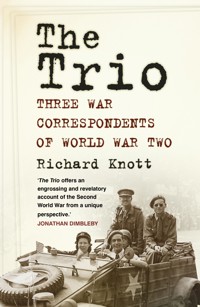
The Trio tells the story of three war correspondents, two Englishmen and an Australian, all in their 30s, whose friendship was forged during the Second World War. They became so close that their colleagues dubbed them 'The Trio', sometimes out of disgruntled rivalry. Alan Moorehead, Alexander Clifford and Christopher Buckley worked for the Express, Mail and Telegraph respectively. Clifford and Moorehead lived together more closely than most married couples, and all three correspondents spent the war years travelling relentlessly, chasing news and writing stories, while being reliant on each other's friendship and mutual trust. They slept under the desert stars, in sumptuous Italian villas, in trains and army trucks. They were frequently in the line of fire, while their names became synonymous with the best war reporting. The Trio describes their relationship, what happened to each of them in the war and finally, when the fighting was over, how success gave way to personal tragedy.
Sie lesen das E-Book in den Legimi-Apps auf:
Seitenzahl: 454
Veröffentlichungsjahr: 2015
Das E-Book (TTS) können Sie hören im Abo „Legimi Premium” in Legimi-Apps auf:
Ähnliche



















For Suzie
‘There were three of them, and they stood for three great London dailies.’
Sir Arthur Conan Doyle in The Three Correspondents
‘One is rarely seen without the other – we are known as the three inseparables.’
Alexandre Dumas in The Three Musketeers
‘The war correspondent has his stake – his life – in his own hands. And he can put it back in his pocket at the very last minute.’
Robert Capa in Slightly Out of Focus and quoted bySusana Fortes in Waiting for Robert Capa
Acknowledgements
A curious side effect of the Second World War was an upsurge in publishing, despite a shortage of paper. Newsmen and newswomen often could not wait to turn ephemeral journalism into memoir, and many of their volumes were a great help to me in researching the story of The Trio. It goes without saying that Buckley’s, Clifford’s and Moorehead’s accounts of key campaigns were an inspiration to me, but so were dozens more. Perhaps the most compelling of them were the books by Richard Dimbleby, Eve Curie, Philip Jordan and Richard Busvine, but as my footnotes testify, I could not have written this book without those who went before me, and who endured the discomforts and pain so far removed from my desk in a peaceful Somerset.
The actual starting point for this book was a letter from Alan to Lucy Moorehead describing an idea for his next book ‘so fragile and reeking that I scarcely dare to write about it. It’s a book about our summer school in Taormina and our winter school in Naples.’ I found the quotation in Tom Pocock’s readable biography of Moorehead and it prompted me to explore the Trio’s long and winding road into and out of Taormina. Initially, I turned to the ‘official’ sources of information, notably the Imperial War Museum, where I read with mounting admiration and fascination the extensive papers of Alexander Clifford, and the National Library of Australia where the Moorehead papers are kept. I am grateful to the archivists at both institutions. Other sources of material have included The National Archives, the British Library, the Liddell Hart Centre for Military Archives at King’s College, University of London, the Bodleian Library, and the Christian Science Monitor Library. I am grateful to the trustees of the Liddell Hart Centre for Military Archives for permission to use quotations from their archive.
One of the pleasures of researching this book has been the willing help received from individuals: both Caroline and John Moorehead have been extremely supportive, both in terms of sharing their memories both of their father and the other members of the Trio: their respective godfathers Alexander Clifford (John) and Christopher Buckley (Caroline). Talking to both Mooreheads was a real pleasure. I am grateful too to Mrs Elizabeth Quyke who holds the copyright for Clifford’s papers at the Imperial War Museum and who readily gave permission for me to mine and use the extensive documents in Clifford’s wonderful archive.
The search for Christopher Buckley’s papers preoccupied me throughout the project. I did not want him to be the third mysterious, and therefore less important, member of the threesome. But the obvious ports of call produced nothing. Yet I knew from a reference in Road to Rome that he had kept some kind of journal – ‘In my diary’, he wrote, ‘I find the following significant entry for September 6: “The war is over for the Italian people…”’1 Did the diary still exist and could it be tracked down? I sent tentative enquiries to Oriel College, Oxford University, where Buckley took his degree, for example, as well as the Tunbridge Wells Civic Society – but without luck. I talked to a friend, Judith Bryant, who specialises in locating the real parents of adopted children. She gave me some wise advice about how to proceed: I progressed from Buckley’s marriage certificate (Christopher Thomas Rede Buckley, bachelor, aged 42, journalist, resident at the National Liberal Club), to his will (via the London Probate Service), to his wife Cecilia’s death certificate (in Suffolk, 1996), and then to her husband’s later remarriage and death (John Russell-Smith, Norfolk, 2006). His widow, Gael Russell-Smith, responded to an enquiry from me, kindly suggesting I contact Shirley Tudor-Pole who was able to describe her memories of Buckley and who put me in touch with Genista Toland, the daughter of Cecilia Buckley’s brother, Hugh. The conversations I had with both were helpful and confirmed for me Buckley’s charm and erudition. They also both took the view, however, that Cecilia’s business-like, no-nonsense view of the world was such that Buckley’s papers would not have been preserved. ‘She would have thrown stuff out’, I was told with great certainty. Shirley helped clear Cecilia’s house when she died and she confirmed that there were no papers of any significance left.
There are other names I should mention: I wrote to both Jonathan Dimbleby (about his father) and Sir Max Hastings (about The Daily Telegraph and Christopher Buckley) and received, in both cases, kind and interested replies. My commissioning editor at The History Press, Jo de Vries, has again been a pleasure to work with and supportive throughout. In addition, I should like to thank Lyndall Passerini, Betsy Connor Bowen, Paul Patterson and Anthony Grey. I am grateful to Ana and Kino Bardaji who explored and photographed the Bar Basque in St-Jean-de-Luz on my behalf from their home across the border in Spain. I am also grateful to William Lancaster for permitting me to quote from his father’s letters to the Mooreheads. Every effort has been made to trace the copyright holders of the material in this book.
Finally I want to thank my wife, Vanessa, who has put up with my obsessive pursuit of these three heroes of mine, provided shrewd and timely advice about the book’s structure, and brought me reviving cups of coffee when I was at my desk, just as Cecilia did for Christopher Buckley as he worked away at his writing nearly seventy years ago in that upstairs room at 46 Mount Sion, Tunbridge Wells.
NOTE
1 Buckley, p.164.
Contents
Title
Dedication
Quote
Acknowledgements
PART 1 – The Duo: ‘Follow Clifford! Follow Moorehead!’
1 ‘Monty’s Blue-Eyed Boys’
2 The Road to War
3 Cairo and Beyond – the Nomadic Life
4 ‘We Have Attacked in the Western Desert’
5 The Cheese and the Mousetrap
6 The Trio’s Early Days
7 The Road to Persia
8 ‘What’s the Flap?’
9 Cold Christmas in Benghazi
10 Written Out?
11 Foreign Correspondent
12 The Bonfires of Cairo
13 From Suez to Syracuse
PART 2 – The Trio: Sicily to Lüneburg
14 The Villa in Sicily
15 ‘My Treasure. I am Coming Home.’
16 The Lion D’Or, the Ritz and the Canterbury
17 ‘Some News for You’
18 ‘That’s What You’re Here For’
PART 3 – The Trio is Broken: ‘No One Can See Very Clearly’
19 And Now the War is Over
20 Towards Journey’s End
21 ‘Why In Hell Don’t We Fight Them?’
22 The Trio Divided
23 A Loss for Words
24 A Final Dispatch
25 A Return to the Bar Basque
Appendix: The Trio’s Itinerant Years
Bibliography
Copyright
PART 1
The Duo: ‘Follow Clifford! Follow Moorehead!’
1. ‘Monty’s Blue-Eyed Boys’
In the middle of August 1943, a small group of war correspondents arrived in the hilltop town of Taormina on the island of Sicily. There were three of them – Christopher Buckley, Alexander Clifford and Alan Moorehead – and they worked for three London newspapers: TheDailyTelegraph, the Daily Express and the Daily Mail. They had been drawn together by the shared demands of a dangerous job, the familiarity of living cheek-by-jowl in the open air of the North African desert, and the recognition that each of them would be the lesser without the other two. They had not known each other long – a few eventful years – but, in a world of guns, bombs and frantic movement, their friendship had been accelerated to the point where it bordered on love. They were known as ‘The Trio’.
On that hot summer’s day they approached Taormina by way of a tree-lined road which passed through shaded verges where wild geraniums grew. It was a cautious progress prompted by the fact that the Germans had planted scores of mines in the road. A young peasant woman appeared, clutching a jug of wine and glasses, and offered them a drink. So began the pleasures of Taormina. The town was captured ‘in the old style’, the Daily Mail’s Alexander Clifford wrote home to his mother, declaring it to be ‘the most lovely place in the world’.1 On that Saturday afternoon the three men slowly climbed ‘the precipitous goat-track’ which led up into the town, watched by the ‘townspeople leaning over the ramparts’.2 On one side, far below the red cliffs and rocks, lay the Mediterranean and, in the distance across the strait, the pale outline of the Italian mainland. To the north-west was ‘the great black lava bulk of Mount Etna’.3 It felt like walking into paradise. By the time the Trio reached the top of the winding path, they were panting for breath and desperately hot, scarcely ready for what greeted them, an excited, enthusiastic mob, and an Italian officer with a fine sense of occasion and a Shakespearian turn of phrase. ‘My lords,’ he said, ‘we have waited too long for you!’4
‘It felt like walking into paradise’: Taormina and ‘the great lava bulk of Mount Etna’. (Author’s collection)
* * * *
Buckley, Clifford and Moorehead were called the ‘Trio’, the ‘Inside Set’, or ‘Monty’s blue-eyed boys’,5 often with a hint of envy or resentment by those who worked outside the privileged circle. Each brought a distinctive quality to this unique friendship. Buckley was the historian, the military thinker who knew his Clausewitz and could talk the strategic talk. Clifford was the linguist, able to make himself understood across Europe, the cook with a flair for improvised cooking in the most unpromising of situations. Moorehead was perhaps the truest ‘writer’ amongst them, a correspondent with the sharpest of eyes for pictorial detail. In their day, they were famous; their dispatches from distant war zones were breakfast reading in millions of British households. Then, once the war was over, each of them had to confront the daunting prospect of forging a new reputation in a much changed world. It is probably fair to say that only Alan Moorehead’s name is still widely known so many decades after the end of the Second World War. All three deserve to be remembered, and each was silenced cruelly and too soon.
The three of them shared a love of words, an eye for news and great resilience. Physically, Buckley and Clifford towered over the diminutive Moorehead. Christopher Buckley was tall, gentle, erudite and donnish, a reluctant schoolmaster who had become an elder statesman to his fellow newsmen. He regularly told people that ‘he always wanted to be a bishop because of the peace it would bring him, and also because he fancied himself in gaiters’.6 Known as ‘The General’, he could be brusque, even rude at times, and he had little patience with those he thought to be fools. In his military uniform he looked decidedly uncomfortable. He loved cricket, architecture and the novels of Anthony Trollope and, while he was frightened of both heights and depths, he was invariably fearless in the face of gunfire. Alexander Clifford was ‘square-shouldered, cool, reserved, with uncompromising eyes’.7 He was the Trio’s translator, chef and source of information. He loved cats and music and was a talented sportsman, excelling at golf and tennis. Gifted and intelligent, he rather drifted into journalism. Alan Moorehead, by contrast, was ‘a short neat compact man like a coiled spring’. He had left his native Australia in the mid 1930s, sensing that it was ‘a land where nothing happened’,8 and his accent had become emphatically English. His career, writing and life were all profoundly affected by his friendship with Alexander Clifford.
* * * *
The friendship between Moorehead and Clifford had had a fractious beginning in a truculent exchange between the two reporters in a bar in southern France during the Spanish Civil War. However, by the time the two of them and Buckley were holed up in Taormina in 1943 – reading, writing and occasionally staring over the straits of Messina towards the Italian mainland – the relationship was characterised by a shared camaraderie, affection, mutual regard and trust, integrity and an unstinting determination to see the war through, from Cairo to its sombre conclusion at Lüneburg Heath. It was a journey which involved passing encounters with a series of the great and good – and not so good – whose lives came into the Trio’s extended circle and who figure in this book: the spy Kim Philby, Ernest Hemingway, field marshals Montgomery, Wavell and Auchinleck, Eve Curie, Randolph Churchill, Lord Beaverbrook, Richard Dimbleby and many others. The principal focus of this book, however, is the Trio and the stories of its individual members. In recounting those stories there is much to be revealed about the role of ‘war correspondent’: the extent to which they were censored, were unwitting or conscious propagandists, were ‘used’ by the intelligence services, or suffered from what we would now call post-traumatic stress disorder.
In October 1944 the magazine Picture Post published a piece entitled ‘The Men Who Send the Front Line News’. Written by Macdonald Hastings, Buckley, Clifford and Moorehead were among the most important correspondents described; Hastings reckoned that there were 180 front-line correspondents, but of those just twenty-five were responsible for most of the first-hand news of the fighting. ‘For nearly five years,’ he wrote, ‘men like Moorehead, Clifford [and] Buckley … have lent us their eyes. Every day for years, they’ve followed the fighting. Every day for years, they’ve sat at field conferences and sweated over their maps to decide where the fighting was hottest.’ Hastings described the strain as ‘fearful’ in an atmosphere which was ‘hysterical’. Moreover, ‘week in, week out, the war correspondents never get away from it’.9 By late 1944, when Hastings’ piece appeared, Buckley, Clifford and Moorehead had been doggedly pursuing the ebb and flow of wartime front lines for so long that a profound tiredness had eroded the zest of the previous decade. They had, after all, been ‘wounded, blown up, lost, hungry, filthy, dirty, frightened and exhausted’ for too long. And then, once the war was over, there was the challenge of acclimatising to peacetime, when each member of the Trio went in a sharply different direction. The story begins, however, in Spain, in an earlier war.
NOTES
1 Clifford papers (16727), Imperial War Museum (IWM), file AGC/2/1/7; letter from Alexander Clifford to his mother, 28 July 1943.
2Road to Rome by Christopher Buckley, p.131.
3Daily Express, 17 August 1943.
4 Buckley, p.136.
5War Correspondent by Michael Moynihan, p.131.
6 According to the war correspondent Eric Lloyd Williams.
7Magic Mistress by Doon Campbell, p.73.
8Alan Moorehead: A Rediscovery by Ann Moyal, p.4.
9Picture Post, vol. 25, no. 3, 14 October 1944.
2. The Road to War
It is the last day of 1937. Under cover of darkness, five cars drive slowly out of the Spanish city of Saragossa, heading for the front at Teruel, a bleak, walled town, high on an exposed plateau. Teruel – ‘a mountain stronghold of great strategic significance’1 – lies besieged by the Republican army in cruel weather: bitterly cold, with driving snow blown about by a piercing wind. At –18ºC, it is cold enough for men to freeze to death. Vehicle engines have seized up and frostbite amongst the troops is widespread. Spain’s civil war is about to enter its third year, a war characterised by brutal, unforgiving fighting from the outset, when General Franco’s Nationalist army had rebelled against the country’s elected government. The war has attracted the world’s interest, this rehearsal for the Second World War, and that is why these five dark saloons are leaving Saragossa in the pre-dawn of an unpromising New Year’s Eve. They are carrying a posse of war correspondents, each of them muffled up against the cold, their typewriters on their knees, all of them coughing in the collective fug of cigarette smoke.
The road to the front was familiar since they had travelled this way just the day before. The day of 30 December had been one of bright glittering frost, and as the light had finally begun to fade, a Nationalist officer had exhorted them to return early the following morning. ‘If you’re here in good time tomorrow you’ll have something really interesting to write about’ – so Colonel Sagardia, his hair lightened by years of Moroccan sun, had put it. The journey was a penance to be endured, however, the road rutted, stony and uneven. The Daily Telegraph’s correspondent Karl Robson later wrote: ‘If you want to test your patience, try typing at dusk in the back of a car on a primitive country track, making two carbon copies; the original for the telegraph office, one copy for the censor, and one for yourself.’2
Robson was accompanied by Kim Philby of The Times, H.R. (Richard) Sheepshanks of the Reuters news agency, an American photographer, Bradish Johnson, and Edward Neil of Associated Press. It was noon by the time the correspondents’ cars rolled into Caudé, some 8 miles from Teruel. They pulled up close to a barn and got out, ears immediately assaulted by the cold and the guns from a nearby battery. The noise, the bitter temperature and the need to consult a map of the front soon prompted Robson to get back into the car, and the others quickly followed. Suddenly they heard the roar of an incoming shell which rocked the car and showered stones and shattered bricks on its roof. Moments later Philby appeared – he had been in the car directly behind Robson’s − with blood trickling down his face and soaking into his clothes. He had been lucky: the shell had exploded close to the car’s left wheel with sickening results: ‘three figures, with grotesquely blackened faces, lolling motionless in their seats’.3 Johnson had a hole in his back. Philby had survived, but Johnson, Neil and Richard Sheepshanks were either dead or close to it.
To Robson, Kim Philby appeared to be ‘a serious, slightly stodgy, young English journalist, rather taken with his own importance, who wrote reports about the Franco side in which his objectivity did not quite conceal his fascist sympathies’.4 It was a misjudgement, albeit an understandable one shared by many. In fact he was working undercover for the Russians as an intelligence officer. Philby was based in the Basque city of Bilbao where he masqueraded as an archetypal right-wing aesthete by taking an exotic mistress, the Canadian-born divorced actress, Frances (‘Bunny’) Doble, Lady Lindsey-Hogg. Wounded, and after treatment in a field hospital, Philby was driven back to Saragossa. Once there he headed straight for a bar where the customers stared at his bizarre appearance since ‘the blast had destroyed most of his clothes’, leaving him clad in ‘a pair of old sandals and a woman’s pale blue coat with a moth-eaten fur collar’.5 After one of the waiters, who knew something of the circumstances, had brought him a large drink, he was fêted as a hero. He would continue his double life unsuspected, his credibility helped by his wounds at Caudé.
Philby’s luck was not shared by Richard Sheepshanks of Reuters, who was destined never to leave Caudé alive. ‘Badly wounded in the head and face, (with) an eye missing’, he died later that evening.6 His replacement was the 28-year-old Alexander Clifford. Born in Eltham, Kent in April 1909, Clifford was a gifted musician (aged 5, he could already play the piano), and a natural linguist, speaking nine languages, six of them fluently. At Charterhouse, one fellow student, the cartoonist Osbert Lancaster, remembered ‘the sight of Alex marching purposefully and in time to early school as seen by laggard Lancaster far in the rear’. There was something ‘of the air of the cat who walked by himself’, Lancaster thought, a characteristic which Clifford never lost.7 With his brother Henry (known as Tony), he walked and bicycled around Europe during the 1930s and, after taking a degree at Oxford (Oriel College), he joined the Reuters agency in 1931. ‘The rest of his career,’ his brother thought, ‘was like surf riding.’8
Clifford knew that following Sheepshanks would not be easy, and indeed his difficulties began the moment he tried to cross the Spanish border. It was early January 1938. ‘I had to reveal my grandma’s maiden name,’ he wrote to his brother, going on to describe the two lots of fingerprinting, the photographs, the weighing and searching of his baggage, and the way he was shunted from one military HQ to another.9 Once he had finally crossed the border, he checked into San Sebastian’s Maria Cristina Hotel, a palatial establishment set alongside a malodorous river, with windows giving a salt-misted view of the white-capped Atlantic. The hotel’s old-fashioned charm did not compensate for the fact that the war had already moved on from the city, and Clifford was soon keen to seek out action further west. He needed to be closer to the front – and the difficulties in obtaining dinner before ten at night only made him more restless. Drifting idly from bar to bar, seeking sustenance in prawns and sherry, did not seem fitting somehow for a correspondent at large in a war zone.
So, on 12 January 1938, Alex Clifford set out west on the road to Bilbao and soon came close to the harsh reality of the war. He found himself watching in awe as harassed surgeons treated an Italian officer whose forehead had been shot away. ‘His brain was sticking out,’ Clifford wrote later, describing how the operation had given the Italian a new forehead, grafted from part of his thigh. He visited the Basque town of Guernica, which the German Luftwaffe had pounded with bombs the year before, and was shocked by the devastation. ‘I never imagined a place could be so completely destroyed,’ he wrote. Eventually he reached Saragossa, just 7 miles from the fighting. He walked across a section of recently abandoned battlefield looking at the debris and discarded military hardware, bemused both by their scale and occasional quirkiness – a discarded golf putter, for example, lying abandoned in the dust. For a short while he shared accommodation with Karl Robson before moving on to Madrid, travelling via Burgos and Toledo, its ruined, fire-blackened Alcazar somehow symbolising Spain’s burning, bitter struggle. At one point he was handed a rifle by some of Franco’s soldiers who encouraged him to shoot towards the Republican trenches. It discomfited him enough to warn his brother in a letter that he should keep the story quiet. He spent an evening in trenches which the Republicans had recently abandoned: there were still peas cooking, warm coffee in a pot and an unfinished game of draughts missing its two players. He visited the front at Teruel (where his predecessor had died) and, on 22 February, he and Karl Robson were with the Nationalist infantry when they marched into the town, its buildings heavily damaged by gunfire. Bizarrely, the insurgents had taken to wearing a variety of outlandish hats, and Clifford ‘saw one Moor wearing a top hat and carrying a bassoon and a sewing machine’.10 Of the 9,500 troops defending Teruel, all were now dead or prisoners. Years later, he would be reminded of the surrounding rugged landscape when deep in the Libyan Desert.
A postcard home from the ‘Clifford Travel Bureau’, 1937. (IWM, Clifford Papers)
Although he was reporting from the Nationalist lines, Clifford was not beyond helping those on the other side of the conflict. For example, he ‘was able to render a service for the wife of a British volunteer, Mr Clive Branson, recently captured by General Franco’s forces’. Branson was an artist and a Communist; Clifford helped locate his whereabouts in Spain.11
For a young man still in his 20s, Spain was a series of vivid initiations: Alex caught a flea in a cheap cinema and was a passenger on a train which derailed as he was travelling to Salamanca (thereby avoiding an air raid). He had his photograph taken with Kim Philby and lunched in Pamplona at a wonderful restaurant run by nine beautiful sisters where the cooking could not be faulted, even by someone with Clifford’s cautious appetite. He also interviewed the Nationalist leader, General Franco, at some length, under conditions of the greatest secrecy, and pausing at one point because of an air raid warning. He found the Fascist leader ‘very charming’; deploying his Spanish in such circumstances and at considerable length was more of a concern to Clifford than the general’s politics. He was more unsettled by Franco’s entourage, not least a brooding German presence. He wrote to his sister Liz that he was ‘a little entangled with the German secret police and sometimes I am genuinely frightened,’12 and his fear was evident in his insistence that Liz should tell no one. When he and Kim Philby were photographed in the company of the head of the German secret police, he declared in a letter to his brother that he dared not reveal the German’s name.
Clifford liked Saragossa, partly because there were relatively few war correspondents there. It could be unpleasantly hot – 112°F in the shade – and the city’s ‘puritanical mayor’ insisted that coats must be worn in public. Fleas were a persistent problem. Just as irritating was the close observation by Franco’s secret state. The scrutiny was enough to provoke Clifford into an act of minor rebellion: at the end of one letter to his sister, he added a sentence for prying eyes: ‘Oh I must protest in the strongest possible terms against this indiscriminate opening of my letters.’13 His hand-to-mouth existence was not easy: he developed an ‘orticario’, a stress-induced red rash all over his body. He was constantly on the move; at one point he complained that his luggage was scattered far and wide across Spain. For the most part he was based in the lands north of Madrid – a month in Burgos, for example – and there were frequent return visits to San Sebastian. The Basque town’s hotels were full of well-heeled refugees from Madrid and Barcelona, escaping what they saw as the Red hordes, and the presence of so many exiled fascist sympathisers could prove hazardous. On one occasion, Robson and Clifford were in the lounge of the Maria Cristina Hotel when the Spanish national anthem suddenly boomed out from the radio. They both stood, a gesture insufficiently patriotic for a tipsy young Francoist who demanded why they had not given the Fascist salute, and who refused to accept their Englishness as a legitimate reason. Despite being known in the hotel, Clifford and Robson were asked to leave by the Italian manager: ‘No, gentlemen, no, you have caused this disturbance. You have offended my guests. You must go at once.’ Their luggage was hurriedly produced and they were compelled to leave immediately. There were apologies forthcoming in the coming days, but it did little to compensate for the indignity of being hustled unceremoniously down the hotel’s steps and out into the street, with their luggage scattered over the pavement.
Alexander Clifford’s ‘Salvoconducto’ – his ‘safe-conduct’ when working in Spain. (IWM, Clifford Papers)
There was more to life in Spain than war reporting; there were affairs of the heart too and gossip about Alex’s private life, something which evidently pleased him. He confessed to his sister – no doubt smiling as he wrote it – that there was a rumour he was ‘trifling with the affections of two ladies, one a widow and the other a married marquesa with three children’. Evidently the relationship with the marquesa was a serious entanglement: a year or so later she sent Alex a postcard when he was back in London: ‘This is Velasquez’s view of Zaragoza I used to tell you about. Also our bridge and the place we used to walk in. How far away all this seems! Only last year! … Where are you? I am longing to hear from you.’14 Clifford’s flourishing career as a war correspondent might well have been prematurely cut short: the marquesa’s husband was only prevented from seeking satisfaction in a duel by being unable to leave the front line.
* * * *
Alexander Clifford first met Alan Moorehead in the spring of 1938, at the Bar Basque in Saint-Jean-de-Luz, just over the border from Spain in southern France. Moorehead was working as a ‘stringer’ for the Daily Express, on £5 per week plus some expenses, reporting from the border town of Hendaye on the continuing air raids on Barcelona and, more generally, on the campaign in the field. There was nightly gunfire as would-be refugees tried to cross the River Bidasoa between France and Spain. He had arrived in Saint-Jean-de-Luz on the overnight train from Paris and he headed straight for the bar from the station, passing a line of horse-drawn cabs before pushing through the bar’s door. Inside there were ‘Basque murals on the walls, scenes of pelota players and peasants dancing the jota, and the decor was rustic walnut and red plush,’15 while behind the bar lurked Otto, ‘the omniscient Sud-Tiroler barman.’ This meeting between Clifford and Moorehead was a significant moment in both men’s lives – they would, through the war years, frequently hark back to their shared memories of the Bar Basque’s roast duck, dancing, Thursday night cabaret, wine and Fleursd’Hendaye, the local liqueur, as if to a golden age. The bar had the reputation of being at the heart of European intrigue, the haunt of reporters, diplomats, agents and the clandestine in general. The weather had been appalling and this first meeting between the two war correspondents was distinctly chilly too. Otto pointed Robson and Clifford out to the new arrival, and walking uneasily over to them, Moorehead observed that Robson ‘had an air of extreme gentleness’ as well as being remarkably handsome, reminding him of El Greco. Nothing about Clifford appealed, however. Indeed he looked forbidding, peering ‘in an uncompromising way through his glasses’ and disconcerting Moorehead with his ‘round head, a broad cerebral brow and a tight looking mouth’. To cap it all, Clifford seemed irritated at being interrupted, Moorehead thought, and it was Robson who finally deigned to speak. Piqued and confused, the Australian picked up his luggage and stalked out of the bar. He and Clifford would not meet again for two years.
The Bar Basque, Saint-Jean-de-Luz. (Ana and Kino Bardaji)
The Bar Basque in 2014. (Ana and Kino Bardaji)
* * * *
Alan Moorehead was born in Melbourne, Australia, in July 1910, and came to England in 1935. Two years later, working for the Daily Express, he was in Gibraltar attempting to report on Spain’s civil war from across the border. It proved a difficult assignment: ‘the war in Spain might have been a thousand miles away for all the information we were able to get about it in Gibraltar.’16 The days settled into an ‘aimless and listless routine’: Moorehead dutifully pointed his binoculars at Spain, saw nothing of note and, bored and frustrated, found himself too often drinking coffee in one of a series of bars, reading the Gibraltar Gazette while waiting for something to happen. From his balcony at the Rock Hotel, he could see the coast of Africa, but Spain itself was ‘mysterious and forbidden’. He went to the cinema, played tennis and swam. His ‘mind reeled with boredom’. It was illuminating to realise, amidst the tedium, that the Royal Navy’s officers ‘almost to a man were supporters of General Franco’.17 Then, just when it seemed that nothing would ever disturb Gibraltar’s peace, a real story broke: in fading light, the German battleship Deutschland steamed slowly into the harbour, its deck lined with coffins draped in Nazi flags. The ship had been attacked by Republican aircraft – flown by Russians – off the coast of Ibiza, and thirty-one crew members had been killed. Moorehead felt ‘a moment of ghoulish release’18 at this unexpected gift of news.
For all that, Gibraltar seemed to be a backwater, too far from the action on which a foreign correspondent feeds, and six months stranded on the Rock proved enough for Moorehead. He decided to travel: first to Algiers by Italian liner, then by German freighter to Istanbul, before boarding an oil tanker full of Rumanian petrol bound for Valencia in Spain. It would prove an eventful voyage, though not initially. The tanker headed west through a Mediterranean calm, in sultry heat, while the sea’s ‘warm water flopped back from the bows like blue jelly being sliced open with a knife’.19 The first hint of trouble came from the drunken advances of the lascivious Russian skipper who showed an unhealthy interest in Moorehead’s underwear: ‘He picked up a pair of blue silk underpants and waved them at me chuckling and nodding.’20 Later, the ship faced a different kind of danger: as they approached the Spanish coast, there was a resounding storm whose dark intensity at least hid their whereabouts. In clear light, an air attack on a ship heavy with highly inflammable fuel was something to be feared.
Once in Valencia, Moorehead warmed to the spirit of its people – their generosity and their mutual respect. Tipping, for example, was frowned upon. Moorehead attributed this ‘to the civil war, or rather by the belief on the Republican side that all men are equal’.21 To his disappointment he could never extend his stays in Spain (older, more experienced reporters had priority). It became a ‘place of forbidden exhilaration’ and, invariably, his flying visits always found him longing for something to happen to keep him there.
* * * *
Christopher Buckley, the third member of the Trio, had been a schoolmaster at St Christopher’s School, Letchworth before deciding to go to Spain, initially as a volunteer for the Friends’ Ambulance Unit. In appearance and background it would be hard to find a starker contrast with Alan Moorehead. Buckley was tall, with sandy-coloured hair and a slight stoop. He wore glasses which gave him a professorial look, without ever seeming as if he could see very well. He loved poetry, books and cricket: ‘If there was anything of which he was inordinately proud, it was the row of Wisdens’ that he collected through his lifetime.22 After his experience with the Ambulance Unit, he hitch-hiked around Republican Spain, periodically sending back reports to the Christian Science Monitor in America, despite having had no Fleet Street training at all. In the summer of 1938 he visited one of the relief camps set up to look after Catalan children whose lives had been scarred by the fighting. This was the Torre Inglaterra, situated in the picturesque mountain town of Puigcerdá on the border with France. Buckley had taught there the preceding summer for a month, stirred by the children’s desperate eagerness to learn, despite having just ‘half a dozen pencils among a class of 30’. As a freelance reporter, he lived a hand-to-mouth existence, learning, for example, ‘the technique of eating whenever an opportunity for a meal presented itself’. The wise war correspondent never turned down a chance to eat, a principle which would prove invaluable in the years ahead.
All three members of the Trio would hold Spain dear in their minds for the rest of their lives: Buckley, for example, would remember the voracious bites of the mosquitoes in Alicante in August 1938 when he was living under canvas in an olive grove on Sicily five years later. He never lost the deep empathy he had for the army of the Spanish Republic, believing that ‘of the shames of my life none lies heavier than that I had denied the final proof of my fellowship to the Republic’.23 Moorehead’s view of Spain changed over time. Early on, he had readily left the country for the greater attractions of Paris where ‘we were as much engrossed in watching Josephine Baker dancing in her girdle of bananas as we had been in the civil war’.24 Later he fell in love with the Spanish landscape and felt great sympathy for its people as the Civil War destroyed or changed lives for ever. Early in 1939 Moorehead headed south for a week in the Pyrenees through a chain of mountains that ‘makes you wonder why you waste your time living in any other place’.25 It was the first time he had been able to watch the Spanish Civil War at close quarters and he was deeply troubled by the flood of refugees trying to escape from Franco’s aircraft: ‘black bombers come down when the men below are helpless’.26 The refugees, in groups of twenty or more, stumbled down from the snowline, traversing a mountain ridge. The rocks were coated with ice and occasionally someone would lose their footing and tumble down into the valley. Moorehead counted the bodies of eighteen men and women who had fallen far below into the ravine.27 He met Dolores Ibárruri, ‘La Pasionaria’, the Spanish Republic’s impassioned and articulate voice; Moorehead had been encouraged ‘to offer her untold sums of Beaverbrook’s gold’, presumably for some unworthy scheme dreamed up to sell even greater numbers of newspapers. At all events, Moorehead was enormously impressed by her. But, above all, he was haunted by the images of thousands of Spanish refugees struggling to reach safety as the Republican cause collapsed and died.
Clifford, too, held Spain in his heart, its landscape in particular having a powerful and enduring influence on him. Driving through a desert landscape in Libya years later, he would suddenly recall crossing a similar barren waste in Spain during the civil war. He was not to see the sad end of things in Spain, however. In June 1938 he wrote to his mother from Saragossa, telling her that he had ‘just finished a hard spell of work capturing Castellon’, but soon after that he moved into the uncertain, trembling territory of the war yet to come. By November 1938 he was in Berlin as Reuters’ chief correspondent for Germany. He stayed there for some ten months, observing the drift towards war while caught up in a frantic social whirl of opera, concerts, lunches, hangovers, cinema, cocktail parties, exhibitions, visits to the zoo, and theatre and tennis matches (the Davis Cup). There were also trips abroad, to Venice, for example, and Yugoslavia. Despite all this he found himself homesick for Spain. In a letter to his sister he coyly revealed that he had become ‘rather involved’ with a ‘fantastically lovely Russian princess,’ but that didn’t stop him meeting his Spanish marquesa in Copenhagen for an illicit and happy weekend together, thoughts of husband and Hitler largely put aside. There were idyllic days still – ‘I floated down the Autobahn in a lovely golden evening’ – but there was unquestionably a growing sense of menace in Berlin. On 14 February 1939 he got up early and caught the 6.56 a.m. train to Hamburg, arriving in time to see Hitler launching a new 35,000-ton battleship, the Bismarck. A few months later, on 1 May, he stood watching ‘a terrible torchlight tattoo, where Goering spoke’, while, on 22 May, he was present at the signing of the German/Italian alliance – the Pact of Steel.
Towards the end of August the British embassy advised Clifford to leave the country and he duly flew out on 1 September, a circuitous route via Sweden and Amsterdam, before finally landing at Shoreham on the English south coast. The next day he caught the boat train via Dover and Ostend to Brussels, arriving at the city’s Grand Hotel in the early hours. He found himself staring at the walls of a bare, featureless room and worrying about the chaos of his personal affairs back in England, unresolved as a result of his employer’s insistence that he leave forthwith for the Continent. Later, he bumped into an old acquaintance, a fellow guest at the hotel. A month ago, perhaps, this would have been a pleasure, but the erstwhile friend worked for a German news agency. They carefully avoided eye contact as they passed in the hotel corridors. In these uncertain times, Clifford did not sleep well in Brussels, his nights often punctuated by nightmares.
The same day Clifford was flying out of Berlin, Christopher Buckley was in Warsaw ‘wondering whether (he) should get out of Poland alive’. That Friday afternoon, the 1st, he saw eighteen bombers flying over the city and took shelter under an archway in company with some thirty or forty other people. Occasionally the ground shook as the bombs fell nearby. Warsaw, he thought, was unprepared for the inevitable, ‘without a single trench for civilian defence against aviation’.28 Moreover, there were no deep shelters and gas masks were a rarity. The mood initially was fearful, but this was soon matched by an ‘irritation at (the) continued interruptions in the business of the day’. There were queues for most things – for money exchange and for work permits, for example – while Buckley’s last meal in Warsaw was ‘unduly prolonged by the impossibility of leaving the restaurant during an air raid’. With no little anxiety he found himself remembering the previous summer’s raids on Alicante in Spain. Air raid sirens howled periodically. Once, he was in a large department store in the city when he heard, after the ninth round of sirens, an unprecedented announcement over the radio in English, pleading that the bombing raids should be reported to the British parliament. It was only a matter of hours before the British prime minister took to the airwaves himself, his bleak, exhausted voice declaring war on the German aggressor. His reluctant acceptance that appeasement had failed left Buckley unimpressed. He thought the guarantee to Poland ‘was the best that could be done in the appalling circumstances into which our Government and that of the French had allowed things to drift’. As for the prime minister: ‘the less said about Mr Chamberlain, except to echo Byron’s epitaph on Lord Castlereagh, the better!’29
* * * *
Alan Moorehead took ‘almost the last train out of France before the war’, bound for Italy.30 To the north of the Alps it was cold, but in northern Italy the train rattled through a landscape still in high summer. The Express’s editor Arthur Christiansen – ‘sometimes genial, most often irascible’31 – was deploying his writers far and wide, ready for the anticipated outbreak of fighting. Moorehead’s home for the foreseeable future was to be Rome, and he took a flat next to the house where John Keats had died in the Piazza di Spagna. The Italian capital was bathed in a ‘flickering autumnal light’ and the talk was all of war.
In the months leading up to the outbreak of war, Alan had been based in Paris working for the Express from its office in Rue du Louvre. His immediate boss was Geoffrey Cox, and the relationship between the two was somewhat edgy, Cox believing that they were ‘too alike in appearance let alone anything else’ for them to work comfortably together. Cox saw himself as ‘a descriptive writer and I jolly well wasn’t going to let Moorehead do the descriptive stories’.32 As for Alan, he had other things on his mind, not least the Express’s women’s editor, Lucy Milner. The cartoonist Osbert Lancaster remembered her ‘being sent off to Paris to cover the dress shows with her customary but unconvincing air of long-suffering’.33 According to Mary Welsh, the fourth Mrs Hemingway, when Moorehead had bought her a drink at a bar on the Champs-Élysées he had confided that ‘he hadn’t found a Parisian girl who suited his taste for long’.34 The bachelor life was palling; Welsh reminded him about Lucy Milner – ‘wise, witty and lovely’. The next day Moorehead was in the London office and stopped off at Lucy’s desk on the editorial floor and, a month after the war broke out, Alan and Lucy were married in Rome.
The Mooreheads’ flat in the Piazza di Spagna in Rome. (Author’s Collection)
Alan and Lucy Moorehead on their wedding day in Rome. (National Library of Australia)
* * * *
Alexander Clifford had left London for France on 19 September 1939, having been appointed to submit reports under the byline of ‘Eyewitness’, ‘a pseudonym which he loathed’.35 He was to provide basic coverage of the war in France ‘while (other correspondents) were being vetted to weed out potential spies’.36 The War Council had picked him as the ‘legman representing the whole world’s press on the western front’. Still relatively junior (‘no ace reporter’), he had been ‘picked to avoid jealousy among great-name newswriters’.37 As September drifted into October, Clifford grew increasingly impatient – nothing much was happening, and when it did the army censors proved intractable, while senior officers were determined that any localised detail should be taboo: General Gamelin, for example, warned correspondents, ‘You are going to describe only anonymous landscapes’.38 The military historian Basil Liddell Hart for one was disturbed by the heavy hand of censorship: ‘The Press ought to be renamed the Suppress’, he wrote,39 while Clifford told the BBC’s Charles Gardner that on one occasion an ‘army censor had taken out a story referring to the moon having shone’.
By early January 1940 Clifford was based in Amsterdam, still wondering when the ‘phoney war’ would end. It was a nervy, unsettling interlude made worse for Clifford since Amsterdam was full of former colleagues from Berlin. There was both a news drought and a strong sense of competition, and what news there was must be filtered by the censors. By 19 March the struggle between the army’s higher powers and the press was so serious that ‘the correspondents … declared a strike against censorship measures’, a protest which continued for a week.
* * * *
It was two years after the ill-fated meeting in the Bar Basque that Moorehead and Clifford met again. In May 1940, Moorehead had headed for Greece and checked into the Grande Bretagne Hotel in Athens. In the lift he came face to face with someone he ‘disliked, distrusted and feared’ – who else but Alexander Clifford? That ‘almost Prussian head’; that ‘air of superiority and pernickety indifference’. Initially, Moorehead’s opinion of Clifford was unchanged: he remained affronted by the Englishman’s apparent disdain in the Bar Basque. But a few drinks changed everything; now the two men talked for hours at a ‘rickety wooden table drinking ouzo, turning away the bootblacks, the sellers of pistachio nuts and lottery tickets’, while the dust and heat of the city subsided and the air acquired ‘the clear and buoyant colour of a rock pool in the tropics’.40 Alan hadn’t talked so well with anyone for years. By the end of the evening, they ‘had agreed to continue our travels together’. The practicalities were discussed – should they enlist? – but Moorehead recognised the cool logic of Clifford’s view that ‘the thing to do was to become a war correspondent’. Soon they were making plans to get sent to Cairo together, anticipating the strategic importance of Egypt once Italy came into the war, as seemed certain. Clifford duly wired the Daily Mail in London, for whom he had been working since 1 May: ‘Moorehead of the Express proceeding to Cairo stop shall I follow.’ Moorehead sent a similar query to his own office. The telegrammed responses from London were perfect: ‘Follow Clifford’ and ‘Follow Moorehead’.
* * * *
Following the story of Clifford and Moorehead so many years after is relatively straightforward: there are letters, diaries, documents and, particularly in Moorehead’s case, a substantial body of work. Christopher Buckley, however, is in many ways a more shadowy figure, his past sometimes hidden, a fact made worse by the existence of a modern namesake sprawling over Google. In addition, there are, it seems, no papers, notebooks or diaries extant, other than in the collected archives of others. How then to pursue a shadow, this third member of the Trio? The evidence is that all his papers were destroyed on his death, a conclusion reached after a lengthy investigation via his marriage and death certificates, his will and probate documents, his wife’s death certificate, and members of his extended family who remembered him. These family members were sure that his wife would have had little compunction after his death about discarding the papers he had left behind, despite her evident love for him. Businesslike and unsentimental, she just wasn’t the kind of person to hoard such things.
So it is that the early years of the Trio’s story focuses largely on just two of the three men. Buckley’s journey to the villa in Taormina, via Greece and Cairo, remains only partially revealed. If we are to follow Moorehead and Clifford on their exuberant way to North Africa, then spare a thought for the third member of the Trio, Christopher Buckley, destined to fall in with the other two remarkable pressmen, but only once the tide of war had begun to turn, and for now, pursuing a lone furrow somewhere in Europe.
NOTES
1Ten Years to Alamein by Matthew Halton, p.34.
2Foreign Correspondent ed. Wilfrid Hindle, p.257.
3 Ibid., p.259.
4Philby KGB Masterspy by Phillip Knightley, p.56.
5 Ibid., p.58.
6 Ibid.
7 Moorehead papers, National Library of Australia (NLA), MS 5654: letter to Lucy Moorehead (undated, but c. 1971). The comparison with the cat was from a review of Alan Moorehead’s A Late Education in The Sunday Times, 20 December 1970.
8 Letter to Alan and Lucy Moorehead from Henry Dalton (Tony) Clifford, 23 October 1970. Moorehead papers, NLA, MS 5654.
9 Clifford papers (16727), IWM, file AGC/2/3.
10Evening Standard, 23 February 1938. Clifford papers (16727), IWM, AGC/5/4.
11Reuters Review, Clifford papers (16727), IWM, AGC/5/1.
12 Undated letter, Clifford papers (16727), IWM, file AGC/2/2.
13 Letter of 27 August 1938. Clifford papers (16727), IWM, file AGC/2/2.
14 Dated 14 October 1939. Clifford papers (16727), IWM, AGC/5/1.
15A Late Education by Alan Moorehead, p.2.
16 Ibid., p.65.
17 Ibid., p.66.
18 Ibid., p.71.
19 Ibid., p.83.
20 Ibid., p.85.
21 Ibid., p.95.
22 Walter Oakeshott in an article for Time and Tide entitled ‘Journalism and Truth’, 9 September 1950.
23 Buckley, p.22.
24A Late Education, op. cit., p.44.
25 Ibid., p.112.
26Alan Moorehead by Tom Pocock, p.44. Pocock is quoting from a letter to Lucy Moorehead.
27 See Moorehead’s report in the Daily Express for 2 April 1938.
28Christian Science Monitor, 19 September 1939.
29 Byron wrote: ‘Posterity will ne’er survey / A nobler grave than this: / Here lie the bones of Castlereagh: / Stop, traveller, and piss.’ Quoted from a letter to Basil Liddell Hart, dated 15 May 1944. Liddell Hart Papers, LH1/125/1.
30Mediterranean Front by Alan Moorehead, p.11.
31Fighting Words by Richard Collier, p.9.
32 Interview, IWM Sound Archives, 26937.
33With an Eye to the Future by Osbert Lancaster, p.153.
34How It Was by Mary Welsh Hemingway, p.42.
35A.A.S.F. by Charles Gardner, p.19.
36The Violent Decade by Frank Gervasi, p.204.
37Time, 2 October 1939.
38 Collier, p.13.
39 Liddell Hart papers, LH11/1939/118.
40A Late Education, op. cit., p.5.
3. Cairo and Beyond – the Nomadic Life
The flying boat to Cairo came down on Crete’s Suda Bay and Clifford and Moorehead, emphatically not ‘following’ each other but in companionable cahoots, stripped off and stepped straight into the sea from the aircraft’s open door. Once they reached Cairo, however, all semblance of tranquillity disappeared. It was, for a start, unbearably hot – a brutal 106° – and the city assailed them, as it did others who flew in from the grey of northern Europe: its frantic noise, chaotic traffic, the ‘starved and beaten cabhorses, mangy dogs, rabies, venereal disease, and dysentery’.1 Fastidious Europeans complained of the smell: ‘The all-pervading, never failing smell. Sweat, and garlic and the musty hangover of a thousand years of smell.’2 But it had a bewitching quality too, such that the BBC’s Richard Dimbleby could describe the city as both ‘unbelievably corrupt and, sometimes, incredibly beautiful’.
Clifford and Moorehead settled into Cairene life, bathing in the Nile, watching cricket at the Gezira Sporting Club, where they would sometimes eat lunch together on the balcony, the cold buffet being ‘a bargain meal much appreciated by GHQ secretaries’.3 The two correspondents bought uniforms which were embellished with bright green and gold tabs which Moorehead disliked since they ‘gave one the feeling of being a delegate at a Rotary convention’.4 For their part, the military looked on the war correspondents with a blend of loathing and puzzlement. Accommodation was at the Carlton Hotel which was cheaper than the famous Shepheards; Clifford’s room was on the seventh floor with a view down to an open-air cinema. The nights were punctuated by the clatter of dominoes and backgammon pieces, as well as cinematic gunfire.
Alex liked the climate, wore shorts and drove a handsome, substantial Ford V8 motor car. In these early days, it was possible to enjoy a life of partying and polo since the war seen from Cairo was ‘merely a noise on the radio’. The threat of bombing was minimal, it seemed, and indeed one Cairo inhabitant remarked that ‘the roads are much more dangerous than air raids’.5




