


Erhalten Sie Zugang zu diesem und mehr als 300000 Büchern ab EUR 5,99 monatlich.
- Herausgeber: Luath Press
- Kategorie: Lebensstil
- Sprache: Englisch
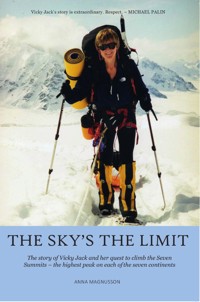
There is a myth: that travel and exploration are the privileged pastimes of youth. Adventure has an age restriction, and the extraordinary an expiry date. Vicky Jack's inspiring tale of courage, perseverance and strong-headedness reveals the falsity behind this myth as she becomes the oldest British woman to reach the summit of Mount Everest. The Sky's the Limit is the account of Vicky's journey from the Munros of her native Scotland to the summit of the world's highest peak. Her pilgrimage is full of trials as she battles through Antarctic storms, falls off Mt McKinley in Alaska, is shot at in Indonesia, and runs out of oxygen on Mt Everest; yet Vicky's characteristic determination is never diluted as she strives towards her goal. Anna Magnusson brilliantly captures Vicky's sense of ambition, faithfully retelling this tale of inspiration, challenge and success. This story is both a reminder to all that it is never too late to chase a childhood ambition, and an encouragement to never give up on your dreams – no matter how out of reach they may seem.
Sie lesen das E-Book in den Legimi-Apps auf:
Seitenzahl: 371
Veröffentlichungsjahr: 2017
Das E-Book (TTS) können Sie hören im Abo „Legimi Premium” in Legimi-Apps auf:
Ähnliche













ANNA MAGNUSSONis a writer, broadcaster and radio producer. In 2006 she publishedThe Quarriers Story, a history of Quarriers Homes, once the biggest orphanage in Scotland, and now a leading care charity. She also editedThe Time of our Lives(Rannoch Press, 2011), a collection of memories of wartime schoolgirls evacuated from Glasgow to Auchterarder. Anna is an award-winning radio producer and broadcaster who has made documentaries all over the world.
The Sky’s the Limit
The Story of Vicky Jack and her QuestTo climb the Seven Summits
ANNA MAGNUSSON
Luath Press Limited
EDINBURGH
www.luath.co.uk
Originally published by Black & White, 2007.
This edition published by Luath Press, 2016.
ISBN: 978-1-910745-79-3
eISBN: 978-1-912387-02-1
The author’s right to be identified as author of this work under the
Copyright, Designs and Patents Act 1988 has been asserted.
© Anna Magnusson 2007, 2016
For Mum and Dad
The best storytellers
MAGNUS MAGNUSSON, 1929–2007
MAMIE MAGNUSSON, 1925–2012
Contents
Acknowledgements
Foreword
Prologue
CHAPTERONE:In the Garden
CHAPTERTWO:Travelling
CHAPTER THREE:The Highest Hill in Europe – Mount Elbrus
CHAPTER FOUR:Under African Skies – Kilimanjaro
CHAPTER FIVE:High in The Andes – Aconcagua
CHAPTER SIX:The White South – Vinson Massif
CHAPTER SEVEN:The Hardest Journey – Mount Mckinley
CHAPTER EIGHT:The Dark Mountain – Carstensz Pyramid
CHAPTER NINE:The Road to Everest
CHAPTER TEN:The Highest Mountain in the World – Mount Everest
CHAPTER ELEVEN:On Top of the World
Epilogue
Afterword
Acknowledgements
‘She looks as if a puff of wind will blow her away’ is how one old friend describes Vicky Jack.
Appearances can be deceptive, as I found out during the months of talking to Vicky and writing her story for this book. She wears her achievement in climbing the Seven Summits so lightly as to render it almost invisible, but as I got to know her I was enormously impressed and inspired by her talents, her personality and her great appetite for life. She was unstinting in her time and efforts as we talked about her life and career and climbing – always thoughtful and always open and I thank her most sincerely. Those conversations and the writing of the book took place during a very intensive period of only three or four months in 2007. It was an exhausting process but Vicky never once flagged along the way. That’s probably why she got to the top of Everest. Those hectic months were also the foundation of a lasting friendship with Vicky. She is a remarkable person.
I would also like to thank the many people – friends, family, climbing chums, work colleagues – who helped me with information, stories, reflections and memories. I hope that the Vicky you find in this book is, at least in small part, the Vicky you know.
August 2016
Foreword
AFTER I HAD completed the Seven Summits, I was asked if I was going to write a book about ‘my adventures’. I knew that what I really enjoyed was the adventuring and not writing so I decided to look for someone to write the book for me. Never having delved into the book-writing world before, it took some time and, just when I was starting to make progress, I was awarded an honorary doctorate from Glasgow Caledonian University. Magnus Magnusson was the university’s chancellor at the time and, during the pre-award-ceremony lunch, I was sitting next to him. We were chatting and he suddenly put his hand on my arm and, with an excited boyish look, said that his daughter Anna wanted to write another book and he thought that my story would be ideal for her. He asked if it would be all right for him to suggest it to her and of course I said, ‘Yes.’
I then met Anna and she was not only keen to write about the adventures but also wanted to cover my life. I found this prospect quite daunting as I am not one to discuss my experiences, feelings and emotions, particularly with someone I didn’t know. However, when we met, I immediately liked Anna – she has a quiet confidence, a good sense of humour and is very insightful. I felt that I could trust her to write a true account of my story and we agreed to go ahead. It was a lot harder than I thought it would be but the hours spent talking about my past were made so much easier by Anna’s relaxed patience and perceptive questioning.
I tend to make light of things but, underneath, there is a serious person and Anna was swift to discover this. In fact, I think now she probably knows me better than I know myself! Thanks, Anna – you have captured my life astonishingly well.
And of course thanks to everyone we contacted who so enthusiastically added their accounts to the book.
I believe we tend to limit our own horizons but I also believe that, if you really want to do something and you feel it from your heart, you can achieve almost anything – the sky’s the limit!
I hope you enjoy the book.
Vicky Jack
Prologue
AS LIGHT BEGANto smudge the horizon on 22 May 2003, Vicky Jack stood at 27,500 feet on Mount Everest, about 1,500 vertical feet from the summit.
It was a beautiful dawn. The weather was superb, there were no clouds, and I cried with the sheer impact of seeing the dawn growing, looking down on everything. We were above every hill around us. You could see the curvature of the Earth. I could hear the oxygen coming through the pipe beside my ear. I could hear my own ragged gasps for breath. I was absolutely exhausted, but there was this sudden feeling of elation: and that split second of feeling will never leave me.
That day on Everest was the planned culmination of her six-year quest to climb the Seven Summits, the highest peaks on the seven continents: Mount Elbrus in the Caucasus; Kilimanjaro in Tanzania; Aconcagua in the Andes; the Vinson Massif in Antarctica; Mount McKinley (also known as Denali) in Alaska; Carstensz Pyramid (also known as Puncak Jaya) in Indonesia; and Mount Everest in Nepal. There is some debate about which are the seven highest peaks, and there are two rival lists. Some people climb Mount Kosciuszko in Australia instead of Carstensz.
When Vicky climbed Mount Everest in 2003 she was 50, a fit, wiry, slight woman who had a successful career in human resources and had recently set up her ownHR consultancy. She’d already had many adventures climbing the highest mountains all over the world, from Alaska to Antarctica: she’d spent a night being very sick in the freezing cold on Mount Elbrus and had nearly died in a blizzard in Antarctica after summiting the Vinson Massif; she’d fallen off a narrow ledge 16,000 feet up on Mount McKinley in Alaska; and, in 2001, she’d been smuggled in a speeding truck through the world’s largest open-cast mine (where no women, let alone tourists, were allowed), en route to climbing the Carstensz Pyramid in Papua, Indonesia. And here on Everest was the ultimate challenge, the final test of her determination to push herself to the limits of her mental and physical strength.
Forty-three years earlier Vicky had been on a different hill, a tiny mound by comparison, on a childhood holiday in the Scottish Highlands. She and her brother, Brian, were climbing Ben Bhuidhe with their parents. They raced up the hill in great excitement and Vicky’s father called to them to sit down and not get too far ahead. So the children were laughing and giggling, bumping their way up the hill backwards on their bottoms, shouting to Mum and Dad below to hurry up. They were so slow! Later that day, skipping down off the hill, Vicky was thrilled and scared when she and Brian found a dead wildcat which had been hung from a barbed wire fence, by the farmer presumably, to warn off other predators.
Ben Bhuidhe was Vicky’s first Munro (a hill over 3,000 feet), her first proper hill. The personal and inspirational journey from that first climb, all the way to the summits of the highest mountains in the world, including Everest, is the story of this book. Vicky is not an elite mountaineer, and this book is not about mountaineering. It is about how hills and mountains have been an inspirational part of her life.
Vicky is one of us, and her life has been like millions of ordinary lives – a middle-class background, an unexceptional childhood, a career – except for the fact that a comfortable life and successful career weren’t enough. Always there was the pull and the drive to test her limits, to live her life to the full. ‘I believe in going for life and giving it your all,’ she says. ‘I’ve always believed in that.’ And so she began a ten-year plan to climb all Scotland’s Munros, which was wonderful when she was doing it because it gave her something to aim for and a sense of purpose outside her enormously demanding work; but, when she completed the final one, she felt rudderless and needed another challenge. One night, in a pub with some friends, she was talking about this and somebody said, ‘Why don’t you climb the highest hill in Europe?’ Months later, on the descent from Mount Elbrus, one of the team asked, ‘Are you doing the Seven Summits, then?’ ‘I don’t know,’ replied Vicky. ‘What are they?’ From that moment she was hooked. The next seven years of her life would be devoted to achieving her goal.
But on that day in May 2003, within reach of the summit of Everest, within an hour and a half of realising her dream, Vicky turned back. The weather had changed and was threatening, she was exhausted, there was a queue of people waiting to get up the Hillary Step and somewhere in the midst of her oxygen-deprived consciousness, an instinct told her to turn back. Weeks and weeks of climbing and acclimatisation, a great deal of money to pay for the trip, years of mental and physical preparation for this yearned-for moment – and she turned back.
So near and yet so far. Three hundred vertical feet away from the summit, and I had to turn back. The weather was bad and getting worse and the wind was blowing me over. I wasn’t capable of making a rational decision at that altitude. It was an instinct. So I turned back. I still think it was the right decision to have made. I’ve never regretted turning back.
She promised she would return the following year, somehow, and try again. And she did. In May 2004, at the age of 51, she became the oldest British woman to summit Everest and the first Scottish woman to complete the Seven Summits.
Vicky doesn’t call herself a climber – she’s a ‘high hill walker’; she won’t call the peaks she’s summited mountains – ‘that’s too scary’ – so she calls them hills. She describes herself as an ordinary woman who pushes herself to achieve the extraordinary things many of the rest of us dream about as we sit in offices or stuck in traffic, making ends meet, holding on to security – if only we had the time, the energy, the drive, the money. Vicky herself says that if she’d settled down years ago and had a family as well as a career, she might not have been driven to search for the fulfilment and peace and sense of achievement which lie at the heart of her mountain climbing.
As a woman, she has pursued her dream very much in a man’s world – on most expeditions to the Seven Summits she was the only woman. She’s had to match men physically in the most gruelling and hostile natural environments, and has held her own in an intensely competitive, male-dominated sport. Wrapped up under impenetrable layers of fleece and a down suit in the Antarctic, she cheerfully admits that she’s been just one of the boys. And when she embarked on the Seven Summits she was also looking after her widowed mother, driving the 100 miles each weekend from her home in Aviemore to Balquhidder where her mother lived on her own.
The high mountains of the world are open to people like Vicky, ordinary people with drive and determination and passion. They are no longer the preserve of the elite mountaineers. Whether people with money and determination, rather than the mountaineering skills and physical strength and experience built up over years of climbing, should be allowed in increasing numbers to try for the summit of, for example, Mount Everest, is a current and controversial question. But, for Vicky Jack, climbing the seven highest mountains in the world is about taking responsibility for her own life and raising it above the everyday and the normal. She has devoted years of careful, meticulous preparation and serious training to make sure she is fit and competent on the mountains. She has skills, character and gifts, and she’s pushed them to the farthest limits she can. For Vicky, climbing the Seven Summits has been about having fun, even when you’re stuck in a tent with a man with smelly feet and you’re freezing and feeling sick and don’t want to climb another step. It’s been about freedom and the powerful, heady joy of being in the high mountains, under the endless sky, surrounded by the beauty and grandeur of the natural world. It has always been about being, and feeling, wonderfully alive. That is the story of this book and, to Vicky, it’s very simple:
If I had died on Everest, I wouldn’t think it was a waste of my life. In fact, if it was possible to choose, I’d rather die on a mountain – but at the age of 80, at the end of my life – than in an old people’s home.
CHAPTER ONE
In the Garden
WHEN SHE WASten Vicky Jack was given a birthday present which she has never forgotten. Her eyes still gleam with delight when she describes it, almost 45 years later:
It was a trapeze and Dad suspended it from a silver birch tree in the back garden. My bedroom overlooked the roof of the kitchen and washhouse, and I could see over to the gooseberry bushes against the wall which separated the back garden from what we called the top garden. The top garden sloped up to the trees and, from my window, I could look out on to my trapeze. I loved it and spent hour after hour alone on it. You could use it as a swing or you could take the seat off, shorten the ropes and attach the trapeze or take away the trapeze and attach two hoops to the ropes to swing from. I remember I always used the trapeze and hoops, never the swing. When I was on the trapeze, I imagined being in the circus. It’s difficult to describe the feeling. I was free! I think that’s why I loved it so much.
Vicky was always happiest as a child – and, as it turned out, as an adult – when she was doing something sporty or physical in the open air – tennis, gardening, lacrosse, walking. At school in the douce Renfrewshire village of Kilmacolm where she grew up, her preferred subjects were the sciences partly because ‘in the science lab, you were moving around. I think it’s the movement thing – I don’t want to be sitting behind a desk.’ She was Captain of Games for two years running and excelled at tennis. In fact, her dream between the ages of 11 and 18 was to play at Wimbledon. The Jack household did not have a television until Vicky was about 15 so she used to go to a friend’s house to watch her heroes and heroines – Rod Laver, John Newcombe, Tony Roche, Billie Jean King and the elegant, dark-haired British player of the late 1960s and early 1970s, Roger Taylor, who fascinated Vicky because he used to train by running with weights strapped around his ankles. During the summer, Vicky would be on the tennis courts at the bottom of her road four or five evenings a week after supper, playing with her brother Brian or doubles with her parents or sometimes with the twins down the road, Evelyn and Gwen, who played in the Juniors at Wimbledon.
They used to spend hours on the courts and, occasionally, I was asked to play with them. Because they played at Junior Wimbledon, I thought, ‘Hey, I could do it too!’ So that’s how I believed my dream would be a reality.
In reality, Vicky was a very good tennis player – so good that a careers advisor, visiting the school, suggested that she take it up professionally. There was, of course, no question of her following this advice. As her father said, no one made money out of playing tennis. Well, not in 1971, anyway. Vicky was tickled by the whole incident.
I remember coming home, laughing and saying to my parents, ‘You’ll never guess what they told me at school to do as a career!’ It was more about how daft the career advisor’s advice was. It was a joke, really. I was sitting six Highers!
The tennis courts belonged to St Columba’s School, the private girls’ school (it is mixed today) which Vicky attended from 1958 to 1971. Because the Jacks lived so near – just 100 yards up the quiet, villa-lined Duchal Road – the school gave Vicky’s father charge of a key and the family made good use of the courts whenever they were free. Today the courts are still there, and at the far side beyond the fence is the Paisley and Clyde Railway Path, which used to be the railway line linking Houston, Bridge of Weir and Kilmacolm with Paisley and Glasgow. From 1869, the line carried generations of commuters and businessmen like Vicky’s father the eighteen miles or so to Glasgow and back every day and, when St Columba’s was opened in 1897, it was the railway which brought thousands of pupils over the years from Greenock, Bridge of Weir and beyond. The line closed in 1983 and the station, which was only a ten-minute walk from Vicky’s house, was later converted into a pub and restaurant – the first pub in ‘dry’ Kilmacolm.
Duchal Road itself looks much the same as it did on 27 March 1953 when Vicky was born. The road is wide and quiet, the detached Victorian houses discreetly shaded and protected by trees, fences and hedges. The houses are perhaps more obviously prosperous and well-tended than back in the 1950s and 1960s. The Jacks’ big red sandstone house, ‘Ainslie’, which her father inherited from his father, had no central heating and Vicky fondly remembers the blistered paint on the back door and the roof that leaked occasionally. The garden was shaggy and messy and rather wild – perfect for children to play in. Vicky is the youngest of the four children of Tom and Maureen Jack. Her brother Brian, who died in 1980, was two years older and her closest companion in childhood and adolescence. They shared a bedroom as young children and Vicky remembers that, if she couldn’t sleep at night, Brian would give her his blankets and pillows. He was a generous, quiet boy – ‘a free spirit’ Vicky calls him – very like her mother, and even when Brian was older and spending time with friends of his own he never pushed his little sister away.
He used to take me with him to his friends if I was on my own with no one to play with or his friends would come to our house. The gang would meet in the kitchen for coffee and Mum and I would be there and they’d wander into the house in dribs and drabs. It was a nice atmosphere. They were all boys and, as they got older and got interested in girls, my job was to find them girls! Eventually, I’d say, ‘Excuse me, what about me?’ But they’d just laugh and say, ‘Oh, no – you’re one of us. You’re one of the gang.’
Vicky was not so close to her sisters, Jill, six years her senior, and the eldest, Shirly, who is eight years older. The children seemed to split down the middle quite naturally and, since Jill left home when Vicky was only 13, the two sisters never got to know each other properly. In later life, the three have all led very separate lives. Shirly’s memories of growing up in Kilmacolm hardly feature Vicky at all and, as the baby of the family, Vicky’s recollections are very much focused on her own little world of Mum and Dad and Brian.
She doesn’t remember Shirly or Jill climbing that first Munro, Ben Bhuidhe, but they may well have since the whole family was on holiday together. They were staying in a house belonging to friends on the shores of Loch Eck, north of Dunoon, where Shirly remembers going fishing with her father. She caught her first fish – a sea trout – on Loch Eck and was particularly thrilled because, as she remembers, sea trout ‘fight like hell’. Shirly also remembers her father, who was a keen fisherman, teaching her to cast on the lawn of the holiday house.
For many years in the 1960s and early 1970s, the family went to a caravan in Ardnamurchan for their summer holidays, and spent the days walking and exploring. At home in Kilmacolm, the Jacks did a good deal of walking – the obligatory Sunday afternoon walks around the local reservoir, up the local hill, Misty Law, or to Loch Thom which overlooks Greenock and Gourock and has beautiful views across to Arran. Vicky remembers walking in the woods near the golf course with Brian or her mother and then across The Moss, a watery moor teeming with birds which rose up and flapped away in great clouds when disturbed. The whirring of wings and piercing cries were magical.
At primary school she was happy and contented.
There was a lovely big playground with lots of trees. A couple of big ropes with knots hung from the trees and I remember I used to love swinging on them. And we used to play aeroplane tig and career about on roller skates. We had gardening as a subject and I excelled at this because I was the only girl who knew how to hoe! Dad had taught me. I loved gardening and used to go round at breaktime and chat with Mr McKearnan, the gardener. We’d plant lettuces and all kinds of stuff. At the end of each year at Prep School, everyone got a prize, a book for arithmetic, reading, writing etc. I’ll never forget that one of the prizes I got was for gardening. All the parents were there and everyone laughed when I went up – not many people get prizes for gardening!
At home her father grew vegetables and worked in the garden, but it was because ‘it had to be done, rather than because he actually enjoyed it’. Vicky enjoyed it for its own sake and because it involved physical labour. She remembers a fireman who used to get the bus from Port Glasgow to earn some extra money by gardening for the Jacks and how, one summer, she spent hours helping him to build steps up to the top garden. Her job was to scurry around the garden collecting suitable stones to use and, as the days wore on, she became more adept at eyeing up the size and dimensions and choosing the right shape of stone.
She savours this childhood memory with the intense pleasure of someone who has always taken great satisfaction in teamwork and in doing a job well. Climbing the Seven Summits demanded enormous self-discipline and single-mindedness but Vicky has never been a loner. She is a rather private person who does not readily express emotions or share problems but she loves being with people, working together and solving problems. Nothing gives her greater pleasure than having a piece of work to complete or a challenge to take on – the child in the garden, diligently searching for the right stones and devoting all her energies to the task in hand, becomes the woman carefully building her career and marshalling her resources for the challenge of climbing to the tops of high mountains.
The Jack household of Vicky’s childhood was a place of physical activity and doing. It was not a home where books and reading were high on the agenda. Vicky was very conscientious and able at school but the thing she hated most was having to write English essays for Monday morning – compositions she had to make up out of her head. She would always leave them to the last moment – usually the Sunday night – when her father was cleaning all the shoes for school and it could be put off no longer.
On a Sunday night that sinking feeling set in. Often Dad would end up more or less writing the essay for me. Mrs Jones was the English teacher and little did I know that she was perfectly well aware of what Dad did. One time I got six out of ten, with the comment, ‘Tell your father it wasn’t so good this week!’ I’ll never forget it. I showed the comment to my father – he just laughed!
Writing or reading books didn’t come naturally to Vicky. She much preferred to be outdoors and freely admits that she did not read much as a child. It was partly because books were kept in a cupboard in the nursery which was very damp – the books were fusty-smelling and covered in mould and she didn’t like touching them. So any notion that she may have sat for hours as a child, curled up in a chair in the library, poring over books about Everest and the high places of the world, is misplaced. She has never been an armchair traveller or an adventurer whose inspiration came from childhood wonderment at dramatic stories of far-off places.
But as a child she did want to be an explorer – or at least she had a vague sense of wanting to do something and be somewhere which was free and open and different. ‘I didn’t go tramping over the fields or away by myself walking all day, pretending I was an explorer. It wasn’t like that. It was a state of mind, really.’ So this skinny, active girl who is remembered by school friends as excelling at sports, as friendly and pleasant but having a certain reserve about her – ‘quite self-contained,’ says one classmate – this was a girl whose other dream, if she couldn’t go to Wimbledon, was to become an explorer.
I wanted to be a marine biologist and work forNational Geographic, which I never actually got as a periodical! I saw it in the library, I think. The interesting bit for me was to go and explore, not to read the magazine. I remember I watchedThe Undersea World of Jacques Cousteauon television at a friend’s house and I liked the idea of diving in the sea, not thinking about the dangers you might meet. It was always sunny and bright in my mind and you’d see all these beautiful fish and explore the ocean. I thought that would be brilliant.
For someone who has carved out such a successful career for herself, Vicky seems to have been gloriously unconcerned all along the way about details. What excites her are grand ideas and seemingly impossible challenges. Once the idea has grabbed her, only then does she direct her huge capacity for hard work and meticulous planning towards realising her dreams. These two sides to her character – a delight in a challenge and a powerful ability to achieve specific goals – have brought her considerable career success and enabled her to take on the hugely demanding – and serious – task of climbing the Seven Summits. These qualities are evident in her childhood and while she was growing up. She set herself very high standards at school and although she was consistently in the top third throughout her senior years, work was a constant worry.
I took school quite seriously and I do remember having this great weight on my shoulders about work. There was an angst there. I always wanted to be top of the class. Occasionally I’d get top marks and I’d think, ‘Yes!’ But then I’d be back again in the top third. But I wanted to be top.
She was surprised and thrilled when she was made Games Captain and enormously proud of all the little colours for sporting achievement which she sewed on to her gym tunic each year. There are many photographs of Vicky in the school magazines over the years: Lacrosse First team, 1967–68, 1968–69, 1970–71; Tennis team 1969–70, 1970–71; Prefects 1969–70. In all the photographs, she looks happy and relaxed, with a big wide smile, and her long blond hair is pulled into the obligatory hairstyle of generations of sporty schoolgirls – enormous bunches tied with elastic bands. Her name is also on a prizewinners’ plaque at the main school entrance – the Fiona Keydon Memorial Prize (1970–71) for outstanding service to the school. Her games teacher, Mrs Sandeman, says Vicky ‘was always a very reliable sort of girl both on and off the sports field. She would never let you down.’
There is no doubt that Vicky was a successful all-rounder at school but her academic achievements were sometimes at the expense of an unrelenting self-imposed pressure to succeed and almost crippling anxiety when it came to exams.
I found exams really difficult. I got really worked up and swotted and swotted for them. I remember Mum getting really worried because I was absolutely ashen for days and weeks and she would force me to go out for walks. So I developed a very strict regime. I would study, study, study and then think, ‘Oh, no, I’ve got to take an hour to go out and walk.’ Or, ‘Oh, no, I’ve got to take half an hour to eat.’ I took exams far too seriously.
It’s tempting to wonder which aspects of her personality Vicky inherited from or shared with her parents. They were a contrasting couple. Her father, Tom Jack, owned and ran a children’s clothing manufacturing business at 128 Ingram Street in Glasgow. He and his younger brother, Donald, inherited the business from their father. Thomas Jack and Company Ltd made children’s clothes under the label ‘Agatha’ and sold to outlets such as Harrods and House of Fraser. Each morning, Vicky’s father boarded the train at Kilmacolm, along with all the other fathers and businessmen, spent the day at the factory and came back on the same train every evening. In the summer, Brian and Vicky would run to the station in the evening sun and sit on the platform bench, waiting for their father’s train to arrive. Vicky speaks of her father, who died in 1989, with great affection and considerable understanding. He was a complex man.
From what I have been told, Dad was very wild before he got married but, once he married Mum, he took the responsibility of being a husband and father very much to heart. As a father, he was sometimes strict but always kind. He worked very hard because he was terribly concerned about providing for us but the business was never a great moneymaker and he was never well off. I think that worried him. There was a tension about my father. He was very tall and straight, always polite and gentlemanly. I know some people found him quite formal and perhaps sometimes a little aloof, but I never did.
By contrast, Maureen Jack – 16 years younger than her husband – was what Vicky describes as ‘a free spirit’, someone utterly unconcerned with and, in all probability, blissfully unaware of social pressures or convention. Later in life, after the family had all grown up, Maureen was persuaded by a friend to go along to an art class in the village. She discovered a considerable talent for painting, mostly in watercolours and gouache. Sheila Fraser was a close friend and she, too, joined the art class. For the first lesson, she remembers, they all went to Maureen’s house and ended up painting the dustbin because ‘that just happened to be what we were looking at!’ They often went to friends’ gardens to paint and Sheila was put in charge of getting permission to hold the classes in the big, secluded gardens all over Kilmacolm. She says Maureen ‘was just a natural. She didn’t believe she could do anything but she was naturally talented at painting.’
Elspeth MacRobert was another friend. On the wall of her living room, there is a lovely, delicate watercolour Maureen painted of Knapps Loch, a beautiful lochan nestled among the green slopes just on the edge of Kilmacolm. Elspeth remembers Maureen with almost fierce affection, describing her as ‘extremely shy and very, very quiet’, a lovely woman with fair hair and a nice figure who ‘was probably a bomb when she was in the Wrens.’ Maureen, like most married women of that generation, didn’t go out to work and Elspeth remembers she used to bring along Brian and Vicky when they went for coffee in the village. Looking after the children, meeting friends and running the house were the main occupations for Maureen, although Vicky remembers that her mother was not much interested in domestic chores.
She hated cooking and she wasn’t a particularly good cook. We used to love her lentil soup, though. We had a lady who came and cleaned the house downstairs while Mum did the upstairs. I don’t really know how she spent her days because I, of course, was at school. But I do remember she occasionally went for a ‘rest’ in the afternoons - she suffered a bit from headaches. When she was in the Wrens, she was part of the gymnastics team and she enjoyed hillwalking and played tennis. I was extremely close to both my parents and loved them deeply. I knew that their love for me was unconditional and that always gave me great strength and purpose in life.
Vicky was particularly close to her mother and looked after her for many years after Tom Jack died, when she was living alone in the cottage in Balquhidder which she and her husband moved to in 1975. Vicky visited Maureen nearly every weekend even though her career meant she was living and working far away in Aviemore, Aberdeen and Inverness and travelling all over the world to climb. They enjoyed each other’s company immensely and Vicky describes her as ‘my best friend’. Her older sister, Shirly, had a much more difficult relationship with her mother. ‘We didn’t really communicate very well,’ she says. The sense of freedom about Maureen, the quiet moving through life which Vicky found so attractive, was experienced by her sister as a lack of energy and will. Shirly was the eldest child of whom much was expected and she admits that she gave her parents a hard time as a teenager. During the years when she rebelled against what she describes as her father’s ‘Victorian’ strictness, she wanted her mother to be on her side and stand up for her – something she felt she did not do.
Vicky and her mother had a very special bond, a closeness in which some shared attitude to life and living, some view of the world, drew them firmly together. Perhaps, too, Vicky enjoyed that more relaxed, less pressured position of the youngest child. She also enjoyed a closer relationship with her father than any of her siblings.
I remember when I was about twenty and Dad was trying to sell the house. He was standing on the front door step with the prospective buyer and I was late to catch a train into Glasgow. I remember running out of the house, seeing him standing there, feeling awkward that he was talking to someone else and not wanting to run through the two of them because that was bad manners. I raced up to Dad, gave him a big hug and said, ‘See you later.’ Later on, Mum told me that that had meant a huge amount to Dad and the stranger, apparently, had said, ‘I wish my daughters would do that to me.’ That display of affection broke a barrier with Dad. I’m not going to say that after that we were very close because I think we were close before that. I used to sit on the floor and lean against Dad’s leg when he was sitting in front of the fire. He would stroke my hair and I loved that. So I think there was that bond but I didn’t pour my heart out to him.
The talking was all done with her mother – although Vicky jokes that she’s ‘still waiting to be told the facts of life!’ Activities and outings were organised by her father. Shirly remembers it was their father who introduced them all to sports and hillwalking and fishing. And Vicky certainly inherited her father’s powerful work ethic, perhaps even that self-imposed pressure to succeed and achieve. Shirly, with a sister’s eye for detail, describes Vicky’s ambition and drive as ‘turbo-charged. She’s fiercely focused. I think she could do with slowing down a bit and relaxing. She knows that.’ They have different outlooks on life but what they do share is vivid memories of something which helped to shape how Vicky thought about work and career – their father’s clothing business.
As a child of about five, Vicky – with her pretty blond hair and blue eyes – modelled some of the ‘Agatha’ line for the catalogues.
It was always hugely exciting going to Dad’s factory, along a dirty, cobbled alley, through the doorway and into the big, clunking lift with the heavy metal gate. Then up past S. & P. Harris who made shirts and out into a stone stairwell, through a tall wooden door into a corridor of brown linoleum.
Tom Jack’s office was at the far end of the corridor and Vicky remembers it with astonishing clarity – the brown linoleum floor, the huge window and, below it, a big, deep shelf full of files and, in front of that, her father’s huge wooden desk, chipped and worn, with a leather top. Behind the desk was a chair with a large cushion on it, covering the hole where the seat had fallen through. On top of the desk sat a phone with a brown speaker box beside it, a few pieces of paper and not much else. Tom Jack was a neat man.
Vicky vividly remembers the sights, sounds and smells of the factory: the hollow sound of her footsteps on the linoleum, echoing to the high ceilings; the chemical smell of the treatments used on the fabrics which sat in huge bales in the stock-room; the pockmarks gouged by years of high-heeled shoes on the wooden floor in the machine room where between 40 and 60 women worked; the zip-zip-zip of the massed sewing machines; the clack-clack of the fabric cutters working on the laying-up tables; and the rhythmic thump-pshhh-thump-pshhh from the big steam irons as finished garments were noisily pressed, ready for the delivery rail. This was a magical, thrilling world for Vicky – a world of ceaseless activity, of camaraderie and banter, of hard, manual work and long hours.
Between the ages of about 16 and 18, Vicky worked in the factory during holidays and over the summer but, as a child, her principal memories are of being led through the factory floor by the designer, Miss Lucia Maxwell, who wore miniskirts, black high-heeled boots and a lot of mascara and lipstick and whose favourite colour was sweetie pink. Vicky would be paraded round the factory in Miss Maxwell’s very pink designs and then taken to a nearby studio for the photographing.
The other abiding memory is of the times, twice a year, when Tom Jack introduced the new range of designs. There was tremendous angst during those periods – it required a huge amount of time to write out all the sample tickets for each new line and there was always pressure for a new range to sell well. Each ticket had the code number, size and colour range and it was all done manually. The great thrill for Vicky was when her father brought tickets home with him to work on and everyone would help out. She would be given a big sheet of paper, one per style, and a bunch of tickets. She would then write each ticket out very carefully, taking the numbers and codes off the big sheet, bind them into a neat bundle and give them to her father, ready for the next lot. Like helping the gardener build a wall in the top garden, here was a task ideally suited to Vicky’s love of organising and her delight in working in a team. That’s why she remembers it so vividly.
Looking back on childhood, I liked to be with people and to feel as if I was helping. I like having company and all these little scenarios from childhood are linked to doing things with people – as a team. And, when it comes to climbing, the joy for me is sharing experiences with others, more than getting to the top.
Getting to the top does matter a great deal though, however much enjoyment there is in being part of a team. It matters enough that Vicky spent six years fulfilling her ambition to get to the top of the Seven Summits. She enjoyed it all immensely but she also took the challenge very seriously. American businessman Bob Jen climbed Mount Everest with Vicky on her second attempt. He believes that teamwork will only get you so far, on that mountain at least, as ‘by the time you get to the South Col at 26,000 feet, you’re on your own’. At that altitude, when your body is dying, cell by cell, from lack of oxygen and the summit is still 3,000 feet above you, it is your own willpower and desire that will get you there.
At 18, Vicky Jack did not know that 33 years later she would be standing on the summit of Mount Everest. All she knew was that she had good Higher results, a place at Stirling University and she was going there to study first biology and then marine biology. After that, off she would go to work for National Geographic and explore the world. But then her father told her the bad news – he could not afford to send her to university. The business was not doing well enough and Vicky did not qualify for a grant. So that was that. None of her siblings had gone to university – none of them had wanted to – but it was still rather a shock to have her plans upset. The big idea – her only idea for her future, actually – had evaporated. Although she was secretly rather relieved at the thought of not having to study and sit exams for the next few years, another anxiety began to simmer. It was the question which was to dog Vicky from now on, after each career challenge had been overcome and each goal achieved – ‘What do I do now?’.
CHAPTER TWO
Travelling
THERE IS A story Vicky tells about herself in primary school which reveals something rather delightful about her personality, even though she was only seven when it happened.




