


23,99 €
23,99 €
-100%
Sammeln Sie Punkte in unserem Gutscheinprogramm und kaufen Sie E-Books und Hörbücher mit bis zu 100% Rabatt.
Mehr erfahren.
Mehr erfahren.
- Herausgeber: John Wiley & Sons
- Kategorie: Fachliteratur
- Sprache: Englisch
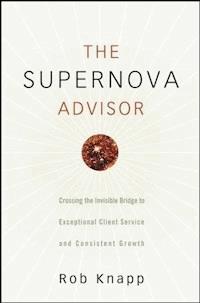
The Supernova Model is a client service, client acquisition, and practice management model that drives an explosive acceleration in revenue and client satisfaction by capitalizing upon the 80/20 Rule. First implemented by financial advisors at Merrill Lynch--under the leadership of author Rob Knapp--it has grown increasingly popular within the financial services industry. The Supernova Advisor skillfully outlines this proven model and reveals how it can be used to create an exceptional experience for your clients, while significantly growing your business.
Sie lesen das E-Book in den Legimi-Apps auf:
Seitenzahl: 179
Veröffentlichungsjahr: 2010
0,0
Bewertungen werden von Nutzern von Legimi sowie anderen Partner-Webseiten vergeben.
Legimi prüft nicht, ob Rezensionen von Nutzern stammen, die den betreffenden Titel tatsächlich gekauft oder gelesen/gehört haben. Wir entfernen aber gefälschte Rezensionen.
Ähnliche

















Table of Contents
Title Page
Copyright Page
Dedication
Foreword
Acknowledgments
Introduction
When Clients Attack
When Clients Leave
Two Emergencies, One Question
The Science of a Supernova
Where It Leads
The Bear Was Back
Arriving at Your Moment to Choose
A Revolution from the Middle
The Steps on This Bridge
CHAPTER 1 - The Trouble with Success
Pareto’s Discovery and the Beginning of the Vital Few
Because the Money Kept Coming
CHAPTER 2 - Contact
“Talk to Me—Here’s When”
What Drives Exceptional Service
Doing the Math on Client Contact
The Supernova Contact Ritual: 12/4/2
Contact Is Not Discipline—It’s Ritual
Let’s Refocus
CHAPTER 3 - Segmentation
“You’re on Service Probation”
The First Hurdles
Segmentation 101 to 401
Segmentation Isn’t Subtle
The 11 Screens
Client Upgrades, Client Handoffs
Min/Max
Grow the Team with the Business
CHAPTER 4 - Organization
Inverting the Org Chart
An Update on the “Permanent Record”
A Day in the Life
The CA Owns the Calendar—Period
The Bank of Trust: Now Accepting Deposits
The Greatest Time-Saver Ever: Batch Processing
Ritual over Discipline
Golfers and Compliance Officers
“It’s What We Are Referred On”
CHAPTER 5 - Planning
What Money Can’t Buy
Beyond Binders
Planning Is Meaning with Deadlines
Planning and Implementation: Joined at the Hip
Your Family CFO
Planning Deepens and Protects Your Relationship
Investing as Nonhero
The Coach: You
The Family Office, Reimagined
CHAPTER 6 - Acquisition
Supernova Is Growth
Growth in a Minimum/Maximum Environment
The Mantra: Service and Growth
The Referral Mind-set
Putting Wheels on the Best Ideas
Go to the Folder
Diving in Vertically
Professional Networking at Supernova Speed
Who Has the Time?
CHAPTER 7 - Leading the Practice
Three Reasons to Change
Lessons from the Nation’s Best Dental Practice
The Supernova Gameboard
Reflective Accountability
Why People Change
The Bank of Trust, Internal Branch
Who’s the Boss?
Do More with Less—Really
Implementation Is Experimentation
Final Thoughts on Moving Forward
About the Author
Index
Copyright © 2008 by Rob Knapp. All rights reserved.
Published by John Wiley & Sons, Inc., Hoboken, New Jersey.
Published simultaneously in Canada.
Wiley Bicentennial Logo: Richard J. Pacifico
No part of this publication may be reproduced, stored in a retrieval system, or transmitted in any form or by any means, electronic, mechanical, photocopying, recording, scanning, or otherwise, except as permitted under Section 107 or 108 of the 1976 United States Copyright Act, without either the prior written permission of the Publisher, or authorization through payment of the appropriate per-copy fee to the Copyright Clearance Center, Inc., 222 Rosewood Drive, Danvers, MA 01923, (978)750-8400, fax (978) 646-8600, or on the Web at www.copyright.com. Requests to the Publisher for permission should be addressed to the Permissions Department, John Wiley & Sons, Inc., 111 River Street, Hoboken, NJ 07030, (201) 748-6011, fax (201) 748-6008, or online at http://www.wiley.com/go/permissions.
Limit of Liability/Disclaimer of Warranty: While the publisher and author have used their best efforts in preparing this book, they make no representations or warranties with respect to the accuracy or completeness of the contents of this book and specifically disclaim any implied warranties of merchantability or fitness for a particular purpose. No warranty may be created or extended by sales representatives or written sales materials. The advice and strategies contained herein may not be suitable for your situation. You should consult with a professional where appropriate. Neither the publisher nor author shall be liable for any loss of profit or any other commercial damages, including but not limited to special, incidental, consequential, or other damages.
For general information on our other products and services or for technical support, please contact our Customer Care Department within the United States at (800) 762-2974, outside the United States at (317) 572-3993 or fax (317) 572-4002.
Wiley also publishes its books in a variety of electronic formats. Some content that appears in print may not be available in electronic formats. For more information about Wiley products, visit our Web site at www.wiley.com.
Library of Congress Cataloging-in-Publication Data:
Knapp, Rob, 1946-
The supernova advisor : crossing the invisible bridge to exceptional client service and consistent growth/Rob Knapp.
p. cm.
Includes index.
ISBN 978-0-470-24927-7 (cloth)
1. Investment advisor-client relationships. 2. Customer relations. 3. Management. 4. Leadership. I. Title.
HG4621.K64 2008
658.8’12—dc22
2007034473
This book is dedicated to my wife, Marcia, and our children, Courtney and Christopher. Their patience and faith kept my travels from becoming absence. Their enthusiasm inspires me almost as much as their love nourishes me. The rest of my life is dedicated to returning everything they have given.
Foreword
When Rob Knapp asked me to contribute the forward on his Supernova book, I agreed straightaway. But before we go forward, let me take you back a bit. I’m considered somewhat of an expert on helping leaders create changes in people—changes that result in a better bottom line for their organization. At least, that’s the work I get paid to do.
It’s no secret that getting people to change themselves, not because they have to, but because they want to, defines the word leadership. The drama plays out when a leader is coaching others to willingly get out of their comfort zone, jump into their learning zone, and start to think and behave in new or different ways. This is the most difficult assignment that any leader can tackle, whether as a parent, teacher, minister, priest, rabbi, boss, or friend. When that’s happening, change is happening, and it’s a leaders job to spark those happenings.
Rob Knapp is one of those rare leaders.
Rob and his teams have gotten a PhD in the hard knocks school of leaders leading change. Better yet, they’ve transformed what they’ve learned into a powerful change system called Supernova. This is a can’t-fail change system that anyone who’s willing to do the work can accomplish. How do I know? I saw it happen, saw it with my own eyes, saw it big time, and saw it create fabulous results for all the players in the game.
Okay, now we can move forward. I want to take you forward into your future so you can see what I saw.
I saw Rob and his teams leading groups of stubbornly entrenched people to willingly transform themselves by turning to a new path of future possibility that truly set them free. It’s the path of the Supernova advantage.
And that’s only half of the story. As a client of one of these Supernova teams, I experienced all the Supernova customer benefits that set me free. Okay, you got it; I’m a huge Rob Knapp fan, just as you’ll be by the time you get to middle of Chapter 1 in this book. Rob makes you want to follow him because it will set you free—free to become the most successful and fulfilled advisor coach in your niche of the world. I can sum up in two words what you’ll want to do after you’ve read the last page: Clone him.
Rob Knapp is a rare person who can lead a traditional command-and-control organization through genuine sustainable change. And when that person is neither the commander nor the controller of that organization, it’s beyond rare. It’s remarkable. It’s in the realm of phenomenal.
Look, my business is change—studying it, coaching it, inhabiting it, and inhaling in very personal terms—and I’ve never encountered anyone like Rob Knapp. In the dictionary of Larry Wilson, look up change agent and you’ll see Rob’s picture. Look up Supernova and you’ll see a couple of thousand more people who successfully changed the way they work because, through Rob’s teaching, they changed how they even thought about work. They weren’t told to change; they changed because Rob and his teams showed them an idea powerful enough to overcome all the negative barriers to change.
The role of any leader is to bring about change, not because change itself is inherently better than the status quo, but look out the window and notice that our whole world is changing. Staying put is a recipe for failure, so it’s a leader’s prime responsibility to get others on a better path to success and fulfillment. It’s then they’ll want to develop themselves so they too can become leaders in the rapidly changing cultural landscapes we all inhabit. Rob’s not the first guy to figure this out. In fact, the need to continually evolve with, or ahead of, the business environment is becoming a basic survival strategy in every leader’s tool kit.
So why, then, is change so hard to execute, and how did Rob and his team accomplish it? The answer awaits you, but I’ll offer this preview: Rob realized that leading people to change is an emotional challenge, not merely an intellectual one. When Rob invited the financial advisors of Merrill Lynch to follow him onto the invisible bridge, he didn’t hire teams of hotshot outsiders. He tapped into the emotions of the people within the Merrill culture, and refocused them with imagination, intuition, and, yes, intelligence. There were some very rational, left-brained reasons why adopting Supernova made sense, and Rob integrated them within an argument as emotionally powerful as it was intellectually sound.
The adoption of Supernova was a phenomenon in another way, too, equally as compelling. It arose from the field, where the problems were felt and the answers were forthcoming when true leaders give expectations, permission, and protection to their followers to do so.
In most organizations, attempting change is driven too much from the top. Solutions are fashioned not from collaborating with the field, but by pushing down “do what you’re told to do” from those furthest from the customer. No invisible bridge, just planks to walk and orders to follow. The Supernova story has a totally different look and feel and produces more results with less effort and far less stress.
It’s a story of the people—the little people—trusting each other and leading each other to the promised land of fruits and honey.
All that being said, Supernova wasn’t the focal point of reorganization. There were no special project teams pulled away from their day-to-day jobs. The people at the center of Supernova simply volunteered to help spread the word about a better way to serve their clients and grow their business. Why? Their visibility certainly wasn’t going to help them advance through the organization, and there were no bonuses waiting on the other end of a successful implementation.
The people who preached Supernova simply did so for the good of their peers. Why do soldiers fight? Not for a flag, but for each other. Not to overdo it, but this group led this collaborative change process for one another. And, I’m delighted to report, for their clients—clients like me. Now that’s different!
As I said, I’m a loyal client of a Merrill team that adopted and still practices Supernova. They execute the model expertly, and they continue to grow, and so do I. I love to recommend them. They treat me as though I’m one of their best clients, and it’s not because I have tens of millions parked with them. It’s because of their Supernova mind-set.
You’ll learn all about the magic of the model as you read Rob’s book.
As a client of a Supernova team, I really relish the service and the investment expertise. I have a financial plan based on my life plan; my investments are built around that financial plan, and I get a phone call every month, four reviews and two in person. I also appreciate that my team has time for me if I have a problem, and it is resolved quickly. This is very different than my previous experience. I am eager to refer business to my financial advisor team. They, too, treat me as though I am one of their best clients. I know why now. It’s because of Supernova. And Supernova is because of Rob Knapp.
I’ll never forget watching Rob as he retold the story of Indiana Jones standing on the cliff, torn between his fear of falling and his trust that the bridge would hold him. Trust won out for Indiana Jones, and for the thousands of professionals who crossed the bridge. Rob’s gift then, and now, is that he knows that trust is the glue that advances all of us as professionals and enriches us as humans.
So The Supernova Advisor is as close to cloning Rob as you can get. His genius is in here, as well as his creativity and generosity. Don’t just read this book—devour each and every practice as though your future depends on it, because it does. Cross the bridge, and be sure to bring your customers along with you. When everybody wins, the world is a better place. Thank Rob and yourself for making a difference in so many lives. So Be It!
LARRY WILSON September 2007
Larry Wilson is widely considered one of the foremost thinkers, speakers, and doers in the business world today. He founded two premier companies: Wilson Learning Corporation (1965), a more than $50 million training and research organization; and Pecos River Learning (1985), a change management and leadership development organization. These companies Larry founded have carved new territories in how we think about business, customers, and ourselves. Larry’s newest venture is called Wilson Collaborative, a new business model for new thinking leaders.
As an author, his writings are world renowned. In 1984, he co-authored the best seller The One-Minute Sales Person (Morrow, 1984), which sold over one million copies. His other best-selling books include: Changing the Game: The New Way to Sell (Simon & Schuster, 1987) and Stop Selling, Start Partnering (John Wiley & Sons, 1997). His latest book, Play to Win! Choosing Growth over Fear in Work and Life (Bard Press, 1998), was selected Best Business Book for 1999 by Fore Word magazine as well as winning the prestigious Benjamin Franklin Award for Best Business Book for 1999. He is a Senior Fellow at the College of Education & Human Development, University of Minnesota. In May 2005, Northland College granted Larry an honorary PhD in business.
Acknowledgments
Supernova was created in the rarest of spaces, a place without ego, a region where the personal pronoun “I” yielded to a larger purpose. Supernova was brought to life by a group of people, to help a large group serve an even larger group. We created a new way to work, and grow, and serve. Here, I honor their courage and celebrate their success.
To chronicle my appreciation, Supernova’s initial practitioners are the best place to begin. We called them “Pioneers” because they were truly the first to venture into this new territory. They took the leap of faith and stepped onto the invisible bridge first—George Kempf, Tony Singh, Jim McEnerney, and Hagood Ellison were Supernova’s most persuasive spokes-people, not because of what they said but because of what they accomplished. You’ll read some of their stories in the chapters ahead.
Jim Walker, the Chief Administrative Officer of Merrill Lynch, helped us develop the solid footing that Supernova rose from. His contribution to “8 Steps to Success” was Supernova’s genesis. Jim did all the original research to support what we felt intuitively. He brought researchers from Har vard and MIT into the conversation and invited them to poke and probe at Supernova, to test it in laboratories, and tell us the truth about what we had created. As CAO, Jim gave us the executive air support we needed, and he stood with us on stage at that very first rollout meeting in Boston. His very presence said simply, “I believe.” And I am very grateful.
Jeff Ransdell did more than give the model its wonderfully appropriate name. He also gave us the confidence to take Supernova on the road to other Merrill Lynch districts. He knew that peer-to-peer transmission was the only way this disruptive idea could thrive. Jeff helped construct the core pieces of Supernova. He designed the spreadsheet and did the research that put the first hard ceiling on how many clients could take a seat on the first Supernova flights.
John Hesse deserves more than can be acknowledged here. Far more. He put in hundreds of hours developing the Supernova software and then trained Supernova tech teams across the country. He was the Supernova tech support department, and it’s fitting that the software he created—that helped FAs simplify and justify their client segmentation decisions—is often called “The Hesse Report.”
Jon Spafford’s early insight that merely annuitizing the FA’s business wasn’t going to help it thrive. His idea to “automate” and “elevate” are still alive today in the Supernova advisor’s organization and segmentation. Jon is an engineer of the advisory business, brilliant, visionary, and greatly appreciated.
Kim Firestone was Supernova’s first and only full-time employee. And that doesn’t come close to describing how central and essential she was to its success. No one else could manage the technology and the human personalities as well as Kim. She was a one-person training department. She stayed in the districts after the presentation team left and helped transform the enthusiasm into meaningful change. She was, and is, a force of nature whose energy sustained Supernova throughout its development.
James Gorman envisioned Supernova as integral to the Merrill Lynch strategy and allowed its early promise to prove itself in the FA teams across the country. His steady confidence was a source of strength for every member of the development team and every FA who took the step onto that bridge.
Andy Seig and Bob Sherman helped Supernova survive through their determination to help Merrill’s client call center develop in both capacity and service capability. Without their advocacy, Supernova could not have succeeded on the scale that it did.
Karla Ransdell kept us focused on where Supernova’s soul resided: planning. Her enthusiasm for the entire model energized us all.
Bob Dineen was the first one to suggest we take Supernova on the road. Did I say “suggest”? He nearly commanded us, and we’re grateful that he did.
Before Supernova erupted and all we knew was our service was eroding and our clients were leaving, Jim Shoaf was a warrior for knowledge. His energy drove us deep into the structural issues at the core, and his continual challenges propelled us toward the solution that became Supernova.
Supernova puts the client associate in a leadership position on the team, so it’s fitting that our own Supernova team had Kelly Carroll front and center. She was both a spokesperson from the stage during rollouts and a superb supporter for the teams implementing Supernova.
Darby Henley’s firsthand understanding of accountability’s power to transform a team was essential to developing the leadership components of Supernova. And Bob Johnson was the first to suggest that our Supernova principles created something greater than the sum of its parts when configured in the five-star constellation we see today.
Like all exceptional assistants, Mary Ann Urbancic’s contributions can’t be specifically identified because there simply aren’t enough pages. Suffice it to say, she did about everything, every day. The more complex the challenge, the more calm competence she brought to it. Supernova is as much hers as it is anyone else’s on these pages.
I learned long ago that the title of mentor should not be granted easily. Given the level that genuine mentors operate on, it’s nearly a sacred title. Mentoring me now and throughout my career have been Richard Weylman, Larry Wilson, and Jim Loehr.
Richard helped me see the wisdom and elegance in Supernova’s early emphasis on segmenting our clients and organizing our service. His mentorship then deepened as we discussed, and then presented, Supernova’s acquisition component. Richard added immeasurable richness and impact by helping our FAs to present themselves as true brands. He was, and remains, ahead of his time.
Larry’s restless brilliance has inspired me to challenge the status quo while simultaneously envisioning new pathways. His life of choosing growth over fear is true leadership embodied. He is a teacher of the highest order.
Jim’s insights into reaching and sustaining peak performance have reshaped not only how I work, but how I live.
This book has been a collaboration nearly as enriching as Supernova itself, and several people deserve my gratitude. Julie Young is a spirited muse and a careful reader. I’m deeply appreciative of her continuing guidance and gently powerful wisdom. Greg Perry inhabits every page of this book. In our editorial partnership, he lifted Supernova out of my memory and helped me see it with fresh eyes and communicate it with renewed vigor.
My appreciation extends to every advisor and every team that brought this new way of working into their businesses. Each one stood on the edge of a canyon and took an exhilarating first step onto the invisible bridge of Supernova. This book is for them, and for every professional who follows them.
ROB KNAPP September 2007
INTRODUCTION
Stepping onto the Invisible Bridge
YOUR JOURNEY TOWARD THE EXCEPTIONAL
Some movies offer remarkably appropriate metaphors for the choices we make in our careers and lives. In Indiana Jones and the Last Crusade,




