


4,39 €
Mehr erfahren.
- Herausgeber: Shepherd Walwyn Publishers
- Kategorie: Geisteswissenschaft
- Sprache: Englisch
The Teaching of Reality is, as far as we know, the first translation into English of Tattvopadeśa, a work attributed to the great spiritual teacher Śankara. The text reveals the full significance of the great sentence ‘You are That’ (tat twam asi), which is said to convey the essence of the entire teaching of the Upanishads and to be the key to Advaita, the philosophy of non-duality. The reader is led through a systematic process enabling the real Self to be realised in practice.
Sie lesen das E-Book in den Legimi-Apps auf:
Seitenzahl: 32
Veröffentlichungsjahr: 2015
Ähnliche




















THE TEACHING OF REALITY
THE TEACHING OF REALITY
Śrī Śaṅkara Ācārya’s
Tattvopadeśa
Translated by
WARWICK JESSUP
SCHOOL OF ECONOMIC SCIENCE
© Warwick Jessup 2014
All rights reserved. No part of this book may be reproduced in any form without the written permission of the publisher, The School of Economic Science.
This translation first published in 2014 by
The School of Economic Science
11 Mandeville Place, London W1U 3AJ
www.schooleconomicscience.org
EPUB 978-0-9565968-6-4MOBI 978-0-9565968-7-1PDF 978-0-9565968-8-8
The SanskritpadaTM, SCompTM and Flags2TM Sanskrit fonts used in this book are designed and distributed by David Hockley, Oxford (tel. 01844 339944);
© 2003 David Hockley.
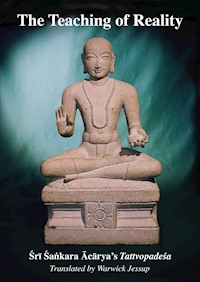
Cover: sculpture of Ādi Śaṅkara by Devalankunda Vadiraj
Photograph © Richard Wythe
Cover design by ml design
Typeset by Alacrity, Chesterfield, Sandford, Somerset
Printed and bound in the United Kingdom
by s|s| media limited, Rickmansworth, Hertfordshire
DEDICATED TO
HIS HOLINESS SHRI SHANTANANDA SARASWATI MAHARAJ JI
ACKNOWLEDGMENTS
The following should be acknowledged: Mr Leon MacLaren, for his initial inspiration in the study of Advaita, Dr Satyanarayana Sastry, the Rev. Dr Stephen Thompson, Mrs Isabelle Glover and Mr Paul Douglas for their helpful comments, Mr Michael Croza-Ross for typing the whole text and suggesting improvements, and Mr Donald Lambie for proposing the translation and providing constant support. Any errors are the responsibility of the translator.
INTRODUCTION
Tattvopadeśa, literally ‘the pointing out’ (upadeśa) of reality (tattva), is one of many works attributed to Ādi Śaṅkara, the first of the Śaṅkara Ācāryas, and the most eminent exponent of Advaita Vedānta. It is here rendered into English – to the best of our knowledge for the first time.
‘Vedānta’ means ‘end of the Veda’, referring to the Upaniṣads. The Upaniṣads occur at the end of each of the four Vedas, the compositions which are at the basis of the Sanskrit tradition. Literally, ‘veda’ simply means ‘knowledge’. So ‘vedānta’ can be taken as ‘the culmination of knowledge’.
‘Advaita’ means ‘non-duality’. It is this non-duality which is taught by the sentence ‘You are That’ (tat tvam asi). This sentence is said to convey the essence of the entire teaching of the Upaniṣads. Tattvopadeśa offers insight into how ‘You are That’ (tat tvam asi) should be understood.
Words have layers of meanings, and to discover the true meaning of a word or sentence in its context, correct analysis needs to take place. In considering the great statement ‘You are That’ (tat tvam asi), the system of analysis adopted by the Tattvopadeśa is, in essence, elimination (vyatireka) followed by positive realisation (anvaya). Superimposed erroneous meanings of ‘You’ (tvam), such as being a body, and of ‘That’ (tat), such as omniscience, are eliminated, clearing the way for the positive realisation of the Absolute (brahman). The text explores the implied meaning (lakṣaṇā) within ‘You are That’ (tat tvam asi) and analyses how the sentence operates as a whole to bring about the realisation of non-duality (advaita).
It is clear that this analysis is not just an intellectual exercise but rather an essential part of the process of reflection, with its three aspects – hearing the words (śravaṇa), application of the mind (manana), and profound understanding (nididhyāsana). Besides this, the text emphasises the importance of having a teacher, in accordance with the statement ‘One who has a teacher knows’ (ācāryavān puruṣo veda), Chāndogya Upaniṣad 6:14:2. A number of versions of the Sanskrit text have been considered, and the most likely readings adopted.
THE TEACHING OF REALITY
1 The Teacher spoke these words to his disciple1




