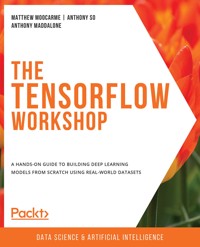
The TensorFlow Workshop - Matthew Moocarme - E-Book

The TensorFlow Workshop E-Book

Matthew Moocarme

0,0
31,19 €

-100%
Sammeln Sie Punkte in unserem Gutscheinprogramm und kaufen Sie E-Books und Hörbücher mit bis zu 100% Rabatt.

Mehr erfahren.
Beschreibung

Getting to grips with tensors, deep learning, and neural networks can be intimidating and confusing for anyone, no matter their experience level. The breadth of information out there, often written at a very high level and aimed at advanced practitioners, can make getting started even more challenging.

If this sounds familiar to you, The TensorFlow Workshop is here to help. Combining clear explanations, realistic examples, and plenty of hands-on practice, it’ll quickly get you up and running.

You’ll start off with the basics – learning how to load data into TensorFlow, perform tensor operations, and utilize common optimizers and activation functions. As you progress, you’ll experiment with different TensorFlow development tools, including TensorBoard, TensorFlow Hub, and Google Colab, before moving on to solve regression and classification problems with sequential models.

Building on this solid foundation, you’ll learn how to tune models and work with different types of neural network, getting hands-on with real-world deep learning applications such as text encoding, temperature forecasting, image augmentation, and audio processing.

By the end of this deep learning book, you’ll have the skills, knowledge, and confidence to tackle your own ambitious deep learning projects with TensorFlow.

Das E-Book können Sie in Legimi-Apps oder einer beliebigen App lesen, die das folgende Format unterstützen:

EPUB
MOBI

Seitenzahl: 496

Veröffentlichungsjahr: 2021

Bewertungen
0,0
0
0
0
0
0
Mehr Informationen
Mehr Informationen
Legimi prüft nicht, ob Rezensionen von Nutzern stammen, die den betreffenden Titel tatsächlich gekauft oder gelesen/gehört haben. Wir entfernen aber gefälschte Rezensionen.


The

TensorFlow Workshop

A hands-on guide to building deep learning models from scratch using real-world datasets

Matthew Moocarme, Anthony So, and Anthony Maddalone

The TensorFlow Workshop

Copyright © 2021 Packt Publishing

All rights reserved. No part of this book may be reproduced, stored in a retrieval system, or transmitted in any form or by any means, without the prior written permission of the publisher, except in the case of brief quotations embedded in critical articles or reviews.

Every effort has been made in the preparation of this book to ensure the accuracy of the information presented. However, the information contained in this book is sold without warranty, either express or implied. Neither the authors, nor Packt Publishing, and its dealers and distributors will be held liable for any damages caused or alleged to be caused directly or indirectly by this book.

Packt Publishing has endeavored to provide trademark information about all of the companies and products mentioned in this book by the appropriate use of capitals. However, Packt Publishing cannot guarantee the accuracy of this information.

Authors: Matthew Moocarme, Anthony So, and Anthony Maddalone

Reviewer: Abhranshu Bagchi

Managing Editor: Prachi Jain

Acquisitions Editors: Royluis Rodrigues, Kunal Sawant, and Sneha Shinde

Production Editor: Salma Patel

Editorial Board: Megan Carlisle, Heather Gopsill, Manasa Kumar, Alex Mazonowicz, Monesh Mirpuri, Bridget Neale, Abhishek Rane, Brendan Rodrigues, Ankita Thakur, Nitesh Thakur, and Jonathan Wray

First published: December 2021

Production reference: 1141221

ISBN: 978-1-80020-525-3

Published by Packt Publishing Ltd.

Livery Place, 35 Livery Street

Birmingham B3 2PB, UK

Table of Contents

Preface

1. Introduction to Machine Learning with TensorFlow

Introduction

Implementing Artificial Neural Networks in TensorFlow

Advantages of TensorFlow

Disadvantages of TensorFlow

The TensorFlow Library in Python

Exercise 1.01: Verifying Your Version of TensorFlow

Introduction to Tensors

Scalars, Vectors, Matrices, and Tensors

Exercise 1.02: Creating Scalars, Vectors, Matrices, and Tensors in TensorFlow

Tensor Addition

Exercise 1.03: Performing Tensor Addition in TensorFlow

Activity 1.01: Performing Tensor Addition in TensorFlow

Reshaping

Tensor Transposition

Exercise 1.04: Performing Tensor Reshaping and Transposition in TensorFlow

Activity 1.02: Performing Tensor Reshaping and Transposition in TensorFlow

Tensor Multiplication

Exercise 1.05: Performing Tensor Multiplication in TensorFlow

Optimization

Forward Propagation

Backpropagation

Learning Optimal Parameters

Optimizers in TensorFlow

Activation functions

Activity 1.03: Applying Activation Functions

Summary

2. Loading and Processing Data

Introduction

Exploring Data Types

Data Preprocessing

Processing Tabular Data

Exercise 2.01: Loading Tabular Data and Rescaling Numerical Fields

Activity 2.01: Loading Tabular Data and Rescaling Numerical Fields with a MinMax Scaler

Exercise 2.02: Preprocessing Non-Numerical Data

Processing Image Data

Exercise 2.03: Loading Image Data for Batch Processing

Image Augmentation

Activity 2.02: Loading Image Data for Batch Processing

Text Processing

Exercise 2.04: Loading Text Data for TensorFlow Models

Audio Processing

Exercise 2.05: Loading Audio Data for TensorFlow Models

Activity 2.03: Loading Audio Data for Batch Processing

Summary

3. TensorFlow Development

Introduction

TensorBoard

Exercise 3.01: Using TensorBoard to Visualize Matrix Multiplication

Activity 3.01: Using TensorBoard to Visualize Tensor Transformations

Exercise 3.02: Using TensorBoard to Visualize Image Batches

TensorFlow Hub

Exercise 3.03: Downloading a Model from TensorFlow Hub

Google Colab

Advantages of Google Colab

Disadvantages of Google Colab

Development on Google Colab

Exercise 3.04: Using Google Colab to Visualize Data

Activity 3.02: Performing Word Embedding from a Pre-Trained Model from TensorFlow Hub

Summary

4. Regression and Classification Models

Introduction

Sequential Models

Keras Layers

Exercise 4.01: Creating an ANN with TensorFlow

Model Fitting

The Loss Function

Model Evaluation

Exercise 4.02: Creating a Linear Regression Model as an ANN with TensorFlow

Exercise 4.03: Creating a Multi-Layer ANN with TensorFlow

Activity 4.01: Creating a Multi-Layer ANN with TensorFlow

Classification Models

Exercise 4.04: Creating a Logistic Regression Model as an ANN with TensorFlow

Activity 4.02: Creating a Multi-Layer Classification ANN with TensorFlow

Summary

5. Classification Models

Introduction

Binary Classification

Logistic Regression

Binary Cross-Entropy

Binary Classification Architecture

Exercise 5.01: Building a Logistic Regression Model

Metrics for Classifiers

Accuracy and Null Accuracy

Precision, Recall, and the F1 Score

Confusion Matrices

Exercise 5.02: Classification Evaluation Metrics

Multi-Class Classification

The Softmax Function

Categorical Cross-Entropy

Multi-Class Classification Architecture

Exercise 5.03: Building a Multi-Class Model

Activity 5.01: Building a Character Recognition Model with TensorFlow

Multi-Label Classification

Activity 5.02: Building a Movie Genre Tagging a Model with TensorFlow

Summary

6. Regularization and Hyperparameter Tuning

Introduction

Regularization Techniques

L1 Regularization

L2 Regularization

Exercise 6.01: Predicting a Connect-4 Game Outcome Using the L2 Regularizer

Dropout Regularization

Exercise 6.02: Predicting a Connect-4 Game Outcome Using Dropout

Early Stopping

Activity 6.01: Predicting Income with L1 and L2 Regularizers

Hyperparameter Tuning

Keras Tuner

Random Search

Exercise 6.03: Predicting a Connect-4 Game Outcome Using Random Search from Keras Tuner

Hyperband

Exercise 6.04: Predicting a Connect-4 Game Outcome Using Hyperband from Keras Tuner

Bayesian Optimization

Activity 6.02: Predicting Income with Bayesian Optimization from Keras Tuner

Summary

7. Convolutional Neural Networks

Introduction

CNNs

Image Representation

The Convolutional Layer

Creating the Model

Exercise 7.01: Creating the First Layer to Build a CNN

Pooling Layer

Max Pooling

Average Pooling

Exercise 7.02: Creating a Pooling Layer for a CNN

Flattening Layer

Exercise 7.03: Building a CNN

Image Augmentation

Batch Normalization

Exercise 7.04: Building a CNN with Additional Convolutional Layers

Binary Image Classification

Object Classification

Exercise 7.05: Building a CNN

Activity 7.01: Building a CNN with More ANN Layers

Summary

8. Pre-Trained Networks

Introduction

ImageNet

Transfer Learning

Exercise 8.01: Classifying Cats and Dogs with Transfer Learning

Fine-Tuning

Activity 8.01: Fruit Classification with Fine-Tuning

TensorFlow Hub

Feature Extraction

Activity 8.02: Transfer Learning with TensorFlow Hub

Summary

9. Recurrent Neural Networks

Introduction

Sequential Data

Examples of Sequential Data

Exercise 9.01: Training an ANN for Sequential Data – Nvidia Stock Prediction

Recurrent Neural Networks

RNN Architecture

Vanishing Gradient Problem

Long Short-Term Memory Network

Exercise 9.02: Building an RNN with an LSTM Layer – Nvidia Stock Prediction

Activity 9.01: Building an RNN with Multiple LSTM Layers to Predict Power Consumption

Natural Language Processing

Data Preprocessing

Dataset Cleaning

Generating a Sequence and Tokenization

Padding Sequences

Back Propagation Through Time (BPTT)

Exercise 9.03: Building an RNN with an LSTM Layer for Natural Language Processing

Activity 9.02: Building an RNN for Predicting Tweets' Sentiment

Summary

10. Custom TensorFlow Components

Introduction

TensorFlow APIs

Implementing Custom Loss Functions

Building a Custom Loss Function with the Functional API

Building a Custom Loss Function with the Subclassing API

Exercise 10.01: Building a Custom Loss Function

Implementing Custom Layers

Introduction to ResNet Blocks

Building Custom Layers with the Functional API

Building Custom Layers with Subclassing

Exercise 10.02: Building a Custom Layer

Activity 10.01: Building a Model with Custom Layers and a Custom Loss Function

Summary

11. Generative Models

Introduction

Text Generation

Extending NLP Sequence Models to Generate Text

Dataset Cleaning

Generating a Sequence and Tokenization

Generating a Sequence of n-gram Tokens

Padding Sequences

Exercise 11.01: Generating Text

Generative Adversarial Networks

The Generator Network

The Discriminator Network

The Adversarial Network

Combining the Generative and Discriminative Models

Generating Real Samples with Class Labels

Creating Latent Points for the Generator

Using the Generator to Generate Fake Samples and Class Labels

Evaluating the Discriminator Model

Training the Generator and Discriminator

Creating the Latent Space, Generator, Discriminator, GAN, and Training Data

Exercise 11.02: Generating Sequences with GANs

Deep Convolutional Generative Adversarial Networks (DCGANs)

Training a DCGAN

Exercise 11.03: Generating Images with DCGAN

Activity 11.01: Generating Images Using GANs

Summary

Appendix

Preface

1. Introduction to Machine Learning with TensorFlow