


9,99 €
Mehr erfahren.
- Herausgeber: Sonicbond Publishing
- Kategorie: Geisteswissenschaft
- Serie: On Track
- Sprache: Englisch
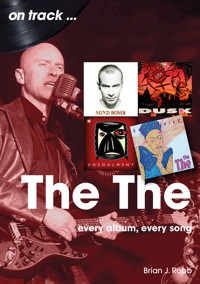
The The was always a personal project for songwriter Matt Johnson. Started in 1979, when Johnson was a teenager, the post-punk outfit became central to the political and personal pop of the 1980s. Never a singles band, despite a few minor hits, their albums were successful: Infected in 1986 reached 14, followed by 1989’s Mind Bomb at number four and 1993’s Dusk at number two. Band members included Johnny Marr and DC Collard, with other collaborators including JG Thirlwell, Jools Holland, Neneh Cherry, Zeke Manyika, and Sinead O’Connor - a Who’s Who of 1980s independent pop.
A reluctant live musician, Johnson created Infected: The Movie instead of a world tour in 1986. The Mind Bomb band, including Marr and Eller, launched the 1989-90 The The vs The World tour. Johnson appeared to retire following 2000’s Naked Self, although he kept busy, with a sideways move into scoring movies. It wasn’t until 2018 that The The returned to playing live and this was followed in 2024 with the new album, Ensoulment and its accompanying tour, almost a quarter of a century after the band’s last recorded music. In recent years, Johnson has been busier than ever with podcasts, an Official Bootleg series,and other idiosyncratic projects.
The Author
Brian J. Robb is the New York Times and Sunday Times bestselling biographer of Leonardo DiCaprio, Johnny Depp, and Brad Pitt. He has also written books on silent cinema, the films of Philip K. Dick, Wes Craven, Laurel and Hardy, the Star Wars movies, Superheroes, Gangsters, and Walt Disney, as well as science fiction television series Doctor Who and Star Trek, and Depeche Mode for Sonicbond Publishing. His illustrated books include an Illustrated History of Steampunk and Middle-Earth Envisioned, a guide to J.R.R. Tolkien's The Lord of the Rings (Winner, Best Book, Tolkien Society Awards). He is a Founding Editor of the Sci-Fi Bulletin website and lives near Edinburgh, UK.
Das E-Book können Sie in Legimi-Apps oder einer beliebigen App lesen, die das folgende Format unterstützen:
Seitenzahl: 290
Veröffentlichungsjahr: 2025
Ähnliche

















The The
Every Album, Every Song
On Track
Brian J Robb
Contents
Introduction
1. See Without Being Seen (1978, 2020)
2. Burning Blue Soul (1981)
3. Soul Mining (1983)
4. Infected (1986)
5. Mind Bomb (1989)
6. Dusk (1993)
7. Hanky Panky (1995)
8. Naked Self (2000)
9. The The Miscellany
10. Ensoulment (2024)
Bibliography
Introduction
If given his time over again, musician and songwriter Matt Johnson may have chosen a more user-friendly band name for his musical endeavours over the next 45 years. As it was, aged just 17 in 1978, Johnson – at the urging of his friend and early collaborator Keith Laws – chose The The, a name that would confound search engines in the 21st-century internet age. Even Johnson’s actual birth name doesn’t help much. In a pop music context, there is Jamiroquai’s keyboard player, Matt Johnson, and another independent UK- based singer/songwriter also named Matt Johnson! Beyond music, Johnson shares his name with a Canadian actor and film director, an author of paperback thrillers and a Welsh broadcaster!
Asked about the band name in 2006, Johnson was philosophical. Talking to Chaos Control, he rather wearily noted: ‘It has been raised before and, of course, I have thought about it and received numerous complaints about it, too. Obviously, I cannot change the name of my band at this late stage, but what we have tried to do is to get Sony [owner of the back catalogue] to contact various online retailers to tweak their search engines to accommodate the name. Some have responded to this. It also depends on how you type the name: The The, “The The”, ‘TheThe’.’
On the other hand – as so often in his lengthy (and, perhaps, underproductive) career – Johnson took a perverse delight in being difficult to find. ‘It does make it harder to find unauthorised recordings, bootlegs, [and] free downloads of The The, which I’m quite happy about’, he candidly admitted. ‘Also, in the internet age when people are becoming increasingly spoilt and expect to find anything [and] everything they want instantly, maybe it’s a good thing that The The has gone back to being the underground, word of mouth band it always was? Maybe it’s good for people to have to dig around a little to find the things they want rather than having everything served up...?’
Back in 1979, when Johnson was just a teenager, such future concerns were far from his mind. His musical experiments began with reel-to-reel tape, that most analogue of mediums. He began working with overdubbing, combining his vocals with his self-taught musical abilities (‘I’ve always been reluctant to describe myself as a musician in a lot of ways’, he told Tape Op), in the basement of his parents’ pub, The Crown. He quickly turned that experience into a professional opportunity when he secured the position of ‘tape op’ – a tape operator, or more formally, ‘an apprentice sound engineer’ – at De Wolfe Studios at the heart of London’s Soho, not too far from that city’s own Tin Pan Alley, Denmark Street. Eager to impress, Johnson was given permission by his bosses to use his downtime to work on his own music, utilising the studio’s equipment.
Across its history, with various combinations of members, The The have never been a chart-storming outfit. By 2024, as the band embarked on their first tour since 2018, accompanying new album Ensoulment – the first for 25 years – the band had racked up a mere 52 weeks in the top 75 singles chart, with only seven of those reaching the top 40. The two highest chart hit singles were the Disinfected EP (1994), which reached number 17, and the band’s political anthem ‘The Beat(en) Generation’, which reached number 18. Between them, those two records only troubled the singles chart for nine weeks. ‘Heartland’, the third most-popular single, made it to number 29 and spent 11 weeks in the charts.
It was a different and more successful story with album releases. Both 1989’s Mind Bomb (number four) and 1993’s Dusk (number two) made the top five, an improvement on the two earlier albums: 1983’s Soul Mining (number 27) and 1986’s Infected (number 14). Even Johnson’s typically idiosyncratic album of Hank Williams covers, Hanky Panky, made it into the top 30 at number 28. It was all the more disappointing that the sublime 2000 album Naked Self – the most recent original album prior to 2024’s Ensoulment (which reached a respectable number 19) – only made it to number 45 and remained in the chart for a single week. His 1993 song ‘Slow Emotion Replay’, from his biggest hit album Dusk, neatly sums up Johnson’s most frequent lyrical obsessions: ‘So don’t ask me about war, religion, or God, love, sex, or death...’
It’s no wonder that Johnson released little new material for the better part of the next two decades, making his small but dedicated following wait. In the first decade of the 21st century, Johnson didn’t touch his guitar for seven whole years. However, chart history alone does not do justice to the life and work of a musical creator as complex and conflicted as Matt Johnson.
Johnson was born in 1961, so he was exactly the right age to experience the tail-end of the DIY musical explosion of punk in the mid-1970s. Johnson grew up in pubs with his parents, Eddie and Shirley (of the Blitz generation – not the club, but the Second World War), and three brothers: Eugene, Andrew and Gerard. He and Andrew took advantage of instruments left by guest bands to play at being pop stars. His musical interest was sparked by living above The Two Puddings pub on Stratford Broadway, East London. The place Johnson called home had been notorious for its violence in the 1940s and 1950s, when it was nicknamed the Butcher’s Shop thanks to the frequently spilt blood on its white tiles. Growing up, Johnson didn’t know that history, but his father, Eddie Johnson, did. He was the landlord of The Two Puddings from the year after Matt Johnson’s birth until the pub finally closed in 2000. It was a storied venue that had played host to the likes of The Who, Screaming Lord Sutch (whom Johnson remembered carting a skull with exotic red jewelled eyes around with him), The Small Faces and David Essex, who made his live debut in the pub. As a kid, Johnson was barely aware of who the acts were that his Uncle Kenny (Eddie’s younger brother) was signing up to play. From his bedroom, he could hear the glorious noises they made, and wondered – as he drifted off to sleep – what it might be like to be them...
Johnson grew up in an environment in which music was all pervasive, and storytelling was an everyday working-class art form (his father, Eddie, was a frustrated writer – Johnson would publish his memoir Tales From The Two Puddings when Eddie was 80). Not allowed in the pub or out onto the Stratford streets, Johnson and his older brother, Andrew, lived in an imaginative world they conjured up in the back yard. The younger Johnson soon joined Andrew at the local school where he was terrorised by aggressive dinner lady ‘Mrs Mac’ (commemorated in his 2007 song). His younger brother, Eugene, joined the family in 1965, and by 1973, the quartet of brothers was completed with the arrival of Gerard (born on 1 January 1973, and hailed on the BBC’s Nationwide as the first baby born since Britain entered the Common Market). Three of the brothers – Matt, Andrew and Gerard – would all work together in several artistic pursuits, from music and art to films.
There were other homes (a brief stint in the Suffolk countryside) and other pubs (the haunted 17th-century The King’s Head in Ongar, where Johnson attended the local comprehensive). He remembers the first record he ever bought – T. Rex’s ‘Ride A White Swan’, released as a single in October 1970. More interestingly, given his eventual musical evolution, Johnson also recalls buying 1974’s Snowflakes Are Dancing, Isao Tomita’s second album of electronic soundscapes (based on composer Claude Debussy’s ‘tone paintings’) – a sophisticated taste for a 13-year-old.
Johnson’s ambitions to make music emerged around the age of 11 in 1972, helped along by a friend from Ongar, Nick Freeston, who had been given a drum kit for Christmas. Johnson had an old acoustic guitar, and he ‘appropriated’ the family reel-to-reel tape recorder. They were joined in their musical endeavours by a third member, Russell Ball, who, due to his eccentric appearance and proficiency at school, was known as ‘the Prof’. Their first efforts consisted of reproducing tracks from The Beatles’ album Help. They called themselves Roadstar.
By 1974, the Prof was gone, replaced by Brett Giddings, who came with all sorts of exciting new equipment and even some musical competence. As Johnson recalled to biographer Neil Fraser: ‘With Brett we went from playing these rather weedy acoustic versions of Beatles songs to playing things like ‘Smoke On The Water’, ‘Black Night’ and ‘Rebel Rebel’, and thinking ‘This is great!’’ They were joined by a fourth member, Matt Bratby, who had his own bass guitar. Around this time, Johnson got more serious about his musical proficiency and started piano lessons.
‘[Roadstar] was my first band. That was a really important part of my life, and they were great guys – there was great camaraderie. The band was a wonderful creative outlet.’ The long hot summer of 1976 and the arrival of punk did little to change Matt Johnson’s prospects. Roadstar quietly fell apart as its various members left school and found jobs. For Johnson, too, school soon came to an end, and his indifferent academic performance meant his employment options were few. Working from a book titled So You Want To Be In The Music Business?, which big brother Andrew had bought for him, Johnson began writing to London record labels, studios and production houses in search of opportunity. Hundreds of letters later, in summer 1977, he scored a lowly job with De Wolfe, a venerable library music house that supplied music to film and television. Based in Soho’s Wardour Street, De Wolfe – right next door to the Marquee Club and across the street from the offices of Hammer Films – boasted a well-equipped eight-track recording facility, which immediately drew Johnson’s attention. Although a glorified tea-boy, 15-year- old Matt Johnson was in his element.
From his lowly position, Johnson was like a sponge absorbing the analogue technicalities of tape transfer systems and editing. He learned audio tricks – multi-track dubbing, reverse recording, complex edits, tape loops and audio distortion. He quickly came to realise that writing songs and learning to play instruments was just one part of being a musician – if he could conquer the recording studio, he’d be in an entirely new world.
While his parents relocated to The Crown in Loughton, Johnson was broadening his musical education with the encouragement of his De Wolfe colleague Colin Lloyd Tucker, who introduced Johnson to The Velvet Underground, The Residents and Pere Ubu. He also discovered Throbbing Gristle, Cabaret Voltaire and This Heat, all of whom were creating idiosyncratic, distinctive music in a post-punk mode. The punk DIY aesthetic combined with the new sounds made possible by the studio techniques he was learning and the new electronic instruments used by the likes of the earliest 1977 incarnation of The Human League opened up new musical horizons.
The basement cellar of The Crown became Johnson’s musical playground, kitted out with second-hand recording gear and instruments. He applied the techniques he’d picked up at De Wolfe to his own homemade recordings in the cellar of the pub. ‘I’d heard ‘Private Plane’ by Thomas Leer, which he did all by himself – all the playing and writing, everything. This was the big turning point because it introduced me to a whole new form of music. Leer had all these drum machines and [tape] loops and totally different instrumentation, and listening to his atmospheric experimentation opened up a whole new world. I realised then that I didn’t have to make songs that sounded like everybody else. People could put out a record they had made in their bedroom. That was really inspiring.’ By the age of 16, Matt Johnson’s musical direction had been set...
See Without Being Seen (1978, 2020)
Personnel:
Matt Johnson: vocals, instrumentation
Produced at Metropolis Studios (2020 remaster)
Producer: Matt Johnson
Label: Cineola (2020)
Chart places: n/a
UK release date: 1 May 2020 (2020 remaster)
Running time: 49:00 (2020 remaster)
All tracks written by Matt Johnson
Recognising the potential of the technology now available, from electronic instruments to advanced studio techniques, the still-teenage Matt Johnson began to think of himself as a one-man band, enabled by the changing way music was made and recorded. It also gave him something else he’d continually strive for: control. That didn’t mean he wouldn’t work with others (The The would become a catch-all umbrella for Johnson’s solo efforts and his output with a band made up of various individuals who would come and go over the next few decades). As early as November 1977, he’d placed an advert in the New Musical Express seeking like-minded collaborators: ‘Looking for a bass/lead guitarist into Velvets/Syd Barrett.’ He received many replies but failed to click with most applicants. One did get through Johnson’s reserve: Charles Blackburn, a year older than Johnson and on an extended stay in London from his home in Hull. For the first two months of 1978, the pair collaborated, developing, rehearsing and recording each other’s songs. It didn’t last – Blackburn eventually ran out of time, money and places to crash, and so had to return to Hull.
Johnson’s De Wolfe colleague Colin Lloyd Tucker was also making extensive use of the De Wolfe facilities during downtime to record his own music, overdubbing the instruments himself. He and other De Wolfe co-workers even played some support gigs at various London live music venues under the band name of Plain Characters. Johnson followed Tucker’s activities closely, even appearing as a vocalist on a Tucker track, ‘Casey’s Last Trip’ (adopting the band name French Ghosts).
Johnson continued working on his own music in the basement of his parents’ pub, bringing the results into De Wolfe to use their facilities to improve the quality of his work. This effort would come together as Johnson’s debut album, See Without Being Seen – a collection of what he called ‘demo tracks’ released in limited quantities on cassette in 1979. Recorded in late 1978 and early 1979, Johnson transferred his demos in March 1979 onto quarter-inch tape at De Wolfe, where he had access to a professional graphic equaliser that allowed him to ‘fine-tune’ his debut. He sold copies at gigs he attended, duplicated onto C30 cassettes – this original release consisted of seven tracks (the 2020 re-release totalled 13).
Writing to a friend, Steve Parry, Johnson noted of See Without Being Seen: ‘[It] deals with you or I (or anyone listening to the songs) as a spectator seeing abstract views of life, be it of people or situations or how people react to various situations and pressures.’ The concept of See Without Being Seen suggests that of a voyeur, an observer who is himself unobserved. It spoke to Johnson’s loner nature, his self-reliance and his self-perception as an outsider, socially, musically and politically. Politics in Britain was lurching rightward with the election of the Conservative government in May 1979. Johnson had grown up in a socialist environment, which – combined with his experiences as a young man in the 1980s – contributed to his avowedly left-wing outlook.
Johnson’s musical output was somewhat limited. The tracks on See Without Being Seen relied heavily on his Crumar keyboard, his guitar and his growing abilities with multi-track recording and the use of distortion and effects pedals. Disappointed by the results, Johnson lost faith in these early works, although he felt a couple of the songs might have potential. Looking back four decades later, Johnson confessed (in liner notes): ‘At my age, I’m well past the point of feeling embarrassed about the accuracy of the tuning, the sloppiness of the timing or the poor technical quality of the recordings. I listen to them now with intrigue, every chord, every note, signifying the baby steps of a mixed-up kid into the world of experimental sound recording.’
Johnson continued to rely only on himself. In between recording sessions, he moonlighted as a bass guitarist with Nick Freeston’s pseudo-punk band, then called Cardiac Arrest. In 1978, without Johnson but with Freeston on drums, Gavin Gritton on vocals, Ian ‘Haggis’ Haggerty on bass and Gary Dawson on guitar, they reformed as Anti-Establishment, releasing a trio of singles produced by The Damned’s Rat Scabies.
A second NME advert placed in 1979 called for aspirant musicians inspired by Throbbing Gristle and The Residents (he particularly liked their Duck Stab! EP), showing how Johnson’s musical influences were developing. Response to the ad was disappointing, but it did lead to one significant early partnership. Johnson met with three respondents, but only Keith Laws made enough of an impression. Now a professor of neuropsychology at the University of Hertfordshire, in 1979, Laws was the same age as Johnson and shared many of the same musical tastes. It was Laws who introduced Johnson to the Krautrock music of German experimental bands like Neu! and Faust. Laws also had a collection of instruments and recording equipment that matched Johnson’s own, with the addition of early synthesisers. The pair reckoned they had the equipment, ambition and songwriting skills necessary to launch a ‘proper’ band in a live setting.
‘Troops’ 2.47
A rudimentary drum machine kicks off See Without Being Seen, with distorted, inaudible, echoing vocals humming over the top. Johnson’s Crumar keyboard provides a synthy-sounding drone. It’s a muddy sound thanks to the multiple track overlays, but Johnson’s main vocals – seemingly describing the thoughts and actions of a military unit – are clear enough. The layering suggests a sonic ambition that, at the age of 17 and with limited equipment and resources, may have actually been beyond the developing artist. It’s a short (under three minutes), sharp blast of intent, and elements of the sound mix and the vocals are clearly indicative of the later direction of Johnson’s musical creativity. Not so impressed with the actual music when looking back, it is the memories of its creation that stick most strongly with Johnson. ‘Despite the imperfections of these recordings, there are very warm memories associated with their creation: my late older brother Andrew (Andy Dog [who contributed illustrations to The The’s output]) and I set up our respective small studios in the large cellar of our parents’ pub, The Crown … his for artwork, mine for music. We’d spend so many evenings down there … we’d sit up late into the night, animatedly discussing future plans, swapping ideas and offering encouragement...’ It was in this environment of spirited collegiate collaboration that ‘Troops’ and the rest of See Without Being Seen were created.
‘Homa’s Coma’ 3.51
Opening with Johnson’s youthful voice declaring ‘take one’, ‘Homa’s Coma’ opens with the drum machine running at a more rapid pace. The first hints of rhythm have the unmistakable feel (if expressed much more primitively) of many later The The records, even if the production remains murky. ‘Homa’s Coma’ proves the first instance of lyrics that would recur on more polished recordings. As Johnson hinted at in his liner notes: ‘The eagle-eyed may even recognise the odd lyric or melody that ended up appearing on later releases.’ The opening lyrics – ‘History repeats itself within the realms of my inexperience’ – instantly recall the later song ‘Icing Up’, with Johnson’s vocals on this earlier recording repeated almost exactly on the later iteration. Equally, ‘See me dwindle, watch me dwell/In my cut out corner, in my plastic world’ finds new life, slightly altered, at the end of ‘Icing Up’: ‘See me dwindle, watch me dwell/In my plastic corner, in my plastic world’. Johnson continually reworked and redeveloped some of this earlier material in the early days of the more professional releases under his The The banner. At the age of just 17, Johnson was not only capturing a sense of teen ennui but also capturing the future inertia that would inhibit his career. Recapitulating the punk cry of ‘No future!’, Johnson penned lyrics like ‘I have no future, for I’ve had no past’ – which also found its way into ‘Icing Up’, a more polished and expanded version of the ideas expressed in ‘Homa’s Coma’.
‘Planetarium’ 4.29
‘Planetarium’ is a frazzled pop song, aggressively played and sung, that – with sharper production – could have held its own against early work from the likes of The Human League or Cabaret Voltaire. From an inauspicious ‘plinky plonky’ start, ‘Planetarium’ turns into a much heavier, darker- sounding outing. The driving rhythm provides a suitable backdrop for Johnson’s voyeuristic vocals laid over the top. ‘I like to watch them’, he declares. ‘I like to watch them go walking by’. The lyrics have something of the bored teenager in a thankless work environment staring out the window at the people passing – ‘I can see everyone, can everyone see?’ Other lines suggest an envy about the lives others are living in comparison to the more mundane world of the singer: ‘I like to dream about them, the things they do at night’. Johnson even anticipates 21st-century constant surveillance, not least from people compulsively filming each other on phones: ‘I like to film them, and see them film me’.
There’s definitely something Hitchcockian here – from the obsession with following and watching in 1958’s Vertigo to the ‘peeping tom’ nature of Norman Bates in Psycho (1960), many of Hitchcock’s films featured voyeurism (Rear Window, 1954). It’s certainly possible that Johnson caught a matinee of one or more of Hitchcock’s films and found their themes chimed with his own preoccupations. There’s also the question of what exactly the ‘Planetarium’ of the title is. A planetarium is an educational theatre that recreates views of the night sky. The lyrics ‘Me in my room, in my planetarium’ suggest that the singer’s world is limited entirely to his own teenage bedroom. All he can do is look out, watching others living their lives. There’s a strict control on his own emotions, too: ‘Controlled elation, fights back again’. As well as the sonic sophistication of ‘Planetarium’, Johnson also shows signs of developing his lyrical obsessions.
‘Spaceship In My Barn’ 4.36
An instrument that would become key to much of The The’s output makes its first appearance at the opening of ‘Spaceship In My Barn’ – the harmonica. Above the fuzz of the layered multi-track drums and guitar, Johnson blows his harmonica before it is dropped in favour of his droning vocals. Suggesting a drugged state, the opening lines of ‘Spaceship In My Barn’ chronicle an out- of-body experience: ‘Caught in a dreamlike substance of my choice/open is my head receptive to every voice’. Suddenly, Johnson seems to be anticipating the plot of Steven Spielberg’s E.T.: The Extra-Terrestrial (which wasn’t released until 1982) suggesting he’s an alien ready to return to his home- world (perhaps a conscious echo of Bowie’s 1970s work?): ‘Up is my mind and open to the probe/When will they finally believe I really want to go home?’ It’s an interpretation suggested by the song’s explicit title, which also recalls the Superman comic book mythos, where the Kent family conceal the capsule that brings alien Kal-El to Earth in their Smallville barn. The return of the harmonica and the throbbing rhythm guitar suggest nothing less than Hank Williams, whose songbook Johnson would later cover on the 1995 Hanky Panky album.
‘Insect Children’ 3.51
The opening tribal rhythms of ‘Insect Children’ immediately call to mind the opening sounds of ‘Red Cinders In The Sand’, the first track on Johnson’s official first album, Burning Blue Soul. The off-kilter bass suggests The Doors, while the electronic fizz (especially at the fade) recalls the 1960s experimental electronic pop music of Joe Meek (‘Telstar’).
Johnson told Electronic Sound that some of the titles on See Without Being Seen – including ‘Spaceship In My Barn’ and ‘Insect Children’ – had been taken from old American comic books. Lyrically, though, ‘Insect Children’ shows little of that outer space influence. It seems to connect bad behaviour by children – the burning of insects – with the genocidal behaviour of rogue nations, leading to ‘Babies burning in their beds, wreathes of fire surround their heads’. It’s a hint of the political concerns that would inform the songs on 1989’s album Mind Bomb, already percolating within Johnson’s teen mind.
‘My Vymura’ 4.30
Throughout the history of The The, there have been three major themes: the frustrations of teenage life (especially in the early material, naturally); political and social issues, inspired by Johnson’s lived experience; and songs about various aspects of personal relationships (reduced to the basics of love and sex). The oddly-titled ‘My Vymura’ is the first ‘love’ song from Johnson. However, there is no getting away from the fact that the word ‘Vymura’ is more widely attached to a well-known brand of wallpaper. Perhaps Johnson was hoping for a gig writing advertising jingles? As it is, ‘Vymura’ appears to be the name of the singer’s romantic interest (‘My Vymura, how I love her’), a seemingly bright, happy and contented artist. There may be a certain irony in the otherwise bland lyrics, reinforced by the haunting laughter after each chorus, as if the singer doesn’t quite believe his own words. The song soon turns to questioning – ‘Do do do do, do you love me?’ – culminating in a possessive claim of ownership: ‘She’s mine’. This approach would echo through other The The songs, exploring the uncertainty of love, including the likes of ‘The Twilight Hour’ on Soul Mining and ‘August & September’ from Mind Bomb, culminating in the screaming cry ‘You’re mine!’.
‘Window Ledge’ 3.16
Haunting and introspective, ‘Window Ledge’ builds on the themes of isolation and longing in ‘My Vymura’. Lyrically, it’s a bit of a mess, talking about hiding in seashells, cooking pies and boxes of Dreft (a laundry liquid!). Amid this word salad, one line does stand out: ‘It’s the latest sensation, excluding the Pope’, a figure Johnson returned to in ‘Song Without An Ending’ on Burning Blue Soul: ‘What are we waiting for?/A message of hope/From the Pope’. Hiding here are lines reflecting thematic obsessions echoed in later tracks, like ‘I’m not quite as happy as I could have been’ and the bitter-sweet ‘We fixed up our candlelight, whispering our tunes/Is love the sweetest thing that’s happened to you?’
‘Window Ledge’ concluded the initial cassette release of See Without Being Seen. Johnson made an attempt to get his work picked up by a proper record label, to no avail. Talking to Wesley Doyle for Conform To Deform: The Weird And Wonderful World Of Some Bizzare [sic], Johnson recalled: ‘I spent a lot of time hanging around the offices of various independent record labels, playing my early recordings – tracks from See Without Being Seen and the unreleased Spirits album – to the likes of Mike Alway at Cherry Red, Ivo [Watts-Russell] at 4AD, Geoff Travis at Rough Trade and Rod Pearce at Fetish Records. I was a teenager, but I was very ambitious and anxious to get going … I felt I should really start putting records out.’ Talking to Electronic Sound in 2014, Johnson said the indie labels would at least ‘sit and listen to the tapes, [and] encourage me to keep at it’, unlike the majors, ‘who kicked me back horribly’. None of these approaches paid off, but Johnson was building up contacts who would help him later on, such as Ivo Watts-Russell, who served as a producer on Johnson’s Burning Blue Soul album in 1981.
‘Sugar & Spies’ 2.56
For the 2020 expanded CD release of See Without Being Seen, Johnson uncovered a further six tracks not included on the 1979 cassette-only release. Long thought lost, the recovered tapes were ‘baked’ (using an inexpensive food dehydrator), pitch corrected and speed adjusted to be as close as possible to his original intentions. The first of these rediscovered tracks is ‘Sugar & Spies’, a return to the theme of watching, although in this case, the lyrics are built around the reversed notion: ‘I cannot see you’. A pulsing buildup through electronic warbling backs Johnson’s echoing vocals. Feedback, programmed drums and whistling synths produce a track unlike anything else in the The The catalogue. It all peters out towards the end, concluding in the detuning ‘electronic tonalities’ – a credit for the electronic soundtrack of sci-fi movie Forbidden Planet (1956), used as composers Louis and Bebe Baron were not members of the Musicians Union – that Johnson often used to wrap up the tracks on See Without Being Seen.
‘White Stone On Earth’ 2.33
During the archival research that uncovered and restored the original cassette release, Johnson also discovered ‘quite a few other recordings from the era between the spring of 1978 and the spring of 1979 which, for some reason or other, didn’t make it onto the original cassette’. Of these, he noted that ‘White Stone On Earth’ was ‘my first foray into the techniques of Musique Concrète [composition using found sounds] and was inspired by a small book I had purchased at the time: Composing With Tape Recorders by Terence Dwyer’.
‘White Stone On Earth’ shares the minimal lyrics of ‘Sugar & Spies’, but sonically is very different. The drums sound like someone bashing biscuit tins and tinkling glass bottles, while Johnson exaggerates his ‘cockney’ accent when declaring such epithets as ‘White concrete/Green grass’. There are also other media with what sounds like a Radio 4 broadcast (perhaps the Shipping Forecast, among other news reports) dropped into the background. Feedback and radio tuning noises proliferate. Johnson would return to using media clips in several later songs, but most prominently in the opening of ‘Sweet Bird Of Truth’ on Soul Mining and ‘Armageddon Days (Are Here Again)’ on Mind Bomb. The second half slows the rhythm and ups the radio extracts (possibly from The Archers). The whole piece reeks of juvenile experimentation, an attempt at a mixed-media audio creation, but one that wouldn’t solicit record label interest. What ‘White Stone On Earth’ does, though, is suggest that Johnson’s interest in using found media extracts to add context to his songs was fully formed as far back as 1978-79.
‘People On Sight’ 3.37
The slower, gentler ‘People On Sight’ is hugely interesting for some of its lyrical content. The kind of preset rhythm that turned up later on ‘This Is The Day’ appears here – Johnson did have an Electro Harmonix Rhythm-12 drum machine, which came with a variety of preset drum patterns. A tempo control sets the pace of each rhythm. The initial drum pattern on ‘People On Sight’ sounds like one of the Latin settings. Johnson was experimenting with the pattern settings while overlaying keyboard hums and occasional guitar strums. Everything slows down for the end, with the vocals breaking up across the last minute as Johnson’s delivery becomes deliberately more hesitant before giving way to aural washes and a brief guitar melody. Of particular interest are the distinctive, notable lyrics: ‘Your right is left and your wrong is right/Your white is black and your black is white’. These reversed meanings also form the basis of the first single of 2024 from the album Ensoulment, ‘Cognitive Dissident’. Written in response to 21st-century culture wars, Johnson includes the evocative lines: ‘Left is Right, black is white’. This reveals that even at 17, Johnson’s distrust and doubt about the wider world, its credos and ideologies, was fully formed and questioning, a symptom of the rise of Thatcher’s Conservatives that would dominate 1980s Britain.
‘Let’s Do It Again’ 3.32
More programmed drumming, changes in tempo and odd foregrounded whistling form the basis of a track that brings Johnson’s rhythm guitar work to the fore. Lyrically and musically, it’s a doodle, a live-sounding jam that amounts to little. Whistling – as heard here – was a The The staple, although Johnson does indulge in some self-harmonising, something he’d incorporate into future songs. Just as the track fades, Johnson’s guitar work goes up a level and starts to sound like something from Burning Blue Soul. As with ‘Sugar & Spies’, this appears to be an experiment where Johnson was getting to grips with his instruments, techniques and vocal possibilities, not necessarily intended to be heard by an audience (or record label executives). As such, it is another curiosity that reveals the roots that would go on to make up the more sublime The The tracks.
‘Empty Night Train Home’ 5.18
Another obsessive setting for songs or musical vignettes, the late-night train home was something Johnson experienced on a daily basis working at De Wolfe in Soho while living in his parents’ pub in Loughton. The daily commute took its toll, and it is no surprise that it should become the subject of one of his earliest songs. There are no lyrics here. Instead, ‘Empty Night Train Home’ is an attempt to conjure up an atmosphere, one much better realised on ‘Diesel Breeze’ on Naked Self. Johnson’s vocal contributions consist of him attempting ‘chu-chu’ noises and some harmonising with his guitar work, interspersed with a few groans – an attempt to summon the atmosphere of his late-night train ride home in 1978. This approach would later pay off in his city symphony songs on Dusk.
‘Lazy Finger Shake’ 4.07
Both ‘Empty Night Train Home’ and ‘Lazy Finger Shake’ reveal that even at this early stage, Johnson was interested in instrumentals, something he would continue to produce for Burning Blue Soul (‘Red Cinders In The Sand’, ‘Out Of Control’ and ‘The River Flows East In Spring’). From its ‘whooshing’ opening and rudimentary drum machine beats, ‘Lazy Finger Shake’ meanders along, an indulgent guitar demo that is vaguely Eastern and is clearly a precursor of those later Burning Blue Soul instrumentals.
Related Tracks
‘Casey’s Last Trip’ 2.17
Matt Johnson appeared as a guest vocalist on a Colin Lloyd Tucker track, ‘Casey’s Last Trip’ (with the pair adopting the band name French Ghosts), with his contributions instantly recognisable. Included on Tucker’s 1984 solo album Toybox (recorded in 1978-79, but not released until five years later), Tucker’s vocal influence from 1970s David Bowie (and even Syd Barrett) is evident.




