


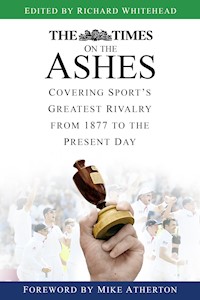
Erhalten Sie Zugang zu diesem und mehr als 300000 Büchern ab EUR 5,99 monatlich.
- Herausgeber: The History Press
- Kategorie: Lebensstil
- Sprache: Englisch
England against Australia for the Ashes – it is one of the oldest and greatest rivalries in sport and almost its entire history has been covered in The Times. The whole story is here: from Shane Warne's ball of the century in 1993 to Gilbert Jessop's power hitting at The Oval in 1902; from the infamous Bodyline tour of 1932–33 to England's surrender to the pace of Lillee and Thomson in 1974–75; from Len Hutton's Coronation-year triumph in 1953 to the long years of defeat before the Ashes were finally recaptured in 2005. The Times on the Ashes showcases great batsmen like Bradman, Ponting, Gower, Trumper, Boycott, Greg Chappell, and the great bowlers of Trueman, Warne, Larwood, Lillee, Underwood, McGrath, Anderson, along with the great captains such as Brearley, Ian Chappell, Vaughan, Armstrong, Jardine, Steve Waugh and Hutton. This book recaptures more than a century of the highs and lows of Ashes cricket through the pages of The Times and features some of the greatest writers in the history of the sport.
Sie lesen das E-Book in den Legimi-Apps auf:
Seitenzahl: 693
Veröffentlichungsjahr: 2015
Das E-Book (TTS) können Sie hören im Abo „Legimi Premium” in Legimi-Apps auf:
Ähnliche



















ACKNOWLEDGEMENTS
Although only one name appears next to ‘editor’ in the credits for this book, it was very far from being a solo project. It could not have been completed without the considerable assistance of many others.
Mark Beynon at The History Press was a swift convert to the idea and has been extremely supportive. Thanks are also due to Juanita Hall, the publisher’s production supremo, and Jemma Cox, the designer, who has done such a wonderful job.
The esteemed cricket photographer Graham Morris showed great generosity in allowing me access to his formidable archive of images, and TheTimes’ chief sports photographer Marc Aspland was a huge help. Without their talents this book would look a great deal greyer. Margaret Clark and Ian Whitbread on the picture desk provided vital technical assistance.
Among the writers, Simon Barnes, Tim de Lisle and Gideon Haigh kindly allowed me to use words that were not copyright of The Times.
Nick Mays, TheTimes’ archivist, and his assistant, Anne Jensen, were magnificent in rooting out the identities of various anonymous cricket contributors, and I cannot give adequate thanks to Dean Burrows for scouring the paper’s photographic library for many of the wonderful older images. Murray Hedgcock and David Frith kindly helped to identify some of the Australians in those pictures.
Various Times colleagues also gave inestimable help, especially Tim Rice who read the text so thoroughly and with impressive dedication. He was also the first to suggest that the concept might actually work. Walter Gammie, the world’s greatest cricket lover, was helpfully enthusiastic, and gentle encouragement came from Ian Brunskill and Tim Hallissey. Thanks also to my colleagues on the Register.
Christopher Lane at Wisden kindly supplied the photographs of Sydney Pardon and thanks are also due to my former colleague Marcus Williams whose book, DoubleCentury, provided invaluable information on Times cricket correspondents.
But the greatest thanks of all must go to my wife Marion Brinton and son Alex who put up uncomplainingly with my long absences from normal domestic life. I owe them a great debt.
Richard Whitehead
CONTENTS
Title
Acknowledgments
Foreword by Mike Atherton
Introduction by Richard Whitehead
Cricket Correspondents of The Times
Other Writers
Photographers
Notes on Style
England’s Heroes
Australia’s Heroes
Flashpoints
Brickbats
Captains
Pitches
Great Batting: England
Great Batting: Australia
Great Bowling: England
Great Bowling: Australia
Great Writing
Weather
Beyond the Boundary
The Fast Men
Fielding
Selection
England’s Glory Days
Australia’s Glory Days
Photographic Credits
Plates
About the Editor
Copyright
FOREWORD
by Mike Atherton
‘But now that suddenly a bowler, Larwood, has come into his own, and has dominated the play … we find that the full force of attack has returned to its proper place in cricket … and at once Test Match cricket has awakened from the sloth of the last 10 years and is again a glorious game’ so wrote ‘our cricket correspondent’ about the Bodyline series more than 80 years ago.
Cricket has changed immeasurably since then, but in some ways it has not changed at all. Clearly, our correspondent, reflecting on the events in Sydney in December 1932, was worried about many of the same things that our current cricket correspondent frets over; namely, the long-term health of the five-day game and the precarious eco-system that is the balance between bat and ball, upon which the greatness of the game depends.
For all the cricket correspondents of The Times, named or unnamed atop their copy, this last would be a central concern. We spend our days watching cricket and we all would prefer to watch decent cricket, no matter the result. If that eco-system is out of kilter, if bat dominates ball excessively, or vice versa, then the game is diminished as a result. Cricket writers are, ultimately, only as good as the deeds they describe.
It is this overriding feature – the competitiveness of the cricket – that has historically set the Ashes apart. Along with its wonderful history and tradition, which gives it prized context, it has more often than not highlighted the best of cricket in all its competitive glory, and occasional goriness.
The practicalities of the job have changed tremendously in the years since Bodyline. John Woodcock, the longest serving and best known, perhaps, of all our correspondents, once told me, with a twinkle in his eye, of his professional commitments on the last tour to Australia that went by boat. A few hundred words at Tilbury Docks, a few hundred more on the stopover in what was then Ceylon, and a few hundred more on arriving in Fremantle. And, of course, a trip to Jermyn Street for a suit on expenses prior to all that.
He played quoits on a daily basis with the England players on the long journey over, he came to know them as friends, socialised with them regularly, so that it was not unusual to find himself in the England changing room from time to time at the invitation of the captain. The players were not paid very much, if at all, and journalists were regarded as their social equals, and probably had much better expense accounts. Very different days, indeed.
The England dressing room is not unknown to me, but I would not dream of entering now without the invitation of captain and coach, which would be unlikely in any event. The dressing room is for players, the press box for cricket writers and very early on in my transition from one to the other, I had to come to terms with the difference. Once you do, it transforms your writing and improves the experience, I would like to think, for our readers. Retain empathy with the players (for the game is immeasurably more difficult to play than to write about), but retain a distance, too, so that you can report and comment without fear or favour.
The distance now between players and reporters, because of the layers of intermediaries such as PR people, agents and press officers, is one of the main disadvantages of modern-day cricket reporting. The daily press conference has actually reduced the power of players’ words and introduced a level of stiltedness to relationships between writers and players. The other disadvantage is the all-consuming nature of it: the internet means that cricket writers are never out of contact and always within the frame of a deadline. Cricket doesn’t sleep any more.
But with the internet has come the ease of actually getting copy from one end of the world to the other. Forty minutes after a match, a thousand words accompanied by the most elegant pictures from our photographers will arrive instantly, allowing readers to download the latest action from Australia on their iPads on the way to work. Radio and television mean that the words do not carry quite the same impact as before, but what impact there is is, at least, immediate.
Nothing comes close to playing in an Ashes series. It stands to reason, then, that nothing comes close to reporting on it. The 2015 series will be the eighth I have covered as an observer, which now means that I have been a professional observer longer than a player (I played in seven Ashes series). A sobering thought. The magic remains, though.
The best series I have ever watched – and I think of myself as extraordinarily privileged to have done so – was the 2005 Ashes, won by Michael Vaughan’s team. With England rising and Australia falling, the protagonists were well-matched, the cricket was superb, a star or two (Andrew Flintoff, Kevin Pietersen) was born, the spirit was competitive and hard but fair, and for three matches in August the narrative turned magically this way and that. It was a truly memorable series and represented the very best of the Ashes.
In this book, you can enjoy a trip down memory lane and relive some of those moments, and many more that The Times has brought to you with, we like would to think, accuracy, style and a little flair.
INTRODUCTION
by Richard Whitehead
What would have caught the eye of readers of The Times as they scanned their favourite daily newspaper – then already 92 years old – on the morning of Monday, 14 May 1877? At first glance it looks much like any other edition from that era – dense columns of type, pages (including the front) devoted to small advertisements, few illustrations to lighten the seas of grey and small headlines giving bare, factual signposting to the stories beneath. There is little doubt, however, what the editor, John Thadeus Delane, thought was the most important issue of the day: most of a page was devoted to the Russo-Turkish war, which had begun the previous month, with despatches from Times correspondents in Bucharest, Vienna, Berlin and Paris. Clearly the world was an unstable place.
On page 5 of a 20-page edition, however, was a rather gentler item and one with a comforting familiarity to sport-loving 21st-century readers – a report of a cricket match between Australia and England. It is easy to miss – appearing three quarters of the way down a long column headlined simply ‘Victoria’ and stuck at the end of an account of events in the state parliament. Filed by ‘our own correspondent’ it tells, in a little over 350 words, the story of the victory, by 45 runs, of a ‘Grand Combined Melbourne and Sydney XI’ against ‘James Lillywhite’s professional touring team’. It is datelined 22 March, three days after the match had finished, but, such was the speed of communications from the other side of the world, that no Times reader would have thought it odd to be reading news that was nearly two months old.
This was the first Test match, although it would not be accorded that status until the end of the 19th century, and the start of a unique sporting rivalry that continues to thrive and beguile nearly 140 years later. For those who hold the paper dear, it is good to know that The Times was there at the start because England v Australia for the Ashes has been one of the great running stories in the history of the newspaper.
To read the accounts of the early skirmishes in international cricket is to marvel at how swiftly the matches acquired a form and pattern that we recognise today. By the mid-1890s there were home and away series, with matches at – among other venues – Lord’s, the Melbourne Cricket Ground, Old Trafford and the Ovals of Kennington and Adelaide. There were centuries, both dour and dashing, terrifying pace bowlers, guileful spinners, masters of seam and swing, brilliant fielding and the odd catastrophic dropped catch. All these elements quickly became fixtures in the cricket reporting of The Times, even if the style of writing and presentation can sometimes seem endearingly anachronistic.
In compiling this book there were twin fascinations in making a detailed examination of the newspaper’s coverage of contests between England and Australia. Most obviously is the journalist’s excitement at discovering how storied moments were reported the next day, fresh on the page before they had acquired a patina of myth and legend. On these pages, for instance, you will find The Times’ account of W.G. Grace’s run out of the Australian tail-ender Sammy Jones at the Oval in 1882, a piece of blatant chicanery that had far-reaching consequences. Grace’s action rebounded spectacularly when the enraged fast bowler Frederick Spofforth then bowled England out for 77. Australia’s seven-run victory prompted the much-quoted mock obituary in The Sporting Times (just for clarity, a different newspaper altogether) and, from there, the creation of the Ashes.
Later there are other occasions that have become milestones in cricket history: Fred Tate’s dropped catch at Old Trafford in 1902; Warwick Armstrong’s ostentatious reading of a newspaper at the Oval in 1921; the extraordinary impact of Don Bradman in 1930; the sporting and diplomatic cause célèbre that was Bodyline in 1932–33; Jim Laker’s 19-wicket tour de force at Old Trafford in 1956; the twin terror of Lillee and Thomson in 1974–75; Shane Warne’s ‘ball of the century’ at Old Trafford in 1993; and the dizzying roller coaster of the epic 2005 series. All these have been witnessed first-hand by the men from The Times.
Just as engrossing is to study the development of journalism, the evolution of the coverage and its presentation, and how it has been shaped by changing technology. When the Hon. Ivo Bligh took his team to Australia in 1882–83 he was presented with a tiny terracotta urn by some genteel Melbourne ladies (one of whom became his wife) containing, it was said, the ashes of a charred bail, a jokey reference to the Sporting Times’ obituary. The Times understood that the cricket lovers among its readership would be sufficiently interested to read short accounts of the matches, but communications with Australia were still such that by publication they were hopelessly out of date; the first Test concluded on 2 January, but was not reported until 14 February. And then there was the potential for misinformation and confusion, as a slightly panicky story published three days later confirmed:
The extraordinary mistake in the telegram which announced that the Australian Eleven had been defeated by Mr Bligh’s team – an announcement which the last mail disproved – caused a little uneasiness in the minds of Englishmen interested in the national game as to whether the subsequent telegrams might not also, have been incorrect. We have been given to understand, however that the second and third matches against Mr Murdoch’s Eleven ended in victories for the English.
However, by the time A.E. Stoddart’s team contested the classic series of 1894–95, the world had moved on at breathtaking pace. Thanks to an expansion of the undersea cable network and an improvement in the equipment and in its reliability, The Times was able to carry full reports of each day’s play only 24 hours later, establishing a timetable for coverage that remains broadly the same today, at least in print. This development was not, however, followed by other innovations. Photographs from series in Australia, sent by wire, did not begin to appear regularly until England’s triumphant tour in 1954–55 and the method of filing copy remained pretty much as it had in the late Victorian era for decades. John Woodcock covered ten tours to Australia as cricket correspondent and switched from telegraph to the more modern telex only in the 1960s.
Latterly, the pace of change has quickened frantically. In 2002–03, for instance, the chief cricket correspondent Christopher Martin-Jenkins filed bite-sized match reports at the close of each day to be sent to readers’ mobile phones. Four years later there were videos for the paper’s website in which he gave his thoughts on the unfolding Australian whitewash. The Times quickly became a leader in keeping pace with the digital world and its unceasing demand for information. The arrival of tablet computers meant that by the time of Mike Atherton’s first Ashes tour as chief cricket correspondent, in 2010–11, he and the other Times writers were filing their reports soon after the close of play in order to appear in an early morning digital edition as well as on the website.
The language and presentation of the coverage has, of course, evolved dramatically, if at times barely perceptibly. To the modern reader the use of ‘Mr’ to describe an amateur, where a professional warrants only a surname, appears extraordinarily old-fashioned (the Australians, being amateurs, were all known as Mr). Likewise, immediately after the First World War there was a vogue for using the players’ military ranks, so England’s first post-war Ashes captain was not Mr Douglas, J.W.H.T Douglas or Johnny Douglas, but Colonel Douglas. Other now seemingly quaint aspects of the reporting language lingered on, notably in referring to the day’s first interval as luncheon.
But The Times was not shy of innovation. It is now customary to have three or four writers covering one day at a Test, each approaching events from a different angle, but the paper had been quick to appreciate the benefits that this division of labour could bring. Colour writers were often sent to the big days, such as England’s long-awaited regaining of the Ashes in 1953 and, from 1954–55, Australian writers have frequently been employed to provide a baggy green perspective.
Fashions in presentation, page layout and typography come and go. Photographs were once a scarce commodity, not least because only news agency photographers were allowed into English Test grounds until 1972, but now reports are illustrated with brilliant colour pictures that can make it appear as if the photographers are out in the middle with the players. Graphics are employed to underline a statistical point, and a great deal of time and trouble is taken to make sure the pages look as enticing as possible. It is a far cry from the days of long, unbroken columns of type that were the standard well into the second half of the 20th century.
The aim of this book is not to provide a definitive, blow-by-blow history of the Ashes as seen through the pages of The Times. Rather, the idea is to select a mixture of memorable moments and performances, to recall some of the great players and characters, and to look at how such things as the weather, the pitches and the paying public have been reported. It was also, needless to say, a chance to showcase some great cricket writing and photography.
All the names you would expect are here: Bradman and Botham; Warne and the Waughs; Hobbs, Hammond and Hutton; Larwood and Lillee; McCabe and McGrath; Grace and Gower; Tyson and Thommo; Bailey, Bedser and Boycott; the Freds of Trueman and Flintoff. But there are scores of others too, those who may have only been bit-part players in cricket’s equivalent of the Bayeux tapestry, but are part of the great Ashes story nonetheless.
It is hard to think of two more venerable and highly regarded institutions than The Times and the Ashes – I hope you will savour their remarkable union.
CRICKET CORRESPONDENTS OF THE TIMES
GEORGE WEST: 1880–1895
Although, from 1867, Charles Box was the first person specifically appointed to write about cricket for The Times, George West seems to have been the first to have the word ‘correspondent’ as his job title. He was 29 at the time he took over from Box and was related on his mother’s side to Squire Osbaldeston, the renowned single-wicket player. He was also the editor of Wisden Cricketers’ Almanack for six years from 1880, thus beginning a long and enduring association between the game’s bible and TheTimes.
ERNEST WARD: 1895–1903
There were several Wards on The Times staff at the time so Ernest Rootsey Ward was awarded the sobriquet ‘Sporting’ in the newsroom at Printing House Square. He was certainly the senior cricket writer and covered many important matches of the time without being given the title of cricket correspondent. Despite his seniority, he shared coverage of Test cricket with R.H. Lyttelton and Philip Trevor. Ward left for the Morning Post in 1903.
SYDNEY H. PARDON: 1903–1925
The redoubtable editor of Wisden for 35 years, he established the Pardon Cricket Reporting Agency and wrote on music, drama and racing for The Times as well as cricket. He was, said his Times obituary, ‘the greatest living authority on the game’. Pardon was blessed with an extraordinary memory for all his specialist subjects and was particularly good at identifying new talent; Jack Hobbs and Victor Trumper were among those he tipped for greatness. Curiously, however, his cricket reporting for The Times was confined to features, previews and notes; coverage of matches was mainly left to R.H. Lyttelton and his eventual successor, A.C.M. Croome.
A.C.M. CROOME: 1925–1930
Arthur Croome had the joyous task of reporting the regaining of the Ashes in 1926 after England’s humblings following the First World War. Croome was a fine all-round sportsman who at Oxford earned cricket and athletics Blues and played cricket for Gloucestershire. It was while fielding on the boundary at Old Trafford in July 1887 that he seriously injured his throat on spiked railings and it was only the prompt action of W.G. Grace – who held the wound together with a rock-steady hand – that saved his life. Croome came to journalism after a spell teaching at Radley and wrote on golf for the Evening Standard and Morning Late Post, as well as on cricket for The Times.
RICHARD ‘BEAU’ VINCENT: 1930–1951
‘Beau’ Vincent – who held the rank of major from his First World War service with the Gordon Highlanders – had been reporting on cricket as a ‘special correspondent’ for some years when he became cricket correspondent, just in time for Bradman’s first tour. He had won a golf Blue at Cambridge and was the first salaried cricket correspondent of The Times, although it was still not the practice to cover overseas tours. During the Bodyline series of 1932–33, Vincent provided commentaries on events 12,000 miles away based on the various cabled accounts. He shunned typewriters and sometimes arrived in the press box without even a pencil, although he was known to carry his dentures in his coat pocket. He brought to his work a ‘fanatical devotion and lively intelligence’. Vincent had never liked travelling, not even to Trent Bridge or Headingley, so it was optimistic of The Times to persuade him to cover the 1950–51 Ashes series. He was photographed with the sports editor on departure from Tilbury, but on arrival, unable to cope, he came straight home. He retired soon afterwards.
GEOFFREY GREEN: 1951–1954
The most celebrated of all Times football writers was for a time also the paper’s cricket correspondent. Remarkably, he was also briefly the lawn tennis correspondent. Green’s short tenure in the cricket job included England’s regaining of the Ashes in the Coronation year of 1953, which he reported in typically colourful terms. In the same extraordinary sporting year he also reported on the Matthews Cup final and Hungary’s 6-3 victory over England at Wembley, which inspired one of his most brilliant and famous pieces. It was when he was asked to edit the sports pages as well that he had to give up his cricket duties, even though he had been looking forward to reporting on England’s defence of the Ashes in 1954–55.
JOHN WOODCOCK: 1954–1987
‘I wonder if anyone has written better about the game,’ Henry Blofeld mused in his autobiography and the answer for generations of Times readers would be definitely not. Woodcock was the newspaper’s longest-serving cricket correspondent and the most revered, even if his name did not appear in print until January 1967 when the paper reversed its policy on bylines. Blessed with a deep love of the game and a vast knowledge of its lore and history, Woodcock wrote beautifully. He formed lasting friendships with many players without compromising his journalistic objectivity. Following in the footsteps of West and Pardon, he edited Wisden for six editions from 1981. He covered 18 Ashes series, plus the short 1979-80 series where the Ashes were not at stake, and was for years reckoned to have seen more days of Test cricket than anyone else in the world. After his retirement he continued to attend Test matches regularly and contributed many more outstanding pieces. In 2014 he had had been contributing to The Times for more than 60 consecutive years.
ALAN LEE: 1988–1999
The task of following John Woodcock might have been overwhelming to some, but Alan Lee had been cricket correspondent for The Mail on Sunday from 1982 to 1986 and quickly put his own stamp on the role. As a graduate of the famous Hayter’s news agency, he had a keen nose for a story and wrote sharp, punchy prose. It was his misfortune that his period in office coincided with a dreadful era for the England team – especially against Australia – and the aggregate score in the Ashes Tests he covered was 20–5. Nevertheless, the continuing sense of crisis in English cricket was perfectly suited to his talents as a newsman. He went on to be The Times’ racing correspondent, a job in which he has been a serial winner of awards.
CHRISTOPHER MARTIN-JENKINS: 1999–2008
Journalists changing jobs rarely attracts interest outside newspaper offices, but when CM-J, as he was known throughout the cricket world, joined The Times from The Daily Telegraph in 1999 it caused a considerable stir. Thanks to his many years as a commentator on Test Match Special, Martin-Jenkins enjoyed a level of recognition which his Times predecessors had not. He had edited The Cricketer and twice been cricket correspondent of the BBC. The high point of his tenure was undoubtedly the epic 2005 series in which England finally regained the Ashes after five matches of unrelenting drama. He completed a unique collection of cricket appointments by serving as president of MCC in 2010–11. His death, aged 67 on New Year’s Day 2013, was mourned by all in the game.
MIKE ATHERTON: 2008–PRESENT
No previous occupant of the post could bring to his work first-hand experience of the white heat of Test cricket. Mike Atherton – usually referred to as ‘Michael’ in The Times in his playing days – made his Test debut during the Ashes series of 1989, taken over the England captaincy during the 1993 series and led the team in Australia in 1994–95. In an injury crisis, he returned to captain the team again for two matches in the 2001 campaign, his farewell series. In retirement he made an instant mark as a television commentator and Sunday newspaper columnist and he has combined his role at The Times with being a leading member of the Sky Sports commentary team. Atherton’s second summer at The Times saw England regain the Ashes and he formed a formidable partnership with Gideon Haigh. His many journalistic awards include being voted sports journalist of the year at the British Press Awards.
Other Writers
SIMON BARNES
One of the most distinctive and highly original voices in sports writing, Barnes joined The Times in the mid-1980s and was chief sports writer for a number of years. Although he was closely associated with the Olympic Games and Wimbledon, he was a cricket lover who relished attending Test matches, especially the Ashes, and was several times sent to Australia to report on key Tests on tour.
JEROME CAMINADA
One of two writers from outside the sports desk sent to the Oval in 1953 to record the reaction to England’s regaining of the Ashes, Caminada was a foreign correspondent before the Second World War but was captured at Boulogne in 1940 and was a prisoner of war until 1944. He worked overseas again after the war.
NEVILLE CARDUS
Merely to say the name Cardus is to invoke thoughts of some of the greatest sports and music writing. Cardus was the celebrated cricket and music correspondent of The Manchester Guardian and inextricably linked with that newspaper, but in the first post-war Ashes series of 1946–47, The Times and its rival shared his reports. Cardus apparently negotiated twice the fee.
DUDLEY CAREW
No less an authority than John Arlott considered that if it had not been for the giant shadow cast by Cardus, Carew would have been recognised as one of the great cricket writers. He wrote several books on the game and sometimes stood in for Vincent at Test matches. Perhaps his versatility counted against him; in a 33-year Times career he wrote on football, the theatre and films, and also contributed fourth leaders and book reviews.
GEORGE CRAIG
Taking a break from covering events in parliament and writing leaders, George Craig was put on colour-writing duties at the Oval in 1926 as England regained the Ashes for the first time since the First World War.
ROY CURTHOYS
The Times’ Australia correspondent for 21 years, between 1936 and 1957, Curthoys had previously been on a retainer for the paper. He covered Tests in Melbourne in 1928–29 and 1932–33.
TIM DE LISLE
The Saturday sports section of The Times was considerably enlivened between 2004 and 2006 by a highly original cricket column by de Lisle. He had been editor of Wisden Cricket Monthly and, in 2003, of Wisden itself, provoking outrage among traditionalists by putting a photograph on the cover.
JACK FINGLETON
Like Atherton, Fingleton knew what it was like to open the batting in Test cricket, in his case amid the unsurpassed hostility of the Bodyline series. Fingleton played in 18 matches for Australia, scoring 1,189 runs at an average of around 42. He was already working as a journalist before his career took off and he returned to the press box on retirement. He provided an Australian viewpoint alongside Woodcock on the 1968 and 1972 series in England.
PAT GIBSON
One of the most respected figures in cricket writing, Pat Gibson was for many years cricket correspondent of The Sunday Express. He joined The Times in the 1990s and was often used as an additional writer at Tests, providing sharp commentaries and quotes. He was a chairman of the Cricket Writers’ Club where the laconic humour of his speeches at the annual lunch was a regular highlight.
GIDEON HAIGH
After making his name with a string of outstanding cricket books – including an account of the Kerry Packer affair and a biography of Australian spinner Jack Iverson – Haigh established himself among the front rank of cricket writers and historians working in any era. He has written a number of books about Ashes series and first worked for The Times during the summer of 2009.
STEWART HARRIS
When John Woodcock was taken ill before the key Adelaide Test of the 1954–55 series, the sports desk sent for Harris, who had only just rejoined the staff as assistant to Curthoys in Melbourne. He was later the paper’s Australia correspondent from 1957 to 1973.
MICHAEL HENDERSON
A true original and a writer of considerable style and humour, Henderson was a regular, distinctive presence on The Times’ cricket pages throughout the 1990s. Like his idol, Neville Cardus, he also wrote on classical music and his pieces were sprinkled with a wide mix of cultural references. He moved to The Daily Telegraph as cricket correspondent in 2009.
RICHARD HOBSON
After joining The Times in the mid-1990s, Hobson first wrote about cricket in 1997 and became deputy cricket correspondent in 1999, working alongside Martin-Jenkins, who praised his ‘independent mind and genuine love of the game’. He has covered eight Ashes series for the paper and on tours is often sent out as the advanced guard, covering early matches and setting the scene before the arrival of the cricket correspondent.
R.H. LYTTELTON
A member of a famous cricketing family, he was a brother of Alfred Lyttelton who kept wicket in England’s first home Test match in 1880. Robert Lyttelton, a passionate advocate of reform of the LBW law, covered many important matches for The Times until the First World War, including the nerve-shredding finish at the Oval in 1902.
ANDREW LONGMORE
A genuine sportswriting all-rounder, Longmore covered a wide variety of sports in a long career at The Times and The Sunday Times. He acted as No. 2 to Lee in the 1989 series.
DELAMORE MCCAY
A distinguished Australian journalist, McCay held a number of important positions in newspapers and in publishing. He was Australian Correspondent of The Times from 1924 to 1928, and then New South Wales correspondent to 1931. He covered the Sydney Tests in the 1932–33 series. McCay is remembered by colleagues as ‘an explosive personality’, who had at his command ‘an inexhaustible fund of quite original expletives’.
FIRMIN MCKINNON
A well-known journalist in Australia before the Second World War, McKinnon was Queensland correspondent of The Times from 1925 to 1942 and covered the Brisbane Test of 1928–29.
A.G. MOYES
‘Johnny’ Moyes was a familiar voice on ABC cricket commentaries in Australia and the author of several cricket books, including biographies of Don Bradman and Richie Benaud. He provided the Australian perspective for The Times during the 1954–55 series.
E.W. PARISH
He may not have appreciated the distinction, but Ted Parish covered the most explosive Ashes Test in history – the Adelaide match in the Bodyline series in 1932–33 in which serious crowd disturbances often looked likely to break out. He was Adelaide correspondent of The Times from 1921 to 1954.
ALAN ROBBINS
The distinction of being the first film critic of The Times fell to Robbins who was appointed in 1913 and wrote a film column after the First World War. It was in his later capacity as special writer that he was sent to the Oval in 1926.
R.C. ROBERTSON-GLASGOW
A right-arm fast-medium bowler for Oxford University and Somerset, Raymond Robertson-Glasgow, often known as ‘Crusoe’, became a much-loved cricket writer and journalist. In 1950–51, when Beau Vincent returned home soon after arriving in Australia, Robertson-Glasgow covered the tour for The Times.
ED SMITH
It was while still a highly successful batsman with Kent that Smith first made his name as a writer with a number of excellent books, which included On and Off the Field, a diary of the 2003 season during which he made three Test appearances. He later captained Middlesex and on leaving the game wrote for various sections of The Times, including a spell as a leader writer.
SIMON WILDE
Although best known as cricket correspondent of The Sunday Times for 15 years, Wilde’s career started as a sub-editor on The Times in the mid-1980s. The first of several highly regarded books, Ranji: A Genius Rich and Strange, was written while on The Times. He moved to writing full time in 1994 and covered a number of Ashes Tests as No. 2 writer to Alan Lee.
F.B. WILSON
A genuine all-rounder, ‘Freddie’ Wilson covered some twenty sports for The Times, including the Headingley Ashes Test of 1921 (A.C.M. Croome was at the university match at Lord’s). He was a former captain of Harrow and Cambridge who also won Blues for rackets and real tennis. He was the father of Peter Wilson, the celebrated Daily Mirror sports columnist, and grandfather of Julian Wilson, the BBC racing correspondent.
GILBERT WOOD
The main piece of colour from the Oval in 1953 was provided by Wood, who, at that time, had only recently moved from parliament to home news. He was a correspondent with British forces during the Suez crisis in 1956.
Photographers
MARC ASPLAND
The chief sports photographer of The Times for 25 years has won a string of awards and is recognised as one of the leaders in his field. He is a fellow of the Royal Photographic Society of Great Britain.
GRAHAM MORRIS
After covering his first Test in the late 1970s, Morris decided to specialise on cricket in the 1980s. He has covered matches at home and abroad for 35 years and has worked for The Times for the past 15 years.
NOTES ON STYLE
Every effort has been made to ensure that the extracts in this book appear as closely as possible to how they were originally published in The Times. However, on occasions some small changes have been made.
It was once the custom, for instance, to put a full point after the word ‘Mr’ and to hypenate ‘today’ but these have been removed, as have other examples of outdated style. Obvious literals or copytaking errors have been corrected. At Brisbane in 1974-75, for instance, John Woodcock clearly did not write: ‘There was snow on the last tour to Australia …’ even if that was what appeared in print. It made sense to correct such mistakes.
Most of the text in the book consists of short extracts from longer pieces, but three dots indicate where the words have been edited or paragraphs removed.
The biggest change is the inclusion of the names of the writers where it has been possible to find these in The Times’ archive. The Times did not give bylines until January 1967, but in an effort to give full credit to the journalists who have written about the Ashes for the paper their names are now revealed. I hope they would not have minded.
Richard Whitehead, editor The Times on the Ashes
An indefinite vista of matches, belonging potentially as much to the vanquished as to the victors of today, stretches across the tracts of the future. Perhaps the popularity of this competition in national sport between the different parts of the Empire is worthy of the serious attention of statesmen.
Leading article, January 7, 1892
Australia is so far away, its climate and its life are so different from those of Great Britain, that we want some special tie, other than that of common descent, common language, and citizenship of one Empire, to bring the two peoples together. We have fought together, and there is no stronger bond. But happily it is seldom that an Empire is called upon to pass through the ordeal of war; and it is necessary to have links that shall hold perpetually and normally in times of peace. Such a link exists in the common delight which the people of England and the people of Australia find in the national game and in the mutual respect engendered by the prowess of the two sides.
Leading article, August 17, 1905
Striking, above all, has been the spirit of the combat. Never less than wholehearted, it has also, largely, been generous spirited. These two teams have produced thrilling human theatre. Whichever ultimately triumphs is, of course, the point. But so is the manner of their moment. It would suit the summer if the victors shared the praise for their triumph. Because in a way, we have all won.
Leading article, September 8, 2005
ENGLAND’S HEROES
MIKE ATHERTON
THIRD TEST, SYDNEY, 1990–91
ALAN LEE, CRICKET CORRESPONDENT
January 8. Atherton very nearly did not make it to his rehabilitating hundred. He made only a single in the first 50 minutes and then, in trying to scamper another to Marsh at short fine-leg looked very fortunate to escape a run-out verdict. His response, however, was a joy, the next ball from Rackemann being driven majestically through cover to complete the slowest century in Ashes history. Atherton will not mind a bit.
SECOND TEST, LORD’S, 1993
ALAN LEE, CRICKET CORRESPONDENT
June 21. Success is a relative term as far as the present England cricket team is concerned, and it is not saying much to acclaim this as their best day of the Lord’s Test match. They batted all day, with great resolve, and lost only four wickets. But defeat, by an undignified margin, is still the probable outcome today.
Nobody deserves this less than Michael Atherton. For more than eight hours over the weekend, he defied and exasperated the Australians. His first-innings 80 was the work of a man making up in determination what he lacked in form.
His second innings was different. On Saturday, he let the Australians bowl to him; yesterday, he drove them back and drove them mad.
Assertive in his shot-making and imperturbable under the verbal onslaught that Merv Hughes, in particular, reserves for him, Atherton richly merited his first century in 14 Tests. It eluded him in as cruel a fashion as this game can provide: run out, 99.
Atherton, called for a third run by Mike Gatting and then sent back, slipped twice as he tried to regain his ground. Hughes’s accurate throw from deep mid-wicket found Atherton flat on his stomach, two yards out.
After a day of taut cricketing theatre, this, for England, may turn out to be the equivalent of the moment in which the Whitehall farce hero is caught red-handed with his trousers down.
THIRD TEST, TRENT BRIDGE, 2001
CHRISTOPHER MARTIN-JENKINS, CHIEF CRICKET CORRESPONDENT
August 4. After a morning’s cricket dominated by the brilliance of Gilchrist and the promise of Alex Tudor, the game reverted for two hours and more to a theme it knows and loves: Atherton versus the rest. Relishing the challenge of hostile fast bowling as only he does and given determined support by Marcus Trescothick and Ramprakash, he kept the match in the balance and the spectators on the edge of their seats until, for the second time in a thrilling match, he was the victim of an erroneous decision.
Defiance from Mike Atherton can only delay the inevitable at Lord’s in 1993
TREVOR BAILEY
FIFTH TEST, THE OVAL, 1953
GEOFFREY GREEN, CRICKET CORRESPONDENT
August 19. England at the start had their backs to the wall, still needing 40 to draw level with Australia on the first innings and seven wickets gone. Yet Bailey remained, in all for just short of four hours, to steer his side with an unflinching innings of 64 to a precious lead of 31.
Bailey’s efforts in this whole series through have been monumental and they will be remembered whatever the final outcome. Wise men use study. Bailey has studied the Australians quite a bit this summer. He possesses patience and patience possesses him.
FIRST TEST, BRISBANE, 1954–55
JOHN WOODCOCK, CRICKET CORRESPONDENT
December 1. This cricketer of inestimable value played in a way foreign to his nature for he lost no opportunity to attack and, when the day was 40 minutes old, he set up what might be considered a landmark in matches between England and Australia by pulling Johnson high and far for 6. It was a rare moment of humour in a tense day, and he looked so ashamed that the umpire had a word with him, as though assuring him that he was within the law and inquiring whether he required the attention of a doctor.
But that stroke apart, Bailey hit 11 4s and a 5, mostly with hooks and cuts, and not until a few balls before he was bowled, taking a swing at Johnston after batting for four hours 20 minutes, did he give a chance or look like getting out. It was a fine performance, worthy of a century, and one which enhanced his considerable reputation as a stubborn fighter in the hour of need.
KEN BARRINGTON
FOURTH TEST, OLD TRAFFORD, 1961
JOHN WOODCOCK, CRICKET CORRESPONDENT
July 31. The highest testimony to Barrington’s determination is that he can have a successful season though not properly in form. What his batting lacks is not virtuosity so much as confidence, for as he showed on Saturday he has the strokes when he chooses to use them. In his innings of 78, lasting three hours 40 minutes, he hit 10 fours, mainly from shots which made the rest of his performance seem over-cautious.
GEOFFREY BOYCOTT
THIRD TEST, EDGBASTON, 1968
JOHN WOODCOCK, CRICKET CORRESPONDENT
July 11. By the time the England team signed in yesterday afternoon it had stopped raining, though they could do no more than throw a ball about. The exception, needless to say, was Boycott, who soon had the groundstaff bowling to him in the indoor school. To Boycott, batting is not a chore but a hobby. When, on tour, others go off to play golf or to bathe, Boycott prefers to have a net, if he can find a bowler or two. In the West Indies, where even the most humble onlooker can pitch a length, he was in his element.
JOHN WOODCOCK
June 21, 1993. On Friday evening, by which time England had only a draw to play for, I ran into Geoff Boycott and said how much I would give to see him batting for us next day. ‘I’ll tell you this, Uncle John,’ he replied, ‘it would be over my dead body that they’d get me out.’
IAN BOTHAM
THIRD TEST, TRENT BRIDGE, 1977
JOHN WOODCOCK, CRICKET CORRESPONDENT
July 29. The honours went to Botham who must have been uncertain when he arrived at the ground soon after breakfast whether he would even play. After a loose first spell Brearley probably brought him on for his second, in the middle of the afternoon, with some misgivings.
What Brearley did know, though, was that with 75 wickets already to his name, Botham has been the most successful bowler of the current season. He is 21 years young and conspicuously strong. He is fit, too, having bowled more first-class overs in the past three months than anyone else. It was a happy time to choose to make the impact he did, having, as he does, no Packer strings attached to him.
FIFTH TEST, EDGBASTON, 1985
JOHN WOODCOCK, CRICKET CORRESPONDENT
August 20. For obvious reasons Border set purely protective fields, though when Lamb was out, caught at mid-wicket five minutes after tea, and Botham came in even that became difficult. There were four balls left of McDermott’s thirtieth over when Botham appeared, cheered to the echo. The first, straight and on a length, he heaved into the pavilion for six. He failed to score off the next, but hit the third to where the first had gone, this time with a stroke of classical purity. On Sunday he had driven the tenth green at The Belfry Golf Club, a carry of over 280 yards only rarely achieved. Greg Norman and Severiano Ballesteros, who have done it, would not, I imagine, fancy their chances of dispatching McDermott into the far yonder.
The arrival of a new star in Ashes cricket – Ian Botham’s debut at Trent Bridge in 1977
A wicket for Ian Botham, celebrated with typical gusto, at the Oval in 1985
SIXTH TEST, THE OVAL, 1985
JOHN WOODCOCK, CRICKET CORRESPONDENT
September 3. But it was not Taylor who shared the limelight with Ellison yesterday, but the irrepressible Botham, who took his thirty-first wicket of the series, his 343rd for England (only 12 behind Lillee), and, into the bargain, held one breathtaking catch as well as another easier one.
It is wonderful what Botham’s winter off has done for him. Gower has never seen him bowl faster than in this match; yet a year ago it looked as though he might have shot his bolt. And after seeing him catch McDermott, diving to his left at second slip, I promise never to say again that he deprives himself of a potentially crucial split second by standing with his hands on his knees.
Quite simply, Botham is a law unto himself. Besides his 343 Test wickets, he has scored 4,409 runs for England and held 91 catches. Hardly a day passes without him doing something which very few others could. Besides having a wonderful eye for a ball and great strength, he is very athletic. Standing at slip he dwarfs those alongside him.
PAUL COLLINGWOOD
THIRD TEST, PERTH, 2010–11
RICHARD HOBSON
December 17. Describing the catch as instinctive does no justice to the hours Collingwood devotes to practice. Instinct, yes, but honed from hard graft. At 34, he is still England’s best fielder. In the one-day team he continues to patrol the most important area at backward point. Scabby elbows like the ugly knees of a Gruffalo are war wounds resulting from years of diving around. Those elbows are given no opportunity to heal.
DENIS COMPTON
FIRST TEST, TRENT BRIDGE, 1938
DUDLEY CAREW
June 13. The contrast between Paynter and Compton was marked. Paynter looked utilitarian and post-War; he is a fine man for doing the honest work of getting runs. Compton, on the other hand, looked an artist, and the instincts of the great cricketers who played in the days when the war meant the Boer War moved in his strokes. He cut McCabe for 4 handsomely and showed an off-drive which was technically perfect. When he played his defensive strokes, too, he played them as though he had been reading text-books.
Compton soon went ahead of Paynter, but they were both running neck and neck in the nineties and then O’Reilly came on and Paynter in his first over first cut him square to the boundary and then hooked him for another 4, which gave him his hundred. The over altogether cost O’Reilly 14 runs. Compton was not long in following him – it was that delectable cut of his which brought him safely home – and then was out hitting at Fleetwood-Smith and being caught by C.L. Badcock deep at square-leg. It was a lovely and memorable innings, and it had only taken him two and a quarter hours.
SECOND TEST, LORD’S, 1938
R.B. VINCENT, CRICKET CORRESPONDENT
June 29. Compton during this time definitely established himself as a Test match player of class. His batting is so compact, the blade so straight both in his forward and defensive play, and his short-armed hook, which he used freely to McCormick, is played with immense power. Some of his off-side strokes came as a delightful relief in a game which had been made up to a great extent of pushes to leg.
FIRST TEST, BRISBANE, 1946–47
NEVILLE CARDUS
December 4. Compton played with a lovely gallantry. He ran out of his ground first ball to Miller and drove defiantly straight, and then he pulled a long hop from Toshack for 4. Bradman then held consultations with Toshack, who now attacked from round the wicket, as Wilfred Rhodes and Blythe did every ball they bowled. Toshack improved a little in direction, but not in power of abstract, and Compton was free to pull him again for 4. Compton eventually fell to a ball that kept low. His little innings shone with a youthful confidence in the good rewards supposed to come from adventure.
FIFTH TEST, THE OVAL, 1956
JOHN WOODCOCK, CRICKET CORRESPONDENT
August 24. Yet, although these 15 minutes turned the whole match upside down, they did not dim Compton’s performance, which came straight out of a story book. He went in when England earlier in the day had also been struggling hard, and Australia were out for his blood. He might have been thinking of those who felt he should not have returned. Certainly no one could have been sure that he would justify his selection, and one wonders if he has ever experienced anything much more nerve racking.
But his eye still seemed wonderfully quick and dependable, and gradually he got the feel of a Test match again. Slowly, too, he realized that with care and discipline he could still do most of the things that once made him the scourge of bowlers. And he proceeded to play an innings which increased considerably in value after he was out. It was a triumph as much of character as skill, and when eventually he fell at 94 everyone must have shed a silent tear.
DENIS COMPTON AND LEN HUTTON
THIRD TEST, OLD TRAFFORD, 1953
GEOFFREY GREEN, CRICKET CORRESPONDENT
July 13. Two unworthy strokes in 32 runs reduced England to a sombre tone. But in the half-hour before tea there came the first defiant ring as Hutton and Compton, perhaps the best players in the world for an awkward wicket, met the challenge. About this time there came one very fine over from Hill in which Hutton was twice struck on the pads, to bring a particularly explosive appeal, and then edged the ball to slip. Now, too, a passing train gave three encouraging toots on its whistle which curiously eased the tension and saw England in to tea at 50 for two.
The evening brought yet a third change in note. The wicket clearly was easing all the time, and now Hutton, frail but majestic, and Compton, determined and sure, showed their mastery, Compton adding to his worth by the wise judgment of his calling. Each searched the boundary on both sides of the wicket with some fine strokes. One remembers two lovely late cuts by Hutton off Miller and there was one remarkable lazy upward sweep, finely angled just over long leg’s head, by Compton that cost Davidson a 6.
So England moved serenely on against a field now set defensively. The clock pointed to a quarter past six. The score was 126 for two, with Hutton 66, Compton 45, and the partnership worth 94. Suddenly Compton played gently forward to Archer and edged Langley a catch standing back.
COLIN COWDREY
SECOND TEST, PERTH, 1974–75
JOHN WOODCOCK, CRICKET CORRESPONDENT
December 11. Whatever the Australians may say about his age there is none in England, not even Boycott, who would have a better chance of successfully making the change from a Surrey fireside to the sound and fury of an Australian Test match all within a week. If he plays it will be as though he dreamt that he was batting against Australia at Perth and woke up to find he was.
JOHN WOODCOCK, CRICKET CORRESPONDENT
December 14. Cowdrey looked in a different class to anyone else, which, of course, he is.
THIRD TEST, MELBOURNE, 1974–75
JOHN WOODCOCK, CRICKET CORRESPONDENT
December 27. Edrich initiated two short singles, which cannot be that short with Cowdrey as one of the partners. Between wickets these days Cowdrey is like a ship in full sail. During the luncheon interval there was a mile race between representatives of the local football clubs. I quite expected to see Cowdrey running in it, only because he is asked to do everything at the moment. On Christmas Day he found himself, among other things, addressing 150 people at a golf club luncheon.
BILL EDRICH
FOURTH TEST, HEADINGLEY, 1948
R.B. VINCENT, CRICKET CORRESPONDENT
July 24. As so often happens after a long stand, another wicket fell almost at once, Edrich being caught at mid-wicket. One can pay Edrich no higher compliment than to say that he resolutely restrained his natural inclination to play that one false stroke somewhere in the direction of long-on which has so often cost him his wicket. For a cricketer who obviously enjoys his game so much it was a dour affair, but this was a Test match, and a five-day business at that, and he did his duty gallantly.
JOHN EDRICH
SIXTH TEST, ADELAIDE, 1970–71
JOHN WOODCOCK, CRICKET CORRESPONDENT
January 30. Boycott’s partner, Edrich, made another opportune and ruthlessly practical hundred, his sixth against Australia out of his 10 for England. When he was seven he should have been caught in the gully by Mallett, but that was his one chance and only five minutes were left by the time Stackpole eventually caught him in the gully.
Hobbs (12), Hammond (9), Sutcliffe (8) and Leyland (7) are the only Englishmen to have made more hundreds against Australia than Edrich and of these Sutcliffe and Leyland also had their temperament to thank for their success as much as their natural ability.
All Edrich’s innings are the same: in all weathers and on all wickets and in all hemispheres, he plays his game, trying nothing beyond a few trusted strokes. In his eight innings in the present series he has made 521 runs at an average of 86.8 which is a record that Hobbs, Hammond, Sutcliffe and Leyland would all have been proud of.
GODFREY EVANS
FOURTH TEST, ADELAIDE, 1954–55
STEWART HARRIS
February 2. Evans square drove Davidson for 4 and chopped him down to third man for 3. Bailey drove for 2 and Davidson’s over had cost nine runs.
Evans reached 20 in 12 minutes, having once hit Davidson back over his head and run 5. He actually set out for a sixth. His innings was more than a cheerful wallop; there was skill and decision in everything he did, not least his running. He scurried, low-slung like a rabbit, up and down between the wickets and Bailey helped him put on 49 in 27 minutes.
ANDREW FLINTOFF
SECOND TEST, EDGBASTON, 2005
MICHAEL HENDERSON
August 8. If heroism has any place in sport, Freddie Flintoff’s performance bordered on the heroic.
The jolly Prestonian twice shaped the match with the bat (nobody who witnessed his thrilling hitting can possibly forget it) and supplied a third shift when Michael Vaughan threw him the ball on Saturday afternoon with a simple request, ‘we need a wicket or two’.
Seven balls later, Langer, the roundhead, and Ponting, the cavalier, had been unhorsed. Responding to the noisy enthusiasm of a crowd that responded in turn to his renewed all-round purpose, Flintoff proved unstoppable.
Figures reveal only so much about a player’s performance, whatever the sport. What matters most of all is the influence a player has on a game when it lies in the balance and, in company of the highest class, at the crucial moments, Flintoff’s brilliance transformed this Test.
Two moments on Saturday will remain imperishable. First, despite the restriction of a sore shoulder and with nine fielders on the ropes, their mouths open like crocodiles at feeding time, he heaved Lee high into the television gantry at long-on. As the crowd roared at the eighth of his nine sixes in the match, an Ashes record that is worth bragging about, Flintoff laughed at his own impudence.
A familiar sight in the summer of 2005; the England players congratulate Andrew Flintoff on another wicket
As if we didn’t know, an unfettered enjoyment of the game is one of his most endearing qualities.
Then came that booming leg-cutter to Ponting, who touched it and walked. Any bowler who gets the Australian captain for a duck should be paid his body weight in Burgundy.
SIMON BARNES
September 19, 2005. If team spirit was at the heart of England’s victory over Australia in the Ashes series, then Flintoff was at the heart of the team spirit. His was the summer, his the glory. Need a few runs? Send for Freddie! Need a wicket? Toss the ball to Freddie! It was the summer when Flintoff ceased to be a large man and became a giant.
FIRST TEST, BRISBANE, 2006–07
SIMON BARNES
November 25. There was a fine moment shortly after Australia had passed 400 with three wickets down when Flintoff broke the decisive partnership by beating Mike Hussey for pace and clean bowling him. The more Australia batted remorselessly on, the more Flintoff didn’t droop, the more he didn’t falter, the more he didn’t surrender. And to have that burst of dynamic energy to shatter Hussey’s stumps was a beautiful moment in a very horrid day.
FIFTH TEST, THE OVAL, 2009
MIKE ATHERTON, CHIEF CRICKET CORRESPONDENT
August 24. This, then, was the fairytale ending that Flintoff craved, and his was a scene-stealing effort of which a late version Marlon Brando would have been proud. Moving and swooping like a primed athlete for possibly the last time, he threw down Ponting’s stumps and stood, as he had at Lord’s, with his arms aloft while he waited for his colleagues to embrace him. There were no runs and wickets for him yesterday, but the gods had granted him, out of recognition for a remarkable career, the day’s defining image.
ANGUS FRASER
THIRD TEST, EDGBASTON, 1989
ALAN LEE, CRICKET CORRESPONDENT
July 8. Play began 5½ hours later and Waugh had managed a mere mortal 43 when he was bowled between bat and pad by the eleventh England bowler to try his luck against him in three Tests.
The triumph, and psychologically it is all of that, belonged to the 23-year-old new cap, Angus Fraser, and he quickly followed up by removing Ian Healy with a similar ball, seaming back from a disciplined line just outside off-stump.
This was overdue reward for Fraser, whose 14 first-day overs had cost only 26 runs and might well have earned a wicket or two. In a series where England have showered favours on the Australians with wasteful bowling and profligate batting, it is heartening to see anyone, let alone a raw newcomer, adhere so skilfully to the essentials […]
The resulting single brought Waugh to face Fraser and brought him to his downfall. It was a ball of perfect length, catching Waugh half-forward and unusually indecisive. The crowd reacted as if they could barely believe what they had seen, but, recovering themselves, they gave Waugh a marvellous ovation as he retired with an enviable average.
If the pitch had sweated under its prolonged covering, Fraser was making the best use of it and Healy, no more positive in footwork than Waugh, fell in similar style with the addition of an inside edge.
MIKE GATTING
SECOND TEST, LORD’S, 1981
JOHN WOODCOCK, CRICKET CORRESPONDENT
July 3.




