


9,05 €
Mehr erfahren.
- Herausgeber: Candid Creation Publishing
- Kategorie: Ratgeber
- Sprache: Englisch
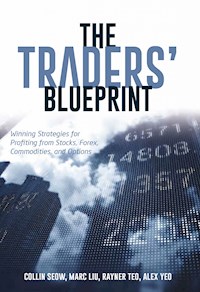
In The Traders’ Blueprint, you’ll find winning strategies to profit from stocks, options, and Forex trading. Following Collin Seow's best-selling trading book The Systematic Trader, this book expands on his strategies along with three other proven top traders that he personally knows and endorses.
There are many different types of asset classes to trade, and The Traders’ Blueprintoffers creative strategies for trading stocks, options, and Forex. It's an exciting time to trade the markets and generate returns on your money that will pay you over and over again.
This book will show you, no holds barred, how skilled traders create the alpha to build consistent wealth.
In The Traders’ Blueprint, you will learn:
- How to trade options safely and generate a consistent income
- A trading methodology that has been profitable over the last 200 years, and that is used by hedge funds and market wizards
- How to profit on your trades even if they go against you
- A little-known trading technique which minimises your losses and maximises your profits (that most traders never find out)
- How to quickly find the best stocks to trade instead of looking for the next “hot tip”
- A simple technique that lets you ride massive trends in the market and grow your wealth steadily over time
- Proprietary trading setups that you can use to profit in the stock, options, and Forex markets
Make sure to check out this blueprint, and augment your trading arsenal with these powerful strategies.
Das E-Book können Sie in Legimi-Apps oder einer beliebigen App lesen, die das folgende Format unterstützen:
Seitenzahl: 166
Veröffentlichungsjahr: 2018
Ähnliche














First published March 2018
Copyright 2018 © Collin Seow, Marc Liu, Rayner Teo, Alex Yeo
All rights reserved. No part of this publication may be reproduced, stored in a retrieval system, or transmitted, in any form or by any means, electronic, mechanical, photocopying, recording or otherwise, without the prior permission of the publisher, except for inclusion of brief quotations in a review.
Candid Creation Publishing books are available through most major bookstores in Singapore. For bulk order of our books at special quantity discounts, please email us at [email protected].
THE TRADERS’ BLUEPRINT
Winning Strategies for Profiting from Stocks, Forex, Commodities, and Options
Author: Collin Seow, Marc Liu, Rayner Teo, Alex Yeo
Publisher: Phoon Kok Hwa
Editor: Tansey Tang
Layout: Geelyn Lim
Cover design: Ryanne Ng
Published by: Candid Creation Publishing LLP
167 Jalan Bukit Merah
#05-12 Connection One Tower 4
Singapore 150167
Website:www.candidcreation.com
Email:[email protected]
Facebook:www.facebook.com/CandidCreationPublishing
ISBN: 978-981-11-6467-5
National Library Board, Singapore Cataloguing in Publication Data
Names: Seow, Collin. | Liu, Marc, author. | Teo, Rayner, author. | Yeo, Alex Zi Ping, author.
Title: The traders’ blueprint : winning strategies for profiting from stocks, forex, commodities and options / Collin Seow, Marc Liu, Rayner Teo, Alex Yeo Zi Ping.
Description: Singapore : Candid Creation Publishing LLP, [2018]
Identifiers: OCN 1022914500 | 978-981-11-6467-5 (paperback)
Subjects: LCSH: Stocks. | Options (Finance). | Investments.
Classification: DDC 332.6322--dc23
CONTENTS
Preface
PART ONESystematic Trading Concepts: A Clear and Objective Method to Profitable Stock Trading
1. The Greatest Enemy in Trading
2. Fundamental and Technical Analysis
3. Systematic Trading
4. Golden Truths of Trading
PART TWOThe Stock Trading Success Formula: Dominating Tactics and Consistent Setup Patterns
1. Why Fundamentals Matter
2. Technical Analysis
3. The Meat and Potatoes
4. Extra Pointers and Cautions
5. Conclusion
PART THREEForex and Futures Trading: How To Profit in Bull and Bear Markets
1. Who Am I?
2. Support and Resistance
3. Understanding Market Structure
4. Entry Triggers
5. How to Develop Your Own Trading Strategy
6. Closing Notes
PART FOURSelling Options: How To Trade Options Effectively And Generate A Consistent Income
1. How Do You Make Money by Trading Options?
2. Options Explained
3. Advantages and Disadvantages of Selling Options
4. Ichimoku Cloud Indicator
5. Pivot Points Indicator
6. Strategies and Rules
7. Analysing the Market
8. Controlling Risk When Trading Options
9. Conclusion
About the Authors
PREFACE
Wow, we’ve finally done it.
It was not an easy task for me personally to produce another book due to my monthly training commitments for The Systematic Trader Course (SMT). But as a team effort, we’ve finally published The Traders’ Blueprint.
Nowadays, retail investors and traders are truly bombarded with tons of information about different trading assets and instruments and the best way to go about trading them.
Many books are full of theories but have no real trading insight.
This book is the real deal for people who want to possess a clear blueprint in trading.
After the success of my first book, The Systematic Trader, I’ve received countless private messages on Facebook and email, thanking me for sharing my heart not just on trading and investing, but also on life itself. Motivated by the impact my first book made, I then decided to gather my close friends, who are trading authorities in their own right, to write a book together.
First, we have the low profile Marc, who is one of the smartest people I know. He has a unique way of looking at the market, which I didn’t agree with at first. However, he has proved me wrong by helping numerous people in my community become consistently profitable traders and raving fans. He conducts his signature class once to twice a year just for passion’s sake, but only to a select group of people. Marc has laid out an effective stock trading strategy in this book for you.
Next, we have Rayner from TradingwithRayner.com. I first met Rayner whilst I was giving a talk to his university’s Investment Club. He has since come a long way, and I follow him regularly in the TradingwithRayner Facebook group, which has close to 20,000 members. He is always focused on adding immense value to his members through regular postings. You will learn much about his trend trading strategies.
Lastly, we have Alex who trades options. Although he is the co-founder of the famous Dr Wealth (formerly known as BigFatPurse), which teaches fundamental analysis, he also trades options in real life. He has managed to achieve consistent yearly returns using the strategy he is about to share.
Beginner to expert traders should be able to glean something from The Traders’ Blueprint. After reading this book, you will start to question some of your notions about the market, and at the same time learn comprehensive trading principles and methods, that will likely stand the test of time.
In closing, I just want to thank you. Thank you for reading this book. I hope that this book becomes a resource towards your own prosperity, not just in the financial markets, but life in general.
Read it and then practise what you’ve read. Then read it again.
I look forward to meeting you someday and personally shaking your hand.
Collin Seow
COLLIN SEOW
PART ONE
Systematic Trading Concepts
A Clear and Objective Method to Profitable Stock Trading
CHAPTER 1
THE GREATEST ENEMY IN TRADING
When I wrote my first book The Systematic Trader, pictured in Figure 1.1, I told myself not to be someone who churned out book after book. However, since the book was published, the response has been overwhelming. People from Japan, Europe, Australia, and even South America have sent me private messages on Facebook or emails thanking me for inspiring them. They said that I have given them a tool that helped them understand the markets and trading, and more importantly, understand life.
Figure 1.1 The Systematic Trader
ANYONE CAN BE A GOOD TRADER
One of the challenges that many people face is following a trade plan, which is why I decided to invest in and work with a company called AlgoMerchant, a financial technology start up that provides a platform for retail investors.
Let me ask you a question. When the man on the street wants to invest his money and doesn’t have the time to do it, where does he usually go? The answer: The banks or insurance companies.
When you go to the bank, the relationship manager or private banker will serve you. After the relationship manager serves you, your money is then processed by the back office, and finally the fund manager will make the money work for you. On top of this, because the money is held in trust, it is also overseen by the compliance officers.
The returns that are generated by the fund managers need to feed the relationship manager, back office staff, and also the compliance officers. So even if the fund manager is really good and making returns, your profits will be reduced because of the expenses.
AlgoMerchant (AM) seeks to change this. You see, it is possible for anyone to be a good trader or investor. You need not be a chartered financial analyst (CFA) or work for the bank. At the end of the day, it is the results or track record that counts. With AM, you can link up your trading account with AM, and from there, AM can track the real time performance of your portfolio. Once a track record is established, you can choose to publicise your portfolio. For me, I have more than 10 years of backtested results and live results to show my returns.
HOW I GOT STARTED
I started trading more than 20 years ago. Since I was in school, I have been interested in trading. My dad was 40 when he had me, so when I graduated from the army, I wanted to make money quickly to repay them.
Though I majored in engineering, I did not want to become an engineer. Through a speed-reading course that cost me a lot of money then, I came to know a financial advisor manager. He shared with me what I could do to become successful. I became a financial advisor instead.
In the first five years of my career as a financial advisor, I did very well; in fact, I was one of the youngest members of the Million Dollar Round Table (MDRT) at the age of 22. After being relatively successful as a financial adviser for five years, I wanted a slower pace in life, and I started trading more seriously. I slowly changed my trading method from fundamental to technical. A few years later, I went on to become a full-time trader, which lasted for two to three years.
During that period, I also sat for two examinations to get licensed as a remisier. The second paper was the toughest. Failing that examination twice would bar one from becoming a remisier. I failed the first time, but fortunately, on my second attempt, I passed.
I did not become a remisier immediately after I passed the examination. Instead, I waited for almost another three years. Before my examination qualification expired, I had to decide whether I wanted to become a remisier. I decided to go ahead and become a remisier, and trade using my account.
Originally, my intention was to trade and not to serve clients. The total clientele I had numbered less than 20. I was basically my biggest client during that time. Then, I had a big client in the first six months.
He was also trading quite a bit, and initially he was profitable.
However, he started to lose money after six months, and instead of slowing down and reviewing his trades, he actually traded more to make back his losses. As his remisier, I could see that he was trading more and increasing his bets. This was the time to stop him from buying, and lower his buying limit. However, I could not control his selling limit. He was desperate and wanted to make back his losses, and so he went to short the market using the selling limits.
Long story short, in three weeks he lost $250,000. However, instead of thinking about how to pay off the losses, he consulted some of his friends about the situation and decided he should file for bankruptcy. The reason was very simple. When a bankrupt owes less than $300,000, it is likely for him or her to be discharged in about 10 years. He and his friends felt that it made more sense for him to declare bankruptcy.
When he said this to me, I was at a loss. He also said that he had a solution for me; it was simply for us to declare bankruptcy together and let the company pick up all the losses! What a good friend.
At that time, he was single, but I was married with one kid and another one on the way. It would wreck the whole family for me to file for bankruptcy too.
I had to find another solution. It was then that I was taking my Certified Financial Technician (CFTe) examinations. I was studying with two other friends. One of them, an Indian national, was a technical analyst at Dow Jones. The other was a fund manager from Germany. We were studying together regularly, and one day, I shared my challenges with them.
My German friend shared with me something that changed my life. He said that a lot of what we learn in the books cannot be used in trading, and can only be used to pass the examinations. I asked him what the best way to learn trading was. He showed me a few books that were written by very successful traders and managers trading billions of dollars. The funny thing is, I have never heard of them, as I have never seen those books in bookshops or in the library.
I studied some of these books and came to my own conclusions about trading. Using some of my research, I developed a unique way of looking at the market that no one was using. Long story short again, after applying the system I developed, within a period of about 18 months, I made back the $250,000 and I used that to pay off the losses.
WHAT IS THE BEST WAY TO LEARN TO TRADE?
I am always asked by fellow traders, friends, and clients about the best way to learn trading, to know exactly what to do and how to do it. I thought about it long and hard. Is it a particular strategy, a special money management method, or even a backtested trading system? The answer is no. Even if you had the best strategy, you may not be able to execute it correctly without the right mental discipline. So what is it? What is the one thing we must have before we really become successful in trading? The answer is in the following quote by Bill Gates, one of the richest men in the world: “Everyone needs a coach. It doesn’t matter whether you’re a basketball player, a tennis player, a gymnast, or a bridge player.”
Get a coach. When you get a coach, you can see exactly what the coach does. Trading requires skills and knowledge, but more importantly, it tends to get emotional. You may have the skill and the knowledge, but you may not have the emotional makeup to succeed. That’s why it is important to get a coach. With a coach, you not only learn the skills and the knowledge, but also get feedback regarding what you are doing. It is entirely possible to learn trading from books and videos through the Internet. However, the percentage of people who succeed is very, very low. On top of that, you will waste a lot of time finding out what does not work. The learning curve is steep, and most people will not be able to make it.
Secondly, trading is risky. Everything that is risky in life requires you to get a license. For example, driving a car. You need to pass your basic theory test, final theory test, and practical test to protect yourself, your family, and other road users. I love diving and have just completed my advanced diving course in Tioman. This allows me to dive deeper, in strong currents, and at night.
Why is it that when it comes to trading, there is no license required? One can just open an account with a brokerage firm with as little as $1,000.
Many years ago, when I was trading full time, I took my CFTe to get certified. Getting certified as an analyst will not guarantee that you become better at trading, but it will help you grasp the basics of technical analysis. By getting a license, you will understand the risks involved, know the drills to do if something goes wrong, and also find out whether technical analysis is suitable for you.
But for trading and investment, there is no such requirement. Anyone who has some money can immediately trade the market. You can walk into any brokerage firm, fill up a form, and in a few days, trade your own money.
Is this dangerous? Of course, especially to yourself and your financial future. So, get a coach, get trained, and get certified.
WHAT IS THE GREATEST ENEMY IN TRADING?
Your greatest enemy is yourself, or more specifically, your emotions. Emotions will cause you to break the rules. Rules are there to protect you from harm. For example, when you are driving on the road, you need to follow the traffic rules so that there is order and you will not harm yourself and fellow road users. However, when people get emotional, they speed, or beat the traffic lights. Sometimes, there are no consequences, but at other times, it may cause you to lose money (with a fine) or even your own life.
This applies to trading as well. When you get emotional, you may break the rules. Sometimes it works out alright, but at other times, you may end up suffering big losses that you may not be able to recover from.
Trading is very emotional. When you buy a stock and the stock goes down by 10%, you can hold it, but there is a risk. What is the risk? It is that it may drop further. If you sell, there is a risk too, that it may recover to your entry price.
On the other hand, if you buy a stock and the stock rises by 10%, there is also risk if you decide to sell. The risk is that it will rise further. If you don’t sell, it may drop back to its original entry price. So, everything is risky, which is why having a plan and controlling your emotions are so vital.
KEY LEARNING POINTS
• Coaching is important in trading because trading is emotional.
• Coaching allows you to model another person.
• Emotions can be an enemy to successful trading.
CHAPTER 2
FUNDAMENTAL AND TECHNICAL ANALYSIS
In this chapter, I want to answer three questions about trading. I believe that if you can answer all three questions, you will be a successful trader.
First, what should I buy and sell? I get this question all the time as a remisier. How can I find the most profitable stocks in the market?
Secondly, when should I buy and sell? How will I know the best time to buy or sell a certain stock, currency pair, or commodity?
Lastly, how much should I buy or sell? How can I manage my risk so that I can maximise my profits and reduce my losses?
WHAT TO BUY
There are two main ways to choose what to buy. One way is called fundamental analysis or FA, and the other is technical analysis or TA.
Fundamental Analysis
For fundamental analysis, the key is to look for the intrinsic value of the stock, or “what it should be worth”. Figure 2.1 shows the difference between a stock’s intrinsic value and its market value.
Figure 2.1 Intrinsic Value
The idea is to look for stocks that are priced below their intrinsic value.
There are many ways to calculate the value of a stock.
One way is to look at the company’s assets to determine its value. Some traders look at the amount of free cash flow in the company, while others look at the dividends. After you find out what the stocks should be worth, you can check those figures against current prices, and look for stocks that are trading below their intrinsic value. These are what we call undervalued stocks. The lower the price below the intrinsic value the better. The gap between the intrinsic value and current price is called the margin of safety.
So how do we learn how to calculate the value of a company?
One way is to attend a $3,000-$5,000 value investing course to learn how to do it yourself. This is a good idea if you want to do it yourself. In fact, I think we should always continue to invest in ourselves.
Another way is to go to www.i3investor.com, as shown in Figure 2.2 and 2.3.
Figure 2.2 I3Investor Singapore Stocks
Once you are in the site, navigate to “price target”, and under “price target”, key in whatever stocks you are analysing. This will give you the target price from all the different analysts contributing to the site. The target price is what analysts believe that stock should be worth.
Figure 2.3 I3Investor US Stocks




