


19,99 €
Mehr erfahren.
- Herausgeber: John Wiley & Sons
- Kategorie: Ratgeber
- Sprache: Englisch
An unbiased, accurate, and up-to-date guide to making college-related decisions
Should I go to college? Which college should I go to? When should I go? What should I study? How should I pay for college? Should I work while I’m attending?
In The Truth About College: The essential guide to help your teenagers succeed – so college doesn’t ruin their lives, #1 New York Times bestselling author, Ric Edelman, delivers an unbiased and eye-opening guide for parents who want to help their children answer their college questions and for the teenagers doing their best to make the “right” choice.
This is not an anti-college screed or a full-throated endorsement of college for everyone. It’s a deeply researched decision-making guide that carefully considers the unique characteristics, considerations, and circumstances that will influence college-related decisions. The book recognizes that college is not a subject that should be considered through an ideological lens. It shouldn’t be one characterized by snap decisions or decisions made based on what peers or parents did or didn’t do. Instead, you’ll learn all about the real-world benefits and costs of attending college today. You’ll discover the doors it unlocks, the doors it closes, the most common mistakes made by college students, and how to minimize the downsides and cost if you or your child decide to attend.
Inside the book:
- A comprehensive and accurate exploration of the specific information that you and your child need to make the most beneficial decisions possible
- Concise summaries at the end of each chapter for easy review, as well as a standalone, step-by-step guide to talking with your teenagers about college
- Clear-eyed, unbiased advice from an experienced finance professional based on contemporary evidence and data about college and the college experience
Perfect for all teenagers preparing to go (or not go) to college and their parents, The Truth About College is packed with the information you need to make smart decisions that will be beneficial over the long-term.
Sie lesen das E-Book in den Legimi-Apps auf:
Seitenzahl: 245
Veröffentlichungsjahr: 2025
Ähnliche




















Table of Contents
Cover
Table of Contents
Title Page
Copyright
Dedication
Preface: Will College Set Your Teenagers on a Lifelong Path of Success, or Will It Ruin Their Life?
What This Book Isn’t
What This Book Is
Note
Who Should Read This Book
The Unusual Convention I Used in Writing This Book
Note
Chapter One: The Benefits of Getting a College Degree
Better Salary
Better Benefits (Almost Like “Free Money”)
Better Work-Life Balance
Better Health
Better Relationships
Better Community Engagement
Better, Better, Better
Note
Chapter Two: The Perils of Going to College
Mismatch Between College Major and Future Career
Saddled with Student Loans and Huge Opportunity Costs
Attending vs. Graduating
Mental Health and Trauma
Chapter Three: People Loved College, Way Back When – These Days, Not So Much
Chapter Four: So, Should College Be Your Goal?
1. What interests you? What do you enjoy doing?
2. What concerns you?
3. What
haven’t
you considered?
Chapter Five: If You Choose to Pursue a College Degree, Here’s the Goal You Need to Set
Note
Chapter Six: In Truth, College Is Really About Lifestyle
Don’t Forget Taxes
Everything Costs More Than You Think
Chapter Seven: The Cost of College
It’s Even More Costly to Attend Out-of-State and Private Colleges and Universities
Notes
Chapter Eight: The Most Important College Choices You’ll Make
If College Is a Money Pit, Student Loans Are the Shovel
Understanding Student Loans
Notes
Chapter Nine: How to Minimize the Cost of Getting a College Degree
1. Earn college credit by passing AP or DE classes in high school
2. Earn college credit by passing CLEP or DSST exams
3. Attend community college for the first two years
4. Choose a college or university that lets you get a degree tuition-free
5. If you’re going to work part-time while attending college, do it for the right reasons
6. Consider working full-time and attending college part-time
7. Select a school that’s within a three-hour drive of home
8. Let’s take this idea a step further, er, uh, closer: Consider living at home while you attend college
9. Let’s go furthest with this idea: Get a degree entirely through online courses
Note
Chapter Ten: The 12 Biggest Mistakes Students Make
1. They rush into college
2. They haven’t considered the type of employer they’d like to work for
3. They get a college degree to enter a field that doesn’t require one
4. Or, they get a required degree, but they don’t get the skills they need to succeed in that field
5. They don’t know that the field they’re pursuing doesn’t offer many jobs
6. They fail to realize they’ve chosen a field that requires a postgraduate degree or professional certification
7. They obtain a graduate degree without regard to ROI
8. They don’t realize that technology will eliminate the career they’re planning to pursue
9. They don’t consider apprenticeships instead of college
10. They fail to consider the lifestyle that their career choice will impose
11. They don’t realize that the school they’ve selected might close
12. They think colleges and universities are benevolent institutions, devoted to their best interests
Notes
Epilogue: College Is Out – Lifelong Learning Is In
20 Conversation Starters to Help Adults and Teenagers Talk About College
Glossary
Sources
Chapter 1
Chapter 2
Chapter 3
Chapter 4
Chapter 5
Chapter 6
Chapter 7
Chapter 8
Chapter 9
Chapter 10
Acknowledgments
Index
End User License Agreement
List of Illustrations
Chapter 4
Table 4.1 High-Paying Jobs That Don’t Require a College Degr...
Chapter 6
Table 6.1 Incomes of U.S. Households
Table 6.2 How Americans Spend Their Money
Table 6.3 How Parents Financially Support Their Adult Children...
Chapter 7
Table 7.1 Getting 30 College Credits Per Year
Table 7.2 The Cost of College
Chapter 9
Table 9.1 Advanced Placement vs. Dual Enrollment
Chapter 10
Table 10.1 Occupations That Don’t Require a College De...
Table 10.2 Occupations Offering Higher-Than-Average Salaries, No D...
Table 10.3 Salaries 10 Years After Graduation
Table 10.4 It’s Highly Likely That These Jobs Won’t Exist in 10 Ye...
Table 10.5 These Jobs Are Probably Here to Stay – and Will Require...
Guide
Cover
Table of Contents
Title Page
Copyright
Dedication
Preface: Will College Set Your Teenagers on a Lifelong Path of Success, or Will It Ruin Their Life?
Who Should Read This Book
Begin Reading
Epilogue: College Is Out – Lifelong Learning Is In
20 Conversation Starters to Help Adults and Teenagers Talk About College
Glossary
Sources
Acknowledgments
Index
End User License Agreement
Pages
iii
iv
v
ix
x
xi
xii
xiii
xv
xvi
xvii
1
2
3
4
5
6
7
8
9
10
11
12
13
15
16
17
18
19
20
21
22
23
25
26
27
28
29
30
31
32
33
35
36
37
38
39
40
41
42
43
44
45
46
47
48
49
50
51
52
53
55
56
57
58
59
60
61
63
64
65
66
67
68
69
70
71
72
73
74
75
77
78
79
80
81
82
83
84
85
86
87
88
89
90
91
92
93
95
96
97
98
99
100
101
102
103
104
105
106
107
108
109
110
111
112
113
114
115
116
117
118
119
120
121
122
123
124
125
126
127
128
129
130
131
132
133
134
135
136
137
138
139
140
141
142
143
144
145
146
147
148
149
150
151
152
153
154
155
156
157
158
159
160
161
162
163
164
165
166
167
168
169
170
171
172
173
174
175
176
177
178
179
181
182
183
184
185
186
187
188
189
190
191
193
194
195
196
197
198
199
200
201
202
203
204
205
206
207
208
209
210
211
212
213
214
215
216
217
218
219
220
221
223
224
225
227
228
229
230
231
232
233
234
235
236
237
238
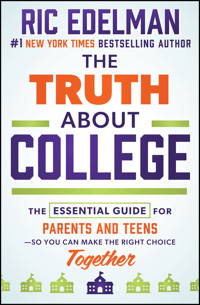
RIC EDELMAN
#1 NEW YORK TIMES BESTSELLING AUTHOR
THE TRUTH ABOUT COLLEGE
THE ESSENTIAL GUIDE FOR PARENTS AND TEENS—SO YOU CAN MAKE THE RIGHT CHOICE Together
Copyright © 2026 by Ric Edelman. All rights reserved.
Published by John Wiley & Sons, Inc., Hoboken, New Jersey.
No part of this publication may be reproduced, stored in a retrieval system, or transmitted in any form or by any means, electronic, mechanical, photocopying, recording, scanning, or otherwise, except as permitted under Section 107 or 108 of the 1976 United States Copyright Act, without either the prior written permission of the Publisher, or authorization through payment of the appropriate per-copy fee to the Copyright Clearance Center, Inc., 222 Rosewood Drive, Danvers, MA 01923, (978) 750-8400, fax (978) 750-4470, or on the web at www.copyright.com. Requests to the Publisher for permission should be addressed to the Permissions Department, John Wiley & Sons, Inc., 111 River Street, Hoboken, NJ 07030, (201) 748-6011, fax (201) 748-6008, or online at http://www.wiley.com/go/permission.
The manufacturer’s authorized representative according to the EU General Product Safety Regulation is Wiley-VCH GmbH, Boschstr. 12, 69469 Weinheim, Germany, e-mail: [email protected].
Trademarks: Wiley and the Wiley logo are trademarks or registered trademarks of John Wiley & Sons, Inc. and/or its affiliates in the United States and other countries and may not be used without written permission. All other trademarks are the property of their respective owners. John Wiley & Sons, Inc. is not associated with any product or vendor mentioned in this book.
Limit of Liability/Disclaimer of Warranty: While the publisher and the authors have used their best efforts in preparing this work, including a review of the content of the work, neither the publisher nor the authors make any representations or warranties with respect to the accuracy or completeness of the contents of this work and specifically disclaim all warranties, including without limitation any implied warranties of merchantability or fitness for a particular purpose. No warranty may be created or extended by sales representatives, written sales materials or promotional statements for this work. The fact that an organization, website, or product is referred to in this work as a citation and/or potential source of further information does not mean that the publisher and authors endorse the information or services the organization, website, or product may provide or recommendations it may make. This work is sold with the understanding that the publisher is not engaged in rendering professional services. The advice and strategies contained herein may not be suitable for your situation. You should consult with a specialist where appropriate. Further, readers should be aware that websites listed in this work may have changed or disappeared between when this work was written and when it is read. Neither the publisher nor authors shall be liable for any loss of profit or any other commercial damages, including but not limited to special, incidental, consequential, or other damages.
For general information on our other products and services or for technical support, please contact our Customer Care Department within the United States at (800) 762-2974, outside the United States at (317) 572-3993 or fax (317) 572-4002.
Wiley also publishes its books in a variety of electronic formats. Some content that appears in print may not be available in electronic formats. For more information about Wiley products, visit our web site at www.wiley.com.
Library of Congress Cataloging-in-Publication Data is Available:
ISBN 9781394406852 (Cloth)ISBN 9781394406869 (ePub)ISBN 9781394406876 (ePDF)
Cover Design: WileyCover Image: © Lena/stock.adobe.comAuthor Photo: Courtesy of the Author
To today’s teenagers.
The world will soon be yours.
Preface: Will College Set Your Teenagers on a Lifelong Path of Success, or Will It Ruin Their Life?
You are almost certainly encouraging the children in your life to go to college, and it’s easy to see why. You know that those who hold college degrees generally have wealthier, healthier, longer and happier lives that are more enriching and impactful for themselves, their families and their communities than those who don’t have college degrees.
But like any opportunity offering big benefits, there are costs and risks. That’s why your behavior is crucial. Over the past 40 years, I’ve advised, trained, counseled and guided tens of thousands of parents, grandparents, step-parents and guardians, as well as countless teachers, high school guidance counselors, youth group mentors and other adults who are trying to positively influence youth. And when it comes to college planning, I’ve seen so many of these well-meaning folks make tragic mistakes that produce outcomes that are the opposite of what they wanted.
The Top 10 Mistakes
Here are the most common errors I’ve encountered throughout my career. Let’s see how many of them you’re guilty of:
Conveying through word, action and attitude that you expect your teenager to go to college. You oppose any suggestion from them that they might not want to go to college.
You have made it clear to your teenager that you expect them to pursue a particular career or to avoid certain careers.
In conversations with the teenager, you have cited others as role models, setting expectations that the teen must (or must not) follow the same college or career path.
Likewise, you have made it clear that there is a certain college or university (most commonly your alma mater, an Ivy League school, a military academy or a religious institution) that you expect them to attend.
Inversely, you have told them there are certain schools you do not want them to attend.
You have made it clear that you would be disappointed if they attended a community college.
You’re the parent, grandparent, step-parent or guardian but haven’t (yet) funded a college savings account in an amount sufficient to allow the teenager to graduate without any student debt.
You have told your teen that they must, or must not, live at home while they go to college.
You have told your teen that they must, or must not, work while school is in session.
You have conveyed to your teenager that they can attend any college or university of their choice. You have not placed any restrictions or parameters – such as cost or distance – on their decision as to which school to attend.
If you think few or none of these mistakes describe you, share the list with your teens and ask them if you’ve done any of them. If they feel they can safely be honest with you, the odds are pretty good that the ensuing conversation will be filled with significant revelations. This gives you an opportunity to change your behavior – before it causes the teenager to pursue a path that will lead to their ruin (and which could cause you the loss of tens or even hundreds of thousands of dollars).
Here’s the key point: Rather than forcing (or merely “influencing”) teenagers down a path of your own vision, you can help best by exposing them to the diverse opportunities that are available, guiding them toward selecting the path that is most likely to produce the best outcome for them.
This means you must not assume that all the teens in your life should go to college at all, let alone attend a specific school or pursue a specific degree. Simultaneously, you must not abdicate these choices solely to the child; no teenager has the experience or maturity to truly know if they should attend college (at all, let alone immediately after graduating high school), where to attend or what major to choose.
This is a big deal. If pursuing a college degree is the right path for each of the teens in your life, it is your responsibility to make certain that they manage their college experience correctly. If you succeed at this, they will enjoy the rewards.
But if you and they mismanage either the decision or the experience, that teenager could waste years of their lives; miss other, better career opportunities; and saddle themselves with massive amounts of debt that will haunt them for the rest of their life. Indeed, as you’ll discover in these pages, college has destroyed the lives of millions of Americans, who as a result of their college experience have found it difficult to buy a car or home, or qualify for desired jobs, and many have avoided marriage or suffered divorce, become drug addicts or alcoholics or died by suicide.
Your teenagers will follow your lead. That means you must set the tone for them. This book will help you do that, so you both can navigate the college question effectively, and if you and they together decide they should pursue a college degree, they’ll have a successful outcome.
For sure, reading this book will have a transformative, life-changing impact on the teenagers in your life.
What This Book Isn’t
This book is not intended to be a damning analysis of our nation’s higher education system. I’m not going to focus on what’s wrong with our educational institutions or explain what policymakers in Congress and state legislatures should do about it.
I’m also not going to tell you how to save (or pay) for college. This is not a financial planning or investment advice book, so there’s no discussion of 529 College Savings Plans or Tuition Pre-Payment Plans. No mention of converting those accounts to Roth IRAs, either.1
What This Book Is
Instead, this book has just one purpose: to give you and your teenagers the specific information you both need so that the student’s post–high school experience helps them enjoy a long, rewarding and happy life.
And, above all, this book will help make sure that college doesn’t ruin their life.
Note
1
Read my other books for that stuff.
Who Should Read This Book
You should read this book if you are a:
Parent, grandparent, step-parent or guardian of a grade 7 to 12 student
K–12 schoolteacher
High school guidance counselor
College admissions officer, professor, dean, provost or president
Student in junior high or high school
College student
The Unusual Convention I Used in Writing This Book
Although this book is vital for the previously cited adults, it’s even more important for the students. Those in college-anticipation mode (meaning, starting in the seventh grade) need the information in this book to help them crystalize their plans. And it’s not too late for students already in college to read this book (freshmen and sophomores will benefit more than juniors and seniors, obviously). Students need this information the most because, in the end, it’s their life – and however they choose to proceed, they’ll (be forced to) live with the consequences. The better prepared they are and the sooner they can prepare, the more likely they’ll make decisions that are best for them.
Therefore, although the title and content (to this point) have been written from me to adults, I’ve written the rest of this book directly to the students. Adults will thus be eavesdropping on the conversation I’ll be having with teens. And that’s as it should be, because (as noted), it’s the student who must live with the consequences (good and bad) of their college decisions. Besides, teens are more likely to listen to me than to the adults in their lives, because every teenager believes that every adult they know is an idiot.1
Even though I’ll be talking to the students, don’t take that to mean adults can skip the rest of the book. As I said, the biggest mistake adults make is abdicating the college decision to their high schoolers. So, you adults need to learn what your teens are about to learn – and that means reading this book along with (or prior to) them. This will allow you adults to decide how you feel about the information, strategies and advice contained herein – giving you the opportunity to have meaningful conversations with your teens, which will be life-changing for all of you.
And to help you engage in those conversations, you’ll all find key takeaways at the end of each chapter, plus a helpful guide to talking with your teenagers at the end of the book.
But before you flip to the end, let’s start at the beginning. In the first chapter, I’ll explain to teens why they should seriously consider going to college.
Note
1
Recall Mark Twain’s comment, “When I was a boy of 14, my father was so ignorant I could hardly stand to have the old man around. But when I got to be 21, I was astonished at how much the old man had learned in seven years.”
Chapter OneThe Benefits of Getting a College Degree
Ask any adult about the importance of going to college, and you’re likely to get an answer that emphasizes career. Your parents, grandparents, step-parents or guardian, as well as high school guidance counselors and college admissions officers and recruiters, along with every well-meaning adult helping to set you on the path to prosperity and happiness, will tell you that a college degree lets you enter a career that offers more money than you’d otherwise be able to get.
They’re not wrong.
And so, as we explore the many benefits of getting a college degree, that’s where we’ll start.
Better Salary
College graduates earn far more money than those who only have a high school diploma. And when I say “far more,” I mean it: The Bureau of Labor Statistics says the average high school graduate earned $51,781 in 2024, while the average college graduate earned $120,302 – or 2.3 times more. Over an entire career, college grads earn a median $900,000 more than non-graduates, according to the Social Security Administration.
As you’ll see in Chapter 6, college graduates are more likely to own their homes than those who only went to high school, and their homes are worth more, too. And the more a house is worth, the more it rises in value over time – helping college graduates retire with even greater wealth compared to those who never went beyond high school.
It’s worth highlighting two factors that help explain why college graduates earn more money over their careers. First, they’re more likely to be promoted than non-degreed workers (because they’re more likely to be in careers that offer advancement), and promotions usually result in higher pay.
Second, college graduates are less likely to be out of work at any point; the unemployment rate, which rises and falls with economic conditions, is almost always nearly twice as high for those with only a high school diploma as it is for college graduates, according to the Pew Research Center.
Avoiding unemployment isn’t just important for your future finances; it helps your mental health, too. Losing a job is extremely stressful, not least because you’ll worry about paying your bills while you’re unemployed. Half of workers who are laid off (known as separated from service because the employer eliminated many jobs, not just yours) take more than five months to find a new job, according to the Bureau of Labor Statistics.
And finding a job after losing one often forces people to relocate, which would disrupt your family and force you to incur moving-related expenses – resulting in even more stress. A 2019 Harris Poll found that more than half (53%) of those who only went to high school had been laid off at some point, compared to just 36% of college graduates. And when laid off, high school graduates were only about half as likely to be financially prepared as those with a college degree (43% versus 64%).
Thus, if you don’t go to college, you’re more likely to be stuck in the same low-paying job and more likely to lose it – and when you do, you’ll be less likely to be financially prepared. Pretty strong arguments for getting a college degree.
Consider all this if you aren’t yet persuaded that a college degree is a great path to financial success. And while you’re at it, also consider this: The higher income you’ll get thanks to your degree will give you a better opportunity to save and invest (thus providing the ability to build wealth) compared to people with lower incomes.
How Salary Leads to Wealth
That last point is important, because there are only three ways people get money in America: earn it, inherit or marry into it, or win it (through gambling and lotteries). The odds of success via gambling and lotteries are astronomically small, so we’ll set that aside. And if you’re like most Americans, any inheritance you get will be so small or so far into the future that it isn’t worth discussing here. Equally unlikely is the notion that you will “marry up” – meaning securing a spouse who’s wealthy. So, we’ll also put aside inheritances and marrying someone rich.
That leaves you with only one avenue: you’ll have to earn whatever money you hope to have in the future. That’s actually the official name: The Internal Revenue Service calls it earned income. Yet, it’s barely enough for most people to pay their basic costs of living: housing, utilities, food, clothes, transportation, health care and insurance.
After paying those bills, most Americans have no money left for entertainment, dining out or vacations. I’m not saying no one ever goes out for dinner (they sure do!). But since they’ve spent all their income on necessities, they must use credit cards for everything else – and that’s a disastrous behavior. You see, if you use a credit card to pay a $25 restaurant tab, you’ll not only have to repay that “principal” (the amount you borrowed), you’ll also have to pay interest to the credit card company to compensate them for paying that tab when you weren’t able to. Every dollar you pay to credit cards for luxuries (and frivolities) is a dollar you can’t use to pay your basic expenses. And the less money you have to buy necessities, the more you’ll use credit cards. This downward spiral lands millions of people in dire financial circumstances. Indeed, Americans in 2025 owed $1.2 trillion in credit card debt, an average of $6,000 per U.S. household, according to the Federal Reserve Bank of New York.
Here’s why using credit cards is the path to poverty: If you make purchases totaling $10,000 in cash, you spend $10,000. But if you use credit cards for those purchases and then pay the minimum monthly payment ($225), you won’t pay off the cards for five years, according to Experian, and you’ll end up repaying $16,036. That’s because the average credit card user pays 21% in annual interest charges.
But some people – mostly college graduates – earn lots of money. Not only can they pay their monthly bills in full, they can also pay for luxuries like eating out and taking vacations without going into credit card debt. Even after they splurge, they still have money left over, which they can put into savings and investments. Thus, instead of paying interest, they get to earn interest – and this is the magic formula that allows people in America to amass wealth.
This is the big secret that no one in the American education system tells you about. You’re led to believe that you need a good education so you can get a good job and earn a good salary. That’s true, but it’s not the full story. You see, it’s not enough that you earn a good salary. Your salary must be so good that you are able to put some of it into savings and investments.
You see, a high earned income lets you enjoy a nicer lifestyle than is possible with a lower income. But lifestyles are fleeting; they depend on income that’s only as secure as the job that provides it. One day, you won’t have that job. You’ll quit, get fired or laid off, become disabled from illness or injury, or retire. Inevitably, therefore, your job will cease, and when it does, your income ceases, too.
That’s why you need more than earned income. You need wealth. Because with wealth, you can maintain your lifestyle even when your earned income ceases or is interrupted.
And the only way you can reliably accumulate wealth is to put some of your earned income into savings and investments. But you can do that only if your income is high enough to pay your bills and splurge on luxuries – and still have money left over.
So, you should want a high income – and you’re far more likely to get a job that pays a high income if you have a college degree than if you don’t have one.
Better Benefits (Almost Like “Free Money”)
A higher salary is just the first of the financial benefits of a college degree. Better-paying jobs also tend to offer more and better benefits, including:
Paid vacation:
You’ll likely get paid even when you’re on a two-week vacation (for someone earning a $75,000 annual salary, that’s worth nearly $3,000 a year).
Paid sick leave:
You’ll probably also get two to four weeks of paid time off when you’re sick (or caring for a sick family member). That’s worth another $3,000 to $6,000 yearly.
Paid health insurance:




