


Erhalten Sie Zugang zu diesem und mehr als 300000 Büchern ab EUR 5,99 monatlich.
- Herausgeber: The History Press
- Kategorie: Lebensstil
- Sprache: Englisch
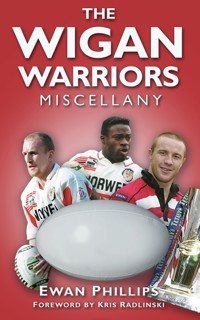
The Wigan Warriors Miscellany is the definitive set text for every fan of the world famous cherry and whites. Packed with facts, fun, gossip, nostalgia and conjecture, it looks back over 138 years of glorious history to celebrate the personalities, victories and controversies of the sport's biggest name. Handily pocket-sized to pull out in the middle of those pub arguments over who was the fastest, dirtiest or biggest, this book will not only tell you who scored the most tries, kicked the most goals or won the most trophies, but also who earned the most red cards, did best on Every Second Counts and broke cricketer David Boon's record for beer consumption on a flight to Australia. Put down your pie and pick up a copy.
Sie lesen das E-Book in den Legimi-Apps auf:
Seitenzahl: 181
Veröffentlichungsjahr: 2017
Das E-Book (TTS) können Sie hören im Abo „Legimi Premium” in Legimi-Apps auf:
Ähnliche















Dedication To the Wigan fans: jackpot winners in the lottery of Rugby League life.
First published 2010
The History Press
The Mill, Brimscombe Port
Stroud, Gloucestershire, GL5 2QG
www.thehistorypress.co.uk
This ebook edition first published in 2017
© Ewan Phillips, 2010
The right of Ewan Phillips to be identified as the Author of this work has been asserted in accordance with the Copyrights, Designs and Patents Act 1988.
This ebook is copyright material and must not be copied, reproduced, transferred, distributed, leased, licensed or publicly performed or used in any way except as specifically permitted in writing by the publishers, as allowed under the terms and conditions under which it was purchased or as strictly permitted by applicable copyright law. Any unauthorised distribution or use of this text may be a direct infringement of the author’s and publisher’s rights, and those responsible may be liable in law accordingly.
EPUB ISBN 978 0 7509 8404 1
Typesetting and origination by The History Press
eBook converted by Geethik Technologies
ACKNOWLEDGEMENTS
Huge thanks to the following: Kris Radlinski for his great foreword and swift responses to my irritating questions, Julie Baker and the team at the excellent new Museum of Wigan Life and Sue ‘Mrs Francis’ Francis for their archive materials, Michelle Tilling at The History Press for her encouragement and editing, Ray Hewson, Bill Francis, Ray Unsworth and Graham Emmerson for prompt responses to my queries, Jane and Tom for the tea and patience and, of course, Wigan RLFC itself for providing such a wealth of material and so many wonderful memories.
FOREWORD
By Kris Radlinski MBE
Wherever I travel in the world and people ask where I am from, my answer ‘Wigan’ always gets the same response: ‘Oh Rugby League. I love that game.’ The club’s history transcends sports and countries; everybody has heard of the famous ‘Cherry and Whites’.
In our little cobbled town Rugby League is a way of life; it’s the main topic of conversation in pubs and the first choice of sport in the playgrounds. A recent survey showed that the two most common phrases used in a Wiganer’s lifetime are ‘gerrum onside’ and ‘can’t run bout legs’. This is the language in which we speak. In the posh areas just outside Manchester, I’ve heard it said that within five minutes of meeting an attractive woman in a bar, she’ll ask what car you’re driving in order to assess your wealth. Not in Wigan, here she’d want to know what position you play and how many tackles you missed in your last game. These two statistics are far more important to the success of any budding relationship.
Everybody knows the Wigan players around town but they aren’t treated any differently, there are no superstars and I wouldn’t like it any other way. The fact that an old woman in a shopping centre can always vent her frustrations over a recent performance means your feet remain firmly planted on the ground. Players are accessible in Wigan; we don’t opt to live out of town and travel in to train every day. To understand and appreciate the importance of Rugby League here you have to be in the middle of it and embrace the opinions of those who pay your wages each week. Yes, it can be a pain in the backside being nice to people who want to abuse you about how you played, but we must accept this as the Wigan supporters are special. Over the years, our success rate has slowed down but our fan base has gone up, underlining the fact that this is firmly a Rugby League town.
As a kid growing up I dreamed of playing at Central Park. Every weekend, with my family, I would sit on the old dugout two hours before kick-off waiting for my heroes to arrive. When the players did appear, I was in awe at the size and strength of these superhuman athletes and from an early age my mind was set on becoming one of them. To have actually realised my dreams and played there on so many occasions makes me feel incredibly lucky.
As I sit here writing this, I am looking out of the window at the current squad training, all with the same hopes and dreams as I had, I am so jealous and would love nothing more than to do it all again. Playing for this club doesn’t just last from the day you sign until the day you leave; the truth is you never leave it. I have known players from Australia who were devastated to leave at the end of their contracts, they preferred the grey skies and warm pints of Wigan to their bikini-filled, sun-drenched beaches: crazy, but very true.
I have been associated with this club for nearly sixteen years and I have done every job imaginable. It only seems two minutes ago that I was in Central Park cleaning the first-team players’ boots and, if I close my eyes and concentrate, I can still smell those old changing rooms. Now, in my current role, I am involved in making decisions that have a huge impact on players’ careers, so I think about what people thought about me as a kid and what persuaded them to take a chance. I’ll be looking for kids with a burning ambition to succeed, who understand the club and who will represent the jersey in the tradition it deserves. The club has been great with me and I will serve it the best way I can until my famous bright red hair has turned silver. Enjoy the book.
Kris Radlinski, 2010
THE ORIGIN OF THE ‘SPECCIES’
Wigan’s first rugby club, the imaginatively titled Wigan FC, was formed on 21 November 1872 at the Royal Hotel, Standishgate (now a branch of WH Smith). Nine days later, the fifty or so founding members played each other in the opening ‘fixture’ on the charmingly named Folly Field, Upper Dicconson Street. The venture’s first proper competitive match was a trip to Warrington on 18 January 1873, which ended in a draw (no doubt there was a fight).
In 1876, financial problems and the difficulty of attracting new players led to a merger with Upholland FC, creating the all-new Wigan and District Football Club. The new club’s games were played at the then Wigan Cricket Club ground in Prescott Street but it folded again within eighteen months.
22 September 1879 saw another relaunch and with it, a bold rebranding: the club was now to be called Wigan Wasps. Go-getting player-secretary Jack Underwood negotiated a return to Folly Field for an annual rental fee of £2.50 and the ‘Wasps’, in blue and white hooped jerseys promptly lost their opening home game to Chorley St Lawrence by the margin of six tries and two touchdowns to Wigan’s one try, one touchdown and one dead ball (whatever all that means). However, the Wasps – the present club’s direct ancestor – soon developed a ‘buzz’ about them and thrived well enough to move back to a ground of their own, Prescott Street, in 1886. In September of that year they took on and beat Wakefield Trinity in front of 5,000 paying ‘speccies’ and in 1888, they were given the accolade of a match with a touring New Zealand Maori side who won 8–1 in front of a 7,000 crowd.
By 1894, Wigan’s ambition led to incursions beyond the environs of Platt Bridge and Goose Green in search of playing talent and brought accusations from Salford that they had paid one of their players – Miles – 30s a week during the summer. Wigan denied the allegations but were found guilty, Miles was labelled a professional and the club earned a three-month suspension. This led to their joining with similarly wronged teams at the George Hotel, Huddersfield, in September 1895 to form the breakaway Northern Union. Soon after, Wigan played their first fixture in the new code away to Broughton Rangers, winning 9–0.
Both Wigan and the new game proved instant crowd-pullers and in 1901, they moved grounds again to Springfield Park – later home to Wigan Athletic of course – where they became League Champions, winning 21 out of 24 fixtures. However, the owners of the ground wanted too large an increase in rent the following year, so in 1902 the club purchased a long-term lease on a plot of land just off Powell Street that was being used for grazing by Joe Hill, a local butcher. The handily located site was owned by the Great Central Railway Company and – in a naming rights forerunner – they stipulated the company name should be reflected in the new ground’s title, so the name Central Park and something of a dynasty was born.
MOST TRIES FOR WIGAN
1
478
Billy Boston
2
368
Johnny Ring
3
312
Brian Nordgren
4
274
Shaun Edwards
5
258
Jimmy Leytham
6
241
Ernie Ashcroft
7
231
Eric Ashton
8
223
Jack Morley
9
189
Ellery Hanley
10
187
Johnny Lawrenson
11
186
Martin Offiah
12
185
Gordon Ratcliffe
13
183
Kris Radlinski
THE WHITE ‘VAN’ MEN
In the 1920s, the Wigan directors became so fond of signing accomplished South African Rugby Union players that opposing fans began disparagingly referring to the club’s home ground as ‘Springbok Park’. Barely a week seemed to pass without the local press trumpeting another exotic purchase’s arrival in drooling terms that usually ended in the phrase ‘looks like a fine specimen of manhood’. The reason for the fad was the incredible success of the club’s first two Cape crusaders: flying winger Adriaan Jacobus ‘Attie’ van Heerden, a motorbike-riding heart-throb who brought the club its first taste of real star quality, and uncompromising second row Gert Wilhelm ‘George’ van Rooyen, a man seemingly responsible for more incredible feats of strength than a character from Greek myth.
Van Heerden quickly made an impression at Wigan using his Olympic hurdling skills to score spectacular long-range tries and develop a reckless habit of leaping over opponents. His famous try in the 1924 Challenge Cup final has gone down in Rugby League history, but just four days after that he touched down four times against Hunlset with one of his efforts involving the beating of eight men for what is still regarded as one of the greatest scores at Central Park. Ideally built – even by today’s standards – at 6ft 1in and 13st 4lbs, his arrival in Wigan caused something of a stir. Contemporary reports describe townsfolk frequently just stopping to stare in admiration at the striking, hatless ‘bonny lad’ as he strode through Wigan. Such was his instant impact and iconic status in the town, his older brother Nicholas was temporarily persuaded to turn his back on a job as a doctor of dental surgery at the University of Michigan and try his luck at Central Park. It quickly became obvious that ‘Van the Second’, though also a decorated former hurdler back home, was not quite in Attie’s league.
If ‘AJ’ was the rapier, Van Rooyen who stood at 6ft 2in and weighed in at just under 17st, was the bludgeon. A massive presence, known as ‘Tank’ or ‘Tiny’ and described as someone who ‘tore down the pitch with the force of an avalanche’, he was bought from Hull KR to ‘strengthen the acknowledged weakness in the forward line’ and clearly did that just by actually standing in it. It is said he could carry a bag of cement under each arm, nonchalantly clear snowy Central Park pitches with a 12ft x 7in wooden plank and once heaved a Corporation horse out of a manhole. He was also reported to have lifted a broken down van off its wheels to the point of almost turning it over, shouldered clear a Central Park crush barrier sunk more than 3ft into the ground and – in his Widnes days – swum across the River Mersey after missing the car transporter.
These two contrasting cult heroes played enormous roles in spreading Wigan’s fame and broadening the club’s scouting horizons, as well as, let’s not forget, bringing in two Lancashire League Championship victories, a Challenge Cup win and an RL Championship.
TEN GREAT: SUPER LEAGUE TRIES
25 August 1997, Jason Robinson (Bradford 18 Wigan 33 at Odsal)
You may not be aware but England Rugby Union national treasure Jason Robinson actually used to play a bit of Rugby League for Wigan and this was one of his very best scores in the Cherry and White: collecting a kick 80m out, he ducked through one tackle, beat another, accelerated past a third defender on the outside and turned Stuart Spruce inside and out before storming in at the corner to continue Wigan’s second-half fightback from 18–0 down. Sensational running or maybe the Bulls defence was just transfixed by those mercifully short-lived Wigan jerseys with the bizarre, swirly ‘warrior’ picture on the front.
24 October 1998, Jason Robinson (Leeds 4 Wigan 10 at Old Trafford)
The inaugural Grand Final promised thrills, skills and Australian-style razzmatazz; it provided defence, handling errors and Manchester-style driving rain. The occasion needed something special and, as so often, Robinson provided it. Scampering away from acting half, he sped across field before knifing between Darren Fleary and Jamie Mathiou to scuttle past Iestyn Harris and score the only try of the game, and in doing so, secured himself the Harry Sunderland Award.
19 March 1999, Mick Cassidy (Leeds 12 Wigan 26 at Headingley)
An unexpected name to see in any list of spectacular tries, but this does a disservice to Cassidy’s ceaseless appetite for work. Minutes after Paul Johnson had run 80m to kill off Leeds’ spirit, Wigan produced a further, even more dazzling move to seal the win: Jason Robinson raced down the right touchline, passed to Radlinski before supporting on his inside to take the return pass and head out left where Cassidy was on hand to storm over in the corner and top an exhilarating support play master class.
27 August 2000, Kris Radlinski (Wigan 20 Bradford 19 at the JJB Stadium)
This incredible last-second score was the first real moment of abandonment at Wigan’s new stadium. Grown men forgot the horror of where they were and leapt speechlessly into the arms of total strangers in the manner of those joyous Central Park occasions down the years. In a game they needed to win to secure top spot, Wigan trailed all evening to a big, organised Bulls outfit, but as the clock ticked down, a pressurised Bradford lost two men to the bin and Wigan went for broke. There were 12 seconds left when Farrell’s wide pass sent Renouf haring and dummying his way up the left wing, the scrum-capped centre perfectly timing his pass to Radlinski who had no guts left to bust in his marathon support run. With the game actually officially over, Farrell still had a thoroughly difficult angled conversion to win the game and it is a tribute to him that no one in the stadium ever really considered he wouldn’t do it. It went over with his customary world-class lack of fuss and Wigan fans perhaps began to approach at least the ‘end of the beginning’ of their despair over the whole Tesco, football stadium and ‘Warriors’ stuff.
29 September 2000, Steve Renouf (Wigan 16 St Helens 54 at the JJB Stadium)
What followed was too painful to recall, but Wigan actually had the perfect start with this gem of a try. Andy Farrell sliced straight through from 75m, handed on to Terry Newton on half way, the hooker continued the move and found Steve Renouf who straightened up before throwing in a beautiful step that took out two defenders and left him free to touchdown under the posts.
10 October 2003, Brian Carney (Leeds 22 Wigan 23 at Headingley)
In terms of quality of rugby, this play-off semi-final is arguably the finest game in Wigan’s still-short Super League existence and saw Irishman Brian Carney briefly looking like the best winger in the world. His first try, after just 6 minutes, saw him riskily allow a Leeds bomb to bounce close to his own 10m line, pluck the ball away from the very cuticles of the hotly pursuing Keith Senior, beat two men down the left wing and link up with Radlinski, who passed another two defenders before Carney accepted his return on the inside to score.
10 October 2003 (same game!), Brian Carney (Leeds 22 Wigan 23 at Headingley)
This was clearly a night when Carney could do no wrong. His second score came on the hour mark after Radlinski had valiantly fought the ball back into play from in goal. The wing took the ball from acting half-back, spun out of a double tackle, accelerated away from Burrow and McDonald and tore the remaining 90m to the posts with Mathers and Cummins chasing in vain. One of the greatest Wigan tries of any era.
3 September 2004, Brian Carney (Wigan 12 Leeds 12 at the JJB Stadium)
Carney’s spectacular 2003 tries were still being talked of and broadcast in the build-up to this game almost a year later, so the genial wing clearly decided to provide a sequel and barely 2 minutes had elapsed when he burned off Senior and Mathers in a 75m touchline-hugging dash before diving over in the corner to add to the growing belief that Carney felt if it wasn’t going to be brilliant, then it wasn’t really worth scoring.
12 September 2004, Andy Farrell (London 22 Wigan 26 at Griffin Park)
This try may not sound quite as spectacular as the other nine, but it was an effort that encapsulated the fighting qualities of Andy Farrell in the season where he won both Man of Steel and the Golden Boot. With his side looking lethargic at 18–22 down in a game they sorely needed to win to ensure a home play-off, the Wigan skipper, filling in at prop and clearly frustrated by the struggle around him, simply seized the game by the scruff of the neck. He dummied, brushed off two defenders and roared under the posts to lift his side and provide a lead they never lost.
11 August 2006, Mark Calderwood (Leeds 18 Wigan 20 at Headingley)
An improbable winner from an underperforming winger against the club that let him go and quite simply, the try that meant Wigan weren’t getting relegated. As Leeds were attacking the Wigan line, Calderwood seized on a stray pass and went 50m before being halted by the Leeds cover. From the play the ball, Chris Ashton (I wonder what became of him?) broke down the right wing, passed back to Calderwood and two lovely sidesteps later, he was over for a try that felt like it had won Wigan the league. It was a long final 15 minutes after that, mind.
CENTRAL PARK: DID YOU KNOW?
During the Second World War, Central Park was used as a training centre for the Home Guard, Air Training Corps and the Territorial Army. The pitch was used as a drill ground, a soldiers’ billet was located under the Douglas Stand and one of the dressing rooms was used as a temporary gaol. Anti-aircraft guns were stationed on the Kop.
Central Park has hosted wrestling bouts, a concert by the Halle Orchestra, a horse riding display by a group of touring Cossacks and a baseball match between two teams of US soldiers stationed nearby. They called themselves the California Eagles and the New York Yanks (New York won 19 to 7 apparently).
The Good Friday derby on 27 March 1959 has gone down in history as Wigan’s record attendance. 47,747 turned up at Central Park to see Wigan win 19–14. The gate receipts were £4,804.
Central Park was regarded as one of the major venues of Rugby League and hosted 21 Test matches, 2 World Club Challenges, 3 Challenge Cup finals (plus the home leg of the 1944 final), 4 Championship Finals, 5 Regal Trophy finals, 24 Lancashire Cup finals, 3 BBC2 Floodlit Cup finals, a Premiership Final and 22 Challenge Cup semi-finals.
In the 1962/63 season, Wigan went eleven weeks without a game due to a two-month ‘Big Freeze’ between December and March. Pneumatic drills had to be used to break up the 2in-thick layer of ice on the rink-like Central Park pitch and the players were forced to train on Blackpool Sands. The scene was something of a shock for the club’s new Fijian signing, Kia Bose, who had just flown in from temperatures of 27°C and had never seen ice before.
When Central Park first opened, there were no dressing rooms, so players got changed in a nearby pub, the Prince of Wales in Greenough Street, and walked to the ground.
On 12 January 1952, a home game between Wigan and Wakefield became the first televised League match as the BBC stationed two cameras on the Douglas Stand to beam live pictures of the first half. Wigan led 16–3 after those 40 minutes with Ernie Ashcroft scoring a truly memorable 50m spectacular that history has now forgotten actually began with a slightly forward-looking pass.
Wigan inaugurated their impressive new £17,500 floodlights with a special game against Bradford Northern on 7 September 1967. Wigan fan and chart-topping singer Georgie Fame performed the kick-off, but the lights failed twice necessitating running repairs and meaning the game took 98 minutes to complete and ended 7–7.
100% CLUB
They may only have pulled on the Cherry and White once but they scored:
James Taylor (stand-off) 1 try v Oldham at Belle Vue
1st place play-off
19 April 1911
J.H. Halsall (centre) 1 try v Hull (a)
League
27 September 1941 (Liverpool Stanley player making wartime guest appearance)
James Robinson (centre) 1 try v Barrow (h)
League
14 April 1945 (Castleford player making wartime guest appearance)
Brian Ludbrook (centre) 1 try v Bramley (h)
League
27 September 1952
Tommy Vose (full-back) 1 try v Salford (a)
League
3 April 1961
Alan Jones (wing) 2 tries v Blackpool (h)
League
23 August 1961
Tony Byrne (hooker) 1 try v Batley (h)
League
27 September 1969
Darren Williams (wing) 1 try v Whitehaven (a)
2nd round Regal Trophy
14 November 1993




